Technology (IJRASET)
Forward and Backward Sweep Algorithm for
Distribution Power Flow Analysis and Comparison
of Different Load Flow Methods
Nikunj Lad1, Prof. Arun Pachori2
Department of Electrical Engineering, Jabalpur Engineering College, Jabalpur (M.P), India
Abstract: Power flow analysis is a very important and fundamental tool for the analysis of any electrical distribution system and is used in the operational as well as planning stages. Certain applications particularly in distribution automation and optimization of an electrical system require repeated load flow solutions. In these applications it is very important to solve the power flow problem as efficiently as possible. This paper describes a forward backward sweep method based approach for load flow analysis in radial distribution system and also includes comparison of different load flow methods. The effectiveness of the proposed forward and backward sweep algorithm will be tested on IEEE-33 bus system.
Keywords: Load flow analysis, Radial distribution system, Backward/forward sweep, Distributed Generation.
I. INTRODUCTION
In radial distribution systems, iterative techniques commonly used in power flow analysis for transmission networks are not suitable, because of their convergence and computational efficiency properties. In transmission systems Newton-Raphson (NR) and Gauss- Siedel (GS) methods are very popular.
However these are non-appropriate methods for distribution network due to high R/X ratio, the existence of unbalanced load. Therefore, due to these distribution network properties which most of the time caused the non-rapid convergence, special methods are needed to solve the load allocation problem rapidly.
Kersting in [1] exposes a forward and backward sweep (FBS) flow solution method for radial distribution systems, with no losses as initial condition. Then it determines voltages at end nodes and starts the backward sweep to calculate new voltages and currents. At the end of each iteration the difference between the calculated and specified values of voltage at source node is used as stopping criterion.
Electric energy that is contributed to the grid from many decentralized locations, such as from wind farms and solar panel installations, is known as Distributed Generation (DG). DG[7] resources have increased dramatically in India due to the policies related to interconnection e.g. new energy metering schemes, as well as due to the programs related to advancing the integration of green & clean energy.
II. FORWARD BACKWARD SWEEP METHOD
A. Variants of Forward Backward Sweep Method
Three variants of FBS method exist which differ on the basis of the electrical quantity being calculated during the iterations:
1) Current summation method: In this variant the currents flowing in the branches are calculated.
2) Power summation method: This variant basically calculates the power flow through branches.
3) Admittance summation method: In this variant driving point admittance for each and every node is calculated and then the
current is calculated.
III. SYSTEM MODELLING
Technology (IJRASET)
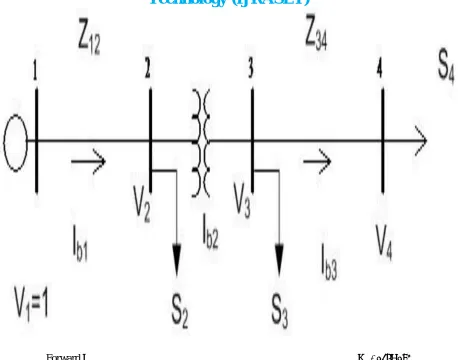
[image:3.612.78.536.69.429.2]Forward → ← Backward
Fig. 1. Radial Distribution System
KERSTING METHOD (KM) [1] for radial distribution network, it is considered that the source voltage and all branch impedance and load impedances are known. To start up the system is considered without losses which mean that there are no load currents. Effective power flow in each branch is obtained in the backward sweep by considering 1 per unit (p.u.) voltage at the end node in first iteration and the end node’s voltage is equal to the voltage calculated in forward sweep in further iterations. This indicates that the backward sweep starts at the end node and proceeds towards the source node. Input: substation voltage, load
Steps:
Initial current = 0, Initial voltage V = 1PU. Compute node current In using Node model. Backward: Compute branch current Ib using KCL. Forward: Update Vk+1 = Vk based on Ib.
Check convergence (|dS|<Error Limit) stop or go to step 2.
Technology (IJRASET)
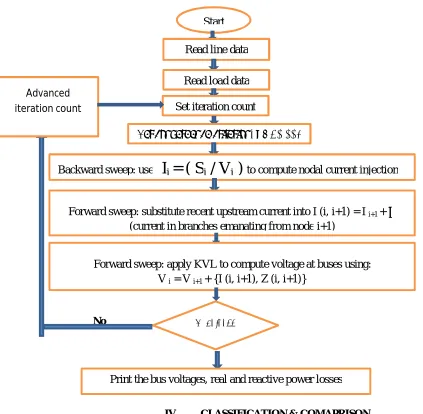
Flow Chart for the Solution Methodology:
No
I. CLASSIFICATION & COMAPRISON
IV. CLASSIFICATION & COMAPRISON
[image:4.612.48.471.92.506.2]In the distribution network, because of the special structure, NR and many other traditional methods used for power flow analysis may fail to converge or use lot of time for calculation. Therefore, a lot of algorithms in the distribution network, such as FBS method, the loop circuit method, power distribution coefficient method, etc. have been proposed. The proposed method is compared with other load flow methods that are used for distribution systems.
Table 1: Classification and comparison
S.No Parameters of comparison Gauss Siedel Newton Raphson Fast Decoupled Load Flow
1. Convergence Linear Quadratic Geometric
2. Arithmetic Operations Least in number
to complete one operation
Elements of Jacobian to be calculated in
each iteration
Less than Newton Raphson
3. No of Iterations Large Number,
increases with increase in buses
Very less (3 to 5 only) for large systems and is practically constant
Only 2 to 5 iterations for practical accuracies
Start
Read line data
Read load data
Set iteration count
Set convergence criterion: ∆V=0.001
Backward sweep: use
I
i= ( S
i/ V
i)
to compute nodal current injectionForward sweep: substitute recent upstream current into I (i, i+1) = I i+1 + ∑ (current in branches emanating from node i+1)
Forward sweep: apply KVL to compute voltage at buses using: V i = V i+1 + {I (i, i+1), Z (i, i+1)}
∆V≤0.0011
Print the bus voltages, real and reactive power losses Advanced
Technology (IJRASET)
4. Slack Bus Selection Choice of slack
bus affects convergence
adversely
Sensitivity to this is minimal
Moderate
5. Accuracy Less accurate More accurate Moderate
6. Memory Less memory
because of sparsity of matrix
Large memory even with compact storage
scheme
Only 60% of memory when compared to NR
7. Programming Logic Easy Very Difficult Moderate
8. Reliability Only for small
systems
Reliable even for large systems
More reliable than NR method.
A. NR & Fast Decoupled Load Flow (FDLF)
This methodis not ideal for the distribution network, and these methods are based on good initial value without which it might
diverge.
B. Newton-Downhill Algorithm
Down-hill algorithm [2] is usually used in theoptimization problem. Generally speaking, NR method is local convergence. It is
wellestablished that in order to make the NRmethod convergence to the global, the initial iterationvalue must be very close to
convergence value. Sometimes it is very difficult to choose the initialapproximate value to meet the convergence conditions of
NR method. TheDown-hill algorithm can make NR methodwith a large-scale convergence. Hence to improve the convergence
rate and to shorten the calculation time this method in the power flow calculation is relatively better because it can make many power flow calculations more robust this is the real need for power flow algorithm.
C. Genetic Algorithm Based
It is simple to implement and suitable for offline problems. However in complex network excessive computation time is needed and it is sensitive to controller parameters
D. Artificial Neural Network
It can handle large amount of data sets and suitable for online problems but the specified input range is limited and greater computational burden is also a disadvantage.
E. Backward/Forward sweep method 1) Advantages
a) Jacobian Matrix is not needed.
b) Not Depends on PV (Voltage Controlled Bus) and DG number for small networks.
c) Suitable for online and offline problems.
2) Disadvantages
a) Unsuccessful for Heavy Load.
b) Unsuccessful for large scale network.
V. CONCLUSION
Technology (IJRASET)
is facing high energy demand as the demand has always grown faster than generation capacity. Presently there are still so many rural areas where electricity has not reached yet and where grid connectivity is neither feasible nor cost effective. That’s why the off grid or decentralized DG is a better option for electricity supply. The growing rate of DG also suggests that alternative energy based solutions will play an increasingly important role in the smart grid and modern utility.
REFERENCES
[1] William H. Kersting, "Distribution System Modeling and Analysis”, Second Edition, Electric Power Engineering Series, CRC Press, 2006.
[2] X. S. Zhang, Z. Liu, E. K. Yu, and J. C. Chen, “A comparison on power flow calculation methods for distribution network,” Power System Technology, vol. 22, No. 4, pp. 45-49, Apr. 1998.
[3] D. Cooke, Learning from the Blackouts Transmission System Security in Competitive Electricity Markets” IEA, 2005, pp. 23-25.
[4] G. Leonidopoulos, “Fast Linear Method and convergence Improvement of Load Flow Solution Methods,” Electric Power System Research, vol. 16, 1989. [5] M. S. Srinivas, 2000. Distribution Load Flows: A Brief Review. Power Engineering Society Winter Meeting, PP: 942-945.
[6] Y. Zhu, K.Tomosiv, 2002. Adaptive Power Flow Method for Distribution Systems with Dispersed Generation. IEEE Transactions on Power Delivery, 17(3): 822-827.
[7] S. Tong, K. N. Miu, 2005. A Network-Based Distributed Slack Bus Model for DGs in Unbalanced Power Flow Studies. IEEE Transactions on Power Systems, 20(2): 835-842.
[8] J. C. M. Vieria, W. Freitas , A. Morelato, 2004. Phase-decoupled Method for Three-Phase Power Flow Analysis of Unbalanced Distribution Systems. IEE Proc.-Gener. Transm. Distrib., 151(5): 568-574.
[9] H. L. Nguyen, 1997. Newton-Raphson Method in Complex Form. IEEE Transactions on Power Systems, 12(3): 1355-1359.
[10] R. E. Abyaneh, R. A. Habibabadi, M. Bavafa, 2012. A Reliability Methodology for Distribution Systems with DG, Journal of Basic and Applied Scientific Research (JBASR), 2(9): 8984-8989.
[11] S. Khushalani, J. M. Solanki, N. N. Schulz, 2007. Development of three-phase unbalanced power flow using PV and PQ models for distributed generation and study of the impact of DG models, IEEE Transactions on Power Systems, 22(3): 1019- 1025.
[12] S. M. Moghaddas-Tafreshi, E. Mashhour, 2009. Distributed generation modeling for power flow studies and a three-phase unbalanced power flow solution for radial distribution systems considering distributed generation, Electric Power Systems Research, 79(4): 680-686.
[13] K. Nagaraju, S. Sivanagaraju, T. Raman, and P. V. Prasad, “A novel load flow method for radial distribution system for realistic loads,” Elect Power Comp. and Syst., vol. 39, no. 2, pp.128-141, 2011.
[14] J. H. Teng, “A Direct Approach for Distribution System Load Flow Solutions,” IEEE Trans. on Power delivery, vol. 18, no. 3, pp.882-887, July 2003. [15] M. H. Haque, “A general load flow method for distribution systems,” Elect. Power Systems Research, vol. 54, pp. 47–54, 2000.
[16] S. Singh, and T.Ghose, “Improved radial load flow method,” Elect. Power and Energy Syst., vol. 44, pp. 721–727, 2013.