Technology (IJRASET)
Soil Stabilization using Nano Materials
V. Subramani #1, S.Sridevi *2 PG student, Department of Civil Engineering
Abstract -- The main aim of the study is to investigate the effect of addition of different nanomaterial's including Nano clay, Nano cement in the soft soil sample to determine its various properties. Various amount of nanomaterial’s (0.5% to 2%) were added to the soil to study their effect on the soil's compaction characteristics, consistency limits and compressive strength. Improvements in the geotechnical properties depended on the type of nanomaterial added and increase in the percentage of each of the nanomaterial’s increased the maximum dry density of the soil. The linear shrinkage and plasticity index decreased with increasing amount of nanomaterial’s content. The unconfined compressive strength increased as the nanomaterial’s content increased up to a certain percentage in the soil and then decreased afterwards.
Keywords- soil stabilization, Nano clay, Nano cement, unconfined compressive strength.
I. INTRODUCTION
Soil stabilization refers to the procedure in which a special soil, a cementing material, or other chemical material is added to a natural soil to improve one or more of its properties. One may achieve stabilization by mechanically mixing the natural soil and stabilizing the material together so as to achieve a homogeneous mixture and also it may be obtained by adding the stabilizing material to an undisturbed soil deposit so that it interacts with the soil and permeate through soil voids. The soil and stabilizing agent are blended and worked together. Soil stabilizing additives are used to improve the properties of less–desirable rood soils. When used these stabilizing agents can improve and maintain soil moisture content, increase soil particle cohesion and serve as cementing and water proofing agents.
A difficult problem in civil engineering works exists when the sub-grade is found to be a clay soil. Soils having high clay content have the tendency to swell when their moisture content is allowed to increase. Many research have been done on the subject of soil stabilization using various additives, the most common methods of soil stabilization of clay soils in pavement work are cement and lime stabilization. The high strengths obtained from cement and lime stabilization may not always be required, however, and there is justification for seeking cheaper additives which may be used to alter the soil properties.
II. OBJECTIVE AND SCOPE OF STUDY
Soils are highly susceptible to volume and strength changes and hence can cause severe roughness and accelerate the detoriation of the pavement structure in the form of increased cracking and decreased ride quality, when combined with truck traffic. In some cases, the sub grade soils can be treated with various materials to improve the strength and stiffness characteristics of the soil. Evolving new construction materials to suit various traffic and site conditions for economic and safe design is a challenging task in road construction.
Effective utilization of local weak soils by impacting additional strength using stabilization methods enable reduction in construction cost and improved performance for roads. Exploring the feasibility of such materials for sub grade and embankment stabilization will help the road building sector to evolve a stronger durable and economic design. Hence the stabilization of sub grade pavements has been gaining popularity in the field of pavement due to its high versatility and flexibility.
III. SOIL STABILIZATION
Technology (IJRASET)
available materials. Methods of stabilization may be grouped under two main types:
A. Modification or improvement of a soil property of the existing soil without any admixture, (e.g. drainage)
B. Modification of the properties with the help of admixtures compaction (e.g. mechanical stabilization, stabilization with cement, lime, bitumen, and chemicals etc.)
IV. METHODOLOGY
Soil stabilization can be accomplished by several methods. All these methods fall into two broad categories namely;
A. Chemical stabilization
B. Mechanical stabilization
A. Chemical Stabilization
Soil stabilization depends mainly on chemical reactions between stabilizer (cementitious material) and soil minerals (pozzolanic materials) to achieve the desired effect. A chemical stabilization method is the fundamental of this review and, therefore, throughout the rest of this report, the term soil stabilization will mean chemical stabilization. Through soil stabilization, unbound materials can be stabilized with cementitious materials (cement, lime, fly ash, bitumen or combination of these). The stabilized soil materials have a higher strength, lower permeability and lower compressibility than the native soil. The method can be achieved in two ways, namely; In situ stabilization and ex-situ stabilization.
1) Stabilizing agents: These are hydraulic (primary binders) or non-hydraulic (secondary binders) materials that when in contact with water or in the presence of pozzolanic minerals reacts with water to form cementious composite materials.
The commonly used binders are: a) cement b) lime c) fly ash d) clay
e) blast furnace slag
In the project the nano cement and nano clay were used as a stabilizing admixture to increase the strength of the soil.
2) Cement Stabilization: The soil stabilized with Portland cement is known as soil cement. The cementing action is believed to be result of chemical reaction of cement with the siliceous soil during hydration. The binding action individual particles through cement may be possible only in coarse – grained soils. In fine grained, cohesive soils, only some of the particles have expected to have cement bonds, and rest will be bonded through natural cohesion.
3) Clay Stabilization: The bentonite found in India is different from rest of world due to chemical composition and higher iron content, which gives dark color. Due to very fine particle size, this shows extra-ordinary swelling and bonding power. This different make the bentonite useful in water well and oil well drilling the special higher mud yield. Hence the bentonite clay is used as a soil stabilizing admixture.
V. SOIL SAMPLE
The soil sample is soft soil (peat) which is distributed in most of the places around the hilly region. A disturbed soil sample is that in which a natural structure of soil get partly or fully modified and is destroyed although with suitable precautions for natural moisture content may be preserved. Such a sample is called as representative soil sample.
Technology (IJRASET)
[image:4.612.110.501.71.784.2]VI. EXPERIMENTAL INVESTIGATION
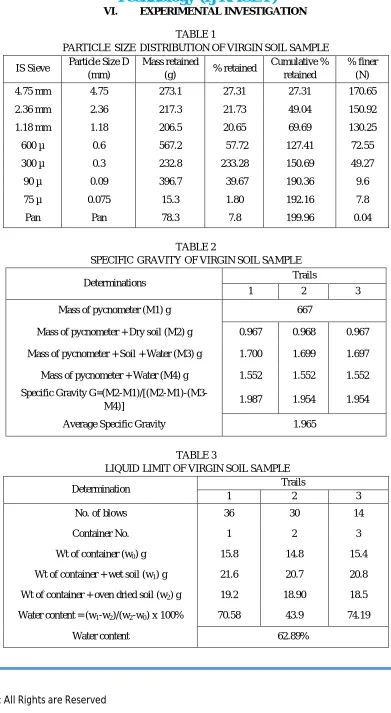
TABLE 1
PARTICLE SIZE DISTRIBUTION OF VIRGIN SOIL SAMPLE IS Sieve Particle Size D
(mm)
Mass retained
(g) % retained
Cumulative % retained
% finer (N) 4.75 mm 4.75 273.1 27.31 27.31 170.65 2.36 mm 2.36 217.3 21.73 49.04 150.92 1.18 mm 1.18 206.5 20.65 69.69 130.25 600 µ 0.6 567.2 57.72 127.41 72.55 300 µ 0.3 232.8 233.28 150.69 49.27 90 µ 0.09 396.7 39.67 190.36 9.6 75 µ 0.075 15.3 1.80 192.16 7.8 Pan Pan 78.3 7.8 199.96 0.04
TABLE 2
SPECIFIC GRAVITY OF VIRGIN SOIL SAMPLE Determinations Trails
1 2 3
Mass of pycnometer (M1) g 667
Mass of pycnometer + Dry soil (M2) g 0.967 0.968 0.967 Mass of pycnometer + Soil + Water (M3) g 1.700 1.699 1.697 Mass of pycnometer + Water (M4) g 1.552 1.552 1.552 Specific Gravity
G=(M2-M1)/[(M2-M1)-(M3-M4)] 1.987 1.954 1.954 Average Specific Gravity 1.965
TABLE 3
LIQUID LIMIT OF VIRGIN SOIL SAMPLE Determination Trails
1 2 3
No. of blows 36 30 14 Container No. 1 2 3 Wt of container (w0) g 15.8 14.8 15.4
Wt of container + wet soil (w1) g 21.6 20.7 20.8
Wt of container + oven dried soil (w2) g 19.2 18.90 18.5
Water content = (w1-w2)/(w2-w0) x 100% 70.58 43.9 74.19
Technology (IJRASET)
TABLE 4
PLASTIC LIMIT OF VIRGIN SOIL SAMPLE
Determination Trails
1 2 3
Container No. 1 2 3 Wt of container (w0) g 11.7 13.5 12.8
Wt of container + wet soil (w1) g 18.3 18.9 18.1
Wt of container + oven dried soil (w2) g 15.80 16.5 15.6
Water content = (w1-w2)/(w2-w0) x
100% 60.9 80 89
Water content 76.63% TABLE 5
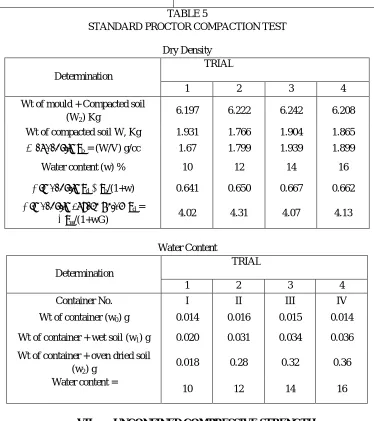
STANDARD PROCTOR COMPACTION TEST
Dry Density
Determination
TRIAL
1 2 3 4
Wt of mould + Compacted soil (W2) Kg
6.197 6.222 6.242 6.208 Wt of compacted soil W, Kg 1.931 1.766 1.904 1.865
Wet density γb = (W/V) g/cc 1.67 1.799 1.939 1.899
Water content (w) % 10 12 14 16
Dry density γd= γb/(1+w) 0.641 0.650 0.667 0.662
Dry density at zero voids, γd =
Gγw/(1+wG) 4.02 4.31 4.07 4.13
Water Content
Determination
TRIAL
1 2 3 4
Container No. I II III IV Wt of container (w0) g 0.014 0.016 0.015 0.014
Wt of container + wet soil (w1) g 0.020 0.031 0.034 0.036
Wt of container + oven dried soil (w2) g
0.018 0.28 0.32 0.36 Water content =
10 12 14 16
VII. UNCONFINED COMPRESSIVE STRENGTH
[image:5.612.119.493.269.690.2]Technology (IJRASET)
B. The unconfined compressive strength increase with the increase in the compaction effort and addition of stabilizers.
C. By the addition of stabilizers alters the properties of the sample.
D. The strength increases with increase in the percentage of stabilizers.
VIII. TEST REPORT
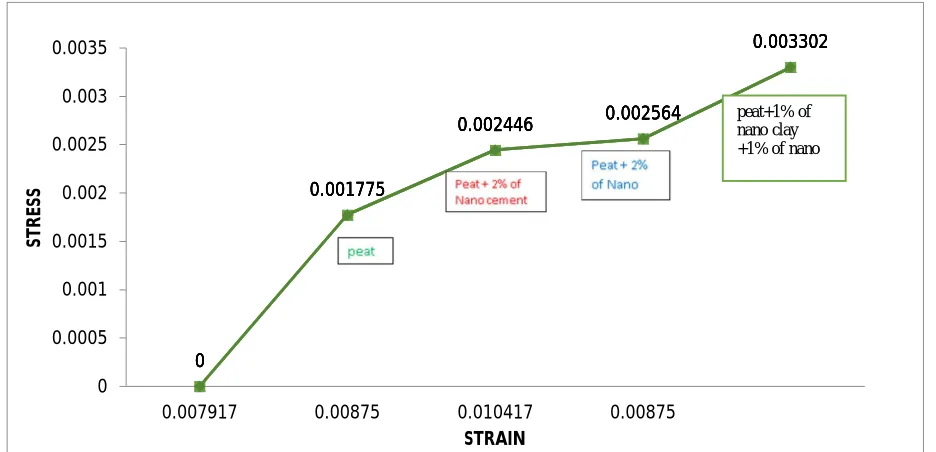
[image:6.612.73.541.168.394.2]The addition of stabilizers alters the properties of the sample. It was found that the strength increases with increase in the percentage of stabilizers and it is shown in figure 1.
Figure 1. Stress-strain curve
IX. CONCLUSION
When comparing the results the test done on the peat soil by adding 2% of Nano cement, 2% of Nano clay and combined addition of 1% of Nano cement and 1% of Nano clay, gave maximum strength in the combined addition of 1 % of Nano cement and 1% of Nano clay. By the addition of Nano cement and Nano clay the maximum strength of the soil was determined. Hence it was concluded that the maximum strength can be attained by adding both the admixtures (Nano cement and Nano clay).
REFERENCES
[1] Indian Standards METHODS OF TEST FOR SOILS (Second Revision) IS: 2720 (Part 1 to Part 41) - 1983, Indian Standards Institution, April 1984, New Delhi.
[2] Indian Standards METHODS OF TEST FOR STABILIZED IS: 4332 (Part 2 to Part 10) - 1967, Indian Standards Institution, January 1968, New Delhi. [3] Indian Standards GLOSSARY OF TERMS AND SYMBOLS (First Revision) IS: 2809 - 1972, Indian Standards Institution, September 1972, New Delhi. [4] “Ground Improvement Techniques” S.Purusothama Raj, Laxmi Publications.
[5] B.C.Punmia &Ashok K. Jain, “Soil Mechanics and Foundation Engineering” Laxmi Publications.
[6] Use of nano clay for improvemet the microstructure and machanical properties of soil stabilized by cement –M.Arabani,A.K.Haghi [7] Effect of nanomaterial treatment on geotechnical properties of a penang soil-Zaid Hameed Majeed, Mohd Raihan Taha
0
0.001775
0.002446 0.002564
0.003302
0
0.001775
0.002446 0.002564
0.003302
0
0.001775
0.002446 0.002564
0.003302
0
0.001775
0.002446 0.002564
0.003302 0 0.0005 0.001 0.0015 0.002 0.0025 0.003 0.0035
0.007917 0.00875 0.010417 0.00875