CFD Simulation of Non-Premixed Light Duty Dual
Fuel (Diesel + Natural Gas) Combustion Engine
and Evaluating Different Type of Pollutant
Emissions
Anil Sahu1, Vardan Singh Nayak2
1
M.Tech Scholar Mechanical Engg. Dept. VIST BHOPAL 2
Asst. ProfessorMechanical Engg. Dept. VIST BHOPAL
Abstract: This study investigated dual-fuel operation with a light duty Diesel engine with Natural gas over a wide engine load range. Natural gas was hereby injected into the intake duct, while Diesel was injected directly into the cylinder. At low loads, high fuel shares are critical in terms of combustion stability and emissions of unburnt hydrocarbons. Dual-fuel combustion has the advantage of providing diesel-like efficiency with Natural gas as the primary fuel, providing potential increases in efficiency of 50% while reducing emissions. Typically a small liquid fuel pilot is injected into a lean mixture of air and a more volatile fuel that is less inclined to auto-ignite. Often it is difficult to simulate the separate chemical effects of the two fuels. In present study we are using non premixed type of combustion model for better mixing and penetration of fuel and air so the complete combustion is achieved and emission is reduced by a great amount as compare to premixed method. NOx emission is reduced as compare to previous base research. Fluent accurately tracks flame propagation, which is critical for dual-fuel cases where the injection and auto-ignition of the liquid pilot fuel serves to initiate the flame propagation. In Fluent the simulation can simultaneously consider both auto-ignition and flame-propagation modes of combustion progress. Fluent fluid flow allows investigations of fuel or additive composition effects, impacts on liquid pilot amount and timing, and NOx reduction techniques such as EGR, etc.
Key words: Dual fuel, Natural gas, Non premixed combustion, Any (Fluent), CFD, Chemkin mechanism, NOx etc.
I. INTRODUCTION
and injection pressure on the combustion process and exhaust emissions from dual fuel engines. The combustion process of NG was controlled by the mixing processes of the pilot fuel with the premixed charge (i.e. no flame propagation or bulk ignition) and whether or not the premixed NG-air mixture is too lean to support the propagation of the turbulent flames if initiated by pilot fuel. Past research on the combustion process of NG-diesel dual fuel engines has focused on the overall heat release process of NG and pilot diesel. In comparison, to the best of our knowledge, little research on the combustion process of gaseous fuels, such as methane, in dual fuel engines has been conducted. It is technically difficult to split the heat release of dual fuel engines to that of pilot fuel and gaseous fuel, respectively. NG-diesel dual fuel engines have been criticized for their high emissions of unburned methane and carbon monoxide (CO). The methane emissions from dual fuel engines not only contribute to overall GHG emissions but also cause a waste of energy. Many researchers have investigated the methane emissions from NG-diesel dual fuel engines. decreased with the increase in engine load. With the concerns of fuel conversion efficiency in dual fuel engines, there has been interest in examining the combustion efficiency of methane fumigated into the intake mixture in NG-diesel dual fuel engines. The emissions of methane, CO, and carbon dioxide (CO2) and the flow rates of fuels and air were further processed to derive the combustion efficiency of methane with the following two assumptions: (1) the methane emitted from the dual fuel engine was that added into the intake mixture; and (2) the CO emissions above that of pure diesel operation was due to the incomplete combustion of methane while disregarding the possibility of incomplete combustion of diesel and other hydrocarbons in natural gas. The lowest combustion efficiency observed at low (10%) load operation was about 65%. The maximum combustion efficiency observed at 70% load was about 95%, similar to that of SI NG engines. It is evident from these early investigations that the improvement of methane combustion efficiency of dual fuel engines at low load is one of the key challenges for the wide application of dual fuel engines especially when low load operation is frequently involved.The contribution of unburned methane to GHG emissions and the desire to further improve the efficiency of dual fuel engines have raised researchers’ interest to understand the mechanism for methane to survive the combustion process and slip through the combustion chamber without participating in combustion. Some researchers tried to investigate the combustion process of dual fuel engines using advanced combustion diagnostic technologies and managed to measure the propagation of flames through the premixed mixture of NG and air. A high-speed digital camera recorded time-resolved combustion luminosity. An intensified charge-coupled device (CCD) camera was used for single cycle OH∗ imaging. The propagation of the turbulent flame through the diesel fuel free bulk gas (premixed NG-air mixture) was observed when the NG-air mixture was richer than the lean flammability limit [24]. However, the NG-air mixture leaner than the flammability limit was not able to support the propagation of the flames initiated by the pilot diesel fuel. The combustion in different zones representing the lean premixed methane-air mixture and pilot fuel diffusion combustion was distinguished using the temporally resolved natural luminosity imaging. The impact of fuel injection strategy and equivalence ratio of the premixed NG-air mixture on the flame propagation through the premixed NG-air mixture was also examined. Combining the natural luminosity image with the heat release rate (HRR) helped to better understand the overall heat release process and the burning of pilot and gaseous fuels. The research identified the multi-pulse fuel injection strategies as a promising and effective strategy capable of enhancing the flame propagation toward the center of the combustion chamber, which was usually not burned with a single pulse injection strategy. The research on the spatial distribution of methane in-cylinder, quantification of the percentage of methane burned in each combustion stage and the mechanism for methane to survive the combustion process is of critical importance for the development of technical approaches optimizing the dual fuel engine combustion process and minimizing methane emissions. However, because of the difficulty in experimental techniques, the spatial distribution of methane within the combustion chamber and the mechanism for methane to survive the combustion process in dual fuel engines have never been experimentally identified.
II. LITERATURE
and higher thermal efficiency, combustion characteristics of RCCI (dual-fuel PCI) are different from single-fuel PCI due to reactivity gradient from two different fuel characteristics as well as local equivalence ratio due to the fuel distribution. Therefore, it is necessary to know the influence of above two factors on the fuel combustion characteristics for better understanding of dual-fuel combustion and its effective utilization. In this research, the characteristics of dual-dual-fuel combustion are evaluated comparing to single-fuel combustion.
Also, dual-fuel combustion modes are classified according to the analysis of heat release rate (HRR) shapes. Major factors in the classification of dual-fuel combustion modes are the degree of fuel reactivity gradient and the local equivalence ratio in the cylinder. Thus, the diesel injection timing, diesel and port injected gasoline fuel ratios and the overall equivalence ratio were selected as the main variables to characterize each dual-fuel combustion mode. The result emphasizes that the dualfuel combustion could be classified as three types by HRR shapes, and it was mainly affected by reactivity gradient and overall equivalence ratio. 3.Carmelina Abagnale et.al the effect of different fuel ratios on the performance and emission levels of a common rail diesel engine supplied with natural gas and diesel oil. Dual fuel operation is characterized by a diesel pilot injection to start combustion in an intake port premixed NG/air mixture.
The combined numerical – experimental study of the dual fuel diesel engine that is carried out in this paper aims at the evaluation of the CFD potential to predict the main features of this particular engine operation. The experimental investigations represent a tool for validating such a potential and for highlighting, at the same time, the major problems that arise from the actual engine operation with different NG / diesel oil fuel ratios. 4.PengGeng et.al Diesel engines are the main source of rapidly-growing energy consumption worldwide. Diesel consumption is responsible for serious air pollution, which includes nitrogen oxides (NOx), hydrocarbon (HC), carbon monoxide (CO) emissions and some particulate matter (PM) discharged from the combustion chamber. In the past few decades, alternative fuels, such as alcohol, biodiesel, natural gas, and Di Methyl Ether (DME), have been used in diesel engines to reduce energy costs and environmental pollution. As a result of alternative fuels directives, an increasing number of diesel engines have adapted dual fuel blends, and an enormous amount of research is focused on new and inadequately studied combustion and emission profiles. Compared to conventional diesel fuel, the application of dual fuels would add new parameters to combustion and emission profiles for diesel vehicles worldwide.
This review aims to reveal (1) Known and anticipated combustion characteristics and emissions products from dual fuels. (2) Toxic properties and the expected influence on engine performance. (3) Identifying promising alternative fuels for emissions control in compression combustion engines.
The results presented herein will show a significant reduction of regular gas and PM emissions by the use of alcohol/diesel dual fuel, while unregulated emissions such as methanol, ethanol, acetaldehyde, formaldehyde, ketone, have increased compared to those from diesel fuel. PM emissions decreased significantly with the increase of alternative fuels, such as alcohols, natural gas, biodiesel and DME, while regular gaseous emissions varied depending on the type alternative fuel and the engine conditions.
As one new and cleaner substitute for diesel engines, DME operation has a longer injection delay, lower maximum cylinder pressure, a lower ratio of pressure rise, and shorter ignition delay in comparison with diesel operation–the opposite of alcohol/diesel and dual fuels. This review evaluates the effects of some alternative fuels (alcohol, biodiesel, natural gas and Di Methyl Ether (DME)) on combustion characteristics and emission products from diesel engines to meet future emission regulations using alternative fuel.
III. OBJECTIVE OF THE STUDY
Present study investigates the mixing of chemical species and the combustion of a dual fuel (Diesel/Natural gas). A cylindrical combustor burning (Diesel +Natural gas) in air is studied using the eddy-dissipation model in ANSYS (Fluent). Our main objective of the study is to analyze the dual fuel combustion model with non-premixed type of combustion and compared the previous research on the basic of combustion rate and emissions. In second part of our study is to evaluation of Thermal NOx and Prompt NOx due to non premixed type of combustion and reduced it as per environment norms. Current study evaluates and use following type of models:
A. Specific turbulent flow with chemical species mixing and reaction.
B. Initiate and solve the combustion simulation using the pressure-based solver.
C. Compare the results computed with constant and variable specific heat.
D. Examine the reacting flow results using graphics.
E. Predict thermal and prompt NOx production.
IV. METHODOLOGY A. Basic Steps to Perform CFD Analysis
1) Pre-processing: CAD Modeling: Creation of CAD Model by using CAD modeling tools for creating the geometry of the part/assembly of which you want to perform FEA.CAD model may be 2D or 3d.
2) Meshing: Meshing is a critical operation in CFD. In this operation, the CAD geometry is discretized into large numbers of small Element and nodes. The arrangement of nodes and element in space in a proper manner is called mesh. The analysis accuracy and duration depends on the mesh size and orientations. With the increase in mesh size (increasing no. of element), the CFD analysis speed decrease but the accuracy increases.
3) Type of Solver: Choose the solver for the problem from Pressure Based and density based solver.
4) Physical model: Choose the required physical model for the problem i.e. laminar, turbulent, energy, multi-phase, etc.
5) Material Property: Choose the Material property of flowing fluid.
6) Boundary Condition: Define the desired boundary condition for the problem i.e. temperature, velocity, mass flow rate, heat flux etc.
B. Solution
1) Solution Method : Choose the Solution method to solve the problem i.e. First order, second order
2) Solution Initialization: Initialized the solution to get the initial solution for the problem.
3) Run Solution: Run the solution by giving no of iteration for solution to converge.
4) Post Processing: For viewing and interpretation of Result. The result can be viewed in various formats: graph, value, animation etc.
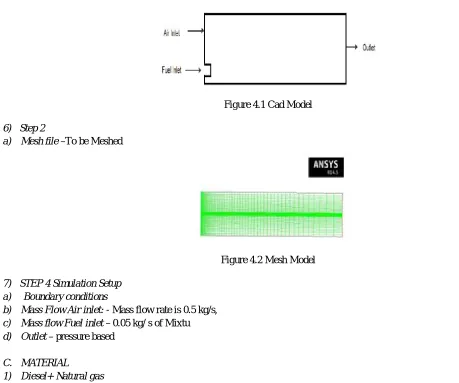
5) .Step I– CAD Model
Figure 4.1 Cad Model
6) Step 2
[image:5.612.38.497.355.738.2]a) Mesh file –To be Meshed
Figure 4.2 Mesh Model
7) STEP 4 Simulation Setup a) Boundary conditions
b) Mass Flow Air inlet: - Mass flow rate is 0.5 kg/s,
c) Mass flow Fuel inlet – 0.05 kg/ s of Mixtu
d) Outlet – pressure based
C. MATERIAL
2) Fluid: The natural gas was selected as a four-component mixture of methane (>90%), ethane, propane and n-butane, whereas diesel oil was represented by the Diesel Oil Surrogate (DOS) model, in which liquid fuel properties are the same of real diesel oil, while fuel vapour is made up of a blend of n-heptane and toluene
3) Mixture: Species I H20, II-O2, III-Fuel -EG, IV-CO2, V-N 4) Mixing law is used.
5) Thermal conductivity: - Define two polynomial coefficients a) 0.0065234 (b) 8.72369*10-6
6) Polynomial coefficient for viscosity a) 5.2348e-07 (b) 5.12365e
7) For absorption coefficient take stable domain.
8) Scattering coefficient is 1.2e-8.
D. Method
1) Coupled
2) Presto model is used:-Presto model is often used for buoyant flows where velocity vector near walls may not align with the wall due to assumption of uniform pressure in the boundary layer so presto can only be used with quadrilateral or Hexahedral
3) Solution Initialisation: - The solution is initialized
4) Run Calculation:- Start the calculation for 2000 iterations.
V. RESULTS AND CONCLUSION
Figure 5.1 Static Temperature of flow field at constant Cp
The peak temperature, predicted using a constant heat capacity of 1000 J/KG-K is over 3000 K .This over prediction of the flame temperature can be remedied by a more realistic model for the temperature and composition dependence of the heat capacity.
The peak temperature has dropped to approximately 2300 K as a result of the temperature and composition dependent specific heat.
Figure 5.3 Specific heat of mixture in stream function
[image:7.612.114.558.78.227.2]The mixture specific heat is largest where the fuel is concentrated, near the fuel inlet, and where the temperature and combustion product concentrations are large. The increase in heat capacity, relative to the constant value used before, substantially lowers the peak flame temperature.
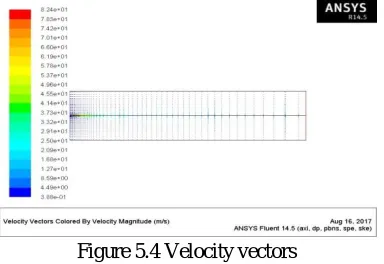
Figure 5.4 Velocity vectors
[image:7.612.213.405.284.416.2]The fixed length option is useful when the vector magnitude varies dramatically. With fixed length vectors, the velocity magnitude is described only by colour instead of by both vector length and colour.
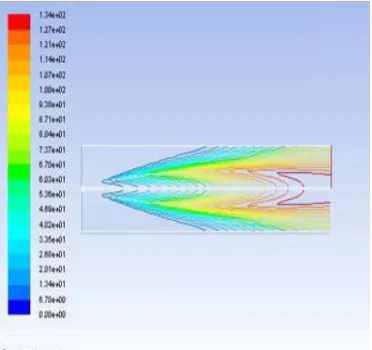
Figure 5.5 Velocity contours
[image:7.612.192.403.458.715.2]The entrainment of air into the high-velocity dual fuel mixture is clearly visible in the streamline display.
Figure 5.7 Mass fractions of 02
Figure 5.8 Mass fraction of N2
[image:8.612.159.444.77.729.2]Figure 5.9 Mass fraction of CO2
Figure 5.11 Mass fraction of NO (Prompt NOx)
Figure 5.12 Mass fraction of NO2 (Thermal NOx)
Figure 5.13 Contours of NO –PPM (Part per Million)
VI. CONCLUSION
The use of a constant Cp (specific heat of mixture) results in a significant over prediction of the peak temperature. The average exit temperature and velocity are also over predicted. The variable Cp solution produces dramatic improvements in the predicted results. The NOx production in this case was dominated by the thermal NO mechanism. This mechanism is very sensitive to temperature. Every effort should be made to ensure that the temperature solution is not over predicted, since this will lead to unrealistically high predicted levels of NO. Further improvements can be expected by including the effects of intermediate species and radiation, both of which will result in lower predicted combustion temperatures. In present study we are using non premixed type of combustion model for better mixing and penetration of fuel and air so the complete combustion is achieved and emission is reduced by a great amount as compare to premixed method. NOx emission is reduced as compare to previous base research.
REFERENCES
[1] Chunhua Zhang et.al, “Effects of combustion duration characteristic on the brake thermal efficiency and NOx emission of a turbocharged diesel engine fueled with diesel-LNG dual-fuel”, Applied Thermal Engineering 127 (2017).
[2] Jeongwoo Lee et.al, “Classification of diesel and gasoline dual-fuel combustion modes by the analysis of heat release rate shapes in a compression ignition engine”, Fuel 209 (2017).
[3] CarmelinaAbagnale et.al, “Combined numerical-experimental study of dual fuel diesel engine”, Energy Procedia 45 ( 2014 ).
[4] PengGeng et.al, “Effects of alternative fuels on the combustion characteristics and emission products from diesel engines: A review”, Renewable and Sustainable Energy Reviews (2016).
[5] AbdelrahmanHegab, “Towards keeping diesel fuel supply and demand in balance: Dual-fuelling of diesel engines with natural gas”, Renewable and Sustainable Energy Reviews 11 (2016).
[6] SohanLal et.al, “The effect of compression ratio on the performance and emission characteristics of a dual fuel diesel engine using biomass derived producer gas”, Applied Thermal Engineering 03(2017).
[7] Gang Li et.al, “Effects of diesel injection parameters on the rapid combustion and emissions of an HD common-rail diesel engine fueled with diesel-methanol dual-fuel”, Applied Thermal Engineering 108 (2016).
[8] R.G. Papagiannakis et.al, “A combined experimental and theoretical study of diesel fuel injection timing and gaseous fuel/diesel mass ratio effects on the performance and emissions of natural gas-diesel HDDI engine operating at various loads”, Fuel 126 (2017).
[9] KyunghyunRyu, “Effects of pilot injection timing on the combustion and emissions characteristics in a diesel engine using biodiesel–CNG dual fuel”, Applied Energy 111 (2013).
[10] NearchosStylianidis et.al, “Chemical kinetics and CFD analysis of supercharged micro-pilot ignited dual-fuel engine combustion of syngas”, Fuel 203 (2017). [11] L. Tarabet et.al, “Experimental investigation of DI diesel engine operating with eucalyptus biodiesel/natural gas under dual fuel mode”, Fuel 133 (2014). [12] Qiang Zhang, “Combustion process and emissions of a heavy-duty engine fueled with directly injected natural gas and pilot diesel”, Applied Energy 157
(2015).
[13] Miqdam Tariq Chaichan, “ Combustion of Dual Fuel Type Natural Gas/Liquid Diesel Fuel in Compression Ignition Engine”, IOSR Journal of Mechanical and Civil EngineeringVolume 11, Issue 6 Ver. IV (Nov- Dec. 2014).
[14] PaliRosha et.al, “Performance and emission characteristics of Diesel+LPG dual fuel engine with exhaust gas recirculation”, International Journal of Science, Engineering and Technology Research (IJSETR), Volume 3, Issue 10, October 2014.
[15] NayanMirgal, “Experimental investigations on LPG - diesel dual fuel engine”, Journal of Chemical and Pharmaceutical Sciences.