5
XI
November 2017
456
©IJRASET (UGC Approved Journal): All Rights are ReservedVoid Mark E-Commerce Application
Mayank Pithwa1, Akshay Ghugal2, Moni Gupta3, Rasika Patil4, Ajay Karare5 1, 2, 3, 4, 5
Computer Science & Engineering, Rashtrasant Tukadoji Maharaj Nagpur University
Abstract: Void Mark E-commerce Application simply means a white label ecommerce application. A white label product is a product or service provided by one company that other companies rebrand to make it appear as if they had made it. The concept of white label enables a successful brand to offer a service without having to invest in creating the technology and infrastructure itself. The manufacturers can increase the sales by allowing another company to sell a white label version of their product or service. Electronic commerce (ecommerce) is a type of business model that enables a firm or individual to conduct business over an electronic network, typically the internet [4]. In this paper the integration of white label concept and ecommerce web application is studied.
Keywords: Business model, ecommerce, electronic network, web application, white label product.
I. INTRODUCTION
Electronic commerce (ecommerce) is a type of business model, or segment of a larger business model, that enables a firm or individual to conduct business, sell products and services over an electronic network, typically the internet. [4]
Some advantages of ecommerce for consumers are given below:
A. Ecommerce works 24 hours a day, seven days a week.
B. Many stores offer a wider variety of products online than they do in their brick-and-mortar counterparts and stores that exist only online offer customers a selection of products that they otherwise could not access.
C. There is no limitation on geographic reach for the customers.
D. The major types of ecommerce are classified based on the nature of transaction:
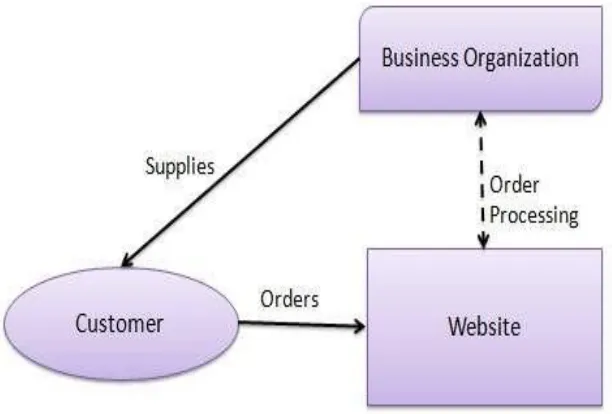
[image:2.612.137.443.448.655.2]1) Business-to-Consumer ecommerce (B2C) - In B2C ecommerce the manufacturers sell their products and services to customers over an electronic network.
Fig. 1 Business-to-Consumer flowchart
B2C Model, a customer access the website, selects a catalogue, orders the product and an email is sent to the business organization. After receiving order, the products are dispatched to the customer.
457
©IJRASET (UGC Approved Journal): All Rights are ReservedFig. 2 Business-to-Business flowchart
B2B implies that seller as well as buyer is business entity. B2B covers large number of applications which enables business to form relationships with their distributors, resellers, suppliers etc.
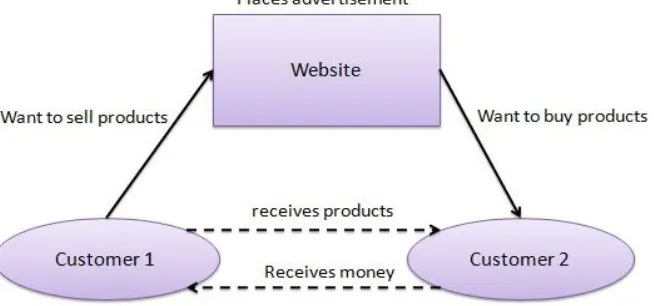
3) Consumer-to-Consumer ecommerce (C2C) - Using C2C e-commerce, customers sell their products directly to other customers over the internet.
Fig. 3 Consumer-to-Consumer flowchart
Customer 1 places an advertisement on the website about the products he wants to sell and customer 2 visits the website to search for the products he wants to buy. The transaction between the two customers goes on until payment and delivery of product is done. [5]
[image:3.612.138.465.345.498.2]458
©IJRASET (UGC Approved Journal): All Rights are Reserved5) Web data mining in ecommerce- Competition for customers is the key factor for ecommerce business in the increasingly fierce competition. If we can grasp customer needs, develop targeted business activities, it will not only provide convenient trading mode and a wide choice for customers, but also make the ecommerce business efficient to retain the customers better. One of the solutions is Web data mining technology. We can get the user behaviour from the browsing behaviour of customers on web and further analysis. This will allow sellers to know more about their customers' needs, and provide personalized results according to customer’s preferences. During ecommerce activities, it will leave the data on web when customers browse information, these data will be ecommerce web data mining data source. The first one is the customer information, it includes not only the customer's registered personal data, but also includes customer's order information, individual requirements and problems, as well as browsing merchandise records and visited pages and so on behavioural information. Such information can help to analyse customer preferences and their background, then forecast the future purchase behaviour of customers. The second one is the commodity information on e-commerce website, each commodity has its own information, such as price and parameters, and it is to be presented to customers through web forms. The last one is the server information, server data will be generated on the server side when client access the server, the data can be categorized into server logs, error logs, cookie logs, through the analysis of these log files, we can optimize server system, improve the operation efficiency, enabling customers to have a better user experience. [1]
6) Commerce security issues- The internet technology is creating huge opportunities to expand existing businesses and forming New Economy, Global Economy, or Electronic-Commerce (E-Commerce). E-commerce describes business transactions, customer services, ordering, delivery and payment, and intra-business tasks that make use of public internet and the digital networked computing environment that links organizations and individuals in business, industry, government, and the home. However, many organizations are intimidated by the new technologies, they are unsure of how to take advantage of them, and wondering how these technologies will support existing investments in skills and infrastructures. In addition, this new type of economy comes with a lot of challenges especially those related to trust and security issues. [2]
II. LITERATURESURVEY
A. Title- Web data mining applications in e-commerce
Author- Yonghua Zhao, Hong Lin ear- 2014
Abstract- Web data mining is a new technology that can find valuable model and information in agriculture, finance and manufacturing industry. With the development of the internet, ecommerce has very strong trends, application of web-based data mining in ecommerce has become a hot topic. [1]
B. Title- E-Commerce Security Issues
Author- Mohamad Ibrahim Ladan
Abstract- The internet technology is creating huge opportunities to expand existing businesses and forming what is called New Economy, Global Economy, or Electronic-Commerce (E-Commerce). However, many organizations are intimidated by the new technologies, they are unsure of how to take the advantage of them, and wondering how these technologies will support existing investments in skills and infrastructures. This new type of commerce comes with lot of challenges related to trust and security issues. [2]
C. Title- Developing an E-Commerce Website
Author- Syed Emdad Ullah, Tania Alauddin and Hasan U. Zaman Year- 2016
459
©IJRASET (UGC Approved Journal): All Rights are Reserved [image:5.612.89.559.67.616.2]III.PROPOSEDSYSTEM
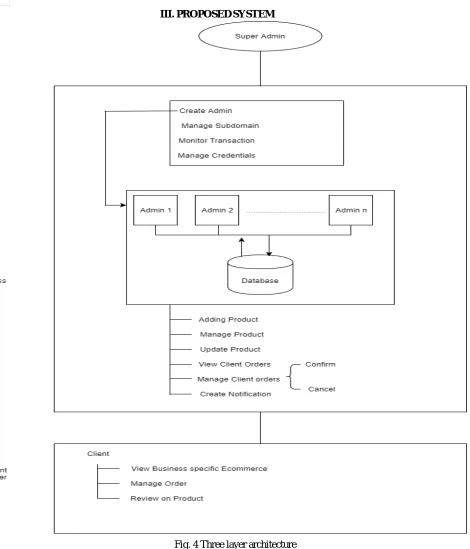
Fig. 4 Three layer architecture
The entire planning process was divided into the following layers that performs its independent tasks as follows:
A. The Admin Layer mainly consists of Super Admin working. The Super Admin has some operations to perform like, he
creates business user accounts, manages subdomains, manages the transactions, as well as manages the credentials. Here, Admins are the people who have their individual businesses and now join the e-commerce website for a wide range of online business activities for their products and services.
460
©IJRASET (UGC Approved Journal): All Rights are ReservedAlso the admin creates notifications for the clients about the products they wish to buy. Also they have the authority to view the database.
[image:6.612.83.544.156.469.2]C. Followed by the Business Layer, next comes the Client Layer. The clients are the end-users, who visit the website if they wish to buy some products of their ease, like the Super admins and Admins even the clients are able to perform some operations in order to buy a product. They can view business specific E-commerce website, manage their own orders, also they can review a product that they have already bought from the website.
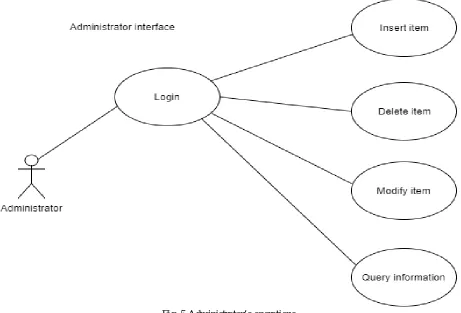
Fig. 5 Administrator’s operations
D. Admin logs in- The admin starts the whole process by entering the username and password and clicking on the submit button. The page sends the message to the server to confirm the information from the database. After successful confirmation, the logged in page is returned with options for the admin to add, modify, delete products, or query information.
E. Admin inserts item- The admin starts this process by clicking on the Input Items button from the logged in page. The page is displayed on the screen with a form for the admin to insert items information and its details. Once insert button is clicked, the web page sends this information to the server, which is stored in the database.
F. Admin removes item- The admin starts this process by clicking on the Remove Items button. The web page is displayed with a drop down menu for the item he/she wants to delete. Once, delete button is clicked, the page sends a message to the server which in turn tells the database to remove the item.
G. Admin modifies item- The admin starts this process by clicking on the Modify Items button. The web page displays a list of available products from the database. The admin then chooses the item he/she wants to modify by clicking on particular item. A page is displayed letting the admin to modify all the item information. Once, the Modify button is clicked, the web page sends a message to the server, which updates the information from the database.
461
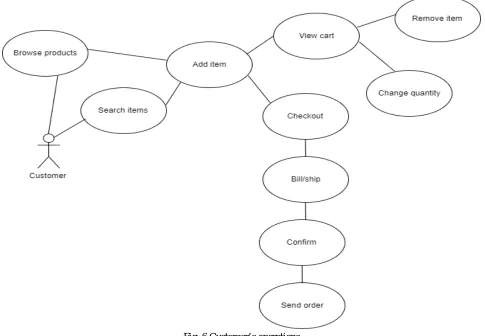
©IJRASET (UGC Approved Journal): All Rights are ReservedFig. 6 Customer’s operations
I. Customer shops for a product: The customer initiates this action by clicking on the desired category for item to be displayed. The page sends a message to the server requesting a listing of all products from the particular category from the database. The action is complete when a page is returned for the customer to view, which contains available products with product names along with their picture, price, capacity, and an option to add the product to the shopping cart.
J. Customer searches for item: The customer starts this process by typing a product description to search for description of a product. The page sends a message to the server asking for a listing of products, whose names matches with the description of the product from the database. The action is complete when a page is returned for the customer to view, which contains a list of the resulting products along with their picture, price, and an option to add the product to the shopping cart. If a given description doesn’t match with any descriptions in the database, a message indicating such is displayed instead of the option to add the product to the cart.
K. Customer adds an item- The customer initiates this process by clicking on the buybutton on the right side of a product’s listing. An item is added to the cart including the price and displayed with the total price and the offer applicable to that product. If the product already exists in the customer’s cart, its quantity is increased by 1. There is a continue shoppingbutton for the customer to continuing shopping for other products.
L. Customer views cart- The customer initiates this action by clicking on the view cart button, available on any webpage. The page sends message to the server and shows a list of all products in the customer’s cart, along with their quantity and total price. If the customer wants to remove any item from the cart he can remove it or can proceed to purchase the product. The customer starts this process by clicking on the Remove or Buy button on the view cart page. The web page sends a message to the server, which removes or buys the product from the customer’s shopping cart.
462
©IJRASET (UGC Approved Journal): All Rights are Reservedon the Change button on the view cart page. The web page sends a message to the server, which updates the product from the customer’s shopping cart.
N. Customer checks out- The customer starts this process by clicking on checkoutbutton on the view cart page. A check out page is displayed letting the customer to create a new account or sign in depending on the customer status. An existing customer would sign in his/her email address and password and click sign in button. The web page sends the message to the server. Then, the server validates the email address and password from the database. If they are both correct, then a shipping and payment information page is displayed letting the customer to fill out the information. After selecting the payment and shipping information, a confirmation page is displayed showing items in the customer’s cart, payment and shipping information.
O. Customer sends order- The customer starts this process by clicking on the send order button from the confirm Information page. Once send order button is clicked, the page sends the message to the server, which sends an email or message to the customer and the sales person. It also stores the customer’s cart, payment and shipping information into the database.
IV.CONCLUSION
E-commerce is continuously progressing and is becoming more and more important to businesses as technology continues to advance and is something that should be taken advantage of and implemented. However, the manufacturers faced difficulty in selling their products online because they were not having any platform to conduct their own ecommerce business. The only solution was to invest time and money unnecessarily for developing their own platform.
To overcome these difficulties we developed a white label ecommerce web application. In this application we are using the concept of white label which refers to a product or service that is produced by one company (the producer) that the other companies (the marketers) rebrand to make it look as if they had created it. Some websites use the concept of white labels to enable a successful brand to offer a service without having to invest in creating the technology and infrastructure itself. Thus, it creates a large number of opportunities for the manufacturers to perform their own ecommerce business and compete worldwide.
REFERENCES
[1] Yonghua Zhao, Hong Lin (August, 2014). Web data mining applications in e-commerce.The 9th International Conference on Computer Science & Education (ICCSE 2014). [Online]. Available: http://ieeexplore.ieee.org/document/6926523
[2] Mohamad Ibrahim Ladan (August, 2014). E-Commerce Security Issues. International Conference on Future Internet of Things and Cloud. [Online]. Available: http://ieeexplore.ieee.org/document/6984195
[3] Syed Emdad Ullah, Tania Alauddin, Hasan U. Zaman (January, 2016). Developing an E-Commerce Website. Microelectronics, Computing and Communications (MicroCom), 2016 International Conference. [Online]. Available: http://ieeexplore.ieee.org/document/7522526
[4] http://www.investopedia.com/terms/e/ecommerce.asp