Internet Protocol version 6
(
IPv6
)
Ayushi Batra1, Vaibhav Garg2, Samrity3 1, 2, 3
(Assistant Professor) HMR Institute of Technology and Management Hamidpur New Delhi, India
Abstract: Internet in today’s world has turned lives upside down for approximately everybody at all. Everything is a click away, may that be reading your daily newspaper or talking to your father who is miles away. IPv4 is the most dominant addressing protocol used on the Internet and most private networks today. With the advent of wide variety of devices and upcoming technologies, the limited addresses of IPv4 are not able to cope with the current internet. IPv6 was mainly developed to resolve the addressing issues as well the security concerns, which are lacked by IPv4. For a while, both the IP might work side by side till IPv6 completely takes over. This paper aims to provide a comprehensive overview of the internet scenario using IPv6 and reviews its enabling technologies and what will be the consequences if it is successfully deployed.
Keywords: Internet protocols; addresses; comparison; transition; connectivity; backbone
I. INTRODUCTION
The mankind is completely through with the present outburst of technologies. What we require exactly right now is a new Internet built from the very beginning that obviously outstands the expectations what we have from the existing Internet. The next generation requires a solid foundation which has an entirely rewritten protocol i.e. IPv6. IPv6. Internet Protocol version 6 (IPv6) is the most recent version of the Internet Protocol (IP), the communications protocol that provides an identification and location system for computers on networks and routes traffic across the Internet.
Protocol transitions are not easy, and the transition from IPv4 to IPv6 is no exception. Protocol transitions are typically deployed by installing and configuring the new protocol on all nodes within the network and verifying that all node and router operations work. Although this might be possible in a small- or medium-sized organization, the challenge of making a rapid protocol transition in a large organization is very difficult. Additionally, given the scope of the Internet, rapid protocol transition becomes an impossible task.
A. RFC 1752 defines the following transition criteria
1) Existing IPv4 hosts can be upgraded at any time, independent of the upgrade of other hosts or routers.
2) Hosts that use only IPv6 can be added at any time, without dependencies on other hosts or routing infrastructure. 3) IPv4 hosts on which IPv6 is installed can continue to use their IPv4 addresses and do not need additional addresses. 4) Little preparation is required to either upgrade IPv4 nodes to IPv6 or deploy new IPv6 nodes.
5) The inherent lack of dependencies between IPv4 and IPv6 hosts, IPv4 routing infrastructure, and IPv6 routing infrastructure several mechanisms that allow seamless coexistence.
II. NEEDFORIPV6
The growth of internet with its need for more addresses is a main factor driving the need for a new version of the Internet Protocol. Currently there are estimated to be more than 100 million computers connected to the Internet. Well, it’s is not exactly known when the Internet run out of addresses. In the future, the number of devices connected to Internet is going to go up at a greater rate. Many of the devices such as phones, automobiles will require network connectivity. This rises the demand for more IP addresses. To overcome different problems related to the Internet, it was suggested the necessity to move from version 4 to version 6 of the Internet Protocol.
A. These are some limitations of IPv4 which force the need of IPv6: 1) Insufficient IP address space
III. DIFFERENCESB/WIPV4ANDIPV6
[image:3.612.175.431.130.276.2]A. Header Formats
Figure 1. Header Formats
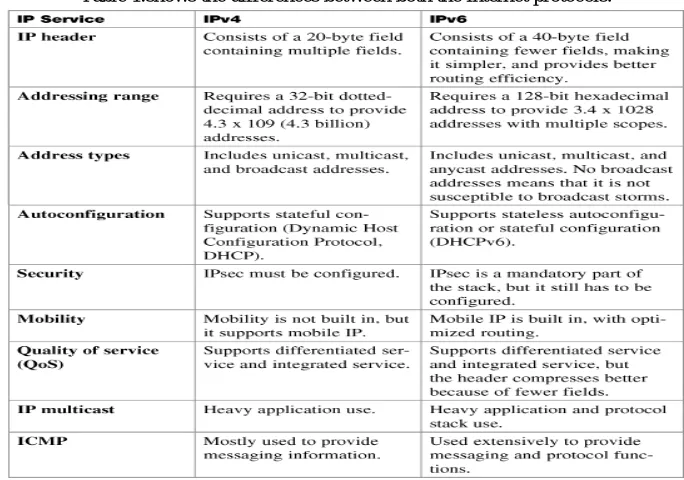
The advantages of IPv6 header over a IPv4 header can be listed as bullets: 1) IPv6 header is much sipler than IPv4 header.
2) The size of IPv6 header is much bigger than that of IPv4 header, because of IPv6 address size. IPv4 addresses are 32bit binary numbers and IPv6 addresses are 128 bit binary numbers.\
3) Here in IPv4 header, the source and destination IPv4 addresses are 32 bit binary numbers. In IPv6 header, source and destination IPv6 addresses are 128 bit binary numbers
4) IPv4 header includes space for IPv4 options. In IPv6 header, we have a similar feature known as extension header. IPv4 datagram headers are normally 20-byte in length. But we can include IPv4 option values also along with an IPv4 header. In IPv6 header we do not have options, but have extension headers.
5) The fields in the IPv4 header such as IHL (Internet Header Length), identification, flags are not present in IPv6 header.
[image:3.612.133.475.482.722.2]6) Time-to-Live (TTL), a field in IPv4 header, typically used for preventing routing loops, is renamed to it's exact meaning, "Hop Limit".
Table 1.shows the differences between both the Internet protocols:
B. Addressing
Octets or segments, or a combination of both, makes up Internet Protocol version 4 (IPv4) and Internet Protocol version 6 (IPv6) addresses.
An IPv4 address has the following format: x .x .x .x where x is called an octet and must be a decimal value between 0 and 255.
Octets are separated by periods. An IPv4 address must contain three periods and four octets.
C. An IPv6 address can have either of the following two formats
1) Normal - Pure IPv6 format
2) Dual - IPv6 plus IPv4 formats
An IPv6 (Normal) address has the following format: y : y : y : y : y : y : y : y where y is called a segment and can be any
hexadecimal value between 0 and FFFF. Colons separate the segments - not periods. An IPv6 normal address must have eight segments, however a short form notation can be used in the Tape Library Specialist Web interface for segments that are zero, or those that have leading zeros. The short form notation can not be used from the operator panel.
An IPv6 (Dual) address combines an IPv6 and an IPv4 address and has the following format: y : y : y : y : y : y : x . x .x . x. The IPv6 portion of the address (indicated with y's) is always at the beginning, followed by the IPv4 portion (indicated with x's).
3) In the IPv6 portion of the address, y is called a segment and can be any hexadecimal value between 0 and FFFF. Colons
separate the segments - not periods. The IPv6 portion of the address must have six segments but there is a short form notation for segments that are zero.
4) In the IPv4 portion of the address x is called an octet and must be a decimal value between 0 and 255. The octets are separated
by periods. The IPv4 portion of the address must contain three periods and four octets.
D. Transition Techniques
Complete transition from IPv4 to IPv6 might not be possible because IPv6 is not backward compatible. This results in a situation where either a site is on IPv6 or it is not. It is unlike implementation of other new technologies where the newer one is backward compatible so the older system can still work with the newer version without any additional changes.To overcome this short-coming, we have a few technologies that can be used to ensure slow and smooth transition from IPv4 to IPv6.
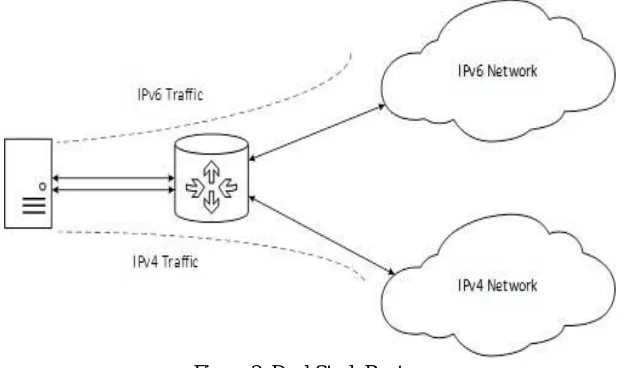
E. Dual Stack Routers
[image:4.612.151.467.481.665.2]A router can be installed with both IPv4 and IPv6 addresses configured on its interfaces pointing to the network of relevant IP scheme.
Figure 2. Dual Stack Routers
IV. TUNNELLING
[image:5.612.107.537.119.205.2]In a scenario where different IP versions exist on intermediate path or transit networks, tunneling provides a better solution where user’s data can pass through a non-supported IP version.
Figure 3. Tunnelling
The above diagram depicts how two remote IPv4 networks can communicate via a Tunnel, where the transit network was on IPv6. Vice versa is also possible where the transit network is on IPv6 and the remote sites that intend to communicate are on IPv4.
F. NAT Protocol Translation
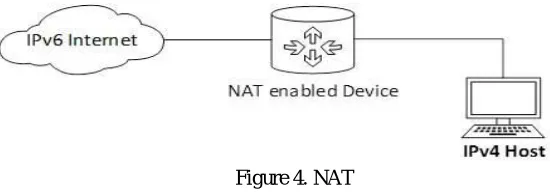
This is another important method of transition to IPv6 by means of a NAT-PT (Network Address Translation – Protocol Translation) enabled device. With the help of a NAT-PT device, actual can take place happens between IPv4 and IPv6 packets and vice versa. See the diagram below:
Figure 4. NAT
A host with IPv4 address sends a request to an IPv6 enabled server on Internet that does not understand IPv4 address. In this scenario, the PT device can help them communicate. When the IPv4 host sends a request packet to the IPv6 server, the NAT-PT device/router strips down the IPv4 packet, removes IPv4 header, and adds IPv6 header and passes it through the Internet. When a response from the IPv6 server comes for the IPv4 host, the router does vice versa.
G. IPv6 Features and Benefits
IPv6 offers larger address space, with 128 bits of IPv6 address allow with some 340 trillion addresses which eventually eliminates any need for NAT. Security is now a major concern with IPSEC being built in the protocol with suitable key infrastructure. It also gives more advantages like Multicasting, simplified processing by routers, mobility, options extensibility, jumbo grams etc. Auto configuration is the main feature of IPv6. IPv6 offers three types of auto configuration- Stateful Auto configuration, Stateless Auto configuration and both. Clients using IPv4 addresses use the Dynamic Host Configuration Protocol (DHCP) server every time they log onto a network. This process is called stateful auto-configuration. IPv6 supports a revised DHCPv6 protocol to support similar stateful auto-configuration, but also supports stateless auto-configuration of nodes that do not require a server to obtain addresses, but uses router advertisements to create an address. This creates a “plug-and-play” environment and can simplify management and administration. IPv6 also allows automatic address configuration and, empowering administrators to renumber network addresses without accessing all clients. IPv6 also offers efficient and hierarchical addressing and routing infrastructure, Built -in security, Mobility, Multicast support, Better support for QoS and New protocol for neighboring node interaction.
V. IMPLEMENTATIONS&CHALLENGES
[image:5.612.159.434.343.441.2]Reliance Industries Limited (RIL) – became the fastest network provider ever to exceed 50 million subscribers – a feat we accomplished in less than three months.
Currently, almost 90% of Jio’s LTE 4G subscribers are using IPv6 – accounting for almost 70% of the country’s IPv6 traffic – which in itself has equated to a rapid rise in India’s total IPv6 capabilities, increasing from 1% to 16% in 2016 (and passing 20% in the new year). Reliance Jio is the first milestone to bring in force the new technology that failed to be brought forward at any platform at all. IPv4 only supports a narrow range of customers, and now we have Jio breaking all stereotypes and bringing ahead one of the finest and most well-spread and preferred network of all times. There are a lot of challenges yet to be overcome by the IPv6 but this in itself is an achievement marking its first step in the digital market. Ipv6 is the future of the Internet. It is not an option but it is an absolute necessity. Nevertheless, it is not going to be a simple or rapid transition. IPv6 implementation gives many challenges some of which are recognized and others are not even known yet. Different manufacturers and service providers are testing the new IPv6 implementations. There are many unknown things related to IPv6 implementations. IPv6 will certainly benefit from these experiences, but still it is a super long way to go before it is enriched fully.
VI. CONCLUSION
The world is moving rapidly towards ubiquitous connectivity that will further change how and where people associate, gather and share information, and consume media. A canvassing of 2,558 experts and technology builders about where we will stand by the year 2025 finds striking patterns in their predictions. IPv6 is the critical backbone for the next generation technology. It holds tremendous promise; however, enterprises and businesses need to have a carefully planned evaluation and transition strategy for IPv6. IPv6 enjoys many advantages as we have discussed with the paper. But even when there are so many positives to bring it to the front, we still have to wait as it will still take time to completely migrate from IPv4 to IPv6, the reason for this is that the devices are not compatible i.e. the devices at layer 2 can work with no or a bit modification, but the devices at layer 3 are needed to be upgraded. But the industries and companies don’t want to upgrade their devices because of their cost and various technical issues. Another reason is that the backbone routers are using IPv4 addresses and they need to change their routing tables. Since the rapid growth of Internet in last few decades the need of IPv6 is must because IPv6 solves internet scaling challenges, provides flexible transition mechanisms for the current internet, and meets the needs of such new markets as mobile, personal computing devices, network entertainment and device control. This should be brought to notice to everyone and the replacement should soon be started to work upon as this is just resisting us from growth even when we know where the advancement should begin from. Security and salability are two huge Internet concerns that can be easily covered up by this change!
REFERENCES
[1] John J Amoss, Daniel Minoli ‘Handbook of Ipv4 to Ipv6 transition’ Auerbach Publications, Newyork, USA.
[2] CiprianPopoviciu, Eric Levy-Abegnoli, Patrick Grossetete ‘Deploying IPv6 Networks’ Cisco Press, Indianapolis USA, 2006
[3] SOLVING IPV4 (32 BITS) ADDRESS SHORTAGE PROBLEM USING IPV6 (128 BITS), Er. Rakesh Gupta, Er. SahilVerma, Er. Kavita. [4] Microsoft, “IPv6/IPv4 coexistence and migration,” White Paper, Washington, November 2001.
[5] B. A. Forouzan, Data Communication & Networking, 4th ed.
[6] R. Hinden and S. Deering, IPv6 Addressing Architecture February RFC 4291. 2006.
[7] Interoperability between IPv4 and IPv6.[Online]. Available: http:/ntrg.cs.tcd.ie/undergrad/ 4ba2.02 /ipv6 /interop.html
[8] K. Ettikan, K. Gopi, and Y. Takefumi, “Application performance analysis in transition mechanism from IPv4 to IPv6,” Research & Business Development Department, Faculty of Information Technology Multimedia University (MMU), Jalan Multimedia, June 2001.
[9] D. Waddington and F. Chang, “Realizing the transition to IPv6,” IEEE Communications Magazine, vol. 40, no. 6, pp. 138–147, June 2002.