Unified Visual Programming Environment
Abhishek Singh
1, Anjali Kataria
2 Information Technology DepartmentDronacharya College of Engineering, Farrukh Nagar, Khentawas, Gurgoan, Haryana
Abstract: This paper briefly describes the process of programming which includes the creation, compilation and execution of programs to perform tasks. The Visual Programming Environment (VPE) provides visual approaches to programming language for writing programs graphically, such type of programming platform benefits in visual representation of dataflow -understanding the logic of the program. The modules developed using various environments like VC++, Visual Basic, Microsoft .NET, JAVA etc. This paper explains an Integrated Visual Programming Environment (IVPE), including concepts of a network used in a system and icon based programming such as image processing etc. By using IVPE, Visual Sequencer (Visual Sequencer - VISER) provides an environment for integrating run-time components such as.NET (managed DLL assemblies), Java (class files), MATLAB(DLLs generated by MCC Matlab compiler), Win32 (unmanaged DLL libraries), COM objects, and Web Services (WSDL supported).
In this paper we have also shown various image processing modules from various programming environments. Keywords: VISER framework, VISER flow manager, test cases, exception handling, VISER performance
I. INTRODUCTION
Program is a sequence of instructions or lines of codes and is required to perform specific task(s). A program can have n number of linked libraries, references or components helping to achieve a required task. In this paper we propose an Unified Visual Programming Environment for representing the flow of execution of various components derived from multiple platforms like Microsoft .NET,JAVA, Windows Shell, Win32, MATLAB, COM, and Web Services. By using a platform known as Visual Sequencer (VISER), a VPE where programs are created graphically. In VISER, program refers to a paradigm that is provided by the VPE. With the increase in programming language environments and their syntactical approaches, one should be aware of the syntax. There are various programming environments for building programs without knowing syntax but one should be having a logical approach which can be an easy process for writing programs.
Visual programming is a solution where we need not be aware of the syntax. The process of visual programming includes both the visual creation of programs and executing those programs. Key benefits of using VPE are rapid prototyping, requires less programming skills (main focus on program logic than syntax), visual representation of data flow, visual representation of all the activities going with data (like data input, outputs, functions, debugging, execution, etc). With the help of VISER, one can test and measure the performance of algorithms (Section V) and one can find the best performed algorithm among various algorithms.
II. INTEGRATED VISUAL PROGRAMMING ENVIRONMENT
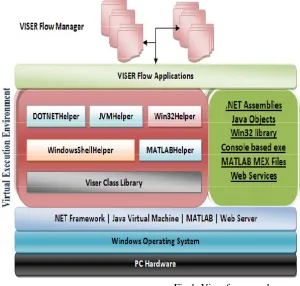
functionalities built on any platform including Microsoft .NET, Web Services, JAVA, Win32APIs, COM, MATLAB and Windows Shell based host scripts. The core component of the framework is its Virtual Execution Environment (VEE) where program flow is parsed and individual activity is executed on their respective platforms. Responsibilities of VEE are listed as below:VISER runtime environment: Provides various facilities for running and managing the VISER flows. Implicit data type conversion: Provides various implicit facilities to convert data from one type to another type. E.g., String to Integer, Integer to String, Integer to Long, etc.DOTNET Helper: Provides various facilities for .NET code functionality extraction and their execution. JVM Helper: Facilities for running and managing java byte code. JVM Helper engine provides a bridge between.NET and JAVA environment through a Java Native Interface (JNI).
Fig.1. Viser framework.
› Win32Helper: Engine provides interoperability between Win32 libraries and .NET. C/C++ interface has been implemented which is integrated in VISER VEE. Win32Helper is responsible for the management of Win32 function extraction and execution of extern or publically declared functions.
› Windows Shell Helper: Windows Shell engine provides the facilities to use host scripts (Shell based executables) to enable successful run at command prompt but the feature provides to use scripts in a visual programming fashion like adding a visual activity (element), assigning executable to it, adding and passing parameter.
› MATLAB Helper: For running and managing MATLAB MEX binaries. Engine provides an interface to run MATLAB MEX DLLs compiled by mcc compiler.
› VISER Class Library: Provides various features including user defined Viser flows, data and data access, cryptographic libraries, data base connectivity, network communications, etc.
B. Viser Flow Manager (GUI)
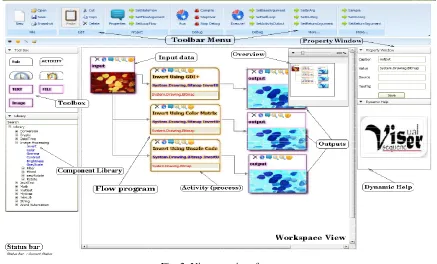
Fig. 2. Viser user interface.
In data flow programming (VPE), all the operations can be performed visually like visually creation of flow programs, argument passing, cut, copy & paste of visual elements. Properties can be set using a property window to individual or selection list visual elements.
III. PROGRAMMING WITH VISER
In Fig. 3, flows are depicted which explains how the program flows are programmed on visual programming platform and how they are helpful to understand program logic.
The flow is used for encoding and decoding a text.
Encoding visual element (Base64 encoding) is used to encode “INPUT TEXT” which results to generate a base64 text output
“SU5QVVQgVEVYVA==”. Result of Encoding element is passed to Decoding element (Base64 decoding)which generates a
[image:4.612.68.535.510.710.2]common for user specific applications. Main components are listed below: Image processing, cryptographic, scientific computations, etc. Date Time components.
Data input and output.
A .Image Processing Samples
VISER provides a separate visual element image I/O which can display input and output images. Processed images can be saved into various standard formats (BMP,JPEG, TIFF, GIF, PNG, ICO, WMF, and EMF). Image processing samples: Fig. 4 and Fig. 5.
B. Distributed Execution: Web Services
Visual Sequencer provides direct support for integration of web services. VISER supports web services in WSDL format. An example is depicted in Fig. 6.
Fig.5. Horizontal edge detection
Fig.6. A visual program with web services
V. TEST AND MEASUREMENT
VISER is not limited to visual programming or data flow programming but one can have the following features: Measure the performance of algorithms.
Comparative study to analyze which is the best algorithm.
Measure the performance on cross platforms (.NET framework, JVM, etc). Measure the performance across the network systems (heterogeneous systems).
After execution of Image Invert project, Invert Using Unsafe Code takes much lesser time than other algorithms as shown in performance chart Fig. 7. This is because the operations in pointers are faster than others.
Fig.7. Performance test for invert algorithms
VI. EXCEPTION HANDLING
Successful and unsuccessful activities will be monitored in two levels. Firstly, exceptions will be thrown by individual frameworks with stack trace information and secondly, in VISER framework itself. Exceptions are logged every time when they are thrown and can be checked by right clicking on unsuccessful or red color marked activities as depicted in Fig. 8.
Fig.8. Exception handling
VII. VISER PERFORMANCE
individual frameworks and VISER framework, performance chart is shown in Fig. 9. We concluded that VISER takes slightly more processing time because of parsing of dataflow programs and some explicit data validation processing.
Fig.9. Image Invert performance test on VISER (Red color) and without VISER (blue color)
VIII. CONCLUSION
In this paper, our approach enriches programming environment by integrating multiple platforms into an Integrated Visual Programming Environment (IVPE) called Visual Sequencer - VISER where building a program is nota big task for those who don’t know the syntax of theprogram. “Anyone can do programming” is the main goal of VPE. Using VPE in our approach also enriches RAD (Rapid Application Development) system for developing programs. VISER is very helpful in testing and measuring algorithms in various dimensions including cross platforms and across network systems.
REFERENCES
[1] N. C. Shu, Visual Programming, Van No strand Reinhold, New York, 1988, ch. 1, pp. 9.
[2] M. Burnett, “Visual programming,” Encyclopedia of Electrical and Electronics Eng., J.G. Webster, ed. New York: John Wiley & Sons,1999.
[3] M. Burnett, "Software engineering for visual programming languages," Handbook of Software Engineering and Knowledge Engineering, vol. 2, World Scientific Publishing Company, pp. 77-92, June 2001.
[4] VisiQuest: A Problem Solving Environment for Scientific Computing and Visualization [Online].
Available: http://www.aertia.com/docs/accusoft/VisiQuest_A problem solving environment for scientific computing and visualization.pdf/
[5] Synopsis Visual Programming Tool [Online]. Available: http://www.codemorphis.com/
[6] Ariane Data flow visual programming environment [Online]. Available: https://clouard.users.greyc.fr/Ariane/.
[7] M. Young, D. Argiro, and S. Kubica, “Cantata: visual programming environment for the Khoros system,” ACM SIGGRAPH Computer Graphics, vol. 29, no. 2, pp. 22-24, May 1995.