R E V I E W
Open Access
Understanding rare and common diseases
in the context of human evolution
Lluis Quintana-Murci
1,2,3Abstract
The wealth of available genetic information is allowing
the reconstruction of human demographic and adaptive
history. Demography and purifying selection affect the
purge of rare, deleterious mutations from the human
population, whereas positive and balancing selection
can increase the frequency of advantageous variants,
improving survival and reproduction in specific
environmental conditions. In this review, I discuss
how theoretical and empirical population genetics
studies, using both modern and ancient DNA data,
are a powerful tool for obtaining new insight into
the genetic basis of severe disorders and complex
disease phenotypes, rare and common, focusing
particularly on infectious disease risk.
Introduction
Intense research efforts have focused on identifying rare
and common variants that increase disease risk in humans,
for both rare and common diseases. Several, non-mutually
exclusive models have been proposed to explain the
func-tional properties of such variants and their contributions to
pathological conditions, and this topic has been reviewed
elsewhere [1
–
10]. These studies implicated multiple
vari-ants in disease susceptibility, but the relative importance of
rare and common variants in phenotypic diversity, both
be-nign and disease-related, has yet to be explored in detail
[11]. We can use an evolutionary approach to tackle this
question, as population genetics models can predict the
al-lelic architecture of disease susceptibility [12, 13]. They are
able to do so because rare and common disease-risk alleles
are a subset of global human genetic diversity, and their
occurrence, frequency, and population distribution is
gov-erned by evolutionary forces, such as mutation, genetic drift
Correspondence:[email protected]
1Human Evolutionary Genetics Unit, Department of Genomes & Genetics,
Institut Pasteur, Paris 75015, France
2Centre National de la Recherche Scientifique, URA3012, Paris 75015, France
Full list of author information is available at the end of the article
(e.g., migration, admixture, and changes in population size),
and natural selection.
The plethora of genetic information generated in the
last ten years, thanks largely to the publication of
se-quencing datasets for both modern human populations
and ancient DNA samples [14
–
18], is making it possible
to reconstruct the genetic history of our species, and to
define the parameters characterizing human demographic
history: expansion out of Africa, the loss of genetic diversity
with increasing distance from Africa (i.e., the
“
serial founder
effect
”
), demographic expansions over different time scales,
and admixture with ancient hominins [16
–
21]. These
stud-ies are also revealing the extent to which selection has acted
on the human genome, providing insight into the way in
which selection removes deleterious variation and the
po-tential of human populations to adapt to the broad range of
climatic, nutritional, and pathogenic environments they
have occupied [22
–
28]. It has thus become essential to
dissect the role of selection, in its diverse forms and
in-tensities, in shaping the patterns of population genetic
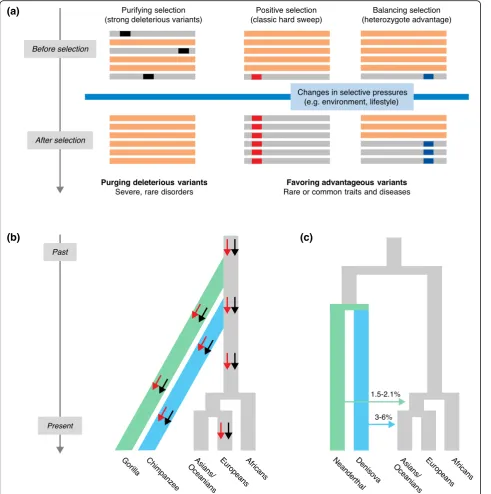
diversity (Fig. 1a), not only to improve our understanding
of human evolutionary history, but also to obtain insight
into phenotypic diversity and differences in the risk of
de-veloping rare and common diseases [12, 13, 24, 29
–
32].
The removal of mutations deleterious to human
health
Studies of the occurrence, frequency, and population
distribution of deleterious mutations are of fundamental
importance if we are to understand the genetic
architec-ture of human disease. Theoretical and empirical
popula-tion genetics studies have shown that most new mutapopula-tions
resulting in amino acid substitutions (non-synonymous)
are rapidly culled from the population through purifying
selection (Fig. 1a) [33, 34]. Indeed, the small number of
non-synonymous variants observed relative to the rate of
synonymous mutation indicates that most
non-synonymous mutations are lethal or highly deleterious,
strongly compromising the reproductive success of their
carriers [34
–
36]. Purifying selection
—
the most common
form of selection
—
refers to the selective removal of alleles
that are deleterious, such as those associated with severe
Mendelian disorders, or their maintenance at low
popula-tion frequencies (i.e., mutapopula-tion
–
selection balance) [32, 37].
The efficacy of purifying selection for eliminating
deleteri-ous mutations from a population depends not only on the
selection coefficient(
s
), but also on population size (
N
),
which determines the magnitude of genetic drift. Unlike
highly deleterious mutations, variants subject to weaker
selection (i.e., weakly deleterious mutations) behave like
“
nearly neutral mutations
”
; they may, therefore, reach
rela-tively high population frequencies [38
–
40]. In large
out-bred populations, with low levels of drift, deleterious
mutations will eventually be eliminated. By contrast, in
small populations, deleterious mutations behave very
much like neutral mutations and may be subject to strong
drift, resulting in moderate-to-high frequencies, or even
fixation [39].
Rare variants are widespread in the human genome
Recent deep-sequencing studies are showing a
surpris-ingly high proportion of rare and low-frequency variants
in different human populations [14, 15, 41
–
47]. The
Ex-ome Variant Server, for example, reports frequency
in-formation from 6515 exomes of individuals of African
American and European American ancestry [46]. The
most recent release of the 1000 Genomes Project, based
on full-genome information for 2504 individuals from 26
populations from around the world, revealed that there
was a large number of rare variants in the global dataset
(~64 million autosomal variants have a frequency <0.5 %,
and only ~8 million have a frequency >5 %), with each
in-dividual genome harboring between 40,000 and 200,000
rare variants [15]. A more recent report of high-quality
ex-ome data from 60,706 individuals of diverse geographic
ancestry, generated as part of the Exome Aggregation
Consortium (ExAC), has provided unprecedented
reso-lution for the analysis of low-frequency variants as well as
an invaluable resource for the clinical interpretation of
genetic variants observed in disease patients [47].
The contribution of rare variants to human disease is
a matter of considerable debate, together with the
distri-bution of these variants in the population, as they may
underlie early-onset disease and increase susceptibility to
common diseases [1, 44, 45, 48
–
50]. Most rare variants
are private to a population, whereas common variants
tend to be shared by different populations [51]. Rare
vari-ants, particularly those specific to a particular population,
tend to have stronger deleterious effects than common
variants [42, 52, 53]. Consequently, as shown by
popula-tion genetics studies, most variants with large funcpopula-tional
effects tend to be rare and private, and only a small
proportion of variants with large effects are common to
different populations. Genome-wide association studies
(GWAS), which focus on common variants, have been
only moderately successful in explaining the genetic basis
of complex diseases [3]. Furthermore, theoretical studies
have shown that a large proportion of the so-called
“
miss-ing heritability
”
is explained by rare variants, particularly
those that affect fitness as well as causing disease [54].
The increasing amount of sequence-based datasets
available, both in basic and medically oriented research,
is accelerating the investigation into the contribution of
rare variants to disease susceptibility. In this context,
di-verse variant annotation tools and predictive algorithms
have been developed to systematically evaluate the
po-tential functional impacts of genetic variants (e.g.,
Poly-Phen, SIFT, and GERP) [55
–
57], helping to prioritize the
study of putative causal variants in further detail. These
methods, which use different statistics and types of
in-formation, generally assess the
“
deleteriousness
”
of each
genetic variant by considering different measures, such
as evolutionary conservation scores, changes in amino
acid sequence, or potential effect on protein function
and structure [58]. Novel methods are increasingly being
developed, providing improved power and resolution.
For example, CADD, which integrates both evolutionary
and functional importance, generates a single prediction
from multiple annotation sources, including other variant
effect predictors [59]. Likewise, MSC provides gene-level
and gene-specific phenotypic impact cutoff values to
im-prove the use of existing variant-level methods [60].
Quantification of the burden of deleterious, mostly
rare, variants across human populations and an
under-standing of the ways in which this burden has been
shaped by demographic history are now key issues in
medical research, because they could help to optimize
population sampling and, ultimately, to identify disease
risk variants.
Expansion out of Africa and the patterns of rare,
deleterious variants
Furthermore, ~85 % of known deleterious variants appear
to have arisen during the last 5000 to 10,000 years, and
these variants are enriched in mutations with a (relatively)
large effect as there has not yet been sufficient time for
se-lection to eliminate them from the population [46].
Fur-thermore, deleterious mutations in Europeans appear to
have occurred after those in Africans (~3000 vs. 6200 years
ago, respectively) [46], highlighting the effects of
demo-graphic history on the distribution of deleterious variants
within the population.
However, some studies have suggested that demographic
history may have a less straightforward impact on the
mean burden of deleterious variants [62
–
64]. Simons and
coworkers concluded that individual mutation load is
insensitive to recent population history [64], and Do
and coworkers suggested that selection is equally effective
across human populations [62]. Several factors underlie
these apparently conflicting conclusions, including
dif-ferences in the choice of statistics and the features of
genetic variation used to assess the burden of deleterious
variation, and differences in the choice of predictive
al-gorithms for defining deleteriousness, together with
dif-ferences in the interpretations of the results; these
factors have been reviewed in detail elsewhere [22, 65].
Nevertheless, all these studies converge to suggest that
demographic history affects deleterious and neutral
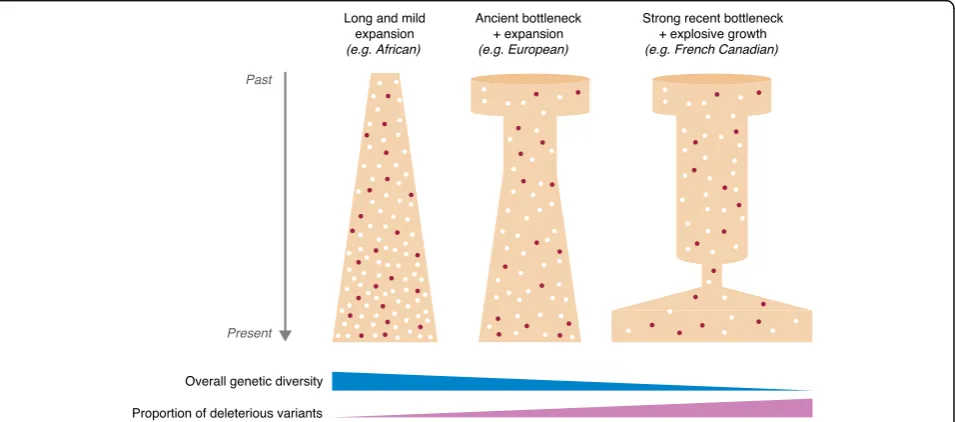
vari-ants differently (Fig. 2), and that mutation and drift have
stronger effects on the frequency of weakly deleterious
mutations in bottlenecked populations than in large,
expanding populations.
Founder effects and bottlenecks increase the burden of
deleterious variation
Besides the impact of long-term population demographics
(i.e., African vs. non-African populations) on the
distribu-tion of deleterious variants, a few studies have evaluated
the effects of more recent, or stronger, changes in
popula-tion demography. For example, it has been shown that
French Canadians have both lower levels of diversity
and a larger proportion of deleterious variants than the
present-day French population. These findings highlight
how a recent major change in population demographics
(i.e., a small founder population of ~8500 French settlers
subsequently growing by about 700-fold to attain its
present size) can profoundly affect the population
’
s genetic
landscape within as little as 400 years [66]. Likewise, the
Finnish population, which experienced a recent
popula-tion bottleneck estimated to have occurred ~4000 years
ago, has larger proportions of rare deleterious alleles,
including loss-of-function variants and complete gene
knockouts, than other populations in Europe or of
European descent [67].
Henn and coworkers investigated the consequences of
a serial founder effect model for the distribution of
dele-terious mutations using a set of African populations and
several groups located at different geographic distances
[image:4.595.61.539.443.654.2]from Africa [68]. Using explicit demographic models and
considering different selection coefficients and dominance
parameters, they found that non-African individuals
car-ried larger proportions of deleterious alleles, mostly of
modest effect, than African individuals, and that the
num-ber of homozygous deleterious genotypes carried by
indi-viduals increased with distance from Africa [68]. These
results highlight the interaction between drift and
purify-ing selection by showpurify-ing that deleterious alleles previously
maintained at low frequencies by purifying selection may
have surfed to higher frequencies in populations at the
edge of the wave expanding out of Africa, due to stronger
drift [53, 68, 69]. Together, these studies suggest that
demographic history has played a central role in shaping
differences in the genetic architecture of disease between
human populations through its effects on the frequency of
deleterious alleles [64, 70].
Favoring advantageous variants to increase
adaptation
Besides the interplay between drift and selection to
re-move deleterious mutations, other
de novo
or already
existing variants can be advantageous and can increase in
population frequency through various forms of positive
and balancing selection [23
–
28, 71, 72]. Humans occupy
diverse habitats and have gone through many different
cultural and technological transitions; human populations
have had to adapt to such shifts in habitat and mode of
subsistence [25]. Dissecting the legacy of past genetic
adaptation is thus key to identifying the regions of the
genome underlying the broad morphological and
physio-logical diversity observed across populations, and to
in-creasing our understanding of the genetic architecture of
adaptive phenotypes in health and disease.
Positive selection targets mendelian and complex traits
Positive selection can manifest in different guises: from
the classic, hard-sweep model, in which a new mutation
can confer an immediate fitness benefit (Fig. 1a), to
al-ternative models of genetic adaptation, such as selection
on standing variation or polygenic adaptation [73, 74],
with each type of selection leaving a specific molecular
signature in the targeted region (reviewed in [23, 26]).
Most studies have focused on signals of positive
selec-tion according to the hard-sweep model, providing
insight into the nature of adaptive phenotypes (see
[23, 24, 26, 29, 31, 72, 75
–
77] and references therein).
These phenotypes range from Mendelian traits (or
al-most so)
—
including the largely supported lactase
per-sistence trait in various populations [78
–
82] and traits
relating to infectious disease resistance (e.g.,
G6PD
,
DARC
,
FUT2
) in particular (reviewed in [76])
—
to complex traits,
such as skin pigmentation [83
–
86], adaptation to climate
variables or high altitude [87
–
93], and the immune
response and host
–
pathogen interactions [24, 29, 31, 77,
94
–
107]. These examples reveal the potent selective
pres-sures that have been exerted by nutritional resources,
cli-matic conditions, and infectious agents since humans first
began to spread over the globe [29, 31, 72, 77, 96, 108].
Many selection signals were detected by
candidate-gene approaches, based on
a priori
choices of the genes
and functions to be investigated. However, a large
number of genome-wide scans for positive selection
have identified several hundred genomic regions
dis-playing selection signals, consistent with the likely
presence in these regions of beneficial, functional variants
[28, 37, 109
–
124]. For example, Grossman and coworkers
identified about 400 candidate regions subject to selection,
using whole-genome sequencing data from the 1000
Ge-nomes Project [28]. These regions either contain genes
in-volved in skin pigmentation, metabolism and infectious
disease resistance, or overlap with elements involved in
regulatory functions, such as long intergenic noncoding
RNAs and expression quantitative trait loci (eQTL). The
presence of non-synonymous variants in less than 10 % of
the candidate-selected regions suggests that regulatory
variation has played a predominant role in recent human
adaptation and phenotypic variation [28], as previously
suggested [125
–
128].
The large number of studies searching for selection
signals contrasts with the much smaller number of
stud-ies trying to determine when selection effects occurred
[83, 129, 130]. Nevertheless, such studies could identify
specific time periods corresponding to abrupt changes in
environmental pressures. Studies aiming to date the
lac-tase persistence allele in Europe have suggested that this
allele was selected in farmers some 6000 to 11,000 years
ago [79, 81, 95, 129, 130], although estimates based on
ancient DNA point to a more recent time [131, 132] (see
below). A recent study, using an approximate Bayesian
computation framework, found that skin pigmentation
alleles were generally much older than alleles involved in
autoimmune disease risk, whose ages are consistent with
selection during the spread of agriculture [129]. A report
suggesting that many selective events targeting innate
immunity genes have occurred in the last 6000 to
13,000 years [95] provides additional support for the
no-tion that the adopno-tion of agriculture and animal
domes-tication modified human exposure to pathogens, leading
to genetic adaptations of immune response functions.
signals probably result from background selection
[74, 93, 123, 124]. There is also increasing evidence to
suggest that other, largely undetected forms of genetic
adaptation, such as selection on standing variation,
poly-genic adaptation, and adaptive introgression [73, 74],
may have occurred more frequently in the course of
human evolution than previously thought (see for
ex-ample [108, 130, 133
–
135]).
Maintaining diversity through balancing selection
Balancing selection can preserve functional diversity,
through heterozygote advantage (or overdominance;
Fig. 1a), frequency-dependent selection, advantageous
diversity fluctuating over time and space in specific
populations or species, and pleiotropy [27, 136, 137].
Unlike other forms of selection, balancing selection can
maintain functional diversity over periods of millions of
years because selection conditions remain constant over
time and are strong enough to avoid the loss of selected
polymorphisms due to drift. In some cases,
polymor-phisms subject to balancing selection can persist during
speciation events, resulting in trans-species polymorphism
(long-term balancing selection; Fig. 1b). In other cases,
balancing selection may occur only in particular species or
populations, owing to specific environmental pressures
(see [27, 136] and references therein). Until a few years
ago, evidence for the action of balancing selection was
re-stricted to a few loci, including the sickle cell hemoglobin
polymorphism (HbS), which protects against malaria in
the heterozygous state [138], and several genes of the
major histocompatibility complex (MHC, or HLA in
humans), which presents intracellular peptides to cells
involved in immune surveillance and triggers immune
responses against diverse pathogens [139
–
141].
Recent studies, bolstered by the whole-genome
se-quence data published for humans and other species, have
suggested that balancing selection is more prevalent than
previously thought (see [27] for a review). Several studies
searching for the occurrence of trans-species
polymorph-ism have shown that advantageous variants in the human
population may have been inherited from distant ancestral
species [142
–
145]. For example, functional diversity in
ABO blood group has been maintained across primates
for millions of years, probably due to host
–
pathogen
co-evolution [142]. Likewise, a scan of long-term balancing
selection in the genomes of humans and chimpanzees has
detected 125 regions containing trans-species
polymor-phisms, principally in genes involved in immune function,
such as
IGFBP7
and membrane glycoprotein genes; these
findings suggest that there has long been functional
variation in response to pressures exerted by pathogens
in these species [144]. Other studies have searched for
balancing selection within humans through the use of
genome-wide approaches or by focusing on particular
gene families. Selection signatures have been detected
in multiple regions, including the
KIR
gene regions
(
KIR
genes are known to co-evolve with their HLA
li-gands [146]), and regions encoding various molecules
involved in cell migration, host defense, or innate
im-munity [146
–
155]. These studies indicate that, despite
its low occurrence, balancing selection has maintained
functional diversity at genes involved in functions relating
to the immune response, as observed for other types of
selection [24, 29, 31, 77, 103].
Tracking selection signatures from ancient DNA data
Population genetics methods can be used to estimate the
approximate age and selection coefficient of adaptive
mutations from data from modern human populations,
with various degrees of confidence. However, the use of
ancient human samples from different time periods is
Box 1. To what extent has positive selection continued
in recent times?
Many human traits related to healthy or disease conditions appear
to have conferred selective advantages in the past [23–28, 71, 109], but the extent to which selection has persisted in very recent times remains largely unknown. This is because current methods of detecting positive selection are designed to measure selection over
long evolutionary timescales [24, 26]. A recent study has developed a new method, the Singleton Density Score (SDS), to infer recent changes in allele frequencies using modern whole-genome sequence data, and to measure selection during the
past 2000 years [190]. Using simulations, they first showed that SDS has equal power to detect hard and soft sweeps within recent evolutionary timescales. By applying SDS to more than 3000 full genomes of British ancestry, they identified several
alleles and traits that have provided, or continue to provide, a strong selective advantage over the last 2000 years. Among the strongest hits, they found the lactase persistence allele, indicating that the known selective advantage provided by this
allele [78, 81] has persisted in very recent times. They also detected strong signals of recent positive selection in the HLA region (associated with multiple traits and diseases), in genes involved in skin pigmentation (likely favoring blond hair and
blue eyes through sexual selection), and some cases of recent polygenic adaptation favoring increased height, increased infant head circumference and birth weight, later sexual maturation in women, and decreased levels of insulin and glycated hemoglobin
making it possible to determine how rapidly the frequency
of adaptive mutations has increased in populations. Until
a few years ago, ancient DNA data were available only for
single individuals or specimens, limiting the analysis to
questions of comparative genomics. We learned a great
deal about the degree of admixture between modern
humans and ancient hominins, such as Neanderthals and
Denisovans, a topic that has been reviewed elsewhere
[16, 17, 156
–
158]. These studies have also revealed the
existence of advantageous
“
archaic
”
variants in the
ge-nomes of modern humans [16, 158]. These variants,
which were acquired through admixture with archaic
humans, have improved adaptation and survival in
modern humans (Fig. 1c, Box 2).
However, much less is known about genetic diversity
levels in populations of modern humans from different
eras, such as the Paleolithic and Neolithic periods. Deep
sequencing is making it possible to sequence multiple
samples per species or population, opening up new
pos-sibilities for the analysis of ancient DNA data within a
population genetics framework (see [156] for a review).
For example, in one recent study, 230 human samples
from West Eurasia dating from between 8500 and
2300 years ago were sequenced [132]. The authors searched
for abrupt changes in allele frequencies over time across
the genome. They identified 12 loci containing variants
with frequencies that rapidly increased over time, consistent
with positive selection. The lactase persistence variant
yielded one of the strongest signals and appeared to have
reached appreciable frequencies in Europe only recently
(less than 4000 years ago), as previously suggested [131].
The other strong signals identified were either directly or
indirectly related to diet, corresponding to genes encoding
proteins involved in fatty acid metabolism, vitamin D levels,
and celiac disease, or corresponded to genes involved in
skin pigmentation [132]. Interestingly, the authors also
de-tected strong selection signals in immunity-related genes,
such as the
TLR1
–
TLR6
–
TLR10
gene cluster, which is
essential for the induction of inflammatory responses
and is associated with susceptibility to infectious diseases
[159, 160]. Thus, ancient DNA studies can help us to
understand the mode of selection following changes in
human lifestyle, and the extent to which such selective
events increased the frequency of functional alleles
as-sociated with specific traits or disease conditions [131,
132, 161, 162].
Insight into rare and common diseases from
natural selection
Genes associated with Mendelian or complex diseases
would be expected to be subject to unequal selective
pressures. We can therefore use selection signatures
to predict the involvement of genes in human disease
[11, 12, 32, 37, 115, 163]. Mendelian disorders are typically
severe, compromising survival and reproduction, and are
caused by highly penetrant, rare deleterious mutations.
Mendelian disease genes should therefore fit the
muta-tion
–
selection balance model, with an equilibrium
be-tween the rate of mutation and the rate of risk allele
removal by purifying selection [12]. The use of population
genetics models is less straightforward when it comes to
Box 2. Archaic admixture and disease risk in modern
humans
One source of adaptive genetic variation is variants from donor
populations that have undergone introgression into recipient populations (or species) through interbreeding or admixture, a phenomenon known as adaptive introgression. During the dispersals of modern humans through Eurasia, they encountered
other human forms, such as Neanderthals and Denisovans [16, 17, 156–158]. Analyses of whole-genome sequences from these hominins [191, 192] have shown that admixture between modern and archaic humans occurred, with modern Eurasian
genomes comprising 1–6 % of Neanderthal or Denisovan ancestry (Fig. 1c) [191, 193–197]. However, these estimations are averaged across the genome, and it has been shown that the degree of archaic ancestry in the modern human genome varies considerably
[194, 198, 199]. A systematic search for regions of Neanderthal ancestry in the genomes of modern humans has shown that, globally, purifying selection has acted against Neanderthal introgression, particularly in protein-coding regions [194]. However,
some regions of the genome can present a high degree of Neanderthal ancestry, which can be as high as 62 % in Asian and 64 % in European populations [194].
Some of the regions presenting the highest degree of Neanderthal
ancestry have been found to overlap alleles that have been associated with phenotypes of medical relevance, such as lupus, biliary cirrhosis, Crohn’s disease, optic-disk size, smoking behavior, IL-18 levels, type 2 diabetes, and hypercoagulation [194, 200]. In
some cases, the introgression of archaic segments into the genomes of modern humans appears to have been adaptive [194, 198]. Cases of adaptive introgression from Neanderthals or Denisovans have been reported for several genes (see [16] for a complete list), such
asEPAS1, involved in human adaptation to life at high altitude [201], BNC2, involved in skin pigmentation [194, 198], and an increasing number of genes involved in immunity to infection, including severalHLAgenes [202],STAT2[203], theOASgene cluster
[204, 205], and theTLR6-TLR1-TLR10gene cluster [95, 206]. Collectively, these studies suggest that archaic admixture has been an important source of adaptive variation but also that modern humans have inherited archaic variation that today
predicting the genes involved in complex disease risk.
Models of adaptive evolution based on positive or
bal-ancing selection apply to a few Mendelian traits or
disorders, most notably, but not exclusively, those
re-lated to malaria resistance (reviewed in [76, 98]).
How-ever, the complex patterns of inheritance observed for
common diseases, including incomplete penetrance,
late onset and gene-by-environment interactions, make it
more difficult to decipher the connection between disease
risk and fitness [12].
Purifying selection, rare variants, and severe disorders
According to population genetics theory, strongly
deleteri-ous mutations are rapidly removed from the population by
purifying selection, whereas mildly deleterious mutations
generally remain present, albeit at low frequencies,
depend-ing on population sizes and fitness effects. Genome-wide
studies are providing increasing amounts of support for
these predictions, as
“
essential
”
genes
—
identified as such
on the basis of association with Mendelian diseases or
ex-perimental evidence from model organisms
—
are enriched
in signs of purifying selection [32, 37, 115, 164]. Purifying
selection has also been shown to be widespread in
regula-tory variation, acting against variants with large effects on
transcription, conserved noncoding regions of the genome,
and genes that are central in regulatory and protein
–
pro-tein interaction networks [8, 10, 165
–
171].
Mutations associated with Mendelian diseases or with
deleterious effects on the phenotype of the organism are
generally rare and display familial segregation, but such
mutations may also be restricted to specific populations
[11]. This restriction, in some cases, may be due to a
se-lective advantage provided by the disease risk allele (e.g.,
the sickle cell allele in populations exposed to malaria
[98]), but it mostly reflects a departure from the
muta-tion
–
selection balance. Small population sizes or specific
demographic events may randomly increase the
fre-quency of some disease risk alleles, because too little
time has elapsed for purifying selection to remove them
from the population, as observed in French Canadians,
Ashkenazi Jews, or Finns [11, 66, 67].
According to these principles of population genetics,
searches for genes or functional elements evolving under
strong purifying selection can be used to identify the
genes of major relevance for survival, mutations of
which are likely to impair function and lead to severe
clinical phenotypes. In this context, the immune
re-sponse and host defense functions appear to be the
prime targets of purifying selection [37, 95, 102]. For
ex-ample, a recent study based on whole-genome sequences
from the 1000 Genomes Project estimated the degree to
which purifying selection acted on ~1500 innate
immun-ity genes. The genes of this class, taken as a whole, were
found to have evolved under globally stronger purifying
selection than the rest of the protein-coding genome
[95]. This study also assessed the strength of selective
constraints in the different innate immunity modules,
organizing these constraints into a hierarchy of
bio-logical relevance, and providing information about the
degree to which the corresponding genes were essential
or redundant [95].
Population genetics has also facilitated the
identifica-tion of immune system genes and signaling pathways
that fulfill essential, non-redundant functions in host
defense, variants of which are associated with severe,
life-threatening infectious diseases (for examples, see
[94, 95, 101, 106], and for reviews [29, 103, 172, 173]).
This is well illustrated by the cases of
STAT1
and
TRAF3
; they belong to the 1 % of genes presenting the
strongest signals of purifying selection at the
genome-wide level [95], and mutations in these genes have been
associated with severe viral and bacterial diseases,
Men-delian susceptibility to mycobacterial disease, and herpes
simplex virus 1 encephalitis [174, 175]. Using the
para-digm of immunity and infectious disease risk, these studies
highlight the value of population genetics as a
comple-ment to clinical and epidemiological genetic studies, for
determining the biological relevance of human genes
in
natura
and in predicting their involvement in human
disease [29, 103, 173, 176].
Genetic adaptation, common variants, and complex
disease
GWAS [28], including height, and multiple regions
associ-ated with infectious and autoimmune disease risks,
includ-ing tuberculosis and leprosy.
Like purifying selection, positive selection is prevalent
among genes related to immunity and host defense
[24, 37, 95, 109, 112, 115, 181]. Notable examples of
immunity-related genes evolving in an adaptive
man-ner, through different forms of positive or balancing
selection, and reported to be associated with complex
traits or diseases include:
TLR1
and
TLR5
, which have
selection signals that seem to be related to decreases
in NF-kB signaling in Europe and Africa, respectively
[28, 94, 95]; many genes involved in malaria resistance
in Africa and Southeast Asia [98, 100]; type-III
inter-feron genes in Europeans and Asians, related to higher
levels of spontaneous viral clearance [101, 182];
LARGE
and
IL21
, which have been implicated in Lassa
fever infectivity and immunity in West Africans [181];
and components of the NF-kB signaling pathway and
inflammasome activation related to cholera resistance
in a population from the Ganges river delta [97]. These
cases of selection related to infectious disease and many
others (see [29
–
31, 96, 103] for reviews and references
therein) indicate that the pressures imposed by infectious
disease agents have been paramount among the different
threats faced by humans [183]. They also highlight the
value of population genetics approaches in elucidating the
variants and mechanisms underlying complex disease risk.
Changes in selective pressures and advantageous/
deleterious variants
Most of the rare and common variants associated with
susceptibility to disease in modern populations have
emerged through neutral selection processes [184].
However, there is increasing evidence to suggest that,
following changes in environmental variables or human
lifestyle, alleles that were previously adaptive can
be-come
“
maladaptive
”
and associated with disease risk
[12, 13, 29, 30, 105]. For example, according to the
popular
“
thrifty genotype
”
hypothesis based on
epidemio-logical data, the high prevalence of type 2 diabetes and
obesity in modern societies results from the selection of
alleles associated with efficient fat and carbohydrate
stor-age during periods of famine in the past. Increases in food
abundance and a sedentary lifestyle have rendered these
alleles detrimental [185]. The strongest evidence that past
selection can lead to present-day maladaptation and
disease susceptibility is provided by infectious and
in-flammatory disorders [12, 29
–
31, 77, 105]. According
to the hygiene hypothesis, decreases in the diversity of
the microbes we are exposed to, following
improve-ments in hygiene and the introduction of antibiotics
and vaccines, have led to an imbalance in the immune
response, with alleles that helped us to fight infection
in the past now being associated with a higher risk of
inflammation or autoimmunity [105].
Population genetics studies have provided strong
support for the hygiene hypothesis, by showing that
genetic variants associated with susceptibility to certain
autoimmune, inflammatory, or allergic diseases, such as
inflammatory bowel disease, celiac disease, type 1 diabetes,
multiple sclerosis, and psoriasis, also display strong
posi-tive selection signals [29, 30, 106, 186
–
188]. For example,
genes conferring susceptibility to inflammatory diseases
have been shown to be enriched in positive selection
sig-nals, with the selected loci forming a highly
intercon-nected protein
–
protein interaction network, suggesting
that a shared molecular function was adaptive in the past
but now affects susceptibility to various inflammatory
diseases [187]. Greater protection against pathogens is
thought to be the most likely driver of past selection,
but it has been suggested that other traits, such as
anti-inflammatory conditions
in utero
, skin color, and hypoxic
responses, might account for the past selective advantage
of variants, contributing to the higher frequencies of
chronic disease risk alleles in current populations [30].
Additional molecular, clinical, and epidemiological studies
are required to support this hypothesis, but these
observa-tions highlight, more generally, the evolutionary trade-offs
between past selection and current disease risk in the
con-text of changes in environmental pressures and human
lifestyle.
Conclusions and future directions
Population genetics offers an alternative approach,
complementary to clinical and epidemiological genetic
studies, for the identification of disease risk alleles/
genes, the characterization of their properties, and the
understanding of the relative contributions of human
genetic variation to rare, severe disorders and complex
disease phenotypes. Recent studies have shown that
both ancient and recent demographic changes have
modified the burden of rare, deleterious variants
segre-gating in the population, whereas the population
fre-quencies of other variants have increased because they
conferred advantages in terms of better survival and
reproduction.
population genetics that consider the relationship between
allele frequency and effect size and the distribution of
phe-notypes, as recently reported [189]. Independently of the
complex interactions between demography and selection,
additional sequence-based studies are required to catalog
rare variants in different worldwide populations (including
isolated populations), focusing not only on point
muta-tions but also on indels, inversions, or copy-number
vari-ation, and evaluate their contribution to disease risk.
Studies of genetic adaptation, particularly those aiming
to make connections with disease in populations
historic-ally exposed to different environmental variables, should
generate whole-genome data for different worldwide
pop-ulations with greatly contrasting demographic histories,
lifestyles, and subsistence strategies. There is also a need
to develop and improve statistical approaches to facilitate
the detection of positive selection following alternative
modes of genetic adaptation, such as selection on standing
variation, polygenic adaptation, and adaptive introgression.
These selection studies, if combined with data for
molecu-lar phenotypes (e.g., gene expression, protein and
metabol-ite levels, epigenetic marks) and organismal phenotypes
(in health and disease), should provide great insight into
adaptive phenotypes of major relevance in human
evo-lution and the genetic architecture of rare and common
human diseases.
Abbreviations
BNC2:Basonuclin-2;DARC: Duffy antigen/chemokine receptor; eQTL: expression quantitative trait loci; ExAC: Exome Aggregation Consortium;
FUT2: Fucosyltransferase 2;G6PD: Glucose-6-phosphate dehydrogenase; GWAS: Genome-wide association studies; HbS: sickle cell haemoglobin polymorphism; HLA: Human leukocyte antigen;IGFBP7: Insulin-like growth factor-binding protein 7;IL21: Interleukin 21;KIR: Killer-cell immunoglobulin-like receptors;LARGE: LARGE xylosyl- and glucuronyltransferase 1; MHC: Major histocompatibility complex; NF-kB: nuclear factor NF-κB;OAS: O-Acetylserine; SDS: singleton density score;STAT1: Signal transducer and activator of transcription 1;TLR: Toll-like receptors;TRAF3: Tumor necrosis factor receptor-associated factor
Acknowledgements
I would like to thank A. Kousathanas, M. Lopez, M. Rotival, M. Silvert, and J. Teixeira for helpful comments and discussions.
Funding
This work was supported by the Institut Pasteur, the Centre National de la Recherche Scientifique (CNRS), the French Government’s Investissement d’Avenir program, Laboratoire d’Excellence“Integrative Biology of Emerging Infectious Diseases”(grant no. ANR-10-LABX-62-IBEID), and the European Research Council under the European Union’s Seventh Framework Programme (FP/2007–2013)/ERC Grant Agreement No. 281297.
Competing interests
The author declares that he has no competing interests.
Author details
1Human Evolutionary Genetics Unit, Department of Genomes & Genetics,
Institut Pasteur, Paris 75015, France.2Centre National de la Recherche
Scientifique, URA3012, Paris 75015, France.3Center of Bioinformatics, Biostatistics and Integrative Biology, Institut Pasteur, Paris 75015, France.
References
1. Pritchard JK. Are rare variants responsible for susceptibility to complex diseases? Am J Hum Genet. 2001;69:124–37.
2. Pritchard JK, Cox NJ. The allelic architecture of human disease genes: common disease-common variant…or not? Hum Mol Genet. 2002;11:2417–23. 3. Manolio TA, Collins FS, Cox NJ, Goldstein DB, Hindorff LA, Hunter DJ, et al.
Finding the missing heritability of complex diseases. Nature. 2009;461:747–53. 4. McCarthy MI, Abecasis GR, Cardon LR, Goldstein DB, Little J, Ioannidis JP,
et al. Genome-wide association studies for complex traits: consensus, uncertainty and challenges. Nat Rev Genet. 2008;9:356–69.
5. Reich DE, Lander ES. On the allelic spectrum of human disease. Trends Genet. 2001;17:502–10.
6. Zwick ME, Cutler DJ, Chakravarti A. Patterns of genetic variation in Mendelian and complex traits. Annu Rev Genomics Hum Genet. 2000;1:387–407. 7. Schork NJ, Murray SS, Frazer KA, Topol EJ. Common vs. rare allele
hypotheses for complex diseases. Curr Opin Genet Dev. 2009;19:212–9. 8. Bodmer W, Bonilla C. Common and rare variants in multifactorial
susceptibility to common diseases. Nat Genet. 2008;40:695–701. 9. Goldstein DB. Common genetic variation and human traits. N Engl J Med.
2009;360:1696–8.
10. Zhu Q, Ge D, Maia JM, Zhu M, Petrovski S, Dickson SP, et al. A genome-wide comparison of the functional properties of rare and common genetic variants in humans. Am J Hum Genet. 2011;88:458–68.
11. Lu YF, Goldstein DB, Angrist M, Cavalleri G. Personalized medicine and human genetic diversity. Cold Spring Harb Perspect Med. 2014;4:a008581. 12. Di Rienzo A. Population genetics models of common diseases. Curr Opin
Genet Dev. 2006;16:630–6.
13. Crespi BJ. The emergence of human-evolutionary medical genomics. Evol Appl. 2011;4:292–314.
14. Abecasis GR, Auton A, Brooks LD, DePristo MA, Durbin RM, Handsaker RE, et al. An integrated map of genetic variation from 1,092 human genomes. Nature. 2012;491:56–65.
15. 1000 Genomes Project Consortium. A global reference for human genetic variation. Nature. 2015;26:68–74.
16. Racimo F, Sankararaman S, Nielsen R, Huerta-Sanchez E. Evidence for archaic adaptive introgression in humans. Nat Rev Genet. 2015;16:359–71. 17. Kelso J, Prufer K. Ancient humans and the origin of modern humans. Curr
Opin Genet Dev. 2014;29:133–8.
18. Veeramah KR, Hammer MF. The impact of whole-genome sequencing on the reconstruction of human population history. Nat Rev Genet. 2014;15:149–62. 19. Novembre J, Ramachandran S. Perspectives on human population
structure at the cusp of the sequencing era. Annu Rev Genomics Hum Genet. 2011;12:245–74.
20. Henn BM, Cavalli-Sforza LL, Feldman MW. The great human expansion. Proc Natl Acad Sci U S A. 2012;109:17758–64.
21. Sousa V, Peischl S, Excoffier L. Impact of range expansions on current human genomic diversity. Curr Opin Genet Dev. 2014;29:22–30. 22. Lohmueller KE. The distribution of deleterious genetic variation in human
populations. Curr Opin Genet Dev. 2014;29:139–46.
23. Nielsen R, Hellmann I, Hubisz M, Bustamante C, Clark AG. Recent and ongoing selection in the human genome. Nat Rev Genet. 2007;8:857–68. 24. Sabeti PC, Schaffner SF, Fry B, Lohmueller J, Varilly P, Shamovsky O, et al. Positive natural selection in the human lineage. Science. 2006;312:1614–20. 25. Jeong C, Di Rienzo A. Adaptations to local environments in modern human
populations. Curr Opin Genet Dev. 2014;29:1–8.
26. Vitti JJ, Grossman SR, Sabeti PC. Detecting natural selection in genomic data. Annu Rev Genet. 2013;47:97–120.
27. Key FM, Teixeira JC, de Filippo C, Andres AM. Advantageous diversity maintained by balancing selection in humans. Curr Opin Genet Dev. 2014;29C:45–51.
28. Grossman SR, Andersen KG, Shlyakhter I, Tabrizi S, Winnicki S, Yen A, et al. Identifying recent adaptations in large-scale genomic data. Cell. 2013;152:703–13.
29. Barreiro LB, Quintana-Murci L. From evolutionary genetics to human immunology: how selection shapes host defence genes. Nat Rev Genet. 2010;11:17–30.
30. Brinkworth JF, Barreiro LB. The contribution of natural selection to present-day susceptibility to chronic inflammatory and autoimmune disease. Curr Opin Immunol. 2014;31:66–78.
32. Blekhman R, Man O, Herrmann L, Boyko AR, Indap A, Kosiol C, et al. Natural selection on genes that underlie human disease susceptibility. Curr Biol. 2008;18:883–9.
33. Eyre-Walker A, Keightley PD. High genomic deleterious mutation rates in hominids. Nature. 1999;397:344–7.
34. Kryukov GV, Pennacchio LA, Sunyaev SR. Most rare missense alleles are deleterious in humans: implications for complex disease and association studies. Am J Hum Genet. 2007;80:727–39.
35. Boyko AR, Williamson SH, Indap AR, Degenhardt JD, Hernandez RD, Lohmueller KE, et al. Assessing the evolutionary impact of amino acid mutations in the human genome. PLoS Genet. 2008;4:e1000083. 36. Eyre-Walker A, Keightley PD. The distribution of fitness effects of new
mutations. Nat Rev Genet. 2007;8:610–8.
37. Bustamante CD, Fledel-Alon A, Williamson S, Nielsen R, Hubisz MT, Glanowski S, et al. Natural selection on protein-coding genes in the human genome. Nature. 2005;437:1153–7.
38. Kimura M, Maruyama T, Crow JF. The mutation load in small populations. Genetics. 1963;48:1303–12.
39. Ohta T. Slightly deleterious mutant substitutions in evolution. Nature. 1973;246:96–8.
40. Akashi H, Osada N, Ohta T. Weak selection and protein evolution. Genetics. 2012;192:15–31.
41. Coventry A, Bull-Otterson LM, Liu X, Clark AG, Maxwell TJ, Crosby J, et al. Deep resequencing reveals excess rare recent variants consistent with explosive population growth. Nat Commun. 2010;1:131.
42. Marth GT, Yu F, Indap AR, Garimella K, Gravel S, Leong WF, et al. The functional spectrum of low-frequency coding variation. Genome Biol. 2011;12:R84. 43. Keinan A, Clark AG. Recent explosive human population growth has
resulted in an excess of rare genetic variants. Science. 2012;336:740–3. 44. Nelson MR, Wegmann D, Ehm MG, Kessner D, St Jean P, Verzilli C, et al. An
abundance of rare functional variants in 202 drug target genes sequenced in 14,002 people. Science. 2012;337:100–4.
45. Tennessen JA, Bigham AW, O’Connor TD, Fu W, Kenny EE, Gravel S, et al. Evolution and functional impact of rare coding variation from deep sequencing of human exomes. Science. 2012;337:64–9.
46. Fu W, O’Connor TD, Jun G, Kang HM, Abecasis G, Leal SM, et al. Analysis of 6,515 exomes reveals the recent origin of most human protein-coding variants. Nature. 2013;493:216–20.
47. Lek M, Karczewski KJ, Minikel EV, Samocha KE, Banks E, Fennell T, et al. Analysis of protein-coding genetic variation in 60,706 humans. Nature. 2016;536:285–91. 48. Agarwala V, Flannick J, Sunyaev S, Go TDC, Altshuler D. Evaluating empirical bounds on complex disease genetic architecture. Nat Genet. 2013;45:1418–27. 49. Gibson G. Rare and common variants: twenty arguments. Nat Rev Genet.
2011;13:135–45.
50. Maher MC, Uricchio LH, Torgerson DG, Hernandez RD. Population genetics of rare variants and complex diseases. Hum Hered. 2012;74:118–28. 51. Gravel S, Henn BM, Gutenkunst RN, Indap AR, Marth GT, Clark AG, et al.
Demographic history and rare allele sharing among human populations. Proc Natl Acad Sci U S A. 2011;108:11983–8.
52. Lohmueller KE, Indap AR, Schmidt S, Boyko AR, Hernandez RD, Hubisz MJ, et al. Proportionally more deleterious genetic variation in European than in African populations. Nature. 2008;451:994–7.
53. Peischl S, Dupanloup I, Kirkpatrick M, Excoffier L. On the accumulation of deleterious mutations during range expansions. Mol Ecol. 2013;22:5972–82. 54. Eyre-Walker A. Evolution in health and medicine Sackler colloquium: genetic
architecture of a complex trait and its implications for fitness and genome-wide association studies. Proc Natl Acad Sci U S A. 2010;107 Suppl 1:1752–6. 55. Adzhubei IA, Schmidt S, Peshkin L, Ramensky VE, Gerasimova A, Bork P,
et al. A method and server for predicting damaging missense mutations. Nat Methods. 2010;7:248–9.
56. Cooper GM, Stone EA, Asimenos G, Program NCS, Green ED, Batzoglou S, et al. Distribution and intensity of constraint in mammalian genomic sequence. Genome Res. 2005;15:901–13.
57. Kumar P, Henikoff S, Ng PC. Predicting the effects of coding non-synonymous variants on protein function using the SIFT algorithm. Nat Protoc. 2009;4:1073–81. 58. Dong C, Wei P, Jian X, Gibbs R, Boerwinkle E, Wang K, et al. Comparison
and integration of deleteriousness prediction methods for nonsynonymous SNVs in whole exome sequencing studies. Hum Mol Genet. 2015;24:2125–37. 59. Kircher M, Witten DM, Jain P, O’Roak BJ, Cooper GM, Shendure J. A general
framework for estimating the relative pathogenicity of human genetic variants. Nat Genet. 2014;46:310–5.
60. Itan Y, Shang L, Boisson B, Ciancanelli MJ, Markle JG, Martinez-Barricarte R, et al. The mutation significance cutoff: gene-level thresholds for variant predictions. Nat Methods. 2016;13:109–10.
61. Gutenkunst RN, Hernandez RD, Williamson SH, Bustamante CD. Inferring the joint demographic history of multiple populations from multidimensional SNP frequency data. PLoS Genet. 2009;5:e1000695.
62. Do R, Balick D, Li H, Adzhubei I, Sunyaev S, Reich D. No evidence that selection has been less effective at removing deleterious mutations in Europeans than in Africans. Nat Genet. 2015;47:126–31.
63. Fu W, Gittelman RM, Bamshad MJ, Akey JM. Characteristics of neutral and deleterious protein-coding variation among individuals and populations. Am J Hum Genet. 2014;95:421–36.
64. Simons YB, Turchin MC, Pritchard JK, Sella G. The deleterious mutation load is insensitive to recent population history. Nat Genet. 2014;46:220–4. 65. Henn BM, Botigue LR, Bustamante CD, Clark AG, Gravel S. Estimating the
mutation load in human genomes. Nat Rev Genet. 2015;16:333–43. 66. Casals F, Hodgkinson A, Hussin J, Idaghdour Y, Bruat V, de Maillard T, et al.
Whole-exome sequencing reveals a rapid change in the frequency of rare functional variants in a founding population of humans. PLoS Genet. 2013;9:e1003815.
67. Lim ET, Wurtz P, Havulinna AS, Palta P, Tukiainen T, Rehnstrom K, et al. Distribution and medical impact of loss-of-function variants in the Finnish founder population. PLoS Genet. 2014;10:e1004494.
68. Henn BM, Botigue LR, Peischl S, Dupanloup I, Lipatov M, Maples BK, et al. Distance from sub-Saharan Africa predicts mutational load in diverse human genomes. Proc Natl Acad Sci U S A. 2016;113:E440–9.
69. Klopfstein S, Currat M, Excoffier L. The fate of mutations surfing on the wave of a range expansion. Mol Biol Evol. 2006;23:482–90.
70. Lohmueller KE. The impact of population demography and selection on the genetic architecture of complex traits. PLoS Genet. 2014;10:e1004379. 71. Segurel L, Quintana-Murci L. Preserving immune diversity through ancient
inheritance and admixture. Curr Opin Immunol. 2014;30C:79–84.
72. Scheinfeldt LB, Tishkoff SA. Recent human adaptation: genomic approaches, interpretation and insights. Nat Rev Genet. 2013;14:692–702.
73. Pritchard JK, Di Rienzo A. Adaptation—not by sweeps alone. Nat Rev Genet. 2010;11:665–7.
74. Pritchard JK, Pickrell JK, Coop G. The genetics of human adaptation: hard sweeps, soft sweeps, and polygenic adaptation. Curr Biol. 2010;20:R208–15. 75. Harris EE, Meyer D. The molecular signature of selection underlying human
adaptations. Am J Phys Anthropol. 2006;Suppl 43:89–130
76. Quintana-Murci L, Barreiro LB. The role played by natural selection on Mendelian traits in humans. Ann N Y Acad Sci. 2010;1214:1–17.
77. Siddle KJ, Quintana-Murci L. The Red Queen’s long race: human adaptation to pathogen pressure. Curr Opin Genet Dev. 2014;29C:31–8.
78. Bersaglieri T, Sabeti PC, Patterson N, Vanderploeg T, Schaffner SF, Drake JA, et al. Genetic signatures of strong recent positive selection at the lactase gene. Am J Hum Genet. 2004;74:1111–20.
79. Tishkoff SA, Reed FA, Ranciaro A, Voight BF, Babbitt CC, Silverman JS, et al. Convergent adaptation of human lactase persistence in Africa and Europe. Nat Genet. 2007;39:31–40.
80. Enattah NS, Jensen TG, Nielsen M, Lewinski R, Kuokkanen M, Rasinpera H, et al. Independent introduction of two lactase-persistence alleles into human populations reflects different history of adaptation to milk culture. Am J Hum Genet. 2008;82:57–72.
81. Itan Y, Powell A, Beaumont MA, Burger J, Thomas MG. The origins of lactase persistence in Europe. PLoS Comput Biol. 2009;5:e1000491.
82. Ranciaro A, Campbell MC, Hirbo JB, Ko WY, Froment A, Anagnostou P, et al. Genetic origins of lactase persistence and the spread of pastoralism in Africa. Am J Hum Genet. 2014;94:496–510.
83. Beleza S, Santos AM, McEvoy B, Alves I, Martinho C, Cameron E, et al. The timing of pigmentation lightening in Europeans. Mol Biol Evol. 2013;30:24–35.
84. Miller CT, Beleza S, Pollen AA, Schluter D, Kittles RA, Shriver MD, et al. cis-Regulatory changes in Kit ligand expression and parallel evolution of pigmentation in sticklebacks and humans. Cell. 2007;131:1179–89. 85. Norton HL, Kittles RA, Parra E, McKeigue P, Mao X, Cheng K, et al. Genetic
evidence for the convergent evolution of light skin in Europeans and East Asians. Mol Biol Evol. 2007;24:710–22.
87. Hancock AM, Witonsky DB, Alkorta-Aranburu G, Beall CM, Gebremedhin A, Sukernik R, et al. Adaptations to climate-mediated selective pressures in humans. PLoS Genet. 2011;7:e1001375.
88. Yi X, Liang Y, Huerta-Sanchez E, Jin X, Cuo ZX, Pool JE, et al. Sequencing of 50 human exomes reveals adaptation to high altitude. Science. 2010;329:75–8. 89. Bigham A, Bauchet M, Pinto D, Mao X, Akey JM, Mei R, et al. Identifying
signatures of natural selection in Tibetan and Andean populations using dense genome scan data. PLoS Genet. 2010;6:e1001116.
90. Simonson TS, Yang Y, Huff CD, Yun H, Qin G, Witherspoon DJ, et al. Genetic evidence for high-altitude adaptation in Tibet. Science. 2010;329:72–5. 91. Hancock AM, Witonsky DB, Gordon AS, Eshel G, Pritchard JK, Coop G, et al.
Adaptations to climate in candidate genes for common metabolic disorders. PLoS Genet. 2008;4:e32.
92. Alkorta-Aranburu G, Beall CM, Witonsky DB, Gebremedhin A, Pritchard JK, Di Rienzo A. The genetic architecture of adaptations to high altitude in Ethiopia. PLoS Genet. 2012;8:e1003110.
93. Coop G, Pickrell JK, Novembre J, Kudaravalli S, Li J, Absher D, et al. The role of geography in human adaptation. PLoS Genet. 2009;5:e1000500. 94. Barreiro LB, Ben-Ali M, Quach H, Laval G, Patin E, Pickrell JK, et al.
Evolutionary dynamics of human Toll-like receptors and their different contributions to host defense. PLoS Genet. 2009;5:e1000562.
95. Deschamps M, Laval G, Fagny M, Itan Y, Abel L, Casanova JL, et al. Genomic signatures of selective pressures and introgression from archaic hominins at human innate immunity genes. Am J Hum Genet. 2016;98:5–21.
96. Fumagalli M, Sironi M. Human genome variability, natural selection and infectious diseases. Curr Opin Immunol. 2014;30C:9–16.
97. Karlsson EK, Harris JB, Tabrizi S, Rahman A, Shlyakhter I, Patterson N, et al. Natural selection in a bangladeshi population from the cholera-endemic ganges river delta. Sci Transl Med. 2013;5:192ra86.
98. Kwiatkowski DP. How malaria has affected the human genome and what human genetics can teach us about malaria. Am J Hum Genet. 2005;77:171–92. 99. Laayouni H, Oosting M, Luisi P, Ioana M, Alonso S, Ricano-Ponce I, et al.
Convergent evolution in European and Rroma populations reveals pressure exerted by plague on Toll-like receptors. Proc Natl Acad Sci U S A. 2014;111:2668–73.
100. Louicharoen C, Patin E, Paul R, Nuchprayoon I, Witoonpanich B, Peerapittayamongkol C, et al. Positively selected G6PD-Mahidol mutation reduces Plasmodium vivax density in Southeast Asians. Science. 2009;326:1546–9.
101. Manry J, Laval G, Patin E, Fornarino S, Itan Y, Fumagalli M, et al. Evolutionary genetic dissection of human interferons. J Exp Med. 2011;208:2747–59. 102. Mukherjee S, Sarkar-Roy N, Wagener DK, Majumder PP. Signatures of natural
selection are not uniform across genes of innate immune system, but purifying selection is the dominant signature. Proc Natl Acad Sci U S A. 2009;106:7073–8.
103. Quintana-Murci L, Clark AG. Population genetic tools for dissecting innate immunity in humans. Nat Rev Immunol. 2013;13:280–93.
104. Sabeti PC, Reich DE, Higgins JM, Levine HZ, Richter DJ, Schaffner SF, et al. Detecting recent positive selection in the human genome from haplotype structure. Nature. 2002;419:832–7.
105. Sironi M, Clerici M. The hygiene hypothesis: an evolutionary perspective. Microbes Infect. 2010;12:421–7.
106. Vasseur E, Boniotto M, Patin E, Laval G, Quach H, Manry J, et al. The evolutionary landscape of cytosolic microbial sensors in humans. Am J Hum Genet. 2012;91:27–37.
107. Wlasiuk G, Nachman MW. Adaptation and constraint at Toll-like receptors in primates. Mol Biol Evol. 2010;27:2172–86.
108. Jeong C, Alkorta-Aranburu G, Basnyat B, Neupane M, Witonsky DB, Pritchard JK, et al. Admixture facilitates genetic adaptations to high altitude in Tibet. Nat Communs. 2014;5:3281.
109. Pickrell JK, Coop G, Novembre J, Kudaravalli S, Li JZ, Absher D, et al. Signals of recent positive selection in a worldwide sample of human populations. Genome Res. 2009;19:826–37.
110. Sabeti PC, Varilly P, Fry B, Lohmueller J, Hostetter E, Cotsapas C, et al. Genome-wide detection and characterization of positive selection in human populations. Nature. 2007;449:913–8.
111. Tang K, Thornton KR, Stoneking M. A new approach for using genome scans to detect recent positive selection in the human genome. PLoS Biol. 2007;5:e171.
112. Voight BF, Kudaravalli S, Wen X, Pritchard JK. A map of recent positive selection in the human genome. PLoS Biol. 2006;4:e72.
113. Carlson CS, Thomas DJ, Eberle MA, Swanson JE, Livingston RJ, Rieder MJ, et al. Genomic regions exhibiting positive selection identified from dense genotype data. Genome Res. 2005;15:1553–65.
114. Kelley JL, Madeoy J, Calhoun JC, Swanson W, Akey JM. Genomic signatures of positive selection in humans and the limits of outlier approaches. Genome Res. 2006;16:980–9.
115. Barreiro LB, Laval G, Quach H, Patin E, Quintana-Murci L. Natural selection has driven population differentiation in modern humans. Nat Genet. 2008;40:340–5.
116. Chen H, Patterson N, Reich D. Population differentiation as a test for selective sweeps. Genome Res. 2010;20:393–402.
117. Jin W, Xu S, Wang H, Yu Y, Shen Y, Wu B, et al. Genome-wide detection of natural selection in African Americans pre- and post-admixture. Genome Res. 2012;22:519–27.
118. Weir BS, Cardon LR, Anderson AD, Nielsen DM, Hill WG. Measures of human population structure show heterogeneity among genomic regions. Genome Res. 2005;15:1468–76.
119. Akey JM, Zhang G, Zhang K, Jin L, Shriver MD. Interrogating a high-density SNP map for signatures of natural selection. Genome Res. 2002;12:1805–14. 120. Akey JM. Constructing genomic maps of positive selection in humans:
where do we go from here? Genome Res. 2009;19:711–22.
121. Williamson SH, Hubisz MJ, Clark AG, Payseur BA, Bustamante CD, Nielsen R. Localizing recent adaptive evolution in the human genome. PLoS Genet. 2007;3:e90.
122. Fagny M, Patin E, Enard D, Barreiro LB, Quintana-Murci L, Laval G. Exploring the occurrence of classic selective sweeps in humans using whole-genome sequencing data sets. Mol Biol Evol. 2014;31:1850–68.
123. Hernandez RD, Kelley JL, Elyashiv E, Melton SC, Auton A, McVean G, et al. Classic selective sweeps were rare in recent human evolution. Science. 2011;331:920–4.
124. Granka JM, Henn BM, Gignoux CR, Kidd JM, Bustamante CD, Feldman MW. Limited evidence for classic selective sweeps in African populations. Genetics. 2012;192:1049–64.
125. Vernot B, Stergachis AB, Maurano MT, Vierstra J, Neph S, Thurman RE, et al. Personal and population genomics of human regulatory variation. Genome Res. 2012;22:1689–97.
126. Fraser HB. Gene expression drives local adaptation in humans. Genome Res. 2013;23:1089–96.
127. Pickrell JK. Joint analysis of functional genomic data and genome-wide association studies of 18 human traits. Am J Hum Genet. 2014;94:559–73. 128. Schaub MA, Boyle AP, Kundaje A, Batzoglou S, Snyder M. Linking disease associations with regulatory information in the human genome. Genome Res. 2012;22:1748–59.
129. Nakagome S, Alkorta-Aranburu G, Amato R, Howie B, Peter BM, Hudson RR, et al. Estimating the ages of selection signals from different epochs in human history. Mol Biol Evol. 2016;33:657–69.
130. Peter BM, Huerta-Sanchez E, Nielsen R. Distinguishing between selective sweeps from standing variation and from a de novo mutation. PLoS Genet. 2012;8:e1003011.
131. Allentoft ME, Sikora M, Sjogren KG, Rasmussen S, Rasmussen M, Stenderup J, et al. Population genomics of Bronze Age Eurasia. Nature. 2015;522:167–72. 132. Mathieson I, Lazaridis I, Rohland N, Mallick S, Patterson N, Roodenberg SA,
et al. Genome-wide patterns of selection in 230 ancient Eurasians. Nature. 2015;528:499–503.
133. Berg JJ, Coop G. A population genetic signal of polygenic adaptation. PLoS Genet. 2014;10:e1004412.
134. Turchin MC, Chiang CW, Palmer CD, Sankararaman S, Reich D, Hirschhorn JN. Evidence of widespread selection on standing variation in Europe at height-associated SNPs. Nat Genet. 2012;44:1015–9.
135. Messer PW, Petrov DA. Population genomics of rapid adaptation by soft selective sweeps. Trends Ecol Evol. 2013;28:659–69.
136. Charlesworth D. Balancing selection and its effects on sequences in nearby genome regions. PLoS Genet. 2006;2:e64.
137. Klein J, Sato A, Nagl S, O’HUigin C. Molecular trans-species polymorphism. Annu Rev Ecol Syst. 1998;29:1–21.
138. Allison AC. Protection afforded by sickle-cell trait against subtertian malareal infection. Br Med J. 1954;1:290–4.
139. Klein J, Satta Y, O’HUigin C, Takahata N. The molecular descent of the major histocompatibility complex. Annu Rev Immunol. 1993;11:269–95. 140. Hughes AL, Nei M. Pattern of nucleotide substitution at major histocompatibility