HiDE : a tool for unrestricted literature
based discovery
Preiss, J and Stevenson, M
Title
HiDE : a tool for unrestricted literature based discovery
Authors
Preiss, J and Stevenson, M
Type
Conference or Workshop Item
URL
This version is available at: http://usir.salford.ac.uk/49085/
Published Date
2018
USIR is a digital collection of the research output of the University of Salford. Where copyright
permits, full text material held in the repository is made freely available online and can be read,
downloaded and copied for noncommercial private study or research purposes. Please check the
manuscript for any further copyright restrictions.
Judita Preiss
University of Salford
The School of Computing, Science & Engineering Newton Building, Salford
Greater Manchester M5 4WT [email protected]
Mark Stevenson
Department of Computer Science University of Sheffield
211 Portobello Sheffield S1 4DP
Abstract
As the quantity of publications increases daily, researchers are forced to narrow their attention to their own specialism and are therefore less likely to make new connections with other areas. Literature based discovery (LBD) supports the identification of such connections. A number of LBD tools are available, however, they often suffer from limitations such as constraining possible searches or not producing results in real-time.
We introduce HiDE (Hidden Discovery Explorer), an online knowledge browsing tool which allows fast access to hidden knowledge generated from all abstracts in Medline. HiDE is fast enough to allow users to explore the full range of hidden connections generated by an LBD sys-tem. The tool employs a novel combination of two approaches to LBD: a graph-based approach which allows hidden knowledge to be generated on a large scale and an inference algorithm to identify the most promising (most likely to be non trivial) information.
Available athttps://skye.shef.ac.uk/kdisc
1 Introduction
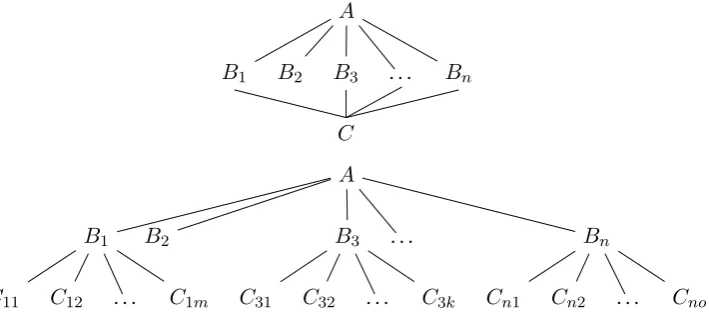
Literature based discovery (LBD) is an automatic technique addressing the ever increasing volume of research literature by inferring as yet unobserved connections. The approach was pioneered by Swan-son (1986) who hypothesised a (hidden) connection betweenRaynaud phenomenonandfish oil, despite the fact that the two were not mentioned together in any publications. Swanson noticed that one pub-lication linked Raynaud phenomenon toblood viscosity and another linkedblood viscosity to fish oil, suggesting the trial of administering fish oil to Raynaud disease patients. LBD can be executed in one of two modes: closed or open discovery. In closed discovery, both A, the source term, and C, the target term, are specified, and only the linking terms (with relationships to both A and C) are sought, while open discovery explores a much larger space with only the source term being specified and all relationships being pursued (see Figure 1).
LBD has a range of applications including identification of potential treatments, drug repurposing and drug side effect prediction. However, in its general form LBD generates a vast number of hidden connections and the usefulness of existing open discovery systems, such asArrowsmith(Swanson and Smalheiser, 1999), Bitola’s (Hristovski et al., 2006), FACTA+ (Tsuruoka et al., 2008) or Literome (Poon et al., 2014), is often limited by heavy restrictions on the input, linking terms and output and/or time required to generate results.
2 Approach
HiDE combines two LBD approaches. To ensure a usable (rather than excessive) quantity of quality hidden knowledge, we combine: (1) the widely usedA-B-C modelintroduced by Swanson (1986) which starts from a term,A, finds all termsBito whichAis related, repeats the process to find all termsCij related to eachBi, and proposes any previously unconnectedA−Cij as hidden knowledge, and (2) a
A B1 B2 B3
C
. . . Bn
A B1
C11 C12 . . . C1m
B2 B3
C31 C32 . . . C3k
. . . Bn
[image:3.595.125.480.65.223.2]Cn1 Cn2 . . . Cno
Figure 1: Closed discovery, bothAandCspecified (top), and open discovery, onlyAspecified (bottom)
novel (to LBD) approach based on work in knowledge base completion which generates new connections by performing random walks through a knowledge base graph.
TheA-B-C modelis a useful approach for LBD but it can generate vast amounts of hidden knowledge potentially leading to the need for restrictions on theB/Cterms and/or slow processing times. Exploiting techniques from graph theory (West, 2007), our LBD system (Preiss et al., 2015) uses the adjacency matrixM describing the graph formed from the connections between terms in a document collection: entrymijis a positive integer if a relationRis detected between termstiandtj. Iftiandtjare not related anywhere in the document collection,mij will be zero. Hidden knowledge in the document collection can then be identified by looking for non zero terms in the matrix generated by norm(M2)−norm(M) where norm convertsmij to 1 ifmij >0and leaves it as 0 otherwise. This generates hidden knowledge connected via a single linking step and allows large amounts of hidden knowledge to be pre-computed.
Thegraph modelis an inference system due to Lao et al (2011) based on the Path Ranking Algorithm, which performs random walks through a knowledge base graph. In our case, the knowledge base is constructed from the manually created triples (such as X may treat Y) listed in the Unified Medical Language System (UMLS) Metathesaurus. The system generates path up to length 2, and uses logistic regression to combine the paths to yield new connections.
Both LBD systems are applied to all PubMed abstracts published up to 30 April 2016: the linguis-tically motivated subject-relation-object triples (such as X-treats-Y or X-affects-Y) are extracted from a SemRep (Rindflesch and Fiszman, 2003) annotated 2016 version of PubMed (available as semmed-VER26 download created using regular SemRep version 1.7 and UMLS 2016AA1) and used for the
A-B-C model. UMLS 2016AA was used to obtain the manually created triples for the graph model. A range of filtering approaches are applied to reduce the volume of hidden knowledge (Preiss, 2014). Individually, theA-B-C modelgenerated a total of 2,947,874,564 pairs of hidden knowledge, while the
graph modelyielded 198,295,133 pairs. The intersection of hidden knowledge pairs, 6,471,922 pairs, is presented within the interface, and the hidden knowledge pairs are ranked by the weights output by the
graph model.
3 Online System
The approach described in Section 2 is implemented as a publicly available tool, HiDE (Hidden Discov-ery Explorer), which allows a user to interactively explore the hidden knowledge generated by an LBD system.
Interaction with HiDE begins with the user specifying a term of interest. HiDE then generates a list of potentially relevant UMLS CUIs from which the user selects one. The hidden knowledge available is grouped by UMLS Medical Subject Headings (MeSH) terms which provides types such asdisease,
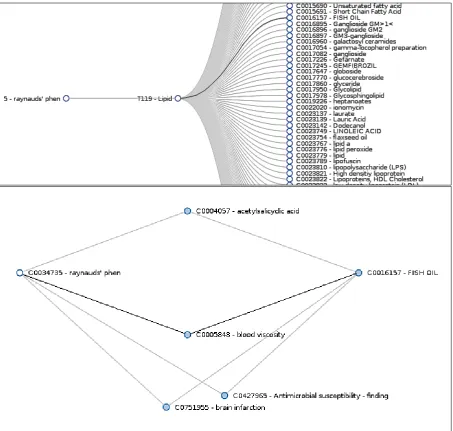
C0034735 – Raynaud Phenomenongenerated from publications between 1960 and 1985 highlighting Swanson’s fish oil connection, bottom the linking terms betweenC0034735 – Raynaud Phenomenon
andC0016157 - fish oilwith the highly citedblood viscositylink highlighted
enzyme andgene. The user selects a MeSH term, which allows them to filter the result set to MeSH terms of relevant to them while also reducing the number of results returned, and the hidden knowledge generated from the original CUI is presented. Users can view hidden knowledge in increments of 100 pairs and linking terms in increments of 50.
3.1 Implementation Details
[image:4.595.74.528.60.491.2]4 Example
Figure 2 presents the output of HiDE when replicating the connection between Raynaud andfish oil
(Swanson, 1986) from 1960-8 Medline publications using the matrix method only (as the inference method would require a UMLS from 1968 which does not exist). The top portion of Figure 2 shows a zoomed in section of the hidden knowledge generated by HiDE by entering the search termraynaud, selecting the CUIC0034735 – Raynaud Phenomenonand then the MeSH termlipid. The figure shows that the link to theCtermfish oilis found by HiDE (this link is highlighted). Selecting this CUI reveals theBterm(s) via which the hidden knowledge was established; the bottom of Figure 2 shows the linking terms betweenRaynaudandfish oil, demonstrating that HiDE finds the frequently cited link viablood viscosity(highlighted).
5 Conclusion
We present HiDE, an LBD tool suitable for exploring hidden knowledge generated by an LBD system including linking terms. Rather than imposing a filtering by design, HiDE does not restrict the hidden knowledge presented to the user while allowing them to quickly drill down to MeSH terms of interest and thus carry out their own ‘filtering’. Using a novel combination of two LBD approaches – a graph-based approach and an inference algorithm – the most promising information is computed off line, thereby enabling fast response times to queries and allowing users to fully explore the information generated.
Acknowledgements
The work described in this paper was funded by the Engineering and Physical Sciences Research Council (EP/J008427/1).
References
Dimitar Hristovski, Carol Friedman, Thomas C. Rindflesch, and Borut Peterlin. 2006. Exploiting semantic rela-tions for literature-based discovery. InProceedings of the 2006 AMIA Annual Symposium, pages 349–353.
Ni Lao, Tom M. Mitchell, and William W. Cohen. 2011. Random walk inference and learning in a large scale knowledge base. InProceedings of the Conference on Empirical Methods in Natural Language Processing, pages 529–539.
US National Library of Medicine. Semantic knowledge representation. https://semrep.nlm.nih.gov/. Accessed: 31-07-2017.
Hoifung Poon, Chris Quirk, Charlie DeZiel, and David Heckerman. 2014. Literome: PubMed-scale genomic knowledge base in the cloud.Bioinformatics, 30(19):2840–2842.
Judita Preiss, Mark Stevenson, and Robert Gaizauskas. 2015. Exploring relation types for literature-based discov-ery. Journal of the American Medical Informatics Association, 22:987–992.
Judita Preiss. 2014. Seeking informativeness in literature based discovery. InProceedings of BioNLP 2014, pages 112–117.
Thomas C. Rindflesch and Marcelo Fiszman. 2003. The interaction of domain knowledge and linguistic structure in natural language processing: interpreting hypernymic propositions in biomedical text. Journal of Biomedical Informatics, 36(6):462–477.
Don R. Swanson and Neil R. Smalheiser. 1999. Link analysis of MEDLINE titles as an aid to scientific discovery: Using Arrowsmith as an aid to scientific discovery.Library Trends, 48:48–59.
Don R. Swanson. 1986. Fish oil, Raynaud’s syndrome, and undiscovered public knowledge. Perspectives in
Biology and Medicine, 30:7–18.
Y. Tsuruoka, J. Tsujii, and S. Ananiadou. 2008. Facta: a text search engine for finding associated biomedical concepts. Bioinformatics, 24(21):2559–2560.