A New Framework for Defining, Identifying and Explicating Tacit
Knowledge: Qualitative Research using Aspectual Analysis on SMEs
ALEX GACHUHI KIMANI
Thesis submitted in partial fulfilment of requirements for a PhD in
1
Table of Contents
Table of Figures ... 7
Abstract ... 10
Chapter 1: Introduction ... 13
1.1 Introduction ... 13
1.2 Background of Research ... 13
1.2.2 Tacit Knowledge & SMEs ... 14
1.3 Research Problems ... 17
1.4 Focus of Research as Intended Solution to Research Problems ... 19
1.5 Rationale & Scope ... 20
1.6 Research Criteria ... 21
1.6.1 Introduction to Dooyeweerd & Aspectual Analysis ... 22
1.6.2 Research Domain (Background of Organisation) ... 23
1.6.3 Research Approach ... 23
1.7 Research Aim & Objectives... 24
1.8 Contribution ... 25
1.9 Thesis Structure ... 26
Chapter 2: Literature Review ... 28
2.1 Introduction ... 28
2.2 The Nature of Knowledge and framing of Tacit Knowledge ... 29
2
2.2.2 Individual vs Shared Tacit Knowledge ... 34
2.3 The Importance of Tacit Knowledge in Organisations ... 35
2.4 Definitions and Understandings of Tacit Knowledge in Literature ... 37
2.4.1 Overview of differing definitions ... 37
2.4.2 Michael Polanyi ... 40
2.4.3 Baumard’s view ... 41
2.4.4 Gascoigne & Thornton ... 41
2.4.5 Collins ... 42
2.4.6 Wilson’s View ... 44
2.4.7 Rebernik & Sirec’s View ... 45
2.4.8 Conclusion ... 47
2.5 Explication of Tacit Knowledge ... 48
2.5.1 Nonaka & Takeuchi’s View... 48
2.5.2 Krogh & Roos’ view ... 50
2.5.3 Repertory Grid Technique ... 51
2.5.4 Conclusion ... 51
2.6 Identifying tacit knowledge (review of tacit knowledge in different fields) ... 52
2.6.1 Practical Intelligence and Tacit knowledge ... 52
2.6.2 Tacit knowledge and Artificial Intelligence ... 53
2.7 Tacit Knowledge Research Context in SMEs ... 55
3
Chapter 3. Theoretical Framework ... 60
3.1 Introduction ... 60
3.2 Background on Dooyeweerd’s Philosophy ... 60
3.2.1 Dooyeweerd’s Critique of Philosophical Thought ... 61
3.2.2 Dooyeweerd’s Exploration of the Ground Motives ... 61
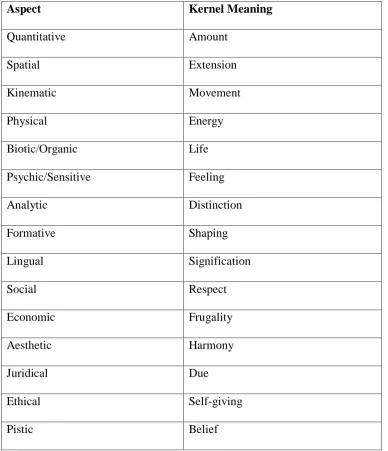
3.3 Introduction to Dooyeweerd’s Aspects ... 63
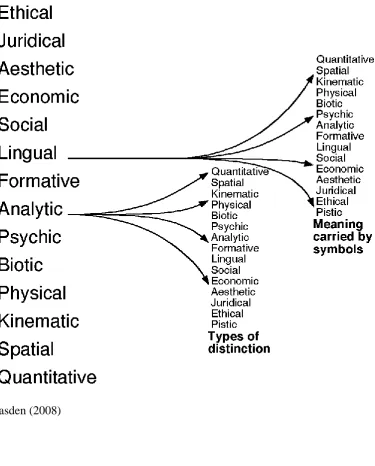
3.3.1 Characteristics of Aspects ... 65
3.4 Theoretical Framework design ... 67
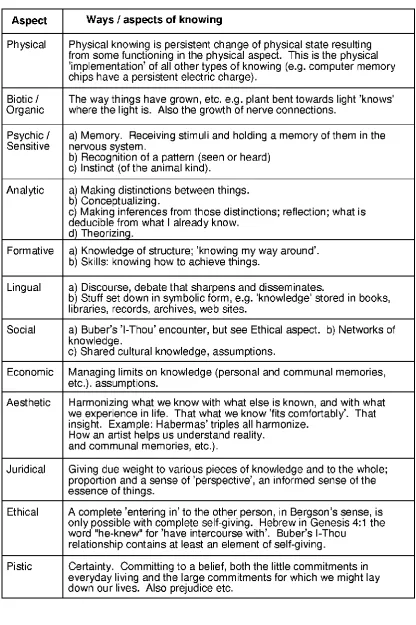
3.4.1 Theory of Knowing ... 67
3.4.2 Types of Tacit Knowledge ... 69
3.4.3 Ability to Explicate Tacit Knowledge ... 79
3.5 Using Dooyeweerd’s Aspects to Understand Tacit Knowledge in Literature ... 80
3.5.1 Michael Polanyi’s view... 80
3.5.2 Nonaka and Takeuchi’s view ... 81
3.5.3 Wilson’s View ... 82
3.5.4 Baumard’s View ... 83
3.5.5 Von Krogh & Roos’ View ... 84
3.5.6 Rebernik & Sirec’s View ... 85
3.5.7 Reinterpreting the definitions with Dooyeweerd ... 86
3.5.8 Explication of Tacit Knowledge by Dooyeweerdian Framework ... 88
4
3.7 Conclusion ... 92
Chapter 4. Research Methodology ... 93
4.1 Introduction ... 93
4.2 Research Paradigm... 93
4.2.1 Postivist Research Philosophy ... 94
4.2.2 Interpretive Research Philosophy ... 97
4.2.3 Critical Research Philosophy ... 104
4.2.4 Dooyeweerd as a Theoretical Research Lens ... 110
4.2.5 Paradigm Chosen ... 112
4.2.6 Justification of Interpretivist & Critical stance ... 114
4.3 Research Design... 120
4.3.1 Justification of Chosen Research Design ... 121
4.4 Research Approach ... 122
4.5 Research Methods ... 123
4.5.1 Case Study ... 123
4.5.2 Research Sample ... 124
4.5.3 Triangulation ... 132
4.5.4 Interviews ... 134
4.6 The Field Work ... 139
4.6.1 Gaining Access ... 139
5
4.6.3 Pilot Study ... 144
4.7 Data Collection ... 149
4.7.1 The Interview Process ... 149
4.7.2 The Questions asked during the interview ... 152
4.8 Research Analysis ... 155
4.8.1 Multi-Aspectual Knowledge Elicitation ... 155
4.8.2 Aspectual Analysis... 157
4.8.3 Presentation of Analysis ... 157
4.8.4 Sampling in analysis ... 158
4.9 Ethical Considerations & Limitations of Study ... 158
4.9.1 Ethical Approval ... 158
4.9.2 Brief summary of the limitations of the research: ... 161
CHAPTER 5: Analysis ... 162
5.1 Evolution of the analysis: preliminary analysis ... 162
5.1.1 Profile of Interviews and Organisation Context of Preliminary Analysis & Aspectual Analysis... 162
5.1.2 Preliminary Analysis of Interviews ... 165
5.1.2.1 Interview 1 ... 165
5.1.2.2 Interview 2 ... 168
5.1.2.3 Interview 3 ... 170
5.1.2.4 Interview 4 ... 171
6
5.2 Aspectual Analysis of Interviews ... 174
5.3 2nd Stage of Analysis: Aspectual Analysis Sorting ... 228
5.3 Making the Statement (Making the utterance) ... 246
5.4 Conclusion ... 249
Chapter 6: Discussion & Findings ... 250
6.1 Introduction ... 250
6.2 Summary of What Dooyeweerd Understanding is Expected to Do ... 250
6.2.1 Make Sense of The Debates ... 251
6.3 Empirical Support that Dooyeweerd can make sense of the debates... 265
6.4 Utterance and Tacit knowledge ... 269
6.5 Using Dooyeweerd to Analyse Tacit Knowledge ... 270
6.6 Summary of Final Framework for Identifying and Explicating Tacit Knowledge in SMEs ... 270
6.6 Conclusion ... 273
Chapter 7: Contributions & Conclusions ... 274
7.1 Overview of the Research ... 274
7.2 Whether the targets of the thesis have been met ... 276
7.2.1 To What Extent Have the Aims and Objectives Been Achieved... 276
7.2.2 Answer to the Main Research Question... 278
7.3 Discussion on the Validity and Quality of the Research ... 279
7.4 Contributions... 293
7
7.4.2 Contribution to the Practical Research of Tacit Knowledge ... 295
7.4.3 Contribution to the Practice of Explicating Tacit Knowledge ... 295
7.4.4 Contribution to Methodology in the Testing of Inter-Aspect “Reaching Out” .... 296
7.5 Further Research ... 297
7.5.1 Multiple Data Collection Methods... 297
7.5.2 Overcoming limitations of the current Research ... 298
7.5.3 Tacit & Explicit Lenses ... 298
7.6 Conclusion ... 299
Bibliography ... 300
Table of Figures
Figure 1: Aspects of knowing and their Kernel Meanings (Basden, 2008) ... 63Figure 2: Aspects showing Inter-aspect Reaching Out ... 66
Figure 3: Aspects of Knowing (Basden, 2008) ... 70
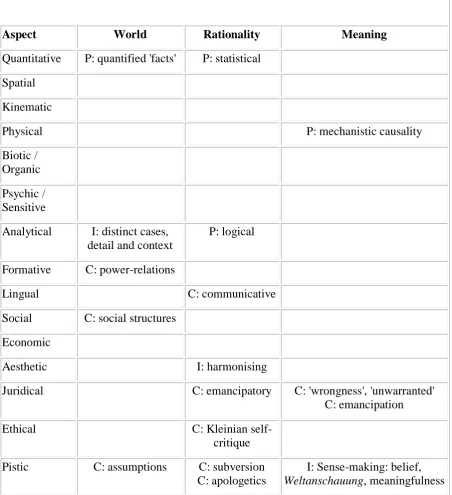
Figure 4 Ground Ideas of Three Approaches to IS Research (Basden, 2011) ... 117
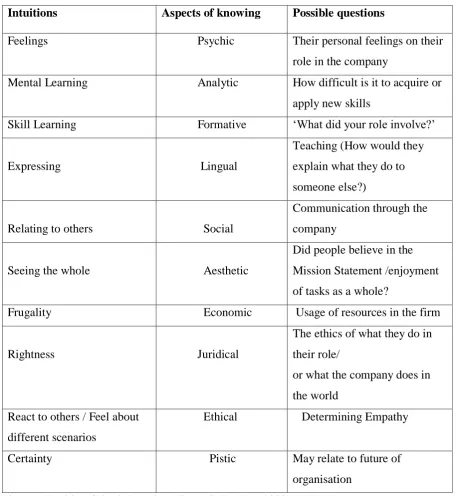
Figure 5 Intuition Criteria based on Figure 3 (Basden, 2008) ... 146
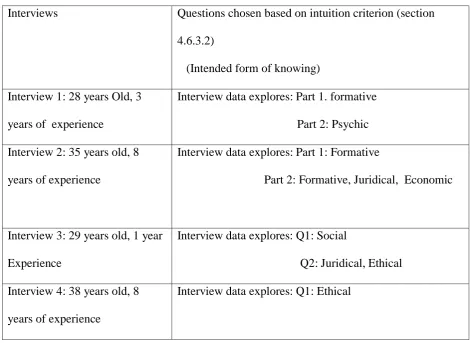
Figure 6: Types of Tacit Knowing Explored in Interviews ... 147
Figure 7: Profile of Interviews Used in Research ... 151
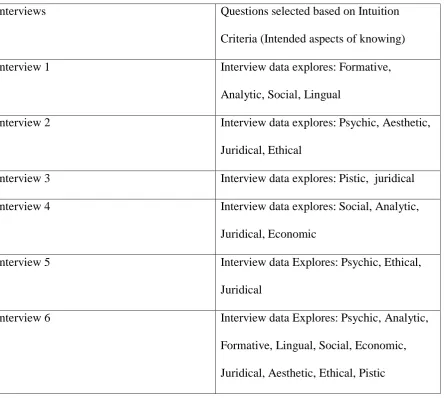
Figure 8: Preliminary Analysis Interviews ... 163
Figure 9: Main Analysis Interview Profile ... 164
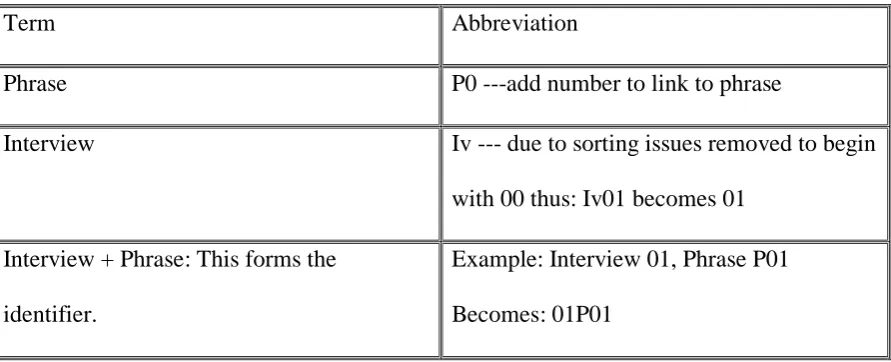
Figure 10: Abbreviations used in Analysis Data Sorting... 229
8
Figure 12: Bar Chart of Spoken Motivations ... 231
Figure 13: Unspoken Motivations Data ... 233
Figure 14: Barchart of Unspoken Motivations ... 234
Figure 15: "Can it Be Explicated" Data ... 236
Figure 16: Bar Chart of "Can it Be Explicated"... 238
Figure 17: Tacit Knowledge About the Statement Data ... 240
Figure 18: Bar Chart of Tacit Knowledge About the Statement ... 241
Figure 19: Tacit Knowledge behind the Statement Content Data ... 243
Figure 20: Bar Chart of Tacit Knowledge behind the Statement Content ... 245
Figure 21: Flow Of Utterance/Statement ... 248
Figure 22: Nonaka & Takeuchi Model in Dooyeweerdian Terms ... 257
Figure 23: Rudimentary illustration of Individual & Collective Tacit Knowing ... 259
Figure 24: Solution for Individual & Collective Forms of Tacit Knowing ... 260
Figure 25: Evidence of Multiple forms of knowing in Analysis ... 265
9
Acknowledgement
First of all I would like to thank my supervisors Dr Suzanne Kane and Prof Andrew Basden
for their invaluable support during the course of the doctorate process. Their understanding
and insight allowed me to expand my mind in ways I will never be able to repay.
To Suzanne Kane whose dedication and understanding allowed this dissertation to take place
even when the toughest obstacles were met. I will be forever grateful for the guidance you
gave me.
To Andrew Basden whose philosophical discussions and observations on life I will forever
treasure. Thank you for inspiring me to explore complex philosophical constructs and for
guiding me through every step of this process. Your invaluable advice on life will never be
forgotten. I’m so thankful for your commitment.
To my mother and sisters for their unwavering support and encouragement through this
process and in life and to my mother especially for being my inspiration and guiding light.
Finally, to all my friends with whom I’ve had discussions on the notion of tacit knowledge,
10
Abstract
Area of Concern: There is a growing awareness that tacit knowledge accounts for a
substantial portion of vital knowledge in both individuals and organisations. The advent of
knowledge and organisational management frameworks has brought about a realisation that
the difficulty of managing tacit knowledge is primarily due to a wide variety of conflicting
definitions in both philosophy and scientific theories (Gourlay, 2004). These conflicts in
literature are yet to be resolved by current frameworks, particularly those that examine the
models of tacit knowledge flow in organisations. This indicates that a gap exists for creating a
new foundation for identifying tacit knowledge. For this to be achieved, empirical data has
been collated in the form of perceptions of personnel at two SME organisations in
Manchester. The research has obtained these perceptions through semi-structured qualitative
interviews. These interviews form the necessary data for analysis that has been carried out
using the method of aspectual analysis. Aspectual analysis derives from the principles of
Herman Dooyeweerd’s theory of modal aspects, and has been the primary form of analysis of
the data collected. By utilising these modal aspects, and applying Dooyeweerd’s theory of
knowing to the concept of tacit knowing; this research aims to identify different forms of tacit
knowledge and their varying degrees of explication. This research may in turn be used to
unite the views of tacit knowledge in literature, and propel the current discourse into a more
constructive narrative that the researcher hopes will aid greater understanding of the
importance of tacit knowledge. It may also be used as a base for the extension of literature in
areas where knowledge is paramount such as organisational learning and the creation of
11
This issues discussed thus lead to the researcher asking the question:
“How can Dooyeweerd’s philosophy be used to analyse the tacit knowledge held by a variety
of people of at an SME thus revealing the different types of tacit knowledge and discerning
which types can be explicated?”
In answering this main research question, the research has achieved three main contributions
that can be described as: Theoretical, Practical, and Methodological.
Theoretical Contribution: The research performed a review of both philosophical and
practical literature on tacit knowledge showing that there is no agreed foundation for
defining, identifying or explicating tacit knowledge. In terms of philosophical review of the
nature of tacit knowledge, authors such as Yu (2004)’s Wittgenstein examination of Polanyi’s
tacit knowing encompasses detailed review of philosophical underpinnings of tacit knowing,
but ultimately limited scope of the types of tacit knowing and exploration of their differing
levels of explication. This research expands this thinking and shows how these different areas
can be articulated. In the case of practical literature, authors such as Gourlay (2002;2004)
show how different empirical researchers define tacit knowledge differently, yet do not go
further into stating that this are different types of tacit knowledge being discussed. The
conflict is illuminated, but the theoretical frameworks for accounting for differences in tacit
knowledge views tends to exclude rather than include important observations. This research
shows how different views of tacit knowledge can be unified within a singular framework as
guided by Dooyeweerd’s modal aspects.
Practical Contribution: As Gourlay (2004) notes, different empirical studies have taken
multiple interpretations of tacit knowledge in their research, thus resulting in ambiguity on
the nature of tacit knowledge in research. Gourlay review shows that two of the main
12
is individually or collectively held and whether it can be made explicit. In addressing the first
problematic of individually or collectively held tacit knowing, the research in this thesis
shows how different types of tacit knowledge are held in a spectrum with some individually
held, and others collectively held and also some with both a collective and individual
component of knowing. In the second problematic of explication, the research creates a
framework that shows how some forms of tacit knowledge can be explicated to varying
degrees within the spectrum of different types of tacit knowing while utilising aspectual
analysis and the property of inter-aspect reaching out.
Methodological Contribution: The research expands on utilising Dooyeweerd’s philosophy
to illuminate scientific fields in this case applying the theory of modal aspects in conjunction
with the property of inter-aspect reaching out within the modal spheres to reveal the forms of
tacit knowledge that exists behind “the making of a statement”, and the tacit knowledge that
exists “behind the content of the statement” within an interview setting. This is an expansion
of aspectual analysis that is described by authors such as Winfield (2001) & Basden (2008).
Key Words: Tacit Knowledge, SME, Explication, Herman Dooyeweerd, Qualitative
Research, Interpretive & Socio-Critical Research, Aspectual Analysis, Knowledge
13
Chapter 1: Introduction
1.1 Introduction
This chapter provides an overview of the thesis covering the reasons behind conducting the
research into tacit knowledge held in organisations. It gives a background on how the nature
of tacit knowledge in literature has evolved as the world has moved towards a knowledge
based society. Additionally, it introduces different types of tacit knowledge as described in
literature and gives reasoning behind why we need to identify the different types of tacit
knowledge. Moving on from this, it summarises the issue of explication controversy of tacit
knowledge and outlines the rationale and scope of the research. Finally it declares the main
research aim of the thesis and the objectives that need to be completed in order to achieve this
aim.
1.2 Background of Research
According to Virtanen (2011), in the early period of the 1990’s, knowledge became the most
important resource of production and economy of organisations. Toffler (1990) as cited by
Nonaka et al. (2000), claimed that “we now live in a knowledge-based society where
knowledge is the source of highest quality power.” Stewart (2001) deduced that this meant
placing knowledge assets at a position of higher importance to an organisation than physical
or financial assets meant that new management techniques, technologies and strategies would
be needed. Nonaka & Takeuchi (1995) further emphasised the advent of this
knowledge-centric age when they concluded that learning and creation of new knowledge was of prime
importance for an organisation. The shift from an industrial society to a knowledge based
society elevated knowledge management to be one of the most influential organisational
14
Contemporary knowledge management asserts that there are two kinds of knowledge: tacit
knowledge and explicit knowledge (Nonaka & Takeuchi, 1995). This is adopted from
Polanyi (1958) dissection of personal knowledge where he coins the phrase ‘tacit’ knowledge
to account for knowledge that is difficult to articulate as opposed to explicit knowledge which
is knowledge that can be readily articulated in formal language and transmitted across
individuals easily.” For Polanyi (1958), tacit knowing is the dominant principle of all
knowledge. Polanyi (1966) summarises the notion of tacit knowing with the famous phrase,
“we know more than we can tell.”
With the need for knowledge to be strategically managed by firms, a realisation that tacit
knowledge makes up a large proportion of this knowledge has led to greater interest in the
research into its constitution. Nonaka & Takeuchi’s (1995) theory of organisational
knowledge creation is considered one of the main proponents that has made the idea of tacit
knowledge in organisations popular concept. A key challenge for organisations arises from
whether it is possible to manage tacit knowledge and ultimately harness it into explicit
knowledge (Irick, 2007).
The rapid changes in the economic environment have brought the issue of organisational
knowledge as the only sustainable source of competitive advantage (Horvath, 2000). In
effect, tacit knowledge forms the basis of organisational knowledge. Thus, tacit knowledge is
viewed as a key lever to achieving innovation success within a firm (Seidler-de Alwis &
Hartmann, 2008).
1.2.2 Tacit Knowledge & SMEs
According to a business statistics report by Rhodes (2016) presented to the House of
Commons in the UK, there were 5.5 million businesses in the UK in November 2016. Of
15
people. SMEs are a vital part of any national economy. According to the Organisation for
Economic Cooperation and Development, SMEs are responsible for employing 60-70 percent
of a nation’s workforce (OECD, 2002).
In establishing the importance of SMEs, then it is essential to focus on what or how to make
them succeed. As Ngah & Jusoff (2009) describe, researchers and practitioners alike advocate
knowledge sharing as one of the primary resources of the knowledge economy. Knowledge
sharing leads to knowledge accumulation, dissemination and acquisition. Within this
knowledge based economy, knowledge is widely considered as the most important
organisational resource and therefore critical for the long term sustainability of competitive
advantage and success of any organisation (Alavi & Leidner, 2001; Davenport et. al 1998;
Nonaka & Takeuchi 1995). If knowledge is the most crucial resource, then its nature must be
explored; and within organisational and knowledge management literature, the debate ranges
on the dichotomy of knowledge in its tacit and explicit dimensions. Recent developments on
the notion of knowledge sharing have ventured into the tacit element of knowledge, such as
Pathirage et. al (2007), but have not been fully explored. Nonaka & Takeuchi (1995) as cited
by Ngah & Jusoff (2009), argue that tacit knowledge is the one that creates competitive
advantage for organisations.
Cohen & Kaimnekais (2007) assert that the nature of knowledge in SMEs is almost
completely tacit in nature. The influential research of Nonaka & Takeuchi (1995) proclaim
that the flow from tacit to explicit knowledge is essential for the success of an organisation,
but Wong & Radcliffe (2000) differ in stating that this transition is incredibly difficult within
SMEs, and thus advices that sharing this tacit knowledge is the preferred way to aid SMEs in
improving performance; particularly when tacit knowledge sharing would take place during
socialisation and other informal ways where SMEs have efficient and informal
16
there is merit in proclaiming that sharing of tacit knowledge can somehow overcome the
process of making tacit knowledge explicit, the researcher will show that the process of
sharing tacit knowledge itself is dependent on making tacit knowledge explicit sometimes
inadvertently.
Tacit knowledge is often identified as a key intangible resource (Jacobson, 1990) and also a
primary strategic attribute of certain human resources (Coff, 1999). However, as with many
intangible resources the question arises as to whether tacit knowledge may be a source of
sustained competitive advantage. Additionally, some authors characterise tacit knowledge as
hidden or unstructured knowledge acquired over a period of time through experience,
reflection and intuition showing the difficulty of extracting it compared to explicit knowledge
(Davenport & Prusak, 2000; Nonaka & Takeuchi (1995). Others view tacit knowledge as a
process (Alavi & Leidner, 2001; Chong et. al, 2011) and place emphasis on ways to nurture,
share and sustain knowledge through open and informal learning approaches such as
communities of practice (CoPs) and other forms of social interaction techniques.
However, this is not effective for SMEs. Beijerse (2000) asserts that SMEs often lack
absorptive capacity because they have no formal strategy for developing, disseminating,
sharing or applying knowledge. SMEs often struggle to participate in open innovation
because of knowledge transfer issues that are brought about by organisational and cultural
differences (Vrande et. al, 2009).
Ultimately, these challenges present an opportunity for the researcher to explore whether a
new framework can be able to account for different forms of tacit knowledge within an SME,
and more importantly facilitating knowledge sharing through the explication of tacit
17
1.3 Research Problems
In the arena of knowledge and organisational management, tacit knowledge has been
relegated to the background in spite of its strategic importance; primarily due to technology
being limited to the transfer of explicit knowledge (Johannessen, et al., 2001). A greater
emphasis in this arena has been placed on the explicable nature of tacit knowledge in relation
to explicit knowledge which has in turn led to a static argument on how to actually measure
tacit knowledge. Thus three major issues that have arisen in attempting to understand tacit
knowledge:
i.) How do you identify tacit knowledge?
ii.) A wide variety of conflicting definitions of tacit knowledge.
iii.) Whether it is possible to explicate tacit knowledge.
Identifying Tacit Knowledge: Due to the conflicting nature of definitions in literature, most
of the empirical work that has been conducted into tacit knowledge faces criticism since it
may only cover one form of tacit knowledge identification without catering to tacit
knowledge as defined by other authors (Gourlay, 2004). Thus, one of the main factors of
conducting the research in this thesis is to account for different types of tacit knowledge.
Variety in Definitions: Most of the literature focuses on the notion of whether tacit
knowledge resides solely in an individual, in a social environment or resides in both. Howell
(1996) emphasises that knowledge is non-codified and resides solely in an individual’s
performance of skill; while Hutchins (1995) indicates that knowledge resides not only in an
individual, but also in the social workgroup to which they belong. The research aims to
account for these definitions of tacit knowledge and resolve the conflict.
Ability to Explicate Tacit Knowledge: Conflicts have also arisen on the subject of
18
articulated at all; with some arguing that it is impossible to explicate tacit knowledge. Polanyi
(1966) argues that tacit knowledge cannot be explicated while Nonaka & Takeuchi (1995),
who use Polanyi as their philosophical foundation, define different types of tacit knowledge
to account for its explication. This thesis aims to show what types of tacit knowledge can be
explicated and identify the ones that are impossible to articulate.
In addition to these three main problems, we have to assess the research viability in an SME
context:
SME Context: The ability to differentiate between different types of tacit knowledge and
explicate them within an SME presents a difficult challenge due to their inherent nature. Tacit
knowledge research in the context of organisational learning (“defined as creating, retaining
and transferring knowledge within an organisation” Argote(1999) ) is dependent on trust and
shared norms of openness and reciprocity to facilitate progress (Dyer & Singh, 1998).
However, trust presents particular difficulties for SMEs who fear opportunistic behaviour
from competitors and thus this lack of trust manifests itself in fear at both a personal and
organisational level, and is a strong inhibiting factor for knowledge sharing in SME
networks. As Pattinson et. al, (2011) states, “Individuals fear losing their expert status
whereas organisations fear disclosure of their competitive advantage.” This distrust needs to
19
1.4 Focus of Research as Intended Solution to Research Problems
The advent of knowledge and organisational management frameworks has brought about a
realisation that the difficulty of managing tacit knowledge arises from a wide variety of
conflicting definitions in both philosophy and scientific theories. These conflicts in literature
are yet to be solved by current frameworks, particularly those that examine the models of
tacit knowledge flow in organisations. Thus, there exists a gap for creating a new foundation
for identifying tacit knowledge and ultimately ascertaining its definition in literature.
In order for this framework to exist beyond a priori state, this research will examine a
workforce’s perceptions at different organisational levels of an SME based in Manchester.
Thus, an analysis of these perceptions and how they affect tacit knowledge management at
the organisation will be carried out. By mapping these different types of tacit knowledge the
research aims to further the understanding of definitions in literature and also contribute to
the methods of identifying tacit knowledge.
This mapping will be performed by utilising the philosophical notions of Herman
Dooyeweerd (1894-1977), particularly the modal aspects, as a guide to analysing different
20
1.5 Rationale & Scope
The vast sea of philosophy which attempts to disentangle the roots of knowledge is too broad
a scope for any singular dissertation. The study of a form of knowledge however, requires
that we explore the underlying structure which leads to its definition. The research examines
the roots of how tacit knowledge can be encompassed in knowledge research, but veers away
from the defining knowledge itself. However, Dooyweerd’s philosophy provides a platform
from which the relationship between knowing, knower and knowledge can be illuminated.
The dichotomy of presenting knowledge as tacit and explicit is explored, and the research
shows how most of our knowing is tacit in nature, and suggests that explicit knowledge
comprises a small part of our knowledge. Tacit knowledge as claimed by many authors such
as Nonaka & Takeuchi (1995) is what allows organisations to sustain a competitive
advantage; and thus is ultimately more important than explicit knowledge.
In the practical sense, the research covers knowledge creation and shows how the adaptive
nature of an organisation must be inclusive of the notion of tacit knowledge, and how current
knowledge transfer theories do not account for most elements of tacit knowing. Basden
(2008) states “The challenge is always to make tacit knowledge explicit, but without
destroying its life-world characteristic.” Examining the different types of tacit knowledge
makes it plausible to map a way for retaining this tacit knowledge for the organisation. This
retention of tacit knowledge thus links together with the notion of organisational learning. It
is important to note that tacit knowledge stems from individual learning, however, this does
not necessarily lead to organisational learning. (Ikehara, 1999). It falls upon the organisation to
integrate individual learning to the organisational learning. The ability to identify the
21
organisation with the ability to harness and retain tacit knowledge accumulated by its
employees.
Through the analysis performed on the current literature it is clear that the different
definitions of tacit knowledge cannot be integrated. Therefore, the underlying conflict created
through literature cannot be resolved. Some authors such as Gourlay (2004) have analysed
the different definitions, but have not extended their research to account for the integration of
these concepts. Nonaka and Krogh (2009) identified the controversy in tacit knowledge
conversion and defended the distinction that needs to be made between tacit and explicit
knowledge. However, they did not account for the ambiguity around tacit knowledge in
current literature. In addition, others have performed extensive analysis on the variety of
views on tacit knowledge such as Hedesstrom & Whitley (2000) and concluded the tacit
knowledge in certain fields, for example knowledge management, is completely different to
Polanyi’s tacit knowledge. In view of this underlying conflict present in literature, this
dissertation adds the necessary extensions that will aid authors to explore tacit knowledge
more effectively.
1.6 Research Criteria
From its definition, tacit knowledge is knowledge that cannot be explicated. However, by
devising an intuition criterion we can be able to discern different types of tacit knowing by
delving into explicable areas such as skills, communication and experience. Thus, the
research will involve the conducting of qualitative interviews with personnel at different
levels of the organisation to gauge their perceptions on differing notions of explicable
knowledge. The researcher hopes to strike a balance in terms of diverse perceptions by
22
array of data yields better results at the analysis stage. Once the interviews are gathered the
research will use aspectual analysis (governed by Dooyeweerd’s modal aspect) in the hope
that a new way of identifying tacit knowledge will have been achieved.
1.6.1 Introduction to Dooyeweerd & Aspectual Analysis
To introduce the notion of aspectual analysis, we can first ask the question:
“Why is Dooyeweerd suitable to fulfilling the aim of analysing the perceptions of a
workforce in order to identify tacit knowledge?”
A brief introduction of Dooyeweerd is thus necessary. Herman Dooyeweerd was a Dutch
philosopher who believed that theoretical thought was inadequate to understanding the
complexity of the world as it presents itself to us in our everyday experience. Basden (2008)
He believed that theoretical attitude towards thinking about the world has always been given
greater account over ‘everyday experience’ as a guide to thinking about the world. The main
mistake of philosophy, he believed, was the overriding assumption that theoretical thought
was autonomous; meaning that it could be used as a base foundation for everything else and
is thus seen as the only way to achieve ‘true knowledge’.
From this philosophical thinking, Dooyeweerd suggested that the diversity of everyday
experience is brought about by the diversity of meaning; and thus observed that there are
fifteen spheres of meaning through which we function. This will be explained further in
Chapter 3 while detailing the theoretical framework. Aspectual analysis involves examining
the world through these spheres of meaning, which we call Aspects. From these aspects we
can discern different forms of tacit knowledge, all encompassed under one framework, but
23
In this thesis, the researcher aims to utilise Dooyeweerd’s original views supported by
Professor Andrew Basden’s interpretation of Dooyewerd specifically on interpretation of
Modal spheres into aspects, and also the illumination of Dooyeweerd’s theory of knowing.
This is an important distinction to make due to the limited amount of research in utilising
Dooyeweerd’s philosophy.
1.6.2 Research Domain (Background of Organisation)
The field work was conducted at Axion Recycling Ltd and BettaVeg, two SMEs based in
Manchester. Axion Recycling Ltd is a plastic fabrication company and BettaVeg, is a fruit
and vegetable wholesale supplier. Axion Recycling Ltd are resource recovery experts based
in Salford and Manchester where they house one of the most advanced plastics recycling
facilities in Europe. The team is comprised of experienced chemical engineers, polymer
specialists, field consultants, researchers and analysts providing a wide array of prospective
actors for the research. BettaVeg is a much smaller company employing under 30 employees.
The comprise of a sales and marketing team, management staff, drivers and administration
staff responsible for day to day running of the company. The diversity in professions
provided a rich array of interview data for optimal aspectual analysis.
1.6.3 Research Approach
The research will utilise a qualitative approach due to the depth of understanding and
flexibility it allows the researcher when collecting the perceptions of a workforce in interview
settings. Denzin & Lincoln (1994) consider qualitative research to be a realistic approach
which allows the researcher to address the research questions relating to how experiences in a
particular field may be made visible thus creating social construct. Schultz (1993) supports
this notion of utilising qualitative research to gain insight by stating that “qualitative research
employs meanings in use by societal members to explain how they directly experience
24
1.7 Research Aim & Objectives
As stated in chapters 1.3 & 1.4, the aims and objectives derived from the focus, scope and
rationale of research can be summarised as:
i.) Resolve conflict on the nature of tacit knowledge in literature
ii.) Create a framework for identifying different types of tacit knowledge
iii.) Show how different forms of tacit knowledge can be explicated
The research hopes to achieve these aims by carrying out the following objectives:
i.) Background analysis of tacit knowledge definitions, views and philosophical
foundations thus identifying conflict in literature
ii.) Collection of empirical data through qualitative interviews
iii.) Using Dooyeweerd’s modal aspects as the base for the aspectual analysis to be
carried out on the interview data
These aims and objectives are designed to fulfil and expound the original research question:
How can Dooyeweerd’s philosophy be used to analyse the tacit knowledge held by a
variety of people at an SME, thus revealing the different types of tacit knowledge and
25
1.8 Contribution
The framework created will act as a base for resolving conflict in literature. Thus at a
rudimentary level, the research contributions to knowledge can be summarised as:
Theoretical Contribution:
i.) Identifying different types of tacit knowledge and showing how they account for
different ideas of tacit knowing in both philosophical and practical literature
Practical Contribution:
i.) Showing how the new framework can account for individually held and
collectively held forms of tacit knowledge as well as those that have both
elements.
ii.) Showing how different forms of tacit knowledge can be explicated
Methodological Contribution:
Showing how within aspectual analysis, how the property of inter-aspectual reaching
out can be utilised to illuminate tacit knowledge, and ultimately different fields of
26
1.9 Thesis Structure
This thesis is divided into seven sections:
Chapter 1 is an overview of the research into tacit knowledge. It gives a brief introduction
into the nature of tacit knowledge and the inception of the idea. It gives reasons why tacit
knowledge is an important element when analysing knowledge creation. The chapter raises
the issues present in current literature and also identifies the areas of literature that the
research will encompass, giving the aims and objectives as well as the rationale and
contributions of the research. Finally, this chapter gives a brief introduction to the research
strategy and a brief reasoning behind aspectual analysis.
Chapter 2 is the literature review. In this section the different definitions of tacit knowledge
in literature are discussed. Additionally, the views on tacit knowledge by protagonists in
different fields ranging from business to information systems are critically analysed. Authors
presenting views on both the advantages and disadvantages of tacit knowledge are examined;
with supporting authors opposing or agreeing with those views are identified. This chapter
also introduces the reader to the notion of Dooyeweerd, introducing authors who give reasons
as to why his philosophy would be able to encompass the differing notions of tacit
knowledge. Finally, this chapter also presents the differing views of tacit knowledge relative
to Dooyeweerd’s theory of knowing.
Chapter 3 is a discussion of the theoretical framework that will govern the research process.
Derivations made from Dooyeweerd’s theory of knowing relative to the current literature on
tacit knowledge are explored. This shows the importance of Dooyeweerdian thinking when
super imposed on the analysis of the contextual and conceptual notions of tacit knowledge.
Chapter 4 covers the research methodology. It gives an overall literature review on the
27
theoretical framework will be tested and gives a justification on the methods that were
utilised. It also discusses why the normal research patterns could not have provided the
desired results. Finally, it discusses the ethical elements that the research faces.
The fifth chapter presents the analysis and findings of the research and a conclusion to the
research. It examines the interview data collected and uses aspectual analysis to draw
findings from the data. It also presents a discussion of the results gathered and whether the
desired outcomes have been achieved. In addition, this chapter summarises the contributions
made by the research in relation to the findings. This chapter shows whether the aims of the
research were achieved relative to the initial research question and the implications it may
have on future research performed on tacit knowledge.
The sixth chapter presents the findings of the research and a discussion of the implications
relative to the problems the thesis is attempting to resolve. It shows the disparities between
the theoretical framework and what the data analysis of the empirical study are; and whether
the researcher needs to alter the framework. Within the limitations of the forms of tacit
knowing studied, it shows how the problems in literature can be addressed from the data
gathered and the possible extensions for higher quality of findings.
The seventh chapter of the research presents the contributions and conclusions of the
research. It shows how the research objectives were met and how the researcher answered the
main research questions of the dissertation. This section extensively covers the limitations of
the research and argues the stance of the validity and quality of the research. This section also
covers a number of future research suggestions, showing how new and exciting paths for that
research into tacit knowledge could unfold. It finally concludes the chapter by asserting
whether a new framework for defining, identifying and explicating tacit knowledge has been
28
Chapter 2: Literature Review
2.1 Introduction
As Chapter 1 describes, the purpose of this study is to ensure better clarity of tacit knowledge
definitions, understanding and its potential for explicability. This second chapter will
examine the relevant existing bodies of literature on tacit knowledge and analyse the
discourse in greater detail.
This chapter begins by examining the definitions of tacit knowledge as applied in empirical
studies. The definitions stem from how those studies approach tacit knowledge in the context
research. Gourlay (2004) advises that by exploring how tacit knowledge is viewed in
empirical studies, it may help design a framework towards a better definition. It goes further
to explain that at this early stage of the literature review, there should not be a leap towards
assigning ‘types’ of tacit knowledge. This chapter then moves to describe the understanding
of tacit knowledge in both philosophical and practical application literature. The foundations
for establishing a notion of knowledge that is implicit lies heavily in philosophy and this must
be explored to see how the tacit knowledge in practical studies have been established in
different ways. A discussion of both the philosophical foundations and practical or empirical
interpretations of tacit knowledge is also examined.
Once a conclusion has been reached for this section of the literature review, the research
examines how the identification of tacit knowledge has also been explored in both
philosophical and empirical/practical studies of knowledge that is implicit. A similar
undertaking in thoroughly examining the discourse in both areas of literature is performed
and a conclusion reached.
This chapter then moves on to explore the explicability of tacit knowledge and examines both
29
and a conclusion suggested. This chapter then examines organisational tacit knowledge
explored in a different way as described in the previous parts of the chapter. This then leads
to the research also examining areas of tacit knowing not greatly covered and interesting
ideas of tacit knowledge that may aid in greater clarity of tacit knowledge. This chapter then
examines the possibility for a need of a new foundation of tacit knowledge. This section of
the chapter re-examines the different sections of the literature review and how the
inter-dependency and conflict in literature seem to hinder the progress in mapping a clear
understanding and definitively positive discourse in the concept of tacit knowledge. This
section thus concludes the chapter charting a course towards creating a theoretical framework
capable of providing a new foundation for understanding tacit knowledge.
2.2 The Nature of Knowledge and framing of Tacit Knowledge
The vast sea of philosophy which attempts to disentangle the roots of knowledge is too broad
a scope for any singular dissertation. The study of a form of knowledge however, requires
that we explore the underlying structure which leads to its definition. Thus, this section gives
a brief overview of the perception of knowledge and in turn tacit knowledge in the wider
research fields.
To answer the Socratic question, “What is it to have knowledge?” or “What is knowledge?”
much of Western philosophy has followed Plato’s offering that, “ knowledge is justified true
belief.”. This is widely considered as the basis component for the definition of knowledge
(Nonaka & Takeuchi, 1995). However, Gettier (1963) provided a platform that showed that
Justified True Belief as offered by Plato did not take into consideration the possibility of a
person being justified to believe a proposition that was false in nature. While avoiding the
30
epistemological discussions is relevant. Knowing something requires that the thing being
known be believed. Thus, in this instance, belief is the basic component of knowledge to
which the truth and the justification conditions are set (Scheffler, 1965). Graham (1998) goes
further and asserts that to believe something requires one to mentally represent it as true.
Thus, belief is a mental state in which a subject holds a proposition to be true (Virtanen,
2010). Vehkavaara (2000) concludes that to represent something mentally as true, “naturally
includes an idea that the knowing subject is conscious of that belief.”
Virtanen (2010) citing Steup (2008) proclaims that the content of the belief must correspond
the prevailing state of things in reality so that it can be regarded as knowledge and thus it
becomes ostensibly clear that a false proposition cannot be known. However, the truth of a
thing does not make the belief in “justified true belief”, accordingly knowledge as per
definition (Pollock & Cruz, 1999). Vehkavaara (2000) asserts that “the condition of
justification presupposes that knowledge can be expressed in a form of propositional
sentence(s), because an essential idea behind the condition of justification is that the
verification of knowledge should be repeatable, or at least examinable by anyone.”
In light of this argument, another definition of knowledge has been considered by Davenport
and Prusak (2000), that knowledge: “is a fluid mix of framed experience, values, contextual
information and expert insight that provides a framework for evaluating and incorporating
new experiences and information.” The scope of in depth analysis of various epistemological
perspectives of knowledge is outside the limits set for this dissertation, but as Alavi &
Leidner (2001) summarises, knowledge has been regarded as an object that can be stored,
transferred and manipulated; a process that can be applied in practice; a state of mind or the
factor of knowing and understanding; an ability to “access information”; a capability to find
31
As Plato’s definition is the wider accepted notion, then it is important to show the thread that
leads from defining knowledge to determining tacit knowledge.
Following on from Plato’s definition of knowledge, Yu (2006) citing Grimen (1991) shows
how Plato’s philosophy accounted for tacit knowledge without proclaiming it as knowledge.
This can be extrapolated from Plato’s dialogue Laches, the theme of which is courage. In this
dialogue, Socrates claims that “And that which we know we must surely be able to tell”
Laches, who is a distinguished general says: “I fancy that I do not know the nature of courage
but, somehow or other, she has slipped away from me and I cannot get hold of her and tell
her nature.” According to Socrates’ standard now that Laches cannot tell the nature of
courage he does not know what it is. Grimen (1991) thus suggests that the idea of tacit
knowledge traces its roots back to Greek philosophy, but that the philosophy did not consider
it to be knowledge. The idea that what counts as knowledge must be capable of being
articulated and what cannot be told is not knowledge was further enhanced in modern time.
Johannessen (1990) as cited by Yu (2006) elaborates that from Galileo’s famous saying, “The
book of Nature is written in mathematical language,” to Leibniz’s dream of a universal
language, i.e. his characteristic universalis, to logical postivists’ view of knowledge,
propositionally oriented understanding became more prominent and influential. Johannessen
further claims that within the framework of logical positivism, knowledge and language are
woven together in an indissoluble bond. Thus, the prerequisite that knowledge should have a
linguistic articulation becomes an unconditional demand. As Johannessen (1991 puts it, the
possibility of possessing knowledge that cannot be wholly articulated by linguistic means
emerges, against this background, as completely unintelligible. However, this doctrine of
logical positivism has since been called into question. It has been recognised in various
philosophical arguments that propositional knowledge, which is knowledge that is
32
language that is scientifically relevant. Johannessen (1991) thus observes that this scenario
presented researchers with a legitimate argument that knowledge exists in cases where it is
not possible to articulate in full measure by proper linguistic means. This leads us to the
originator of the term “tacit knowledge”, Michael Polanyi, who calls this kind of knowledge
that cannot be fully articulated.
In the context of knowledge in organisations, Krogh et. al (2000) claim that many researchers
have defined various kinds ranging from individual and organisational knowledge, to
organisational learning models. These researchers give the example of how knowledge would
be perceived by cognitive scientists compared to managers at an organisation. The cognitive
scientists will define knowledge as involving cognitive structures that represent a given
reality, whereas the manager will presumably perceive that no singular definition of
knowledge would encompass all disciplines, professional levels and organisations. “The
manager is much more likely to associate knowledge with specific situations and
“know-how.” They declare that both the scientists and managers are right, and quote Wittgenstein
(1958) epithet that asserts, “knowledge is often in the eye of the beholder, and you give
meaning to the concept through the way you use it.”
** This highlights one of the issues that a Dooyeweerdian framework might resolve. Showing
that beyond the different definitions of knowledge, tacit knowledge can be viewed within a
unifying framework whereby different forms of tacit knowing are not exclusive to certain
groups of researchers or fields, but can be experienced by the whole of human kind in
aspectually different ways.
2.2.1 Tacit vs Explicit Dichotomy & Michael Polanyi’s Tacit Knowledge
Based on the foundations of positivist epistemology, the majority of knowledge literature
33
One of the most common distinctions is that between tacit and explicit knowledge. As
Casselman & Samson (2005) note, even with the complexity represented in exploring
knowledge, a dichotomy between tacit and explicit knowledge is the dominant view. The
most commonly held definition for the two phenomena is that “explicit knowledge is
knowledge about facts and tacit knowledge is knowledge that is experientially based.”
(Nonaka, 1994 & Grant, 1996). Explicit knowledge can be codified and documented and
subsequently communicated, while tacit knowledge is less tangible, typically exists only in
the mind of the individual and is not easily communicated. It should be noted that the
dichotomy in practical literature was brought to prominence by Nonaka and Takeuchi (1995)
theory of knowledge creation as Moordian (2005) notes. Nonaka and Takeuchi (1995)
classify “explicit knowledge as one which can be articulated in formal language including
grammatical statements, mathematical expressions, specifications and so forth. This language
can be transmitted across individuals easily…we shall argue a more important kind of
knowledge is tacit knowledge, which is hard to articulate with formal language. It is personal
knowledge, embedded in individual experience and involves intangible factors such as
personal belief, perspective and the value system.”
Virtanen (2010) notes that this view treats knowledge in a traditional way, namely defining it
as justified, true belief (explained in section 2.1). Nonaka & Takeuchi (1995) states that “in
our theory of organisational knowledge creation we adopt the traditional definition of
knowledge as justified true belief.” Hislop (2005) as cited by Virtanen (2010) notes that the
fundamental assumption that this view takes is that explicit knowledge is objective and a
discrete entity. As tacit knowledge is seen convertible into explicit knowledge, the most
crucial knowledge management process is to identify the sources of significant tacit
34
Nonaka & Takeuchi are a good example to showcase the dichotomy of tacit and explicit
knowledge and how conflict arises when the epistemological foundations of knowledge are
traversed. This is because Nonaka and Takeuchi (1995) claim that their model incorporates
an extension of Polanyi’s tacit and explicit knowledge. Virtanen (2010) insists that Polanyi
never said that there existed two types of knowledge ontologically, although a number of
authors such as Baumard (1996) and Spender (1996) do support this notion. As discerned by
Brown and Duguid (2001), Polanyi’s original conception of tacit knowledge was not a
separate category of knowledge, rather an integral part of all knowing. Thus a dichotomy, if
one was to exist, would be that of two forms of tacit knowledge (McAdam et. al, 2007).
Thus the conflict here is seen as two major proponents of the notion of tacit knowledge
differing in their view of the dichotomy of tacit knowledge. As McAdams et. al (2007) notes
do we take Nonaka and Takeuchi’s (1995) view that separates tacit and explicit knowledge as
two types of knowledge or Polanyi (1966) who argues that they are two dimensions of one?
2.2.2 Individual vs Shared Tacit Knowledge
McAdams et al (2007) notes that Choo (1998) distinguished between Polanyi’s type of tacit
knowledge individuals and a phenomenon that was similar in nature, but a characteristic of
groups. Baumard (1999) also emphasised the importance of recognising that knowledge in
general can be both an attribute of individuals and of groups or collectives. He concludes that
tacit knowledge can also be a property of individuals and groups. Von Krogh & Roos (1995)
also distinguishes between individual knowledge and social knowledge, however, they make
the distinction that socially held knowledge resides in the relations of the individuals. They
make the case that tacit knowledge represents knowledge that is embedded in the individuals
and can only be an individual case even when socially functioning. For Nonaka & Takeuchi
(1995), tacit knowledge is a form of personal knowledge, but also account for tacit
35
2.3 The Importance of Tacit Knowledge in Organisations
Grant (1996) claims that knowledge and, most importantly, tacit knowledge is an
organisation’s most strategically essential resource. Nonaka (1991) also indicates that tacit
knowledge is the most important asset that the organisation has and that it becomes the base
from which an organisation can renew and sustain its activities and ultimately its competitive
edge. Brown and Duguid (1998) suggest that “an organisation’s core competency is more
than the explicit knowledge of know-what.” It requires “tacit know how” to put “know-what”
into practice (McAdam, et al., 2007).
Current literature emphasises the importance of tacit knowing not only as a form of
competitive advantage and as strategy (Johannessen, et al., 2001), but also related to
organisational learning, innovation (Lam, 2000) and product development (Kreiner, 2002).
Johannessen, et al., 2001 citing Sveiby (1997) claim that tacit knowledge is the practical
knowledge used to perform a task and it is also the knowledge that is used as a tool to handle
what is being focused on. As a result, tacit knowledge in the organisational context as stated
by Johannessen et al, 2001, “is practical, action-oriented, experience based, context-linked
and personal, but not subjective or relative. It is objective i.e. it can be tested, checked,
investigated empirically meaning that work done using tacit knowledge can be tested for
quality, durability and reductions in the cost of production.”
Leonard (1998) proclaims that managers can use tacit knowledge to aid convergent thinking
by creating guiding visions and concepts for groups involved in innovation. Furthermore,
collective tacit knowledge is created through shared experiences such as trips to customer
36
Pathirage et al. (2007) as cited by Venkitachalam & Busch (2012), weighed the importance of
tacit knowledge in attaining specific industry benefits. For example, due to the labour
intensive nature of the construction industry it is dependent on prior individual knowledge to
determine the future business solutions. Additionally, Kamara et al. (2003) argue that
construction professionals such as engineers and architects consider “transferring certain
types of tacit know-how such as best practices from past projects as complex.” Pathirage et.
al (2007) and many other studies (Teerajetgul & Chareonngam, 2008; Moungnos &
Charoenngam, 2003; Sauer et al. 2001) have all suggested that in a highly competitive
industry a “people driven” approach is critical as it typifies how organisations can learn. In
this regard, Dolog et al., (2008) argued for a personalisation strategy approach to learning.
The framework they developed focused on enabling individual learning networks as a shared
space of interconnected knowledge repositories which linked towards tacit knowledge being
fostered to usher in organisational learning (Venkitachalam & Busch, 2012).
This section has shown how different organisations perceive their knowledge management in
regards to tacit knowledge and how different perspectives of tacit knowledge form their
assessments on its importance. It also shows how the push towards a knowledge based
37
2.4 Definitions and Understandings of Tacit Knowledge in Literature
This chapter will examine the existing bodies of knowledge on the proposed field of tacit
knowledge. The importance of tacit knowledge will be explored as well as the different
elements that constitute the problems that the research aims to resolve. These problem areas
cover:
i.) Variety of Definitions of Tacit Knowledge.
ii.) Ability to Identify Tacit Knowledge.
iii.) Explication of Tacit Knowledge.
After examining these three problem areas a conclusion on the findings will be given in
section 2.8.
2.4.1 Overview of differing definitions
There are fundamental differences of opinion on key elements of tacit knowledge constitution
such as how it is acquired, its role and whether or not it can be explicated (Gourlay, 2004).
Below is a selection of definitions of tacit knowledge in literature each with a differing
meaning but describing different elements of the same concept.
Polanyi (1966) defined tacit knowledge as knowledge that cannot be articulated because it
has become internalised in the unconscious mind. Polanyi coined the phrase “we know more
than we can tell” from which he conceptualised tacit knowledge.
According to Nonaka and Takeuchi (1995), tacit knowledge is defined as personal knowledge
embedded in individual experience; which involves intangible factors such as personal belief
38
Howell (1996,) as cited by Hedesstrom & Whitley (2000) relates tacit knowledge to the
performance of skills and defines tacit knowledge as “non-codified, disembodied know
acquired through informal take-up of learned behaviour and procedure.”
Howell (1996) & Nonaka & Takeuchi (1995) definitions are almost similar with Howell
(1996) relating tacit knowledge more directly to skills of individuals. Thus, the first two
definitions have an inclination to tacit knowledge being an individual aspect.
In contrast, Hutchins (1995) defines tacit knowledge of not being only present in individuals,
but rather distributed through a social workforce, who work together on similar activities,
thus suggesting that tacit knowledge is enabled by a group rather than the individual
(Hutchins, 1995). Von Krogh & Roos (1996) supports the notion that tacit knowledge resides
in relationships as well as ways of making decisions that affect the way people interact with
each other.
In an organisational context tacit knowledge is viewed as the source of knowledge for
innovative ideas in organisations (Nonaka & Takeuchi, 1995). This differs slightly from the
views of Baumard (1999) who suggests that tacit knowledge is the source of sustained
competitive advantage; while Rebernik & Sirec (2007) describes tacit knowledge as a
restrictive force and are also joined in the debate by Johanssen et. al (2001) who describe it as
being “manifested in tradition” which impedes innovation.
2.4.1.1 Epitomes of Tacit knowledge
McAdam et al. (2007) citing Horvath et al. (1999) suggests that identifying subtypes of tacit
knowledge could be used to optimise or tune approaches of knowledge management. These
epitomes of tacit knowledge are artefacts that enable us to articulate the diffuseness of tacit
39
The most frequently used epitomes of tacit knowledge compiled by McAdam et al. (2007) are
as follows:
1. Intuition (Augier et al., 1999; Leonard and Sensiper, 1998; Sternberg and Horvath, 1999;
Durrance, 1998; Giunipero et al., 1999; O’Dell and Grayson, 1998; Saint-Onge, 1996;
Cook and Brown, 1999).
2. Skills (Polanyi, 1966; Augier et al., 1999; Bennett and Gabriel, 1999; Brockmann and
Anthony, 1998; Nonaka and Takeuchi, 1995; Cook and Brown, 1999).
3. Insight (Leonard and Sensiper, 1998; Durrance, 1998; Giunipero et al., 1999; Bennett and
Gabriel, 1999; Brockmann and Anthony, 1998; Brown and Duguid, 1998).
4. Know-how (Giunipero et al., 1999; O’Dell and Grayson, 1998; Nonaka and Takeuchi,
1995; Brown and Duguid, 1998; Cook and Brown, 1999).
5. Beliefs (Durrance, 1998; Saint-Onge, 1996, Nonaka and Takeuchi, 1995; Brown and
Duguid, 1998).
6. Mental models (Leonard and Sensiper, 1998; Durrance, 1998; Nonaka and Takeuchi,
1995; Gore and Gore, 1999).
7. Practical intelligence (Giunipero et al., 1999; Somech and Bogler, 1999).
A distinctive feature of epitomes of tacit knowledge in literature is the different levels of
abstraction. As McAdam et al. (2007) points out, these different epitomes of tacit knowledge
relate to different levels of tacitness based on whether they are perceived as being highly
40
cannot be conveyed to others, and thus even though abstraction is a defining quality of tacit
knowing, abstraction in meaning or description does not aid the process of effectively
exploring the notion of tacit knowing.
2.4.2 Michael Polanyi
Michael Polanyi was the pioneer of the concept of tacit knowledge as part of a problematic
aimed at the philosophical conception of science and scientific theorising (Mooradian, 2005).
Polanyi argued that the philosophy behind scientific practice was inherently flawed since it
only considered the formulaic knowledge exchanged in laboratories; as opposed to the skills
that are actually required to work in a laboratory (Polanyi, 1966). Thus, his intention was for
us to recognise the importance of this embodied knowledge; which he defined as being
difficult to discern and express. Through the arguments presented that encompass tacit
knowledge, Polanyi was thus able to make his initial argument that science had a subjective
side and was not entirely an objective phenomenon (Mooradian, 2005). Polanyi’s rendition of
tacit knowledge involved expressing the facts that “we know more than we can say and it is
exemplified by acts of knowledge in which the persons performing the act successfully
cannot fully account for their success” (Polanyi, 1966). Polanyi stated that the integration of
subsidiary knowledge (tacit knowledge) and the focal knowledge constitutes tacit knowing;
thus implying that through repetition, experience and integration with memory, “skills are
transformed into their subsidiary role as an enabler of an expanded knowledge” (Polanyi,
1969).
Most of the authors of tacit knowledge cite Polanyi and this has created a wide debate as to
whether the interpretations of Polanyi’s views were correct. Wilson (2002) argues that
Polanyi’s view of tacit knowledge has been misunderstood and that the explication of tacit
knowledge is not possible. Others such as Nonaka and Takeuchi (1995) have used Polanyi as
41
knowledge is possible. (Wilson’s and Nonaka & Takeuchi’s views have been analysed
further in section 2.4.6 and section 2.4.1 respectively).
2.4.3 Baumard’s view
Baumard presents four categories of knowledge and the observable behaviours exhibited by
each. These four types are: “observed explicit individual behaviours, observed explicit
collective behaviours, observed tacit individual behaviours, and observed tacit collective
behaviours” (Baumard, 1999). According to Basden (2008), Baumard emphasises that tacit
knowledge in organisations is socially tacit; thus encouraging individuals to release it in a
public space. Baumard (1999) gives communities of practice as an example of this public
space where knowledge is created through social interaction. Some authors such as Callahan
(2005) suggest that these communities of practice can be used to manage tacit knowledge.
The issue of explication in relation to Baumard (1999) is only possible through social
interaction.
Baumard addresses tacit knowledge in both knowledge management context and
organisational context. He indicates that tacit knowledge is important since expertise rests on
it and also because it is a major factor in attaining a competitive advantage.
2.4.4 Gascoigne & Thornton
Gascoigne & Thornton (2013) note that tacit knowledge is context-dependent, conceptually
structured and practical knowledge. They argue that any logical account of tacit knowledge
must respect its status as both tacit and as knowledge. However, if one addresses the notion
of it being tacit in terms of its principle of inarticulacy and places the assumption that there
are states of subjects that are cognitive but cannot be articulated, then a conundrum is created
42
They go further and state that the truth of Polanyi’s slogan, “we know more than we can tell”
should be expounded to include the statement “without the aid of both one’s environment and
one’s skills, whether bodily or not” (Gascoigne & Thornton, 2013).
Turner (2014) indicates that through analytical epistemology of three philosophical constructs
of tacit knowledge in the form of Polanyi, Ryle and Heidegger, Gascoigne & Thornton
(2013) have concluded that what underpins the connection between Polanyi’s tacit knowing
to the other two is that Heidegger and Ryle are seen as proposing a regressive argument that
prioritises “knowing how” over “knowing that”.
2.4.5 Collins
Collins (2001) studied scientists and other groups of skilled professionals with an interest in
the role and nature of tacit knowledge. He defines tacit knowledge as “the knowledge or
abilities that can be passed between scientists by personal contact but cannot be, or have not
been, set out or passed on in formulae, diagrams, verbal descriptions and instructions for
action. In earlier writings Collins (1974) acknowledged the role of Polanyi’s contribution to
the idea of tacit knowledge, but argued that the phenomenon was “immanent in the
philosophy of Wittgenstein” from whom he drew more inspiration. Two of the studies
explored by Collins (1974) explored the difficulties faced in replicating experiments and
being able to match the results or successfully carry out the study by another group of
scientists. Collins (1974;2001) as cited by Gourlay (2002) asserts that tacit knowledge was
evident where teams could perform the studies, but were not able to transmit that to others
because in fact they were unaware of the real reasons for their success. In both instances
Gourlay (2002) notes, it turned out that the features of the experimental set-up they regarded
as marginal or routine practice, and thus overlooked in the documentation of the results, were