A MODEL FOR DETERMINING THE DEGREE OF CONTRADICTIONS IN INFORMATION
Ram Gopal Raj1, Vimala Balakrishnan2
1Department of Artificial Intelligence, 2Department of Information Science
Faculty of Computer Science and Information Technology University of Malaya, 50603 Kuala Lumpur
Email: 1[email protected], 2[email protected]
ABSTRACT
Conversational systems are gaining popularity rapidly. Consequently, the believability of the conversational systems or chatterbots is becoming increasingly important. Recent research has proven that learning chatterbots tend to be rated as being more believable by users. Based on Raj’s Model for Chatterbot Trust, we present a model for allowing chatterbots to determine the degree of contradictions in contradictory statements when learning thereby allowing them to potentially learn more accurately via a form of discourse. Some information that is learnt by a chatterbot may be contradicted by other information presented subsequently. Choosing correctly which information to use is critical in chatterbot believability. Our model uses sentence structures and patterns to compute contradiction degrees that can be used to overcome the limitations of Raj’s Trust Model, which takes any contradictory information as being equally contradictory as opposed to some contradictions being greater than others and therefore having a greater impact on the actions that the chatterbot should take. This paper also presents the relevant proofs and tests of the contradiction degree model as well as a potential implementation method to integrate our model with Raj’s Trust Model.
KEYWORDS: Information, contradiction, vector space model
1.0 INTRODUCTION
Conversational systems or chatterbots are common these days, [1]. We can see various versions online and each of these has different methods implemented to allow them to interact. Learning chatterbots are relatively new and the techniques used to learn tend to vary as well, [2], moreover learning is imperative in allowing chatterbots to perform better than their non-learning counterparts. While we are on the subject of learning, it is important to note that in a chatterbot’s case, the social environment in which it functions or inhabits results in the fact that any chatterbot must take into account that it will interact with different individuals and by that token the importance and accuracy of the information may be determined by judging the trustworthiness of each individual from whom a given piece of information originated. As presented by [3], contradictions may arise between two pieces of information. For example, “publishing a paper is complicated” is in contradiction with “publishing a paper is not complicated”. [3] uses a model for trust based on the chatterbot’s past experience with users to allow a chatterbot to determine which piece of information to store or learn. However, the model only accounts for pieces of information in complete contradiction. There are other contradictions that may occur in which the statements are not in complete opposition, for example, “publishing a paper is moderately complicated” is in contradiction with “publishing a paper is complicated”, but not to the same degree as “publishing a paper is not complicated”, which is in complete opposition. Therefore this paper presents a method to calculate the degree of contradictions that occur between separate but related pieces of information.
2.0 CONTRADICTION MODELS
Part of understanding information involves storing the information in formats that allow system guided access based on information requests or questions. Such a format is shown in [2]. The informational content must be matched for relevance in order to answer questions correctly and accurately. However, when information is contradictory, there is currently no available model for determining just how contradictory it is.
information to be tagged before the model can be used. Any grammatical parser may be used but inaccuracies in tagging will probably result in inaccuracies in conflict degree measurement. Grammatical parsing of sentences is currently very common, the most successful being the Stanford Parser, [5]. Dependency parsing was most popularly described by Noam Chomsky. Parsing allows parts-of-speech to be attached to words in sentences, but does not allow any comparisons of sentences from an informational standpoint, meaning sentences go on without the information being understood by systems, [6].
3.0 DEVELOPING A CONTRADICTION DEGREE MODEL FROM MODELS FOR DETERMINING SIMILARITY
A contradiction exists when two pieces of information are dissimilar. However, just because two pieces of information are dissimilar does not mean that a contradiction exists. Bearing this in mind, we now look at some existing methods for gauging the similarity of documents using vector space analysis. Generally similarity based models are used to determine relevance of a document as a correlation of similarity between the request to the actual document. How the document is compared depends on the level of representation used, but the greater the similarity between the request, or query, and the document the greater the relevance of the document is. The relevance status value (RSV) generated can then be used to rank the documents. The most common similarity model is the vector space model (VSM), [7], [8] and [9]. The VSM represents the query and document within a high-dimensional term space as individual term vectors. The terms are tagged with weights that indicate the priority level of those terms within both the query and the document. Consequently, the RSV of a document for a given query is represented by a vector similarity measure, most commonly the cosine angle between the vectors.
If the term space is excessively large, semantic similarity between terms can be determined using latent semantic indexing, [10], that can at times improve the quality of the representation. Alternatively multinomial distribution of terms can be used to improve representations, [11]. Representation based on statistical language models is shown in, [12], [13] and [14]. Representation is done using a “unigram language” model, composed from word distribution, and Kullback-Leibler divergence is used to measure similarity by using a query generation model as a special case and by increasing estimation within the query language model in order to obtain feedback, [13].
The model presented in this paper differs in multiple aspect from traditional VSMs due to the following - our model, contradiction degree model (CDM), is concerned with obtaining the angle between the vectors: (1) the CDM is using the vectors to represent individual sentences, not a document and query, (2) as opposed to a two-dimensional space, CDM uses a three-dimensional vector space for the critical terms of verbs, adjectives and adverbs, and (3) the CDM relies heavily on the subject and object of each sentence as the system within which each vector exists, meaning there is no contradiction between sentences with different subjects or objects and no vectors that exist in different systems can have a contradiction degree.
A document is formally represented by a document vector →d = (x1, x2, x3,……, xn), where n is the number of terms and
xk is the weight given to term k. The query is represented as →q = (y1, y2, y3, ……, yn). [15], assigns weights calculated
by taking into account the document length, local frequency of the term within either the document or the query and the global frequency of the term in both the document and the query. The use of a cosine measure results in the similarity function, sim(d,q) = (→d. →q) / √(||→d|| . ||→q||).
Weighting for CDM is obtained by first performing part-of-speech tagging, via Stanford parser, as done in [16] and [17] or any other reliable part-of-speech tagger, on the sentences. Adjectives are then given a value k, k + 1 and k+2, for positive, comparative and superlative respectfully and –k, -k - 1 and –k - 2 for the adjective’s antonym equivalents. The same goes for adverbs. Verbs are given values i and –i for basic verbs and their negative equivalents respectfully, the negative equivalent generally being “not”.
Due to the different term specification methods between VSM and CDM, the part-of-speech tagging is sufficient for normalizing the terms in CDM therefore negating the need for any additional normalization methods. In addition, due to the fact that CDM populated its vector space based on the terms’ respective frequencies, normalization methods like that given by [15] may reduce the accuracy of the conflict degrees generated.
A typical VSM will have a retrieval model that is decomposed into the query term vector, the document term vector and the distance between the two. Similarly the CDM will be used on two sentences possessing the same subjects and objects, but instead of performing a retrieval task, the CDM will measure the distance between the term vectors of the two sentences as a degree of contradiction between the two sentences. This in effect will produce a measure of the difference between the information being represented by the two sentences allowing a system to adjust its response to receiving contradictory information. Bear in mind that like VSMs, the CDM is a general comparison framework and as such the representation of sentences or information as well as the contradiction degree is in principle arbitrary. Just as the VSM is a procedural retrieval model, the CDM performs the generation of a contradiction degree, as the second stage after representation of information is complete. We have left the remaining stage open since CDM is intended for comparison in moderating machine learning, but the exact technique for learning is up to the user. CDM provides a moderating weight for learning systems such as that presented by [2].
To summarize, CDM compares grammatically processed sentences based on subject-object-verb agreement and contradiction degree is measured via vector analysis. The vectors move in three degrees. Sentences are divided into subject, object and verb forms using any available and reliable grammatical parser. Adjectives, verbs and adverbs are held aside in the order in which they appear in a sentence and are later used as the terms to form the related vectors.
Each axis represents a different functional part-of-speech. The x-axis represents adverbs, the y-axis represents verbs and the z-axis represents adjectives.
The nouns that form the subject and object, equivalent to a predicate, are the phases or systems within which the vectors exist. In order for a contradiction to form, the subjects and objects of the sentences being compared must be equal or at least complimentary.
4.0 USING CDM
Now let us look at the representation of the sentence “Harry bought a small cat”. Part of speech tagging results in “Harry” = noun/subject, “bought” = verb, “small” = adjective and “cat” = noun/object. The sentence we shall call S1 is represented as a vector →S1 = 0i + 1j - 1k = 0 + j - k. Now we take the sentence “Harry bought a big cat” as S2
represented as a vector →S2 = 0 + j + k. Note that it does not make a difference if “small” is represented as a positive
value on the z-axis of the vector so long as its antonym “big” is represented by an complimentary negative value. The angle between the vectors represents the contradiction degree so:
CƒD(S1,S2) = cos-1[(→S1. →S2)/(| →S1|.|→S2|)]
= cos-1[(0.0 + 1.1 –1.1)/(√(02 + 12 + (-1)2). √(02 + 12 + 12))]
= cos-1[(0)/(√(2). √(2))]
= cos-1(0) = 90˚
Continuing on the same sentences, now we take the sentence “Harry did not buy a cat” as S3 that is represented by vector →S3 = 0i - 1j + 0k = 0 - 1 + 0. Contradiction degree between S1 and S3 is:
CƒD(S1,S3) = cos-1[(→S1. →S3)/(| →S1|.|→S3|)]
= cos-1[(0.0 - 1.1 –1.0)/(√(02 + 12 + (-1)2). √(02 + (-1)2 + 02))]
= cos-1[(-1)/(√(2). √(1))]
= cos-1(-1 / √(2)) = 135˚
The contradiction degree between S1 and S2 is smaller than the contradiction degree between S1 and S3 because Harry buying a small cat as opposed to a big cat is not as big a contradiction as Harry having not bought a cat at all. Having looked at what we may call a basic sentence, not let us examine a more complicated representation.
Now we take the sentence “Harry went slowly to the mall to buy a small cat” as S4 and the sentence “Harry went quickly to the mall to buy a big cat” as S5.The two sentences are represented by vectors →S4 = -1i + 2j - 1k = -1 + 2 – 1 and
→S5 = 1i + 2j + 1k = 1 + 2 + 1. Contradiction degree between the two is:
CƒD(S4,S5) = cos-1[(→S4. →S5)/(| →S4|.|→S5|)]
= cos-1[(-1.1 + 2.2 –1.1)/(√((-1)2 + 22 + (-1)2). √(12 + 22 + 12))]
= cos-1[(2)/(√(6). √(6))]
= cos-1(2 / 6) = 70.52˚
The contradiction degree between S4 and S5 is not as large as the contradiction degree between S1 and S3 because both S4 and S5 involve Harry going to the mall to buy a cat, the only difference here being the pace or speed at which Harry went to the mall and therefore results in the smallest contradiction degree of the three examples.
5.0 EVALUATION OF CDM
50 examples and 50 solutions. The respondents were also asked to rate the degree to which the original sentence and their sentence were in contradiction on a scale of 1 to 10, 1 being minimally contradictory and 10 being entirely contradictory. Each respondent was only requested to perform the said task on 5 different sentences to reduce the odds that the test set generated would follow a limited pattern. The eventual number of first set respondents was 47, resulting in some of the original sentences having more than one contradictory sentence, which suited the purpose of our evaluation best.
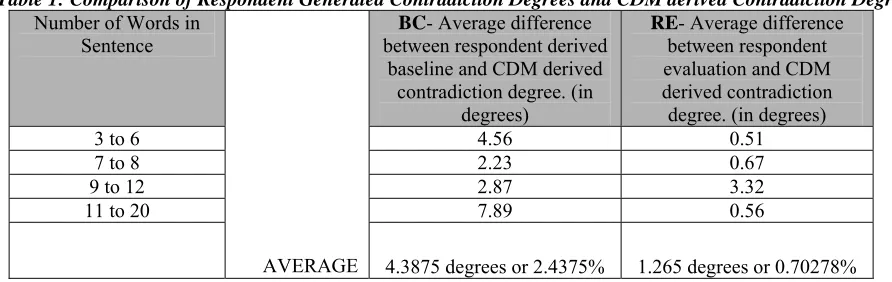
In order to reduce the potential error in respondent based contradiction ratings, once we had obtained the first set of results, using the original sentences and the respondent derived contradictory sentences, we acquired a second and third set of contradiction ratings from two more sets of respondents containing 50 respondents each. We then averaged the three sets of ratings for the respective sentences and scaled them to match the CDM 1 to 180 scale to obtain the baseline comparison for CDM. This is shown as the baseline comparison (BC) in Table 1.
[image:5.612.84.530.310.451.2]As a final evaluation, a fourth and fifth set of respondents, numbering 47 and 43 respondents respectively, was requested to rate the contradiction degrees of the various sentences. They were either to agree with the generated result, meaning zero difference, or if they disagreed, to provide their own contradiction degree, this time on a scale of 1 to 180. This is shown in Table 1 as the respondent evaluation (RE).
Table 1: Comparison of Respondent Generated Contradiction Degrees and CDM derived Contradiction Degrees
Number of Words in
Sentence between respondent derived BC- Average difference baseline and CDM derived
contradiction degree. (in degrees)
RE- Average difference
between respondent evaluation and CDM derived contradiction degree. (in degrees)
3 to 6 4.56 0.51
7 to 8 2.23 0.67
9 to 12 2.87 3.32
11 to 20 7.89 0.56
AVERAGE 4.3875 degrees or 2.4375% 1.265 degrees or 0.70278%
6.0 COMBINING CDM WITH RAJ’S TRUST MODEL
The trust quotient (TQ) as given by [3] is:
Trust Quotient, TQ = [(arctan (tan (PTQ previous - π/2) + ((sin (PCC – π/2)) + 1) +
((sin (NCC + π/2)) – 1))) + π/2] + [(arccot (cot (NTQ previous + π) - ((sin (PCC –
π/2)) + 1) - ((sin (NCC + π/2)) – 1))) – π]
where 0˚ < PTQ previous < 180˚
and 0˚ > NTQ previous > -180˚
and 0˚ ≤ PCC ≤ 180˚
and 0˚ ≥ NCC ≥ -180˚
PTQ previous is the stored Positive Trust Quotient
NTQ previous is the stored Negative Trust Quotient
PCC is the number of consecutive truths
NCC is the number of consecutive lies
[3] proposes the use of TQ where there are contradictions in information being provided by users and that already stored in the system although all contradictions are taken as being of the same magnitude. Contradictions result in perceived truths, PCC and perceived lies, NCC. Combining CDM with TQ with CƒD as a moderating weight results in:
CDM_TQ = [(arctan (tan (PTQ previous - π/2) + ((sin ((PCC . CƒD / π) – π/2)) + 1) + ((sin ((NCC . CƒD / π) +
π/2)) – 1))) + π/2] + [(arccot (cot (NTQ previous + π) - ((sin ((PCC . CƒD / π) – π/2)) + 1) - ((sin
((NCC . CƒD / π) + π/2)) – 1))) – π]
7.0 DISCUSSION AND CONCLUSION
CDM’s exibility and arbitrary representation scheme make it adaptable to being incorporated into many information-learning models as a weightage moderator as seen in our modified chatterbot trust function, CDM_TQ. Limitations of
CDM would surround the fact that the model is heavily reliant on the accuracy of the initial parsing of the sentence. If the parts-of-speech cannot be correctly identified then the model will not works as required. The model works on the assumption that the part-of-speech tagging or parsing is close to perfect. The limitations of the Stanford Parser are documented in [19]. A cited limitation of dependency parsers such as the Stanford Parser is its incorrect handling of prepositional phrases. This limitation happens frequently in English. Take for example the sentence “They chose her as their representative.” or with expressions of an idiomatic nature such as “out of sync.” dependency parsers as they are fail to represent this properly since the parts-of-speech of these sentences do not correlate to the grammar patterns represented in such parsers, [19]. The part-of-speech tagging method presented in [20] does not suffer from this weakness and can be used with CDM instead to overcome this limitation.
and superlative word forms are critical to CDM and do form a simplistic but effective weighting scheme. As such the study of sentence or information representation is not inherently separate from the contradiction degree measurement. This does lessen the separation between the contradiction degree and the weighting of terms. Therefore the precise semantics of the contradiction degree is greatly reliant on the final representation or term weights assigned to the various sentences. As such, any further study of CDM will probably be heuristic in nature. As part of future work in this area, a more precise method for weighting the terms used in the sentence representation of CDM could be developed.
REFERENCES
[1] M. Mauldin, “Chatterbots, Tinymuds and the Turing Test: Entering the Loebner Prize Competition”, in the proceedings of the National Conference on Artificial Intelligence (AAAI-94), August 1994.
[2] R.G. Raj and S. Abdul-Kareem, “Information Dissemination And Storage For Tele-Text Based Conversational Systems' Learning”. Malaysian Journal of Computer Science, December 2009, Vol. 22(2): pp 138-159.
[3] R.G. Raj, “A Novel Trust Model for Chatterbots”, Journal of Computer Science and Engineering, November 2010, Vol.4 Issue 1, pp. 1 –10.
[4] C. Campbell, F. Deek, T. Murray and B. Van De Walle, “Measuring Consensus and Contradiction Among stakeholders in Emergency Response Information System Requirements Negotioations”, in the proceedings of ISCRAM 2004. 2004.
[5] M.A. Covington, “A Fundamental Algorithm for Dependency Parsing”, in the proceedings of The 39th Annual
ACM Southeast Conference, 2001.
[6] M. Danieli and E. Gerbino, “Metrics for evaluating dialogue strategies in a spoken language system”, in Working Notes AAAI Spring Symposium on Empirical Methods in Discourse Interpretation and Generation, 1995.
[7] G. Salton, A. Wong, and C. S. Yang, “A vector space model for automatic indexing”. Communications of the ACM, 1975, Vol. 18(11): pp 613–620.
[8] G. Salton and M. McGill, “Introduction to Modern Information Retrieval”. McGraw-Hill, 1983.
[9] G. Salton, “Automatic Text Processing: The Transformation, Analysis and Retrieval of Information by Computer”. Addison-Wesley, 1989.
[10] S. Deerwester, S. Dumais, T. Landauer, G. Furnas and R. Harshman, “Indexing by latent semantic analysis”. Journal of the American Society for Information Science, 1990, Vol. 41, pp. 391–407.
[11] S. K. M. Wong and Y. Y. Yao, “A probability distribution model for information retrieval”. Information Processing and Management, 1989, Vol. 25(1): pp 39–53.
[12] J. Lafferty and C. Zhai, “Document language models, query models, and risk minimization for information retrieval”, in Proceedings of SIGIR'01, pp. 111–119.
[13] C. Zhai and J. Lafferty, “Model-based feedback in the KL-divergence retrieval model”, in proceedings of the Tenth International Conference on Information and Knowledge Management (CIKM 2001), 2001, pp 403–410.
[14] V. Lavrenko, “A generative theory of relevance”. PhD thesis, University of Massachusetts, Amherst,MA, 2004.
[16] C. D. Manning and S. Hinrich, “Foundations of Statistical Natural Language Processing”, MIT Press, 1999, ISBN 978-0262133609, pp. 24.
[17] D. Klein and C.D. Manning, “Accurate Unlexicalized Parsing”, in Proceedings of the 41st Meeting of the Association for Computational Linguistics, 2003, pp. 423-430.
[18] M. Kolln and R. Funk, “Understanding English Grammar”, Sixth Edition. Longman Publishers, 2002.
[19] S. Ravi, K. Knight and R. Soricut, “Automatic prediction of parser accuracy”, in Proceedings of the 2008 Conference on Empirical Methods in Natural Language Processing, Honolulu, Hawaii, October 2008, Association for Computational Linguistics, pp 887–896.
[20] R.G. Raj, “An Adaptive Learning Tele-Text Chatterbot”. PhD thesis, University of Malaya, Kuala Lumnpur, Malaysia, February 2011.
BIOGRAPHY
Ram Gopal Raj holds a PhD from the University of Malaya (UM) and is attached with the Department of Artificial
Intelligence of the Faculty of Computer Science and Information Technology at UM. His research is mostly related to chatterbot technology and information search methods as well as knowledge representation schemes.
Vimala Balakrishnan holds a PhD from Multimedia University (MMU). She is currently a senior lecturer at the