International Journal of Emerging Technology and Advanced Engineering
Website: www.ijetae.com (ISSN 2250-2459,ISO 9001:2008 Certified Journal, Volume 3, Issue 11, November 2013)
283
Development of Self-Tuning Intelligent PID Controller Based
on BPNN for Indoor Air Quality Control
Yang SONG1, Shenyi WU2, Yuying YAN3
HVACR & Heat Transfer Research Group, Faculty of Engineering, University of Nottingham, Nottingham NG7 2RD, UK
Abstract—For those who spend most of their time working
indoors, the indoor air quality (IAQ) could affect their working efficiency and health. This paper presents an intelligent proportional-integral-derivative (PID) controller for IAQ control. Different from the traditional PID controller, this novel controller combined with Back-Propagation Neural Networks (BPNN) technology will regulate the PID parameters kp, ki, kd automatically. In the present study, the
algorithm of the BPNN-based PID controller is first discussed in details, and the control performance is then tested by simulation using MATLAB. The difficulty in IAQ control is the existence of control disturbance, time delay and measurement errors. The results show that the combined control algorithm has better performance on the systemic stability, disturbance resistance, fast response rate and small overshoot compared with traditional PID controller.
Keywords—Back-propagation, neural network, PID
control, IAQ control, stability analysis.
I. INTRODUCTION
A growing number of heating, ventilating and air conditioning (HVAC) systems are being installed in buildings as a way of providing thermal comfort (TC) and improving indoor air quality (IAQ) for occupants [1]. Over the past decades, exposure to indoor air pollutants is believed to have increased due to a variety of factors, including the reduction of ventilation rates (for energy saving), the construction of more tightly sealed buildings, and the use of synthetic building materials and furnishings as well as chemically formulated personal care products, pesticides and household cleaners. As investigating all types of indoor air pollutants for general air quality monitoring and control is a complicated matter [2–4], it was suggested that the measurement and analysis of indoor carbon dioxide (CO2) concentration could be useful for understanding IAQ and ventilation effectiveness [5–7]. Although healthy people can tolerate a CO2 level up to 10,000 ppm without serious health effects, an acceptable indoor CO2 level should be kept below 1000 ppm or 650 ppm above the ambient level in order to prevent any accumulation of associated human body odour [8–9].
Being able to influence most of these factors, proper control strategies are needed to operate the building HVAC systems in order for optimizing occupant comfort and energy saving in built environment.
In order to achieve an optimal system performance in terms of response speed, systemic stability, disturbance resistance and small overshoot, a neural network proportional-integral-derivative (PID) controller with back-propagation based weight updating algorithm is proposed in this paper.
II. LITERATURE REVIEW
A. Current control methods
Different approaches for controlling indoor building environments have been developed for improving IAQ in buildings. They can be classified into two categories: (1) conventional methods; and (2) computational intelligence technologies.
Although intelligent control technologies are developing very fast in the recent decades, conventional control methods including dead zone control, PID control [10,11], optimal control [12–14], predictive control [15] and adaptive control [16], etc. are still widely used for indoor air quality control, especially PID controller because of its practicality.
International Journal of Emerging Technology and Advanced Engineering
Website: www.ijetae.com (ISSN 2250-2459,ISO 9001:2008 Certified Journal, Volume 3, Issue 11, November 2013)
284
B. Problems of current control methods
The introduced control methods are developed and employed in building HVAC systems to improve IAQ and some of them have excellent performance. However, the current control technologies still have problems need to be solved and their shortages can be summarized as follows:
1) Requiring bespoke design. Conventional control methods like PID control need to be designed based on the building model, and even for an adaptive controller, such knowledge is still required at certain extent. Therefore, it is quite likely that the mismatch of model could occur and poor control performance can be expected as a consequence.
2) Difficulty to put into applications. The weak points of fuzzy controllers are due to the difficulty of defining accurate membership functions and lack of the systematic procedure for the transformation of the expert knowledge into the rule base. Moreover, tuning parameters is a time consuming task. Neural network can automatic the process of tuning parameters, significantly reduce development time and results in a better performance. However, in neural nets, both knowledge extraction and knowledge representation are difficult. Other advanced control technologies also require expert knowledge library or need operators with specific skills, which prevents them from wide applications.
3) Lagging behind the development of HVAC technologies. Current control algorithms do not provide specific control for these HVAC systems and do not have excellent control performance.
C. Future perspectives
These shortages make it difficult to provide a quick solution to the demand for accurate control in building HVAC systems and to meet the demand for some new HVAC systems as well as to perform multi-task control with the aim to minimize energy consumption in buildings and maximize the improvement to the IEQ. In order to address the issues, the development of control technologies in the following areas is desirable:
1) New control approaches may merge both the conventional and advanced control methods. There are two possible ways: a method by which individual merits are combined, and another by which analogies between these are overlapped.
2) The control process that does not require intervention of the users with specific skills or knowledge.
3) Closed-loop, real-time and on-line learning ability. The IAQ performance evaluation system could be included to make a control process have the self-learning and modifying ability.
In order to achieve these goals, a new PID controller based on Back-Propagation Neural Networks (BPNN) learning algorithm will be discussed in next section.
III. DEVELOPMENT OF BPNN-BASED PIDCONTROLLER
[image:2.612.326.552.222.399.2]A. Control structure
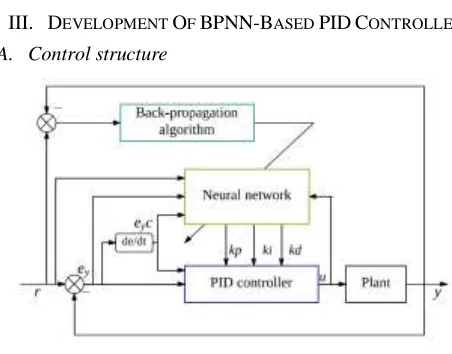
Figure 1: BPNN based PID control scheme
Figure 1 presents the structure of the proposed intelligent PID controller based on BPNN learning algorithm. It contains two parts: 1) a classic PID controller and 2) BPNN. The PID controller is used to control the control object (indoor air quality in building environment). The control performance depends on the setting of PID control parameters kp, ki and kd which can be auto tuned by the
BPNN. The BPNN uses an on-line training algorithm based on a gradient descent approach to update network weights and ensures that the designed neural network is able to calculate the desired PID control parameters for the PID controller. Therefore, in this control approach, by combining the classic PID control and the intelligent BPNN the targeted system output can be tracked with a guaranteed stability.
B. PID control algorithm
The incremental digital PID control algorithm can be expressed as follows:
2 1 2
1 1
k e k e k e k
k e k k
e k e k k u k u
y y
y d
y i y
y p
International Journal of Emerging Technology and Advanced Engineering
Website: www.ijetae.com (ISSN 2250-2459,ISO 9001:2008 Certified Journal, Volume 3, Issue 11, November 2013)
285
Where u is the output of the PID controller, kp is the
proportional term, ki is the integral term, kd is the derivative
term and ey is the system error that can be expressed as
follows:
k yk r key (2)
Where y is the system actual output and r is the system targeted output.
[image:3.612.50.280.248.444.2]C. BPNN algorithm
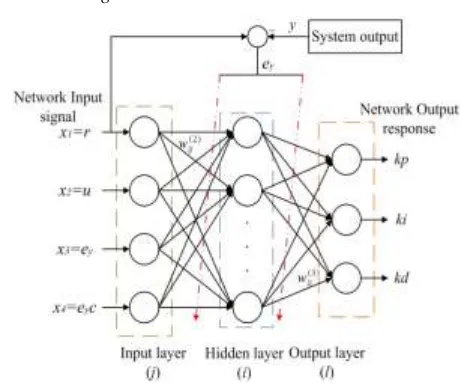
Figure 2: BPNN algorithm scheme
If the neural network has sufficient amount of neurons, it is able to approximate any continuous function with only one hidden layer [22–24]. Therefore, a neural network with only one hidden layer is designed. As shown in Figure 2, the proposed design is a four-input-three-output BPNN with three layers: input layer, one single hidden layer and output layer. In this section, the forward feed algorithm and the back-propagation weights adjustment rule is discussed in detail.
1 Input layer: The designed neural network has four inputs as shown in both Figure1 and Figure 2 and they are:
c
e
e
u
r
x
x
x
x
y y
4 3 2 1
Where r, u and ey is defined in equation (1) and (2); and
eyc is the changing rate of system error ey that can be
expressed as follows:
k e
k e
k1
c
ey y y (3)
Output of each neuron in the input layer is expressed as:
j x Oj
1
j1,2,3,4
(4)In the designed algorithm, superscript (1), (2) and (3) stands for input layer, hidden layer and output layer.
2 Hidden layer: Input of each neuron in the neural network hidden layer is expressed as follows:
1 41 2 2
j j
ij
i k w O
in
i1,2,,N
(5)Where wij(2) is the weight connecting the input layer
neurons to the hidden layer neurons and N is the number of neurons in the hidden layer.
Output of each neuron in the neural network hidden layer is expressed as follows:
k f
in
k
Oi2 i2 (6)
Where f(x) is the activation function in the hidden layer that presents the relation between the input and output of each neuron. Symmetrical Sigmoid function is used as the activation function and can be expressed as follows:
xx xxe e
e e x x
f
tanh (7)
3 Output layer: Input of each neuron in the output layer is given as:
k O w k
in i
N
i li l
2
1 3
3
l1,2,3
(8)Where wli(3) is the weight connecting the hidden layer
neurons to the output layer neurons.
Output of each neuron in the output layer is given by:
k in g k
Ol l
3
3
(9)
p
k k
O13
(10)
i
k k
O23 (11)
d
k k
O33 (12)
International Journal of Emerging Technology and Advanced Engineering
Website: www.ijetae.com (ISSN 2250-2459,ISO 9001:2008 Certified Journal, Volume 3, Issue 11, November 2013)
286
Since these values cannot be negative, the non-negative Sigmoid function is used as the activation function in output layer and it is given as:
x x x e e e x x g 1 tanh 2
1
(13)
The proposed neural network can regulate the PID control parameters automatically and it can reduce sufficient time cost for engineers in control system design process. However, modelling errors often exist in model based process control and dramatically increase the difficulty to accurately control the process. Therefore, an on-line training algorithm is applied to adjust network weights for reducing the system error ey in the design of the
BPNN controller.
4 Weights update: In this algorithm, the system output error function is defined as:
2 22 1 2
1
y
y k rk yk e
E (14)
The training process of the neural network model must be carried out before it can be put into use. This training process is repeated until the mean square error of the training data reaches the desired minimum. In the present work, the training process is based on back propagation. The basic idea of back propagation is to adjust the neuron weights using gradient descent algorithm on the error function in an iteration process. Generally, the adjustment of each weight from hidden-layer to output-layer can be expressed as follows:
3 3 li y li w k E k w
(15)
However, in order to avoid the ‘local minima’ which is the best known problem associated with back-propagation algorithm; a momentum term is added to the weight change in the proposed algorithm. This means that the weight change this iteration depends not just on the current error, but also on previous changes. So the adjustment of each weight from hidden-layer to output-layer is modified as follows:
3 3
1
3
w
k
w
k
E
k
w
li li yli
(16)Where is learning rate, is momentum factor.
kw k in k in k O k O k u k u k y k y k E k w k E li l l l l y li y 3 3 3 3 3 3
(17)
k O
kw k in i li l 2 3 3
(18)
Based on equation (1), (10), (11) and (12), the following equations are calculated:
1
3 1 k e k e k O k u y
y (19)
e
kO k u y 3 2 (20)
3
2
1
2
3 k e k e k e O k u y yy (21)
Then, the learning algorithm of the weight update in output layer can be expressed as follows:
k w k w kwli3 1 li3 li3 (22)
k O k w kwli li l i
2 3 3 3 1
(23)
g
in
k
k O k u k u k y k e l l y l 3 3 3 '
(24)
Where the first derivative of g(x) is given by:
x g x
g
x
g' 1 (25)
And the learning algorithm of the weight update in hidden layer can be expressed as follows:
k
w
k
w
k
w
ij2
1
ij2
ij2 (26)
k w
k
O
kwij2
ij2 1
i2 j1 (27)
3 1 3 3 2 2 ' l li l ii f in k w k
(28)
Where the first derivative of f(x) is given by:
2 1 ' 2 x f xf (29)
D. Summarise of BPNN based PID control
In the control process, the weights in the neural network are trained by the back-propagation weights adjustment rule in order to obtain the best PID parameters kp, ki and kd
International Journal of Emerging Technology and Advanced Engineering
Website: www.ijetae.com (ISSN 2250-2459,ISO 9001:2008 Certified Journal, Volume 3, Issue 11, November 2013)
287
Therefore, an acceptable indoor air quality can be provided by the control of designed system. The algorithm of the BPNN based PID can be summarised as follows:
1) Initialize the each weight in the neural network wij(2)(k) and wli(3)(k), as well as learning rate
and momentum factor
while k=1.2) Collect data r(k) and y(k) and calculate the system error ey using equation (2).
3) Calculate the input and output of each neuron and get the PID parameters kp, ki and kd.
4) Calculate the output of PID controller using equation (1).
5) On-line training. Adjust the weight of each neuron in the neural network with the back-propagation learning algorithm in order to realize self-adaptive regulation of the PID parameters kp, ki and kd. 6) Set k=k+1 and go back to rule 1).
IV. SIMULATION RESULTS AND DISCUSSION
The BPNN based PID control system is tested using MATLAB application tools. The difficulty in IAQ control for building environment is the existence of control disturbance and time delay. Simulations are conducted and results are analysed to discuss the performance including response speed, overshot, stability and adaptability of the proposed control strategy in IAQ control.
A time-varying system is used to represented IAQ control process for simulations to assess the effectiveness of the proposed neural PID control with on-line learning approach. As the process parameter becomes time variant, it causes difficulties to the system reference tracking control. The mathematical model of the control object is given as:
1
1
0.2 ( 2)1
1
2
u k u k
k y
k y k a k y
Where a(k) is a parameter varying over time and it is given as:
a(k)=1.4(1-0.9e-0.3k)
Set the initial learning rate 0.28 and momentum factor 0.04.The weights in the neural network are initialized in the range [-0.5, 0.5] randomly.
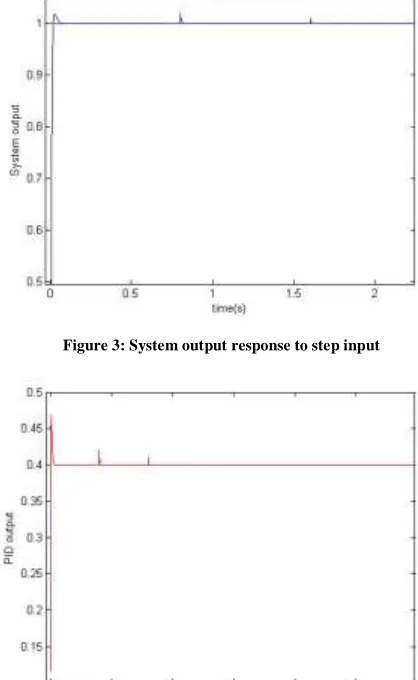
Firstly, the step signal (r (k)=1) is introduced at time t=0. The simulation result of the proposed control system output is presented in Figure3. As shown in the Figure, the system has very fast response speed and very small overshot.
[image:5.612.333.542.232.572.2]Since there some disturbance factors in the actual control process, to further verify the robustness of the BPNN based PID control system, two disturbance loads at time t=0.8 and t=1.6 are added when the system is in the steady state. It can be seen in Figure 3 that when there are disturbances the control system can be fast stable and good stability can be provided.
Figure 3: System output response to step input
Figure 4: PID output response to step input
In Figure 4, PID controller output response to the step input signal and disturbances are presented and it performs the developed approach with small oscillations and short settling time.
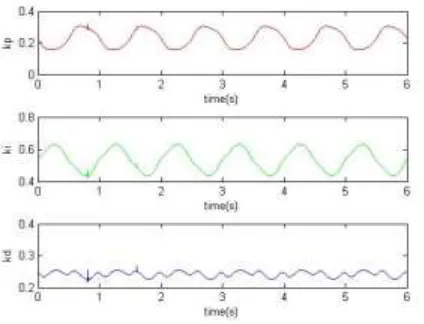
The auto-tuning process of the PID parameters kp, ki and
kd can be observed in Figure 5. It shows that the proper PID
International Journal of Emerging Technology and Advanced Engineering
Website: www.ijetae.com (ISSN 2250-2459,ISO 9001:2008 Certified Journal, Volume 3, Issue 11, November 2013)
288
When the disturbances are suddenly added the neural network can quickly response to such situation and calculate the best kp, ki and kd for the PID controller so that
[image:6.612.60.265.190.359.2]the system can be kept stable.
[image:6.612.330.544.247.613.2]Figure 5: Auto-tuning of PID parameters (step input)
Figure 6 System output response to sine input
Then, to further verify the performance of the BPNN based intelligent PID control system a unit sine set-point (r(k)= sin(2
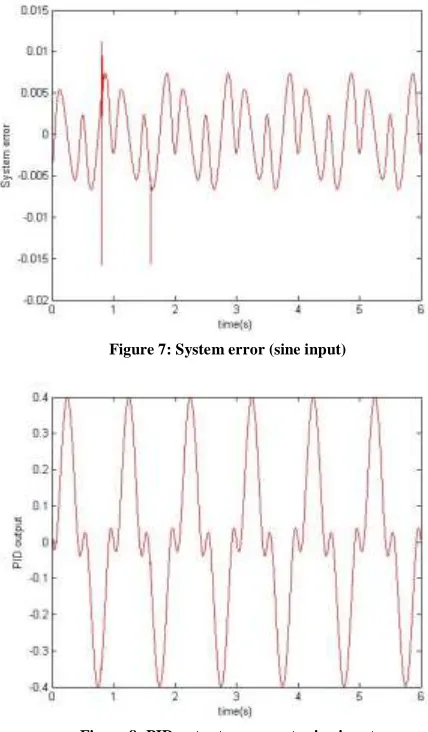
t)) is introduced at time t=0 and two disturbances at time t=0.8 and t=1.6. The initial weights in the developed neural network are selected randomly. These unsuitable weights may cause poor control performance; however, by adjusting them using the back-propagation learning algorithm the desired weights in the neural network can be fast obtained and are put to use for achieving the targeted system output.In Figure 6, system output response to the sine input is presented. The result shows that the sine signal has been well tracked and the newly developed controller can cope with time variable parameter and time-varying system reference. There is no big overshot at the beginning that might be caused by the randomly set neural network weights. With the disturbances suddenly added, no oscillations were occurred and it can be observed more clearly in Figure 7 where describes the system error.
Figure 7: System error (sine input)
Figure 8: PID output response to sine input
[image:6.612.58.269.366.550.2]International Journal of Emerging Technology and Advanced Engineering
Website: www.ijetae.com (ISSN 2250-2459,ISO 9001:2008 Certified Journal, Volume 3, Issue 11, November 2013)
289
[image:7.612.61.273.189.351.2]Figure 9 shows that the developed neural network control method has very good adaptability to parameter and system reference time variations. The desired output can be provided quickly in different situations.
Figure 9: Auto-tuning of PID parameters (sine input)
As it has been shown with simulations that the back-propagation neural network technique is capable of providing suitable parameters for PID controller and the targeted system output can be achieved. Analysis shows that the response speed, stability, small system error and adaptability of the BPNN based PID control system have been guaranteed.
V. CONCLUSION AND FUTURE WORK
In this paper, an intelligent PID control system based on back-propagation neural network is introduced to address the drawback of PID control, i.e., it has to be designed based on the building model which is prone to the mismatch of model and poor control performance as a consequence and time consuming on parameters tuning. The proposed controller also avoids the need of knowledge extraction and knowledge representation in neural networks by a novel on-line training based neural network controller with respect to the variations observed from the system reference input and the actual output. Simulation trials have been conducted to show that the new developed control system presents excellent robustness to disturbance loads and process modeling errors and very good adaptability to cope with time variant process parameters, which was demonstrated from using the IAQ control model with time-dependent parameter. In the future work, optimization approaches such as genetic algorithm will be used to optimize the neural network architecture to improve the control performance.
REFERENCES
[1] Yu, B.F., Hu, Z.B. and Liu, M. 2009. Review of research on air conditioning systems and indoor air quality control for human health, Int J Refrig, (32), 3–20.
[2] Yang, S., Wu, S., Yan, Y.Y., 2013. Control strategies for indoor environment quality and energy efficiency—a review, International Journal of Low-Carbon Technologies, doi:10.1093/ijlct/ctt051. [3] Hui, P.S., Wong, L.T. and Mui, K.W. 2006. Feasibility study of an
express assessment protocol for the indoor air quality of air-conditioned offices, Indoor and Built Environment, 15(4), 373–378. [4] Mui, K.W., Wong, L.T., Hui, P.S. and Law, K.Y. 2008. Epistemic
evaluation of policy influence on workplace indoor air quality of Hong Kong in 1996–2005, Building Services Engineering Research and Technology, 29(2), 157–164.
[5] Persily, A.K. 1997. Evaluating building IAQ and ventilation with indoor carbon dioxide, ASHRAE Transactions, 103(2), 193–203. [6] ASTM, 2003. Standard guide for using indoor carbon dioxide
concentrations to evaluate indoor air quality and ventilation, D6245-98, (reapproved 2002).
[7] Committee of European Normalization, Ventilation for buildings: design criteria for the indoor environment. Brussels, Luxembourg: Commission of the European Communities, Directorate General for Science, Research and Development Joint Research Centre-Environment Institute, CR1752, 1998.
[8] ASHRAE, ANSI/ASHRAE Standard 62-2007, Design for acceptable indoor air quality, American Society of Heating, Refrigerating and Air-Conditioning Engineers, Inc., Atlanta, 2007.
[9] Mui, K.W. and Wong, L.T. 2007. Evaluation of neutral criterion of indoor air quality for air-conditioned offices in subtropical climates, Building Services Engineering Research and Technology, 28(1), 23– 33.
[10] Levermore, G.J. 1992. Building Energy Management Systems: An Application to Heating and Control. E & FN SPON.
[11] Dounis, A.I., Bruant, M., Santamouris, M.J., et al. 1996. Comparison of conventional and fuzzy control of indoor air quality in buildings, J Intell Fuzzy Syst, (4), 131–40.
[12] Wang, S. and Jin, X. 2000. Model-based optimal control of VAV air-conditioning system using genetic algorithms, Build Environ, (35),471–487.
[13] Zaheer-uddin, M. and Zheng, G.R. 2000. Optimal control of time scheduled heating, ventilating and air conditioning processes in buildings, Energ Convers Manag, (41), 49–60.
[14] Kummert M., Andre, P. and Nicolas, J. 2001. Optimal heating control in a passive solar commercial building, Solar Energ, (69), 103–116.
[15] Milanic S.R.K. 1996. Neural network models for predictive control of a thermal plant. In: Proceedings of the International Conference on EANN.
[16] Lam, H.N. 1993 Stochastic modeling and genetic algorithm based optimal control of air conditioning systems, Build Simulat, 435–441. [17] Sanchez, L., Doctor, F. and Hagras, H. 2004. An evolutionary algorithm for the off-line data driven generation of fuzzy controllers for intelligent buildings, In: Systems, Man and Cybernetics, IEEE International Conference, 42–47.
International Journal of Emerging Technology and Advanced Engineering
Website: www.ijetae.com (ISSN 2250-2459,ISO 9001:2008 Certified Journal, Volume 3, Issue 11, November 2013)
290
[19] Altrock, C., Arend, H.O., Krause, B., Steffens, C. and Behrens-Rommler, E. 1994. Adaptive fuzzy control applied to home heating system, Fuzzy Sets and Systems, (61), 29-35.
[20] Liang, J. and Du, R. 2005. Thermal comfort control based on neural network for HVAC application. IEEE conference, 819-824. [21] Zhao, Z.Y., Tomizuka, M. and Isaka, S. 1993. Fuzzy gain scheduling
of PID controllers, IEEE Transactions on Systems Man and Cybernetics, (123), 1392-1398.
[22] Hornik, K., Stinchcombe, M. and White, H. 1989. Multilayer feedforward networks areuniversal approximators, Neural Networks 2(5), 359–366.
[23] Cybenko, G. 1989. Approximation by superpositions of a sigmoidal function, Math.Control Signals Syst. (MCSS), (2), 303–314. [24] Ken-Ichi, F. 1989. On the approximate realization of continuous