C o m p e t e n c y m a p p i n g f r a m e w o r k
fo r r e g u l a ti n g p r of e s si o n ally
o ri e n t e d d e g r e e p r o g r a m m e s i n
h i g h e r e d u c a ti o n
P e r e r a , S, B a b a t u n d e , SO, Z h o u , L, P e a r s o n , J a n d E k u n d a y o, DO
h t t p :// dx. d oi.o r g / 1 0 . 1 0 8 0 / 0 3 0 7 5 0 7 9 . 2 0 1 6 . 1 1 4 3 9 2 6
T i t l e C o m p e t e n c y m a p p i n g f r a m e w o r k fo r r e g u l a ti n g
p r of e s sio n ally o ri e n t e d d e g r e e p r o g r a m m e s in h i g h e r e d u c a ti o n
A u t h o r s P e r e r a , S, B a b a t u n d e , SO, Z h o u , L, P e a r s o n , J a n d E k u n d a y o, DO
Typ e Ar ticl e
U RL T hi s v e r si o n is a v ail a bl e a t :
h t t p :// u sir. s alfo r d . a c . u k /i d/ e p ri n t/ 4 9 7 8 8 /
P u b l i s h e d D a t e 2 0 1 6
U S IR is a d i gi t al c oll e c ti o n of t h e r e s e a r c h o u t p u t of t h e U n iv e r si ty of S alfo r d . W h e r e c o p y ri g h t p e r m i t s , f ull t e x t m a t e r i al h el d i n t h e r e p o si t o r y is m a d e f r e ely a v ail a bl e o nli n e a n d c a n b e r e a d , d o w nl o a d e d a n d c o pi e d fo r n o
n-c o m m e r n-ci al p r iv a t e s t u d y o r r e s e a r n-c h p u r p o s e s . Pl e a s e n-c h e n-c k t h e m a n u s n-c ri p t fo r a n y f u r t h e r c o p y ri g h t r e s t r i c ti o n s .
Competency mapping framework for regulating professionally
oriented degree programmes in higher education
Srinath Perera
a, Solomon Olusola Babatunde
a, Lei Zhou
a, John Pearson
aand
Damilola Ekundayo
ba
Faculty of Engineering & Environment, Northumbria University, Newcastle upon Tyne, UK b
Faculty of Technology, Design and Environment, Oxford Brookes University, Oxford, UK
Abstract
Recognition of the huge variation between professional graduate degree programmes and employers requirements, most especially in the construction industry, necessitated a need for assessing and developing competencies that aligned with the professionally oriented programmes. The purpose of this research is to develop a competency mapping framework (CMF) in this case for the quantity surveying (QS) honours degree programme. The graduate competency threshold benchmark (GCTB) is a key component of the CMF. Therefore, the CMF contains the mapping process, the template documents and the benchmark. The research adopted literature review, pilot study, case studies (including semi-structured interviews), and expert forum in developing the framework. The framework developed in this research provides new insight into how degree programmes map against competencies. Thus, the framework can be applied more widely, to other professional degree programmes, for monitoring and improving the quality and professional standards of construction degree programmes by accrediting bodies. This should connect construction graduates more effectively to the industry.
Keywords: Competencies; construction; curriculum; degree programmes; higher education.
1 Introduction
The competence-based education initially started in nursing education in the 1970s (Cowan et al., 2007) and gained popularity in many other disciplines in formal and informal education and training all around the world (Meyer and Semark, 1996). The significance of competency-based measures in promoting the development of appropriate professional training requirements is well underscored (Tett et al., 2000; Gibb, 2003). Therefore, an educational strategy based on competencies has become a norm. For example, a robust competency model helps to align practice and academic priorities. Some earlier studies support this. For instance, Getha-Taylor et al. (2013) argued that competency-based programs provide students with the knowledge, skills, and attitudes necessary for successful careers. Rissi and Gelmon (2014) claimed that the recognition of the substantial variation in professional roles and employment settings that graduates enter necessitated the needs to define programme contents that concentrate on creating and assessing competencies that aligned with programme mission and students’ career goals. Batterman et al. (2011) stated that educational competencies depict learning objectives and are utilised to plan educational programmes, develop curricula, and assess existing programmes. Arain (2010) suggested that the essential competence of a construction program in the core area of construction project management is in imparting to its students the necessary expertise to practice professionally in the construction industry.
There is a considerable interest in identifying specific competencies for construction oriented degree programmes. For instance, Ahn et al. (2012) examined key competencies for construction graduates in the United States. Arain (2010) identified competencies for baccalaureate level construction education in Alberta, Canada. Batterman et al. (2011) studied competencies for graduate education programmes in the energy and sustainability area among others. In spite of these studies of the competencies required of construction related graduates in HEIs, very few studies attempted to provide insight of how modules/courses in undergraduate studies mapped against these. Also, construction industry employers have been vocal in reporting their perception of a lowering of employability of graduates. A recent study investigating the views on both industry and academia concluded that there are significant levels of dissatisfaction with the quality of graduates (Perera and Pearson, 2011). It is identified that the root cause of the issue is that graduates produced from different Royal Institution of Chartered Surveyors (RICS) accredited degree programmes in HEIs having significantly different competency levels, often far below what the industry expects. The lack of a mechanism to systematically evaluate programme module content against RICS competencies and a benchmark for graduate competencies is, therefore, considered as the core cause of this problem (Perera and Pearson, 2011). This research aims to fill this gap by developing a competency mapping framework (CMF) that comprises the graduate competency threshold benchmark (GCTB) for quantity surveying (QS) honours degree programmes. Achieving this is fundamental to success in aligning the views of industry, academia and the professional body – RICS. In this respect, this research was guided by the following derived objectives:
• Examination of the mandatory, core and optional competencies and benchmarking the expected level of compliance for RICS accredited degree programmes.
• Development of a competency mapping and assessment methodology to analyse the compliance of programmes to set benchmarks for Graduate route.
• Development of a competency mapping scoring system to analyse the level of mapping and gaps.
It is believed that the process used to develop the framework can be applied to any professionally oriented degree programme in HEIs. Further, the framework would be useful for the monitoring and management of existing degree programmes in any construction- related discipline. It is anticipated that this research will contribute to improving understanding of the knowledge and skills context, more efficient alignment of HEI outputs with industrial needs and ultimately to the future positive development of the construction sector at large.
2 Subject area descriptions of construction education degrees
Subject area descriptions are best considered as benchmarking exercises for a particular field of study or discipline group (Newton et al., 2012). Construction education in HEIs represents a field of study that encompasses the modern academy such as Architecture, Engineering, and Law, among others. Is is corroborated by (Newton et al., 2012) that the discipline of Building and Construction draws together a substantial range of distinctive academics and professional practice. Thus, at the core of the discipline are a number of discrete professions such as Construction Management, Quantity Surveying, Building Surveying, Facilities Management and Property Development, united through a shared concern with the initiation, provision, operation and sustainability of the built environment (Newton et al., 2012). Construction is a practice-oriented collection of professions. Therefore, the educational unit should establish an effective relationship with the industry (ACCE, 2015). Against this backdrop, necessitated the professional bodies nationally and internationally to develop both the policy and practice for construction education. For instance,in the United States, bachelor degree programmes in construction management are accredited by the American Council for Construction Education (ACCE). Thus, ACCE defines the academic standards and criteria by which those construction education programmes seeking accreditation or re-accreditation shall be assessed. In Australia, academic standards for building and construction professions are developed and refined through national consultation involving all relevant professional bodies and higher education providers (see Newton and Goldsmith, 2011b). For example, in 2010-2011, the Learning and Teaching Academic Standards (LTAS) project in building and construction established the Threshold Learning Outcomes (TLOs) that all graduates of an Australian bachelor award in building and construction are expected to have met or exceeded (ALTC, 2011; Newton, 2011; Newton et al., 2012). In the UK, in establishing the benchmark standards for construction, property and surveying, the Quality Assurance Agency for Higher Education (QAA) made reference to national occupational standards that have been developed by the Construction Industry Council, as well as to the accreditation policies produced by professional bodies such as the Chartered Institute of Building (CIOB) and the Royal Institution of Chartered Surveyors (RICS) (QAA, 2008). Thus, the single honours degree programmes in HEls in the UK are formulated with reference to the QAA benchmark statements in construction, property and surveying (2008) and accredited by RICS/University Partnership Scheme for which it must meet quality thresholds as identified in the RICS Assessment of Professional Competence in Quantity Surveying and Construction (2009).
3 Quantity surveying education
degrees grew from the early 1970’s with the move from diploma to degree level qualification for entry to the profession. This transition from diplomas to university degrees was in line with the general transformation of the higher education sector of the British education system. The majority of these degrees were delivered by the former polytechnics, the most of which, in turn, became new universities in the early 1990’s (Perera and Pearson, 2013).
In the UK, the RICS-university partnership agreement is the primary mechanism to ensure the academic quality of accredited programmes. This process involves ensuring that certain minimum standards, known as “thresholds” as set out in the guidance and policy document on university partnerships are achieved (RICS, 2008a). A stipulation regarding relevant employment of graduates was waived off late, due to the current economic situation (RICS, 2008a). At present, there is no formal obligation for programme teams to map their curricula against specific RICS QS competencies at specific levels, although most seek this outcome to some extent. The guidance and policy document does list and refer to the ‘Assessment of Professional Competence’ (APC) requirements, suggesting the “likelihood of meeting threshold standards and leading to an existing APC pathway” as a factor in the accreditation or otherwise of a programme (Perera and Pearson, 2013). The 2010 “vision for high-quality education” was set out by an education task force in 1999 (RICS, 2008a). This envisaged strong partnerships between the RICS and a limited number of recognised centres of academic excellence, characterised not only by an appropriate range of curricula at undergraduate and postgraduate levels, but also increased freedom for selected universities to develop courses and methods of delivery at all academic levels. This is a far from prescriptive recipe, which lacks consideration of matching specific levels to core competencies. It is against this backdrop that this research developed a graduate competency threshold benchmark (GCTB), which led to the development of a final competency mapping framework (CMF).
4 Research methods
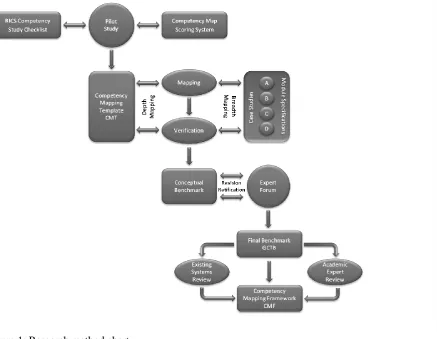
Figure 1: Research method chart
The four stages and the main research instrument adopted in this research are detailed as follows:
4.1Stage 1: Pilot study
A literature review was conducted to identify the full QS study checklist structured by RICS competencies. This was followed by developing a competency mapping scoring system that could provide a numerical scale mapping of competencies to degree programme curricula (see Figure 1). A pilot study involving two senior academic staff and two industry experts were used to test the scoring system and develop the final competency mapping template (CMT) (see Figure 1). The CMT is a dual vector scale matrix with a ‘breadth scale and a depth scale’. Breadth scale contains study topics while depth scale contains competencies. Therefore, the CMT formed the basis for carrying out case studies mapping competencies to existing degree programmes.
4.2 Stage 2: Case studies
descriptive statistical analysis was used to develop a conceptual competency benchmark using these four case studies, which is the final output of this stage.
4.3 Stage 3: Expert forum
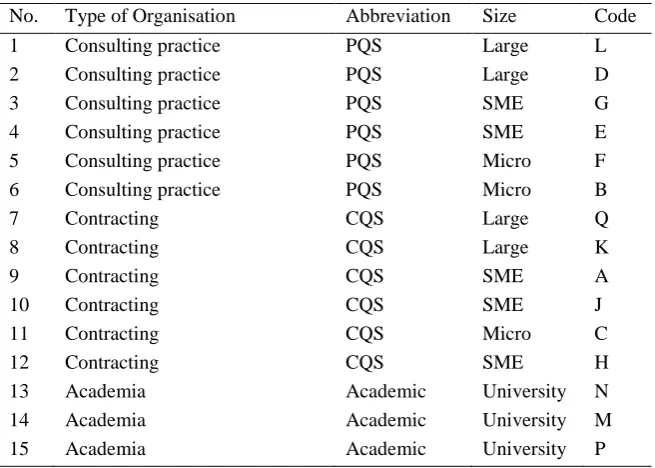
An expert forum comprised 15 persons (12 industry experts and 3 academic experts) was constituted to revise and modify the conceptual competency benchmark developed in stage 2 of the research above. The identified industry experts come from large, SME and micro level organisations. These included quantity surveying employer organisations from both traditional consulting and contracting sectors. A total of 15 interviews were conducted comprising 3 academics (programme leaders), 6 consultant quantity surveyors (2 experts from each category of large, SME and micro) and 6 contractor quantity surveyors (2 experts from large, 3 from SME and 1 from Micro level organisation) (see Table 4 for details). The resulting findings were analysed using relevant descriptive statistics and presented as a ratified benchmark. Delphi technique (Rowe and Wright, 2001) was used to extract and harmonise the views of the experts and to finalise the benchmark level of achievement of competencies for graduate QS.
4.4 Stage 4: Review of existing processes to integrate CMF
The GCTB forms the basis of the final stage of the research, where it is incorporated in to existing programme curricular development and management process, creating the CMF. A detailed review of the existing programme validation and management methods was carried out. Three highly experienced RICS accredited QS honours degree programme directors (who are also full members of the RICS) were selected to develop the mechanism to integrate the GCTB to create the final CMF. This stage provides insight on how the CMF can be used within these existing systems to ensure academic quality standards.
5 RICS quantity surveying competencies
The RICS QS competencies provide the basis on which the competence of a chartered quantity surveyor is defined. These are arranged into three groups, depending upon their perceived relevance to the role of the quantity surveyor as follows:
1 Mandatory competencies: personal, interpersonal and professional practice and business skills common to all pathways [into membership] compulsory for all candidates.
2 Core competencies: primary skills of the candidate’s chosen RICS pathway. 3 Optional competencies: selected as an additional skill requirement for the
candidate’s chosen RICS pathway from a list of competencies relevant to that pathway. In most cases there is an element of choice, though usually driven by their employer’s specialism.
Similarly, the RICS distinguishes between three possible levels of attainment in each of a range of competences when setting its requirements for those seeking full membership as follows:
Level 1: Knowledge (theoretical knowledge)
Level 2: Knowledge and practical experience (putting it into practice)
Level 3: Knowledge, practical experience and capacity to advise (explaining and advising)
specialisation, consulting or contracting as the case may be, which must be at Level 2). The further requirement is for 2 optional competencies at Level 2 or above.
6 The competency mapping scoring system
The competency mapping scoring system is developed as a dual vector scale matrix consisting of a ‘breadth scale and a depth scale’. The breadth scale indicates the extent of coverage of competencies as mapped to RICS QS study checklist (RICS, 2008b). The check list provides 359 individual study topics categorised into 25 different competencies. These signify the extent of coverage (breadth of knowledge) expected under the current set of competencies. The depth scale provides an indication of the time spent on achieving competencies. These are briefly discussed as follows:
6.1 Breadth scale
RICS QS competencies were analysed at a detailed level using the QS study checklist (RICS, 2008b). This checklist is used as the framework for developing the conceptual benchmark where the binary alternatives 1 and 0 are used to indicate coverage of a topic under a competency. For example,
1 - Reflects that the topic is dealt with by the degree programme concerned.
0 - Reflects that it is not dealt with by the degree programme concerned.
These are indicated against the three level classification of level of achievement by the RICS (RICS, 2009), as follows:
Level 1 - Knowledge and understanding
Level 2 - Application of knowledge and understanding
Level 3 - Reasoned advice and depth of technical knowledge
A specific topic may be covered at both Levels 1 and 2. In this case, there is a value 1 in both Level 1 and Level 2 columns. If a topic achieves Level 2 coverage then it is assume that there is always Level 1 coverage as well. In another topic, if the topic is dealt with at Level 1 only then values 1 and 0 were placed against columns Level 1 and Level 2 respectively. Level 3 achievements are not expected to be covered in degree programmes as it is not practical to expect a graduate to cover a competency at Level 3. However, as the benchmark reflects a minimum conceptual achievement level, it will not prevent anyone achieving a competency at Level 3 if it is feasible within their degree programme.
6.2Depth scale
6.3 Competency mapping template (CMT) and Competency mapping record (CMR)
A CMT incorporating the breadth and depth scales was developed on a spreadsheet using the competency mapping scoring system. It contains two tabs, one each for the breadth scale (mapping) and the depth scale (mapping). The breadth mapping tab contains the study checklist topics organised into competencies (vertical) mapped against module specifications (horizontal). In a similar way the depth mapping tab contains the RICS QS competency list (vertical) mapped against module specifications (horizontal).
[image:9.595.99.450.197.295.2]
Figure 2: Competency mapping process
The mapping process involves taking each module specification, identifying module topics and mapping them against the breadth scale. Subsequently, time utilised for each topic for a competency is estimated and noted in the corresponding cell in the depth scale mapping tab. When all breadth and depth scale information is recorded for a degree programme it becomes a record of how module content is mapped against RICS competencies. This is termed as the competency mapping record (CMR) for the programme.
7 The competency mapping of the case studies
7.1 Developing the conceptual benchmark
The conceptual benchmark was developed by mapping module specifications of four universities (case studies) RICS accredited QS honours degree programmes against the RICS study checklist (RICS, 2008b) using the aforementioned CMT. The process used in mapping competencies for the case studies is summarised as follows:
1. A request to conduct a case study of the selected QS degree programme was sent to the respective programme director explaining the process.
2. The module specifications and the programme module structure were obtained from the respective case study (university).
3. The CMT with the breadth and depth scales was used to map the RICS competencies to the module specifications.
4. Programme module specifications were individually mapped to competencies using the CMT by the researchers. These process consisted of the following:
a. Topics for each module were identified and mapped to those in the breadth scale of study checklist topics.
b. Using the module credit allocation and proportionately distributing it to module content, the learning time allocation for each topic was estimated and allocated in the depth scale.
d. The completed mapping for a degree programme was termed a competency mapping record (CMR) (see Figure 2).
5. The completed competency mappings (CMRs) were then sent to the respective programme directors for further revision.
6. Revisions were discussed and agreed with the programme directors to finalise the CMR of each programme.
Each RICS competency is made up of several topics (known as the study checklist). The breadth mapping, which is the scope of coverage, was carried out across Level 1 and Level 2. As noted above, Level 3 is not included because a QS graduate would not have attained this level upon graduation. Since the benchmark is a minimum threshold it is not required to be considered. The depth mapping was carried out at competency level, unlike the breadth mapping which was carried out at detailed study checklist level. Credits hours are used for the depth mapping. There are a total of 360 credits (3600 hours) of learning in a degree programme. Therefore, there will be less than 3600 hours available to map against RICS competencies. This is because a typical degree programme contains topics that are related to but not specifically identified within RICS competencies. For example, the subject areas of basic economics, mathematics, and topics such as the background to the legal system are not directly related to RICS competencies.
Both breadth and depth mappings of the case studies (A, B, C, & D) were initially carried out by the researchers using the respective programme specifications. The results were then sent out to the programme leaders of the degree programmes concerned for necessary adjustments and ratifications. Descriptive statistics such as mean and percentage scores were used to analyse and present the results of the case studies as a conceptual framework.
7.2 Comparative analysis of case studies
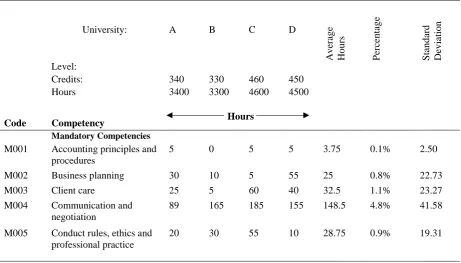
[image:10.595.68.530.499.762.2]The four case study competency mappings were collated and statistically analysed to develop the conceptual benchmark for mapping graduate level QS competencies. A summary of the depth mapping of case studies is provided.
Table 1: Results of the comparative analysis of competency mapping of case studies - depth mapping
University: A B C D
Av
er
ag
e
Ho
u
rs
Per
ce
n
tag
e
Stan
d
ar
d
Dev
iatio
n
Level:
Credits: 340 330 460 450
Hours 3400 3300 4600 4500
Hours
Code Competency
Mandatory Competencies
M001 Accounting principles and procedures
5 0 5 5 3.75 0.1% 2.50
M002 Business planning 30 10 5 55 25 0.8% 22.73
M003 Client care 25 5 60 40 32.5 1.1% 23.27
M004 Communication and negotiation
89 165 185 155 148.5 4.8% 41.58
M005 Conduct rules, ethics and professional practice
University: A B C D Av er ag e Ho u rs Per ce n tag e Stan d ar d Dev iatio n Level:
Credits: 340 330 460 450
Hours 3400 3300 4600 4500
Hours
Code Competency
M007 Data management 85 65 90 120 90 2.9% 22.73
M008 Health and safety 30 50 40 195 78.75 2.6% 77.93
M010 Teamworking 132 95 130 240 149.25 4.8% 62.84
Core Competencies
T010 Commercial management of construction
50 105 120 10 71.25 2.3% 50.72
T017 Contract practice 373 190 240 90 223.25 7.2% 117.71
T013 Construction technology and environmental services
377 597 655 1090 679.75 22.0% 298.56
T022 Design economics and cost planning
230 280 230 270 252.5 8.2% 26.30
T062 Procurement and tendering
216 253 130 130 182.25 5.9% 62.20
T067 Project financial control and reporting
65 55 63 55 59.5 1.9% 5.26
T074 Quantification and costing of construction works
380 520 430 390 430 13.9% 63.77
Optional Competencies
T008 Capital allowances 2 0 20 20 10.5 0.3% 11.00
M006 Conflict avoidance, management and dispute resolution procedures
91 30 120 30 67.75 2.2% 45.17
T016 Contract administration 50 60 82 60 63 2.0% 13.52
T020 Corporate recovery and insolvency
0 0 0 0 0 0.0% 0.00
T025 Due diligence 0 0 0 0 0 0.0% 0.00
T045 Insurance 30 10 0 0 10 0.3% 14.14
T063 Programming and planning
80 80 103 185 112 3.6% 49.86
TO66 Project evaluation 100 45 225 220 147.5 4.8% 89.49
T077 Risk management 60 15 110 20 51.25 1.7% 44.04
M009 Sustainability 100 150 265 150 166.25 5.4% 69.93
Total hours 2620 2810 3363 3540 3083.25 100.0% 438.23
Percentage coverage of competencies
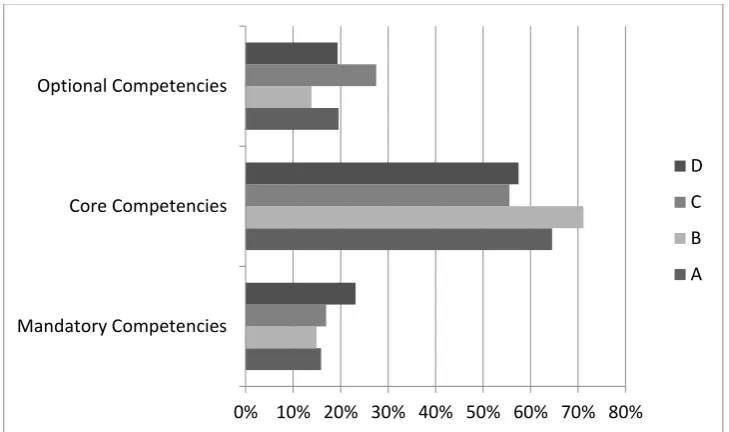
There are many variations on how the programme curricula of individual case studies (universities) are mapped to competencies. Most variations are in the mapping of a few core competencies and of the optional competencies. This is somewhat expected as individual programmes have their own strengths and character. The average total mapping of competencies stands at 78%, indicating that 22% of the curricula in undergraduate programmes reflect knowledge content that does not directly map against competencies. These are often fundamental and basic knowledge components that are essentially required in order to be able to deliver knowledge that would assist in the achievement of competencies. A detailed analysis of the weightings for mandatory, core and optional competencies across the four case studies is presented in Figure 3.
Figure 3: Cross analysis of types of competencies for case studies A, B, C & D
As indicated in Figure 3 it is very clear that all universities have given overwhelming priority to core competencies. Two universities have given the second level of priority for either optional or mandatory competencies.
8 The conceptual benchmark for graduate route
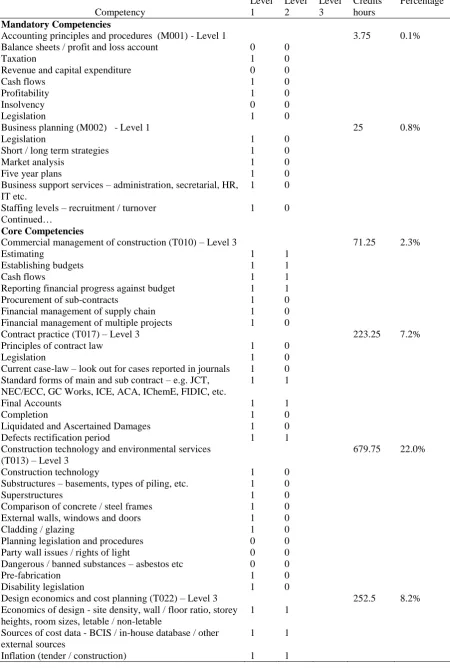
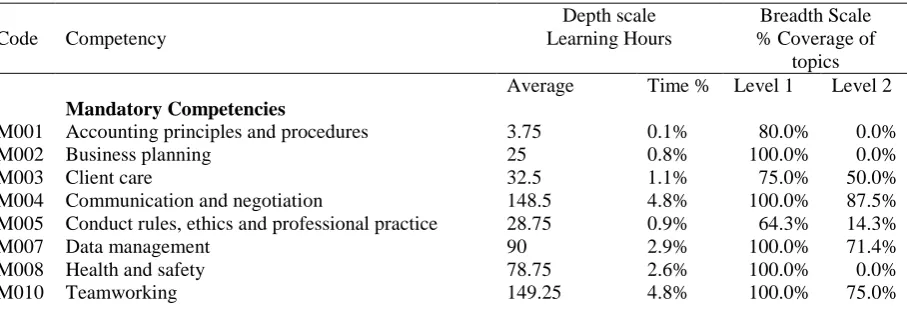
The conceptual benchmark (see Table 2) is a two dimensional matrix reflecting overall average coverage and average depth of coverage of the four case studies. The conceptual benchmark values reflect the levels of achievement of competencies by graduates completing a degree from the four case study QS programmes. It reveals under Level 1 and Level 2 columns the topics covered in all the four RICS accredited degree programmes examined. A value of 1 against a particular topic implies that at least one of the case study degree programmes covers this. The credits hours’ column, which is the average of the four case study values, indicates typical expected times (in hours) devoted to each competency, whilst the percentage column shows the relative time proportion. Only a brief extract of the conceptual benchmark is shown (as the table extends to several pages).
0% 10% 20% 30% 40% 50% 60% 70% 80% Mandatory Competencies
Core Competencies Optional Competencies
D
C
B
Table 2: Results of the sample of conceptual benchmark Competency Level 1 Level 2 Level 3 Credits hours Percentage Mandatory Competencies
Accounting principles and procedures (M001) - Level 1 3.75 0.1% Balance sheets / profit and loss account 0 0
Taxation 1 0
Revenue and capital expenditure 0 0
Cash flows 1 0
Profitability 1 0
Insolvency 0 0
Legislation 1 0
Business planning (M002) - Level 1 25 0.8%
Legislation 1 0
Short / long term strategies 1 0
Market analysis 1 0
Five year plans 1 0
Business support services – administration, secretarial, HR, IT etc.
1 0
Staffing levels – recruitment / turnover 1 0 Continued…
Core Competencies
Commercial management of construction (T010) – Level 3 71.25 2.3%
Estimating 1 1
Establishing budgets 1 1
Cash flows 1 1
Reporting financial progress against budget 1 1
Procurement of sub-contracts 1 0
Financial management of supply chain 1 0 Financial management of multiple projects 1 0
Contract practice (T017) – Level 3 223.25 7.2%
Principles of contract law 1 0
Legislation 1 0
Current case-law – look out for cases reported in journals 1 0 Standard forms of main and sub contract – e.g. JCT,
NEC/ECC, GC Works, ICE, ACA, IChemE, FIDIC, etc.
1 1
Final Accounts 1 1
Completion 1 0
Liquidated and Ascertained Damages 1 0
Defects rectification period 1 1
Construction technology and environmental services (T013) – Level 3
679.75 22.0%
Construction technology 1 0
Substructures – basements, types of piling, etc. 1 0
Superstructures 1 0
Comparison of concrete / steel frames 1 0
External walls, windows and doors 1 0
Cladding / glazing 1 0
Planning legislation and procedures 0 0 Party wall issues / rights of light 0 0 Dangerous / banned substances – asbestos etc 0 0
Pre-fabrication 1 0
Disability legislation 1 0
Design economics and cost planning (T022) – Level 3 252.5 8.2% Economics of design - site density, wall / floor ratio, storey
heights, room sizes, letable / non-letable
1 1
Sources of cost data - BCIS / in-house database / other external sources
1 1
Competency
Level 1
Level 2
Level 3
Credits hours
Percentage
Location factors, regional variations 1 1
Currency fluctuations 1 0
Estimating 1 1
Cost Plans 1 1
Cost Planning 1 1
Life cycle costing - capital / running costs / replacement 1 1
Value Engineering 1 1
Value Management 1 1
Continued…
Optional Competencies
Capital allowances (T008) 10.5 0.3%
Current legislation 1 0
Capital and revenue expenditure 1 0
Taxation 1 0
Capital Allowances legislation 1 0
Claiming capital allowances 1 0
Plant and machinery 1 0
Enhanced capital allowances 0 0
Conflict avoidance, management and dispute resolution procedures (M006)
67.75 2.2%
How standard forms of contract deal with conflict avoidance and dispute resolution
1 0
Conflict avoidance 1 0
Partnering 1 0
Negotiation 1 0
Mediation 1 0
Conciliation 1 0
Adjudication 1 0
Arbitration 1 0
Expert Witness 1 0
Continued…
298 99 3083.25 100.0%
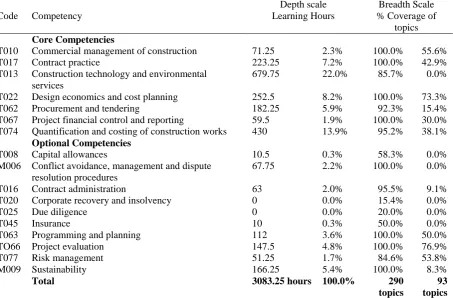
[image:14.595.74.528.616.773.2]On the whole, the conceptual benchmark shows the average level of graduate competency achievement from four universities (case studies) of RICS accredited programmes. Thus, the conceptual benchmark indicates graduate attainment of RICS QS competencies. This provided a basis for further investigation of industry and academic views of the conceptual benchmark and their expectations. This is essential to harmonise diverse views and to generate a minimum graduate competency benchmark that satisfies the aspirations of all stakeholders. In order to provide a meaningful comparison of the priorities of the conceptual benchmark, the summary of the depth and breadth scales for competencies is provided.
Table 3: Results of the summary of conceptual benchmark
Depth scale Breadth Scale
Code Competency Learning Hours % Coverage of
topics Average Time % Level 1 Level 2
Mandatory Competencies
M001 Accounting principles and procedures 3.75 0.1% 80.0% 0.0%
M002 Business planning 25 0.8% 100.0% 0.0%
M003 Client care 32.5 1.1% 75.0% 50.0%
M004 Communication and negotiation 148.5 4.8% 100.0% 87.5%
M005 Conduct rules, ethics and professional practice 28.75 0.9% 64.3% 14.3%
M007 Data management 90 2.9% 100.0% 71.4%
M008 Health and safety 78.75 2.6% 100.0% 0.0%
Depth scale Breadth Scale
Code Competency Learning Hours % Coverage of
topics
Core Competencies
T010 Commercial management of construction 71.25 2.3% 100.0% 55.6%
T017 Contract practice 223.25 7.2% 100.0% 42.9%
T013 Construction technology and environmental services
679.75 22.0% 85.7% 0.0%
T022 Design economics and cost planning 252.5 8.2% 100.0% 73.3%
T062 Procurement and tendering 182.25 5.9% 92.3% 15.4%
T067 Project financial control and reporting 59.5 1.9% 100.0% 30.0% T074 Quantification and costing of construction works 430 13.9% 95.2% 38.1%
Optional Competencies
T008 Capital allowances 10.5 0.3% 58.3% 0.0%
M006 Conflict avoidance, management and dispute resolution procedures
67.75 2.2% 100.0% 0.0%
T016 Contract administration 63 2.0% 95.5% 9.1%
T020 Corporate recovery and insolvency 0 0.0% 15.4% 0.0%
T025 Due diligence 0 0.0% 20.0% 0.0%
T045 Insurance 10 0.3% 50.0% 0.0%
T063 Programming and planning 112 3.6% 100.0% 50.0%
TO66 Project evaluation 147.5 4.8% 100.0% 76.9%
T077 Risk management 51.25 1.7% 84.6% 53.8%
M009 Sustainability 166.25 5.4% 100.0% 8.3%
Total 3083.25 hours 100.0% 290
topics
[image:15.595.75.529.74.372.2]93 topics
Table 3 is derived from obtaining average figures from the four case studies completed. The depth scale was developed using mean time periods utilised for each competency. The breadth scale was developed by considering the frequency of engagement with the topics in the study checklist and considering any of the case study programmes dealing with the topic at least once (considered as 1 – contributing to the count). There are 290 topics used at Level 1 across the four case studies and 93 topics used at Level 2. This does not necessarily imply that any one case study (university) used all 290 topics identified here. The total of 290 and 93 for Level 1 and 2 respectively indicate the maximum number of topics dealt with across four case studies. Similarly, there are a total of 3083 hours of learning representing 86% of learning time for a programme (see Table 3).
A detailed analysis of the conceptual benchmark weighting of competencies-mandatory, core and optional competencies is presented.
Figure 4: Conceptual benchmark - weighting of competencies
18%
62%
20% Mandatory
Competencies
Core Competencies
[image:15.595.181.446.584.727.2]The core competencies have the greatest weighting with a 62% share, followed by optional competencies with 20% and mandatory competencies with an 18% share. The conceptual benchmark provides the basis for development of the final benchmark for graduate level competencies. Therefore, the conceptual benchmark was presented to the expert forum.
9 Development of the final benchmark for graduate routes
The conceptual benchmark was presented to a selected expert forum for refinement of both breadth and depth scales for all study topics and competencies. Using the Delphi methodology, the views of experts were harmonised to create the final benchmark. The process is briefly explained as follows:
9.1 Establishing the expert forum
[image:16.595.135.463.368.602.2]The forum of experts consisted of industry practitioners from large, SME and micro level quantity surveying organisations. These included quantity surveying employer organisations from both the traditional consulting and contracting sectors. A minimum of two experts from each category were sought for this exercise. In addition, three quantity surveying programme directors from RICS accredited programmes were also invited to participate. All members were chartered surveyors and experienced either as practitioners or academics. The forum consisted of 15 members representing all types of quantity surveying employers and academics (see Table 4).
Table 4: Composition of the expert forum
No. Type of Organisation Abbreviation Size Code
1 Consulting practice PQS Large L
2 Consulting practice PQS Large D
3 Consulting practice PQS SME G
4 Consulting practice PQS SME E
5 Consulting practice PQS Micro F
6 Consulting practice PQS Micro B
7 Contracting CQS Large Q
8 Contracting CQS Large K
9 Contracting CQS SME A
10 Contracting CQS SME J
11 Contracting CQS Micro C
12 Contracting CQS SME H
13 Academia Academic University N
14 Academia Academic University M
15 Academia Academic University P
9.2Revision and ratification of the conceptual benchmark
The stages followed in the expert forum were as follows:
1. Invitations to industry and academic experts to join the expert forum. 2. Appointment of the expert forum members.
3. Arranging and conducting individual expert forum interviews to obtain views on revisions to the conceptual benchmark.
4. Collating the views of the expert forum members and developing the revised benchmark considering the average views of all experts.
6. Collating all further revisions to develop the ratified benchmark.
7. Converting the ratified benchmark to the final benchmark, this comprises the graduate competency threshold benchmark (GCTB).
The details of how the revised benchmark values were developed from the conceptual benchmark and the development of the ratified benchmark values from the revised benchmark are explained as follows:
For the breadth scale, mode was used to analyse expert forum views. A competency consists of several topics. At Level 1, a topic under a certain competency would either be expected (i.e. by the experts) to be covered (i.e. marked as 1) or not expected to be covered (i.e. marked as 0), in graduate QS education. The same rules applied to Level 2 coverage. Level 3 was not considered because it is not a typical level of attainment in graduate QS education. The modes of the 15 experts’ views were then derived for each topic at both Level 1 and Level 2. For example, if 8 experts (hence 8 ticks) or more thought that a topic should be covered in graduate QS education at Level 1, the topic was marked as 1 under Level 1, and vice versa. The same applied to Level 2 coverage. The numbers of topics covered under each competency, marked as 1, were then used to calculate the percentage coverage of topics for that competency, at both Level 1 and Level 2.
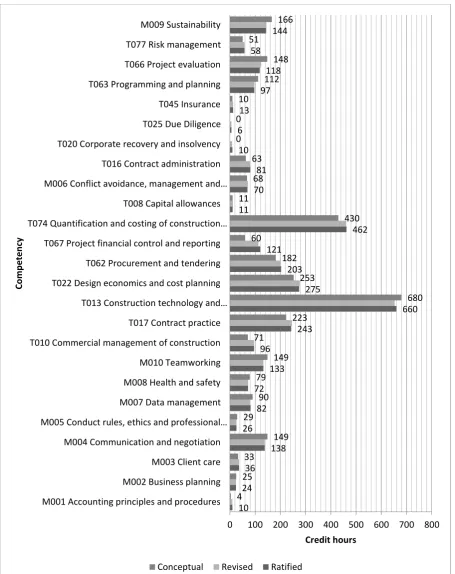
The average views of all experts were used for the depth scale. The experts were asked to amend the conceptual benchmark values i.e. credits hours to reflect the learning hours they thought should be allocated to each competency in graduate QS education. The mean value of the 15 expert forum views on credits hours was then computed for each competency. The mean figure was converted to percentage score to illustrate the relative time proportion for each competency.
Figure 5: Cross comparison of ratified, revised and conceptual benchmarks for graduate competencies
9.3 The graduate competency threshold benchmark (GCTB) - final benchmark
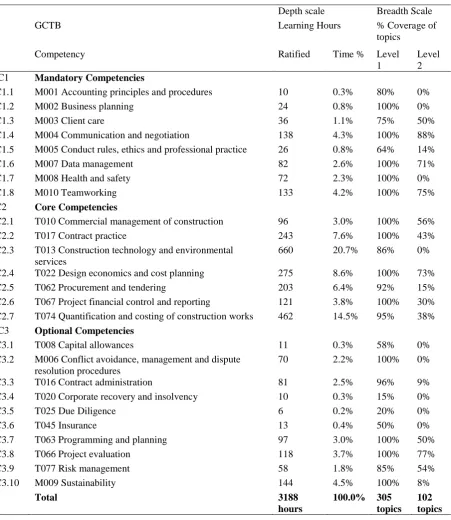
The final ratified benchmark with the dual scale breadth and depth mappings was converted to create the final GCTB. Therefore, GCTB represents minimum levels of competency achievement. A summarised version of the final benchmark (GCTB) is presented.
10 24 36 138 26 82 72 133 96 243 660 275 203 121 462 11 70 81 10 6 13 97 118 58 144 4 25 33 149 29 90 79 149 71 223 680 253 182 60 430 11 68 63 0 0 10 112 148 51 166
0 100 200 300 400 500 600 700 800
M001 Accounting principles and procedures M002 Business planning M003 Client care M004 Communication and negotiation M005 Conduct rules, ethics and professional…
M007 Data management M008 Health and safety M010 Teamworking T010 Commercial management of construction T017 Contract practice T013 Construction technology and… T022 Design economics and cost planning
T062 Procurement and tendering T067 Project financial control and reporting T074 Quantification and costing of construction…
T008 Capital allowances M006 Conflict avoidance, management and…
T016 Contract administration T020 Corporate recovery and insolvency T025 Due Diligence T045 Insurance T063 Programming and planning T066 Project evaluation T077 Risk management M009 Sustainability Credit hours Co m p e te n cy
Table 5: Summarised final benchmark (GCTB)
Depth scale Breadth Scale
GCTB Learning Hours % Coverage of
topics
Code Competency Ratified Time % Level
1
Level 2 C1 Mandatory Competencies
C1.1 M001 Accounting principles and procedures 10 0.3% 80% 0%
C1.2 M002 Business planning 24 0.8% 100% 0%
C1.3 M003 Client care 36 1.1% 75% 50%
C1.4 M004 Communication and negotiation 138 4.3% 100% 88%
C1.5 M005 Conduct rules, ethics and professional practice 26 0.8% 64% 14%
C1.6 M007 Data management 82 2.6% 100% 71%
C1.7 M008 Health and safety 72 2.3% 100% 0%
C1.8 M010 Teamworking 133 4.2% 100% 75%
C2 Core Competencies
C2.1 T010 Commercial management of construction 96 3.0% 100% 56%
C2.2 T017 Contract practice 243 7.6% 100% 43%
C2.3 T013 Construction technology and environmental services
660 20.7% 86% 0%
C2.4 T022 Design economics and cost planning 275 8.6% 100% 73%
C2.5 T062 Procurement and tendering 203 6.4% 92% 15%
C2.6 T067 Project financial control and reporting 121 3.8% 100% 30% C2.7 T074 Quantification and costing of construction works 462 14.5% 95% 38% C3 Optional Competencies
C3.1 T008 Capital allowances 11 0.3% 58% 0%
C3.2 M006 Conflict avoidance, management and dispute resolution procedures
70 2.2% 100% 0%
C3.3 T016 Contract administration 81 2.5% 96% 9%
C3.4 T020 Corporate recovery and insolvency 10 0.3% 15% 0%
C3.5 T025 Due Diligence 6 0.2% 20% 0%
C3.6 T045 Insurance 13 0.4% 50% 0%
C3.7 T063 Programming and planning 97 3.0% 100% 50%
C3.8 T066 Project evaluation 118 3.7% 100% 77%
C3.9 T077 Risk management 58 1.8% 85% 54%
C3.10 M009 Sustainability 144 4.5% 100% 8%
Total 3188
hours
100.0% 305 topics
102 topics
Figure 6: Overall comparison of coverage of topics (breadth scale) across competency categories
As indicated in Figure 6 it is evident that most topics, especially within mandatory and core competencies need to be covered at Level 1. There is a slightly higher coverage expected at Level 2 for mandatory competencies over core competencies.
The depth scale indicates the minimum number of learning hours that needs to be allocated to each competency in a RICS accredited QS honours degree programme. The module specifications of such a programme can be mapped to the RICS QS competencies, identifying the learning hours spent for each competency. The minimum benchmark developed in this research provides a threshold minimum to achieve in this competency. This is presented in Figure 7.
89.9% 96.2%
72.4%
37.3% 36.5%
19.8%
0.0% 20.0% 40.0% 60.0% 80.0% 100.0% 120.0%
Mandatory competencies Core competencies Optional competencies
Figure 7: Benchmark minimum learning hours - depth scale
Similarly, the breadth scale in the benchmark indicates the expected percentage coverage of the RICS QS study checklist. Thus, summary of which study topics need to be covered is indicated in the benchmark presented in Figure 8.
10 24
36
138 26
82 72
133 96
243
660 275
203 121
462 11
70 81 10 6
13 97
118 58
144
0 100 200 300 400 500 600 700
M001 Accounting principles and procedures M002 Business planning M003 Client care M004 Communication and negotiation M005 Conduct rules, ethics and professional…
M007 Data management M008 Health and safety M010 Teamworking T010 Commercial management of construction T017 Contract practice T013 Construction technology and… T022 Design economics and cost planning
T062 Procurement and tendering T067 Project financial control and reporting T074 Quantification and costing of construction…
T008 Capital allowances M006 Conflict avoidance, management and…
T016 Contract administration T020 Corporate recovery and insolvency T025 Due Diligence T045 Insurance T063 Programming and planning T066 Project evaluation T077 Risk management M009 Sustainability
Minimum Learning Hours
Co
m
p
e
te
n
ci
e
Figure 8: Benchmark minimum coverage of study topics - breadth scale
10 Discussion
It is increasingly evident today that significant attention is paid to competency-based education for professional graduate degree programmes in higher education institutions (HEIs) in many disciplines across the globe. The purpose of this research is to develop a competency mapping framework (CMF) for the professionally oriented degree programmes taking quantity surveying (QS) honours degree programme as an exemplary. To accomplish this, researchers conducted an extensive review of relevant literature, pilot study, case studies (including semi-structured interviews), and expert forum using Delphi technique in developing the CMF. The selected case studies comprised four leading QS honours degree programmes in the UK, all accredited by the RICS. The curricula of these programmes (module specifications) were mapped against RICS QS competencies. The case studies, therefore, provided the basis for the development of the benchmark for graduate competencies. The 25 RICS competencies identified in this research are grouped into three as follows: (1) 8 mandatory competencies, (2) 7 core competencies, and (3) 10 optional competencies (RICS, 2009). This approach is similar to previous studies. For instance, Ahn et
80% 100% 75% 100% 64% 100% 100% 100% 100% 100% 86% 100% 92% 100% 95% 58% 100% 96% 15% 20% 50% 100% 100% 85% 100% 0% 0% 50% 88% 14% 71% 0% 75% 56% 43% 0% 73% 15% 30% 38% 0% 0% 9% 0% 0% 0% 50% 77% 54% 8%
0% 20% 40% 60% 80% 100%
M001 Accounting principles and procedures M002 Business planning M003 Client care M004 Communication and negotiation M005 Conduct rules, ethics and professional…
M007 Data management M008 Health and safety M010 Teamworking T010 Commercial management of construction T017 Contract practice T013 Construction technology and… T022 Design economics and cost planning
T062 Procurement and tendering T067 Project financial control and reporting T074 Quantification and costing of construction…
T008 Capital allowances M006 Conflict avoidance, management and…
T016 Contract administration T020 Corporate recovery and insolvency T025 Due Diligence T045 Insurance T063 Programming and planning T066 Project evaluation T077 Risk management M009 Sustainability
% Coverage of study topics
Co m p e te n ci e s
al. (2012) identified 14 key competencies for the United States construction graduates. Through factor analysis the authors grouped the identified competencies into 4 classes of competencies for construction graduates as follows: (1) general competency, (2) affective competency, (3) cognitive competency, and (4) technical competency.
Arain (2010) identified the graduate competencies for baccalaureate level construction education in Alberta, Canada. The author recommended that the breadth and depth of the cores curricula ensured sufficient coverage of fundamental and extended topics in construction project management. This present research mirrors similar research undertaken in Alberta, Canada (see Arain, 2010), the United States (see Ahn et al., 2012), in Australia (see Newton and Goldsmith, 2011a, 2011b; Newton et al., 2012), in the UK (see Perera and Pearson, 2011), in South Africa (see Nkado and Meyer, 2001), but expand the works with increased attention to the mapping of the breadth and depth of competency groups. Perlin (2011) recognised mapping as an approach for “evaluation and restructuring of an individual course and curriculum objectives for alignment with programme competencies and accreditation requirements”. The mapping process further provided an opportunity for evaluating how well the overall curriculum reflects the program’s stated competencies in terms of breadth and depth (Rissi and Gelmon, 2014). Against this backdrop, this research developed a competency mapping framework (CMF) for programme appraisal and benchmarking. The CMF consists of three essential instruments to include graduate competency threshold benchmark (GCTB), competency mapping template (CMT) and competency mapping record (CMR). In achieving the CMF, a logical learning credit based competency mapping scoring system is developed as a dual scale matrix consisting of a ‘breadth scale’ and ‘a depth scale’. The breadth scale consists of 4 columns to include Level 1 and Level 2 columns that indicate the level at which a topic is to be achieved at the undergraduate level. The other two columns present statistics of percentage coverage of topics at Levels 1 and Level 2 respectively. The depth scale consists of two columns to include the credit hours column that indicates the amount of time an undergraduate student should spend in learning topics related to a competency, and the final column provides statistics of the percentage time allocation for a competency (see Figure 9 for details). This approach is similar to the process adopted by Newton and Goldsmith (2011b) when developing
Threshold Learning Outcomes (TLOs) to benchmark the graduate outcomes from Bachelor-level study in building and construction management in Australia.
Figure 9: Sample portion of final GCTB
11 Conclusions
a useful methodology to map program curricula to competencies, which can be replicated in any construction oriented degree programme. The practical implication indicates that CMF can be used effectively in programmes development and validation. The CMF would further be useful in monitoring and improving quality and professional standards of any degree programmes. It is believed that this research finding would align practice and academic priorities, thus enhancing the employability of construction graduates.
Acknowledgments
The authors wish to acknowledge the RICS Research Trust, members of Construction Economics and Management Research Group (CEMRG) in the Faculty of Engineering and Environment, and Northumbria University for their support for this research.
References
ACCE (2015). “Standards and criteria for accreditation of postsecondary construction education degree programs”. Available at:
http://www.acce-hq.org/images/uploads/Doc_103_OBS_final_042915.pdf
(December 8, 2015).
Australian Learning and Teaching Council (ALTC) (2011).“Learning and teaching
academic standards project: building and construction academic standards statement”.
Available at:
http://disciplinestandards.pbworks.com/w/file/fetch/53056843/altc_standards_BUILD ING.pdf (December 8, 2015).
Ahn, Y., Annie, R. and Kwon, H. (2012). "Key competencies for U.S. construction graduates: industry perspective". Journal of Professional Issues in Engineering Education Practice, 138(2), 123–130.
Arain, F. (2010). "Identifying competencies for baccalaureate level construction education: enhancing employability of young professionals in the construction industry".
Construction Research Congress, 194-204.
Batterman, S., Martins, A., Antunes, C., Freire, F. and da Silva, M. (2011). "Development and application of competencies for graduate programs in energy and sustainability".
Journal of Professional Issues in Engineering Education Practice, 137(4), 198–207. Bowen, P., Cattell, K., Distiller, G. and Edwards, P. J. (2008). "Job satisfaction of South
African quantity surveyors: An empirical study". Construction Management and Economics, 26(7), 765–780.
Cowan, D. T., Norman, I. and Coopamah, V. P. (2007). "Competence in nursing practice: A controversial concept– A focused review of literature". Accident and Emergency Nursing, 15(1), 20–26.
Dainty, A. R. N., Cheng, M. I. and Moore, D. R. (2003). "Redefining performance measures for construction project managers: an empirical evaluation". Construction Management and Economics, 21, 209-218.
Getha-Taylor, H., Hummert, R., Nalbandian, J. and Silvia, C. (2013). "Competency model design and assessment: Findings and future directions". Journal of Public Affairs Education, 19(1), 141–171.
Gibb, S. (2003). "Information advice and guidance – Is it time for a national research forum".
Career Development International, 8(4), 169-218.
Kaklauskas, A., Daniūnas, A., Amaratunga, D., Urbonas, V., Lill, I., Gudauskas, R., . . Jackutė, I. (2012). "Life cycle process model of a market-oriented and student centered higher education",. International Journal of Strategic Property Management,
Keraminiyage, K. and Lill, I. (2013). "Strategies to address gaps in the supply and demand of skills and knowledge in built environment-related disciplines". International Journal of Strategic Property Management, 17(2), 111-113.
Ling, F. Y. Y. and Chan, A. H. M. (2008). "Internationalising quantity surveying services".
Engineering, Construction and Architectural Management, 15(5), 440–455.
Male, S. (1990). "Professional authority, power and emerging forms of ‘profession’ in quantity surveying". Construction Management and Economics, 8(2), 191-204. Meyer, T. and Semark, P. (1996). "A framework for the use of competencies for achieving
competitive advantage". South African Journal of Business Management, 27(4), 96– 103.
Newton, S. (2011). “Building and construction learning and teaching academic standards statement: learning and teaching academic standards project”, Strawberry hills, Australia: Australian Learning and Teaching Council. Available at: http://www.altc.edu.au/ (December 8, 2015).
Newton, S. and Goldsmith, R. (2011a). “An analysis of stakeholder preferences for threshold learning outcomes in construction management in Australia In:Egbu, C. and Lou, E.C.W. (Eds.) Proceedings27th Annual ARCOM Conference,5-7 September, Bristol, UK,
Newton, S. and Goldsmith, R. (2011b). “Setting academic standards for tertiary education in the construction industry”, In Proceedings of 36th AUBEA conference, Melbourne, Australia. Available at: http://www2.bond.edu.au/about/faculties/bus/isda/aubea.html (December 8, 2015).
Newton, S., Betts, M., Burt, R. and Lees, M. (2012). “Setting global academic standards for the building and construction industry: a discussion piece”, In Proceedings of the Joint CIB International Conference: Management of Construction: Research to Practice, Birmingham School of the Built Environment, Birmingham City University, UK.
Nkado, R. and Meyer, T. (2001). "Competencies of professional quantity surveyors: a South African perspective". Construction Economics and Management, 19, 481-491.
Pathirage, C. P. and Amaratunga, R. D. G. (2006). "A vision for the quantity surveying education in the 21st century: United Kingdom perspective. In: Customising the quantity surveying education, Department of Building Economics, University of Moratuwa, Sri Lanka.
Perera, S. and Pearson, J. (2011). "Alignment of professional, academic and industrial development needs for quantity surveyors: Post recession dynamics". RICS Education
Trust funded research report, UK. Available at:
http://www.rics.org/uk/knowledge/research/research-reports/alignment-of- professional-academics-and-industrial-development-needs-for-quantity-surveyors-the-post-recession-dynamics-/ (September 20, 2014).
Perera, S. and Pearson, J. (2013). "RICS professional competency mapping framework for programme appraisal and benchmarking”, RICS Research Trust funded research Main Report, RICS. Available at: , http://www.rics.org/uk/knowledge/research/research-reports/professional-competency-mapping-framework/ (September 20, 2014).
Perlin, M. S. (2011). “Curriculum mapping for program evaluation and CAHME accreditation”. Journal of Health Administration Education, 28(1), 27–47.
Pheng, L. S. and Ming, K. H. (1997). "Formulating a strategic marketing mix for quantity surveyors". Marketing Intelligence & Planning, 15(6), 273–280.
Rashid, K. A. (2002). "A study on the curricula for the bachelor of quantity surveying courses in Malaysia". The Surveyor, 3, 17–22.
RICS (1971). The future role of the quantity surveyor: London: RICS.
RICS (1983). The future role of the chartered quantity surveyor: London: RICS.
RICS (1992). The Core Skills and Knowledge Base of the Quantity Surveyor. London: RICS. RICS (2008a). Your pathway to qualifying in quantity surveying and construction: supplemental guidance. RICS Quantity Surveying and Construction Faculty in conjunction with RICS Education and Training. London.
RICS (2008b). Policy and Guidance on University Partnerships. RICS Education and Qualification Standards Department. London.
RICS (2009). “Requirements and competencies, RICS education and qualification standards”.
Available at:
http://www.rics.org/site/scripts/download_info.aspx?fileID=3729&categoryID=98 (September 20, 2014).
Rissi, J. J. and Gelmon, S. B. (2014). "Development, implementation, and assessment of a competency model for a graduate public affairs program in health administration".
Journal of Public Affairs Education, 20(3), 335-352.
Rowe, G. and Wright, G. (2001). "Expert Opinions in Forecasting: Role of the Delphi Technique" In Armstrong, Principles of Forecasting: A Handbook of Researchers and Practitioners. Boston: Kluwer Academic Publishers.
Smith, P. (2009). "Trends in the Australian quantity surveying profession: 1995–2008".
Proceedings of the 13th Pacific Association of Quantity Surveyors Congress (PAQS 2009), 17–18 August, Kuala Lumpur.