Methods in discourse variation analysis:
Reflections on the way forward
Pichler, H
http://dx.doi.org/10.1111/j.14679841.2010.00455.x
Title Methods in discourse variation analysis: Reflections on the way forward
Authors Pichler, H
Type Article
URL This version is available at: http://usir.salford.ac.uk/18663/ Published Date 2010
USIR is a digital collection of the research output of the University of Salford. Where copyright permits, full text material held in the repository is made freely available online and can be read, downloaded and copied for noncommercial private study or research purposes. Please check the manuscript for any further copyright restrictions.
Pichler, Heike. 2010. Methods in discourse variation analysis: Reflections on the way forward. Journal of Sociolinguistics 14(5): 581-608.
NOTE: This is a pre-publication version of the paper. Please consult the given publication or contact me directly for an off-print of the final versions.
Methods in Discourse Variation Analysis:
Reflections on the Way Forward1
ABSTRACT
This paper demonstrates the need for a uniform model of discourse variation
analysis which is equipped to capture the complex nature of discourse variation
and change whilst also ensuring generalizability. A review of the literature shows
that the current heterogeneity in corpus construction, data quantification and
theorizing of discourse variables impedes reliability and intersubjectivity.
Suggestions are offered to achieve comparability, and a case is made for a
consistent integration of pragmatic function as a factor group in the analysis. The
extension of the variationist paradigm to the level of discourse is discussed, and
the need for a definition of discourse variables which caters for their flexibility
and multifunctionality is demonstrated. It is argued that some methodological
consistency is required in variationist discourse analysis in order to advance
towards a holistic description of patterns in language variation and change which
spans all components of the grammar, and to systematically explore how
discourse features are used and manipulated to create social identities.
Key words: discourse variation and change, discourse variables, discourse
markers, variationist methodology, generalizability
Running title: Methods in discourse variation analysis
ABSTRACT
Dieser Beitrag plädiert für eine einheitliche Methode zur
Diskursvariationsanalyse, welche der Komplexität von Dikursvariationen gerecht
wird und Generalisierungen zulässt. Der Literaturüberblick ergibt, dass die
gegenwärtige Heterogenität in der Zusammenstellung von Korpora,
Datenquantifizierung und Konzeptualisierung von Diskursvariablen
Zuverlässigkeit und Intersubjektivität beeinträchtigt. Es werden Vorschläge
unterbreitet, wie man Vergleichbarkeit sicher stellen kann, und es wird für eine
konsistente Integration von pragmatischen Funktionen als Faktorengrupppe in der
Analyse plädiert. Die Anwendung eines variationistischen Ansatzes auf die
Analyse von Diskursmarkern wird erörtert. Des Weiteren wird die Notwendigkeit
illustriert, Diskursmarker als Variable zu definieren, wobei ihre Flexibilität und
Multifunktionalität berücksichtigt werden muss. Methodische Konsistenz ist
erforderlich, um eine umfassende Theorie von Sprachvariation und -wandel zu
formulieren und um systematisch zu analysieren, wie diese Variablen zur
Konstruktion von sozialen Identitäten verwendet werden.
Schlüsselwörter: Diskursmarker, Variation, Sprachwandel, Quantifizierung,
Generalisierung
1. INTRODUCTION
The study of discourse-pragmatic features such as oh, well, I mean, you know, etc. has not traditionally fallen under the remit of variationist sociolinguistics. Because
of their ill-defined grammatical status, their extra-sentential positioning and their
lack of truth-functional semantic meaning, discourse-pragmatic features have for
long been viewed as extra- or a-grammatical elements of language in traditional
grammatical accounts.2 Marginalized as overt manifestations of verbal
dysfluencies and inarticulateness, meaningless verbal fillers and superfluous
hesitation markers, they were dismissed as not warranting linguistic investigation.
Scholarly interest in these features developed only in the 1980s, with the growing
recognition that they carry social meaning, perform indispensable functions in
social interaction, and constitute essential elements of sentence grammar (Dines
1980; Schiffrin 1987; Traugott 1995).3
Although variationist studies of discourse-pragmatic features are still
relatively rare, especially when compared to the profusion of variationist studies
of phonological and, to a lesser extent, lower-level morpho-syntactic features,
they consistently highlight the fact that discourse features, like features in other
components of the grammar, evince orderly heterogeneity and a capacity for
change. It has been repeatedly shown, for example, that patterns of variation in
terms of the frequency, strategic use and formal encoding of discourse features
correlate with social and internal factors (e.g. Cheshire 1981; Holmes 1995;
Macaulay 2005; Pichler 2009; Stubbe and Holmes 1995), and that these factors
are motivating forces in discourse change (e.g. Ferrara and Bell 1995; Pichler
2008; Tagliamonte and Hudson 1999). Yet despite accumulative evidence that
discourse features are systematically involved in patterns of language variation
elementary stage’ (Macaulay 2002a: 298). In this paper, I demonstrate that the
embryonic state of discourse variation analysis is due largely to the lack of a
coherent set of methodological principles, and argue that the development of a
reliable and uniform model of analysis is paramount in order to advance our
understanding of discourse variation and change.
Quantitative studies of lower-level phonological and morpho-syntactic
variation and change have been relatively homogeneous and congruent in focus
and methodology, thus ensuring reliability and intersubjectivity, i.e., that the same
results are obtained across different datasets and by different analysts (Bailey and
Tillery 2004: 11). The resultant comparability (and, necessarily, the profusion) of
studies has allowed scholars to formulate general principles as regards, for
example, the role of women in language change and the relative importance of
social and internal factors in language variation (Labov 1998; Preston 1991). Yet,
these generalizations might not apply equally across all levels of the grammar for
there is evidence that the mechanisms underlying variation and change in
discourse (and higher-level syntax) are different from those in phonology and
morpho-syntax (Cheshire, Kerswill and Williams 2005). Progression towards a
holistic theory of language variation and change therefore necessitates that
generalizations about patterns of variation and change in discourse (and syntax)
be drawn independently. Alas, this endeavour is hampered by the persistent
diversity of methods used in discourse variation analysis and the resultant lack of
cross-corpora comparability. This makes it difficult, if not altogether impossible,
to synthesize the results of previous studies into a set of coherent findings, and
thus, to formulate empirically grounded generalizations of discourse variation and
change. In this paper, I advocate methods which ensure reliable cross-corpora
internal dimensions of discourse variation and change as well as the role of
discourse features in the marking and construction of social identities.
The diversity of methods in discourse variation analysis can be linked to the
fact that discourse-level features ‘are used by speakers in such complex and
sophisticated ways [that] studying variation in their use is no straightforward task’
(Stubbe and Holmes 1995: 85). Because of fundamental differences in the nature
and use of lower-level and higher-level linguistic features, it remains a
contentious issue whether the variationist paradigm, originally developed by
Labov (1963, 1966) for the analysis of phonological variability, can be extended
to the analysis of higher-level variability. Discourse-level features do not easily
satisfy the criteria set out by Labov (1972) for the linguistic variable, the principal
methodological tool in variationist analysis. Firstly, the operation of semantic and
pragmatic constraints on discourse features affects the frequency critical for
quantitative analysis. Secondly, their intrinsic multifunctionality prohibits
discourse variants from being identified on the basis of semantic equivalence.
Thirdly, their multifunctionality causes difficulties in circumscribing their
variable context, which hampers attempts to quantify their variability in an
accountable manner (see, however, D’Arcy 2005). These complexities have led to
the adoption by discourse variationists of highly differential methods of analysis.
The heterogeneity mainly affects the nature of the corpora investigated; the
theoretical basis for defining discourse variables; the quantitative methods
employed; and the optional integration of function as a factor group in the
analysis.
This paper sets out to critically examine the methodological heterogeneity of
discourse variation studies, with the aims of (a) assessing the reliability of the
differ, (c) exploring the theoretical implications of these differences, and (d)
proposing an analytical framework which is equipped to ensure reliability and
intersubjectivity. I begin, in section 2, with exploring how comparability can be
promoted despite the inevitable diversity in the construction of corpora used for
discourse variation analyses. In section 3, I argue in favour of extending the
linguistic variable to the analysis of discourse-level features, provided that it is
modified to cater for their distinctive characteristics. Section 4 examines the
respective suitability and value of different quantitative approaches to discourse
variability – those which require a closed set of variants and those which do not. I
posit in section 5 that in order to provide accurate accounts of discourse variation
and change, it is necessary to integrate pragmatic function as a factor group in the
analysis. Finally, in section 6, I provide a summary of the analytical methods
advocated in this paper, outline what insights about discourse variation and
change they may afford us, and explain how their adoption might benefit the
variationist enterprise as a whole. In this section, I also discuss how a reliable and
uniform framework of discourse variation analysis may inform efforts to explore
how individuals manipulate discourse variation to negotiate and establish social
meanings and identities.
I do not claim to answer here all the questions surrounding discourse
variation methodology, but I hope to stimulate serious reflection and discussion
amongst discourse variationists in order to generate a gradual progression towards
the formulation of a coherent theory of discourse variation and change.
2. CORPUS CONSTRUCTION: CATERING FOR CONTEXTUAL
The usage of discourse-pragmatic features is strongly constrained by the
interactional and situational context of their occurrence, to the extent even that
these factors may outrank the effect of social factors on discourse variability (see
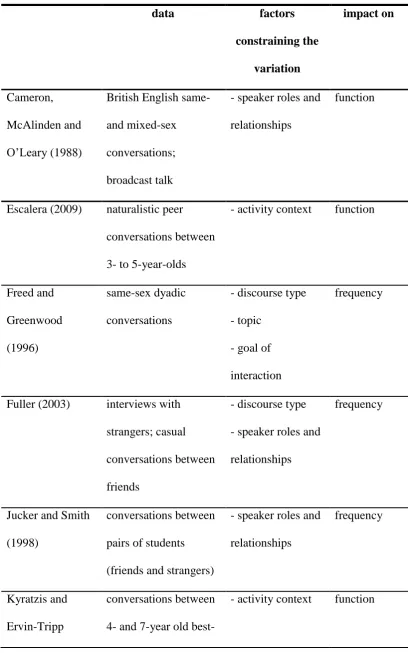
e.g. Schleef 2008). Table 1 lists quantitative studies into the effect of context on
discourse-pragmatic variation, detailing which contextual factors affect the
variables’ use, and whether it is their frequency or their function that is affected.
A wide array of contextual factors is involved: discourse type and activity context;
topic, purpose of and attitudes to the interaction; speaker roles and relationships;
and communicative channel. The fluctuating frequencies of discourse-pragmatic
features are generally attributed to their communicative function(s) being more or
less relevant across different contexts (see, for example, Freed and Greenwood
1996), while their differential functional uses across context are often attributed to
the variable interactional demands of different speech events (see, for example,
Mauranen 2004).
[insert Table 1]
The extreme context-sensitivity of discourse features hampers cross-corpora
comparability and generalizability. With comparability not generally a design
feature of dialectal corpora, different corpora may produce differential
opportunities for the occurrence and strategic use of discourse features. It may
therefore prove (near) impossible to disentangle the effect of contextual, social
and geographical factors on the observed variation. Terraschke (2007), for
example, failed to establish whether the differential rate of general extenders, i.e.,
clause- or utterance-final constructions such as and that, and stuff like that, or something, in her and Overstreet’s (1999) corpora is due to dialectal differences
(New Zealand vs. American English) or contextual differences in the relationship
Difficulties in cross-corpora comparisons could potentially be resolved if
scholars were to construct corpora on parallel principles. Yet this is not a realistic
scenario. Firstly, corpora are collected with different goals and assumptions in
mind, and researchers work with different resources. These factors control the
overall design features of private corpora, yielding a wide range of vastly
differential corpora. Secondly, as Kallen and Kirk (2007) highlight in their
discussion of the construction of the ICE-Ireland corpus, even where scholars aim
to construct comparable public corpora according to global design principles, they
face local challenges that require some elaboration or modification of these
principles. In the absence of consistent corpus construction principles, scholars
therefore need to exercise great caution when comparing corpora of socially and
regionally diverse speech samples, and consider at all times the possibility that
cross-corpora differences may reflect the effect of differential contextual
constraints on the variation, rather than actual social or geographical variation
(see, for example, Escalera 2009).
The isolation of contextual factors from other factors can be facilitated by
implementing the following measures. Firstly, more studies need to be conducted
which test the effect of multifarious contextual factors on the usage and
distribution of the range of discourse-pragmatic features. Secondly, detailed
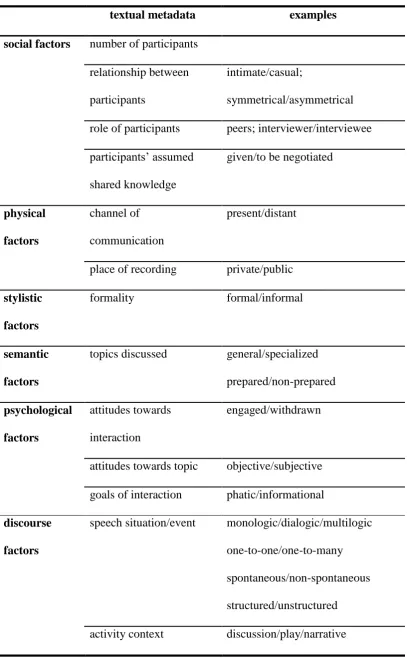
demographic as well as textual metadata about corpora need to be provided. In
conjunction with detailed knowledge of contextual effects on the use of targeted
discourse variables, knowledge of metadata will allow scholars to assess – maybe
not with total but at least with some confidence – whether the findings obtained
across corpora are comparable, or whether cross-corpora differences in the use
and distribution of discourse variables are an artefact of differential contextual
would yield more conclusive insights about dialectal variation in general extender
usage if there was cogent evidence from other studies about the effect of
interpersonal relationships on the usage of these constructions, and if detailed
provision of metadata by both scholars allowed us to rule out the potential effect
of any other contextual factors on cross-corpora variability. The type of
metatextual data required for all studies of discourse variation and change is
summarized in Table 2.
[insert Table 2]
3. DISCOURSE VARIABLES: DELIMITING THE VARIABLE CONTEXT
In order for discourse variation analysis to progress towards accountability,
comparability and generalizability, it is crucial to address another issue which has
not yet been satisfactorily resolved: whether discourse-pragmatic features can be
operationalized as linguistic variables, and if so, on what grounds.
The concept of the linguistic variable was originally developed by Labov
(1963, 1966) for the analysis of phonological variability: to fully understand the
mechanisms underlying linguistic variation, it is necessary to isolate the whole set
of possible variants of a variable and to report the total number of the variants’
actual and potential occurrences (‘Principle of Accountability,’ Labov 1972:
71-72). Whilst Sankoff (1973: 44, 58) argues that the extension of the linguistic
variable to levels ‘above and beyond phonology’ is ‘not a conceptually difficult
jump,’ others have expressed their reservations about this extension.
Dines (1980) and Lavandera (1978) questioned the methodological and
theoretical soundness of scholars’ wholesale transfer of the linguistic variable to
the analysis of non-phonological variability on the basis that the defining criterion
higher-level linguistic variables due to their differential semiotic nature. Their proposals
to modify the defining criterion of the linguistic variable for the analysis of
discourse (and syntactic) features were criticised by Cheshire (1987) and Romaine
(1984) for being made without consideration of the theoretical assumptions
underlying the variable’s original conception. Yet it is hard to conceive how the
mechanisms underlying higher-level variability can be satisfactorily explained
without modifying the linguistic variable in accordance with the properties of the
grammatical level to which it is applied.
The notion of the discourse variable has to account for a very different
phenomenon than notions conceptualized for variables in other components of the
grammar, including that proposed by Serrano (to appear) for syntactic variables.4
Unlike other linguistic features, discourse-pragmatic features do not occupy a
fixed syntactic or segmental slot nor is their pragmatic meaning constant; they
occur in a variety of positions and take on different pragmatic meanings across
different contexts of use. They are referentially and syntactically optional
elements of discourse that can be omitted without necessarily altering the
propositional meaning or syntactic structure of an utterance. Consequently, their
usage in discourse is triggered by different motives than that of other linguistic
features; discourse features are not generally employed to communicate content
but to express speaker attitudes and guide hearers’ decoding of messages (see
Section 5 below). A satisfactory definition of discourse variables, then, has to
account for the unique nature of discourse-pragmatic features as well as the
possibility that, due to their unique nature, variability in their use might be
motivated by a different combination of factors than that of other variables. The
big question is which unifying criterion to employ to establish equivalence
since discourse features are semantically bleached and thus, by definition, lack
semantic meaning.
Dines (1980) and Lavandera (1978) propose to substitute the condition of
semantic sameness for one of functional comparability. Dines illustrates this
conceptualisation of discourse variables in her analysis of general extenders (or
what she calls ‘set-marking tags’): and that, and stuff like that, or something, etc. The equivalence relationship between the variants is established on the basis of
their performing a common function in discourse, i.e., ‘cue[ing] the listener to
interpret the preceding element as an illustrative example of some more general
case’ (Dines 1980: 22). The function-based conceptualisation of discourse
variables has been very influential and has been widely adopted in subsequent
studies of discourse variation, particularly in studies of quotatives (‘all strategies
used to introduce reported speech, sounds, gesture and thought by self or other,’
Buchstaller 2006: 5) (see also Macaulay 2001; Tagliamonte and Hudson 1999)
and intensifiers (‘every option speakers have at their disposition to reinforce or
boost the property denoted by the head they modify,’ Rickford et al. 2007: 7) (see
also Ito and Tagliamonte 2003; Macaulay 2006). This conceptualisation is not
without its problems, though.
Firstly, if we take function as the theoretical basis for defining discourse
variables, it might sometimes be unfeasible to list variants exhaustively and to
adhere to the principle of accountability. Function is an open category that spans
different components of the grammar. Hence, identifying all variants of the
targeted functional category and noting each variant’s actual and potential
occurrences might be beyond the remit of individual analyses. Also, to include a
range of elements from different components of the grammar ‘in the same analytic
(Cheshire, Kerswill and Williams 2005: 164). Yet unless we close the set of
variants, we might not be able to fully explain the variation found in our data (see
sections 4.2 and 4.3).
Secondly, we need to acknowledge that discourse-pragmatic features are
polysemic elements, and that function is not a stable denominator. As pointed out
above, Dines (1980: 23) argues that different surface forms of general extenders
are related by virtue of their ‘common function of marking the preceding element
as a member of a set.’ On this basis, the general extender system can be treated as
a closed set, and the proportional distribution of variants can be modelled within a
standard variationist framework (see, for example, Dubois 1992). However, this
approach might oversimplify the nature of general extender usage. General
extenders perform a wide range of functions beyond evoking a larger set (Aijmer
2002; Cheshire 2007; Overstreet 1999) and their uses are far from being restricted
to set-marking functions (Cheshire 2007; Pichler and Levey under review;
Tagliamonte and Derek 2010). Also, different forms of general extenders are
associated with different discourse functions (Aijmer 2002; Overstreet 1999).
These insights suggest that general extenders are not in fact a unitary functional
category. In other words, they cannot be treated as an analytical whole on the
theoretical basis of having a common discourse function.
This view receives additional support from the fact that in the process of
grammaticalization, discourse-pragmatic features over time develop new
functions in addition to, or instead of, their original semantic meanings (Brinton
1996; Traugott 1995). Yet even if the original definition of general extenders’
core function was modified to reflect the semantic-pragmatic meaning shifts
associated with their diachronic development, this would not satisfy variationists’
different core function than that postulated in Dines (1980), they would strictly
speaking no longer be analysing the same variable as Dines. Any comparisons
between these datasets would therefore be questionable on theoretical grounds.
Secondly, if scholars defined discourse variables on the basis of the functions they
perform in their data, we might end up with diverse definitions of the same
underlying feature. After all, the functional spectrum performed by
discourse-pragmatic features is highly contingent on context (see section 2 above). Again,
cross-corpora comparisons would not be theoretically defensible. What we need,
then, is a conceptualisation of discourse variables which (a) encapsulates the
different meanings which discourse-pragmatic features develop in the course of
their grammaticalization (see also Schwenter and Torres Cacoullos 2008: 11-12);
(b) allows us to capture discourse-pragmatic features’ polysemic layering, that is,
‘synchronic variation among different meanings in the same form’ (Torres
Cacoulos 2001: 462); and (c) allows us to quantify functional variation and
change (see section 5). Definitions of discourse variables based on functional
comparability are inadequate for these purposes.
A definition of discourse variables which is better equipped to capture the
complexity of discourse variability is one based on its variants’ underlying
structural similarity. In her research into patterns of variation in the formal
encoding of discourse-level elements, Pichler (2008, 2009) defines the discourse
variables I DON’T KNOW and I DON’T THINK as constituting fixed multi-word
constructions whose variants, though not necessarily sharing the same discourse
function, are formed with the same components: the first person singular
pronominal subject ‘I’, negative periphrastic DO, and the predicates ‘know’ or
‘think’. Pichler extends this conceptualization to negative polarity tag questions,
syntactic environment (appended to an utterance) and are formed with the same
grammatical components (auxiliary, negative particle, pronoun). Most recently,
structure-based conceptualizations of discourse variables have also been adopted
in studies of general extenders, which have been defined on the basis of
‘prototypically shar[ing] a structural pattern schematically represented as:
(connector) (modifier) (generic noun/pro-form) (similative) (deictic), where
parentheses indicate the optionality of individual components’ (Pichler and Levey
under review) (see also Tagliamonte and Denis 2010).5
Defining discourse variables on the basis of their underlying structure has
several methodological and theoretical values. Firstly, this conceptualization
caters for discourse-pragmatic features’ diachronic meaning changes and
synchronic polyvalence whilst still ensuring that ‘the variants are in some way the same, have something in common’ (Dines 1980: 18, italics in the original). It thus
enables scholars to draw cross-corpora comparisons of the distribution of a form
which has developed different pragmatic meanings in different varieties under the
envelope of one discourse variable. Secondly, because in this definition, discourse
features are not reduced to some fabricated core meaning, it allows scholars to
include function as a parameter in the quantitative analysis and investigate
whether functional variation and change impact on the distribution of variants (see
further Section 5). Thirdly, if the theoretical basis for delimiting discourse
variables is structural equivalence rather than functional comparability, it is
possible to close the set of variants that defines the variable, and to conduct an
accountable quantitative analysis along the parameters of the variationist
paradigm (see Section 4.1). How we conceptualise discourse variables thus has
Some discourse variables might be better conceptualised based on functional
comparability between variants (e.g. intensifiers), others based on structural
commonality (e.g. general extenders).6 Such differences are an inevitable result of
the diverse formal and functional nature of the class of discourse-pragmatic
features which makes it unfeasible to categorically apply one conceptualization to
all of these features. What is important is that scholars are consistent in how they
conceptualise specific discourse features and that they set out clearly how they
have delimited the variable context. In the past, scholars have sometimes
quantified variation in the use of discourse-pragmatic features without
conceptualising them as discourse variables (e.g. Cheshire 2007; Ferrara 1997).
Yet, unless scholars identify the forms they analyse under the umbrella of a
variable, it may prove difficult to establish how the different forms included in the
analysis are related to each other, what the theoretical basis is for grouping them
together, and what forms are, in fact, included in the analysis. This problem can
be circumvented by employing the functionally- or structurally-based discourse
variable as a heuristic analytical device, thus making explicit which forms have
been included in the analysis and what the commonality is between them.
4. DATA QUANTIFICATION: MULTIPLE REGRESSIONS,
FREQUENCIES, ALTERNATIVES
Variationist sociolinguistics aims to ‘express in quantitative terms the strength and
association between a contextual feature and the linguistic variable’ (Bayley 2002:
118). For discourse variability, three quantitative approaches to uncovering these
correlations can be distinguished: one which is employed with features
conceptualised as discourse variables with a closed set of variants; one which, in
reveal patterns of variation and change; and one which, also in the absence of a
closed universe of variants, delimits the variable context syntactically.
4.1. Quantification of Variables with a Closed Set of Variants: Multivariate
analyses
A key advantage of conceptualising discourse-pragmatic features as linguistic
variables – whether on functional or structural grounds – is that it allows
researchers to close the set of possible variants and report their proportional
frequencies out of the variable, in line with the principle of accountability. Yet,
because linguistic variation is generally constrained by multiple social and
internal factors, overall frequencies and proportional frequencies of variants
across independent variables alone do not fully explain the mechanisms of
variability in the data nor do they detect evidence of linguistic change in every
instance. In order to provide reliable descriptions of the social and internal
conditioning of discourse variation and change, it is necessary to conduct a
multivariate analysis of the data which can quantitatively assess the relative effect
of multiple intersecting independent variables on the data when they are
considered simultaneously. The method of multivariate analysis most commonly
used in variationist sociolinguistics to date is variable rule analysis with Goldvarb
X (Sankoff, Tagliamonte and Smith 2005).7 The statistical modelling techniques
of this method reveal three lines of evidence: (i) statistical significance of
individual factors and factor groups, (ii) relative strength of factor groups, and (iii)
constraint hierarchy within factor groups (Tagliamonte 2002: 733). They provide
a precise and replicable measure of the patterns of variability and change in the
data.
Despite its intrinsic values, multivariate analysis is not consistently applied
statistical analyses, i.e., they demonstrate that multiple social and internal factors
constrain the occurrence of discourse variants without giving any indication of
their relative importance (e.g. Andersen 2001; Macaulay 2005; Stubbe and
Holmes 1995). Macaulay (2006), for example, reports the distribution of
intensifier pure in Glasgow teenage speech across a range of social and internal factors (age, gender; predicative vs. attributive position, negative vs. positive
evaluative purpose, syntactic position). Yet because he does not subject his data to
multivariate analysis, we do not know which of these factors makes the most
important contribution to the occurrence of pure in this variety, or which
constraints might be shifting in importance across age groups. The study therefore
does not fully capture the variable grammar.
Another drawback of univariate analyses of discourse variability is that they
hamper cross-corpora comparability. Pichler’s (2008) hypotheses about the
differential social embedding of the grammaticalization of innit in the north and south of England has to remain tentative because Andersen’s (2001) univariate
analysis of innit in London English does not reveal the relative importance of different social factors when their impact is considered simultaneously. Only
when multivariate methods are employed consistently across corpora (and
variables and variable contexts are defined and delimited along the same
parameters) can subtle differences in the significance, strength and ordering of
conditioning effects reveal whether and to what extent different varieties share an
underlying grammar (Tagliamonte 2002).
Waters (2009) conducts a multivariate analysis to compare the impact of five
contextual factors (age, sex, education; polarity, position) on the use and
following cross-variety differences: (i) actually is more grammaticalized in Toronto than York English; (ii) actually is a marker of social group membership in York but not in Toronto. In their studies of quotative BE + like, Buchstaller and D’Arcy (2009) and Tagliamonte and Hudson (1999) convincingly demonstrate the
value of multivariate analysis for tracking the diffusion of innovative discourse
features across national varieties of English. These studies illustrate what insights
multivariate analyses afford us about cross-variety developments in discourse as
well as the social and internal dimensions of discourse variation and change more
generally.
4.2. Quantification of Variables without a Closed Set of Variants (1):
Frequency Tabulations
Multivariate analysis necessitates that discourse variables be defined as a closed
set of functionally or structurally comparable variants. Yet discourse features
cannot always be conceived of in this way because it is not always clear what
other forms might be their co-variants. In this scenario, alternative methods are
required to compute discourse variability in an accountable and replicable manner.
Some scholars report raw frequency scores of discourse-pragmatic features in
their attempts to reveal sociolinguistic differences in their use (e.g. Dines 1980;
Dubois and Crouch 1975). For example, Erman (2001) reports on the basis of raw
numbers that young speakers increasingly use the discourse feature you know for different pragmatic functions than adult speakers. Freed and Greenwood (1996)
report on the basis of raw numbers that the frequency of you know is stable across gender and variable across contextual factors. Inevitably, though, individuals and
social cohorts produce different amounts of speech and thus have differential
opportunities for producing discourse variables.8 The fact, then, that there is no
amount of speech produced by individual cohorts and in different contexts casts
some doubt on the validity of Erman’s (2001) hypothesis that you know is
undergoing functional change, and Freed and Greenwood’s (1996) conclusion that
its occurrence is constrained by contextual factors, not gender.
It is therefore crucial that scholars report relative frequencies of discourse features in order to yield reliable and, importantly, replicable results (see also
Buchstaller 2009). The important question here is: relative to what? If we aim for
utmost comparability, we require normalised quantification methods which
produce the same results across diverse datasets. Methods such as counting
frequencies per line of transcript (e.g. Vincent and Sankoff 1993) or per
minute/hour of speech (e.g. Meyerhoff 1994; Siegel 2002) are problematic in this
respect since the denominator – line of transcript, minute/hour of speech
production – is not stable but variable in length, both across datasets and across
individuals.
A seemingly more accountable method is to index raw scores of discourse
variables as normalized proportions of total word counts (e.g. Andersen 2001;
Cheshire 2007; Fuller 2003; Macaulay 2005; Stubbe and Holmes 1995). To
compute this index, the total number of tokens of a discourse variable produced
by an individual/group is divided by the total number of words produced by this
individual/group. This count is then multiplied by 1,000 or 10,000 to provide a
normalized measure for comparing frequencies. This method has the advantage
that the denominator is stable and easily adjustable. It, thus, seems to provide an
accountablemeasure of relative frequencies which is easily replicable and allows
valid cross-corpora comparisons to be made.
Alas, the execution of this approach is not as consistent as one might hope for
188-189), for example, does not include in his quantification of normalized frequency
measures filled pauses such as um and er. This exclusion is problematic because it implies that filled pauses are marginal, randomly occurring linguistic elements
which do not constitute an integral part of discourse grammar. Because filled
pauses share functional and distributional qualities of other discourse features
(Kjellmer 2003), their exclusion from word counts generated for variationist
analysis is unjustified.9
Further, overall word counts and normalized frequency tabulations are
affected by differential transcription conventions across corpora. Transcribed
datasets may differ in terms of the rigour with which false starts (e.g. th- the man,
f- forever) or elements such as minimal response tokens (e.g. yeah, mhm, mm, uh-huh) and other interjections (e.g. right, oh) are reproduced, and in terms of the adopted orthographic conventions. Tagliamonte (2006: 53-63) recommends the
use of some idiosyncratic spellings, e.g. that cliticised auxiliaries and clitic
negative particles be preceded by a space (e.g. he 's rather than he's; they have nt
rather than they haven't) and that multi-unit discourse elements be hyphenated (e.g. you-know rather than you know). These conventions are of great value for the extraction process in variationist studies, and if they are adhered to consistently,
they might not significantly affect comparisons within single datasets. However,
problems arise when comparisons are made across corpora which have been
transcribed using divergent conventions.
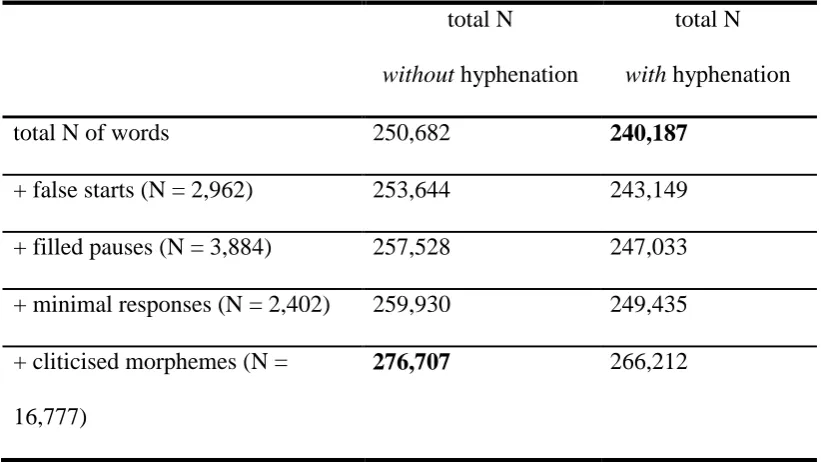
In order to illustrate the severity of these problems, Table 3 compares
differential word counts and tabulation methods based on a corpus of interview
data collected in north-east England (Pichler 2008). The left-hand column shows
transcription of the same corpus with hyphenation of these elements. The word counts in the top rows do not include false starts, filled pauses and minimal
responses; also, cliticised morphemes were counted as constituting a single unit
with their preceding elements. As we move down the table, the total numbers of
these elements (false starts, filled pauses, minimal responses, cliticised
morphemes) are added to the total word count one at a time. A comparison of the
two extremes, i.e., the top-right word count (N = 240,187) and the bottom-left
word count (N = 276,707), reveals that with a medium-sized corpus, different
transcription and tabulation methods can yield differences in overall word counts
of over 35,000 words.
[insert Table 3]
The differential overall word counts have an unsurprising, yet profound,
effect on normalized frequency counts. Based on the two extreme counts
highlighted above, normalized frequency tabulations would reveal that a discourse
variable which is instantiated in the corpus, say, 1,450 times occurred with a
frequency of either 52.4 or 60.4 times per 10,000 words. If we were to compare
these results with those obtained in the same community some 20 years earlier,
where the targeted discourse variable occurred, say, 50 times per 10,000 words,
we would draw very different conclusions from our results: relative stability vs.
incremental increase. Whilst this is a hypothetical scenario, it illustrates well the
far-reaching implications of differential word counts on the conclusions
researchers draw from their analyses.
The only way forward would be for scholars to describe in minute detail,
either in footnotes or appendices, how they arrived at overall word counts. Word
counts would need to be broken down not just for the corpus as a whole but for
counts and frequency tabulations to their own (and vice versa), and thus ensure
the reliability of comparative results. However, it might not always be possible to
provide this amount of detail about corpora. Certainly, though, collaborators on
comparative projects will need to ensure that identical tabulation methods are
used across all corpora investigated.
Even if tabulation methods were to be standardised across corpora, we still
need to acknowledge that amount-of-speech techniques such as the one outlined
above are not the most powerful tool for analysing linguistic variation and change.
Frequency tabulations do not show where in the linguistic system variables occur,
nor what the social and internal mechanisms are that produce variation and change
in their use. A further problem is that this quantification method ignores the fact
that variables do not necessarily have an equal chance of occurrence throughout
an interaction but might be preferred in some stretches of discourse over others
(see further Schegloff 1993; Walker 2010: 63-65). Because they reveal only
general trends in the data, frequency tabulations are of little more than descriptive
value in variationist discourse analysis.
4.3 Quantification of Variables without a Closed Set of Variants (2):
Alternative Methods
An alternative approach to quantifying the distribution of discourse variables
whose universe of variation cannot be delimited on functional or structural
grounds and one which avoids some of the pitfalls of frequency tabulations is that
adopted by D’Arcy (2005) in her analysis of discourse like. D’Arcy circumscribes
the variable context for like according to structural criteria, i.e., as occurring in syntactically delimited positions. In contrast to the amount-of-speech approach,
generalizable. However, as D’Arcy (2005: 27) frankly acknowledges, it does not
take account of the pragmatic constraints operating on the feature’s distribution in
discourse. Consequently, while D’Arcy’s method has obvious advantages over
normalized frequency tabulations, it presents only a partial, albeit in itself highly
convincing, solution to the quantification conundrum in discourse variation
studies. It might be interesting to explore whether it is possible to circumscribe the
variable context of discourse variables according to ‘discourse slots,’ i.e.,
functional slots, as implied in Romero-Trillo (2006). However, much more work
needs to be done on the functionality of discourse features before we can even
begin to consider what these discourse slots may be.
5. QUALITATIVE ANALYSIS: INTEGRATING FUNCTION AS A
PARAMETER IN THE ANALYSIS
As pointed out in Section 1, discourse-pragmatic features are by no means
meaningless or redundant elements of discourse. A wealth of qualitative studies
has shown that they are an indispensable resource for interactants in the
construction and interpretation of discourse as well as in the establishment and
maintenance of social rapport. These functions have been described as ‘genuine
grammatical functions’ (Diewald 2006: 405) on the basis that grammatical
function is understood as an open category which encompasses not just syntactic
functions such as subject, object, complementizer, etc. but also pragmatic and
procedural functions such as the signalling of epistemicity, transitions, etc.
(Brinton 2006).
Some scholars have integrated quantitative with qualitative methods of data
analysis and studied discourse tokens within their interactional context of
and internal factors. Adoption of this approach has revealed that consideration of
discourse function is key to interpreting the usage and distribution of discourse
variables: function accounts for the syntactic and interactional placement of
discourse-pragmatic features (e.g. Schiffrin 1987), the creation of gendered
conversational styles (e.g. Erman 1992; Holmes 1982; Macaulay 2002b), as well
as variation in the formal encoding of discourse variables (e.g. Cheshire 1981;
Pichler 2009; Stenström 1998). In some cases, function may even exert a more
important constraint on discourse variability than social factors (e.g. Pichler
2008). In addition, close analysis of their pragmatic functions can shed light on
discourse features’ diachronic development (e.g. Pichler and Levey under review).
A case can be made, then, for a fuller integration of qualitative methods in studies
of discourse variation and change as well as a consistent inclusion of function as a
factor group in quantitative analyses in order to provide accurate accounts of
discourse variation and change.
Yet, despite its great hermeneutic and explanatory values, consideration of
function is not an integral design feature in all discourse variation studies. Many
variationists treat discourse-pragmatic features as uni-dimensional lexical
elements, quantifying their distribution without any consideration of their
multi-faceted pragmaticmeanings (e.g. Andersen 2001; Dubois and Crouch 1975;
Stubbe and Holmes 1995; Tagliamonte 2005). These studies ignore discourse
variables’ most fundamental property, i.e., the fact that their use is motivated
solely, or at least primarily, by their functionality.
The neglect of function as a parameter in the analysis may be linked to the
intrinsic multifunctionality of discourse-level features: not only do they perform
different functions in different contexts of use but a single instantiation of a
argues that researchers can differentiate on the basis of contextual cues the
primary from the secondary function of multifunctional discourse variables and
categorize them according to the former for the purpose of quantification (see also
Escalera 2009; Lam 2009). This approach might seem appealing when faced with
the daunting task of quantifying tokens across discourse functions. Yet it fails to
reflect the fact that conversationalists may exploit discourse features’
multifunctionality at strategic points in interaction (Coates 1987: 130), and that it
is their multifunctional, not their unifunctional, uses that are unmarked (Cameron,
McAlinden and O’Leary 1988: 77).
This is not the case with the approach adopted by Pichler (2008). When
tokens perform multiple functions simultaneously, e.g. initiating or terminating a
turn whilst also qualifying its content (see Extracts 1 and 2 below), Pichler
categorizes these tokens as multifunctional tokens performing both functions
concurrently. This taxonomy is more accurate than Holmes’s since it allows
researchers to reflect in quantitative terms the multifunctional nature of discourse
variables. Also, it is less subjective than Holmes’s taxonomy since it does not rely
on researchers’ intuitive judgments as to which of the multiple functions is more
important in a given context.
Extract 110
Barbara has just asserted that older people use more non-standard grammar than younger people.
HP: Why do you think that is.
Barbara: I dunno? Maybe just just just e:h education at schools.
Extract 2
HP: What accent would you say you had and do you like it?
Leah: Em. It's a mixture of probably Scottish and Geordie. But °I
dunno°.
Yet even with this approach, an element of subjectivity remains. Analyses can
be somewhat objectified by using multiple researchers to code the data
independently and discuss disagreements until agreement is reached (e.g. Escalera
2009), or by involving members of the fieldwork community in the validation of
functional taxonomies (e.g. Pichler 2008). Nonetheless, these procedures do not
guarantee that the functional descriptions obtained across individual studies are in
fact comparable. The approaches currently available for describing the pragmatic
meanings and functions of discourse-pragmatic features differ in too many
respects to guarantee a uniform description of their use.
Firstly, functional taxonomies of discourse-pragmatic features differ in how
they account for the relationship between their various meanings. Monosemic
approaches assume that a single core meaning can be isolated for individual
discourse features and that variations in their use arise from their interaction with
context (e.g. Dines 1980; Tsui 1991). Polysemic approaches assume that
discourse features have different meanings and functions which are related
through family resemblance or pragmatic extension (e.g. Buchstaller 2004;
Romaine and Lange 1991).11 Polysemic approaches are preferable for variationist
discourse studies since they are better able to account for meaning variation and
change (see section 3 above).
Secondly, discourse-pragmatic features can be studied within a range of
different theoretical and analytical frameworks. They can be examined within a
single framework, such as relevance theory (e.g. Andersen 2001; Blakemore
1988; Jucker 1993), coherence-based theory (e.g. Fraser 1996; Lenk 1998) or
the advantage of providing unified and thus easily comparable accounts of
discourse-pragmatic features. Yet, there is a risk that the focus on a single
theoretical explanation for their use yields incomplete descriptions of discourse
features’ functional versatility (see further Aijmer 2002: 1, 8; Lam 2009: 354).
Bottom-up approaches are theoretically flexible, with functional taxonomies being
established through close examination of every occurrence of the targeted
discourse feature in the data. They might therefore be better suited to yield
comprehensive and data-driven functional taxonomies of discourse features.
Consistent adoption of one of these approaches is certainly necessary to facilitate
cross-corpora comparisons. Pichler (2008), for example, hypothesized that
differences in the social distribution of innit in London English and Berwick English are caused by its performing different functions in the two dialects: in
London English, where innit is favoured by females, it performs functions associated with a co-operative conversational style; in Berwick English, where it
is favoured by males, it performs functions associated with an assertive speech
style. Her attempts to test this hypothesis were hampered by the fact that the two
studies on which the comparison was based (Andersen 2001; Pichler 2008) used
different approaches (top-down vs. bottom-up) to describing the functionality of
innit.
Thirdly, while there is consensus that discourse-pragmatic features function
on multiple functional domains, function-based taxonomies differ in terms of the
number and types of domains they identify. For example, Fischer (2000) and
Schiffrin (1987) identify five domains, Bazzanella (2006) and Erman (2001)
three, and Brinton (1996) only two. Some scholars prefer models such as
Fischer’s because it allows them ‘to show the extreme functional flexibility’ of
fewer domains might be preferable, though. Brinton’s (1996) model allows
scholars to draw as many divisions within each broad domain as are necessary for
accurate qualitative descriptions of their use (e.g. signalling epistemicity or
mitigation; signalling repair, turn-exchange or topic-control), but at the same time
it allows them to collate these divisions into the broad domains (‘interpersonal’
vs. ‘textual’) for quantitative purposes (see further Pichler 2008, 2009). With
other models, scholars might end up with too few tokens in each category to
warrant statistical analysis. Collating categories (possibly on arbitrary grounds)
might then be necessary to allow quantification of the data. For comparative
purposes, it would in principle be possible for scholars to re-organise others’
taxonomies to fit their own models. Yet this is not ideal (least of all because of the
time-consuming nature of the task), and would heavily depend on scholars’
provision of raw scores of tokens for each functional (sub-)category.
6. CONCLUSION
In recent decades, variationist sociolinguistics has witnessed a limited expansion
in discourse variation studies. Nonetheless, we are still a very long way from
having gathered the amount and quality of empirical evidence required to
provide accurate descriptions of dialect variation and change in discourse, and to
formulate general principles about the social and system-internal dimensions of
discourse variation and change. In this paper, I have attributed the lack of
progress in variationist discourse analysis to the methodological and analytical
heterogeneity of the field. I have reviewed a large body of variationist discourse
studies to demonstrate that the diversity of methods currently in use hampers
reliable cross-corpora comparisons and consequently the formulation of
complicated by the fact that some of the methods currently in use yield invalid
variety-specific results. To advance this line of variationist enquiry beyond its
current embryonic state and to allow scholars to answer key questions about
discourse variation and change, I have advocated a uniform approach to studying
variation and change in this component of the grammar. It is envisaged that
consistent adoption of these methods will produce the kind of valid and
comparable results needed to enhance our understanding of discourse variation
and change. The methods associated with this approach were presented in detail
in the preceding sections. They are summarised in Table 4 which serves as a
checklist for future researchers.
[insert Table 4]
In the following, I will briefly recapitulate the potential benefits of the
methodology advocated here. The proposed methods for corpus description and
interpretation make possible the provision of more accurate general descriptions
of social and regional discourse variation than has been possible in the past.
Moreover, the adoption across studies of identical quantitative and qualitative
methods, as proposed here, could facilitate the achievement of three key
objectives: (i) to determine where in the linguistic system intra- and inter-dialectal
discourse variation occurs; (ii) to assess the extent to which correlations between
social factors and discourse variation are variety-specific or pan-dialectal; and (iii)
to establish what role discourse function plays in the conditioning of variation
within and across dialects. To ensure that scholars compare like with like, the case
has been made for conceptualising discourse features as linguistic variables.
With regard to discourse change, consistent adoption of the proposed
methodology would provide scholars with the opportunity to address the
advance discourse change within and across dialects; whether regionally or
socially marked uses of discourse variables and variants are being levelled; and
whether the grammaticalization of discourse variables and their variants
progresses across dialects at similar rates and along similar syntactic and
semantic-pragmatic pathways.12
The adoption of a uniform methodology which yields reliable and
intersubjective results would allow scholars to synthesize the results from
different studies into empirically grounded generalizations of discourse variation
and change. Such results and generalizations are essential if our ultimate goals are
to (i) develop a comprehensive account of dialect variation that encompasses all
levels of the grammar; (ii) uncover potential differences in the social and internal
dimensions of variation and change across different components of the grammar;
and (iii) reveal potential differences in the general direction of ongoing changes
across phonology, morpho-syntax and discourse. A holistic theory of language
variation and change must by definition incorporate discourse variation and
change, and the validity of any such theory is therefore contingent upon the
generalizability of discourse variation and change studies.
The approach outlined here has potential benefits for scholars exploring how
individuals deploy sociolinguistic resources to negotiate and establish social
meanings and identities (Coupland 2007; Eckert 2001). Discourse variables and
their variants have been shown to form part of the sociolinguistic repertoire
which speakers draw on to create social identities (e.g. Mendoza-Denton 2007;
Moore & Podesva 2009; Trester 2009). However, local interpretations of
discourse variation rely on scholars’ access to reliable quantitative survey studies
which reveal the conventionalized social and functional associations of discourse
approach to variationist discourse analysis advocated here could supply this
information and thereby advance explorations of locally contextualized discourse
variation.
Some of the methods advocated here may also have relevance for the
exploration of how social meanings are constructed through discourse variation.
The proposed methodology caters for the operation of contextual and
language-internal constraints on speakers’ selective use of available discourse resources,
and enables scholars to explore whether the functional polysemies of available
discourse resources are exploited for social meaning making, as suggested by
Traugott (2001). The adoption of these methods could facilitate exploration of
the social significance of discourse variation in the communities of practice
framework (Eckert and McConnell-Ginet 1992) as well as in studies of
‘crossing’ (Rampton 1995) and ‘styling’ (Coupland 2007).
This paper has advocated a uniform approach to the quantitative analysis of
discourse-pragmatic features which is equipped to capture the complex nature of
discourse variation and change whilst also ensuring generalizability. As
theoretical insights into the nature of discourse features grow and a more diverse
range of features are investigated, the methodology I have proposed here will
inevitably be subject to refinement. Whatever modifications may be required, the
commitment to ensuring reliability and intersubjectivity is central to the
NOTES
1. An earlier version of this paper was presented at ICAME 30 (University of
Lancaster, May 2009). I would like to thank the audience members for
their insightful comments and questions, in particular Karin Aijmer, Gisle
Andersen and Sali Tagliamonte. I am also very grateful for the detailed
comments on previous written versions of the paper made by Jenny
Cheshire, Stephen Levey, the anonymous reviewers as well as editor Allan
Bell and associate editors David Britain and Lionel Wee, all of which have
much improved the paper. Of course the ultimate responsibility for the
paper has to rest with me.
2. Unlike traditional accounts of grammar, construction-based approaches do
not make a distinction between ‘core’ and ‘peripheral’ phenomena
(Gisborne and Trousdale 2008: 1).
3. The upsurge of interest has been most prominent in qualitative research
paradigms. The pragmatic and discourse analytic research conducted into
discourse-pragmatic features over the last three decades has revealed
important insights into their functionality, their context sensitivity, their
syntactic, semantic and prosodic integratedness as well as their evolution.
In quantitative research paradigms, discourse-pragmatic features have
figured far less prominently. Quantification necessarily entails a certain
amount of abstraction. Nonetheless, it offers a range of complementary
insights to purely qualitative studies. As I will demonstrate in this paper,
valuable complement to qualitative studies because of their potential for
establishing the sensitivity of discourse features to internal constraints as
well as probing the robustness of their functionality across social groups,
space and time.
4. Serrano (to appear) argues (very convincingly) that it is not possible to
understand higher-level variability without abandoning the criterion of
semantic equivalence. She argues that satisfactory explanations of
syntactic variability can only be achieved by ‘placing exactly in meaning
differences the potential to explain variation.’
5. General extenders may contain generic lexical items only (e.g. and that kind of stuff) or they may contain generic along with specific lexical items (e.g. and physical stuff like that) (see Terraschke 2007). A structurally-based conceptualisation of discourse variables allows scholars to specify
which items are included in their analyses.
6. Divergent points of departure are also common in studies of
morpho-syntactic variation (Schwenter and Torres Cacoullos 2008; Hackert 2008).
7. More recently, a new interface of multivariate analysis has been
developed, Rbrul, which overcomes some of the shortcomings of
Goldvarb X (see Johnson 2009 for details).
8. This applies equally to phonological and morpho-syntactic variables.
against the problem by basing their analyses on the same number of tokens
per variable per speakers (see further Guy 1974). Because of the
comparative infrequency of discourse variables, this approach cannot
easily be adopted in discourse variation studies and alternative measures
have to be taken to guard against skewed results.
9. In Pichler's (2008) corpus of a northern English dialect, young speakers
demonstrate markedly lower rates of filled pauses (8.1 per 1,000 words)
than speakers from the middle and older age groups (18.2 and 15.4 per
1,000 words respectively).
10.The following transcription conventions are used:
. falling intonation
? rising intonation
(.) short pause
: syllable lengthening
º º reduced volume
All informant names are pseudonyms.
11.There are also homonymic approaches which assume that the different
meanings of a form are not related. However, they are not widely defended
(Fischer 2006: 14).
12. Of course, the gradualness of changes associated with grammaticalization
might necessitate that analyses of synchronic dialect data be supplemented
REFERENCES
Aijmer, Karin. 2002. English Discourse Particles: Evidence from a Corpus.
Amsterdam, The Netherlands: John Benjamins.
Andersen, Gisle. 2001. Pragmatic Markers and Sociolinguistic Variation: A Relevance-Theoretic Approach to the Language of Adolescents. Amsterdam, The Netherlands: John Benjamins.
Bailey, Guy and Jan Tillery. 2004. Some sources of divergent data in
sociolinguistics. In Carmen Fought (ed.) Sociolinguistic Variation. Critical Reflections. Oxford, U.K.: Oxford University Press. 11–30.
Bayley, Robert. 2002. The quantitative paradigm. In J.K. Chambers, Peter
Trudgill and Natalie Schilling-Estes (eds.) The Handbook of Language Variation and Change. Oxford, U.K.: Blackwell. 117–141.
Bazzanella, Carla. 2006. Discourse markers in Italian: Towards a ‘compositional’
meaning. In Kerstin Fischer (ed.) Approaches to Discourse Particles.
Amsterdam, The Netherlands: Elsevier. 449–464.
Blakemore, Diane. 1988. So as a constraint on relevance. In R.M. Kempson (ed.)
Mental Representations. The Interface between Language and Reality.
Cambridge, U.K.: Cambridge University Press. 183–195.
Brinton, Laurel J. 1996. Pragmatic Markers in English. Grammaticalization and Discourse Function. Berlin: Mouton de Gruyter.
Brinton, Laurel J. 2006. Pathways in the development of pragmatic markers in
English. In Hans van Kemenade and Bettelou Los (eds.) The Handbook of the History of English. Oxford, U.K.: Blackwell. 307–334.
Buchstaller, Isabelle. 2004. The sociolinguistics constraints on the quotative
system - British English and US English compared. Unpublished PhD
Buchstaller, Isabelle. 2006. Diagnostics of age-graded linguistic behaviour: The
case of the quotative system. Journal of Sociolinguistics 10: 3–30. Buchstaller, Isabelle. 2009. The quantitative analysis of morpho-syntactic
variation: Constructing and quantifying the denominator. Language and Linguistics Compass 3: 1010–1033.
Buchstaller, Isabelle and Alexandra D’Arcy. 2009. Localized globalization: A
multi-local, multivariate investigation of quotative be like. Journal of Sociolinguistics 13: 291–331.
Cameron, Deborah, Fiona McAlinden and Kathy O’Leary. 1988. Lakoff in
context: The social and linguistic functions of tag questions. In Jennifer
Coates and Deborah Tannens (eds.) Women in Their Speech Communities. New Perspectives on Language and Sex. Longman, U.K.: London. 74–93. Cheshire, Jenny. 1981. Variation in the use of ain’t in an urban British English
dialect. Language in Society 10: 365–381.
Cheshire, Jenny. 1987. Syntactic variation, the linguistic variable, and
sociolinguistic theory. Linguistics: 25: 257–282.
Cheshire, Jenny. 2007. Discourse variation, grammaticalisation and stuff like that.
Journal of Sociolinguistics 11: 155–193.
Cheshire, Jenny, Paul Kerswill and Anne Williams. 2005. Phonology, grammar
and discourse in dialect convergence. In Peter Auer, Frans Hinskens and Paul
Kerswill (eds.) Dialect Change. Convergence and Divergence in European Languages. Cambridge, U.K.: Cambridge University Press. 135–167.
Coates, Jennifer. 1987. Epistemic modality and spoken discourse. Transactions of the Philological Society 85: 110–131.
D’Arcy, Alexandra. 2005. Like: Syntax and development. Unpublished PhD
dissertation, University of Toronto, Toronto, Canada.
Diewald, Gabriele. 2006. Discourse particles and modal particles as grammatical
elements. In Kerstin Fischer (ed.) Approaches to Discourse Particles.
Amsterdam, The Netherlands: Elsevier. 406–426.
Dines, Elizabeth. 1980. Variation in discourse – ‘and stuff like that’. Language in Society 9: 13–31.
Dubois, Betty L. and Isabel Crouch. 1975. The question of tag questions in
women’s speech: They don’t really use more of them, do they? Language in
Society 4: 289–294.
Dubois, Sylvie. 1992. Extension particles, etc. Language Variation and Change 4: 179–203.
Eckert, Penelope. 2001. Style and social meaning. In Penelope Eckert and John R.
Rickford (eds.) Style and Sociolinguistic Variation. Cambridge, U.K.: Cambridge University Press. 119–126.
Eckert, Penelope and Sally McConnell-Ginet. 1992. Think practically and look
locally: Language and gender as community-based practice. Annual Review of Anthropology 21: 461–490.
Erman, Britt. 1992. Female and male usage of pragmatic expressions in
same-gender and mixed-same-gender interaction. Language Variation and Change 4: 217–234.
Erman, Britt. 2001. Pragmatic markers revisited with a focus on you know in adult and adolescent talk. Journal of Pragmatics 32: 1337–1359.
Escalera, Elena A. 2009. Gender differences in children’s use of discourse
Ferrara, Kathleen W. 1997. Form and function of the discourse marker anyway: Implications for discourse analysis. Linguistics 35: 343–378.
Ferrara, Kathleen and Barbara Bell. 1995. Sociolinguistic variation and discourse
function of constructed dialogue of introducers: The case of be + like.
American Speech 70: 265–290.
Fischer, Kerstin. 2000. Discourse particles, turn-taking, and the
semantics-pragmatics interface. Revue de Sémantique et Pragmatique 8: 111–137. Fischer, Kerstin. 2006. Towards an understanding of the spectrum of approaches
to discourse particles: Introduction to the volume. In Kerstin Fischer (ed.)
Approaches to Discourse Particles. Amsterdam, The Netherlands: Elsevier. 1–20.
Fraser, Bruce.1996. Pragmatic markers. Pragmatics 6: 167–190.
Freed, Alice F. and Alice Greenwood. 1996. Women, men, and type of talk: What
makes the difference. Language in Society 25: 1–26.
Fuller, Janet M. 2003. The influence of speaker roles on discourse marker use.
Journal of Pragmatics 35: 23–45.
Gisborne, Nikolas and Graeme Trousdale. 2008. Constructional approaches to
language-particular description. In Graeme Trousdale and Nikolas Grisborne
(eds.) Constructional Approaches to English Grammar. Berlin: Mouton de Gruyter. 1–4.
Guy, Gregory R. 1974. Variation in the group and the individual: The case of final
stop deletion. Pennsylvania Working Papers on Linguistic Change and Variation 1: 1–75.
Hackert, Stephanie. 2008. Counting and coding the past: Circumscribing the