International Journal of Emerging Technology and Advanced Engineering
Website: www.ijetae.com (ISSN 2250-2459, ISO 9001:2008 Certified Journal, Volume 6, Issue 8, August 2016)
194
Improvement in M-Gear Protocol to Increase Lifetime of
Network
Varsha
M. Tech scholar, Department of Computer Science Engineering and Information Technology, BhagatPhool Singh MahilaVishwavidyalaya, KhanpurKalan, Sonepat, Haryana, India
Abstract— Wireless Sensor Networks (WSNs) have served humankind to screen nature of the spots which are impossible. The sensor hubs have constrained vitality to sense and send the information. The utilization of vitality ought to be effective so that system lifetime and also the throughput is moved forward. A portion of the directing conventions have been conceived to course the information detected by the sensors in the WSN is pointed to be vitality proficient. Grouping based Energy effective Steering conventions principally harp on expanding the lifetime as well as execution of the system. Drain based conventions can be adjusted to give a system more lifetime and enhanced execution. In this research work, we have investigated and thought about two WSN conventions, M-GEAR and LEACH, on the grounds of system lifetime and execution of the system.
Keywords—WSN, Leach, M-Gear, Neural Network, Energy Efficient
I. INTRODUCTION
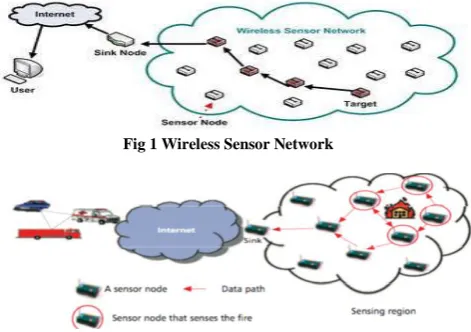
[image:1.595.317.553.240.406.2]The WSNs are networks of computing devices; they are considerably different from traditional networks. Traditional wireless networks use limited network range, security, reliability and also have storage and bandwidth constraint. The first difference of WSNs compared to traditional data networks is that they have severe energy, computation, storage and bandwidth constraints. The second difference of WSNs compared to traditional data networks is their overall usage scenario and the implications which it brings to the traffic and interaction with the users. Typically, in traditional networks, users are connected to a node (or group of SNs) and require a service from another node. Another structural characteristic of WSNs is the choice of communication mode, i.e., single hop versus multi-hop. For example, the network may be designed in such fashion that the SNs in each cluster either use single hop, or multi-hops to reach the CH or BS. The optimum choice of communication depends on the radio energy model. The network may consists of a single type of SNs (homogeneous network), or it may consist of multiple types of SNs with different functionality (heterogeneous network). Since cheap SNs are expected to be manufactured in bulk quantities, node reliability is another important factor that should be taken into account for dimensioning the networks.
Fig 1 Wireless Sensor Network
Fig 2 Traditional Wireless Sensor Network
The development of wireless sensor networks was inspired by military applications like surveillance in war zones. WSN is an emerging technology currently being deployed in seismic monitoring, Wild life studies, manufacturing and performance monitoring. In such scenarios the SNs are densely deployed in a predetermined geographical area to self-organize into ad hoc wireless networks to gather and aggregate data. Such networks typically contain a large number of the densely deployed SNs which function as a wireless peer-to-peer network. They use multi-hop and cluster based routing algorithms.
II. ENERGY CONSUMPTION IN WSN
International Journal of Emerging Technology and Advanced Engineering
Website: www.ijetae.com (ISSN 2250-2459, ISO 9001:2008 Certified Journal, Volume 6, Issue 8, August 2016)
195
For each WSN there exists a Base Station (BS) which gets and gathers the information sent by the sensor hubs. The vitality which is spent on sending a k bit information is a great deal more than getting k bit information [3]. Vitality to send one piece of information relies on the separation between the sender hub and the collector hub. On the off chance that sensor hubs were to send information straightforwardly to the BS the hubs which are more remote need to spend more vitality to send k bit information to BS [3]. So the sensor hubs which are situated a long way from the BS would kick the bucket sooner than the sensor hubs which are found closer to BS.
Fig.3 Energy Spend In Radio Transmission [3]
III. NEURAL LEACH AND M-GEAR
Drain opens scope for some steering conventions for WSNs. The strategies in LEACH manage homogeneous system. As indicated by LEACH new bunch head is chosen for each round. This prompts new bunch development for each round. New bunch arrangement for each round squanders a huge measure of restricted vitality. On the off chance that present group head has more vitality than a portion of the groups in the bunch, then in the following cycle a hub with less vitality can be chosen as new bunch head. So lingering vitality of current bunch head must be mulled over prior to the race of new bunch head. Henceforth new bunch head substitution calculation was presented by D. Mahmood et al. The vitality required to transmit information from a hub to group head is straightforwardly corresponding to the square of the separation in the middle of hub and group head. Thus hubs dwelling close to the bunch head must utilize low enhancement of the sign than that of the hubs which are situated far from group head. So D. Mahmood et al proposed a double transmitting power levels moreover.
Productive Cluster Head Replacement Algorithm: It is an edge in group head arrangement for exceptionally next round.
On the off chance that current group has not spent much vitality amid its residency and has more vitality than required edge, it will remain bunch head for the following round also. This is how, vitality squandered in steering bundles for new group head and bunch development can be spared. In the event that bunch head has less vitality than required limit, it will be supplanted as per LEACH calculation [5].
Double Amplification Levels for Data Transmission: Hub detects the information and sends it to group head specifically this transmission is intra group transmission. Group head totals the information got from hubs and transmits the information to base station this is Cluster head to Base station transmission. The transmission among Cluster Heads is termed as Inter Cluster Head Transmission. The least vitality required for each of the three sorts of transmissions can't be the same. So when a hub is chosen as the group head it employments high energy to open up the sign. What's more, in the following round at the point when other hub is chosen as the group head it utilizes little energy to open up the sign.
IV. M-GEAR:GATEWAY-BASED ENERGY-AWARE
MULTI-HOP ROUTING PROTOCOL
Energy utilization and lifetime of network are the most important features in the field of the WSN. This study present clustering based routing for WSNs. A large number of the clustering protocols are homogeneous, for example LEACH [7], [2], PEGASIS [4], Due to the fact that clustering protocols consume less energy, these protocols for WSNs have gained extensive acceptance in many applications. Many on hand WSN protocols use cluster based scheme at manifold levels to minimize energy expenditures. CH in most cluster based protocol is selected based on a probability. It is not obvious that CHs are distributed uniformly throughout the sensor field. Therefore, it is fairly possible that the selected CHs will be concentrate in one region of the network. Hence, a number of sensors will not find any CHs in their environs. Similarly some protocols used unequal clustering and try to use recourses proficiently on condition that multi-hop routing.
V. ARTIFICIAL NEURAL NETWORK
International Journal of Emerging Technology and Advanced Engineering
Website: www.ijetae.com (ISSN 2250-2459, ISO 9001:2008 Certified Journal, Volume 6, Issue 8, August 2016)
196
ANNs, like people, learn by example. An ANN is configured for a specific application, such as pattern recognition or data classification, through a learning process. Learning in biological systems involves adjustments to the synaptic connections that exist between the neurones. This is true of ANNs as well. Neural network simulations appear to be a recent development. However, this field was established before the advent of computers, and has survived at least one major setback and several eras. Many important advances have been boosted by the use of inexpensive computer emulations. Following an initial period of enthusiasm, the field survived a period of frustration and disrepute. During this period when funding and professional support was minimal, important advances were made by relatively few researchers.
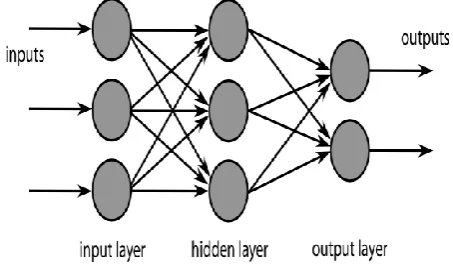
[image:3.595.51.278.539.671.2]Feedback networks can have signals travelling in both directions by introducing loops in the network. Feedback networks are very powerful and can get extremely complicated. Feedback networks are dynamic; their 'state' is changing continuously until they reach an equilibrium point. They remain at the equilibrium point until the input changes and a new equilibrium needs to be found. Feedback architectures are also referred to as interactive or recurrent, although the latter term is often used to denote feedback connections in single-layer organizations. Real Time Operation: ANN computations may be carried out in parallel, and special hardware devices are being designed and manufactured which take advantage of this capability Fault Tolerance via Redundant Information Coding: Partial destruction of a network leads to the corresponding degradation of performance. However, some network capabilities may be retained even with major network damage.
Figure 4 an example of a simple feed forward network
VI. RESEARCH METHODOLOGY
To achieve aforesaid objectives, the following phases have been adopted:
1. Initial Phase: A detailed literature survey is done from eminent journals like IEEE, Elsevier and Springer, etc. This will provide the basic and conceptual knowledge of the domain.
2. Implementation Phase: A MATLAB programming environment is used for development of algorithms for energy efficient routing in WSN. LEACH is supposed to be one of the most significant algorithms proposed in WSN routing. The same will be again implemented here in both homogeneous WSNs and heterogeneous WSNs. LEACH protocol is re-investigated in this project. To explore LEACH and MODLEACH routing protocols in WSN.
3. Testing Phase: A comparative analysis for various network parameters is then conducted.
VII. MOTIVATION
LEACH gives birth to many protocols. The procedures of this protocol are compact and well coped with homogeneous sensor environment. According to this protocol, for every round, new cluster head is elected and hence new cluster formation is required. This leads to unnecessary routing overhead resulting in excessive use of limited energy. If a cluster head has not utilized much of its energy during previous round, than there is probability that some low energy node may replace it as a cluster head in next cluster head election process.
There is a need to limit change of cluster heads at every round considering residual energy of existing cluster head. Hence an efficient cluster head replacement algorithm is required to conserve energy. In clustering protocols as LEACH, nodes use same amplification energy to transmit data regardless of distance between transmitter and receiver. To preserve energy, there should also be a transmission mechanism that specifies required amplification energy for communicating with cluster head or base station.
VIII. PROBLEM STATEMENT
International Journal of Emerging Technology and Advanced Engineering
Website: www.ijetae.com (ISSN 2250-2459, ISO 9001:2008 Certified Journal, Volume 6, Issue 8, August 2016)
197
To cope up with these constraints, initially direct transmission approach was discussed. In direct transmission, a node sense data from its environment and transmits it straight to base station. This method, no doubt, ensures data security however; on the other hand we have to compromise on nodes life time due to excessive power consumption (if BS is far away). Hence, using direct transmission technique, nodes that are far away from BS die early as they require more power to propagate their signal, making a portion of Field vacant for sensing.
To solve this problem, minimum transmission energy (MTE) emerged. In this technique, data is transmitted to base stations via multi hop. This gives birth to almost same problem we faced in direct transmission. Differences are only this that in minimum transmission energy algorithm, far away nodes remain alive longer with respect to the nodes nearer to BS. Reason behind early expiry of nearer nodes is routing of all data trace to base station. Moreover, transmitting bulk of sensed data from each node use much energy. To overcome this problem, concept of Directed Discussion was introduced that discuss data processing and dissemination.
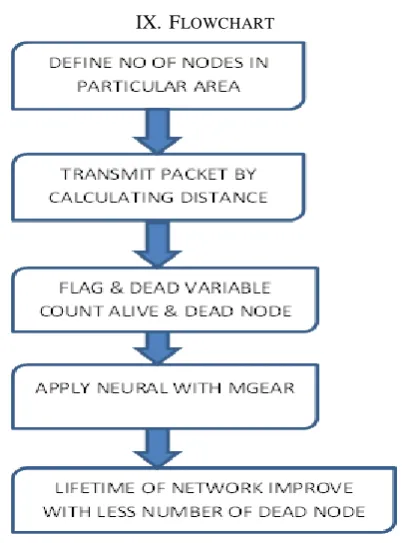
IX. FLOWCHART
X. RESULT ANALYSIS
1) Network lifetime
[image:4.595.315.567.125.279.2]The average network lifetime of proposed scheme. The proposed new cost function to elect forwarder node plays an important role to balance the energy consumption among the sensor nodes. A new forwarder node is selected.
Figure 5: Interval plot- Analysis of network lifetime
[image:4.595.312.564.260.381.2]2) No of alive nodes
Figure 6: Interval plot- Analysis of No of alive Nodes
3) Energy Analysis
The proposed model use multi hop topology, in which each farthest node transmits its
Figure 7: Interval plot- Analysis of Energy
4) Throughput
[image:4.595.61.266.406.678.2]By breaking down Figure 8 we see that the throughput of Neural M-GEAR and M-Gear is more noteworthy than that of Neural LEACH with Leach. This is on the grounds that M-GEAR keeps up remaining vitality of sensor hubs to keep going long utilizing the passage hub.
[image:4.595.314.567.630.740.2]International Journal of Emerging Technology and Advanced Engineering
Website: www.ijetae.com (ISSN 2250-2459, ISO 9001:2008 Certified Journal, Volume 6, Issue 8, August 2016)
198
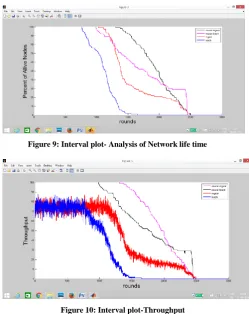
[image:5.595.46.296.193.508.2]The average network lifetime of proposed scheme. The proposed new cost function to elect forwarder node plays an important role to balance the energy consumption among the sensor nodes. A new forwarder node is selected.
Figure 9: Interval plot- Analysis of Network life time
Figure 10: Interval plot-Throughput
As indicated by the investigation in view of MATLAB reenactment we unmistakably see that passage hub which is conveyed on account of M-GEAR enhances the system lifetime and in addition the throughput of the system.
XI. CONCLUSIONS
We describe an energy efficient multi-hop routing protocol using gateway node to minimize energy consumption of sensor network we have dissected and thought about the exhibitions of two steering conventions M-GEAR and Neural M-Gear the premise of system lifetime and throughput. In spite of the fact that, the execution of Neural LEACH is enhanced when contrasted with LEACH however the presentation of the entryway hub has enhanced the execution of the system.
As indicated by the investigation in view of MATLAB re-enactment we unmistakably see that passage hub which is conveyed on account of M-GEAR enhances the system lifetime and in addition the throughput of the system. Consequently we presume that to the detriment of the door hub one can without much of a stretch accomplish higher execution of the system. In this work we divided the network into logical regions. Each region use different communication hierarchy. Two regions use direct communication topology and two regions are further sub-divided into clusters and use multi-hop communication hierarchy. Each node in a region elects itself as a CH independent of other region. This technique implies better distribution of CHs in the network. Simulation and result evaluation section shows that our proposed protocol performs well compared to LEACH.
REFERENCES
[1] Yick, J.; Mukherjee, B.; Ghosal, D. ―Wireless Sensor Network
Survey‖, ComputNetw 2008, 52, 2292–2330.
[2] Chen, D. Varshney, P. K. ―QoS Support in Wireless Sensor
Networks: A Survey‖, In Proceedings of the International Conference on Wireless Networks, (ICWN ’04), Las Vegas, NV, USA, 21–24 June 2004; pp. 227–233.
[3] Akkaya, K.; Younis, M. ―A Survey on Routing Protocols for
Wireless Sensor Networks‖ Ad Hoc Netw. J. 2005, 3, 325–349.
[4] A. Manjeshwar and D. P. Agarwal, ―TEEN : A Protocol for
Enhanced Efficiency in Wireless Sensor Networks‖, in the Proceedings of the 1 st International Workshop on Parallel and Distributed Computing Issues in Wireless Networks and Mobile Computing, San Francisco, CA, April 2001.
[5] D. Mahmood, N. Javaid, S. Mahmood, S. Qureshi, A. M. Memon
and T. Zaman, MODLEACH: A Varient of LEACH for WSNs, Eighth International Conference on Broadband and Wireless Communication and Applications, pp. 158-163, 2013.
[6] Alel Ben-Othman, Bashir Yahya ―Energy efficient and QoS based
routing protocol for wireless sensor Networks‖, J. Parallel Distributed computing (70), P-849-857, March, 2010.
[7] C. Y. Chong and S. P. Kumar, Sensor Networks: Evolution,
Opportunities and Challenges, IEEE, 91, No. 8, pp. 1247-1256, Aug 2003.
[8] Meena Malik, Dr.Yudhvir Singh, AnshuArora ―Analysis of
LEACH Protocol in Wireless Sensor Networks‖ Volume 3, Issue 2, February 2013.
[9] L.M.C. Arboleda and N. Nasser, Comparison of Clustering
Algorithmsand Protocols for Wireless Sensor Networks, Canadian Conference on Electrical and Computer engineering, pp. 1787-1792, May 2006.
[10] MortazaFahimiKhaton Abad 1, Mohammad Ali JabraeilJamali 2