International Journal of Emerging Technology and Advanced Engineering
Website: www.ijetae.com (ISSN 2250-2459,ISO 9001:2008 Certified Journal, Volume 4, Issue 1, January 2014)
128
Performance and Emission Analysis of Diesel Engine using
Jatropha oil with Super Charger and EGR
R. Selvan
1, Dr. K. Maniysundar
21
Research Scholar, 2Research Supervisor, Department of Mechanical Engineering, M.V.J. College of Engineering, Bangalore-560 067, India
Abstract— Transesterified vegetable oil, also called bio-diesel is becoming increasingly important as a fuel for bio-diesel engine due to several reasons. Bio-diesel is a renewable, inexhaustible and a clean burning fuel. Many studies have shown that properties of bio-diesel are very close to petro diesel. Bio-diesel can be used in diesel engine without modification.Bio-diesel has no aromatic, no-sulfur and contains 10-12% oxygen by weight. These characteristics of bio-diesel reduce the harmful emissions of unburned hydrocarbons and CO, research has shown that NOx, emission is higher in case of bio-diesel fueled engine. Exhaust gas recirculation is an effective technique to reduce NOx. The aim of present research work is to use B10,B20, B30, blend of jatropha methyl ester and cooled EGR in order to reduce pollutant from diesel engine emission of NOx, CO, HC,are recorded and compared with petro diesel. Various performance parameters was evaluated such as brake thermal efficiency, BSFC, SEC, TFC were calculated. Result indicates the reduction of NOx and brake thermal efficiency decreased with the application of EGR.The effect of super charging also studied and the performance of the engine are evaluated in terms of BSFC, TFC, SEC, brake thermal efficiency and volumetric efficiency. The investigation result shows that the output and brake thermal efficiency and volumetric efficiency of the engine with super charger was improved in comparison with naturally aspirated engine.
Keywords—Jatropha, Super Charger, EGR, Engine
I. INTRODUCTION
Vegetable oils present very promising alternate to Diesel oil since they are renewable and have similar properties. Several research and project in the field of Internal combustion Engine are being focused on reduced Emission, which not only makes commercial sense but also helps benefit the environment reducing harmful emission from diesel vehicles helps improve local air quality which is no becoming increasingly important towards corporate social responsibility. The use of vegetable oils as fuels for diesel engines is not a new concept. It is known that when Sir. Rudolph Diesel invented diesel engine he used Peanut oil in his engine.
Jatropha an alternate fuel could be attributed to some important facts. Indian climate condition is suitable for Jatropha cultivation.
Has no insects, pets and not browsed by animals, can survive long periods of drought. It can grow in saline and alkaline soils, arid and semi-arid condition. Its properties match with that of petroleum diesel.
Engine performance can be improved with
supercharging. Supercharging improves the combustion process in Diesel engine. An increase in air pressure of the engine intake reduces ignition dealy, resulting in a better combustion and smooth operation with lower rate of the pressure rise(1-2). A reciprocating air compressor has been
used for supercharging. An inlet pressure of 4kg/cm2 is
maintained for supercharging condition.
From various researches it’s found that NOx emission is
higher in Jatropha based bio-diesel. An effective technique
to reducing NOx emission in diesel engine is Exhaust Gas
Recirculation (EGR). NOx are formed when the combustion
temperature is high. Any technique that reduces the
combustion temperature will thus lead to decreased NOx
formation (10-11). EGR technique involves recirculation of exhaust gas in to the intake system of the engine. The recirculated exhaust gas displaces some of the normal intake charge of the engine, which slows and cooles the
combustion process, thereby reducing NOx formation. In
this project the cooled EGR is used as it can reduce the Nox
emission. In cooled EGR the recirculation is varied from 5to 15%. EGR control valve controlled EGR-recirculation.
II. CHARACTERIZATION OF JATROPHA OIL
Jatropha curcas is a large plant and belongs to the family of Euphorbiacea occurring almost throughout India. It has a long productive period of around 40-50 years. It grows as a tree up to the height of 3-5 mt. it is a good plantation for Eco-restoration in all types wasteland.
III. AVAILABILITY OF JATROPHA OIL
International Journal of Emerging Technology and Advanced Engineering
Website: www.ijetae.com (ISSN 2250-2459,ISO 9001:2008 Certified Journal, Volume 4, Issue 1, January 2014)
129
Jatropha curcus plant is a drought-resistant, perennial plant living up to40- 50 yearsit can grow in saline and alkaline soils, arid and semi-arid condition.T he production
of jatropha seeds is about 0.8 kg/m2 per year. The oil
[image:2.612.328.561.156.305.2]content of jatropha seeds 40% by weight. Fresh jatropha is a slow drying, odorless and colorless oil, and turns yellow after aging. Jatropha an alternate fuel could be atributed to some important facts, Indian climate condition are suitable for Jatropha cultivation. Has no insect, pets and not browsed by animals, can survive long periods of drought.
Table 1
Properties of Diesel and Jatropha Methyl Ester
IV. EXPERIMENTAL SETUP
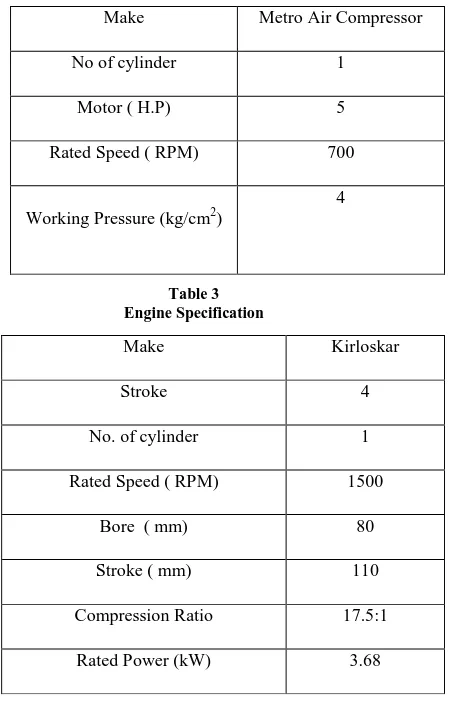
The experimental investigation carried out in a single cylinder 4-stroke water cooled diesel engine developing 3.68 kW at 1500 RPM was used. The engine details are given in table 1. The schematic of the experimental set up is shown in fig 1. An eddy current dynamometer was used for loading the engine.
The super charging operation is carried out in a reciprocating single cylinder air compressor at working 4
kg /cm2.The super charger consist of a air compressor also
orifice meter connected to U-tube water manometer for measurement of flow rate of air, surge tank and valve fitted to control the quantity of air being supplied to the engine.
The EGR setup consist of a water cooled heat exchanger for cooling exhaust gas, reaction chamber and valves fitted to control the quantity of exhaust gas being recycled.
Fig.1 Schematic diagram of the experimental setup Table 2
Air compressor specification
[image:2.612.43.265.277.473.2]
Table 3 Engine Specification
Property Diesel Jatropha
Methyl Ester
Density ( kg/m3) 840 870
Sp.gravity 0.840 0.870
Kinematic Viscosity
(c St) at 400C 3.5 5.65
Flash point ( 0 C) 56 170
Calorific value (kj/kg) 42926 35717
Make Metro Air Compressor
No of cylinder 1
Motor ( H.P) 5
Rated Speed ( RPM) 700
Working Pressure (kg/cm2)
4
Make Kirloskar
Stroke 4
No. of cylinder 1
Rated Speed ( RPM) 1500
Bore ( mm) 80
Stroke ( mm) 110
Compression Ratio 17.5:1
[image:2.612.347.572.356.707.2]International Journal of Emerging Technology and Advanced Engineering
Website: www.ijetae.com (ISSN 2250-2459,ISO 9001:2008 Certified Journal, Volume 4, Issue 1, January 2014)
130
V. PROCESS FLOW CHART
Fig.2 Process flow chart
VI. EXPERIMENTAL PROCEDURE
The engine was coupled to an eddy current dynamometer to measure the output, fuel flow rates were timed with calibrated burette. Exhaust gas analysis was performed using exhaust gas analyzer.
The blends of B10, B20, and B30 of Methyl Ester of Jatropha Diesel was prepared by volume basis and used for experimental purpose.
The test was carried out no super charger and with super charger in addition of air supply of 5, 10 percent compared to naturally aspirated engine. During the experiments engine speed, fuel consumption air consumption was recorded with super charger and without super charger. The effect of air enrichment on various parameters such as Brake Thermal Efficiency, TFC, BSFC.SEC and emissions
CO, HC, NOX, and smoke was determined with various
blends of jatropha oil.
The engine was tested no EGR and with EGR at the rate of 5, 10, 15 percent exhaust gas re-circulation. The amount of exhaust gas in to intake pipe is controlled through the EGR-valve.the EGR is cooled by water. The intake
temperature can be controlled at the range of about 250
-350C.The engine speed, fuel consumption, and exhaust gas
re-circulation rate also recorded. Exhaust gases were
analyzed by gas analyzer in which CO, HC, NOx, were
recorded. .
VII. RESULTS AND DISCUSSION
Based on the experimental data the graphs were drawn. These graphs show the variation in brake thermal efficiency, BSFC, and emissions.
The variation of brake thermal efficiency with brake power at various blends of jatropha oil of the base engine is compared with additional air flow rates in fig.3. The condition where atmospheric air was used is designated as normal diesel operation or base engine operation. There is an improvement in the brake thermal efficiency of B10, B20 and B30 blends where the additional air is enhanced. This improvement is may be due to better combustion with additional air supply to the engine.
Fig.3. Variation of brake thermal efficiency with brake power
In fig.4. The variation of volumetric efficiency with brake power at various blends of jatropha oil of the base engine is compared with super charged engine. There is an improvement in the volumetric efficiency in all jatropha blends where the additional air is enhanced.
International Journal of Emerging Technology and Advanced Engineering
Website: www.ijetae.com (ISSN 2250-2459,ISO 9001:2008 Certified Journal, Volume 4, Issue 1, January 2014)
131
[image:4.612.320.565.121.302.2]The variation of CO emission with brake power at various blends of jatopha oil is shown in fig.5 CO emission in the exhaust is the indication of an extent of incomplete combustion. With super charging CO emission is slightly increased with B10, B20 and B30 when compared with diesel.
Fig.5. Variation of CO emission with brake power
The variation of HC emission with brake power at various blends of jatopha oil is shown in fig.6 with super charging the HC emission decreases because of improved combustion quality and improved homogeneity of the mixture.
Fig.6. Variation of HC emission with brake power
The variation of NOx emission with brake power at
various blends of jatopha oil is shown in fig.7, NOx
[image:4.612.48.290.212.364.2]emission significantly increases with increase in air supply.
Fig.7. Variation of NOx emission with brake power
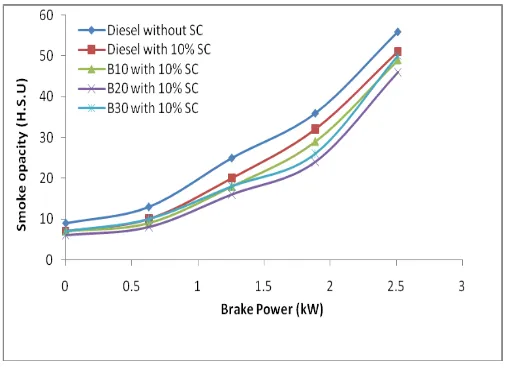
The variation of smoke emission with brake power at various blends of jatopha oil is shown in fig.8 smoke density drastically decrease with increase air supply to the engine at all loads due to better oxidation of soot .The additional air flow rate improves the combustion process which results in less smoke.
Fig .8. Variation of smoke opacity with brake power
[image:4.612.323.576.391.579.2] [image:4.612.47.290.443.618.2]International Journal of Emerging Technology and Advanced Engineering
Website: www.ijetae.com (ISSN 2250-2459,ISO 9001:2008 Certified Journal, Volume 4, Issue 1, January 2014)
132
Fig.9. Variation of brake thermal efficiency with brake power
In fig.10 shows the variation of BSFC on brake power with effect of EGR. The BSFC values are increased in all blends of Jatropha oil compared to normal diesel operation.
Fig.10. Variation of BSFC with brake power
In fig.11 shows the variation of CO emission on brake power with effect of EGR. The CO emission increases because of the post-combustion oxidation are reduced with EGR recirculation on account of lower gas temperature and lower oxygen concentration.
Fig.11. Variation of CO emission with brake power
The variation of HC emission on brake power with effect of EGR is shown in fig.12. The HC emission decreases with increasing EGR ratio, compared to normal diesel operation
Fig.12. Variation of HC with brake power
In fig.13 shows the variation of NOX emission on brake
power with effect of EGR. The NOX emission decreases
with EGR. The amount of EGR circulation is more it leads
International Journal of Emerging Technology and Advanced Engineering
Website: www.ijetae.com (ISSN 2250-2459,ISO 9001:2008 Certified Journal, Volume 4, Issue 1, January 2014)
133
Fig.13. Variation of NOx emission with brake power
VIII. CONCLUSION
An experimental investigation was conducted to test the performance and emission characteristics of Jatropha oil and its fuel blends with diesel in single cylinder diesel engine with super charger and EGR, the results obtained suggest the following conclusion.
1.Petro diesel and blends of jatropha oil exhibited
similar performance and similar emission
characteristics under various operating condition.
2.With super charging brake thermal efficiency is
increases with B10, B20 and B30 when compared to naturally aspirated diesel engine.
3.With no super charging B10, B20 and B30 blends,
volumetric efficiency is low compared to super charged engine.
4.NOx emission increased with super charging. CO and
HC emissions are decreased with super charging in all blends. Smoke opacity is significantly reduced.
5.B20 is the best blend with diesel showed better results
with brake thermal efficiency, volumetric efficiency and less emission formation with 10 % of supercharger.
6.With the effect of EGR, brake thermal efficiency
decreases with B10, B20 and B30 when compared to naturally aspirated diesel engine.
7.With no EGR B10, B20 and B30 blends, BSFC values
are increased compared to EGR incorporated engine.
8.NOx emission decreased with EGR, CO emissions
increased and HC emissions decreased in all blends of jatropha oil.
9. B20 is the best blend with diesel showed better results
with brake thermal efficiency, Brake specific fuel consumption, and less NOX emission with 10 % of EGR.
REFERENCES
[1] Donepudi Jagadish, Puli Ravi Kumar and K.Madhu Murthy,‖The efffect of supercharging on Performance and emission characteristics of C.I engine with Diesel-Ethanol-Ester Blends‖Thermal Science, Volume 15, Issue 4, 2011, Pg 1165.
[2] R. Vidya Sagar Rajua, V. Nageswara Reddyb, G. Narasa Rajua,and Dr. G. Sreenivasa Rao, ―The Effect of Super Charging and Rice Bran Oil Biodiesel As an Additive in Diesel- Ethanol Blends For Diesel Engines‖International Journal of Engineering Research & Technology (IJERT), Vol. 2 Issue 9, September – 2013.
[3] Deepak Agarwal and Avinash Kumar Agarwal, ―Performance and Emission characteristics of Jatropha oil (preheated and blends) in a DI compression Ignition Engine‖, Applied thermal Engineering, Volume 27, Issue 13, Sept-2007, Pg 2314-2323.
[4] S. Jindal, B.P. Nandawana, N.S. Rathore, V. Vasistha, ―Variable Compression ratio engine was run with jatropha Methyl Ester (B100) at different compression Ratio and injection pressures to evaluate the Performance with Emissions along with the standard settings‖. Applied thermal engineering 30 (2010) Pg 442-448. [5] V. Manieniyan and S. Sivaprakasam, ―Performance, Emission and
Combustion characteristics of diesel engine using biodiesel‖, SAE International powertrains, Fuels and Lubrication Congress, Shanhai, China, June 23-25, 2008-01-1577.
[6] M. Sundaresan, S. Chandrasekaran, P. Tamil Porai, ― Analysis of Combustion, Performance and Emission characteristics of blends of Methyl ester of jatropha oil in DI Diesel engine‖, 20076566 (JSAE), pg 1-6.
[7] Iman K. Reksowardojo, Ichsan H. Lubis, Wishnu manggala S.A., Tirto P. brodjonegoro, Tatang H. Soerawidjaja, W. Arismunandar Nguyen Ngoc, Dung and H. Ogawa ― Performance and exhaust gas Emissions of using biodiesel fuel from physic nut (Jatropha curcas L) oil on a direct injection diesel engine‖, JSAE 200777278, pg 1232-1236.
[8] ―Iman K. Reksowardojo Tirto p. Brodjonegoro and W. Arismanandar R. Sopheak, H. Ogawa ―The combustion and exhaust gas emission of a DI Compression ignition engine using physic nut oil (Jatropha curcas oil)‖.SAE 2007-01-3622.
[9] G. Amba prasad rao, P. Rama mohan ―Performance evaluation of DI & IDI engines with Jatropha oil Based biodiesel‖. IE(I) jul 2005-vol-86 pg72-76
[10] F. K. Forson, E. K. Oduro, E. Hammond-donkoh ―Performance of Jatropha oil blends in a diesel engine‖. Renewable energy 29-2004 pg 1135-1145
[11] ―S. K. Mahla, L. M. Das, M. K. G. Babu, ―Effect of cooled EGR on performance and exhaust emission characteristics of Biodiesel fueled engine‖. Proceedings of the third international conference on thermal engg: theory and applications May 21-23, 2007, Amman, Jordan [12] S. Aldajahc, O.O. Ajayia, G.R. Fenskea and I.L. Goldblattb ―Effect
of Exhaust gas recirculation contamination of diesel engine oil on wear‖ 10 sep 2007, volume 263, issues1-6 , pg 93-98 ,16th
International Journal of Emerging Technology and Advanced Engineering
Website: www.ijetae.com (ISSN 2250-2459,ISO 9001:2008 Certified Journal, Volume 4, Issue 1, January 2014)
134
[13] ―Wang Ying, Zhou Longbao‖ Experimental study on Exhaust Emissions from a multicylinder DME engine operating with EGR & Oxidation Catalyst‖. Applied thermal engg ,28(2008) 1589-1595 [14] R. Kumar. M. Sharma, S.S. Ray, A.S. Sarpal, A.A. Gupta, D.K. Juli,
R. Sarin ,R.P .Verma and N.R. Raje ―Biodiesel from Jatropha curcus and pongamia pinnata‖ IOC, R&D Centre , sector-13 ,Faridabad.SAE 2004-28-0087
[15] S.R. Kalbande and S.D.Vikhe ―Jatropha and karanj bio-fuel. An alternate fuel for diesel engine‖, ARPN Journal of Engg and Applied science, Feb 2008, vol -3 pg7-12.