Initial validation of the Arthroscopic Skills
Acquisition Tools (ASATs): A low cost,
online tool to develop and evaluate core
skills for shoulder arthroscopy
Volume 1 (of 1)
Maulik Jagdish Gandhi
@00327591
The University of Salford, Manchester, UK
Centre for Health Sciences Research
Submitted in Fulfillment of the Requirements of the
Master of Philosophy (MPhil)
INITIAL VALIDATION OF THE ARTHROSCOPIC SKILLS ACQUISITION TOOLS (ASATS):A LOW COST, ONLINE TOOL TO DEVELOP AND
INITIAL VALIDATION OF THE ARTHROSCOPIC SKILLS ACQUISITION TOOLS (ASATS):A LOW COST, ONLINE TOOL TO DEVELOP AND
EVALUATE CORE SKILLS FOR SHOULDER ARTHROSCOPY 3
Table of Contents
LIST OF TABLES 6
LIST OF FIGURES 7
GLOSSARY OF TERMS 8
DEDICATION 9
ACKNOWLEDGEMENTS 10
DECLARATION 11
ABSTRACT 13
CHAPTER 1 – INTRODUCTION TO THE THESIS AND STUDY 14
CHAPTER 2: LITERATURE REVIEW 16
AIM OF THE LITERATURE SEARCH 16
SEARCH TERMS 16
DATABASES SEARCH 17
AN OVERVIEW OF ARTHROSCOPY 18
ARTHROSCOPIC SKILLS 19
SKILLS REQUIRED TO PERFORM MINIMALLY INVASIVE SURGERY (MIS) AND ARTHROSCOPY 19
HOW ARTHROSCOPY IS DIFFERENT FROM OTHER FORMS OF MINIMALLY INVASIVE SURGERY 20
HOW SHOULDER ARTHROSCOPY IS DIFFERENT FROM OTHER FORMS OF ARTHROSCOPY 21
LEARNING CURVES OF MINIMALLY INVASIVE SURGICAL SKILLS AND ARTHROSCOPY 26
CURRENT TRAINING METHODS 28
CURRENT METHODS OF ARTHROSCOPIC SKILLS ASSESSMENT 30
SUBJECTIVE ASSESSMENT 30
COMPETENCE BY NUMBERS 31
OBJECTIVE ASSESSMENT 31
DRIVERS FOR NEW TRAINING METHODS 35
MINIMISING PATIENT HARM AND ASSOCIATED LITIGATION 35
INITIAL VALIDATION OF THE ARTHROSCOPIC SKILLS ACQUISITION TOOLS (ASATS):A LOW COST, ONLINE TOOL TO DEVELOP AND
EVALUATE CORE SKILLS FOR SHOULDER ARTHROSCOPY 4
STANDARDISING TRAINING AND IDENTIFYING TRAINING REQUIREMENTS 36
IMPROVING HOSPITAL EFFICIENCIES 36
RESPONDING TO ENFORCED WORKING TIME DIRECTIVES 37
AN OVERVIEW OF SIMULATION 38
BENEFITS 38
LIMITATIONS 38
TYPES OF SIMULATORS 38
VALIDATION STUDIES INTO ARTHROSCOPIC SIMULATION 44
CONSTRUCT VALIDITY STUDIES 45
CONTENT VALIDITY STUDIES 47
PREDICTIVE/TRANSFER VALIDITY STUDIES 48
FACE VALIDITY STUDIES 50
CONCURRENT VALIDITY STUDIES 51
PRACTICAL PRESSURES LIMITING UPTAKE OF SIMULATION 52
NEED FOR ASATS (IDENTIFICATION OF NECESSITY FOR THIS STUDY) 52
INTRODUCTION TO THE ASATS 54
INTRODUCTION TO THE INSIGHT ARTHRO VRSIMULATOR 60
THESIS AIMS 63
CHAPTER 3 – METHODOLOGY 64
INTRODUCTION 64
RESEARCH DESIGN 64
GAINING ETHICAL APPROVAL 64
PARTICIPANTS 65
INCLUSION CRITERIA 65
EXCLUSION CRITERIA 65
RECRUITMENT 65
SIGNING UP TO A STUDY SESSION 66
GAINING CONSENT 66
INITIAL VALIDATION OF THE ARTHROSCOPIC SKILLS ACQUISITION TOOLS (ASATS):A LOW COST, ONLINE TOOL TO DEVELOP AND
EVALUATE CORE SKILLS FOR SHOULDER ARTHROSCOPY 5
PROCEDURE 66
ASSESSMENTS 66
DATA HANDLING 67
DATA COLLECTION AND STORAGE 67
DATA RETRIEVAL 68
DATA PROTECTION 68
STATISTICAL ANALYSIS 68
CHAPTER 4: RESULTS 69
OPERATING ROOM VR TASK 70
PALPATE VR TASK 70
VISUALISE VR TASK 70
PENDULUM VR TASK 71
ASATS OUTCOME MEASURES 71
CHAPTER 5: DISCUSSION 81
RELEVANCE FOR TRAINING 82
DEVELOPMENT COSTS 83
LIMITATIONS 84
FUTURE WORK 84
CONCLUSION 85
REFERENCES 86
APPENDICES 99
ETHICAL,ORGANISATIONAL AND SPONSOR APPROVALS 100
PARTICIPANT INFORMATION SHEET (DETAILED & OVERVIEW) 102
ARTHROSCOPIC SKILLS ACQUISITION TOOLS 106
PARTICIPANT CONSENT FORM 112
PARTICIPANT ADVERT MATERIAL DEVELOPED WITH SCALPEL SURGICAL SOCIETY 113
SESSION PLAN 116
INITIAL VALIDATION OF THE ARTHROSCOPIC SKILLS ACQUISITION TOOLS (ASATS):A LOW COST, ONLINE TOOL TO DEVELOP AND
EVALUATE CORE SKILLS FOR SHOULDER ARTHROSCOPY 6
List of tables
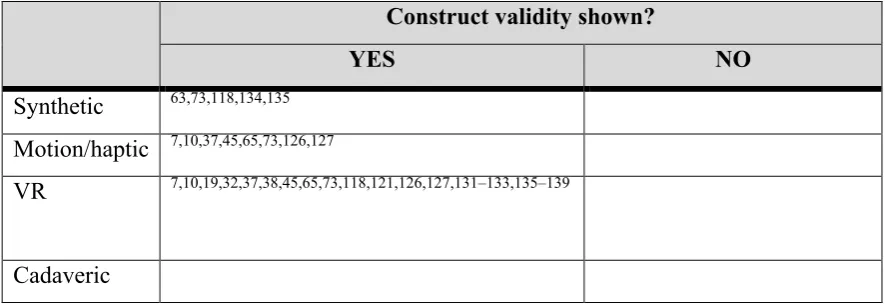
Table 1: Summary of construct validity evidence by simulator category.
Table 2: Summary of content validity evidence by simulator category.
Table 3: Summary of predictive/transfer validity evidence by simulator category for skills on the simulator.
Table 4: Summary of predictive/transfer validity evidence by simulator category for skills in the operating room.
Table 5: Summary of face validity evidence by simulator category.
Table 6: Summary of the prototype Arthroscopic Skills Acquisition Tools (ASATs). “Shape match with Inverted Controls” was used as the assessment ASAT in this correlation study.
Table 7: ASATs performance measures.
Table 8: VR performance measures.
Table 9: Expected correlations between the “Shape Match with Inverted Controls” ASAT and Virtual Reality (VR) tasks.
Table 10: Basic demographics of participants.
Table 11: Summary of correlations between the “Shape Match with Inverted Controls” ASAT and the “Operating Room” VR task.
Table 12: Summary of correlations between the “Shape Match with Inverted Controls” ASAT and the “Palpate” VR task.
Table 13: Summary of correlations between the “Shape Match with Inverted Controls” ASAT and the “Visualise” VR task.
Table 14: Summary of correlations between the “Shape Match with Inverted Controls” ASAT and the “Pendulum” VR task.
Table 15: Observed correlations between the “Shape Match with Inverted Controls” ASAT and VR tasks.
INITIAL VALIDATION OF THE ARTHROSCOPIC SKILLS ACQUISITION TOOLS (ASATS):A LOW COST, ONLINE TOOL TO DEVELOP AND
EVALUATE CORE SKILLS FOR SHOULDER ARTHROSCOPY 7
List of Figures
Figure 1: Shoulder scope (on a plastic shoulder model) showing the hand position, fulcrum point and instrument within the joint.
Figure 2: Schematic diagram of a Class 1 Lever highlighting the resultant opposite direction of camera/instrument motion to hand movement (effort).
Figure 3a: (above) Shoulder scope (on a plastic shoulder model) hand position showing the camera and instrument perpendicular to each other.
Figure 3b: (below) Position of the camera and instrument perpendicular to each other.
Figure 4a: (above) Shoulder scope (on a virtual reality shouler model) hand position showing the camera and instrument opposite to each other.
Figure 4b: (below) Position of the camera and instrument perpendicular to each other.
Figure 5: Shoulder arthroscopy in the beach chair position showing the joint line (red) being perpendicular to the floor (yellow) (image courtesy of Len Funk, www.shoulderdoc.co.uk).
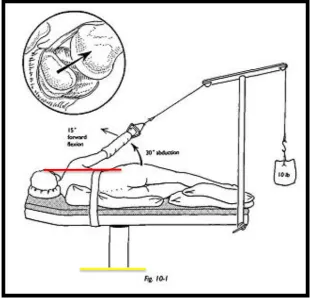
Figure 6: Shoulder arthroscopy in the lateral decubitus position showing the joint line (red) being parallel to the floor (yellow) (image courtesy of Len Funk, www.shoulderdoc.co.uk).
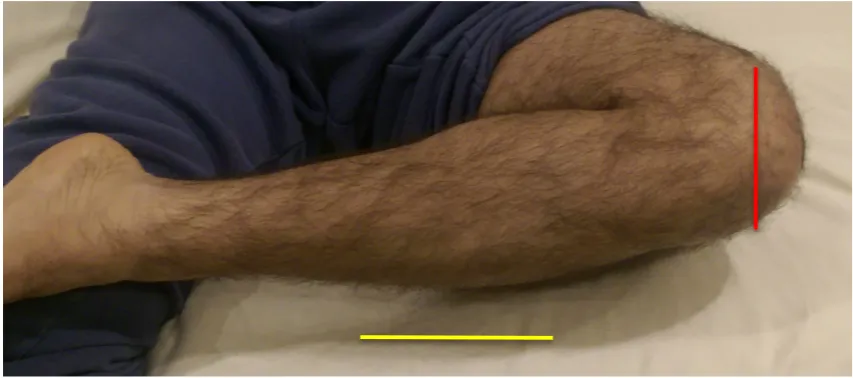
Figure 7: Knee held in a flexed position whilst supine showing the joint line (red) being parallel to the floor (yellow).
Figure 8: Knee held in a “figure of 4” position whilst supine showing the joint line (red) being perpendicular to the floor (yellow).
Figure 9: Learning curve graph. Image modified under the Creative Commons Attribution-Share Alike 3.0 Unported License. Original image ©Alan Fletcher 2013.
Figure 10: Commercial box trainer (Arthrobox® by Arthrex, Naples, FL, USA).
Figure 11: Layout of the ASATs.
INITIAL VALIDATION OF THE ARTHROSCOPIC SKILLS ACQUISITION TOOLS (ASATS):A LOW COST, ONLINE TOOL TO DEVELOP AND
EVALUATE CORE SKILLS FOR SHOULDER ARTHROSCOPY 8
Glossary of Terms
2D: 2-Dimensional 3D: 3-Dimensional
AO: Arbeitsgemeinschaft für Osteosynthesefragen ASATs: Arthroscopic Skills Acquisition Tools BOA: British Orthopaedic Association
CCT: Certificate of Completion of Training GRS: Global Rating Scale
JCST: Joint Committee of Surgical Training MIS: Minimally Invasive Surgery
NHS: National Health Service OR: Operating Room
UK: United Kingdom
INITIAL VALIDATION OF THE ARTHROSCOPIC SKILLS ACQUISITION TOOLS (ASATS):A LOW COST, ONLINE TOOL TO DEVELOP AND
EVALUATE CORE SKILLS FOR SHOULDER ARTHROSCOPY 9
Dedication
This work would not have been possible without the commitment of my family.
To my wife, Praksha: you have stayed by my side, from application to the MPhil programme, sacrificing weekends for me to collect data to proof-reading my final thesis. You have been with me through the frustrations of trying to disseminate the findings of this work and kept me on track of thinking of the bigger picture. Thank you.
To my children, Kaisha, Preesh and Krish: you have always kept my work in perspective. When things are hard, then I only need to look at your smiles to keep me going. Preesh – your period of illness inspired me into being strong through times of adversity. Thank you all.
To my parents, Mum and Dad: you have always encouraged me in all my endeavours and let me think “outside the box” which has allowed me to have these ideas in the first place. Thank you both.
To the superior force which oversees Karma: I hope I have done some good. Thank you for this opportunity.
INITIAL VALIDATION OF THE ARTHROSCOPIC SKILLS ACQUISITION TOOLS (ASATS):A LOW COST, ONLINE TOOL TO DEVELOP AND
EVALUATE CORE SKILLS FOR SHOULDER ARTHROSCOPY 10
Acknowledgements
I would like to thank my supervisors for the support I have received.
Professor Laurence Kenney: thank you for your guidance and help through the second half of my programme and also in the write-up phase with your comments and critical appraisal.
Professor Lennard Funk: thank you for all your support and encouragement in applying and seeing me through this programme. Without your encouragement and also access to the hospital and simulator, this whole thing would not have been possible.
I also thank Mr. Michael Anderton, an orthopaedic registrar in the North West Deanery, for help in data collection during some assessment sessions.
INITIAL VALIDATION OF THE ARTHROSCOPIC SKILLS ACQUISITION TOOLS (ASATS):A LOW COST, ONLINE TOOL TO DEVELOP AND
EVALUATE CORE SKILLS FOR SHOULDER ARTHROSCOPY 11
Declaration
I declare that I have solely written this thesis, and that the content and findings of the studies are not being submitted for the award of any other higher degrees, except for the award of an MPhil at the University of Salford.
I declare that I have disseminated the results of the study at recognised national and international research meetings as podium and poster presentations as listed below.
Podium Presentations:
• 50th Golden Anniversary Congress of the European Society for Surgical Research (ESSR), Liverpool, England. September 2014.
This resulted in a published abstract. Full reference:
Gandhi MJ, Anderton MJ, Funk L. Arthroscopic Skills Acquisition Tools (ASATs): an online simulator to develop core skills for arthroscopy. European Surgical Research. 2015; 55 (suppl 1): 1-167.
• 25th SECEC-ESSSE (European Society for Surgery of the Shoulder and Elbow) Congress, Istanbul, Turkey. September 2014.
This resulted in a published abstract. Full reference:
Gandhi MJ, Anderton MJ, Funk L. Can a low fidelity simulator teach the same core arthroscopic skills as a high fidelity simulator? International Journal of Surgery 12 (2014), S83.
Poster Presentations:
• 26th SECEC-ESSSE (European Society for Surgery of the Shoulder and Elbow) Congress, Milan, Italy. September 2015.
• British Orthopaedic Association (BOA) Annual Congress, Liverpool, England. September 2015.
A manuscript has also been published in a peer-reviewed journal targeting an international audience for arthroscopy. The full reference is:
Gandhi MJ, Anderton MJ, Funk L. Arthroscopic Skills Acquisition Tools (ASATs): an
INITIAL VALIDATION OF THE ARTHROSCOPIC SKILLS ACQUISITION TOOLS (ASATS):A LOW COST, ONLINE TOOL TO DEVELOP AND
EVALUATE CORE SKILLS FOR SHOULDER ARTHROSCOPY 12
I declare that I have received the following prizes relating to this work:
• British Orthopaedic Association (BOA): Runner-up Award in “Innovation in Simulation and Technology Enhanced Learning” at BOA Annual Congress, Brighton, England. September 2014.
I declare that I have been shortlisted for the following prizes relating to this work:
INITIAL VALIDATION OF THE ARTHROSCOPIC SKILLS ACQUISITION TOOLS (ASATS):A LOW COST, ONLINE TOOL TO DEVELOP AND
EVALUATE CORE SKILLS FOR SHOULDER ARTHROSCOPY 13
Abstract
There are increasing time pressures on surgical training, including the European Working Time Directive. Developing arthroscopic surgical skills (keyhole surgery into a joint) has a longer learning curve than open surgery, driving the need to develop efficient training techniques. Virtual reality (VR) simulators offer great potential but such high fidelity simulators are not widespread because of their cost and subsequent access restrictions.
A structured program of developing transferrable skills using widely accessible, low cost, but low fidelity simulators may help maximise training opportunities on VR simulators. To address this, the author developed the Arthroscopic Skills Acquisition Tools (ASATs), designed to develop and evaluate the core skills for shoulder arthroscopy, to complement training on VR simulators, cadavers and real patients.
This thesis presents the initial validation study of the ASATs. Performance, assessed using a VR simulator correlates with intra-operative and cadaveric arthroscopic performance and can differentiate between novices and experts, thereby providing a practical “gold standard” test environment for the initial validation of the ASATs. This MPhil study aims to evaluate correlations between performance measured using one of the ASATs and performance on a VR shoulder arthroscopy simulator.
Following ethical approvals, 49 volunteers were recruited and individually received a 1-hour standardised introduction and familiarisation process containing written material, videos and five different ASATs. They were then assessed using a sixth ASAT and four VR tasks. Correlations were assessed between the ASAT measures and the VR measures using Pearson’s correlation coefficients.
INITIAL VALIDATION OF THE ARTHROSCOPIC SKILLS ACQUISITION TOOLS (ASATS):A LOW COST, ONLINE TOOL TO DEVELOP AND
EVALUATE CORE SKILLS FOR SHOULDER ARTHROSCOPY 14
Chapter 1 – Introduction to the thesis and study
The student (MJG) is a practicing doctor who is in his final year of training (10th tier post-graduation from medical school) in an orthopaedic training programme in the United Kingdom (UK). He is aspiring to be a shoulder surgeon, and has a particular interest in arthroscopic surgery. He has experienced first-hand many of the different training methods described and this has inspired him to develop a low cost simulation system, the initial validation of which is the focus of this thesis.
The General Medical Council (GMC) states as part of “Good Medical Practice”, a doctor must1:
“… be competent in all aspects of work…”
“…keep skills up to date…”
“…regularly take part in activities that maintain and develop competence and performance…”
Being competent, keeping skills up to date and maintaining performance is not just in the interest of the individual surgeon, but also important to other stake holders such as hospitals and patients.
Traditional surgical training has been delivered on a one-to-one basis, similar to a master-apprentice relationship.2 This method of surgical training is evolving to address the main modern-day challenges:
1. Minimising patient harm and associated litigation3–7.
2. Consensus for the need to be able to objectively define surgical performance4,8–15
3. Standardising training and improving training efficiency15–18. 4. Improving hospital efficiencies3,19.
INITIAL VALIDATION OF THE ARTHROSCOPIC SKILLS ACQUISITION TOOLS (ASATS):A LOW COST, ONLINE TOOL TO DEVELOP AND
EVALUATE CORE SKILLS FOR SHOULDER ARTHROSCOPY 15
Simulation can address the points raised above, but as will be addressed, practical limitations currently exist with implementation29. Specifically, high fidelity simulation systems may allow the development of skills but the practical application of such systems has been called into question due to poor availability. This has led to the development of low fidelity systems, with high accessibility. One such simulator was designed by the student (MJG) to specifically address these limitations. This simulator was named the Arthroscopic Skills Acquisitions Tools, or ASATs for short.
The thesis begins with a literature review and Chapter 2 summarises how this search was performed. An overview of arthroscopy, arthroscopic skills, current training methods and methods of skills assessment is presented.
This leads onto the drivers for new training methods and overview of simulation as a possible solution. The evidence is reviewed and the practical pressures that are limiting the uptake of simulation is highlighted. This brings the thesis onto why there is the need for a new solution like the ASATs and defines this thesis aims.
INITIAL VALIDATION OF THE ARTHROSCOPIC SKILLS ACQUISITION TOOLS (ASATS):A LOW COST, ONLINE TOOL TO DEVELOP AND
EVALUATE CORE SKILLS FOR SHOULDER ARTHROSCOPY 16
Chapter 2: Literature Review
Aim of the Literature Search
A review of the published literature was conducted to establish the full journey of a training doctor wishing to become an orthopaedic surgeon and the opportunities available to develop surgical skills, specifically arthroscopic skills. Such opportunities can come from training in other surgical specialties that employ minimal invasive surgery (MIS) and from within orthopaedics.
The first step was to identify the skills required for arthroscopy. Traditional and current training methods to acquire these skills are reviewed. This was followed by identifying methods to assess arthroscopic skills. A review is presented of the attempts to develop tools that aim specifically to improve surgical skills. The drivers for new training methods were explored and the concept of simulation introduced.
A comprehensive review of the different types of validation studies for arthroscopic simulators performed is presented. The end of this section highlights the practical pressures limiting uptake of simulation and introduces the Arthroscopic Skills Acquisition Tools.
Finally, the gap in the literature is identified, which this thesis aims to address.
Search Terms
Virtual Reality Arthroscopy Laparoscopy Orthopaedics Orthopedics Simulation
Computer Simulation Simulator
INITIAL VALIDATION OF THE ARTHROSCOPIC SKILLS ACQUISITION TOOLS (ASATS):A LOW COST, ONLINE TOOL TO DEVELOP AND
EVALUATE CORE SKILLS FOR SHOULDER ARTHROSCOPY 17
Databases Search
MEDLINE (from 2004-2016).
INITIAL VALIDATION OF THE ARTHROSCOPIC SKILLS ACQUISITION TOOLS (ASATS):A LOW COST, ONLINE TOOL TO DEVELOP AND
EVALUATE CORE SKILLS FOR SHOULDER ARTHROSCOPY 18
An overview of arthroscopy
Arthroscopy is a form of minimal invasive surgery (MIS) or key-hole surgery into a joint. Other forms of MIS include laparoscopy, where the instruments and camera are placed into different parts of the body, typically the abdomen. Arthroscopy is carried out by surgeons in the field of Orthopaedics, whilst laparoscopy can be performed by surgeons in the field of General Surgery or Gynaecology.
Arthroscopy can be used in diagnosis and treatment of an increasing number of joint conditions30. In addition to smaller scars, benefits of arthroscopic surgery can include shorter
recovery time, reduced risk of infection and shorter hospital in-patient stay.
It is accepted that arthroscopy requires a different type of skill set to open surgery31. Core skills training for the next generation of orthopaedic surgeons needs to include arthroscopic skills19,32–
INITIAL VALIDATION OF THE ARTHROSCOPIC SKILLS ACQUISITION TOOLS (ASATS):A LOW COST, ONLINE TOOL TO DEVELOP AND
EVALUATE CORE SKILLS FOR SHOULDER ARTHROSCOPY 19
Arthroscopic Skills
Skills required to perform minimally invasive surgery (MIS) and arthroscopy
As indicated by the lack of a consensus on assessment, discussed in the section “Current methods of arthroscopic skills assessment”, there remains some debate on what constitutes the core hand-eye coordination skills that needs to be attained over the course of training to be an arthroscopy surgeon15,19,35,36.
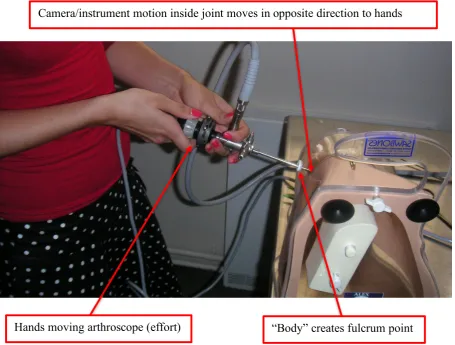
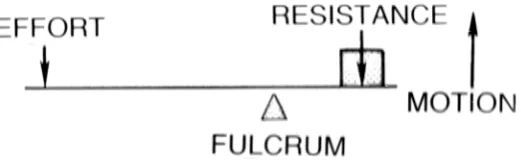
[image:19.595.85.541.365.710.2]Arthroscopic surgery requires many of the same technical skills required for other minimal-invasive surgical procedures. They all utilise a camera and instruments through separate access portals. In both MIS and arthroscopy, it is accepted that hand-eye coordination and manual dexterity37 are the core skills. Hand-eye coordination requires the appreciation of inverted hand-eye movements. This is because the body acts as a fulcrum (Figure 1). This represents a Class 1 lever and this is drawn schematically in Figure 2.
Figure 1: Shoulder scope (on a plastic shoulder model) showing the hand position, fulcrum point and instrument within the joint.
Hands moving arthroscope (effort)
Camera/instrument motion inside joint moves in opposite direction to hands
INITIAL VALIDATION OF THE ARTHROSCOPIC SKILLS ACQUISITION TOOLS (ASATS):A LOW COST, ONLINE TOOL TO DEVELOP AND
[image:20.595.183.444.106.187.2]EVALUATE CORE SKILLS FOR SHOULDER ARTHROSCOPY 20
Figure 2: Schematic diagram of a Class 1 Lever highlighting the resultant opposite direction of camera/instrument motion to hand movement (effort).
The operator’s visual field usually is not wide enough to contain their hands and the camera display monitor because they are positioned at a distance from each other. This means the operator can either look at their hands or the monitor. This results in the disconnection of visual and proprioceptive stimuli. This presents unique technical challenges, namely, the simultaneous interpretation of proprioceptive and visual stimuli from a three-dimensional structure presented as a two-dimensional image and hence development of competence in triangulation is also a central skill31,38.
The additional skills described in the literature include reaction speed, anticipation, steady and accurate movements, and ability to reverse hand-eye coordination32,35,39,40. In arthroscopy, the primary surgeon often uses one hand for camera manipulation allowing the other hand to be used for instrument manipulation.
It is traditional thinking that these skills are best acquired through actual instrument handling and rely on realistic substitutes for live patients38.
How arthroscopy is different from other forms of minimally invasive surgery
There are some notable differences in surgical technique between laparoscopy and arthroscopy37,41.
INITIAL VALIDATION OF THE ARTHROSCOPIC SKILLS ACQUISITION TOOLS (ASATS):A LOW COST, ONLINE TOOL TO DEVELOP AND
EVALUATE CORE SKILLS FOR SHOULDER ARTHROSCOPY 21
smaller than the abdomen, thus meaning the instruments used are shorter. The structures within a joint during arthroscopy also provides more tactile feedback, as cartilage and bone are firmer surfaces than abdominal structures37.
Finally, in laparoscopy the operative field is expanded using carbon dioxide gas (CO2) whilst
in arthroscopy it is inflated using irrigation fluid42. The effect of the fluid is that it produces a
flow effect away from the camera, pushing structures of interest away from visualisation. Techniques need to be employed to try and counter this effect. These are a different set of skills that are not developed during laparoscopic training.
How shoulder arthroscopy is different from other forms of arthroscopy
Arthroscopy is being performed in multiple joints, including shoulder, elbow, wrist, hip, knee and ankle. The two most commonly performed arthroscopies are in the shoulder and knee joint. Not all arthroscopies utilise the same skills as is evident between shoulder and knee arthroscopy41,43.
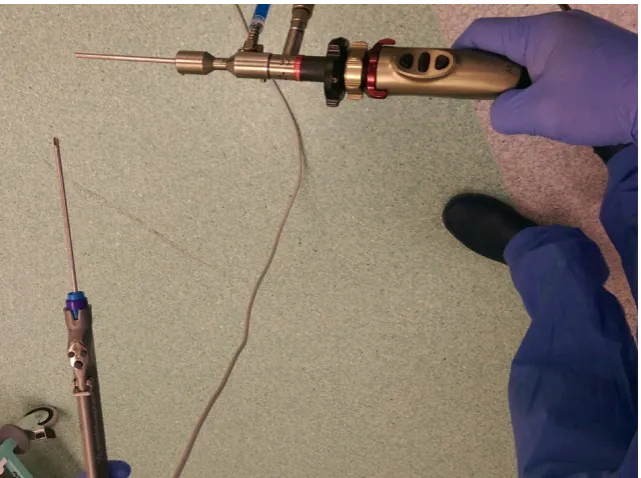
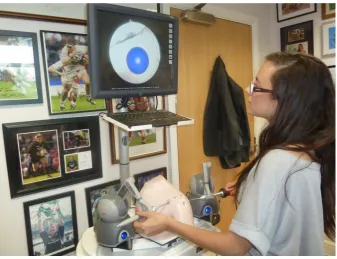
In the shoulder joint, the major plane of movement is vertical, the operating field is smaller, and the primary surgeon’s hands are either perpendicular to each other (Figure 3) or facing each other (Figure 4)44. In the knee joint, the major plane of movement is horizontal, the operating
field slightly larger and the surgeon’s hand primarily parallel to each other44. The effect of the
hand position tests the surgeon’s ability to triangulate.
INITIAL VALIDATION OF THE ARTHROSCOPIC SKILLS ACQUISITION TOOLS (ASATS):A LOW COST, ONLINE TOOL TO DEVELOP AND
EVALUATE CORE SKILLS FOR SHOULDER ARTHROSCOPY 22
Figure 3a: (above) Shoulder scope (on a plastic shoulder model) hand position showing the camera and instrument perpendicular to each other.
[image:22.595.142.481.55.307.2] [image:22.595.152.473.422.661.2]INITIAL VALIDATION OF THE ARTHROSCOPIC SKILLS ACQUISITION TOOLS (ASATS):A LOW COST, ONLINE TOOL TO DEVELOP AND
EVALUATE CORE SKILLS FOR SHOULDER ARTHROSCOPY 23
Figure 4a: (above) Shoulder scope (on a virtual reality shoulder model) hand position showing the camera and instrument opposite to each other.
[image:23.595.143.481.74.333.2] [image:23.595.222.403.438.759.2]INITIAL VALIDATION OF THE ARTHROSCOPIC SKILLS ACQUISITION TOOLS (ASATS):A LOW COST, ONLINE TOOL TO DEVELOP AND
[image:24.595.145.479.63.396.2]EVALUATE CORE SKILLS FOR SHOULDER ARTHROSCOPY 24
Figure 5: Shoulder arthroscopy in the beach chair position showing the joint line (red) being perpendicular to the floor (yellow) (image courtesy of Len Funk, www.shoulderdoc.co.uk).
[image:24.595.155.466.442.740.2]INITIAL VALIDATION OF THE ARTHROSCOPIC SKILLS ACQUISITION TOOLS (ASATS):A LOW COST, ONLINE TOOL TO DEVELOP AND
[image:25.595.173.451.54.371.2]EVALUATE CORE SKILLS FOR SHOULDER ARTHROSCOPY 25
Figure 7: Knee held in a flexed position whilst supine showing the joint line (red) being parallel to the floor (yellow).
[image:25.595.97.524.439.628.2]INITIAL VALIDATION OF THE ARTHROSCOPIC SKILLS ACQUISITION TOOLS (ASATS):A LOW COST, ONLINE TOOL TO DEVELOP AND
EVALUATE CORE SKILLS FOR SHOULDER ARTHROSCOPY 26
Learning Curves of minimally invasive surgical skills and arthroscopy
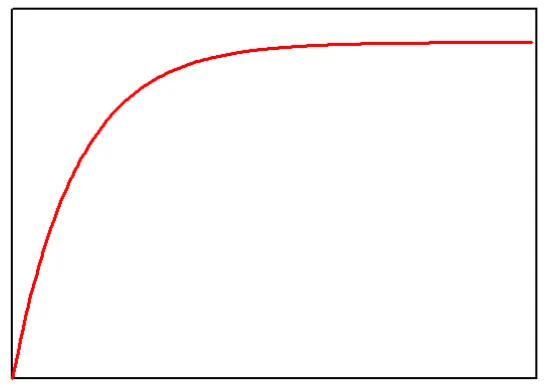
[image:26.595.183.458.233.427.2]The development of any skill is associated with a learning curve43,45. If plotted with time spent practicing (experience) along the x axis, and a performance measure (learning) on the y-axis, this learning curve typically reaches a plateau (Figure 9). The variables that may influence the final look of this curve include the difficulty of the skill being acquired, the individual’s ability to acquire the skills and other confounding variables such as supplementary training and intensity of training opportunities46–48.
Figure 9: Learning curve graph. Image modified under the Creative Commons Attribution-Share Alike 3.0 Unported License. Original image ©Alan Fletcher 2013.
It has been shown that surgeons in the early phase of their arthroscopic skills learning curve have an increased risk of iatrogenic injury6,10,49. This is because these trainees often have problems with adequate joint visualisation and triangulation50.
No predictive factors that represent a faster progression along a learning curve have been identified51. Practice through repetition can show progression through a learning curve, and even skill retention45,51. The transfer of these skills into theatre will be reviewed later (“Predictive/transfer validity evidence”).
Traditional teaching in open surgery relies initially on observational training38 but this has been shown to be sub-optimal in the development of MIS skills49. As a result, to acquire these skills
P
er
for
m
anc
e
m
ea
sur
e
INITIAL VALIDATION OF THE ARTHROSCOPIC SKILLS ACQUISITION TOOLS (ASATS):A LOW COST, ONLINE TOOL TO DEVELOP AND
EVALUATE CORE SKILLS FOR SHOULDER ARTHROSCOPY 27
and progress up the learning curve, specific training is required that includes many hours of practice31,37 and a significant financial burden (in theatre)4.
The amount of time spent practicing can be reduced by external factors such as Working Time Directives, which is reviewed later (“Drivers for new training methods”). This could slow the trainee reaching the plateau part of their learning curve. The impact of a slow learning curve increases the overall cost of training by increasing the time required for achieving competence. A slower learning curve also subjects patients to increased risk through iatrogenic injury. The effect it has on the trainees include decreasing confidence within the surgical procedure which may subsequently affect performance3.
There have been studies published in the literature which look into progressing trainees along their learning curve, particularly in a simulated environment37,46–48,51. This has the advantages that there are no pressures associated with operating on real patients, and the focus on skills developments occurs in a controlled safe environment15,52.
INITIAL VALIDATION OF THE ARTHROSCOPIC SKILLS ACQUISITION TOOLS (ASATS):A LOW COST, ONLINE TOOL TO DEVELOP AND
EVALUATE CORE SKILLS FOR SHOULDER ARTHROSCOPY 28
Current Training Methods
Training has multiple objectives and these can be targeted through different routes20. Broadly, surgical training can be split into knowledge acquisition and skills acquisition. Other objectives, such as decision-making, leadership and communication skills are also required20,37, but these are not covered in this thesis.
Knowledge acquisition, such as anatomy, needs to be learned to be able to perform safe and effective operations. This is typically learned at a basic level at medical school and more detailed knowledge is developed during post-graduate training. As the anatomical knowledge of the surgeon is not the focus for this thesis, no further discussion is provided here.
Orthopaedic training requires a lengthy period of skills assimilation to develop established surgical techniques alongside rapidly evolving techniques53. Traditionally, skills have been developed during the actual procedure, for example during the operation (intra-operative skills acquisition)38. This often is accompanied by pre-procedure cognitive simulation and post-procedure feedback. Cognitive simulation can be as simple as checking the trainee knows the steps of the surgical procedure to virtual operative experience on a mobile device54. Post-procedure feedback has traditionally been sub-optimal, with little in the way of constructive feedback. As a result, more objective feedback mechanisms and tools have been developed and these will be reviewed in the “Methods of arthroscopic skills assessment” section of the thesis.
More recently, skills simulation has progressed to allow reproduction of the surgical steps of specific operations53. Surgical approaches on human cadavers has been the gold standard in surgical training55.
Clearly there is tissue variability and ethical considerations when using human cadavers or animal models, so there have been attempts to simulate using different models. Simulating open orthopaedic surgical techniques using synthetic bone substitutes has been used by the Arbeitsgemeinschaft für Osteosynthesefragen (AO) foundation for over 50 years56. Specific to
this thesis, models that have been used for arthroscopy are reviewed in the simulator section.
INITIAL VALIDATION OF THE ARTHROSCOPIC SKILLS ACQUISITION TOOLS (ASATS):A LOW COST, ONLINE TOOL TO DEVELOP AND
EVALUATE CORE SKILLS FOR SHOULDER ARTHROSCOPY 29
training for arthroscopic skills development. Cadaveric simulation was viewed as the most effective and preferred method of training.
INITIAL VALIDATION OF THE ARTHROSCOPIC SKILLS ACQUISITION TOOLS (ASATS):A LOW COST, ONLINE TOOL TO DEVELOP AND
EVALUATE CORE SKILLS FOR SHOULDER ARTHROSCOPY 30
Current methods of arthroscopic skills assessment
Ultimately, the purpose of surgical training is to produce a surgeon who is able to perform operations. This introduces the concept of competence. Historically, competence has been bestowed to trainees by senior surgeons, who themselves have gained competence through experience and peer-review57–59. This definition of competence is highly subjective. The inability to define competency and quantifying arthroscopic proficiency has been recognised35.
Training programmes are adopting more competency-based models, in which objective skills assessment are required for trainee progression15,36.
In the UK, the Joint Committee of Surgical Training (JCST) mandates a trainee to have performed a minimum of 40 arthroscopic procedures spread across all joints (knee, shoulder, hip and ankle) under supervision over the course of a training programme (6 years) 44 to be eligible for the Certificate of Completion of Training (CCT).
The competence level now relies more heavily on defining performance. Performance needs to be measurable in order to show progress along a learning curve and plateauing at the same level as an expert. This requires a form of assessment, which broadly can be subjective or objective. Assessment methods on performance have been criticised and continue to evolve.
For the method of assessment to be deemed applicable, it must show feasibility, reliability, and validity60. Validity is described in more detail in a later section.
Subjective assessment
Subjective assessment of a trainee is the simplest and earliest form of assessment. It follows similar principles to an apprenticeship, where a trainer will give their trainee or apprentice a global assessment35. It has been shown this form of assessment does not reflect the actual level of skill the trainee may possess11,15. The actual global assessment of a trainee’s situational
INITIAL VALIDATION OF THE ARTHROSCOPIC SKILLS ACQUISITION TOOLS (ASATS):A LOW COST, ONLINE TOOL TO DEVELOP AND
EVALUATE CORE SKILLS FOR SHOULDER ARTHROSCOPY 31
To improve the assessment of a trainee’s skill, more objectively-based assessment tools have been developed 35,55,58,62–65, whilst remaining feasible and practical37,66. These are discussed below.
Competence by numbers
A learning curve is established and maintained at a plateau if a skill is continuously practiced43,45. This does not define competence, but it does make the assumption that the majority of novices should achieve the same skills performance plateau of experienced surgeons with continued practice43,45. Little evidence exists on how skills acquired in one joint environment actually transfer to another joint. This raises questions surrounding the suitability of modern training programmes at delivering sufficient arthroscopic competencies across the various different anatomical sites encountered in treating patients44.
Similarly, the Arthroscopy Association of North America (AANA) does not quantify competence, but requires that 50 arthroscopic cases be performed annually to maintain active membership67. The American Board of Orthopedic Surgery (ABOS) requires a one-year accredited ACGME sports medicine fellowship and at least 75 arthroscopy cases to be eligible for subspecialty certification in sports medicine68.
The assumption that every novice will progress along a learning curve and performance will plateau at the same level as an expert has been challenged in both arthroscopy46,47and
laparoscopy48. Hence, it is not appropriate to rely solely on competence by numbers57,59.
Objective assessment
To address the limitations of the above methods of assessment for arthroscopy, more objective methods of assessment has been developed. This allows objective feedback thus allowing for the transition from an apprenticeship-based method of training to a more competency-based training58,62.
Objective assessment tools described can be broadly defined into:
INITIAL VALIDATION OF THE ARTHROSCOPIC SKILLS ACQUISITION TOOLS (ASATS):A LOW COST, ONLINE TOOL TO DEVELOP AND
EVALUATE CORE SKILLS FOR SHOULDER ARTHROSCOPY 32
2. Procedural checklists/Global ratings scores (GRS): categorical subjective assessment of defined intra-procedural steps.
A recent systematic review in 2016 highlighted 13 studies that evaluated measurement outcomes for knee arthroscopy training69. The outcome measures used:
- Mean time to perform the task in all 13 studies.
- Navigation and triangulation based tasks in 10 studies. - Cartilage collision and surgical force in 6 studies. - Hand movement/motion analysis in 3 studies.
In shoulder arthroscopy, outcome measures that were able to discriminate skill level on shoulder simulators7,10,70,71 include:
- Time to completion of tasks.
- Distance and path travelled by probe. - Number of probe collisions.
Force measurement evidence
Iatrogenic damage during arthroscopy can occur when there is inadvertent collision with intra-articular structures or during portal placement10,11,15. The surgeon will get tactile feedback when the inadvertent collision is made. Therefore measurements of force when a collision is made and the number of collisions provides an objective method of evaluating tactile surgical performance35. This method of objective assessment has been shown to correlate with level of knee arthroscopic experience, with fewer collisions and lower collision forces noted in experts compared with novices72,73.
Motion analysis evidence
INITIAL VALIDATION OF THE ARTHROSCOPIC SKILLS ACQUISITION TOOLS (ASATS):A LOW COST, ONLINE TOOL TO DEVELOP AND
EVALUATE CORE SKILLS FOR SHOULDER ARTHROSCOPY 33
It could be used as an adjunct to more traditional methods of assessment35,37,52,74,75,79–81. It helped identify that a subset of medical students failed to achieve competence despite sustained practice46,47, supporting the notion that competency by numbers may not be achieved by all those who practice. There are however associated equipment costs and limitations in that validation has only been shown performing basic arthroscopic tasks35,37.
Global Rating Scales (GRS)/ Task or Procedure-specific checklist evidence
These systems all rely on the principle of scoring against preset criteria by trained assessors. The checklist contains essential elements of a procedure, whilst the GRS focuses on specific surgical behaviours53. These have been shown to superior to direct observation by experts alone82,83.
Global rating scales assess performance across several domains to generate an overall performance rating in simulated and clinical settings62,84–87. They are attractive as they are generic, easy to use in terms of lack of additional equipment, applicability to multiple tasks and usability in the operating room62. They have been used across different surgical specialties82,84,88,89.
In orthopaedics, GRS has shown to have the ability to assess skills levels and learning curves
35,58,63. There are different GRS including the Arthroscopic Skills Assessment Form and
OAAS35 and Arthroscopic Surgery Skill Evaluation Tool (ASSET)55. The different GRS have similarities in the assessment and domain and anchors. This has unsurprisingly resulted in similar scores and thereby similar differences between skill levels62.
The performance of global rating scales assessment have correlated with motion76–78.
INITIAL VALIDATION OF THE ARTHROSCOPIC SKILLS ACQUISITION TOOLS (ASATS):A LOW COST, ONLINE TOOL TO DEVELOP AND
EVALUATE CORE SKILLS FOR SHOULDER ARTHROSCOPY 34
INITIAL VALIDATION OF THE ARTHROSCOPIC SKILLS ACQUISITION TOOLS (ASATS):A LOW COST, ONLINE TOOL TO DEVELOP AND
EVALUATE CORE SKILLS FOR SHOULDER ARTHROSCOPY 35
Drivers for new training methods
Training methods will continue to evolve as evidence accumulates around new methods of learning and with the advancement of technology and innovation. There are also drivers for change, such as
1. Minimising patient harm and associated litigation.
2. Consensus for the need to be able to objectively define surgical performance 3. Standardising training and identifying training requirements.
4. Improving hospital efficiencies.
5. Responding to enforced working time directives.
Minimising patient harm and associated litigation
UK national initiatives such as the National Joint Registry (NJR) and the National Hip Fracture Database (NHFD) now collect data that can identify and report back at hospital level regarding performance95,96. The NJR also releases data to the public on individual surgeon’s performances. Although arthroscopic procedures are not compulsorily recorded, the National Ligament Registry (NLR) voluntarily collects information about some knee ligament reconstructive arthroscopic operations and also the clinical outcome97. Surgeons are under increasing pressure to demonstrate competence in an objective manner to both peers and to the public8,98.
Litigation arising from accidental injury from orthopaedic surgery causes substantial costs to the NHS3. As identified earlier, it has been shown that surgeons in the early phase of their
arthroscopic skills learning curve have an increased risk of iatrogenic injury6,10,49.
Consensus to objective define surgical performance
The difficulty to define a competency level has been discussed earlier. It is accepted that in order to be able to set up a competency level, an objective measure of surgical performance needs to be achieved12–15. Although several methods of objective measurements have been reviewed, no ideal parameter has been identified in isolation. It is likely that a combination of techniques will be required.
INITIAL VALIDATION OF THE ARTHROSCOPIC SKILLS ACQUISITION TOOLS (ASATS):A LOW COST, ONLINE TOOL TO DEVELOP AND
EVALUATE CORE SKILLS FOR SHOULDER ARTHROSCOPY 36
Standardising training and identifying training requirements
There are limitations of a traditional apprenticeship model, notably it lacks the objective assessment and also the process can be inefficient particular in terms of time and cost4–
7,10,11,15,18. This challenge is compounded by the implementation of work-hour restrictions
(discussed below), to the stage that the adequacy of traditional arthroscopic training during residency has become an increasing concern 21,22,62,99.
If there is national variation in training methods, this also makes it difficult for the JCST to provide a benchmark for trainees to compare their own training progress against their peers (Personal communication with the British Orthopaedic Association (BOA) Simulation Working Group).
Objective assessment may help plot a trainee’s learning curve and help determine whether their performance has plateaued. This performance plateau can then be compared with an expert to see if similar competence (as measured by that specific performance parameter) has been achieved. This helps identify those individuals whose performance parameter do not plateau at the level of an expert48. This can allow appropriate feedback to the trainee and the
implementation of supportive measures, either through extended training time and additional training methods. The current evidence does not support the use of such assessments to be used as a screening tool in identifying individuals who may not possess the technical skills necessary for a career in orthopaedic surgery46. Other parameters can be important in identifying surgical performance, including the performance of the entire surgical team, age, and personality traits100–102.
Improving hospital efficiencies
Hospital managers often are in charge of improving theatre utilisation. The effect of training a junior surgeon often results in a longer operative time, which can translate into a longer theatre session. In other words, for the same amount of theatre time, less surgical procedures can be done. This has an effect on patients, surgeons, trainees, surgical and managerial staff.
By allowing trainees to train outside the theatre, trainees will require less operative time to gain the same level of operative skills20. The more efficiently a trainee can perform simulated
expert-INITIAL VALIDATION OF THE ARTHROSCOPIC SKILLS ACQUISITION TOOLS (ASATS):A LOW COST, ONLINE TOOL TO DEVELOP AND
EVALUATE CORE SKILLS FOR SHOULDER ARTHROSCOPY 37
level efficiency. This minimises the effect on patients, staff and also the finances within the health services3.
Responding to enforced working time directives
Enforced limits on working hours has been introduced internationally25,103 aiming to improve patient safety and reduce tiredness amongst doctors and healthcare staff23–26. Although the working time has reduced, this also has had a negative effect on training time62,99. To maintain existing services with a workforce that has hours that are capped means that staff numbers need to increase, and this again has a negative impact on opportunities to develop procedural and technical skills as more trainees are competing for the same procedural training20.
INITIAL VALIDATION OF THE ARTHROSCOPIC SKILLS ACQUISITION TOOLS (ASATS):A LOW COST, ONLINE TOOL TO DEVELOP AND
EVALUATE CORE SKILLS FOR SHOULDER ARTHROSCOPY 38
An overview of simulation
The definition of simulation is constantly evolving20,32,33,106 and there is no clear definition of orthopaedic simulation. Within the medical field, simulation has been broadly defined as “any technology or process that recreates a contextual background in a way that allows a learner to experience mistakes and receive feedback in a safe environment”107.
Benefits
The benefits of simulation are well recognised in many specialties including general surgery52, emergency medicine108 and anaesthetics109. Trainees can concentrate in a controlled
environment on skills acquisition15,52. Work is already underway for the 2018 UK orthopaedic
specialist curriculum where simulation is likely to feature heavily (Personal communication with the BOA Simulation Working Group).
Limitations
There still remains limited evidence regarding transfer validity of simulation methods into theatre20. It is also accepted that even the most complete and validated training simulators cannot recreate and develop all the different components a surgeon will encounter20. It is critical that trainees and trainers remember that technical ability forms only one component of the skill set required to be an accomplished surgeon20,37. Whilst simulation may facilitate in the challenge of gaining sufficient technical aptitude, it fails to address other essential components: clinical experience, decision making and attitude’20,37.
Types of Simulators
Broadly, simulation can be divided into: 110
1. cognitive simulation 2. skills simulation
a. technical skills, such as operative techniques.
INITIAL VALIDATION OF THE ARTHROSCOPIC SKILLS ACQUISITION TOOLS (ASATS):A LOW COST, ONLINE TOOL TO DEVELOP AND
EVALUATE CORE SKILLS FOR SHOULDER ARTHROSCOPY 39
ii. Low-fidelity simulation: defined as simulation that exemplifies simpler constructs or components of the skill needed to be learned.
b. non-technical skills, such as communication and leadership skills, not discussed in this thesis.
Cognitive simulation has been used in other scenarios such as elite sport111. This type of
simulation is one of the newest examples of innovation within surgical training with limited evidence of transference to surgical ability20,112. Cognitive simulation does not focus on the development of physical skills, but focusses on trainees to rehearse stages of the operation without physical movement20. This could be in the individual’s mind, or openly discussed with the trainer, or using props or technological aids with the aim to ultimately increases the awareness of potential complications20.
There is evidence that neural pathways that are stimulated from imagined muscle movements can be as effective as physical practice113. The Association of Surgeons in Training (ASiT) in the United Kingdom has recognised the potential and cognitive simulation courses have been delivered with positive feedback114. If proven to be effective, cognitive simulation could provide a low-cost, easily accessible tool that can be applied to multiple different procedures without the need for specialist equipment20. Rehearsal of procedures is now possible using
mobile simulation software applications54,115.
For technical skills simulation, an example of high fidelity simulation would be cadaveric surgery11. A human cadaver would have unparalleled accuracy in anatomy and tactile tissue feedback35. Synthetic models may fall in between high and low fidelity simulation as models can allow increasing detailed anatomical accuracy without the maintenance or ethical issues, but have been criticised for a lack of face validity116. Low fidelity simulation include the basic
fracture management courses run using synthetic bones, such as the Arbeitsgemeinschaft für Osteosynthesefragen (AO)56.
INITIAL VALIDATION OF THE ARTHROSCOPIC SKILLS ACQUISITION TOOLS (ASATS):A LOW COST, ONLINE TOOL TO DEVELOP AND
EVALUATE CORE SKILLS FOR SHOULDER ARTHROSCOPY 40
A review of the literature has identified different types of technical skills simulation in arthroscopy. These can be summarised as:
1. Synthetic 2. Computer 3. Virtual Reality 4. Cadaveric
Synthetic
Artificial models can be split into non-anatomical and anatomical simulation. Non-anatomical models tend to concentrate on task-based training, so that the core principals, such as visualisation, triangulation and tactile feedback can be learned37. They are less suitable for other parts of arthroscopy, such as positioning and also requires supervision and guidance by a senior surgeon37. In arthroscopy, most synthetic models come as a box-trainer which provides a simple, cost-effective and accessible form of training37. Box trainers contain the same core features:
1. Outer shell with holes providing access to the inner working area and act as the fulcrum for the camera and intruments/tools.
2. Inner working area (varying complexity).
3. Equipment: always camera in one hand +/- instrument/tool in the other hand
INITIAL VALIDATION OF THE ARTHROSCOPIC SKILLS ACQUISITION TOOLS (ASATS):A LOW COST, ONLINE TOOL TO DEVELOP AND
[image:41.595.159.466.54.324.2]EVALUATE CORE SKILLS FOR SHOULDER ARTHROSCOPY 41
Figure 10: Commercial box trainer (Arthrobox® by Arthrex, Naples, FL, USA).
The instruments used can be real instruments used within surgery20 or can be alternatives. It is likely that real instruments will have a knock-on effect and increase the overall cost of the simulation, but allow the trainee to develop familiarity with the equipment118. This experience has shown to transfer well into the operating room20. Typically, such box trainers would be dry, however models which simulate water flow in arthroscopy have been tested (wet box simulators) 61,119–122.
INITIAL VALIDATION OF THE ARTHROSCOPIC SKILLS ACQUISITION TOOLS (ASATS):A LOW COST, ONLINE TOOL TO DEVELOP AND
EVALUATE CORE SKILLS FOR SHOULDER ARTHROSCOPY 42
Computer (motion analysis/haptic feedback) and VR
Computer-based simulators are evolving from the experimental stages with established construct validity in knee and shoulder arthroscopy65,73,125–127 The development of less
expensive high performance computers combined with advances in graphical and force-feedback technology (haptics) has accelerated this movement 35. Motion analysis, force collision and accurate timing of task performance allows for objective data to be collected and feedback provided7,10,11,15,70–73.
Improved face-validity in simulators both in terms of graphics and equipment has resulted in the high-fidelity computer models being termed virtual reality (VR), although the distinction between the two is not clear. Software required to run VR simulators can be installed on most modern computers, but the input devices are usually very specialised.128
Virtual reality simulators have a built-in means of objective assessment, such as task completion times, instrument handling efficiency and motion path analysis37,124. Surgical VR simulation has emerged at the forefront of technologies and processes in the education and training of surgical residents, with high expectations. 3
Examples of VR arthroscopy simulators include the Insight Arthro VR (GMV, Madrid, Spain), now known as Simbionix Arthro Mentor (Simbionix Ltd., Aiport City, Israel), Procedicus arthroscopy simulator (Mentice, Göteborg, Sweden), Sheffield Knee Arthroscopy Training System (SKATS; University of Sheffield, Sheffield, England) and Virtual Environment Knee Arthroscopy training system (VE-KATS; Castle Hill Hospital, Hull, UK).
Cadaveric
Human cadavers remain the highest fidelity simulator model11. In addition to superior anatomical and tissue characteristics, fresh frozen cadavers can reproduce conditions during an arthroscopy, such as fluid management, and equipment use58. It remains the gold standard
teaching platform in instructional courses35.
INITIAL VALIDATION OF THE ARTHROSCOPIC SKILLS ACQUISITION TOOLS (ASATS):A LOW COST, ONLINE TOOL TO DEVELOP AND
EVALUATE CORE SKILLS FOR SHOULDER ARTHROSCOPY 43
INITIAL VALIDATION OF THE ARTHROSCOPIC SKILLS ACQUISITION TOOLS (ASATS):A LOW COST, ONLINE TOOL TO DEVELOP AND
EVALUATE CORE SKILLS FOR SHOULDER ARTHROSCOPY 44
Validation studies into arthroscopic simulation
Validity has been described60 as
“the extent to which the assessment tool can accurately measure what it is designed to measure and consists of 5 dimensions:
1. construct, 2. content,
3. predictive/transfer, 4. face,
5. concurrent.”
The definitions of these types of validation has been provided below33,60:
Construct validity: the extent to which a test measures what it sets out to measure. A specific inference of construct validity is the ability to differentiate between subjects of varying levels of experience
Content validity: ensure that the important domains of simulation are covered and the content criteria have the appropriate relevance (eg appropriate surgical skills)
Predictive/Transfer validity: extent of the simulator to enhance trainee’s performance with continued use.
INITIAL VALIDATION OF THE ARTHROSCOPIC SKILLS ACQUISITION TOOLS (ASATS):A LOW COST, ONLINE TOOL TO DEVELOP AND
EVALUATE CORE SKILLS FOR SHOULDER ARTHROSCOPY 45
Construct validity studies
The simplest method to perform a construct validity study is to compare a minimum of 2 groups of known skill levels based of real-life arthroscopic experience, such as experts and novices19,32,45,131,132. The performance at arthroscopy is accepted to be different (and not tested) and the study’s objective assessment method is assumed to be valid if it reliably identifies individuals belonging to the correct group, i.e. novices perform at novice level, and experts perform at expert level19. Construct validation is by far the most common method of validation in arthroscopic simulation literature at present.
The majority of the studies show that the simulator tested does show construct validity between novices and experts, but there are some studies which highlight the difficulty in differentiating between the intermediate levels7,38,127. Discrimination between novice and intermediate trainees in surgical education should be paramount19,35
Experienced surgeons have achieved better results in performing VR-simulated arthroscopic tasks compared to novices as measured by one or a combination of time to complete a procedure, computer-assessed motion analysis compared with a predetermined optimum and number of probe collisions 7,10,37,38,73,118,133.
INITIAL VALIDATION OF THE ARTHROSCOPIC SKILLS ACQUISITION TOOLS (ASATS):A LOW COST, ONLINE TOOL TO DEVELOP AND
EVALUATE CORE SKILLS FOR SHOULDER ARTHROSCOPY 46
Construct validity shown?
YES NO
Synthetic 63,73,118,134,135
Motion/haptic 7,10,37,45,65,73,126,127
VR 7,10,19,32,37,38,45,65,73,118,121,126,127,131–133,135–139
[image:46.595.84.527.56.208.2]Cadaveric
INITIAL VALIDATION OF THE ARTHROSCOPIC SKILLS ACQUISITION TOOLS (ASATS):A LOW COST, ONLINE TOOL TO DEVELOP AND
EVALUATE CORE SKILLS FOR SHOULDER ARTHROSCOPY 47
Content validity studies
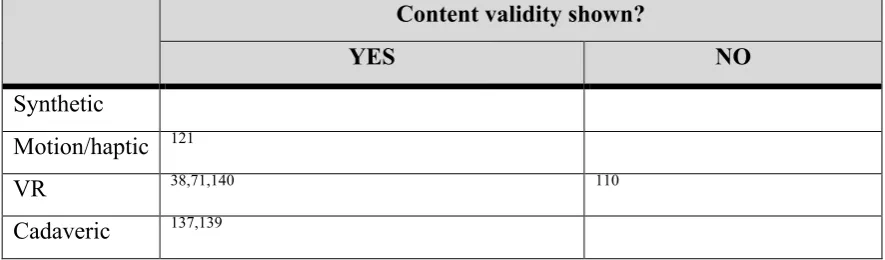
The aim of content validity is to ensure the important domains have appropriate relevance, and for arthroscopy this is appropriate surgical skills. It is not surprising that most studies looking at content validity have involved the high fidelity simulators which are more life-like and have shown appropriate relevance.
Table 2 summarises the evidence by simulator category type (synthetic, computer, VR, cadaveric).
Content validity shown?
YES NO
Synthetic
Motion/haptic 121
VR 38,71,140 110
[image:47.595.84.527.249.379.2]Cadaveric 137,139
INITIAL VALIDATION OF THE ARTHROSCOPIC SKILLS ACQUISITION TOOLS (ASATS):A LOW COST, ONLINE TOOL TO DEVELOP AND
EVALUATE CORE SKILLS FOR SHOULDER ARTHROSCOPY 48
Predictive/transfer validity studies
Predictive or transfer validity aims to investigate how a trainee’s performance changes with continued use. This can be measured in 2 ways:
1. effect on performance on the simulator, 2. skills transfer into theatre
The difficulties to measure performance have already been discussed, and so objective measures form the basis of this type of study. The majority use objective measures such as motion tracking, collision force and time taken to complete performance. Motion tracking can be used within a virtual environment (VR simulators) or during the use of synthetic simulation. VR simulators can measure collision data such as force and depth of collision alongside parameters of basic arthroscopic skills, such as navigation and triangulation (camera and instrument motion paths).
The majority of studies show that with repeated practice, individuals perform better on the performance task being assessed. However, some studies have shown that performance did not improve with repeated practice32,41,44,133,136,140. A possible explanation for the findings is that
the individual may not have the aptitude to develop these skills. Another interesting point raised in one study showed that although developing skills in one particular anatomical environment, this may not translate into another simulated environment, for example training on a shoulder arthroscopic simulator may not increase performance on a knee arthroscopic simulator44.
There is quite a heterogeneity of results when it comes to results of studies looking at transfer of skills into theatre. Primarily the problem lies in measuring intra-operative surgical performance. A possible explanation for the disparity in results from the different studies may be that the skills taught by a simulator may be too specific for the procedure itself41. The difficulties of measuring intra-operative performance have been discussed before, and as a result the majority of studies use a form of global rating scales to help objectify surgical performance.
Table 3 summarises the evidence of effect on performance by simulator category type (synthetic, computer, VR, cadaveric).
INITIAL VALIDATION OF THE ARTHROSCOPIC SKILLS ACQUISITION TOOLS (ASATS):A LOW COST, ONLINE TOOL TO DEVELOP AND
EVALUATE CORE SKILLS FOR SHOULDER ARTHROSCOPY 49
Predictive/transfer validity for skills on simulator?
YES NO
Synthetic 20,37,43,45,134 44
Motion/haptic 37,45,73,121,136
VR 3,10,32,38,43,63,70,133,136,140,141 41,44,71,135 Cadaveric
Table 3: Summary of predictive/transfer validity evidence by simulator category for skills learned on the simulator.
Predictive/transfer validity for skills in operating room?
YES NO
Synthetic 20
Motion/haptic 37,65,73
VR 7,37,38,46,65,135,137,142 19,32,41,136,143
Cadaveric 20
[image:49.595.82.530.55.188.2] [image:49.595.86.528.269.401.2]INITIAL VALIDATION OF THE ARTHROSCOPIC SKILLS ACQUISITION TOOLS (ASATS):A LOW COST, ONLINE TOOL TO DEVELOP AND
EVALUATE CORE SKILLS FOR SHOULDER ARTHROSCOPY 50
Face validity studies
Face validity refers to ability of the simulator to look like the clinical setting. There are 2 key components for arthroscopic simulation – external face validity and internal face validity. External face validity refers to how the simulator looks on the outside and how it represents the external anatomy of the joint. The internal face validity refers to the visual information displayed on the screen during arthroscopy. This maybe a tangible visualisation, such as in synthetic models or maybe a virtual representation like in VR simulators.
There is no objective method of measuring face validity, but the most common method is along the principle of the Likert scale144. This is a scale between 1 and 5 (or 10) and the user rates the face validity of the simulator. It attempts to objectify the assessment but has little in the way of an objective criteria defining the anchor points within the scale. There is no consensus of when a simulator achieves face validity and it is difficult to compare studies.
In general, most simulators had some external face validity, however the internal face validity was highest in the VR and cadaveric simulators. It is also worth noting that cadaveric simulation in particular can also allow simulation of fluid management, the light source, and shavers, the usefulness of which should not be underestimated58.
Table 5 summarises the evidence by simulator category type (synthetic, computer, VR, cadaveric).
Face validity shown?
YES NO
Synthetic 118 145
Motion/haptic 122
VR 38,121,122,133,146 132
[image:50.595.85.526.517.649.2]Cadaveric 58,145
INITIAL VALIDATION OF THE ARTHROSCOPIC SKILLS ACQUISITION TOOLS (ASATS):A LOW COST, ONLINE TOOL TO DEVELOP AND
EVALUATE CORE SKILLS FOR SHOULDER ARTHROSCOPY 51
Concurrent validity studies
Concurrent validity investigates the use of a new simulator against an established validated simulator. The most common method is to use a simulator that has achieved construct validity and then test for concurrent validity.
Positive correlations have been found between:
1. VR and cadaveric simulation70,147.
2. Motion tracking (computer) and synthetic model simulation37.
INITIAL VALIDATION OF THE ARTHROSCOPIC SKILLS ACQUISITION TOOLS (ASATS):A LOW COST, ONLINE TOOL TO DEVELOP AND
EVALUATE CORE SKILLS FOR SHOULDER ARTHROSCOPY 52
Practical pressures limiting uptake of simulation
The advantages of simulation in acquiring arthroscopic skills have been discussed, however the practical application of these training techniques have limited its widespread use.
Synthetic models lack the objective parameters of performance and hence rely on supervision from senior surgeons for feedback. This could be in real time or recorded and played back at a later time. Performance can then be assessed using tools described earlier. The costs associated with this include purchasing/leasing costs and replacement of parts. Time for senior surgeon’s time to assess and deliver feedback also needs to be factored in.
Building on this, technology such as motion analysis and collision forces allows more objective feedback. Computer models are highly objective since they use internal metric calculations and are assessor independent. They have few ethical considerations but have generally been costly, require fixed training facilities, and need specialised technical support105. The objective measures recorded have been validated for basic arthroscopic tasks only, which may limit its ultimate use35,37.
VR simulation has now adopted much of the technology from computer models and with more realistic input devices and visual graphics, represents the highest fidelity non-cadaveric simulator. It does come at a very high price (approximately US $100,000 from personal communication), often making it cost-prohibitive for most institutions. Such high cost investments are subsequently protected from out of hours’ open access training, principally out of fear of inadvertent damage. This limits wide-spread access to trainees.
Cadaveric simulation represents the gold standard in arthroscopic simulation. However, the limitations include risk of disease transmission, cost, preparation time, storage and variability anatomy and pathology. This means that this is cost prohibitive and makes it difficult to standardise training. Assessment relies again on non-objective parameters such as GRS or checklists and subsequent feedback will require time from senior surgeons.
Need for ASATs (Identification of Necessity for this study)
INITIAL VALIDATION OF THE ARTHROSCOPIC SKILLS ACQUISITION TOOLS (ASATS):A LOW COST, ONLINE TOOL TO DEVELOP AND
EVALUATE CORE SKILLS FOR SHOULDER ARTHROSCOPY 53
been seen, GRS or checklists have attempted to objectify performance but are not truly measuring objective parameters.