International Journal of Emerging Technology and Advanced Engineering
Website: www.ijetae.com (ISSN 2250-2459, ISO 9001:2008 Certified Journal, Volume 3, Issue 4, March 2014)
644
Implementation of Total Productive Maintenance Methodology:
A Review
Vijay D Kedaria
1, Prof. Vivek A. Deshpande
21
PG Student, GH Patel College of Engineering& Technology, V. V. Nagar, Anad, Gujarat, INDIA. 2Associate Professor, G H Patel College of Engineering &Technology, V. V. Nagar, Anad, Gujarat,INDIA.
Abstract— Today’s global world competitive market every industry needs to minimize its operating cost and produce world class products. Maintenance Practice is considered as an important function to increase the Productivity by maximizing the overall equipment effectiveness. Total Productive maintenance (TPM) is an approach to understand equipments function, equipment failure and relationship with product quality.TPM is interference between man and machine. The purpose of this paper is to understand and investigate the contribution of TPM in Indian industry.TPM is a systematic procedure to achieve maximization of profit, increase equipment life ,also improve employee morale .The study find out the basic requirement of TPM and proper planning for implementing TPM at the initial stage in the organization .This study discuss important key performance indicators (KPI) of TPM which are machine breakdown time, Mean time between failure (MTBF), Mean time to repair(MTTR). The main objective of TPM is to create active participation of all employees in maintenance and production system.
Keywords— Total Productive Maintenance, Overall Equipment Efficiency, Mean time between machine failure, Mean time to repair, Preventive maintenance.
I. INTRODUCTION
Total Productive Maintenance (TPM) is a unique Japanese philosophy combines with American preventive maintenance and total involvement of employees.TPM is an innovative system for equipment maintenance that optimizes effectiveness, eliminates breakdowns and promotes autonomous operator maintenance through day-to-day activities.
TPM aims to use equipment at its maximum effectiveness by eliminating waste and loss caused by failure of the equipment, set up and adjustment, speed losses, process defects and reduced yield.
TPM aims at improving the productivity by improving its personnel and their skills by changing the corporate culture. The operator carries out daily maintenance work such as clean up lubrication, tightening and external inspection so that the equipment does not breakup.
Today’s industrial scenario huge losses occur in the manufacturing shop floor. These losses are due to operators maintenance personal process, tooling problems and non availability of components in time etc. The quality related wastes are of significant importance, as they matter the company in terms of time, material and reputation of the company. These are also other invisible losses like breakdown of the machines, material shortages start up loss, bottlenecks in the process.zero-oriented concepts such as zero defects, zero breakdown and zero accidents are becoming prerequisite in the manufacturing and assembly industries [1].
The changes in the current business environment are characterized by intense competition, there by increased pressures to reduce costs, and heightened volatility in customer requirements on the demand side [2].
The change in the market increased the level of global competitiveness between organizations and everyone wants to satisfy customers more than others do. The global marketplace has witnessed an increased pressure for reduced operating costs with improved performance in industrial sectors including healthcare [3, 4]. Hence, the aim of this paper is to present an implementation methodology for the TPM in chemical industries that can reduce maintenance cost and improve operational efficiency.
Avoid wastage in a quickly changing economic environment. Producing goods without reducing product quality. Reduce cost. Produce a low batch quantity at the earliest possible time. Goods send to the customers must be non-defective. Establishing a total system of Preventive Maintenance for the life of equipment [5].TPM consist of eight pillars, which are autonomous maintenance, Kobestsu kaizen, planned maintenance, Training & development, office TPM, Safety, environment, and finally initial flow control. [6]
II. LITERATURE REVIEW
International Journal of Emerging Technology and Advanced Engineering
Website: www.ijetae.com (ISSN 2250-2459, ISO 9001:2008 Certified Journal, Volume 3, Issue 4, March 2014)
645 For the world class maintenance how CMMS (computerized maintenance management system) help & CMMS need for industry with different factors for world-class maintenance system [7]
Ref. [8]: Author et al investigated that the critical study of OEE and tact time analysis with eyed time and finding performance ratio of equipment. The performance ratio of such equipment as evaluated as 100% in traditional approach all the time because the cycle time is always same as the cycle time is always same as the ideal cycle time and high OEE value interaction approach will usually lead to overproduction during low demand of period.
Author et al, Study of implementation of TPM in small-scale industry it is essential tool for business competitive machines performance and improved OEE 13.83% and hence higher OEE indicate better control will have over equipment and processes [9].]Ref. [10]: Author et al investigate that the critical studies of auto industry of implementation of TPM reduce down time; improve monthly output 7.52% with performance efficiency and quality. Ref.[5]:Authors et al, imperial study of this paper OEE study, how 5S helps in TPM and find out Jishu hozen pillar implementation (Lubrication, CLIT and one point lesson).
Calculation of OEE with six big losses in short pining
machine with increased OEE 20%[11].Rigorous
implementation of TPM need to top management
commitement,resource management ,performance
measurement system, education and training, continuous improvement system and work culture involvement factors are most important.
2.1 Goals of TPM
1. Obtain Minimum 90%OEE (Overall Equipment Effectiveness)
2. Run the machines even during lunch. (Lunch is for operators and not for machines!)
3. Operate in a manner, so that there are no customer complaints
4. Reduce the manufacturing cost by 30%
5. Achieve 100% success in delivering the goods as required by the customer.
6. Maintain an accident free environment.
III. FRAME WORK OF TPM
As per Japanese concept workplace, need to clean and all the things arranged as per requirement and unnecessary things are removing from the work place hence first step towards TPM implementation is’5S’.
5S
5S is a barometer of management.
Various companies reveal frequent use of the term, PM/QC, and the posting of various management graphs on the management board at the workplace.
However, examinations of machines, materials and workers in the field reveal that the driving mechanism of machines is covered with dust, oil is leaking, and workers are working without a hard hat and shoes, as if nothing matters. In plants, quantity and quality should be manufactured by equipment, however in conditions such as the ones described above, TPM or TQC cannot be consider to be performed successfully.
What is 5S?
1. Order (Seiri):-
This means sorting and organizing the items as critical, important, frequently used items, useless, or items that are not need as of now. Critical items should be kept for use nearby and items that are not be used in near future, should be stored in some place. For this step, the worth of the item should be decided based on utility not cost. Because of this step, the search time reduced.
2. Arrangement (Seiton):-
The concept here is that "Each item has a place and only one place". The items should be placed back after usage at the same place. To identify items easily, nameplates and colored tags has to be used. Vertical racks used for this purpose, and heavy items occupy the bottom position in the racks.
3. Cleaning (Seiso):-
This involves cleaning the work place free of burrs, grease, oil, waste, scrap etc. No loosely hanging wires or oil leakage from machines.
4. Standardizing (Seiketsu):-
Employees have to discuss together and decide on standards for keeping the work place / Machines / pathways neat and clean. These standards implemented for whole organization and are tested / inspected randomly.
5. Discipline (Shitsuke):-
International Journal of Emerging Technology and Advanced Engineering
Website: www.ijetae.com (ISSN 2250-2459, ISO 9001:2008 Certified Journal, Volume 3, Issue 4, March 2014)
646 IV. EIGHT PILLARS OF TPM
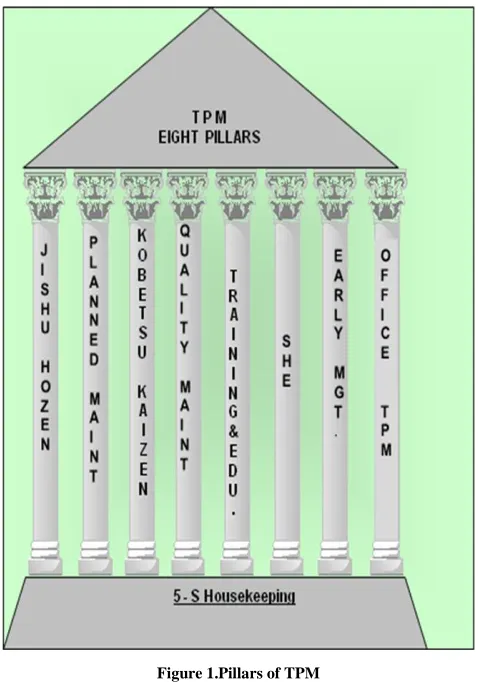
[image:3.612.49.288.223.564.2]The Japan Institute of Plant Maintenance propose the introduction of TPM pillar is based on the implementation of a series 8 pillars of TPM in a systematic way to optimize plant and equipment efficiency by crating perfect interaction between man and equipment. The Figure 1 represents a common structure of TPM.
Figure 1.Pillars of TPM
1. Jishu Hozen / Autonomous /Operators pillar
Autonomous Maintenance aims to create a scenario where all operators look after own equipment, carrying out routine checks, oiling and greasing, replacing parts, doing repairs, spotting problems at an early stage, checking precision and so on. The most important skill required of an operator is the ability to identify abnormalities and notice immediately when something is not quite right with the quality or the equipment. This skill requires three abilities
The ability to set conditions.
The ability to sustain
The ability to take corrective action and affect repairs
The problems that stop equipment from working, or make it work less effectively, can be eliminated - in other words, zero-defect, zero-breakdown status can be attained - by changing the way everyone who works with the equipment. When the equipment works better, the people work better, and when the people work better, the whole factory works better. Autonomous Maintenance should be introduced gradually under the guidance of management, with each step implemented thoroughly. It should involve the whole workforce and empower each individual to fulfill his or her potential.
Seven step of implementation of Jishu Hozen pillar.
Step 0: Safety
Step 1: Initial Cleaning
Step 2: Eliminate sources of contamination and inaccessible.
Step: 3 Creation and Maintenance of cleaning and lubrication Standard.
Step: 4 General inspections.
Step: 5 Autonomous inspections
Step: 6 Standardization.
Step: 7 fully implemented autonomous maintenance pillar
Step zero to four implement initial understanding base and after that making a schedule for general inspection and then fully implement the autonomous pillar & analyzed MTBR.
2. Kobetsu Kaizen
Various “kaizen” activities to accomplish maximum efficiencies of individual facilities, equipment and manufacturing processes, as well as entire plants, by
thoroughly elimination losses and improving
performance.Kaizen Realize the zero loss situation in such as an equipment failure and product defect & that affect ultimate production efficiency situation.
2.1 Activities of Kobetsu kaizen
International Journal of Emerging Technology and Advanced Engineering
Website: www.ijetae.com (ISSN 2250-2459, ISO 9001:2008 Certified Journal, Volume 3, Issue 4, March 2014)
647 2.2 Various methods for kobetsu kaizen
PM Analysis (Analysis method approaching phenomena from a physical viewpoint) ,Know-how analysis (why-why analysis) ,Fault tree analysis (FTA) Failure mode and effects analysis (FMEA), Industrial engineering ,Value analysis (VA),Just in Time (JIT),QC Tools.
3. Planned Maintenance
When we want to implement equipment maintenance in line with the business objectives, factory-wide maintenance orientation must be proactively changed from breakdown maintenance to preventive and predictive maintenance. Factories need this because they aim to minimize cost and maximize production.
The purpose of Planned Maintenance is to ensure the equipment conditions at their best with the minimum maintenance cost, enabling equipment to unction at an optimal level whenever operation is required.
In order to achieve this purpose, both the production department and the maintenance department must carry out their roles of equipment maintenance properly. In addition, other activities such as Kobetsu Kaizen (Individual
Improvement, Focused Improvement) and MP
(maintenance prevention) activities must be coordinated to realize the ultimate aim of minimum cost production.
4. Quality Maintenance
The purpose of Quality Maintenance is to produce defect free products to maintain the product quality through eliminating non-conformance to satisfy the demand of the customer. The Japanese Institute Of Plant maintenances define Quality Maintenance as activities that are to set equipment conditions that preclude quality defects, based on the basic concept of maintaining perfect equipment to maintain perfect quality of products. The conditions are checked and measured in time series to verify that measured values are within standard values to prevent defects. The transition of measured values watched to predict possibilities of defects occurring and to take counter measures before hand.
5. Training and Education
All shop-floor training should be based on a clear understanding of the human resource development systems and policies laid out by the company’s personnel and training departments. Prospective trainees are selected, and their training needs assessed. This assessment may be based on past work performance evaluations, daily observation, or the individual’s own stated wish for training. Once these training needs have been established, a training plan is drafted.
The training policy, objectives, curriculum, teaching method and other details worked out, and the training and development plan is finalized.
Training may implemented by day-to-day teaching and coaching, informal chats, and assistance with self-study. Off-the-job-training is another effective method worth considering.
6. Safety, Health and Environment
The basic principle of safety, health and environment is to minimize the number of accidents, health problems and damage to the environment. This pillar plays a great role in the other pillars that addresses workplace organization and discipline, regular inspections and servicing, and standardization of work procedures.
7. Office TPM
Companies must map out a clear strategy to respond to this change and dramatically shorten their product time-to-market. At the same time, they must distinguish themselves from their competitors in both quality and cost. These are the most important challenges facing managers today.
Eighty percent of a product’s quality and cost is already determined at the development, design, and production stages. Development, design, and all other staff departments must cooperate determinedly to ensure that the production department does not produce useless or wasteful
products. Meanwhile, companies must set up
manufacturing plants in a way that enables the production department to fill orders on time, at the quality and cost that the development and engineering departments prescribe. This is not the responsibility of the production department alone – it requires a TPM program that embraces the entire company, including the administrative and support departments.
TPM activities in administrative and support
departments do not involve production equipment. Rather,
these departments increase their productivity by
documenting administrative systems and reducing waste and loss. They can help raise production-systems effectiveness by improving every type of organized activity that supports production. Their contributions to the smooth running of the business should be measurable.
International Journal of Emerging Technology and Advanced Engineering
Website: www.ijetae.com (ISSN 2250-2459, ISO 9001:2008 Certified Journal, Volume 3, Issue 4, March 2014)
648 OEE (%) = Availability (%) *Performance rate (%) *Quality rate (%) (1)
Where
Availability (%) = Actual operating time (min) X 100 (2)
Planned operating time (min)
Performance rate (%) = (Net operating rate X Operating speed) X 100 (3)
Quality rate = Total no. produced –No. Scrapped X100
Total no. produced
The most important objective of OEE is not to get an optimum measure, but it indicates in which area improvement is needed [6].
VI. CONCLUSION
The main aims of study of this paper understand TPM methodology and tools of TPM.Implementation of TPM is not overnight. It is day-to-day activity with involvement of all employees. It needs top management commitment. The performance measurement for production process is very important for sustaining firms. Managers make decisions from this correct evolution. Therefore, appropriate measurement is necessary. The accuracy of global performance evolution is essential to improve and succeed in business goal. One of the important and widely used metrics of performance in manufacturing is OEE especially for firms applying TPM [3].Total productive maintenance is one of the best tools for making our industries competitive and effective in the field of maintenance .TPM may be the only thing that stands between success and total failure for some companies [11].
REFERENCES
[1] Kalbande DR,SV,GT Thampi (2010)” Total Productive Maintenance A case study in manufacturing industry ,industrial Engineering journal, NITIE, Vol. II &issue 16 oct2010.
[2] Ahuja, I.P.S.& Khamba,J.S.(2008).An evolution of TPM implementation initiatives in Indian industries for enhanced manufacturing performance. International Journal of quality &Reliability Management,(2),147-72.
[3] Basu, R. (2001).Six sigma to fit sigma.IIE solutions, 33(7), 28-33. [4] Gosavi, A. (2006), A risk sensitive approach to total productive
maintenance .Automatica, 42, 1321-1330.
[5] Mr.Ranjeet M.Jadhav, Mr.Morosin Alessandro, Pro.S.H.Sawant,(2012),”Total Productive Maintenance aspect : A journey towards manufacturing excellance”,International Journal of mechanical and civil engineering ,ISSN: 2278-1684,PP:-51-59. [6] D.Sivakumar,S.M.Sapuan,N.IsamailandM.Y.Ismail,(2012)”Applicat
ion of Total Productive Maintenance to reduce non stick pad problem in IC Packging”International journal of Engineering and science” ,vol.3 ,2086-3799
[7] GoyalRavikumar,MaheshwariKapil,(2013),Maintenance :From Total Productive to world class maintenance”. International Journal of scientific research and reviews, 2(1), 1-23.
[8] PerumalPuvanasvaran, Y.S.Teoh, C.C.Tay (2013), “Consideration of demand rate in overall equipment effectiveness (OEE) on equipment with constant process time”. Journal of industrial Engineering management 6(2), 507-524.
[9] Ponce-Hernandez, M.M., Gonzalez-Angeles A, Navarrow-Gonazalez C.R. &Cabrera-Cordova E,(2013), “Overall Equipment Effectiveness (OEE) Diagnosis and improving in a small business as an essential tool for business competitiveness “Research journal of recent science,Vol.2(6),58-65.
[10] Prof.A.Bangar,Hemlata Sahu,Jagmohan batham ,(2013),”Improving Overall equipment effectiveness by implementing Total Productive Maintenance in Auto industry”, International Journal of emerging technology and advanced engineering,Vol.3 ,Issue 6.