International Journal of Emerging Technology and Advanced Engineering
Website: www.ijetae.com (ISSN 2250-2459,ISO 9001:2008 Certified Journal, Volume 5, Issue 3, March 2015)
188
Device And Client Authorization Design Apprroach To
Address IOT’s Security Concerns
Ashwini A.Varhekar
1, Prof. S. P. Mankar
21
Computer science and Engineering SGBAU, Guruji Ward, Arvi, Maharashtra, India 2Information Technology SGBAU, Guruji Ward, Arvi, Maharashtra, India
Abstract— This paper deals with addressing security
concerns of IOT by proposing Authorization Server design approach for both IOT devices as well as Client (The user controlling these devices). Authorization Server (AS) is one of the actors described in Open Authorization (OAuth) protocol. AS take care of issuing access tokens to the client after successfully authenticating the resource owner and obtaining authorization. Current version of Authorization Server
supports "Resource Owner Password Credentials"
authorization grant type only. The resource owner authentication will be implemented based on Directory Server interactions. Token is represented as a 128-bit immutable
universally unique identifier UUID (native java
implementation). Generation process described in RFC 4122: A Universally Unique Identifier (UUID) URN Namespace, UUID is generated using a cryptographically strong pseudo random numbers. A cryptographically strong random number minimally complies with the statistical random number generator tests specified in FIPS 140-2, Security Requirements for Cryptographic Modules, An output sequence is cryptographically strong, as described in RFC 1750: Randomness Recommendations for security.
Keywords— OAS (Open Authorization Server), JSON
(Java Script Object Notation), LDAP (Lightweight Directory
Access Protocol), UUID (Universally Unique Identifier), FIPS
I. INTRODUCTION
The promises of IOT go far beyond those for individual devices. Mobility management is a rapidly evolving example of the impact of IOT devices. Imagine if suddenly every packages delivered to your organization came up with a built-in RFID chip that could connect to your network and identify itself to its connected logistics system. Or you can picture a medical environment in which every instrument in the exam room connected to the network to transmit patient data collected via sensors. Even in the industries like farming, imagine if every domestic animal were digitally tracked to monitor its location, health and behavior. The IOT's possibilities are limitless, and so is the number of devices that could manifest [1]
The IOT and the rise of a machine-to-machine (M2M) ecosystem have been long anticipated. As the ecosystem covered with major trends like the cloud computing and big
Data, businesses need to be prepared to securely address the new wave of connected intelligent devices and protect the data that comes with them. To help better understand the realities of security in this coming wave, Beecham Research has analyzed the relevant results of its recent research survey conducted for Oracle of the M2M/IOT market. This analysis of security concerns and methods for the IOT era are Enriched by additional recent studies by Beecham Research focused on key points: 1. How imperative is a system approach in securing any IOT program? 2. How are the newest ideologies of security for IOT affecting program success? 3. What are the best practices in strongly fortifying devices, data, identify and more? 4. If improvement is key to differentiation, how do you deliver innovation without compromising on security, which is often supreme? 5. What are the effects on device manufacturers and ISV’s? More cost or more opportunity.
II. RELATED WORK
How we got here the evolution of network security:
Protection of data has been an question ever since the first two computers were connected to each other. By means of the commercialization of the Internet, security worries expanded to cover personal privacy, financial dealings, and the threat of virtual theft. In IOT, security is attached from safety. Whether involuntary or malicious, interfeing with the controls of a pacemaker, a car, or a nuclear reactor poses danger to human life.
International Journal of Emerging Technology and Advanced Engineering
Website: www.ijetae.com (ISSN 2250-2459,ISO 9001:2008 Certified Journal, Volume 5, Issue 3, March 2015)
189
If malware accomplished to breach a firewall, antivirus techniques created on signature matching and blacklisting would kick in to identify and cure the problem.
Future, as the universe of malware expanded and techniques for avoiding finding advanced, whitelisting techniques started replacing blacklisting. Similarly, as added devices started coming onto corporate networks, many access control systems were developed to authenticate both the devices and the users sitting after them, and to authorize those users and devices for specific actions.
2.2 New threats constrain and challenges:
Relating these same practices or variants of them in the IOT world needs substantial reengineering to address device constraints. Banning, for example, needs too much disk space to be practical for IOT applications. Embedded devices are designed for little power consumption, with a small silicon form and often have limited connectivity. They typically have only as much processing capability and memory as desirable for their tasks. And they are often ―headless‖—that is, there isn’t a human being functioning them who can input authentication IDs or decide whether an application should be trusted; they must create their own judgments and decisions about whether to accept a command or execute a task. The endless diversity of IOT applications stances an equally wide variety of security challenges. For example:
In factory ground automation, deeply embedded programmable logic controllers (PLCs) that operate robotic systems are typically combined with the enterprise IT infrastructure. How can those PLCs be protected from human interference while at the same time defending the investment in the IT infrastructure and leveraging the security controls obtainable?
Equally, control systems for nuclear reactors are attached to infrastructure. How can they get software updates or security patches in a timely mode without impairing functional safety or incurring significant recertification costs every time a patch is rolled out?
A clever meter—one which is able to send energy usage data to the utility operator for dynamic billing or real-time power grid optimization—must be able to shield that information from unauthorized usage or revelation. Information that power usage has dropped could indicate that a home is empty, making it an best target for a burglary or worse.
III. PROPOSED WORK
3.1 Building Security from Bottom up approach:
Knowing no one lone control is going to adequately protect a device, how do we apply what we have acquired over the past 25 years to implement security in a variety of scenarios? We do so through a multi-layered approach to security that starts at the beginning when power is applied, launches a trusted computing baseline, and anchors that trust in something immutable that cannot be tampered with. Security must be addressed all the way through the device lifecycle, from the initial design to the Operational environment:
Secure booting: When power is first introduced to the device, the legitimacy and veracity of the software on the device is verified using cryptographically generated digital signatures.
Access control: Next, diverse forms of reserve and access control are applied. Mandatory or role-based entrance controls built into the operating system limit the privileges of device components and applications so they access only the resources they want to do their jobs
Device authentication: When the device is plugged into the network, it should authenticate itself prior to receiving or transmitting data.
Firewalling and IPS: The device also wants a firewall or deep packet going-over capability to control traffic that is destined to terminate at the device
Updates and patches: After the device is in
operation, it will start receiving hot patches and software updates. Operators need to roll out patches, and devices need to validate them, in a way that does not consume bandwidth or impair the useful safety of the device.
3.2 End to end security solutions:
International Journal of Emerging Technology and Advanced Engineering
Website: www.ijetae.com (ISSN 2250-2459,ISO 9001:2008 Certified Journal, Volume 5, Issue 3, March 2015)
190
To mitigate this security challenges at both IOT devices and client (Application which controlling these IOT devices) we are suggesting below Authorization and Authentication model. This will address current security concerns of the IOT devices.
3.3 Proposed high level design overview:
Authorization Server (AS) is one of the actors described in Open Authorization (OAuth) protocol. AS take care of issuing access tokens to the client after successfully authenticating the resource owner and obtaining authorization. Current version of Authorization Server supports "Resource Owner Password Credentials" authorization grant type only.
[image:3.612.351.536.137.308.2]The resource owner authentication will be implemented based on Directory Server interactions.
Figure 1: Interactions Overview
3.4 Design Overview:
This section contains overall Architecture, Logical and Physical Design, and Deployment Topology Design for Open Authorization Server. This section provides a brief overview of OAS architecture and key components of the stack that have been used to design processes, which are detailed in subsequent sections. The OAS component interacts with Client entities and provides management of client tokens, using ―Resource Owner Password Credential‖ authorization grant described in OAuth 2.0 protocol specifications.
[image:3.612.68.261.326.478.2]OAS is based on such business relationships (between user, client and tokens): A client can have only one access/refresh token pair associated with it in the same period of time. A client can use any user credentials to obtain tokens and not avoided to use other credentials in future attempts.
Figure 2: Interfaces and communication Protocol
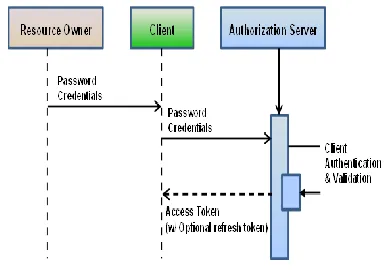
OAS interacts with all clients using HTTP/JSON. During processing of the request, OAS interacts with Directory Server using LDAP. OAS server supports only ―Resource Owner Password‖ authorization grant. Below figure illustrates the steps needed to obtain tokens.
Figure 3: Resource Owner Password authorization flow
The flow illustrated in Figure 3 includes the following steps:
1. The resource owner provides the client with its username and password.
2. The client requests tokens from OAS by including the credentials received from the resource owner. When making the request, the client authenticates with the authorization server.
[image:3.612.344.537.388.523.2]International Journal of Emerging Technology and Advanced Engineering
Website: www.ijetae.com (ISSN 2250-2459,ISO 9001:2008 Certified Journal, Volume 5, Issue 3, March 2015)
191
3.5 Client Authentication:
Client authenticates itself by including its credentials (client id/client secret) in request as authentication header (HTTP Basic authentication scheme defined in [RFC2617]).
Client secret has a single pre-configurable value across all clients. It means that whatever client id is included in the request, if client secret matches with the trusted secret then client will be authorized.
3.6 Resource owned credentials validation:
Resource owner credentials provided in request will be validated against Directory Server using ―binding‖ approach. OAS will try to bind to Directory Server using resource owner credentials and perform a search query. In case binding or search fails, user will become unauthorized. Search query could be configured.
Before validating user credentials with Directory Server OAS checks:
If user name (e.g. <username>@abc.com) contains the domain part that matches with one of the predefined domains (e.g. abc.com) in AS configuration, AS will remove the domain part from user name (e.g. <username>) and then pass it on to the Directory Server for validation.
If user name (<username>@xyz.com) contains the domain part that does not match with any of the predefined domains (e.g. abc.com) in AS configuration, AS will not remove the domain part from user name (e.g. <username>@xyz.com) and pass it on to the Directory Server for validation as is.
If user name (e.g. <username>) does not contain the domain part, AS will pass it on to Directory Server for validation as is.
3.7Authorization token encryption mechanism:
If any malicious user knows the username and password then he can get hold of authorization token and can bypass the OAS to authenticate with application and there may be possibility of getting authorization token for one user and register for another user since the authorization token is static (same for all users).
So to avoid such situations, OAS encrypts the authorization token which is combination of uconnect ID, access token, expires in and random seed. The token is encrypted using RSA encryption algorithm. The RSA encrypted authorization token is then encoded using Base64 encoding The above generated token is also prefixed (separated by colon) with the configurable static value to get information about the client.
Figure3: Flow of Encryption
IV. CONCLUSIONS AND FUTURESCOPE
The proliferation of devices with communicating-actuating capabilities is bringing closer the vision of an Internet of Things, where the sensing and actuation functions seamlessly blend into the background and new capabilities are made possible through access of rich new information sources. But with the insurmountable increase in the number of millions devices and client application( Mobile application) controlling them security of them will be a challenge and it needs be addressed by choosing bottom to top designing approach and multiple scalability across different platform.
Security at both the devices as well as network levels is critical to the operation of IOT. The intelligence that enables devices to perform their tasks must also enable them to recognize & counteract security threats. Fortunately, this does not require a revolutionary approach, but rather an evolution of measures that have proven successful in IT networks, adapted to the challenges of IoT and to the constraints of connected devices. Instead of searching for a solution that does not yet exist, we need to make address the security at both devices as well as network level.
REFERENCES
[1] wr_security-in-the-internet-of-things.pdf. [2] OWASP_Internet_of_Things_Top_Ten_Project
[3] Aberer, K., Hauswirth, M., Salehi, A.: Middleware Support for the Internet of Things. In: 5th
[4] http://www.cisco.com/web/solutions/trends/iot/security.html [5] Bohn, H., Bobek, A., Golatowski, F.: SIRENA - Service
Infrastructure for Realtime Embedded
[6] Networked Devices: A Service Oriented Framework for Different Domains.
[7] Developing Solution’s for IOT – White paper by Intel corp. [8] Securing future designs security for IOT by harber research.com. [9] Security concern of IOT devices by Machantosh Magzine. [10] Security of M2M communication – by m2m alliance.com.
[11] Native Java implementation for UUID :
International Journal of Emerging Technology and Advanced Engineering
Website: www.ijetae.com (ISSN 2250-2459,ISO 9001:2008 Certified Journal, Volume 5, Issue 3, March 2015)
192 [12] UUID generation process : http://www.ietf.org/rfc/rfc4122.txt
[13] FIPS 140-2, Security Requirements for Cryptographic Modules