A FRAMEWORK FOR EMPLOYEE APPRAISALS
BASED ON INDUCTIVE LOGIC PROGRAMMING
AND DATA MINING METHODS
DARAH MOHAMMAD AQEL
SCHOOL OF COMPUTING, SCIENCE AND ENGINEERING,
INFORMATICS RESEARCH CENTRE, COLLEGE OF SCIENCE
AND TECHNOLOGY, UNIVERSITY OF SALFORD
Contents
Acknowledgments... ix
Abstract ... x
Chapter 1: Introduction ... 1
1.1 Motivation and Challenges ... 5
1.2 Research Objectives and Methodology ... 6
1.2.1 Objectives and Main Contributions ... 6
1.2.2 Research Methodology ... 6
1.3 Thesis Outline ... 9
1.4 Summary ... 10
Chapter 2: Literature Review ... 11
2.1 Performance Appraisal, Goals Setting and the SMART Approach ... 11
2.1.1 Overview of Performance Appraisal Methods ... 11
2.1.2 Overview of Goal Setting and the SMART Approach ... 14
2.2 Natural Language Processing and Information Extraction ... 21
2.2.1 Natural Language Processing ... 21
2.2.2 Applications of NLP ... 24
2.2.2.1 Information Retrieval ... 24
2.2.2.2 Sentiment Analysis ... 24
2.2.2.3 Machine Translation ... 25
2.2.2.4 Information Extraction ... 25
2.2.2.4.1 Information Extraction and its Tasks ... 25
2.2.2.4.2 Information Extraction Systems ... 26
2.2.3 Semantic Class Disambiguation ... 29
2.2.4 Word Sense Disambiguation... 32
2.2.4.1 Description of Word Sense Disambiguation ... 32
2.2.4.2 Supervised WSD Approaches ... 34
2.2.4.2.1 Naïve Bayes ... 34
2.2.4.2.2 Neural Networks ... 35
2.2.4.2.3 K-Nearest Neighbor ... 36
2.2.4.3 Unsupervised WSD Approaches ... 37
2.2.4.3.1 Context Clustering Methods ... 37
2.2.4.3.2 Word Clustering Methods ... 38
2.2.4.4.1 Overlap of Sense Definitions ... 38
2.2.4.4.2 Structural Approaches ... 42
2.2.4.5 Methods Used to Compare the Performance of WSD Systems ... 43
2.3 Machine Learning and Data Mining Methods ... 43
2.3.1 Machine Learning ... 44
2.3.2 Data Mining ... 45
2.3.3 Common Methods in Machine Learning and Data Mining ... 45
2.3.3.1 Machine Learning and Data Mining Methods Used for Classification and Prediction ... 46
2.3.3.1.1 Naïve Bayes ... 46
2.3.3.1.2 K-Nearest Neighbor ... 46
2.3.3.1.3 Artificial Neural Networks ... 47
2.3.3.1.4 Decision Tree Induction ... 47
2.3.3.1.5 Rule Induction Learners ... 48
2.3.3.1.6 Regression Analysis ... 50
2.3.3.2 Open Source Software of Data Mining and Machine Learning ... 55
2.4 Overview of Inductive Logic Programming (ILP) ... 56
2.4.1 Inductive Logic Programming ... 57
2.4.2 Overview of Inductive Logic Programming Systems ... 60
2.4.3 Using ILP for Learning Grammar and Semantic Rules, NLP and IE ... 62
2.5 Performance Evaluation Functions for Machine Learning Methods ... 64
2.6 Discussion and Summary ... 67
2.6.1 Literature Review Summary Tables ... 67
2.6.2 Discussion ... 72
2.6.3 Summary ... 76
Chapter 3: A New Framework for Employee Appraisals ... 78
3.1 System Scenario ... 78
3.2 A Framework for Appraisals Based on ILP and Data Mining Methods ... 79
3.3 Summary ... 88
Chapter 4: The Development and the Linguistic Analysis of the Corpus ... 89
4.1 The Development of the Corpus ... 89
4.2 The Linguistic Analysis and the Semantic Classification of the Corpus ... 91
4.2.1 Using GATE for Text Annotation ... 92
4.2.1.1 Using ANNIE in GATE ... 93
4.2.1.2 Using JAPE Grammars ... 95
4.2.2 Using WordNet for Semantic Tagging ... 102
4.2.2.1 Using Semantic Classes in WordNet ... 102
4.2.2.2 Using WordNet::SenseRelate::AllWords for WSD ... 105
4.2.2.2.1 The Methodology of Applying WordNet::SenseRelate::AllWords on the Corpus ... 106
4.2.2.2.2 Experiments of WordNet::SenseRelate::AllWords ... 110
4.2.2.2.3 Experimental Results of WordNet::SenseRelate::AllWords ... 111
4.2.2.3 Using WordNet::QueryData for Semantic Tagging ... 113
4.2.2.3.1 Description of WordNet::QueryData ... 113
4.2.2.3.2 Applying WordNet::QueryData for the Semantic Tagging of the Corpus ... 115
4.2.2.3.3 Experiments of WordNet::QueryData ... 119
4.2.2.3.4 Experimental Results of WordNet::QueryData ... 120
4.3 Summary ... 123
Chapter 5: The Development of the Framework Based on ILP and Data Mining Methods... 125
5.1 Using ILP to Learn a Grammar for SMART Objectives ... 125
5.1.1 Specifications Needed by ILP and ALEPH ... 126
5.1.2 Using ILP to Learn a Grammar for Writing SMART Objectives ... 127
5.1.3 The Validation of the Rules Learned by ALEPH ... 136
5.2 Using Data Mining Techniques for Assessing the Objectives ... 140
5.2.1 Using Data Mining for Assessing If an Objective is “Achievable” ... 140
5.2.2 Using Data Mining for Assessing Whether an Objective is “Realistic” ... 146
5.3 An Illustrative Example for Describing the Developed System ... 149
5.4 Summary ... 155
Chapter 6: System Implementation and Empirical Evaluation ... 156
6.1 System Implementation ... 156
6.2 An Empirical Evaluation of the Developed System ... 164
6.3 Applying the Developed System to Other Domains ... 167
6.4 Comparing the Developed System with Related Systems ... 178
6.5 Summary ... 181
Chapter 7: Conclusions and Future Work ... 183
7.1 The Research Objectives Revisited ... 183
References ... 190
Appendix A ... 219
A1 The Grammar Rules Learned by ALEPH from the First Corpus ... 219
A2 The Grammar Rules Learned by ALEPH from the Second Corpus ... 223
Appendix B ... 226
B1 The Created JAPE Grammar for the ‘Service’ Annotation... 226
B2 The Target Words Used in the Experiments Conducted by SR-AW on the Second Corpus ... 226
B3 The Target Words Used in the Experiments Conducted by WordNet QueryData on the Second Corpus ... 227
B4 Food and Beverage Dataset ... 228
B5 Communication Dataset ... 228
B6 The Generated Linear Regression Formula for Food and Beverage Dataset ... 228
B7 The Generated Linear Regression Formula for Communication Dataset ... 229
B8 The Suggested Rules for Generating the Dataset Used by JRIP ... 229
B9 The Classification Rules Induced by JRIP in WEKA ... 229
List of Figures
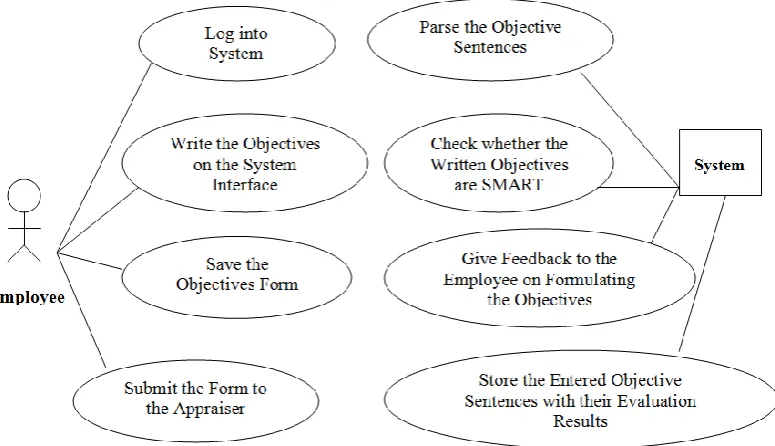
Figure 1 Use Case Diagram of the Potential Capabilities of the System that Supports
Appraisals ... 79
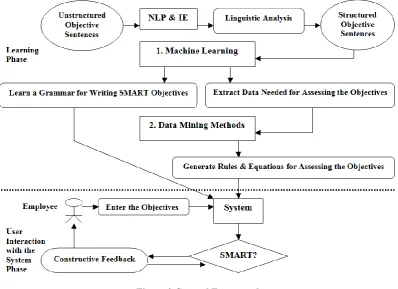
Figure 2 General Framework ... 81
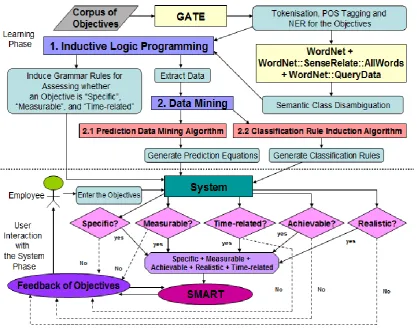
Figure 3 Detailed Framework ... 84
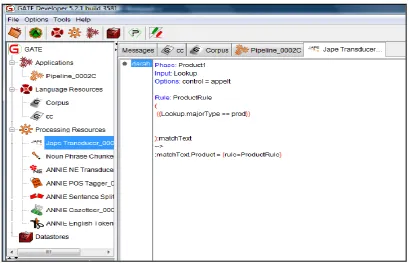
Figure 4 The Created JAPE Grammar for the ‘Product’ Annotation ... 96
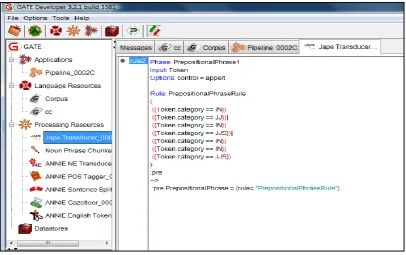
Figure 5 The Created JAPE Grammar for the ‘PrepositionalPhrase’ Annotation ... 99
Figure 6 The Created JAPE Grammar for Matching Some Patterns of Temporal Expressions in the Objectives ... 100
Figure 7 Typical Annotations of the Corpus of Objectives Using GATE ... 101
Figure 8 The Main WordNet Semantic Classes of the Target Nouns and Verbs in the Objectives ... 105
Figure 9 An Outline of the Rules that Check If a Word in an Objective Represents a Noun ... 159
Figure 10 An Outline of the Rules that Check If a Word in an Objective Represents a Verb... 160
Figure 11 A Snapshot of the System Interface (1) ... 162
Figure 12 Typical Annotations of the Second Corpus Using GATE... 168
Figure 13 A Snapshot of the System Interface (2) ... 177
List of Tables
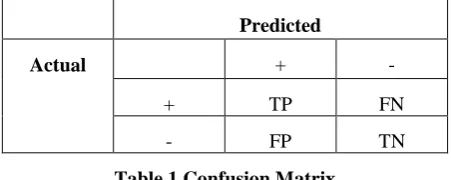
Table 1 Confusion Matrix ... 65
Table 2 Survey Summary of Information Extraction Systems for Text Annotation ... 68
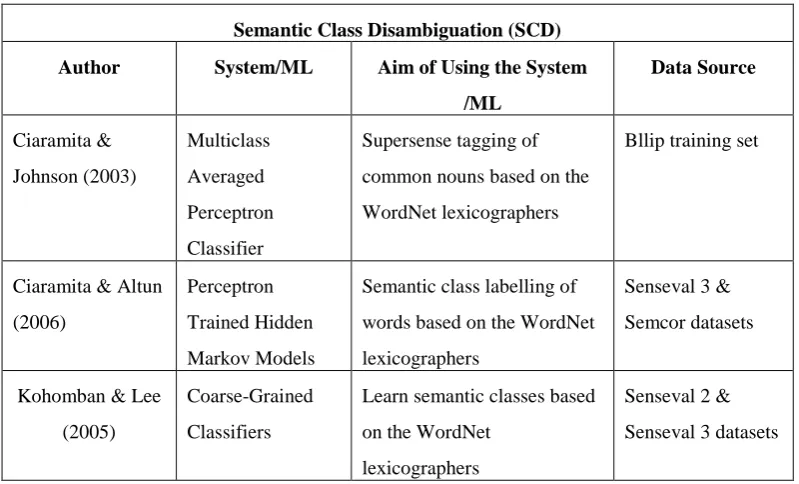
Table 3 Literature Review Summary on Semantic Class Disambiguation ... 68
Table 4 Literature Review Summary on Word Sense Disambiguation ... 69
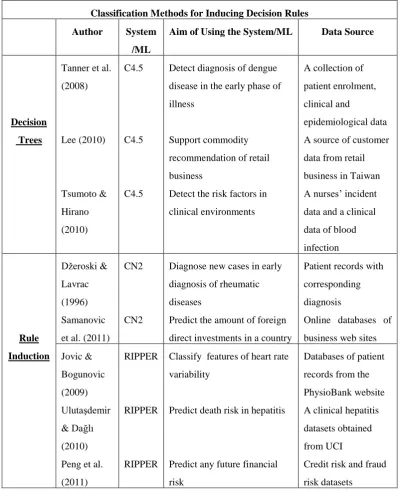
Table 5 Survey Summary of Classification Methods for Inducing Decision Rules .... 70
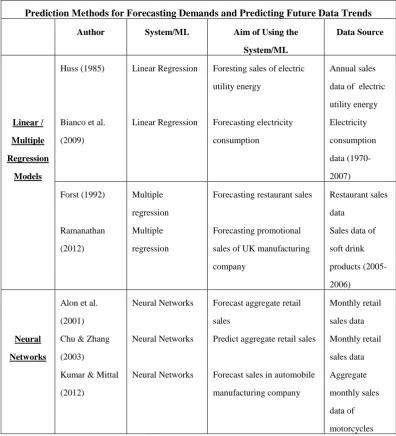
Table 6 Survey Summary of Prediction Methods for Predicting Demands and Future Data ... 71
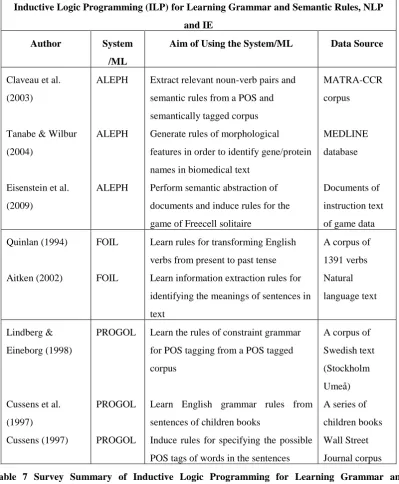
Table 7 Survey Summary of Inductive Logic Programming for Learning Grammar and Semantic Rules, NLP and IE ... 72
Table 8 Target Words, their Test Instances and the Accuracy of Disambiguating the Senses for Each Target Word ... 112
Table 9 WSD Evaluation Results ... 113
Table 10 Target Words, their Occurrences and the Accuracy of Disambiguating the Semantic Classes for Each Target Word ... 120
Table 11 Evaluation Results of Semantic Class Classification ... 121
Table 12 Representation of Words and Words’ Positions in Example 5 ... 131
Table 13 Cross Validation Results (1) ... 139
Table 14 Mobile Sales Data (from 2003 to 2007) ... 142
Table 15 PC Sales Data (from 2003 to 2007) ... 143
Table 16 Empirical Evaluation on the Corpus of Objectives (Related to the Sales Domain) ... 165
Table 17 Evaluation Results of WSD for the Second Corpus ... 170
Table 18 Evaluation Results of Semantic Class Classification for the Second Corpus ... 171
Table 19 Cross Validation Results (2) ... 174
Table 20 Empirical Evaluation on the Second Corpus (Related to the Costs Domain) ... 178
Table 21 The Main Characteristics of the Developed System and Related Systems 181 Table B2.2 Target Words, their Test Instances and the Accuracy of Disambiguating the Senses for Each Target Word………..….227
Table B3.3 Target Words, their Occurrences and the Accuracy of Disambiguating the Semantic Classes for Each Target Word………227
Table B4.4 Food and Beverage Cost Data (from 2000 to 2006)………228
Acknowledgments
First of all, I would like to thank ALLAH ALMIGHTY who gave me the ability,
patience and strength to conduct and complete this thesis. I am very thankful to my
supervisor Professor Sunil Vadera for his assistance, support and feedback during this
research, as well as his help in pointing me in the right direction.
Special thanks to my family, in particular my father, my mother, my brother, my
sisters, and my husband for all their assistance, guidance and encouragement.
Last but not least, I would like to acknowledge and thank everyone who helped me
with good advice during my research work.
The following papers have been published as part of this research, where these papers
include some of the content of this thesis:
Learning a Grammar for SMART Objectives Using Inductive Logic Programming. In Proceeding of the 5th European Conference in Intelligent
Management Systems in Operations (IMSIO2013). The Operational Research
Society, 3-4 July 2013, pp. 66-76.
A Framework for Employee Appraisals based on Inductive Logic
Programming and Data Mining Methods. In Proceeding of the 18th
International Conference on Applications of Natural Language to Information
Systems (NLDB2013). Springer, Berlin Heidelberg, 19-21 June 2013, pp.
404-407.
A Framework for Employee Appraisals based on Sentiment Analysis. In Proceedings of the 1st International Conference on Intelligent Semantic Web –
Services and Applications (ISWSA2010). ACM, 14-16 June 2010, Article 8,
pp. 62-67.
Chapters 4, 5 and 6 are the developed version of these papers which presented interim
Abstract
Employee performance appraisal systems are widely regarded as fundamental for
evaluating employees’ performance and enhancing organisations’ success. Yet, there
is evidence that employees doubt their benefits and fairness, organisations find them
difficult to implement and their value is questioned. Although commercial systems
that support appraisals have been developed, their focus remains on recording and
tracking information, thereby not providing the kind of meaningful and deeper
support for appraisals and the goal setting process such as ensuring that the objectives
are SMART (specific, measurable, achievable, realistic, time-related) and providing
feedback on these objectives.
Developing a supportive employee appraisal system for setting objectives represents a
major challenge for computer science since the objectives are unstructured, assessing
objectives is a subjective process, and there is no known system for writing effective
objectives, providing feedback and supporting the decision making process.
Thus, helping employees to write SMART objectives requires finding the rules of
writing these objectives. As the objective sentences are expressed in natural language,
natural language processing (NLP) techniques and machine learning may have the
potential for supporting the process of setting objectives by first analysing the
objectives text and then identifying the rules for writing SMART objectives. More
specifically, machine learning methods such as inductive logic programming (ILP),
which investigates the inductive acquisition of first-order theories from background
knowledge and examples, could be applied to automatically learn the rules.
The process of setting objectives also requires assessing whether the objectives can be
met given the available resources and time. Data mining techniques may have the
potential to be used for assessing the objectives.
This thesis develops a new framework for employee appraisals. The developed
framework supports the process of setting SMART objectives and providing
feedback. The framework utilises ILP to learn the grammar rules for writing SMART
framework has been implemented using the ILP system ALEPH as well as prediction
and classification rule induction algorithms in the WEKA data mining software. A
novel system has been developed based on the proposed framework to show the
feasibility of the framework. An empirical evaluation of the developed system has
been conducted using a corpus of 300 objective examples and achieved promising
results with an overall accuracy of 83%. The thesis also includes the limitations of the
Chapter 1: Introduction
Organisations aim to improve their performance, increase profitability and achieve set
goals. This requires high-quality management targeted at maximising employee skills,
managing utilisation of resources and increasing employee motivation. Employee
appraisal systems are extensively required for evaluating employee performance,
enhancing company productivity, and endorsing employee loyalty and motivation to
achieve organisational goals (Waldman et al., 1987; Murphy and Cleveland, 1991;
Boice and Kleiner, 1997; Roberts, 2003; Kline and Sulsky, 2009).
Appraising employee behaviour is a challenge that faces organisations in the current
economic crisis where these organisations are struggling in the recession. Even
though employee appraisal systems have numerous benefits for organisations and
employees, several authors have suggested that the level of employees' trust for
management is decreasing (Farnham 1989), especially if there is a misuse in the
performance appraisal systems (Mayer and Davis, 1999). Evidence shows that some
employees fail to find performance appraisal systems beneficial and they doubt their
effectiveness (Smither et al., 2005). Furthermore, others question their fairness
because they regard them as based on incomplete information, opinions and
subjective bias of appraisers, personal preferences, inaccurate rating and lenient in
evaluations (Murphy and Cleveland, 1995; Arvey and Murphy, 1998; Rowland and
Hall, 2012). The element of subjectivity represents a weakness in the process of
appraising performance, where this element may cause unfairness for employees and
it is unavoidable in performance appraisal (Boachie-mensah and Seidu, 2012; Choon
and Embi, 2012). This leads to weaker incentives and may cause harm for workers
and employees, where unfair performance appraisals may actually reduce employee
motivation and performance (Latham and Mann, 2006). In addition, some say that the
process of appraising employees is complicated and is a very time consuming process
(e.g. Finlay and McLaren, 9002).
Although, there are commercial systems for supporting performance appraisals, they
focus on recording and tracking the process and provide little or no support for deeper
Latham, 1981; Locke and Latham 1990, 2002) such as ensuring that objectives are
SMART (specific, measurable, achievable, realistic, time-related) (Doran, 1981; Hurd
et al., 2008; Desmond, 2011) and providing feedback for the quality of the objectives
set. Therefore, poor management and the lack of support for the goal setting process
reduce intrinsic motivation and make the process of goal setting less meaningful and
less effective for the employee, manager and organisation (Locke and Latham, 2009;
Ordonez et al., 2009). Furthermore, studies on goal setting programs have concluded
that the process of goal setting may be affected by different variables and factors
which may influence the whole process of performance appraisal. For instance, the employees’ perceptions of goal-setting process influence their performance, job
satisfaction, productivity and goal commitment (Barrick et al., 1993; Antoni, 2005;
Bipp and Kleingeld, 2011).
Yet, developing a supportive performance appraisal system for setting objectives
represents a major challenge since the objectives are unstructured, assessing
objectives is a subjective process and the process of setting and assessing objectives
requires effort and time. Moreover, there is no known system for setting, writing and
assessing the objectives as well as providing feedback and supporting the decision
making process.
Thus, helping employees to write SMART objectives is a critical pre-requisite for
appraisal systems to achieve their aims. To support the process of setting SMART
objectives, this requires first analysing the written objectives and then finding the
rules of writing SMART objectives. By analysing some examples of written SMART
objectives, it is evident that these objectives are expressed in a certain way in natural
language. Accordingly, natural language processing (NLP) (Manning and Schütze,
1999; Jackson and Moulinier, 2007; Collobert et al. 2011) techniques may have some
potential for analysing the text of the written objectives linguistically. In general, NLP
is a field in artificial intelligence (AI) (Russell and Norvig, 2010) which is based on
processing natural language, both in written and spoken form, by using automatic
methods.
performed linguistic analysis of the objectives. But how can we find these rules? One
option is to interview specialists and attempt to hand-craft the rules. The process of
obtaining the rules can be time consuming and is dependent on the availability of
experts and can lead to the Fiegenbaum (1977) bottleneck for knowledge acquisition.
Moreover, systems based on hand-crafted rules can only be made more precise by
making the rules more complex; however, this will make the process more difficult.
An alternative, which is explored in this thesis, is to attempt to use machine learning
methods (Mitchell, 1997; Alpaydin, 2010) to automatically learn the rules.
Machine learning methods are utilised for learning useful patterns and rules from
observations, processing unstructured text to extract structured information and
deriving significant rules that analyse linguistic patterns in a meaningful way. These
methods have been applied effectively to different domains such as bioinformatics
(e.g. Larrañaga et al. 2006), medicine (e.g. Savage, 2012), finance (e.g. Khandani,
Kim and Lo, 2010), business (Samanovic, Cukusic, and Jadric, 2011), and NLP (e.g.
Ratnaparkhi, 1999; Saito and Hagiwara, 2010).
There are many machine learning methods, such as neural networks (McCulloch and
Pitts, 1943), decision tree induction (Quinlan, 1993), and inductive logic
programming (Muggleton and De Raedt, 1994). Methods such as neural networks
have been successfully used for classification, however tend to be black box methods
in that they are not good for presenting the rationale for their classification and not
particularly suitable for representing the contents of textual data.
Inductive logic programming (ILP) (Muggleton and De Raedt, 1994; Muggleton,
1999; De Raedt, 2008) is an approach to machine learning that integrates machine
learning and logic programming to induce rules (theories) in a form of logic programs
from background knowledge and examples. In particular, it uses a knowledge
representation language to represent complex data in first order logic and to describe
relations between a set of entities in order to infer general rules that describe the
logical representations of these entities. ILP investigates induction rather than
deduction as the core operator of inference. The main advantages of ILP are that it is
knowledge. It has been widely proposed for NLP (e.g. Mooney, 1997; Cussens, 1997;
Lindberg and Eineborg, 1998), information extraction (IE) (e.g. Ramakrishnan et al.
2008; Dědek, 2010), learning grammar rules and semantics (e.g. Claveau et al., 2003;
Eisenstein et al., 2009), bioinformatics (e.g. Santos et al., 2012) and engineering (e.g.
Dolsak, Bratko and Jezernik, 1994).
As ILP machine learning has been successfully applied to learn useful rules in
different domains and applications, it may have the potential to be applied in a
domain such as performance appraisal in order to discover novel linguistic rules that
define a grammar for formulating SMART objectives.
As well as having rules that help in structuring objectives, objectives need to be “achievable” and “realistic”. This implies being able to assess if a stated objective can
be accomplished within the available resources and time. Since the objective
statements express what needs to be achieved in the future, then the task of objectives
assessment could be addressed by utilising data mining techniques (Han, Kamber, and
Pei, 2011). In particular, classification and prediction techniques in data mining,
which have been previously utilised for making precise decisions (Tanner et al. 2008;
Lee, 2010) and forecasting future events (Bianco, Manca and Nardini, 2009) based on
past experience, may have the potential for assessing whether sufficient resources and
time are available to achieve an objective.
Hence, this thesis explores the potential for using semantic technologies of AI based
on natural language processing, machine learning and data mining techniques for
developing a novel system which supports employee performance appraisals. The
thesis develops a new semantic framework for employee performance appraisals. The
developed framework facilitates the setting of SMART objectives and providing
constructive feedback that enables users to improve their objectives. The framework
uses ILP to learn the rules that define a grammar for writing SMART objectives,
which can be exploited to ensure that the objectives are “specific”, “measurable” and “time-related”. The framework also utilises data mining techniques for assessing
whether the objectives are “achievable” and “realistic”. A system has been developed
empirical evaluation of the developed system is presented in this research.
1.1 Motivation and Challenges
Supporting employee appraisal systems to be more effective and improving the
process of setting goals and objectives represent a major challenge for computer
science, since at present; there are no systems that can (Beer, 1982; Waldman et al.,
1987; Cleveland et al., 1989; Locke and Latham 1990; Murphy and Cleveland, 1995;
Mayer and Davis, 1999; Lam and Schaubroeck, 1999; Fletcher, 2001; Locke and
Latham, 2002; Hurd et al., 2008; Kline and Sulsky, 2009):
(a) Help employees to define effective objectives.
(b) Assess whether the written objectives are SMART.
(c) Provide feedback on the objectives.
(d) Predict the required resources based on some historical data in order to make
accurate decisions for allocating the important resources in the future.
(e) Support organisations in planning business strategy and evaluating the future
risk factors of a business based on the suggested objectives.
(f) Measure the progress of a company and its employees by evaluating the
progress of achieving the organisational goals.
(g) Reduce the effort required by managers and save the time required in
appraising the objectives.
(h) Facilitate the communications between employees and managers.
(i) Increase employee motivation, job satisfaction and goal commitment.
objectives, providing feedback and supporting the process of decision making. This
thesis focuses on exploring the extent to which it is possible to achieve the above
mentioned points and to develop a system that can perform the above capabilities. The
focus in this thesis will be on a, b, c, and d, while the others (e, f, g, h and i) are also
important but not the subject of this thesis, given the time limitations.
1.2 Research Objectives and Methodology
Given the above motivation, this section presents the research objectives, hypothesis,
and methodology.
1.2.1 Objectives and Main Contributions
The thesis objectives are:
1. To develop a novel framework for supporting employee performance appraisal
systems and the goal setting process so that employees are able to write
SMART objectives.
2. To explore and assess the use of ILP and data mining techniques for
developing a novel system and framework that support performance appraisals
and goal setting to assess whether the objectives are SMART and provide
feedback on the objectives.
3. To evaluate the framework by applying it to a particular domain and reviewing
the outcomes in terms of system accuracy.
The primary research hypothesis is that the use of ILP and data mining techniques can
help to develop a system for assessing whether the written objectives are SMART and
providing feedback on these objectives. This will support performance appraisals to
provide a better basis for employee performance appraisal and goal setting systems.
1.2.2 Research Methodology
Research is a scientific investigation and systematic search to find new knowledge
The main types of research include (Kothari, 2004):
Descriptive research and analytical research Applied research and fundamental research Qualitative research and quantitative research Conceptual research and empirical research
Descriptive research describes characteristics and data about phenomenon. In
descriptive research, the researchers can not control the required variables. The
methods used in descriptive research include survey investigation and fact finding,
while in analytical research, the researchers use the available variables and
information in order to analyse and evaluate the study (Kothari, 2004).
Applied research is based on finding solutions for social, industrial or business
problems (e.g. marketing research or evaluation research), whereas fundamental
research is based on generalising theories and finding information about applications.
The research related to natural phenomenon is an example of fundamental research
(Kothari, 2004).
Quantitative research investigates empirically a phenomena or hypothesis which is
based on quantity measurement and on the use of statistical techniques (e.g.
experimental approach), while qualitative research is concerned with analysing human
behaviour and opinions to produce information on particular case studies (e.g. opinion
research) (Kothari, 2004).
Conceptual research is used to develop a new theory and concepts or add a new
explanation to existing ones. Empirical research is data-based research that uses facts,
data and variables in order to prove research hypotheses and construct results by
investigating questions and analysing observations and experiences (Kothari, 2004).
Each type of research uses different kinds of research methods and techniques to
solve the research problem scientifically (Franklin and Osborne, 1971; Kothari,
Tape and Film listening) or analysis of documents method (e.g. reference and abstract
guides). The relevant research methods to be used in library research involve non
participant direct observation, participant observation, mail questionnaire, personal
interview, telephone survey and case study (Kothari, 2004).
The scientific method is one of the most commonly used research methods. This
method involves all the techniques that rely on empirical research. The scientific
method is used for investigating phenomena and analysing observations by using
statistical methods and experimental studies in order to test the research hypotheses,
and then determine the validity of outcomes (Franklin and Osborne, 1971; Kothari,
2004).
Hence, given that the objectives in this research (Section 1.2.1) involve assessing
accuracy and the use of machine learning methods, the research methodology adopted
is based on empirical research and the scientific method. The following steps describe
the research methodology adopted to address the research hypothesis and objectives
identified in the foregoing section:
1. Identifying the research problem by stating the factors related to the area of
performance appraisals and specifying the ways of writing effective
objectives.
2. Performing a comprehensive literature review on studies of setting goals and
objectives and studying what constitutes well written SMART objectives.
3. Reviewing some examples for effective SMART objectives and specifying the
key characteristics of the SMART criteria.
4. Constructing a corpus of objectives that includes the reviewed examples of
SMART objectives and some other objective examples.
5. Survey of relevant AI methods which can be used to learn the required rules
6. Developing the framework based on AI methods identified in step 5.
7. Testing the outcomes of the research hypothesis which is based on using ILP
and data mining techniques to develop a novel system that helps to assess
whether the written objectives are SMART and aims to provide feedback on
the written objectives.
8. Evaluating the system, which has been developed based on the proposed
framework, on the sales domain by using a corpus of objectives related to the
sales area in order to estimate and evaluate the performance of application for
the utilised AI methods empirically. The evaluation will use a standard
statistical method for estimating accuracy, such as cross-validation (Geisser,
1975; Kohavi, 1995). The rationale for choosing the sales domain is presented
later in Chapter 4.
1.3 Thesis Outline
The thesis is organised as follows. Chapter 2 presents an overview of approaches to
employee performance appraisal, goal setting and SMART objectives including a
survey of what constitutes well written SMART objectives. Chapter 2 also includes a
survey of relevant NLP, machine learning and data mining methods. The survey of
NLP includes a review of text pre-processing tasks and IE, while the survey of
machine learning focuses on ILP. The survey presented for data mining concentrates
on the classification and prediction methods used in data mining. A discussion about
the methods that have been selected to develop the framework is also included in
Chapter 2. Chapter 3 proposes a new framework for setting SMART objectives and
providing feedback based on the use of ILP and data mining methods and presents a
typical scenario for showing the potential capabilities for a system that supports
employee appraisals. Chapter 4 describes the development of a corpus of objectives
and presents the linguistic analysis performed on this corpus. Chapter 5 describes the
main components of the framework that are utilised to develop a system for setting
SMART objectives, where ILP is used to learn a grammar for writing SMART
objectives and data mining techniques are utilised to assess the objectives. Chapter 6
interface with some illustrative examples of objective sentences. Chapter 6 also
presents an empirical evaluation of the developed system and compares it with related
systems as well as illustrates the generality of the framework. Chapter 7 concludes the
thesis and includes a summary of the achievements, main contributions and directions
for future work.
1.4 Summary
In this chapter, an introductory description of performance appraisal and the goal
setting process as well as their challenges was given. Furthermore, a brief description
of machine learning (in particular ILP) and data mining was presented in the
introduction section in terms of the background to the research work presented in this
thesis. The motivation of supporting employee performance appraisal systems and the
process of setting goals and objectives followed by the objectives and hypothesis of
this PhD research were presented. Finally, the methodology adopted to address the
specified research objectives was given.
In the next chapter, a relevant literature review of the areas of performance appraisals,
goal setting, the SMART approach, NLP, IE, ILP, data mining is presented. A
discussion about the techniques that have been chosen to develop the framework
Chapter 2: Literature Review
As outlined in the introduction, this research explores the use of natural language
processing, machine learning and data mining techniques for developing a new
semantic framework for employee performance appraisals that supports the writing of
SMART objectives and providing feedback on these objectives. This chapter presents
the relevant literature review of these areas. Section 2.1 reviews performance
appraisal, goal setting and the SMART approach. Section 2.2 presents a survey of
natural language processing and information extraction. Section 2.3 gives an overview
of machine learning and data mining methods. Section 2.4 presents an overview of
inductive logic programming. Section 2.5 describes the functions that are normally
used for evaluating the performance of machine learning and data mining methods.
Section 2.6 presents a discussion and summary about the reviewed studies in this
chapter. Moreover, it describes the techniques that have been selected to develop the
framework for this research and illustrates the motivational reasons behind choosing
such techniques. Section 2.6 also includes a set of tables that brings together the
reviewed research in the areas of natural language processing, information extraction,
machine learning and data mining.
2.1 Performance Appraisal, Goals Setting and the SMART Approach
This section begins with an overview of performance appraisal methods in Section
2.1.1, and then provides a detailed review on the process of goal setting and the
SMART approach in Section 2.1.2.
2.1.1 Overview of Performance Appraisal Methods
The success of every organisation depends on the quality and availability of the well-
motivated human resources (Judge and Ferris, 1993). Organisations use subjective
performance appraisals to evaluate an employee’s job performance, provide annual
reviews about the employee’s attitude, enhance work quality and improve a
company's profitability, growth and success (Waldman et al., 1987; Murphy and
Cleveland, 1991, Boice and Kleiner, 1997; Roberts, 2003; Kline and Sulsky, 2009). In
general, performance appraisal is also useful for making important decisions
supportive technique for identifying the training required for employees, evaluating
the achievement of organisational goals and providing performance feedback
(Cleveland et al., 1989).
There are many types of performance appraisal systems, which are based on different
performance appraisal methods such as management by objectives (MBO) (Drucker,
1954), 360 degree feedback (London and Beatty, 1993), behaviourally anchored
rating scales (Schwab, Heneman, and Decotiis, 1975) and forced distribution methods
(Scullen et al., 2005).
The MBO performance appraisal method was first suggested by Peter Drucker (1954)
as a goal setting technique for defining objectives in an organisation. In MBO,
employees are involved in the process of goal setting to set strategic business
objectives and ensure that the organisational objectives are achieved. In 360 degree
feedback (multi-resource feedback), different reviewers e.g. subordinates, peers,
supervisors, collaborators and the employees themselves are involved in appraising an
employee's performance and providing feedback. The behaviourally anchored rating
method is used to illustrate a performance rating for specific behaviours which
indicate a good or poor performance. The forced distribution method evaluates the
employee performance where managers are responsible of distributing the rates for
employees in order to specify the most and least talented members of the work team.
Several researchers have investigated different approaches for appraising an
employee's performance and described the importance of using these performance
appraisal methods for building effective appraisal systems. For instance, De Andrés et
al. (2010) have presented a framework for appraising employee performance by using
the 360 degree appraisal method. In their approach, different groups of reviewers are
involved in the evaluation process, where these reviewers may have different degrees
of knowledge about employees. The methodology focuses on aggregating
judgements, opinions and evaluations about employees in order to assess their
performance. The 360 degree feedback method has been also used in the study proposed by Espinilla et al. (2012) to evaluate employees’ performance. The utilised
method can manage heterogeneous information from several sets of reviewers by
The study suggested by Antoni (2005) develops a model for group goal setting to
investigate the effects of MBO mechanism at team level. This study is based on
examining the effects of the group goal commitment and group goals moderated by
task interdependence on group processes. Results show that group goals and goal
commitment affect group productivity and job satisfaction, while group processes
mediate only job satisfaction, since the moderating effect of task interdependence on
group processes is not supported in this study. Another study that is based on the use
of MBO and goal setting, is the one introduced by Bipp and Kleingeld (2011), where
a goal setting program (process) has been utilised to evaluate an employee’s
performance. The study has investigated how employees’ perceptions of the
goal-setting process influence job satisfaction and goal commitment. The results show that
conscientiousness in goal commitment does not affect the employees’ perceptions of
the process of goal-setting. However, neuroticism may influence the job satisfaction
through the perceptions of the goal content.
Berger, Harbring, and Sliwka, (2013) suggest an approach for evaluating the
performance of employees based on bonus payments by using a forced distribution
system. They have demonstrated that the productivity and incentive effects are higher
under a forced distribution when workers work independently. However, their study showed that supervisors’ social preferences have a great impact on rating employee
behaviour which affects the appraisal process.
Even though the above studies of performance appraisal show its benefits and
effectiveness, the appraisal approaches may suffer from biased ratings, lenient
assessments, personal preferences and unfair judgments (Murphy and Cleveland,
1995; Arvey and Murphy, 1998; Rowland and Hall, 2012). Therefore, performance
appraisals may affect employees' perception of the appraisal process because the
process is mainly based on the supervisors’ judgments and it is still affected by
subjectivity (Choon and Embi, 2012; Boachie-mensah and Seidu, 2012). This may
cause perception of injustice and lack of trust in management, where most employee ratings are obtained from employees’ managers. Furthermore, the goal setting process also may be affected by different factors which may influence the employee’s
performance, job satisfaction, productivity and goal commitment (Barrick et al., 1993;
2.1.2 Overview of Goal Setting and the SMART Approach
The importance of making effective decisions which support the organisational needs
makes organisations to recognise the significance of performance appraisal systems
and their impact on motivation, cognition and success. The first step of developing an
efficient performance appraisal system is to specify the organisational goals. Setting
business goals and writing meaningful objectives are essential aspects for
performance appraisals that every organisation must take it into account, in order to
build strategic plans (Locke and Latham, 1990).
The goals setting process helps to achieve organisational goals by motivating
employees and staff to meet the objectives set (Locke, Shaw, Saari, and Latham,
1981; Locke and Latham, 2002). Furthermore, goal setting can affect the performance
of employees and their productivity (Locke and Latham 1990; Locke and Latham,
2002; Locke and Latham, 2006). The process of goal setting becomes more effective
and may improve the performance and satisfaction of employees if it includes the
feedback on the quality of the goals and objectives (Locke and Latham 1990; Locke
and Latham, 2002).
There is a difference between the terms goals and objectives. Goals are broad
statements of intended actions that are set by organisations to guide actions and
accomplish the desired mission (Hurd at el., 2008). Objectives are specific outcomes
that should be achieved successfully within an expected timeframe (Locke, Shaw,
Saari, and Latham, 1981). Goals can be either short-term, which could be achieved in
a year or less; medium- term, that could be accomplished in 1 to 5 years; or long-term,
that could be attained in 5 to 7 years (Hurd et al.,2008, Ryan, 2011).
As described before, the MBO method (Drucker, 1954) is normally used for setting
business objectives where employees are responsible to their managers in formulating
the objectives, evaluating the results and determining how the objectives will be
achieved under the organisational strategy. The strategic and effective objectives
should be clear and possible to be achieved (Jaques, 2005). In MBO, the objectives
need to be set by using the SMART approach (specific, measurable, achievable,
The SMART approach is a common technique for setting good and effective
objectives. This method is based on involving employees in setting objectives in order
to appraise the quality of the business objectives and measure the achievement of the
objectives (Doran, 1981; Hurd et al., 2008; Desmond, 2011).
Several researchers have studied what constitutes well written objectives and they
have applied the SMART approach for setting objectives, where this approach has
been described by these researchers in different ways. The following studies
summarise the process of setting objectives using the SMART approach and provide
some examples of SMART objectives.
For example, Doran (1981) has proposed the SMART approach for setting goals and
objectives in company management, where the acronym SMART refers to “specific”, “measurable”, “assignable”, “realistic” and “time-related”. He has illustrated that an objective is considered “specific” if it declares a specific area of improvement.
Likewise, the objective is “measurable” if it specifies an indicator of improvement and progress. The objective is “assignable” if it identifies who will achieve the
objective. The objective is “realistic” if it is possible to be achieved given the
available resources. The objective is “time-related” if it states the deadline to achieve
the objective.
Desmond (2011) is another author who has proposed a different definition of the
SMART approach for setting business and project objectives. He has declared that the
SMART acronym refers to “specific”, “measurable”, “achievable”, “realistic” and “time-bound”. In his definition, an objective is “specific” when it focused, detailed
and well defined. It should also state clearly what needs to be done. The objective is “measurable” when its results can be measured. The objective is “achievable”, if it can be attained within the required time. The objective is “realistic” when the resources are available to achieve the objective. The objective is “time-bound” if the
deadline for achieving it is stated in the objective. Desmond has mentioned that the
deadlines need to be both achievable and realistic. He has also presented some
examples for good business objectives:
over the next five years”.
“Implement new processes for selection of positive new business opportunities that will produce three net positive services over the next two years”.
Hurd et al. (2008) proposed a definition for the SMART approach, where the acronym
SMART refers to “specific”, “measurable”, “achievable”, “realistic” and “time-related”. They present the following example to illustrate the idea of SMART
objectives:
“the sales and marketing staff is responsible for bringing three new conferences to the Binghamton Convention Center by the end of 2009”.
In Hurd et al's. (2008) definition, the acronym “S” is for “specific” and means that the
objective is focused, detailed and well-defined. It should also specify what is to be
achieved. In the above example, the objective states clearly what is to be attained,
such as the sales and marketing staff need to find three new conferences in the
Convention Centre. The acronym “M” is for “measurable” and means that it is
possible to measure the achievement of the objective. In the above example, the
objective specifies a numeric indicator to measure the achievement of the objective,
such as the stating of the three conferences. The acronym “A” is for “achievable” and
means that an objective can be achieved within a timeframe. In the above example, it
may be possible to bring three new conferences within 2009. If the centre did not find
any time to achieve the three conferences until year 2012, the objective would not be “achievable”. The acronym “R” is for “realistic” and means that sufficient resources
are available to achieve the objective, where these resources can include staff, budget,
items, skills, equipments etc. For the above example, suppose that the sales and
marketing department consists of 10 employees, who are capable of accomplishing
three conferences per year. If the number of conferences was changed to eight
conferences for the same year, 10 people may not be able to accomplish the eight
conferences, and in this case, the objective will not be “realistic”. The last acronym “T” is for “time-related” and means that the deadline (e.g. year, month) for achieving
the objective is stated in the objective. In the above example, the deadline “2009” is
The paper by Holmes (2005) proposed a study for connecting some programs to the
organisational performance. He has utilised the SMART approach for setting effective
objectives for organisational programs, where the SMART acronym refers to the five
characteristics: “specific”, “measurable”, “achievable”, “relevant” and “time-bound”.
The following are some examples of well-written SMART objectives suggested by
Holmes (2005):
“By June 30, 2006, the company will increase sales to multicultural markets,
as demonstrated by a 15% increase in sales revenue from select ethnic target groups”.
“By December 31, 2005, the quality of employees within the manufacturing
division will improve, as demonstrated by a 10% increase in the quality hire
metric used to assess overall performance”.
“By September 30, 2005, the company will improve service to multicultural
markets, as demonstrated by a 25% decrease in customer complaints from stores in ethnically diverse areas”.
Based on these examples, Holmes suggests the following model for writing effective
SMART objectives:
“By the end of ______, we will ______, as demonstrated by ______.”,
where the first blank states the timeframe for achieving the objective (“time-bound”) (e.g. “June 30, 2006”), the second blank describes the action to be taken in order to
achieve the objective (“specific”) (e.g. “increase sales”) and the final blank specifies a measure for assessing the achievement of the objective (“measurable”) (e.g. “15 %”). Moreover, for ensuring that an objective is “achievable”, the selected measure in the
objective should be achieved within the timeframe. To ensure that an objective is “relevant”, it must be related to the organisation’s strategic objectives (Holmes,
2005).
Carliner (1998) presents a study that explores how to set effective business objectives
contribute to improving the performance of an organisation. His study specifies the
essential elements for writing SMART (specific, measurable, attainable, realistic and
trackable) objectives, where these elements are: the observable goal, the conditions
for achieving the business goal and the level of performance. The observable goal
describes explicitly what is to be achieved, such as specifying whether the goal
pertains to increasing sales, generating revenue, or reducing expenses. In case that the
goal pertains to revenue, the level of performance must be specified in the goal by
stating the amount of revenue (e.g. “$4562”) or its percentage (e.g. “11%”).
Moreover, the required conditions for achieving the goal (deadlines) (e.g. “2002”)
should be declared in the goal (or objective). For assessing the business objective, the
objective should be achieved within deadlines and specific measures of business
performance. The assessment will depend on tracking existing measures of business
performance. The study presents the following examples to illustrate the way of
writing effective business objectives by using the SMART approach.
“Increase sales 5% by June 30 through sales representatives’ use of “The Calculator Program.””.
“Generate $25 million in sales between January and June”. “Obtain ISO 9000 registration by June of next year”.
In the first objective example, Carliner has tracked the sales records in order to check
whether the sales amount has really increased by 5%. He argues that the required
elements for writing SMART objectives are specified correctly in this objective. For
example, the level of performance (“measurable”) is stated (“5%”) in the objective.
The deadline for achieving the objective (“Trackable”) is specified clearly in the
objective (“June 30”). Furthermore, the observable criterion or action is indicated in
the objective, such as this objective pertains to an increasing of the sales (“specific”).
Carliner also gives examples of some ineffective business objectives (non SMART
objectives) such as:
He argues that the first objective is not an effective business objective (not SMART
objective), because it does not specify the observable criterion and does not describe
to what it applies to (e.g. sales, revenue, costs, expenses…). In addition, the other
elements that are needed for writing an effective business objective are missing, such
as the level of performance and deadlines.
Rouillard (2003) describes the important elements for writing well-defined objectives by using the SMART approach. For example, he argues that an objective is “specific”
if it can express the action to be achieved, since the objective must contain an action
verb (e.g. increase, gain...) to express the accomplishment of the outcomes. An objective is “measurable” if the outcomes of the objective can be measured (“quantifiable”) (e.g. 5%). An objective is considered “time- and resource-constrained” if it specifies the deadline to achieve the outcomes (e.g. August 15). An objective is “action-oriented” if it can produce results within the given deadline. In order to be “realistic”, sufficient resources should be available to achieve the
outcomes of the objective. The following examples are proposed by Rouillard to
illustrate the required elements for writing SMART objectives:
“Increase productivity in our division 5% by August 15, without adding any personnel”.
“Gain five new customers and increase gross sales to $20,000 by July 1 within an expense budget of $1,000”.
“Expand market share to 5% by December 31, without increasing advertising expense beyond current levels”.
Williams and Curtis (2007) study the use of SMART objectives in the marketing
domain. They state that the setting of effective objectives may affect positively on the
marketing plan strategy, while the long term objectives are difficult to be achieved
and they will not be SMART. The following examples represent some of the types of
SMART objectives suggested by Williams and Curtis:
“Market share objectives – To gain 30 percent of the market for umbrellas by September 2009”.
“Objectives for growth – To increase the size of our operation from $200,000 in 2006 to $400,000 in 2009”.
The study addressed by Rampersad (2001) introduces a visionary management model
based on the development of the organisational mission, vision, objectives, and
strategies which may improve an organisation's performance. His study proposes
some examples of the organisational objectives based on the use of the SMART
(specific, measurable, achievable, realistic, and time-specific) approach:
“An increase of 6 percent in the market share of product B in South America
within two years”.
“Achieve a market growth of 6-7 percent for the next two years”. “Improve delivery reliability by 50 percent within six months”.
“Reduce the waste percentage from 3 percent to 0.5 percent within one year”.
The above studies (e.g. Doran, 1981; Carliner, 1998; Rampersad, 2001; Rouillard,
2003; Holmes, 2005; Williams and Curtis, 2007; Hurd et al., 2008; Desmond, 2011)
suggest the important elements for writing SMART objectives and provide some
examples for showing the potential structure of the SMART objectives. In general, the objective should be “specific”, where it must declare the action to be achieved,
specify the accomplishment of the outcomes by using an action verb, and state the
domain of the objective. The objective should be “measurable”, and this requires
stating an indicator of progress (i.e. numeric indicator of quality/quantity or
measurement source) to measure the achievement of the objective. The objective should be “achievable”, which means that the objective could be achieved within a given timeframe. The objective should be “realistic”, which means that sufficient
resources are available to achieve the objective. The objective should be “time-related”, and this includes stating the deadline for achieving the objective. Later, in
Chapters 3, 4, 5 and 6 of the thesis, these insights are used with a view to
2.2 Natural Language Processing and Information Extraction
This section describes natural language processing, its tasks and applications as well
as the approaches that are used for natural language processing. Moreover, it provides
a detailed overview of information extraction and its systems.
2.2.1 Natural Language Processing
Natural language can be ambiguous, such that many common words may have the
same writing but indicate different meanings and multiple interpretations depending
on the context in which these words occur. The fast growth of information and
technologies on the Internet has increased the amount of unstructured data where this
data is expressed in natural language. In addition, many knowledge resources
available online such as blogs, surveys, articles, web pages, documents and corpora
(collection of documents) are expressed in free (unstructured) texts written in natural
language. This has increased the demand for software that analyses text of all forms to
solve the ambiguity problem.
Automatic methods in natural language processing (NLP) (Manning and Schütze,
1999; Jackson and Moulinier, 2007; Jurafsky and Martin, 2009; Collobert et al. 2011)
are normally applied to process the ambiguity in the natural language and free textual
data in order to extract knowledge, summarise the available content and transform the
unstructured textual data into structured textual information. In general, NLP is a field
in artificial intelligence (AI) (Russell and Norvig, 2010) which is concerned with the
interactions between computers and human natural language. It uses computer
software and the state-of-the-art systems for analysing linguistic patterns and
generating useful rules from texts in a meaningful way (e.g. learning grammar rules
which can indicate whether a sentence is well formed). Modern NLP systems are
based on the use of machine learning (Mitchell, 1997; Alpaydin, 2010) and statistical
techniques for processing the language (more details about machine learning and its
methods are surveyed in Section 2.3).
In the domain of NLP, machine learning is utilised to derive significant rules by
analysing large text corpora of typical real-world data. In general, most of the
useful information which help in processing the textual data. These knowledge
resources include the following:
Machine-readable dictionaries, which are common to use in NLP for
providing useful information (e.g. meanings of words, grammatical categories
of words, relations etc) (Manning and Schütze, 1999). The WordNet lexicon
(Miller et al. 1990; Fellbaum 1998) (described in more detail in Section 2.2.3)
and Longman Dictionary of Contemporary English (LDOCE) (Proctor, 1978)
are some examples of machine readable dictionaries.
Corpora, which consist of sets of texts, used for learning concepts and
language models. The text provided in the corpora can be raw text or
annotated with word senses (i.e. semantics) and parts of speech (POS) tags.
Both kinds of corpora represent a knowledge resource and could be used by
the NLP approaches (Manning and Schütze, 1999). The Brown corpus
(Kucera and Francis 1967), Wall Street Journal corpus (Charniak et al. 2000)
and American National corpus (Ide and Suderman, 2006) are some examples
of the raw corpora. The SemCor corpus (Miller et al. 1993) (i.e. a subset of the
Brawn corpus that is manually tagged with senses from WordNet) and the
interest corpus (Bruce and Wiebe, 1994) are some examples of corpora
annotated with word senses and POS tags.
Thesaurus, which provides information about relationships between words
(e.g. synonym (words with the same meanings) and antonym (words that have
the opposite meanings) relations) or word meanings (Kilgarriff and Yallop
2000). The Roget's International Thesaurus (Roget, 1911) is an example of a
well-known thesaurus which has been extensively used in the NLP field. Ontologies, which are used in AI and NLP as knowledge resources, include
definition of objects and semantic relations for a set of concepts within a
specific domain (Gruber, 1995).
NLP includes tasks which are usually performed on unstructured text in order to
transform it into a structured format. These tasks represent the pre-processing steps
which are considered the key procedures in NLP for linguistic analysis. The
to describe syntactic information (e.g. grammatical structure, parts of speech etc) or
semantic information (e.g. meanings). In other words, pre-processing tasks can be
applied to perform the linguistic analysis of a given text including the syntactic and
semantic analysis of this text (Manning and Schütze, 1999; Jackson and Moulinier,
2007; Jurafsky and Martin, 2009; Collobert et al. 2011). Some of the NLP tasks are
grouped into subfields of NLP like information extraction (IE) (Appelt, 1999; Moens,
2006), or they may have direct and separate real-world applications such as
information retrieval (IR) (Goker and Davies, 2009) (IE and IR are discussed in
Section 2.2.2). The main NLP tasks include the following pre-processing steps:
tokenization, part of speech (POS) tagging, lemmatization, named entity recognition
(NER), chunking, parsing, co-reference, semantic class disambiguation (SCD) and
word sense disambiguation (WSD) (Manning and Schütze, 1999; Jackson and
Moulinier, 2007; Jurafsky and Martin, 2009; Collobert et al. 2011). In the following
points, a brief description is presented for each of the above mentioned NLP tasks (the
tasks of SCD and WSD are illustrated later in Sections 2.2.3 and 2.2.4 respectively):
Tokenization, which splits the text into a set of tokens. For example,
documents are broken into paragraphs, paragraphs into sentences, and
sentences into individual words.
Part of speech (POS) tagging, which provides a grammatical category for each
word in the text (e.g. ‘eat’: verb, ‘boy’: noun, ‘happy’: adjective, ‘widely’: adverb, ‘in’: preposition etc). It has been widely proposed by many authors
(e.g. Brill, 1992 and Hepple, 2000) as a main task for analysing the text
syntactically at the word level. This task is useful for linguistic analysis and is
normally performed on the tokenized text.
Lemmatization (morphological analysis), which groups together different
forms of a given word into a single word to represent the lexical root of this
word (e.g. is → be, ran → run).
Text chunking (shallow parsing), whose aim is to label segments of a sentence
with syntactic constituents which called chunks. These chucks can be either
verb phrase (e.g. have eaten) or noun phrase (e.g. the girl).
Parsing, representing the process of generating the parsing tree in order to
for POS that can generate a well-formed phrase.
Named entity recognition (NER), a main task in IE, which classifies entity names in text into predefined categories. This task is able to identify expressions that refer to people (e.g. ‘John’), locations (e.g. ‘France’),
organisations (e.g. ‘Microsoft’) etc. It uses heuristic rules that rely on the
syntactic structures of the surrounding context. For example, the NER task has classified the word “John” into the “person” category, because it is a proper
noun started with a capital letter and it has been expressed in a way that
indicates a name of a person.
Co-reference, an IE task, which links multiple expressions in text that refer to a given entity. By considering this sentence “John went to the school yesterday, he was in a holiday for three days”, the task of co-reference states that the word “he” in the given sentence example refers to “John”.
2.2.2 Applications of NLP
There are many applications for NLP such as IR, sentiment analysis, machine
translation and IE. The following describes IR, sentiment analysis, and machine
translation briefly in Sections 2.2.2.1, 2.2.2.2 and 2.2.2.3 respectively, while IE, its
tasks and systems are discussed in more detail in Section 2.2.2.4.
2.2.2.1 Information Retrieval
Information retrieval (IR) (Goker and Davies, 2009) is based on searching
information and documents in order to provide a user with the information requested
in response to a query that includes the search terms. The task of IR is to compare the
query terms with the index terms that appear in the documents. IR uses some NLP
tasks such as stemming (reduce a word to its root form) and it could be applied as an
NLP task for automatic document retrieval, which is mainly based on free text
indexing (e.g. Lewis and Jones, 1996). The web search engines (e.g. Google) which
use stemming algorithms are the most well-known IR applications for retrieving the
needed data.
2.2.2.2 Sentiment Analysis
Sentiment analysis (opinion mining) (Pang and Lee, 2008) is the process of applying