© 2016, IRJET | Impact Factor value: 4.45 | ISO 9001:2008 Certified Journal | Page 2185
Performance Analysis of OLSR & GRP Protocol Under Quality of
Services in MANET
Sonia
1, Joy karan Singh
21
M.tech Student, Dept. of CSE,CT Institute of Technology & Research , Jalandhar,India
2Assistant Professor , Dept. of ECE,CT Institute of Technology & Research , Jalandhar,India
---***---Abstract
-
Routing is a critical matter in MANET andhence the focus of this paper along with the performance analysis of routing protocols.
A mobile ad hoc
network (MANET) is generally explained as a
network that has many free or autonomous nodes,
often collected of mobile devices or other mobile
pieces that can arrange themselves in various ways
and operate without network administration.
Inthis paper, a simulation based comparative analysis is performed on two types of routing protocols over MANET. To access and validate the feasibility of the study, simulation experiments were carried out. The simulation experiments have taken under remote login application with two scenarios (10 and 15 mobile nodes).Optimized Link State Routing (OLSR) and Geographic Routing Protocol (GRP) has been considered for investigation in this paper based on throughput, delay, and load and media access delay performance metrics using OPNET Modeler 14.5.
Keywords:
OLSR, GRP, QOS, MANET Routing Protocols
1. INTRODUCTION
In the recent decade there has been a step development in the market of laptops, hand held devices. These devices are battery used with limited capacity but have the challenge of high processing capability. These mobile devices enable people to access internet or communicate with other devices by using wireless network. Wireless networks are inexpensive and needs less effort as compared to wired networks and there is no requirement of any additional devices. The constant advancement in the field of wireless network has led to growth of Ad-hoc Networks which allow the devices to communicate with each other directly without depending upon any administration. Routing plays a major role as the communication productivity depends on the select route and the productivity of the route [2]. Mobile Ad-hoc network (MANET) is additionally advancement in the field of Ad-hoc networks. In MANET the devices are called nodes which act as host and router whenever required. MANETs use a multi-hop model for the communication. MANET provide the temporary networks in which we can easily added and deleted the nodes. In MANET all the nodes are movable and range of each host is also limited so routing in such conditions is a larger challenge. There are many
types of routing protocols in MANET. The Table-driven (Proactive) and On-demand (Reactive) routing protocols are two major categories of routing protocol [10].The combinations of proactive and reactive routing protocols are called the hybrid routing protocol. In this paper, we have evaluated performance of OLSR and GRP routing protocols based on remote login applications with varying number of nodes and analyzed by means of throughput, delay, load and media access delay metrics by using OPNET Modeler 14.5. The rest of paper is organized as follows: Section 2 presents overview of MANET routing protocols. Section 3 defines simulation environment. Section 4 shows simulation results and the discussion related to the results. Section 5 shows analysis of results. Finally, conclusion is drawn in section 6 and references shows in section 7.
2. MANET ROUTING PROTOCOLS
The first protocol is selected from proactive category namely OLSR whereas the second protocol is selected from Geographic Position Information based routing namely GRP.
Optimized Link State Routing
OLSR is a point to point routing protocol for MANETs which is based on the concept of traditional link state algorithm [4]. The nodes support topology information about the network by exchanging link state messages periodically. To reduce the overhead in the network, OLSR uses the concept of Multipoint Relays (MPR).Two control messages used in OLSR.First is Hello message and second is Topology Control. Hello message are used to observe the link state and neighboring nodes. In this protocol, nodes send HELLO messages to their neighbors at a predecided interval. These messages are periodically sent to dictate the level of the links. Topology control (TC) message is used for broadcasting information for neighbors which involves at least the MPR selector list. The selection of MPR is concluded according to the algorithm. MPRs define to selected routers that can forward broadcast messages throughout the flooding process.
Geographic Routing Protocol
© 2016, IRJET | Impact Factor value: 4.45 | ISO 9001:2008 Certified Journal | Page 2186 and crosses the neighborhood. “Hello” messages are defined
the locations of the neighbors [4]. When a node is cannot send packet to the next node then it returns its packet to final node by using route locking mechanism. GRP follows second approach separately from the concept of real l geographic coordinates received by the GPS. This approach is located on the purpose of reference points in the fixed coordinate system. The major advantage of geographic routing protocol is that it stops long network-broad searches for the destinations. The major drawback of GRP is that all the nodes should have access to their geographic coordinates at each moment.
3. SIMULATION ENVIRONMENT
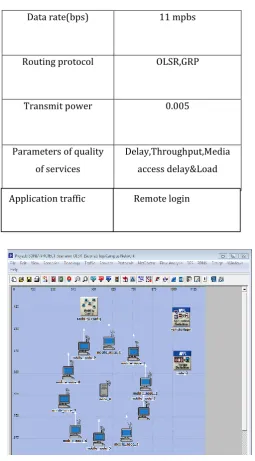
[image:2.595.191.544.66.758.2]The simulations are implemented using OPNET Modeler 14.5 with the nodes spread randomly over a square area of 1200 m x 1200 m. The mobility model used is “Random Waypoint Model” in which a node randomly chooses a objective, called waypoint and progress towards it in a straight line with a constant velocity [2]. The simulations are divided into scenarios with initially 10 nodes and then increasing the number to 15 nodes. The simulation was run for 5 simulation minute with seed value of 128 using application remote login. The pause time for the simulation is considered to be constant. The kernel mode is put to be optimized. The details are record in Table 1. Here in first scenario, used 10 mobile nodes and one fixed WLAN server. The application configuration and profile configuration was drag to workspace. The second scenario used 15 mobile nodes. All the attributes remain the same except the number of nodes were increased. In this sec scenario the same protocols are tested against the similar parameters.
Table 1. Simulation Parameters
Parameters Values
Operation mode 802.11g
No. of nodes 10,15
Simulation time 5 minute
Simulation kernel Based on kernel type preference
Data rate(bps) 11 mpbs
Routing protocol OLSR,GRP
Transmit power 0.005
Parameters of quality of services
Delay,Throughput,Media access delay&Load
[image:2.595.301.557.89.551.2]Table 1. Simulation Parameters
Figure 1: Environment Scenario of 10 Nodes
Figure 2: Environment Scenario of 15 Nodes
© 2016, IRJET | Impact Factor value: 4.45 | ISO 9001:2008 Certified Journal | Page 2187 The performance of the simulation is examined
according to different performance metrics [7]. This quantative measurement is useful for obtaining the performance of network using different routing protocols. The following performance metrics are involved in this study:
(i) Throughput: Throughput is described as the ratio of the total data that reaches a receiver from the sender.
(ii) Delay: Delay is the time of generation of a packet by the source up to the end reception. So this is the time that packets capture to go across the network. (iii)Load: Load is defined in bit/sec and it is the total
load submitted to WLAN layers by all top layers in all WLAN nodes of the network.
(iv)Media Access Delay: For every frame, this delay is calculated as the period from the time when it is entered into the transmission queue, which is arrival time for higher layer data packets and creation time for all other frames types, until the time when the frame is sent to the physical layer for the first time.
4.
SIMULATION RESULTS
The main target of this paper is to evaluate the performance and behavior of each routing protocol with respect to the effect of varying the number of nodes for remote login application. The results are based on evaluation metrics of delay, load, throughput and media access delay. We have divided our study into two sets of experiments: the first set studies the performance of two protocols over a small number of nodes (10 nodes) followed by increase in number of nodes to 15 in second set.
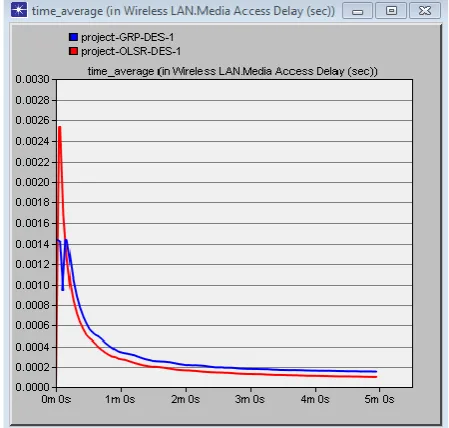
4.1 Media access Delay
The Fig.3(a) & Fig.3(b), x-axis shows the time (minute/second) and y-axis shows the media access delay (sec).The value for OLSR & GRP is 0.00014 &0.000306 using 10 nodes and value for OLSR & GRP is 0.000251 &0.000311 using 15 nodes. In both cases OLSR perform better than GRP protocol.
Fig 3(a): Comparison of OLSR and GRP protocol for media access delay using 10 nodes
[image:3.595.307.540.66.305.2] [image:3.595.321.546.350.564.2]© 2016, IRJET | Impact Factor value: 4.45 | ISO 9001:2008 Certified Journal | Page 2188
4.2 Throughput
The Fig.4(a) & Fig.4(b), x-axis shows the time (minute/second) and y-axis shows the throughput (bits/second).The value for OLSR & GRP is 43301.14 & 19222.01using 10 nodes and value for OLSR & GRP is 112382.6 & 45726.5 using 15 nodes. In both cases OLSR perform better than GRP protocol.
Fig 4(a): Comparison of OLSR and GRP protocol for throughput using 10 nodes
Fig 4(b): Comparison of OLSR and GRP protocol for throughput using 15nodes
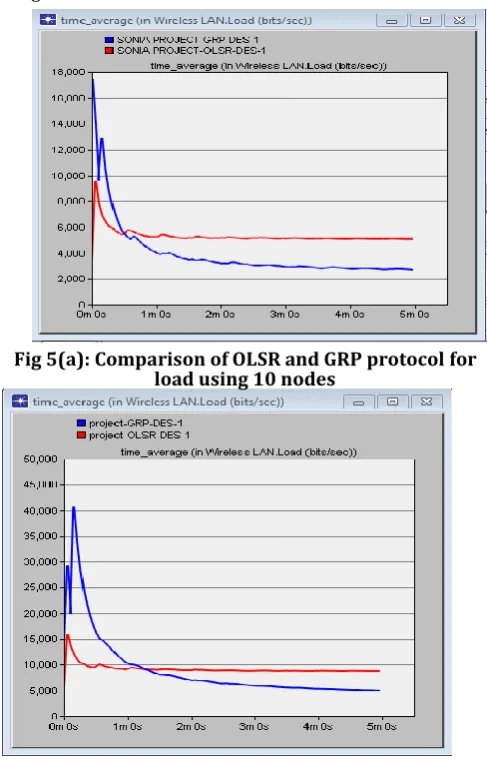
4.3 Load
The Fig.5(a) & Fig.5(b), x-axis shows the time (minute/second) and y-axis shows the load (bits/sec) The value for OLSR & GRP is 5317.388 & 3978.425 using 10 nodes and value for OLSR & GRP is 9136.537 & 8964.137 using 15 nodes.
Fig 5(a): Comparison of OLSR and GRP protocol for load using 10 nodes
[image:4.595.311.555.171.554.2] [image:4.595.46.282.191.376.2] [image:4.595.53.282.413.602.2]© 2016, IRJET | Impact Factor value: 4.45 | ISO 9001:2008 Certified Journal | Page 2189
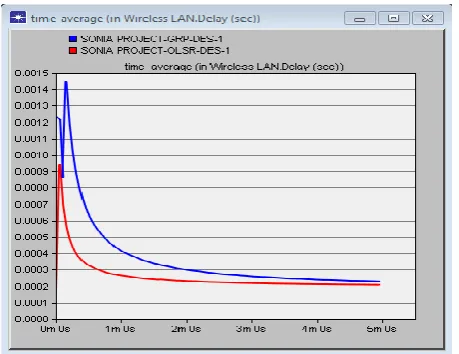
4.4 Delay
The Fig.6 (a) &Fig.6 (b), x-axis shows the time (minute/second) and y-axis shows the delay (sec).The value for OLSR & GRP is 0.000257 & 0.000374using 10 nodes and value for OLSR &GRP is 0.000284 & 0.000395 using 15 nodes. In both cases OLSR perform better than GRP.
Fig 6(a): Comparison of OLSR and GRP protocol for delay using 10 nodes
Fig 6(b): Comparison of OLSR and GRP protocol for delay using 15 nodes
5. RESULT ANALYSIS
[image:5.595.312.572.109.231.2]The result analysis of OLSR and GRP protocols is shown in this section with the help of the simulation outputs with respect to the four performance metrics. The aim of this comparative study of OLSR and GRP routing protocols is to analyze the presentation of protocols. OLSR in our simulation experiments present the overall best performance. The execution of increase in the number of nodes is also clearly display in the result tables shown below.
Table 2. Results for 10 nodes
Table 3. Results for 15 nodes
6. CONCLUSION
The simulation study helps to understand the behavior of OLSR and GRP routing protocols setup over MANET using medium remote login analyzing their actions with respect to the parameters of quality of services. Analysis of routing protocols using OPNET modeler 14.5 shows that in 10 mobile nodes the OLSR perform well than GRP in delay, throughput and media access delay except load. In 15 mobile nodes OLSR is again showing good results in delay, throughput and media access delay except load than GRP. So the overall analysis shows OLSR best protocol in all scenarios than GRP in MANET.
7. ACKNOWLEDGMENTS
I express my sincere and deep gratitude to my guide Mr. Joy Karan Singh, Assistant Professor, Computer Science & Engineering Department, CT Group of Institutions, for the invaluable guidance, support and encouragement. He provided me all resource and guidance throughout work. I am heartfelt thankful to Mr. Anurag Sharma, Head of Electrical & Computer Engineering Department, CT Group of Institutions, for providing us adequate environment, facility for carrying out work.
REFERENCES
[1] Huang J., Liu Y., “MOEAQ: A QoS-Aware Multicast Routing algorithm for MANET,’’Expert Systems with Applications, pp.1391-1399, 2009.
Metrics Delay(sec) Load
(bits/sec)
Throughput
(bits/sec)
Media Access Delay(bits/sec)
OLSR 0.000257 5317.388 43301.14 0.00014
GRP 0.000374 3978.425 19222.01 0.000306
Metrics Delay(sec) Load
(bits/sec)
Throughput
(bits/sec)
Media Access Delay(bits/sec)
OLSR 0.000284 9136.537 112382.6 0.000251
[image:5.595.39.269.176.353.2] [image:5.595.43.271.398.585.2]© 2016, IRJET | Impact Factor value: 4.45 | ISO 9001:2008 Certified Journal | Page 2190 [2] Gundry S., Kusyk J., Zou J., “Performance Evaluation of
Differential Evolution Based Topology Control Method for Autonomous MANET Nodes,”Computers and Communications (ISCC), 2012 IEEE Symposium on. IEEE, pp.228-233, 2012.
[3] Sharma V., Singh H., Kaur M., Banga V., “Evaluation of reactive routing protocols in MANET networks using GSM based voice traffic applications,”Optik-International Journal for Light and Electron Optics, pp.2013-2016, 2012.
[4] Mittal P.,Singh P.,Rani S.,”Performance Analysis Of Aodv, Olsr, Grp And Dsr Routing Protocols With Database Load In Manet,’’International Journal of Research in Engineering and Technology,pp.412-420,2013.
[5] Mahajan S., Chopra V., “Performance Evaluation of MANET Routing Protocols with Scalability using Qos Metrics of VOIP Applications”, Department of Computer Science Engineering, DAVIET Jalandhar.2013.
[6] Kampitaki D., Economides A., “ISimulation study of MANET routing protocols under FTP traffic.” Procedia Technology, pp.231-238, 2014.
[7] Basarkod P., Manvi S., "Mobility and QoS aware anycast routing in Mobile ad hoc Networks,’’ Computers & Electrical Engineering, pp.1-14, 2015.
[8] Neuman A., Lopez E., Navarro L., “Evaluation of mesh routing protocols for wireless community networks," Computer Networks, pp.1-16, 2015.
[9] Malik A., Qadir J., Ahmad B., Yau K., Ullah U.,’’QoS in IEEE 802.11-based Wireless Networks,” Journal of Network and Computer Applications,pp.1-27,2015.