© 2015, IRJET ISO 9001:2008 Certified Journal
Page 72
Design and Simulation of Reliable and Efficient Hybrid
Solar-Wind Power System Using Improved MPPT P& O Algorithm
Rati Ranjan Sabat
1, S.M Ali
2and Rashmita Panigrahy
31
Research Scholar, Department of Electronics Science, Berhampur University, Odisha, India
2
Professor, Department of Electrical Engg, KIIT University, Bhubaneswar, Odisha, India
3
Lecturer, Department of Electronics Science, Berhampur University, Odisha, India
---***---
Abstract -
This paper explains the design andsimulation of a solar-wind hybrid energy system with an Improved perturb and observe (P&O) maximum power point tracking algorithm to extract the maximum power from hybrid solar-wind power system. The hybrid system where the solar power output is improved at different weather conditions and excessive power is stored in a battery and the wind power output also improved as per the availability of ever variable wind speed. The improved control algorithms identify the operating limit violation and adjust itself nearer to the best possible maximum power point. Improvements of these methods can be obtained with the fast sampling rate and the perturbation size using MATLAB/Simulink to simulate the system and to verify the outcomes.
Keywords —
hybrid power system1, maximum power
point tracking (MPPT)2, photovoltaic (PV) power
system3, improved perturb and observe (P&O)4
1. INTRODUCTION
Nonconventional energy sources on the way to becoming a well-established energy source in the coming decades and expected to play an important role in meeting the world’s power demand, due to their abundant availability and less impact on the environment. Initial high capital cost of solar modules is the main barrier of solar energy going widespread. Another disadvantage of solar energy production is that the power generation is not constant throughout the day, as it changes with weather conditions. The efficiency of solar energy conversion to electrical energy yet to reach its best, now it is around the range of 19–21% [1] in good conditions and even lesser especially in low irradiation regions. Hence technology is required to improve the efficiency of solar system by embedding with other renewable energy recourses. Wind energy is the best available renewable recourse to be used with solar system to improve the reliability and efficiency of the power system. The most popular MPPT methods in PV systems uses perturbation and observation (P&O) algorithm, which ensure that the power converters operate at the maximum power point (MPP) of the solar array. PV and wind turbine can be used as hybrid power systems using the MPPT for improving efficiency of the system rather only using PV modules or wind mills separately. The wind
turbine can also operate with maximum aerodynamic efficiency. These systems are called Solar-wind hybrid systems [3] and may be used to supply electricity energy to stand-alone loads, e.g., small villages that are not connected to the main utility. In order to improve the efficiency.
The main objectives of MPPT algorithms are to achieve faster and accurate tracking performance and reduce the oscillations for both solar and wind systems. Separate MPPT algorithms are explained based on the type of the control variable for solar and wind power system. Among different algorithms, much focus has been on perturb and observe (P&O) method [1] [8]. MPPT techniques can be improved through the optimum adjustment of the sampling rate and perturbation size both in accordance with the converter dynamics. This paper explains the optimum parameters of the improved P&O techniques to improve output and efficiency of solar-wind hybrid system.
2. THE PROPOSED MODEL
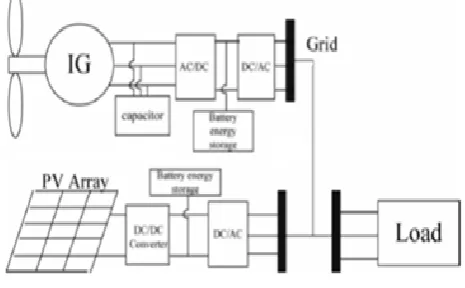
The dynamic proposed model of solar and wind hybrid system is shown in Fig. 1 is consisting of consisting of PV generation system, Wind energy conversion system (WECS) as main components and also have a Battery energy storage system (BESS). Both systems are connected to a common load after conversion of power to required AC through appropriate converters and inverters.
[image:1.595.321.554.589.733.2]© 2015, IRJET ISO 9001:2008 Certified Journal
Page 73
3. THE PROPOSED IMPROVED MPPT SYSTEM3.1 Improved MPPT Control Algorithm Of The Wind Energy System
The wind power generation system explained in this paper with the MPPT controller using P&O algorithm is shown in
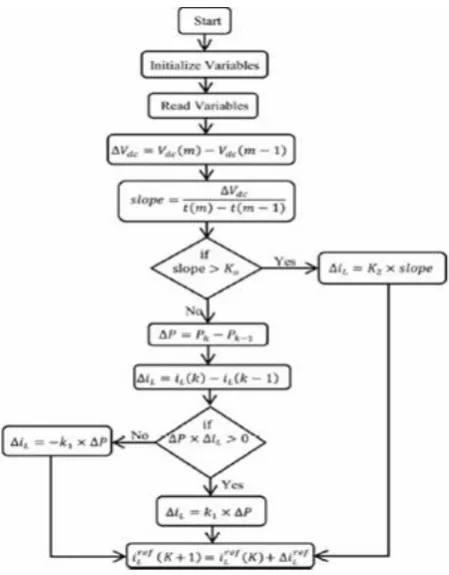
Fig.2. the operating condition for P&O algorithms is considered under sudden wind speed change, especially in scenario of wind speed slowdown. A conventional P&O algorithm does not perform properly under this operational condition due to its slow response to sudden change of wind speed. The proposed algorithm is able to detect the sudden wind speed change, which is projected into dc-link voltage slope change. When a sudden dc-link voltage slope exceeds a certain threshold, the wind speed is verbally expressed to be transmuting rapidly. Corresponding adjustment at the machine to perpetuate generation with MPPT control, which gives an advantage over conventional P&O algorithms.
Fig.2- Flow chart of Improved MPPT algorithm for wind energy system
The algorithm works in two distinct modes: Under slow wind fluctuation conditions it will work in the normal P&O mode in which an adaptive step size is employed with the power increment utilized as a scaling variable.
Fig.3: Configuration of wind energy system
Under sudden wind speed change conditions the second mode i.e the predictive mode works for bringing the operating point to the vicinity of the MPP and it will avail obviate the generator from stalling by rapidly adjusting the generator torque in replication to sudden drops in wind speed.
[image:2.595.327.551.143.298.2]3.2. Conventional P& O Algorithm flow chart of solar energy system
Figure-4 shows the generally followed MPPT P&O algorithm for solar system.
[image:2.595.58.283.324.612.2] [image:2.595.342.546.474.701.2]© 2015, IRJET ISO 9001:2008 Certified Journal
Page 74
3.2 Improved MPPT Control Algorithm Of TheSolar Energy System
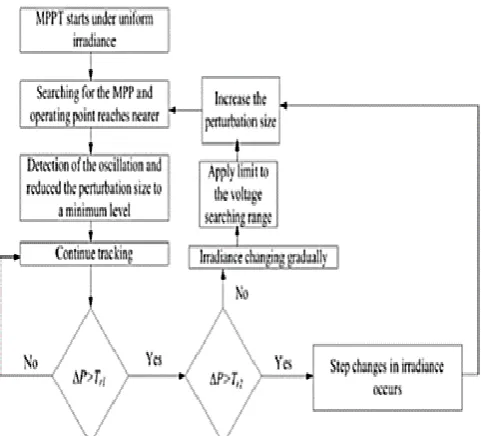
[image:3.595.38.279.190.408.2]It is very difficult to quickly acquire the maximum power point (MPP) by using the conventional perturbation and observation (P&O) MPPT algorithm and the tracking course is not accurate under changing weather conditions.
Fig. 5: Flow chart of Improved P&O Algorithm for Solar system
To improve the performance and efficiency of MPPT tracking, Improved Perturbation and Observation (IP&O) method is used based on auto-tuning perturbation step. A satisfactory trade-off between fast transient responses and steady state performance can be obtained with a small perturbation step size.
Fig.6: Configuration of P&O in Solar system
For the changing environment, it is required to implement MPPT to get the operating voltage close to the maximum power point under keeping economy point of view of solar cells. The improved P&O method periodically increases or decreases the solar cell’s voltage as mentioned before to seek the maximum power point. A variable step method is proposed in this paper to achieve the maximum power point by adjusting the step length according to the distances to the MPP. The step length of duty ratio D is the
ratio of the variation of power P to voltage V, which is the slope of each operating point under very short sampling time. Fig. 4 shows the control block of the improved P&O method.
4. SIMULATION RESULTS
The hybrid system shown in Fig. 1 is simulated using MATLAB/ Simpower and the PV system used in the simulation were conducted to show performance of the model under various conditions, with the comparison of various MPPT schemes for the improved P&O method.
4.1. MPPT System Performance
4.1.1 Wind Power MPPT
Time simulation is done for the hybrid power system with constant load under sufficient wind and irradiance. The turbine output power characteristics and the wind power output characteristics is analysed.
Fig.7: Wind velocity variation
[image:3.595.37.282.530.628.2]© 2015, IRJET ISO 9001:2008 Certified Journal
Page 75
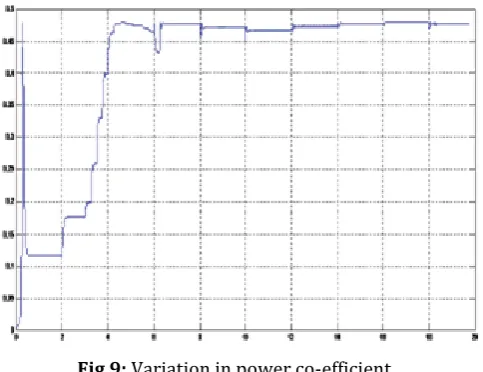
Fig.9: Variation in power co-efficient
[image:4.595.44.286.95.281.2]The proposed algorithm has been tested under different conditions of rapidly changing wind velocity as shown in Fig. 7, .The wind turbine tracks maximum power point of the wind velocity. Controller developed accordingly to track the reference input inductor current generated by the MPPT algorithm. Effective tracking feature of the proposed MPPT algorithm is verified from power characteristics as shown in Fig. 8. Maximum power point tracking capability of the wind energy conversion system is proved by observing the power coefficient, Cp, of the system as shown in Fig. 9. This result proves the operation of the wind energy conversion system at maximum power point.
4.1.2. Solar PV Simulation result with conventional P& O MPPT
The output power from PV is shown in Fig. 10. From Fig. 12 for conventional PV, we can see that the controller provides a better performance than P&O in fig 13 to 15using Improved P&O algorithm for both in the transient and the stability.
Fig.10: Output current
[image:4.595.312.513.105.219.2]
Fig.11: Output Voltage
Fig.12: Output power
4.1.3. Solar PV Simulation result with improved P& O MPPT
Fig.13: Output current
[image:4.595.312.520.274.386.2]© 2015, IRJET ISO 9001:2008 Certified Journal
Page 76
Fig.15: Output powerFrom figure 13, 14 and 15 it is clear that the power output is increased using the improved P&O method.
[image:5.595.31.216.366.460.2]4.2.Performance comparison of both P&O methods: 4.3.
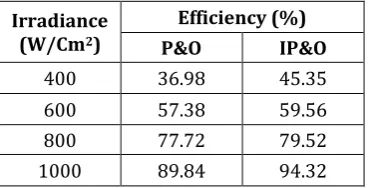
Table 1 shows Analytic Evaluation of Output Efficiency with Various Solar Temperatures at Constant Irradiance.
Table 1: Efficiency at different Irradiance
It can be found that power availability with various irradiance at various temperature, the IP&O method gives higher power than P&O method. It shows that the performance of proposed IP&O control strategy is efficient than P&O control.
Figure16 shows a comparison of power and fig 17 compares the efficiency between P&O and IP&O method at different irradiance.
Fig.16: Power comparison of P&O and Improved P&O at various irradiance
Fig.17: Efficiency comparison P&O and Improved P&O at various irradiance
5. CONCLUSION
It can be concluded that the IP&O method has given higher efficiency than P&O method for both solar and wind system. From the analytic evaluation shows that the proposed IP&O control strategy gives well performance than P&O control. It is found that IP&O method is more capable to tracked than conventional P&O method , also works efficiently at variable temperature with constant irradiance for PV cell and at turbulent wind conditions in case of wind energy system. Also it is observed that for solar system the power is reduced by increasing of temperature and IP&O method has capability to track power efficiently than P&O at different temperature with constant irradiance. The WEC MPPT algorithm utilizes the side current as the perturbing variable, while the dc-link voltage slope information is utilized to detect turbulent wind speed change. Compared to the conventional P&O methods, the proposed MPPT method gives optimum result irrespective of the loading conditions or the wind speed range. Yet, like other methods, the proposed algorithm does not require anemometer or generator speed quantifications. The correctness and validity of improved MPPT method is verified through simulation under varied weather conditions. It was found that, for all the tests, the MPPT of the proposed P&O increases by approximately two to five percentage points. This improvement is important since a hybrid power system installation has a life-time of approximately twenty years. Since these proposed version has little variation to conventional algorithm structure, the improvements can be easily implementable.
Irradiance (W/Cm2)
Efficiency (%) P&O IP&O
400 36.98 45.35
600 57.38 59.56
800 77.72 79.52
[image:5.595.59.270.623.755.2]© 2015, IRJET ISO 9001:2008 Certified Journal
Page 77
References[1] Jubaer Ahmed, Zainal Salam “An improved perturb and observe (P&O) maximum power point tracking 1(MPPT) algorithm for higher efficiency” Elsevier 20 April 2015
[2] Chihchiang Hua and Chihming Shen, “Study of Maximum Power Tracking Techniques and Control Dc/Ac Converters for Photovoltaic Power System”, IEEE transactions 1998
[3] Weidong Xiao, Nathan ozog, William G.Dujford, “Topology Study of Photovoltaic Interface for Maximum Power Point Tracking” IEEE transactions on industrial electronics, vol.54, NO.3, June 2007 [4] J.V. Gragger, A. Haumer, M. Einhorn, “Averaged
Model of a Buck Converter for Efficiency Analysis”, Engineering Letter, Vol. 18, Issue 1, 2010.
[5] R R Sabat, R.; S.M Ali, R Dash “ Performance evaluation of a grid connected photovoltaic system based on solar cell modelling:-Part-II” IEEE xplore Publications, Year: 2015, Pages: 1 – 5
[6] J. Hui and A. Bakhshai, “A Fast and Effective Control Algorithm for Maximum Power Point Tracking in Wind Energy Systems” in the proceedings of the 2008 World Wind Energy Conference.
[7] Johnson, K.E.; Pao, L.Y.; Balas, M.J.; Fingersh, L.J. Control of variable-speed wind turbines: Standard and adaptive techniques for maximizing energy capture. IEEE Trans. Control Syst. Mag. 2006, 26, 70–81
[8] Kazmi, S.M.R.; Goto, H.; Guo, H.J.; Ichinokura, O. A novel algorithm for fast and efficient speed-sensorless maximum power point tracking in wind energy conversion systems. IEEE Trans. Ind. Electron. 2011, 58, 29–36.
[9] Hohm, D.P.; Ropp, M.E. Comparative study of maximum power point tracking algorithms using an experimental, programmable, maximum power point tracking test bed. In Proceedings of Photovoltaic Specialists, Anchorage, AK, USA, 15–22 September 2000; pp. 1699–1702.
[10] Johnson, K.E.; Pao, L.Y.; Balas, M.J.; Fingersh, L.J. Control of variable-speed wind turbines: Standard and adaptive techniques for maximizing energy capture. IEEE Trans. Control Syst. Mag. 2006, 26, 70–81.
[11] Wang and L. Chang, “An intelligent maximum power extraction algorithm for inverter-based variable speed wind turbine systems,” IEEE Trans. Power Electron., vol. 19, no. 5, pp. 1242-1249, Sept. 2004. [12] E. Koutroulis and K. Kalaitzakis, “Design of a
Maximum Power Tracking System for Wind-Energy-Conversion Applications”, IEEE Transactions on Industrial Electronics, Vol. 53, No. 2, pp. 486-494, April 2006.
[13] M. Matsui, D. Xu, L. Kang, and Z. Yang, “Limit Cycle Based Simple MPPT Control Scheme for a Small Sized Wind Turbine Generator System,” Proc. of 4th
International Power Electronics and Motion Control Conference, Xi'an, Aug., 14-16, 2004, vol. 3, pp. 1746-1750.
[14] J. Yaoqin, Y. Zhongqing, and C. Binggang, “A new maximum power point tracking control scheme for wind generation,” in Proc. International Conference on Power System Technology 2002 (PowerCon 2002). 13-17 Oct., 2002. pp.144-148.
BIOGRAPHIES
Rati Ranjan Sabat: Research Scholar at Berhampur University, Berhampur, Odisha, India. Completed M.Tech in the year 2008 and currently perusing PhD in the field of Hybrid
renewable energy systems at
Berhampur University. He has 8 publications in different international journals and presented papers in 7 International and National Conferences. He is the Life member and elected as the Section Managing Committee member of ISTE, Odisha Section, Life member of Institution of Engineers India(IEI)and life member of Solar Energy Society of India (SESI) .
Dr S M Ali is Professor in Electrical Engineering of KIIT University Bhubaneswar. He received his DSc & Ph. D. in Electrical Engineering from International University, California, USA in 2008 & 2006 respectively. He had done M.Tech from Calcutta University. His area of research in the field of Renewable Energy both Solar & Wind Energy. He had also guided five nos. of Ph. D students in his research area. He has 20 papers publication in journals and presented more than 50 papers in different National & International conferences in the field of Renewable Energy. He is Vice President of Solar Energy Society of India, Chairman of ISTE Odisha chapter and Secretary of Institution of Engineers (India) , Odisha state centre.
Dr. Rasmita Kumari Panigrahy is Lecturer in the Department of
Electronic Science, Berhampur
University. She has received her PhD in Electronics Sciences. She has good publication in International journals
and participated in various