© 2016, IRJET | Impact Factor value: 4.45 | ISO 9001:2008 Certified Journal | Page 592
Study On Performance Of Regular And Vertically Irregular Structure
With Dampers, Shear Wall And Infill Wall
Chaitra H N
1, Dr B Shivakumara Swamy
21
Mtech Structural Student, Dept of Civil Engineering, Dr Ambedkar Institute of Technology, Bangalore, Karnataka,
India
2
Professor and Head, Dept of Civil Engineering, Dr Ambedkar Institute of Technology, Bangalore, Karnataka, India
---***---Abstract -
Structures these days are constructed withirregularities along the height for architectural views. The structure is said to be irregular when the distribution of its mass, stiffness and strength varies along its configuration. Seismic load is considered to be an important load that the structure must be analyzed. From the past earthquake records it can be observed that the structures with irregularity show poor seismic performance. This project work is concerned about analyzing and studying the behavior of regular building and different models of vertically irregular building when subjected to seismic loads. The models are provided with different seismic resisting systems such as dampers, shear wall, infill wall and the enhancement in the seismic performance is studied. For the study one model of regular structure and one model of vertical irregular structure of G+9 storey is considered. The analysis is carried out by using FE package of ETABS software by equivalent static method and time history method. For equivalent static analysis zone V is considered and the Bhuj time history record is taken for the time history analysis. The results of various parameters like time period, storey displacement, and storey stiffness are obtained and the graphs are plotted. From the results it can be observed that regular structure possess better seismic performance as compared to vertically irregular structure.
Key Words: Vertically Irregular Building, Dampers, Shear
Wall, Infill Wall, Time History Analysis, Equivalent Static Analysis.
1. INTRODUCTION
In our daily life we come across various types of structures from simple ones like lamp post to complex ones like bridges, multi-storey building etc. The structures are designed to transmit or carry various types of loads like uniformly distributed loads, concentrated loads, uniformly varying loads, dynamic forces etc. Due to the dead load, live load and earthquake forces the structures are designed to carry such loads without causing any damage to the structure and its components during its entire service. Earthquake has severe effects on both mankind and structures. Structures are highly susceptible to collapse or
severe damage during an earthquake and resulting in financial and economic loss and loss oflife. Earthquake is caused due to the sudden movement of earth’s crustwhich results in the breaking and movement of rocks beneath which in turn results in the severe shaking of earth. The configuration of the building can be said to be regular or irregular based on its size and shape, arrangement of the mass and structural components. The configuration of regular buildings are symmetrical in both plan and elevation about its axis and possess uniform distribution of static and dynamic forces. The building which lacks symmetry and possess discontinuity in geometry, mass or load resisting components is termed as irregular. Such irregularities may interrupt the concentration of stresses and the asymmetrical arrangement of mass and stiffness of the building components cause large torsional force.
1.1
Damping
Damping is measured in terms of percentage of critical damping which is minimum amount of damping required to reduce amplitude of free vibrations. The reduction of energy of vibrating structure is dissipated due to various mechanisms. Dampers are classified based on material behavior as viscous and visco-elastic dampers and based on mass counteracting inertia forces as tuned mass dampers and tuned liquid dampers and based on performance of friction as frictional dampers.
1.2
Shear wall
It is a lateral force resisting system in a building. Shear wall is the vertical component of the structure for resisting both gravity and horizontal forces. These shear walls provides adequate strength and stiffness to resist horizontal forces. Shear walls are found to be effective if they are aligned vertically and supported on foundation or footings. Shear walls also resist shear forces and uplift forces. Horizontal forces causes shear force throughout the height of the wall and uplift force at the top of the wall.
1.3
Infill wall
© 2016, IRJET | Impact Factor value: 4.45 | ISO 9001:2008 Certified Journal | Page 593
be constructed using various materials such as bricks,timber, concrete, light steel etc. Masonry infill walls are the most commonly provided
2. METHODOLOGY
During earthquake the loads in the structure reach to collapse load and the stresses in the materials will reach above yield stresses. The following methods are used for analysis.
2.1 Equivalent Static Analysis
It is a linear static method of analyzing where the response of the structure is assumed to behave in linearly elastic manner. It is an indirect method of taking into account the effects of ground motion and their properties and incorporated in terms of fundamental period, response reduction factor, soil type, seismic zone and importance factor.
2.2 Time History Analysis
It is a nonlinear dynamic method. This method helps in understanding the exact nonlinear behavior of the structure. In time history analysis the structure is analyzed by subjecting it to real ground motion records of previous earthquake. This method gives the stepwise solution in terms of time of the multi degrees of freedom equations related to ground motion. This response equation represents the actual response of the structure.
3.
STRUCUTRAL MODELLING
The structural models considered for the study is of G+9 storey. The plan dimensions taken for the study is 25m x 20m. For vertically irregular models the plan of the model vary along with the height. The height of the building is taken to be 3m. The slabs are assumed to be continuous and rigid. The loads are assigned as per IS 875 part1 and part 2. For the study totally two models of the structure are considered out of which one is regular building and the other is of vertical irregularity building. Each model is analyzed for different cases such as with dampers, with shear wall and with infill wall.
3.1 Preliminary Data
Height of each storey : 3m
Live load on floors: 3kN/m2 Floor finish: 2kN/m2 Column size: 300x 500mm
Beam size: 300x450mm
Slab thickness: 150mm
Shear wall thickness: 230mm
Infill wall thickness: 230mm
Materials used: M25 grade concrete, Fe 415 steel , Brick masonry
Density of concrete: 25kN/m3
Density of masonry infill: 20KN/m3
Modulus of elasticity of masonry infill:2100MPa
Seismic zone: V
Zone factor: 0.36
Type of soil : soft soil
Importance factor: 1.5
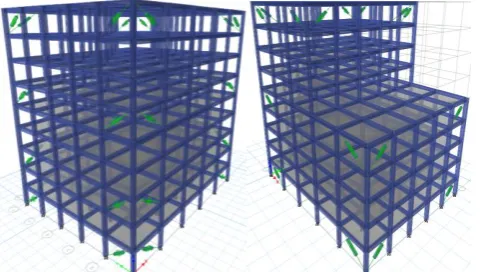
Fig 1: 3d plan of bare frames of model1 and model2 respectively.
Fig 2: 3d plan of model1 and model2 provided with dampers respectively.
[image:2.595.309.550.375.511.2] [image:2.595.307.542.554.692.2]© 2016, IRJET | Impact Factor value: 4.45 | ISO 9001:2008 Certified Journal | Page 594
Fig 4: 3d plan of model1 and model2 provided with infillwall respectively.
4.
RESULTS
Based on the results that are obtained comparison was made for the time period, storey displacement and storey stiffness for both equivalent static analysis and time history analysis considering the bare frame, with dampers, with shear wall and with infill wall for all the models.
4.1 Time Period
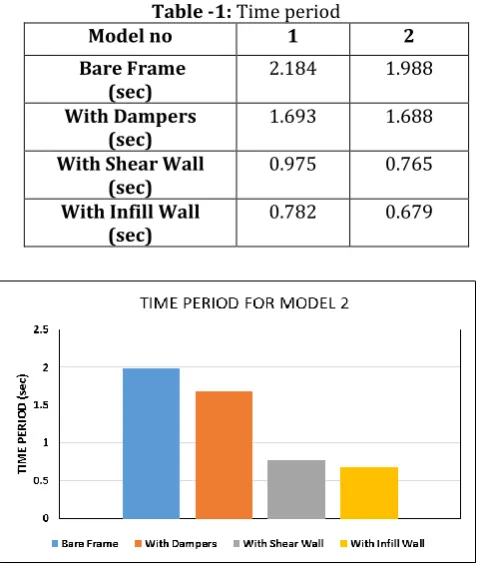
[image:3.595.303.558.68.241.2]The time period then reduces considerably with the use of dampers, shear wall and infill wall. Since the infill wall is provided throughout the building it has performed better as compared to that with shear wall and dampers.
Table -1: Time period
Model no 1 2
Bare Frame
(sec) 2.184 1.988
With Dampers
(sec) 1.693 1.688
With Shear Wall
(sec) 0.975 0.765
With Infill Wall
(sec) 0.782 0.679
Fig 5: Time period plot for model 1 for different cases
Fig 6: Time period plot for model 2 for different cases
4.2 Storey Displacement
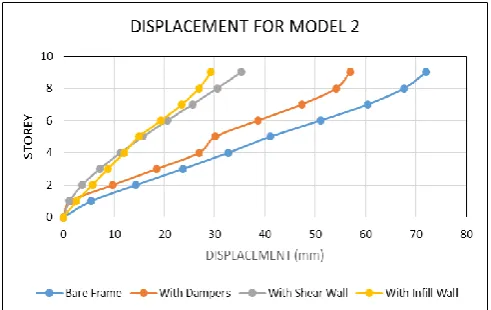
From the graphs represented in fig 7 to fig 10 of storey displacement for the models with different cases it can be observed that displacement is maximum at top storey level. It can also be observed in comparison with bare frame that the displacement has reduced considerably with the addition of dampers, shear wall and infill wall. The models provided with infill wall reduced the displacement to larger extent as compared to that of bare frame. The models provided with dampers helped in reducing the displacement to a minimum extent whereas the models provided with shear wall reduced the displacement to a better extent compared to that provided with dampers.
4.2.1 Equivalent Static Analysis
[image:3.595.34.272.93.237.2][image:3.595.38.277.446.729.2] [image:3.595.313.560.462.624.2]
© 2016, IRJET | Impact Factor value: 4.45 | ISO 9001:2008 Certified Journal | Page 595
Fig 8: Storey displacement plot for model 2 obtained from equivalent static analysis for different cases
[image:4.595.37.281.329.488.2]4.2.1 Time History Analysis
Fig 9: Storey displacement plot for model 1 from time history analysis for different cases
[image:4.595.309.554.371.545.2]
Fig 10: Storey displacement plot for model 2 obtained from time history analysis for different cases
4.3 Storey Stiffness
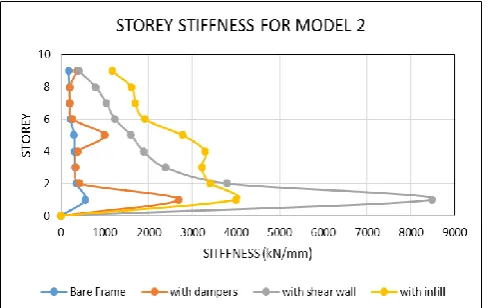
It can be observed from the storey stiffness graphs represented from fig 11 to fig 14 that the stiffness of bare frame for the models is less and that provided with shear wall has more stiffness. It can also be observed that the stiffness is more at the 1st storey level as compared to the other stories for all the cases. It can be seen that the for bare frame structure the storey stiffness variation is very less. It can be observed from the models provided with dampers that storey stiffness is more at the storey were the damper is located. From the graphs it can be observed that models provided with shear wall is stiffer and the stiffness is more at 1st storey level and then decreases linearly for all the models. In case of models provided with infill walls for the regular model the variation in stiffness is linearly reducing where as in case of vertically irregular models provided with infill walls it can be observed that for the stiffness variation is almost linear up to the storey which are similar and then varies with the variation in the storey where irregularity starts.
4.2.1 Equivalent Static Analysis
[image:4.595.40.285.539.692.2]Fig 11: Storey stiffness plot for model 1 obtained from
equivalent static analysis for different cases
© 2016, IRJET | Impact Factor value: 4.45 | ISO 9001:2008 Certified Journal | Page 596
[image:5.595.36.285.106.266.2]4.2.1 Time History Analysis
Fig 13: Storey stiffness plot for model 1 obtained from time history analysis for different cases
Fig 14: Storey stiffness plot for model 2 obtained from time
history analysis for different cases
5. CONCLUSIONS
The conclusions obtained from the analysis and results of the present study can be summed up as follows.
a) The time period and storey displacement was found to be reduced as compared to that of bare frame with the addition of dampers, shear wall and infill wall.
b) The storey stiffness was found to be increased as compared to that of bare frame with the addition of dampers, shear wall, infill wall.
c) The time period, storey displacement and was found to be more in case of regular structure as compared to that of structural model with vertical irregularity.
d) The storey stiffness was found to be almost same at the bottom most storey for both regular and irregular structural models and it decreased along the height. It can be concluded that regular structure possess better stiffness than irregular structure.
e) The structural models provided with dampers was least effective in reducing the time period, storey
displacement, and in increasing the storey stiffness of the structure compared to that with bare frame. f) The structural models with vertical irregularity provided with shear wall gave better performance in increasing the stiffness of the structure.
g) From the results obtained it can be concluded that equivalent static analysis gave more result values as compared to that of time history analysis because of the frequency of the given earthquake time history data.
h) The seismic response of the regular structure is better in comparison with that of irregular structure because of the discontinuities along the height of building.
REFERENCES
[1]“Earthquake Resistant Design of Structures”, by Pankaj Agarwal and Manish Shrikhande, PHI Learning Private Limited, 2013.
[2] “Earthquake Resistant Design of Structures”, by S.K.Duggal.
[3] V.V. Diware and A.C.Saoji “Seismic Assessment of Symmetrical RC Structure with Brick Masonry Infills”, [IJERA], Volume: 2, Issue 3, May-Jun 2012.
[4] Yuvraj Bisht and Saraswati Setia “Seismic Behaviour of A Soft Storey Building With & Without Viscous
Dampers”, (IJERA), 29th March 2014.
[5]Sumyat Aye and Dr. Kyaw Moe Aung “Comparative Study on Seismic Response of RC Structure Using
Viscous Dampers and Viscoelastic Dampers”,
(IJSETR) Vol.03, Issue.08, May-2014.
[6]Ravikanth Chittiprolu and Ramancharla Pradeep Kumar “Significance of Shear Wall in High-rise Irregular Buildings”, (IJEAR), Vol. 4, Issue spl-2, Jan - June 2014.
[7]J. V. Sunil Ganesh and Mallikarjun S. Bhandiwad “Seismic Analysis of Irregular Multistoried Structure with Shear Wall” The International Journal Of Science & Technoledge (THEIJST), Vol. 2, Issue 6, June 2014.
[8]Liya Mathew & C. Prabha “Effect Of Fluid Viscous
Dampers In Multi-Storeyed Buildings”, (IMPACT:
IJRET), Vol. 2, Issue 9, Sep 2014.
[9]Dr. Raghvendra Singh, Prof. Sumit Pahwa, and Ambar Gupta “Seismic Behaviour Of Buildings Having
Vertical Irregularities” Universe of Emerging
Technologies and Science (UNIETS) Volume I, Issue V – October 2014.
[image:5.595.36.281.307.461.2]