An Efficient Load Balance Algorithm for
Vehicular Ad-Hoc Network
clustering technique divided vehicles into groups; the admin of the group was called the cluster-head (CH) and other vehicles in same transmission range was known as the cluster-member (CM). The admin was responsible for the inter and intra cluster communications. Inter-cluster refers to the communication between CM and another CM in the same cluster. While intra-cluster refers to the communication between CM with another CM in a different cluster. The clustering techniques was chosen in order to solve the issues mentioned above. However, high vehicles mobility causes high network topology change of (VANETs). This problem made the cluster unstable and this caused network load, interconnect, overhead, collision, packet loss, packet drop and handoff. To solve these problems, the authors used a different method to elect CH based on different parameters. Because when CH still long time of period, the stability of network would increase and the above problems would reduce. This paper presents a novel method of intelligent cluster head election (ICHE) to form a cluster with more stability and reduce the number of uplink connection by reducing the number of CH in the networks. The reduced number of CH resulted the reduce of load at the base station (BS).
II. RELATEDWORK
In general, the increase of cluster stability is based on a method that used to elect cluster-head based on the increased CH lifetime, reduced CH changing and increased cluster-member duration. In the following, there are several methods that have been used to increase cluster stability. In [4] the author proposed that vehicles with more number of connections than the specific threshold were elected as the leader, then elect CH from the leaders. The leader with low relative velocity was elected as CH. However, if the number of nodes was less than the specific threshold, it must re-format the cluster and this made the cluster unstable. In [5] the author proposed that vehicles with low average velocity, same direction and low distance to their neighbours were elected as CH . In previous work [6] the author proposed dividing the area into static cluster and CH. Nevertheless, the vehicle mobility still has the same effect when used vehicle-to-roadside units (V2R). In prior [7] the author proposed forming the cluster dynamically and electing the node in the centric location of its neighbour's nodes as CH. The author used merge mechanism based on relative distance and direction but if the second CH had more velocity, it caused re-clustering again and this made the cluster unstable. In [8] the author proposed that the vehicles with the same direction and near to each other formed a cluster and elected CH based on [9]. In [9] each cluster had A.H. Abbas
Wireless &Radio Science Centre(WARAS) FKEE, Univ.Tun Hussein Onn Malaysia
Batu Pahat, Johor, Malaysia [email protected]
N.A.M. Alduais
Wireless &Radio Science Centre(WARAS) FKEE, Univ.Tun Hussein Onn Malaysia
Batu Pahat, Johor, Malaysia [email protected] L. Audah
Wireless &Radio Science Centre(WARAS) FKEE, Univ.Tun Hussein Onn Malaysia
Batu Pahat, Johor, Malaysia [email protected]
Abstract—Over the past decade, the vehicular Ad-hoc networks (VANETs) has testified significant attention from authors to safe people’s lives, reduce money consumption and accident. Most of the previous studies focused on clustering especially on electing cluster-head to increase cluster stability. However, no one addressed the effect of the number of connection at the base station (BS). This is because when CH was connected to the base station, it still reserved the link until the vehicle was turned off or moved from BS to another BS. In this paper, proposed a novel method called intelligent cluster head (ICH) to increase cluster stability, and at the same time reduce the number of uplink connection at the base station (BS). In this study, the same mobile BS was used if there was no need for establishment of new BS for VANETs. The simulation was done by using MATLAB through a real data. The results showed that the proposed method provided less number of uplink connections than other previous studies and enhancing the stability of the system. The proposed method resulted in less number of CH by 53.92 % from previous methods.
Keywords—vehicle Ad-hoc networks, VANETs, clustering, intelligent cluster head, load balance, stability.
I. INTRODUCTION
a primary cluster-head (PCH) that elected the nearest node as the secondary cluster-head (SCH). When SCH did not receive any notification from the PCH, it meant that the PCH had moved out of the cluster and SCH became the main CH. However, if SCH did not receive any notification from the PCH while it was still in the network, it meant that the collision had happened in all clusters. In [10] the author proposed electing CH based on affinity propagation. In [11] the author proposed electing CH based on relative speed. In [12] the author proposed applying multi-cluster head, electing CH based on relative mobility and electing secondary CH (SCH) in order to increase cluster stability. However, the increase of CH means the increased number of uplink connection and this would increase the load of
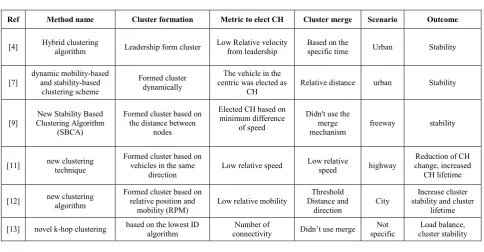
[image:2.595.46.531.235.487.2]connection at the base station (BS). Previously in [13] the author proposed electing CH based on the vehicle with the highest number of connection, in order to increase the stability of cluster and load balance. However, vehicles that moved at high speed or in the opposite direction made the cluster unstable and this increased the load at the base station. In [14], the author proposed electing CH based on the vehicle with low Aggregate Local Mobility (ALM), to reduce CH and CM change. The increased number of CM and CH change of the vehicle if vehicle in the opposite direction and this produce an unstable cluster. The summary of related work is shown in TABLE I.
TABLE I. SUMMARY OF RELATED WORK
III. PROPOSED ALGORITHM
This section presents a new method for clustering formation in order to increase cluster stability and reduce the number of uplink connection at the base station (BS). A. Cluster formation
Cluster formation established dynamically during vehicle mobility, based on beacon broadcast by each vehicle. The beacon had the main parameters that were responsible for increasing the cluster stability. These parameters will be explained in the new method section.
1) The transition steps for each vehicle: There were four steps to form a cluster in this method:
a) Undecided (UN) state: Any vehicle in the initial state. In this state, the vehicle broadcasted its information to the neighbour's vehicles. This information is about its speed, direction, location and its unique ID. In this study, it was assumed that each vehicle had a GPS system in order to know its location and a digital map in order to know its direction
.
b) Cluster Member (CM) state: Vehicle in the UN state. After receiving the reply from the Cluster-Head or Intelligent-Cluster-Head, it changed its state to CM.
c) Cluster-Head (CH) state: It is the manager of the group (Admin). It is responsible for inter and intra communications (communication between source and destination in the same group and in different groups respectively). every communication done during CH in its group. Only CH could communicate with the Base Station (BS) and send CMs information to the BS and only CH could give permission to any Intelligent-Cluster-Head to be the new CH which meant that CH was autonomous.
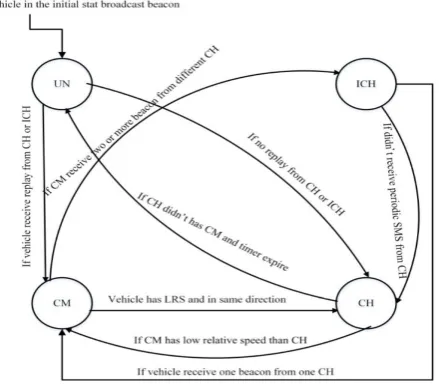
d) Intelligent-Cluster-Head (ICH) state: When CM received two or more beacon messages from different CHs, it sent the messages to inform about the direction and speed of other CHs. If the CH sent a reply, the CM changed its state to ICH. Fig.1 shows the block diagram of the transition state.
Ref Method name Cluster formation Metric to elect CH Cluster merge Scenario Outcome
[4] Hybrid clustering algorithm Leadership form cluster Low Relative velocity from leadership Based on the specific time Urban Stability
[7] dynamic mobility-based and stability-based clustering scheme
Formed cluster dynamically
The vehicle in the centric was elected as
CH Relative distance urban Stability
[9] Clustering Algorithm New Stability Based (SBCA)
Formed cluster based on the distance between
nodes
Elected CH based on minimum difference
of speed
Didn't use the merge
mechanism freeway stability
[11] new clustering technique Formed cluster based on vehicles in the same
direction Low relative speed
Low relative
speed highway
Reduction of CH change, increased
CH lifetime
[12] new clustering algorithm Formed cluster based on relative position and
mobility (RPM) Low relative mobility
Threshold Distance and
direction City
Increase cluster stability and cluster
lifetime
Fig. 1. Block diagram for transition stat
B. The new method for clustering:
The vehicle in the UN state broadcasted a message that contained its speed, direction, unique ID and its location to the neighbour’s vehicles. This broadcast message means that the vehicle wanted to join the network and asked for the permission to join. After broadcasting the message, the vehicles set the timer and waited for the response from CH or ICH. Once the reply had been received, the vehicles changed its states to CM. CH checked the new CM’s relative speed. If one of those CM has the less relative speed to the neighbors vehicles than CH, the CH announce this new CM as the new CH to all its CMs by sending unique ID of new CM to all CM and ICH. The old CH also sent all information that was related in this cluster information about the number of CM and the number of ICH. The data was sent to the BS to inform about the new CH. This was to allow the new CH to communicate directly with the BS without the need to identify itself. The previous CH changed its state to CM, and reformat the cluster again based on the relative speed of the new CM which had a low relative speed.
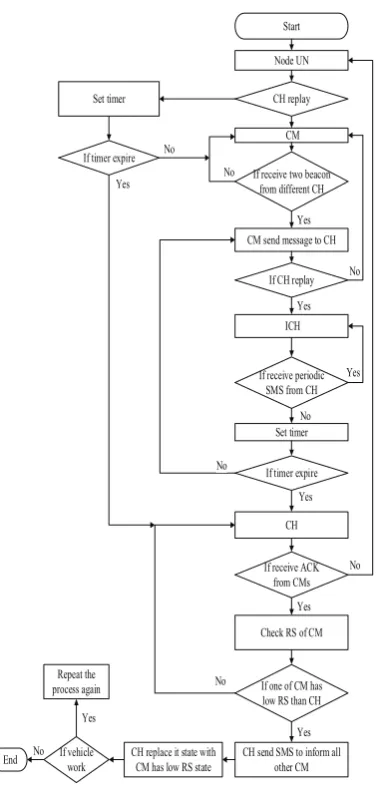
However, if the vehicles in UN did not receive reply messages from CH or ICH, the vehicles in (UN) set the timer, if the timer expire. It assumed there was no CH or ICH in its coverage area, then changed its state to CH in order to be able to be in contact with BS. This was because only CH could communicate with the BS. If a vehicle that in the UN became CH, broadcast beacon to its neighbour’s vehicles to inform them about it and set the timer. If the timer expired and there is no CM join with it, change its state to UN and repeats the process again. However, if the vehicle had followers, it would work as CH. An UN vehicle would be CM if it received two or more beacon messages from different CHs. It then sent the message to its CH and waited for a response. Once it received the response from CH it changed its state to ICH. This ICH had specific permission from CH about moving the connection between CHs in order to reduce the number of connections on the BS by relying on the Receiving Single Strength (RSS). We will explain this process in the next section. Fig. 1 shows a block diagram about this new method and Fig. 2 shows a flowchart of the new method for clustering.
The vehicle in the UN state broadcast message this message has its speed, direction, unique ID and its location to the neighbour’s vehicles. This broadcast message means the vehicle want to join the network and want permission to join. Vehicles after broadcast message set the timer to wait for the response from CH or ICH. If receives the reply, vehicles changes its states to CM. CH check the new CMs relative speed. If one of those CM has less relative speed to the neighbors vehicles than CH, the CH announce this new CM as the new CH to all its CMs by sending unique ID of new CM to all CM and ICH. The old CH also send all information related in this cluster (information about a number of CM and number of ICH, data that will send to BS and also inform BS about new CH to allow new CH to communicate directly with BS without the need to identify itself). In previous CH change its state to CM, and reformation cluster again based on the relative speed of new CM that has low relative speed. However, if vehicles in UN do not received replay message from CH or ICH, the vehicle in (UN) set the timer, if the timer expire. It assumed there are no CH or ICH in its coverage area, then change its state to CH to be able to contact with BS. This is because only CH can communicate with BS. If a vehicle that in the UN be CH broadcast beacon to its neighbour’s vehicles to inform them about it and set the timer if the timer expired and there is no CM join with it, it change its state to UN and repeats the process again. But if vehicle has followers it will work as CH. When UN vehicle be CM if it receives two or more beacon messages from different CH, it sends the message to its CH and waits for a response. If it received the response from CH it changes its state to ICH. This ICH has specific permission from CH about moving the connection from CH to another to reduce the number of connection on the BS by depending on Receiving Single Strength (RSS). We will explain this process in the next section. Fig. 1. shows a block diagram about this new method and Fig. 2 shows a flowchart of the new method for clustering.
C. Load Balance at Base Station
The main problem in this study was the load on the Base Station (BS) caused by the number of connections. It is known that when vehicles moved in VANETs, the vehicles were able to communicate with the BS directly as CH or indirectly as CM. Therefore, the huge number of vehicles in the city caused the huge number of connections at the BS and this led to more packet dropping. Not just that, when the number of connections at the BS exceeded the threshold, this caused the loss of communication between CH and BS. As it is known, each CH had several CMs and this means that more important information about CMs was lost due to many connections at the BS. Therefore, this study used a new method to reduce the huge number of connection on the BS.
Start
Node UN
CH replay
CM
If receive two beacon from different CH
Yes CM send message to CH
If CH replay Yes ICH
If receive periodic SMS from CH
No Set timer
If timer expire
CH
If receive ACK from CMs
Yes Check RS of CM
If one of CM has low RS than CH
Yes CH send SMS to inform all
other CM CH replace it state with
CM has low RS state
No
No No
No
Yes No
Set timer
If timer expire No Yes
Yes
If vehicle work
Yes Repeat the process again
[image:4.595.99.289.48.448.2]No End
Fig. 2. Flowchart of the new method for clustering
When vehicle become ICH it measure the Receive Signal Strength (RSS) of the CHs that within its coverage area from the beacon that CHs broadcast periodically and it knows who’s has highest RSS. ICH sent verification messages (VM) to all CHs in the ICH coverage area. These VMs contained the IDs of the CHs with the highest RSS. When the CHs received these VMs they checked the IDs that were in the VMs. The CH own this ID change its state from CH to main-CH (MCH) while other CH changes them state to Secondary-Cluster-Head (SCH) and send the confirmation message to ICH. ICH sent this confirmation message to MCH. After that, SCH sent its cluster information to MCH during ICH and MCH sent this information to BS. Based on this method, the number of connections at the BS was reduced. Instead of all CHs in the same coverage area sent the information to BS, only MCH sent the information to BS and other CHs sent the information to the MCH. At the same time, MCH broadcasted periodic messages to inform SCH about the information that was sent to BS and to inform SCH about its RSS. SCH also sent its RSS in each reply. If SCH did not receive the periodic message from MCH, the SCH set a timer. If the timer expired and there was no message received from MCH, the SCH assumed the loss of
connection with MCH and changed its state to CH and returned the contact with BS. If one of the SCH had the highest RSS during the periodic message broadcast between MCH and SCH, the SCH directly changed its state to MCH and the previous MCH directly changed its state to SCH. At the same time all other SCHs directly followed the new MCH without needing any permission from the previous MCH because each CH that was connected during ICH had all the information of other CHs. Furthermore, the CHs were already connected and thus, no permission was needed in order to reconnect. The process continually in this direction. In this method, it reduced the huge number of connections at the BS and at the same time, reduced the number of packet dropping because logically vehicles move from coverage area of BS to another coverage area of another BS. Therefore, the area between two BSs had weak RSS. As a result, similar to previous methods that have been explained in the related work, more packets drop would happen. No one has studied the effect of low RSS between BSs. However, if this new method is used, the number of packets drop would be reduced because the CH between the two BS coverage has weak RSS. Instead of using this weak RSS to send information to the BS which increases the probability of collision and packet dropping, the CH sends its information to other CH that has higher RSS during ICH. CH with the highest RSS sends this information to the BS
IV. SIMULATION AND RESULTS
The evaluations of the algorithms were done based on numerous scenarios through extensive simulations. The real-time dataset used in this paper was collected by the prototype (Arduino + GPS with antenna). MATLAB was used to perform the simulations for the proposed algorithms. The symbols and parameters used in this study are listed in Table II and Table III, respectively. The simulation environment was set with the same parameters for all algorithms, in order to compare the performance of the proposed algorithm with different methods.
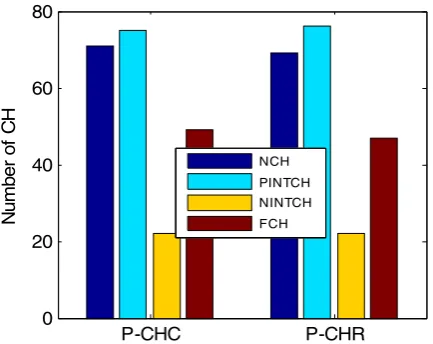
in the last two rows, the number of CH had further reduced compared to the previous method. Therefore, the stability of network had increased and the load at the base station had decreased because the number of uplinks depended on the number of CH. Other than that, the novel intelligent cluster head (ICH) was proposed for more stability and load balance at the BS (See Fig. 4.).
0 20 40 60 80 100 120
T
h
e
Nu
m
b
e
r o
f CH
[image:5.595.49.267.143.304.2]CH-CONN CH-INTR CH-Speed CH-C CH-R
Fig. 3. Comparison of different methods with the proposed algorithm without ICH in terms of the number of CH
P-CHC P-CHR
0 20 40 60 80
N
um
b
er of
C
H
NCH
PINTCH NINTCH
[image:5.595.309.548.161.310.2]FCH
Fig. 4. P-CHC vs P-CHR proposed algorithms based on ICH in terms of the number of CH
0 20 40 60 80 100 120
th
e num
ber o
f
C
H
P-CHC
P-CHR CH-CONN
[image:5.595.316.540.320.410.2]CH-Speed
Fig. 5. Comparison of different methods with the proposed algorithm based on ICH in terms of the number of CH
From Fig. 5, it is clear that the number of CH reduced from 71 to 49 in CH_C and 47 in CH_R method. This means that the final cluster head (FCH) for 575 vehicles was 49 cluster by using (ICH), Based on the comparison between FCH in the proposed method and FCH in the previous method, it was found that the number of CH in the proposed method appeared to be 53.92% less than the previous method.
TABLE II. LIST OF SYMBOLS
TABLE III. SIMULATION PARAMETERS
V. CONCLUSION
In this paper, we introduced the new method for clustering formation and elected stable cluster head (CH), by using intelligent cluster head (ICH). Then we developed the work of (ICH) to solve the main problem in the uplink connection at the Base Station (BS) that provided the outcome from the number of connection of CH. The proposed method produced stable cluster by electing CH based on the most important parameters that had the highest impact on the cluster stability. P-CHR and P-CHC were the proposed methods that used ICH to solve the problem of uplink connection at the base station and also solved the problem of packet dropping between the two base stations because of the weak Receive Signal Strength (RSS) due to the interference frequency’s from the base stations. Future work concerns deeper analysis of the work of ICH Mathematically.
ACKNOWLEDGMENT
This research was funded by the Ministry of Higher Education Malaysia under Fundamental Research Grant Scheme Vot No. 1627 and partially sponsored by Universiti Tun Hussein Onn Malaysia.
REFERENCES
[1] S. Al-Sultan, M. M. Al-Doori, A. H. Al-Bayatti, and H. Zedan, “A comprehensive survey on vehicular ad hoc network,” J. Netw. Comput. Appl., vol. 37, pp. 380–392, 2014.
Parameters Values Transmission range 300 m
Maximum speed 0-110 km/h Number of vehicles 835
Area of study Malaysia Johor Batu Pahat city
Road length 10 km
Number of intersection 6
Data of simulation Collecting real-data of Batu-Pahat Symbol Description
NCH Number of CH
PINTCH Number of proposed intelligent CH NINTCH Number of intelligent CH FCH Final cluster head
CH-CONN Elect CH based on the highest number of connection(HNC)
CH-Speed Elect CH based on low relative speed(LRS) CH-INTR Elect CH based on highest number
interconnect(HNI)
[image:5.595.51.268.355.527.2] [image:5.595.56.263.584.720.2][2] G. Karagiannis et al., “Vehicular networking: A survey and tutorial on requirements, architectures, challenges, standards and solutions,” IEEE Commun. Surv. tutorials, vol. 13, no. 4, pp. 584– 616, 2011.
[3] H. S. Basheer, C. Bassil, and B. Chebaro, “A Framework for Disseminating Trusted Safety Message in V2V Communication,” in Advanced Information Networking and Applications Workshops (WAINA), 2016 30th International Conference on, 2016, pp. 518–525.
[4] J. P. Singh and R. S. Bali, “A hybrid backbone based clustering algorithm for vehicular ad-hoc networks,” Procedia Comput. Sci., vol. 46, pp. 1005–1013, 2015.
[5] M. Aissa, A. Belghith, and B. Bouhdid, “Cluster connectivity assurance metrics in vehicular ad hoc networks,” Procedia Comput. Sci., vol. 52, pp. 294– 301, 2015.
[6] P. K. Dhugga, M. Sharma, and A. Sharma, “An Algorithm for Static Geographical clustering in VANET,” in MOOCs, Innovation and Technology in Education (MITE), 2015 IEEE 3rd International Conference on, 2015, pp. 420–426.
[7] M. Ren, L. Khoukhi, H. Labiod, J. Zhang, and V. Vèque, “A mobility-based scheme for dynamic clustering in vehicular ad-hoc networks (VANETs),” Veh. Commun., vol. 9, pp. 233–241, 2017.
[8] H. Su and X. Zhang, “Clustering-based
multichannel MAC protocols for QoS provisionings over vehicular ad hoc networks,” IEEE Trans. Veh. Technol., vol. 56, no. 6, pp. 3309–3323, 2007. [9] A. Ahizoune and A. Hafid, “A new stability based
clustering algorithm (SBCA) for VANETs,” in Local Computer Networks Workshops (LCN Workshops), 2012 IEEE 37th Conference on, 2012, pp. 843–847.
[10] M. Bhaumik, S. DasGupta, and S. Saha, “Affinity based clustering routing protocol for vehicular ad hoc networks,” Procedia Eng., vol. 38, pp. 673–679, 2012.
[11] Z. Y. Rawashdeh and S. M. Mahmud, “A novel algorithm to form stable clusters in vehicular ad hoc networks on highways,” EURASIP J. Wirel. Commun. Netw., vol. 2012, no. 1, p. 15, 2012. [12] S.-C. Lo, Y.-J. Lin, and J.-S. Gao, “A multi-head
clustering algorithm in vehicular ad hoc networks,” Int. J. Comput. Theory Eng., vol. 5, no. 2, p. 242-247, 2013.
[13] L. Zhang and H. El-Sayed, “A novel cluster-based protocol for topology discovery in vehicular ad hoc network,” Procedia Comput. Sci., vol. 10, pp. 525– 534, 2012.