nD modelling: Industry uptake
considerations
Lee, A and Sexton, MG
http://dx.doi.org/10.1108/14714170710754768
Title
nD modelling: Industry uptake considerations
Authors
Lee, A and Sexton, MG
Type
Article
URL
This version is available at: http://usir.salford.ac.uk/635/
Published Date
2007
USIR is a digital collection of the research output of the University of Salford. Where copyright
permits, full text material held in the repository is made freely available online and can be read,
downloaded and copied for noncommercial private study or research purposes. Please check the
manuscript for any further copyright restrictions.
nD modelling: industry uptake considerations
A. Lee & M. G. Sexton
Research Institute for the Built & Human Environment, University of Salford, UK
Case study
Purpose
nD modelling technology ushers in novel possibilities to transform the design, production and
use of buildings by providing a ‘… multi-dimensional model … [which] … enables true what-if
analyses to be performed to demonstrate the real cost in terms of the design issues … [and] …
the trade-offs between the parameters … clearly envisaged’ (Lee, et al., 2003: 5). The espoused
benefits of a new technology such as nD modelling, however, are not sufficient in itself to
ensure its widespread adoption and use within the construction industry. Technology transfer is
widely considered to be a potentially powerful mechanism to provide the construction industry
with new technologies that can, where appropriate, transform and complement current
technologies to create and sustain better levels of performance (DTI, 2002; Mitropoulos and
Tatum, 1999; DETR, 1998). This paper aims to identify the key enablers and obstacles to the
effective adoption and use of nD modelling technology.
Methodology/ approach
This paper explores the feasibility of industry absorbing and diffusing nD modelling technology
by considering key technology transfer issues; namely organisational direction,
semi-structured interviews around a diagnostic technology transfer framework are used to offer
implications for theory and practice.
Findings
The results from 15 survey interviews indicate that construction professionals appreciate the
potential significant benefits of nD modelling technology, but at present, nD modelling
technology is seen as too embryonic; too far removed from construction firms’ ‘comfort zones’;
requiring too much investment; and, containing too many risks.
Practical implications
The paper concludes that the challenge for nD modelling technology, along with any new
technology, is to shift from its ‘technology push’ emphasis to a more balanced ‘market
orientated’ stance which allows the technology to be shaped by both strategic design concerns,
and the rough and tumble of day-to-day operational needs. If this trajectory is pursued, nD
modelling technology has a positive future.
Keywords: nD modelling, technology transfer, building information model, innovation, IT
(information technology)
Introduction
A construction project team is characterised by many professionals from various disciplines.
The central ambition for this team is to satisfy all stakeholder requirements in order to generate
construction team imposed by the number and variety of social, economic and legislative
factors; different epistemological perspectives and methods; and, the personal requirements and
agendas of the various stakeholder groups. Thus, one of the main challenges facing the
construction project team is how to improve the efficiency and effectiveness of the integrated
design and construction process. Moreover, can a more effective use of information technology
(IT) achieve this? A concept that has recently been proposed as a solution to solve the ills of
co-ordination, communication and reconciliation of diverse stakeholder requirements is nD
modelling.
An nD model is an extension of the building information model, which incorporates
multi-aspects of design information required at each stage of the lifecycle of a building facility (Lee et
al, 2003). nD is unlike traditional 2D and 3D CAD (computer aided design) systems where the
building design is represented in multiple files made up of lines, arcs and circles, and the
building information is contained within several document formats such as spreadsheets and
word processing files. An nD database is constructed with intelligent ‘objects’ which represent
building elements, such as walls, doors and windows. From this central database, different
views of the information can be generated automatically; views that correspond to traditional
design documents; for example, plans, sections, elevations and schedules. As the documents are
derived from the same central database, they are all coordinated and accurate – any design
changes made in the central model will be automatically reflected in the resultant drawings,
ensuring a complete and consistent set of documentation (Graphisoft, 2003).
This paper explores the feasibility of industry absorbing and diffusing the nD modelling
technology by considering key technology transfer issues. Technology transfer is widely
new technologies that can, where appropriate, transform and complement current technologies
to create and sustain better levels of performance (DTI, 2002; Mitropoulos and Tatum, 1999;
DETR, 1998). Commentators, however, have noted that the construction sector often lags
behind other industries in technology adoption (for example, see Sexton & Barrett, 2004;
Fairclough, 2003; Sauer, et al., 1999). We understand effective technology transfer as being the
‘movement of know-how, technical knowledge, or technology from one organizational setting
to another’ (Roessner in Bozeman, 2000, p. 629). This ‘movement’ is driven by a combination
of actors’ unique needs (Klien and Crandell, 1991) and tacit knowledge (Teece, 1977; Howells,
1996). The barriers to the diffusion of new construction technologies are reinforced by, among
other issues, lack of information for relevant construction actors regarding technologies’
characteristics and appropriate uses (Sexton & Barrett, 2004; NAHB, 2001; Anumba, 1998).
Within this context, the paper is structured as follows. First, the nD modelling concept is further
developed. Second, a diagnostic technology transfer framework is presented and supported by a
review and synthesis of the relevant literature. Third, the relevant aims and methodology of a
three year funded research project are articulated. Further, research findings are structured and
analysed using the technology transfer framework. Finally, conclusions are drawn, and
implications for theory and practice offered.
nD modelling demystified
2D and 3D modelling in the construction industry takes its precedence from the laws governing
the positioning and dimensions of a point or object in physics whereby a three number vector
common attribute of many architectural, engineering and construction design packages, such as
3D Studio Max (AutoDesk, 2005) and ArchiCAD (Graphisoft, 2005), which enable the
simulation of design options.
Combining time sequencing in visual environments with the 3D geometric model (x, y, z) is
commonly referred to as 4D CAD (Rischmoller et al, 2000). Using 4D CAD, the processes of
construction can be demonstrated before any real construction activities occur (Kunz et al,
2002). This will aid users to find the possible mistakes and conflicts at the early stage of design,
and to predict the production schedule. Research projects around the world have taken the 4D
concept and developed it further (for example, see Dawood et al, 2002, Kunz et al, 2002).
Commercial 4D packages are also available, such as 4D Simulation from VirtualStep, Schedule
Simulator from Bentley, and 4D CAD System from JGC Corporation (Emerging Construction
Technologies, 2005).
nD modelling builds upon the concept of 4D modelling and aims to integrate an nth number of
design dimensions into a holistic model, which would enable users to construct and visually
project the building design over its complete lifecycle. nD modelling is based upon the building
information model (BIM), a concept first introduced in the 1970s and the basis of considerable
research in construction IT (information technology) ever since. The idea evolved with the
introduction of object oriented CAD; the ‘objects’ in these CAD systems (e.g. doors, walls,
windows, roofs) can also store non-graphical data about the building in a logical structure. The
BIM is a repository that stores all the data ‘objects’ with each object being described only once.
Both graphical and non-graphical documents, such as drawings and specifications, schedules
and other data respectively, are included. Changes to each item are made in only one place and
documentation in this way, communication problems that slow down projects and increase costs
can be greatly reduced (Cyon Research, 2003).
Leading CAD vendors such as AutoDesk, Bentley and Graphisoft have promoted BIM heavily
with their own BIM solutions and demonstrated the benefits of the concept (Lee et al, 2002).
However, as these solutions are based on different, non-compatible standards, an open and
neutral data format is required to ensure data compatibility across the different applications.
Industry Foundation Classes (IFC), developed by the International Alliance for Interoperability,
provides such capabilities. IFCs provide a set of rules and protocols that determine how the data
representing the building in the model are defined and the agreed specification of classes of
components enables the development of a common language for construction. IFC-based
objects allow project models to be shared whilst allowing each profession to define its own
view of the objects contained in that model. This leads to improved efficiency in cost
estimating, building services design, construction, and facilities management (FM). IFCs enable
interoperability between the various AEC/ FM software applications allowing software
developers to use IFCs to create applications that use universal objects based on the IFC
specification. Furthermore, this shared data can continue to evolve after the design phase and
throughout the construction and occupation of the building.
The 3D to nD research project at the University of Salford developed a holistic nD modelling
tool using IFCs, to help improve the decision-making process and construction performance by
enabling true ‘what-if’ analysis to be performed to demonstrate the real cost in terms of the
modelling project developed a tool to incorporate 5 design perspectives in order to systemically
assess and compare the strengths and weaknesses of different design scenarios; namely:
• Determine cost options
• Maximise sustainability
• Examine people’s accessibility
• Incorporate crime deterrent features
• Analyse the building’s acoustics
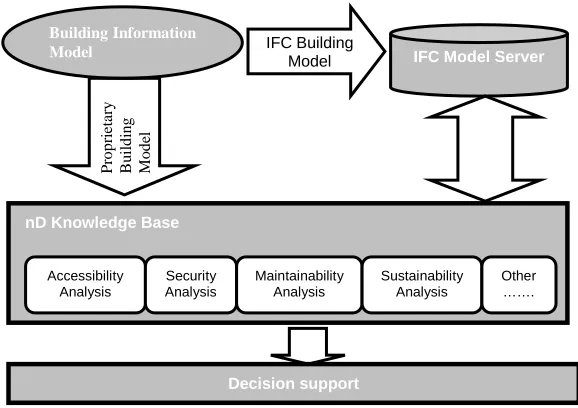
The system architecture, depicted in Figure 1, consists of two primary components:
• An nD knowledge base platform that provides analysis functionality of design
information related to the various design perspective constraints of the nD modelling.
Figure 2, for example, shows a screenshot of accessibility analysis.
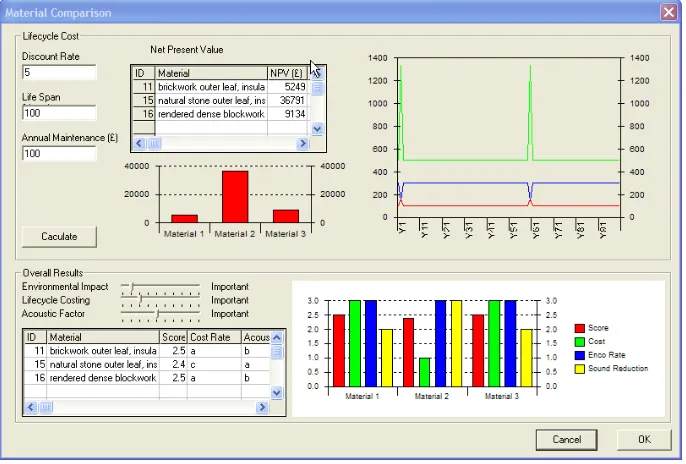
• A decision support system employing a multi-criteria Analytic Hierarchy Process
(AHP) which supports a combined assessment of qualitative criteria and quantitative
criteria. Figure 3 provides a screenshot of the AHP technique for determining suitable
building materials in accordance with prescribed lifecycle costing, acoustic and
Figure 1: System architecture of the nD modelling prototype tool
Figure 2: Screenshot of nD prototype tool, displaying accessibility analysis Building Information
Model IFC Building
Model IFC Model Server
nD Knowledge Base
[image:9.612.184.446.326.591.2]Figure 3: Screenshot of the AHP functionality of nD prototype tool
A full description of the nD tool can be found in Lee et al (2003). The discussion so far has
presented the nD tool and its perceived benefits. The normative benefits, however, does not
automatically equate to its actual adoption and use in industry. To gain a better understanding
of the drivers and barriers to adoption, an appreciation of technology transfer issues is required.
The ‘technology transfer system’ model
Performance improvement based on construction research and innovation absorbed into
companies through technology transfer, can and does, occur successfully. However, present
construction industry technology transfer endeavours are being severely hampered by a lack of
capabilities and processes, and the knowledge characteristics of the technologies being
transferred:
• First, current approaches tend to view technology transfer as a mechanistic
‘pick-and-mix’ exercise – identifying new technologies, and trying to insert them in their existing
form into (unsurprisingly) unreceptive construction companies (Barrett and Sexton,
1999).
• Second, current technology transfer mechanisms are not sufficiently informed by, or
engaged with, company strategic direction and organisational capabilities and
processes necessary to enable them to absorb technologies and to turn them into
appropriate innovations. Experience from the manufacturing sector, for example, has
stressed that the capacity of companies to understand and effectively use new
technologies from external sources is heavily influenced by the level of prior-related
knowledge and expertise (for example, see Adler and Shenhar, 1993).
• Finally, current technology transfer mechanisms do not fully appreciate that both the
ability and motivation for companies to absorb and use new technology is significantly
influenced by the knowledge characteristics of the technology. Grant and Gregory
(1997), for example, concluded from an investigation of manufacturing technology
transfer that the extent of the required tacit knowledge to absorb and use
manufacturing technology had a significant impact on the success of the transfer.
‘Hard’ technologies which are characterised by explicit knowledge require very
different diffusion mechanisms and organisational capabilities and processes than
The interactive nature of these elements stresses the systemic nature of technology transfer, and
can be fruitfully viewed as a ‘technology transfer system’ made up of inter-organisational
networks, organisational direction and capability, and knowledge characteristics of technology.
This more fluid, dynamic view of technology transfer is consistent with the move away from
traditional, sequential models of innovation and technology transfer (Van de Ven, et al., 1999).
This position reconceptualises the technology transfer phenomenon from a simple cumulative
sequence of stages or phases, to multiple progression of divergent, parallel and convergent
paths, some of which are related and cumulative, and others not. The argument is that
technology transfer will only be effective if all three elements are appropriately focussed and
integrated to achieve a specific aim. The three elements of the ‘technology transfer system’ will
are discussed in more detail below.
Organisational direction and capability
The motivation and ability of companies to absorb and innovate from new technologies has to
come from within the company: through envisioning technology strategies and supporting
organisational capabilities. Technology is a crucial strategic variable in creating
competitiveness; indeed, the connection between technology and corporate strategy is
confirmed as ‘increasingly managers have discovered that technology and strategy are
inseparable’ (Kantrow, 1980: 4). The technology strategy of a company should address the
issues of acquiring, managing and exploiting technologies which progress corporate aspirations
(Clarke, et al., 1989). An appropriate focus for a company’s technology strategy can be usefully
considered as the generation of a balanced portfolio of enabling, critical and strategic
technologies. Enabling technologies are classified as those technologies which are necessary at
construction industry. Critical technologies are viewed as those technologies which are unique
to the company, and which give the company a differentiated technology over its existing and
potential competitors. The acquisition and exploitation of enabling and critical technologies are
in the domain of the company’s short- to medium- term technology strategy. Strategic
technologies are those technological trajectories pursued by a company that they anticipate
(through technological and market forecasting) to become the critical technologies of the future.
Strategic technologies, by their intrinsic nature, are in the domain of the company’s long-term
technology strategy.
The motivation and capacity of firms to innovate and to absorb and use new technology are
very much shaped by general business and project environments. Research in innovation in
small construction companies, for example, concludes that there are two principal modes of
innovation: mode 1 and mode 2 (Sexton and Barrett, 2003). Mode 1 innovation focuses on
progressing single project, cost-orientated relationships between the client and the firm – this
mode of innovation is more driven by rapid change and uncertainty in the interaction
environment. (The interaction environment is that part of the business environment which firms
can interact with and influence.) Mode 2 innovation concentrates on progressing multiple
project, value-orientated relationships between client and the firm – this mode of innovation is
more aligned to improving the effectiveness of a firm’s relationship with its clients. The mode
of innovation is substantially determined by the nature of the interaction environment: an
enabling interaction environment encourages Mode 2 innovation; and a constraining
environment is conducive to Mode 1 innovation. An enabling interaction environment is one
small construction firm can only influence to a limited extent, constraining the firm to
innovation activity undertaken within a shorter and more insecure context.
Coupled with strategic direction and business context, companies need the organisational
capability to absorb and use new technology. This capability is influenced by the level of
prior-related knowledge and expertise (i.e. basic skills, shared language, technological acumen) that
exist in the organisation (Cohen and Levinthal, 1990). Thus, it is clear that organisations will
not be able to accomplish many of their key strategic and operational goals for technology
transfer without adequate complementary capabilities (for example, see Bröchner, et al., 2004;
Adler and Shenhar, 1993).
Inter-organisational networks
Companies do not operate in a vacuum; rather, they are situated in a number of fluctuating
inter-organisational networks of varying complexity (Bresnen and Marshall, 2000a, 2000b,
2000c; Betts and Wood-Harper, 1994). Inter-organisational networks promote and facilitate the
development and exchange of knowledge and resources needed to encourage learning and
innovation in participating companies (for example, see Barlow and Jashapara, 1998; Ebers,
1997; Grandori and Soda, 1995). Indeed, it has been argued that the greater the number of
inter-organisational networks that a company is involved in, the greater the likelihood of generating
and supporting successful innovation (for example, see Ahuja, 2000; Porter, 1990).
There are two main types of inter-organisational network. First, companies are exposed to
‘business networks’ through their normal client and supply chain interaction. These networks
and resources (Hauschlidt, 1992). Indeed, the knowledge necessary for innovation processes is
often created at the interfaces of business network technology transfer. The innovation process
is therefore in part a knowledge and technology mobilisation process, based on intensive social
and economic interaction processes (Hakansson, 1987). Second, companies are embedded, to
vary degrees, in ‘institutional networks’, such as educational institutions, government bodies,
research institutions and professional associations. Such networks are also potentially useful in
providing companies with the knowledge and expertise needed for innovation (for example, see
Abbott, et al., 2004; Hauschlidt, 1992). Professional associations, for example, disseminate a
particular body of knowledge to industry via their members, and thus act as vehicles for the
diffusion and translation of knowledge needed for innovation (Constrinnonet, 2004; Allen,
1977).
Knowledge characteristics of technology
Technology is not transferred as a self-contained artefact; rather, for success, the technology
and the knowledge of its use and application must be transferred (for example, see Sahal, 1981).
The extent to which new technology can be effectively absorbed by construction companies is
thus substantially influenced by the knowledge characteristics of the technology being
transferred. Two characteristics are especially important. The first is the extent to which the
knowledge embodied in the technology is explicit or tacit. Tacit knowledge is hard to formalise,
making it difficult to communicate or share with others. Tacit knowledge involves intangible
factors embedded in personal beliefs, experiences and values. Explicit knowledge is systematic
explicit or tacit knowledge, some technologies are just more complex than others. The more
complex a technology, the more difficult it is to unravel (for example, see Gibson and Smilor,
1991).
In summary, the knowledge conversion concept argues that technology transfer is a social
process of interactive learning within and between inter-organisational networks, from which a
shared language of tacit and explicit knowledge can be developed.
Research methodology
The aim of the 3D to nD modelling project was not only to develop a prototype tool, but also to
exploit the technology and evaluate potential industry adoption by addressing technology
transfer issues. This paper concentrates on the latter objective by investigating the drivers and
barriers to industry adoption.
The research methodology was designed to develop a greater understanding of the absorption
and use of nD modelling in construction companies. The primary data was from fifteen
semi-structured interviews with key staff from eleven construction companies comprising of
architects, contractors, specialist consultants and engineers. The organisations were selected at
random from participants of a construction IT seminar held by the University of Salford; all
were SMEs and their involvement/ understanding of BIM varied from none/ little to a great
awareness – 6 of the survey organisations were primarily working with 2D drawings, 7 of the
survey organisations were working with 3D drawings, and the remaining 2 organisations were
utilising 3D models (although these were not BIM models). The survey organisations were
aware of nD technology. In this way, the results were thought to demonstrate the views of the
majority of the industry as opposed to large organisations whom are usually considered to be IT
innovators/ adopters. In each case, the researcher visited the organisation and demonstrated the
nD tool to a number of staff within a workshop environment. The participants were then free to
discuss and utilise the tool at their leisure. The researcher returned to the organisation several
days later to conduct the evaluative semi-structured interview.
A semi-structured interview approach was taken for the data collection to provide both the
stability to follow a predetermined route of enquiry, and the flexibility to probe further where
the interviewee felt that supplementary information was valuable to bring new insights into the
discussion, or to amplify answers in response to preset questions.
The semi-structured interview was shaped by the questions: what are the benefits of the
technology: who would use the technology? where would they use the technology? and when in
the design process would the nD modelling technology be used? The results are structured
around the context of the technology transfer system, as previously described.
Results and analysis
Organisational direction
having potential to ‘improve upon the exchange of construction information,’ with the benefit
being articulated by another architect as being ‘the idea that the drawing is only ever produced
once, and so mistakes made by copying the drawing is only ever produced once – this can
happen with the mechanical and electrical engineers at times.’ This potential benefit was
conveyed by the contractors, with one commenting that ‘nD seems to be a great prospect,
especially if contractors can be involved in the design process. The design plans and elevations
may be checked and checked, but there will always be problems with it. It is human nature that
mistakes is made. We as contractors only find all of these mistakes once the building has been
built. If there can be a checking mechanism, and a way in which we can get involved and see
the designs first, I think problems will be minimised.’
The risk dimension, however, was stressed by both the contractors and the architects, with
concern that nD modelling technology needed to be demonstrably proven to offer greater added
value, compared to existing arrangements, before firms would be sufficiently motivated to
adopt and use it. This view was captured in the argument that ‘change takes time and costs a lot
of money, so you would need to demonstrate the benefits of nD in terms of time, cost and
quality before it would be widely adopted.’ This generic view of risk was brought to life by an
architect who asked, ‘Who will own the drawings? How will risk be assigned? How does this
impact upon professional indemnity? Unless the whole structure and legal system of the
industry is changed, I cannot see how nD can be implemented soon.’
This position was reinforced by the view that the incumbent ways of working were widely
understood and appreciated and that, according to one architect, ‘we have a document
and we, as a company, are happy with this. I think document management systems are more
aligned to the way a construction project team works than the nD tool.’
Inter-organisational networks
There was consensus across the contractor and architect interviewees that the nD modelling tool
needed to be appropriately integrated and mobilised through the supply chain if it was to
generate the sustained impact to encourage widespread adoption and diffusion. The architects
interviewed argued that the principal role of the nD modelling tool was in the design phase,
with involvement from a number of project actors: ‘this tool can only be used during the
detailed design stage. It is during the early design stage where the architect experiments with
the design of the building, and nothing should interrupt that process. Besides, the tool would be
more useful to check conformity of regulations after the engineers have started to add to the
design. We as architects are clear about regulations, and usually our designs conform to the
majority of the regulations. It is when other engineers start to move things in the drawing
around, and someone else wants to move something somewhere else, do things get complicated.
Actually, in this instance I think the tool would really benefit our work.’
The need for project supply chains as a whole to adopt the technology was stressed, with one
contractor articulating that, ‘the tool will only be successful if everyone in the project supports
and fully adopts it. It can only really work if it was an online tool, so that everyone could access
the latest version of the model. I think that the client should own the design, as at the end of the
Knowledge characteristics of the nD modelling technology
The nD modelling tool’s human computer interface was seen as important, with a contractor
remarking that ‘the tool seems to be user friendly and pretty self-explanatory.’ The need for
compatibility with existing design packages was noted, with one architect observing that: ‘we
can still use our own design packages and do not have to learn new ones. This is a great
advantage and must not be overlooked. Architects really have to be specialists on a particular
design package. If a new package is used, drawings take a lot longer which costs more money
to us, and there is more chance of mistakes being made. And this is a bigger problem if you
have to use another design package on another project – this can be very costly.’
In addition, the need for potential adopters to experiment with the new technology was noted.
One architect, for example, emphasised that ‘I need to have the opportunity to play about with
the tool on my own, that is when you can assess how practical something is.’ The theme of
‘getting to know the technology’ was continued into the required capability development after
adoption, with a contractor remarking that, ‘there needs to be training sessions delivered on the
tool, so that people will adopt it …without training, adoption will be sporadic.’
Discussion/ Conclusions
This paper explores the feasibility of industry absorbing and diffusing nD modelling technology
by considering key technology transfer issues; namely organisational direction,
inter-organisational networks, and knowledge characteristics of technology. The results from 15
survey interviews indicate that construction professionals appreciate the potential significant
who had not previously adopted BIM/ nD modelling technology as to gain a representative
view of potential nD modelling industry uptake. The findings reveal, however, that construction
firms will only be motivated to absorb and use nD technology when the technology is
sufficiently proven that it will contribute to the business in a quick, tangible fashion, and which
can be dovetailed into organisational and technological capabilities they already possess. At
present, nD modelling technology is seen as too embryonic; too far removed from construction
firms’ ‘comfort zones’; requiring too much investment; and, containing too many risks.
The implication for practice is that firms need to incrementally adopt nD modelling in order to
start realising the benefits. Indeed, the full benefits cannot be realised with this partial approach,
in that buy-in from the entire construction project team is required. However, the implication is
that it does not matter too much where a firm starts; the effect of nD modelling is likely to be
widespread provided that a sustained effort is maintained. Thus, a firm can choose to start in an
area that has particular importance for them and about which they can get highly motivated.
The second aspect is the rate at which improvement is achieved. It seems clear that the gains of
introducing nD are accumulated slowly. Those seeking to improve should be realistic and take
an incremental approach that, again, starts somewhere and in due course makes significant
progress, through sustained effort. The common core of the above two aspects is the need to
start somewhere and then to maintain the effort. The initial focus for the improvement, or
indeed the specific initiative used to kick off the process, are both clearly necessary in terms of
gaining the commitment and enthusiasm from those involved, however, they are actually less
sector as a whole. Second, to fund research into the areas of concern highlighted by the
practitioners interviewed for this paper; in particular, e-legal issues related to data ownership.
In conclusion, nD modelling addresses a real need to identify and appropriately reconcile
competing design criteria. The challenge for nD modelling technology, along with any new
technology, is to shift from its ‘technology push’ emphasis to a more balanced ‘market
orientated’ stance which allows the technology to be shaped by both strategic design concerns,
and the rough and tumble of day-to-day operational needs. If this trajectory is pursued, nD
modelling technology has a positive future.
References
Abbott, C., Ong, H.C. and Swan, W. (2004) A regional model for innovation and cultural
change in the construction industry. Proceedings of Clients Driving Innovation International
Conference Surfers Paradise, Australia, 25th – 27th October.
Adachi, Y. (2002) Overview of IFC Model Server Framework. In proceedings of the
International ECPPM conference – eWork and eBusiness in Architecture, Engineering and
Construction, Portoroz, Slovenia.
Adler, P.S. and Shenhar, A. (1993) Adapting your technological base: the organizational
challenge. Sloan Management Review, 32, 25-37.
Ahuja, G. (2000) Collaborative networks, structural holes, and innovation: A longitudinal case
Allen, T.J. (1977) Managing the Flow of Technology, MIT Press, Cambridge, MA.
Alshawi, M. & Ingirige, B. (2003) Web-enabled project management: an emerging paradigm in
construction. Automation in Construction, 12, 349-364.
Alshawi, M., Faraj, I., Aouad, G., Child, T. & Underwood, J. (1999) An IFC Web-based
Collaborative Construction Computer Environment. Invited paper, in proceedings of the
International Construction IT conference, Construction Industry Development Board, Malaysia,
8-33.
Anumba, C.J., (1998) ‘Industry uptake of construction IT innovations – Key elements of a
proactive strategy’, Proceedings of the CIB W78 Conference, Stockholm, Sweden: 3rd – 5th
June.
Aouad, G., Sun, M. & Faraj, I. (2002) Automatic generation of data representations for
construction application. Construction Innovation, 2, 151-165.
AutoDesk (2005
Barlow, J. and Jashapara, A. (1998) Organisational learning and inter-firm partnering in the UK
Innovation in Other Sectors, Construction Research and Innovation Strategy Panel, London,
24th June.
Betts, M. and Wood-Harper, T. (1994) Reengineering construction: a new management
research agenda. Construction Management and Economics, 12, 551-6.
Boyd, D. (2001) e-science centre. Available on-line a
Bozeman, B. (2000) Technology transfer and public policy: a review of research and theory.
Research Policy, 29, 627-55.
Bresnen, M. and Marshall, N. (2000a) Partnering in construction: A critical review of issues,
problems and dilemmas. Construction Management and Economics, 18, 229-237.
Bresnen, M. and Marshall, N. (2000b) Motivation, commitment and the use of incentives in
partnerships and alliances. Construction Management and Economics, 18, 587-598.
Bresnen, M. and Marshall, N. (2000c) Building partnerships: Case studies of client-contractor
collaboration in the UK construction industry. Construction Management and Economics, 18,
819-832.
Bröchner, J., Rosander, S. and Waara, F. (2004) Cross-border post-acquisition knowledge
transfer among construction consultants. Construction Management and Economics, 22,
Buchanan, D.A. and Boddy, D.: 1983, Organizations in the computer age, Gower, Hampshire.
Christiansson, P., Dalto, L., Skjaerbaek, J., Soubra, S. & Marache, M. (2002) Virtual
Environments for the AEC sector: The Divercity experience. In proceedings of the international
ECPPM conference – eWork and eBusiness in Architecture, Engineering and Construction,
Portoroz, Slovenia.
Clarke, K., Ford, D. and Saren, M. (1989) Company technology strategy. R&D Management,
19, 3.
Cohen, W.M. and Levinthal, D.A. (1990) Absorptive capacity: a new perspective on learning
and innovation. Administrative Science Quarterly, 35, 128-52.
Dawood, N., Sriprasert, E., Mallasi, Z. & Hobbs, B. (2002) Development of an integrated
information resource base for 4D/ VR construction processes simulation, Automation in
Construction, 12, 123–131.
Derbyshire, A. & Andrews, J. (1993) Crossing Boundaries. Construction Industry Council,
London.
Drogemuller, R. (2002) CSIRO & CRC-CI IFC Development Projects, ITM Meeting, Tokyo.
Eastman, C., (1999) Building Product Models: Computer Environments Support Design and
Construction, CRC Press LLC, Florida.
Ebers, M., (Ed.) (1997) The Formation of Inter-organisational Networks, Oxford University
Press, Oxford
Egan, J., (1998) Rethinking Construction. Report form the Construction Task Force,
(Department of the Environment, Transport and Regions, 1998).
Emerging Construction Technologies (2005)
Emmerson, H., (1962) Studies of Problems before the Construction Industries, HMSO, London.
Fairclough, J., (2002) Rethinking Construction Innovation and Research: A Review of
Government R & D Policies, DTI: London.
Fischer, M., (2000) Construction Planning and Management using 3D & 4D CAD models,
Construction IT 2000, Sydney, Australia.
Gann, D. and Salter, A. (1999) Interdisciplinary skills for built environment professionals: A
Gibbons, M., Limoges, C., Nowotny, H., Schwartzman, S., Scott, P. & Trow, M. (1994) The
new production of knowledge. Sage, London.
Gibson, D.V. and Smilor, R. (1991), Key variables in technology transfer: A field-study based
empirical analysis. Journal of Engineering and Technology Management, 8, 287-312.
Grandori, A. and Soda, G. (1995) Inter-firm networks: antecedents, mechanism and forms.
Organization Studies, 16, 183-214.
Grant, E.B. and Gregory, M.J. (1997), Tacit knowledge, the life cycle and international
manufacturing transfer. Technology Analysis and Strategic Management, 9, 149-61.
Graphisoft (2003) The Graphisoft Virtual Building: Bridging the Building Information Model
from Concept into Reality. Graphisoft Whitepaper.
Graphisoft (2005)th
Hakansson, H., (Ed.) (1987) Industrial Technological Development: A Network Approach,
Croom Helm, London.
Halfawy, M., Froese, T., (2002) Modeling and Implementation of Smart AEC Objects: An IFC
Perspective, CIB W78 Conference 2002 – Distributing Knowledge in Building, Denmark,
Hauschlidt, J., (1992), ‘External Acquisition of Knowledge for Innovations – A Research
Agenda’, R & D management, 22: 105-110.
Howells, J. (1996) Tacit knowledge, innovation and technology transfer. Technology Analysis
and Strategic Management, 8, 91-106.
Kantrow, A.M. (1980) The strategy-technology connection. Harvard Business Review, 58, 4.
Karola, A., Lahtela, H., Hanninen, R., Hitchcock, R., Chen, Q., Dajka, S., Hagstrom, K., (2002)
BSPro COM-Server – interoperability between software tools using industry foundation
classes, Energy and Building 34 (2002) 901-907.
Khemlani, L., (2002), Architecture CAD: A Look Across the Spectrum, CADENCE,
Kiesler, S., Siegel, J. & McGuire, T.W. (1984) Social pyschological aspects of
computer-mediated communication, American Psychologist, 39, pp1123-34.
Klien, G.A. and Crandall, B. (1991) Finding and using technology-specific expertise. Journal of
Technology Transfer, 16, 23.
Kunz, J., Fischer, M., Haymaker, J., Levitt, R., (2002) Integrated and Automated Project
Processes in Civil Engineering: Experiences of the Centre for Integrated facility Engineering at
Stanford University, Computing in Civil Engineering Proceedings, ASCE, Reston, VA, 96-105,
Latham, M., (1994) Constructing the Team: Joint Review of Procurement and Contractual
Arrangements in the UK Construction Industry. Department of the Environment, HMSO, 1994.
Lee, A, Marshall-Ponting, A., Wu, S., Koh, I., Fu, C., Cooper, R., Betts, M., Kagioglou, M. and
Fischer, M., (2003) Developing a Vision of nD-enabled Construction, University of Salford:
Salford.
Lee, A., Wu, S., Marshall-Ponting, A., Aouad, G., Tah, J. H. M. & Cooper, R. (2005) nD
Modelling – A Driver or Enabler for Construction Improvement? RICS Paper Series, 5(6),
April.
Leibich, L., Wix, J., Forester, J., Qi, Z., (2002) Speeding-up the building plan approval - The
Singapore e-Plan checking project offers automatic plan checking based on IFC, The
international conference of ECPPM 2002 – eWork and eBusiness in Architecture, Engineering
and Construction, Portoroz, Slovenia, 2002.
Leveson, R.K. (2003) Understanding interdisciplinarity as a paradox in construction
professionalism, Proceedings of the CIB W78 Conference - Building Education & Research
(BEAR) vol 2, pp828-839, Salford Quays, Salford, UK, 8-11th April 2003.
ISBN:1-900491-90-7
Mitropoulos, P. and Tatum, C.B. (2002) Technology adoption decisions in construction
organizations. Journal of Construction Engineering and Management, 125, 5, 330-338.
Muir, T. & Rance, B. (1995) Collaborative practice in the built environment. E & FN Spon,
London.
NAHB Research Centre, (2001) Commercialization of Innovations: Lessons Learned, NAHB
Research Centre: Upper Marlborough.
Newell, S. & Swan, J. (2000) Trust and inter-organizational networking. Human Relations, 53
(10), 1287-1328.
Nonaka, I. and Takeuchi, H. (1995) The Knowledge Creating Company: How Japanese
Companies Create the Dynamics of Innovation, Oxford University Press, New York.
Payne, M. (2000) Teamwork in Multiprofessional Care. Palgrave, Basingstoke.
Porter, M. (1990) The Competitive Advantage of Nations, Free Press, New York.
Sahal, D. (1981), Alternative conceptions of technology. Research Policy, 10, 2-24.
Sauer, C., Johnson, K. Karim, K., Marosszeky, M. and Yetton, P., (1999) ‘Reengineering the
supply chain using collaborative technology: Opportunities and barriers to change in the
building and construction industry’, IFIP WG 8.2 New Information Technologies in
International Federation for Information Processing, Kluwer Publishers: University of Missouri,
St. Louis: 21st – 22nd August.
Sexton, M.G. and Barrett, P., (2004) ‘The role of technology transfer in innovation within small
construction firms’, Engineering, Construction and Architectural Management, Vol. 11, No. 5,
pp. 342-348.
Sexton, M.G. and Barrett, P.S. (2003) Appropriate innovation in small construction firms.
Construction Management and Economics, 21 (6) 623-33.
Stahl, J., Luczak, H., Langen, R., Weck, M., Klonaris, P. and Pfeifer, T.: 1997, Concurrent
engineering of work and production systems, European Journal of Operations Research, 100,
379-398.
Stansfield-Smith, C. (1999) Review of architectural education – consultation working
document. RIBA, London.
Stevens, C. (1996) The knowledge-driven economy. OECD Observer, 200, 6-11.
Teece, D. (1977) Technology transfer by multinational firms: The resource cost of transferring
technological know-how. The Economic Journal, 87, 242-61.
Watts, C. (2000) Issues of professionalism in Higher Education, in Nicol, D. & Pilling, S. (eds)
Changing architectural education: towards a new professionalism. E & FN Spon, London.
Yu, K., Froese, T., Grobler, F., (2000) A development framework for data models for