ICTMBE 2013 2nd International Conference on Technology Management , Business and Entrepreneurship
Mahkota Hotel Melaka Malaysia 5th December 2013
ISSBN 978-967-0468-56-3
2013
337
An empirical review on knowledge sharing model: Objective,
practice-based and mixed perspectives
Anim Zalina Azizan, Wan Fauziah Wan Yusoff, Abd Rahman Ahmad
Faculty of Technology Management and Business Universiti Tun Hussein Onn Malaysia
86400 Parit Raja Batu Pahat Johor Malaysia
[email protected], [email protected], [email protected]
Abstract
The purpose of this concept paper is to have a better understand on knowledge sharing literature in general and subsequently will focus on the process and the model of knowledge sharing. Knowledge or knowing is personal, and thus is impossible to totally disembody from people into a fully explicit form. Here, knowledge is culturally surrounded within the organization as it is never totally neutral and unbiased and to some extent; it is inseparable from the values of those who produced it. Learning, face-to-face communication, meetings, forums, knowledge sharing and mentoring systems are examples of socially constructed knowledge intensive organization activities. Since the practices-based epistemology conceptualizes knowledge as embodied in action, which is highly contextual and socially constructed, it is easy to sum-up this terminology into one concept called knowledge sharing. Indeed, knowledge sharing practices are always based on practices, for example, practices of interviewing, practices aimed at building commitment and practices of communication. Finally, knowledge sharing has been allocated in three different perspectives named objectives perspectives, practice-based perspectives and mixed perspectives (the later combining the two former perspectives).
ICTMBE 2013 2nd International Conference on Technology Management , Business and Entrepreneurship
Mahkota Hotel Melaka Malaysia 5th December 2013
ISSBN 978-967-0468-56-3
2013
338
Introduction to knowledge sharing
The increasing recognition of the important of knowledge in an organization, the different types of knowledge, the tacitness and explicitness of knowledge, and the distinction perspectives of knowledge (objectivist and practices-based) found in the literature show the influence and importance of knowledge and how it is shared within an the organization.
Knowledge sharing has been identified as a major focus area for how organizations manage knowledge. The relevance of this theme derives, particularly, from the fact that it provides a link between the level of the individual knowledge workers, where knowledge resides and the level of the organization, where knowledge attains its (economic and competitive) value (Hendriks, 1999). Indeed the following organizations have already achieve significant benefits through knowledge sharing activities, including Toyota, Texas Instruments (TI), Dow Chemical and Ford (Dyer & Nobeoka, 2000; Shin, 2004; O'Dell, Wigg & Odem, 1999; McDermoot & O'Dell, 2001 as cited in Yang & Chen, 2007).
Importantly, knowledge sharing can be defined as an activity through which knowledge is exchanged among people, friends, or members of a family, a community or an organization. Szulanski’s (2000) definition of knowledge-sharing was based on the ‘transmitter-receiver’ model. He suggested that knowledge sharing should involve the exchange of organizational knowledge between a source and a recipient. While Ipe (2003a) defined knowledge sharing as a complex process, driven by the power equation within the organization (informally) and the process (which is highly dependent on the culture of the work environment). Yang and Cheng (2007) and Søndergaard, Kerr and Clegg (2007) defined and described knowledge sharing as a set of behaviours about knowledge exchange which involve the actors, the knowledge content, the appropriate media and the societal environment. Additionally, it is not a free-floating phenomenon but arises in a strategic way within the organizational operational context. A definition by Huysman and de Wit (2002), depicts that knowledge sharing as the structured support and guidance of (condition for) acquiring knowledge, exchanging knowledge and using knowledge to support business processes within an organization. From these definitions of knowledge sharing, it can be seen that knowledge sharing is so important to an organization. Understanding why this is so is thus also important.
ICTMBE 2013 2nd International Conference on Technology Management , Business and Entrepreneurship
Mahkota Hotel Melaka Malaysia 5th December 2013
ISSBN 978-967-0468-56-3
2013
339
for participants to gain insights into whether their own individual efforts are still broadly in line with those of others. Sometimes there is a need for face-to-face-based knowledge exchange and problem solving that allows for dealing with unexpected and extraordinary events (Enberg, Lindkvist, & Tell, 2006). Olivera (2000) noted that sharing knowledge among members can effectively buffer the organization from the disruptive effects of turnover, facilitate co-ordination, contribute to the development of innovative products, and may even serve to rebuild an organization. Strategically, knowledge sharing involves giving systematic thought to the long term implications of knowledge in realizing the organization’s objectives. Only when managed knowledge sharing contributes to organizational objectives can it be considered successful (Huysman & de Wit, 2002). Nonaka and Takeuchi (1995)have strengthen this idea by suggesting that a firm will achieve success if they create new knowledge, spread it all over the firm and incorporate it into new technologies and products. They also add that sharing tacit knowledge between individuals through communication is an analog process that requires a kind of ‘simultaneous processing’ to overcome the complexities of issues shared by the individuals.
ICTMBE 2013 2nd International Conference on Technology Management , Business and Entrepreneurship
Mahkota Hotel Melaka Malaysia 5th December 2013
ISSBN 978-967-0468-56-3
2013
340
Knowledge Sharing Factors
Scholars have addressed the question: What factors could inhibit or foster knowledge sharing between individuals and groups? Kalling (2003) noted that there are few theories aimed at outlining the finer causal structures that exist between knowledge and successful knowledge transfer. Some have tried explaining the behaviour of knowledge sharing by personality traits rather than by situational constraints (Hendriks, 1999). Others have focused on interrelationship; they have adopted a social network perspective where knowledge sharing is explained largely by attributing behaviour to the social context in which the actors are embedded (Lang, 2004; Reagans & McEvily, 2003; Yang & Chen, 2007). Numbers of the discussion addresses the factors that influence knowledge sharing by Szulaski (2000), Goh (2002), Ipe (2003a), Kalling and Styhre (2003), Mei, Lee and Al-Hawamdeh (2004), Alavi and Tiwana (2005), Yang and Chen (2007), Liao, Fei and Chen (2007) Sondergaard et al., (2007).
ICTMBE 2013 2nd International Conference on Technology Management , Business and Entrepreneurship
Mahkota Hotel Melaka Malaysia 5th December 2013
ISSBN 978-967-0468-56-3
2013
341
Figure 1: Summary of knowledge sharing factors
Author/Years Research Goal Factors influence knowledge sharing Research Findings Szulanski (2000) To identify stages of transfer and factors that
are expected to correlate with difficulty at different stages of the transfer
The source of knowledge The recipient
The context The knowledge
Factors that affect the opportunity to transfer are more likely to predict difficulty during the initiation phase, whereas factors that affect the execution of the transfer are more likely to predict difficulty during subsequent implementation phases.
Goh (2002) To explores the key factors that have been cited as significant influences on the ability to transfer knowledge
Leadership
Problem-solving/seeking behaviours Support structures
Absorptive and retentive capacity Types of knowledge
Highlight seven practice implications to consider by managerial in order for sharing knowledge effectively.
Ipe (2003) To examines knowledge sharing at the most basic level; namely individuals in
organizations
The nature of knowledge The motivation to share The opportunities to share
The culture of the work environment
All four factors are interrelated and if each of them is favourable, together they create an optimal environment for knowledge sharing within an organization.
Kalling and Styhre
(2003) To explore how knowledge can be shared within and between organizations Cognitive factors Organizational context Motivation
Knowledge sharing always takes place within social communities and it highly context-dependent.
Mei et al. (2004) To identify an effective communication strategy at the onset of the implementation process
The stakeholder
The format of the message The communication vehicles
The communication strategy was
formulated using input collected from focus group discussion.
Yang and Chen
ICTMBE 2013 2nd International Conference on Technology Management , Business and Entrepreneurship
Mahkota Hotel Melaka Malaysia 5th December 2013
ISSBN 978-967-0468-56-3
2013
342
Author/Years Research Goal Factors influence knowledge sharing Research Findings knowledge sharing Human/people
Technology capabilities sharing. (2) Structure, human and technical capabilities are significant for organizational knowledge sharing. (3) The effects of implementing knowledge management on organizational knowledge capabilities and knowledge sharing are also significant.
Liao et al. (2007) To investigate the relationships between knowledge sharing, absorptive capacity and innovation capability in knowledge-intensive industries
Knowledge sharing Absorptive capacity Innovation capability
(1) Absorptive capacity in the intervening factors between knowledge sharing and innovation capability.
(2) Knowledge sharing has a positive effect on absorptive capacity.
Søndergaard et al.
(2007) To present the empirical findings from case study in knowledge sharing with the aim of understanding knowledge sharing in a strategic context through a socio-technical approach
Organizational
Individual and leadership
Sub-factors: geographical location, individual motivation and trust
Factors that have been highlighted impact on knowledge sharing and may act as both barriers and enablers.
ICTMBE 2013 2nd International Conference on Technology Management , Business and Entrepreneurship
Mahkota Hotel Melaka Malaysia 5th December 2013
ISSBN 978-967-0468-56-3
2013
343
Figure 2: Summary of knowledge sharing factors into three dimensions
Dimension Subdimension Factors Authors / Years
Organizational
level Culture The context Sharing culture Szulanski (2000) Ipe (2003a) Kalling and Styhre (2003)
Søndergaard et al. (2007)
Structure Problem-solving/seeking behaviours
Opportunity to share The format of the message Procedure and management innovation
Geographical location of team
Goh (2002) Ipe (2003a) Mei et al. (2004) Liao et el. (2007) Søndergaard et al. (2007)
People The stakeholder Interpersonal Relationships Personal experiences Professional background
Mei et al. (2004) Søndergaard et al. (2007)
Technology Support structure
The communication vehicles
Goh (2002) Mei et al. (2004)
Individual level The source
The recipient Leadership
Absorptive capacity and retentive capacity (cognitive) Motivation
Szulanski (2000) Goh (2002) Ipe (2003a) Kalling and Styhre (2003)
Liao et el. (2007) Søndergaard et al. (2007)
Knowledge level Types of knowledge The nature of knowledge
Szulanski (2000) Goh (2002) Ipe (2003a)
ICTMBE 2013 2nd International Conference on Technology Management , Business and Entrepreneurship
Mahkota Hotel Melaka Malaysia 5th December 2013
ISSBN 978-967-0468-56-3
2013
344 Knowledge Sharing Models
A variety of knowledge sharing models has been developed by scholars to gain a better understanding of the field. The following discussion addresses an analysis of the knowledge sharing models.
McAdam and McCreedy (1999) critically evaluated existing knowledge management models that represented a wide spectrum of views within the field. They focused on three dimensions (knowledge category, intellectual capital and socially constructed). The model emphasises the construction of knowledge within the organization, then assumes that the construction of knowledge is embodied within the organization, not just through explicit programs but through a process of social interchange. Following this embodiment there is a process of dissemination of the espoused knowledge throughout the organization and its environs. Ultimately the knowledge is seen as being of economic use in regard to an organization’s outputs. During the study, McAdam and McCreedy modified Demerest’s (1997) model to address both the social and scientific paradigm of knowledge construction. The model also extended the ‘use’ element to cover both business and employee benefits. The authors concluded that the model is a useful tool to allow knowledge to be associated with the emerging social paradigm, while at the same time contributing to the current paradigm.
Argote and Ingram (2000a) developed the reservoirs knowledge transfer model. The term ‘reservoir’ was used as it connotes that the knowledge can be used again in the future. The authors combined behavioural evidence on knowledge transfer to understand the differential performance of an organization. In addition, they developed a proposition of interaction among members, tasks and tools of knowledge sharing in a new context, as well as identified the most difficult media to use in transferring knowledge. From the model, the authors noted that knowledge can be, firstly, with the organization’s tool and technology. Secondly, knowledge it also embedded in an organization’s task and their interrelationship since the task network is the sequence of the routines and standard operating procedures the organization uses. Finally, knowledge can be embedded in the various networks formed by combining members, tools and tasks. From the research, they found knowledge transfer that involves members through sub-networks is difficult. However, the effective way to transfer knowledge is through the task-tool network. Thus, people are able to transfer tacit and explicit knowledge when they move and adapt to a new environment. Knowledge transfer is more consistent if it is moving through tool-tool network compared to the task-task network. Another successful method for knowledge transfer is through communication and training because knowledge is embedded in the interactions of people, tools and tasks; it also provides a basis for competitive advantage in firms.
ICTMBE 2013 2nd International Conference on Technology Management , Business and Entrepreneurship
Mahkota Hotel Melaka Malaysia 5th December 2013
ISSBN 978-967-0468-56-3
2013
345
each stage of the transfer to explore the predictive power of different factors at different stages of the process. The model suggested four distinct stages in a transfer of knowledge. The first stage is the initial stage, followed by the implementation stage, the ramp-up stage and finally the integration stage. A distinction was usually made between the initiation and the implementation stages of a transfer. Initial implementation of a new practice and the subsequent ramp-up to satisfactory performance involves a two-step sequence: ‘learning before doing’ either by planning or by experimenting before knowledge is actually put to use by the recipient. The follow through efforts typically aim at maintaining and improving the outcome of the transfer after satisfactory results are initially obtained. The result showed that factors affected the perception of an opportunity to transfer knowledge, such as the reliability of the source, predicted difficulty of transfer during the early initiation stage. Other factors affected the execution of transfer, such as the recipient’s ability to absorb knowledge, which affected difficulty during the implementation phases. The ‘causal ambiguity’ of the knowledge or the extent to which it was not well understood predicted the difficulty of the transfer throughout all phases of the transfer process. Szulanski proposed the model to provide a constructive way through which to incorporate difficulty in the analysis of knowledge transfer. By distinguishing between ‘Initiation Stickiness’, ‘Implementation Stickiness’, ‘Ramp-up Stickiness’ and ‘Integration Stickiness’, the model provides a way to describe and to examine, empirically, thse evolution of difficulties.
Olivera (2000) in his research examined the concept of the organizational memory system in the context of multi-unit organizations. He developed a framework for understanding and analysing the memory systems which had been used in a particular organization. The system was developed so that knowledge sharing could be more effective when the organizational knowledge was stored and used among the members. The research showed that the memory systems were not independent of each other, but rather is connected in two ways. First, there is an overlap in content among the systems. This overlap suggests that it is possible for an individual to access similar knowledge through different systems. Second, the memory systems were not connected to each other through pointers to the location of knowledge in other systems; it appears that systems can be complementary. Olivera added that one system can be used to access some experiential knowledge that can be complemented by what is obtained from another system.
ICTMBE 2013 2nd International Conference on Technology Management , Business and Entrepreneurship
Mahkota Hotel Melaka Malaysia 5th December 2013
ISSBN 978-967-0468-56-3
2013
346
The knowledge sharing model developed by Kalling and Styhre (2003), was drawn from the perennial actor-structure discussion in social theory; strategy represents the structure-practices the actor. The authors assumed that knowledge sharing takes place between the firm level perspectives (top management priority); treating it as a strategic matter that aims at creating sustainable competitive advantages; and the shop-floor perspectives (bottom-up perspectives), where knowledge sharing is achieved as practice, in conversations, operations, discussion and practical undertakings in everyday working life. The framework recognize that knowledge sharing is a strategic matter embedded in day-to day practices; and addresses three aspects that need to be taken into account when running knowledge facilitation program: (1) organizational context, (2) cognitive factors, and (3) norms, institutions and incentives. Therefore, the developed knowledge sharing framework can be regarded as a mapping of what is inherently evolving and changing in organizations.
Widen-Wulff and Ginman (2004) studied knowledge sharing by using a social capital paradigm. They defined social capital was defined by its function; it is not a single entity, but a variety of different entities having characteristics in common. They all consist of some aspect of a social structure, and they facilitate certain actions of individuals who are within the structure. The research focused on a three-dimensional model of social capital (structural, communicative and relational dimensions). A structure dimension appears to be necessary for the development and utilization of social capital; it is concerned with access to other actors, individuals and the corporate. From the information science paradigm, the structure dimension involves the traditional information science concept, for example availability, reference and time. From the perspective of information science, trust also is an important aspect to consider. However trust is a challenge in the virtual environment since the representation of trust and trustworthiness may enrich the design of a system for computer-mediated transactions. Widen-Wulff and Ginman concluded that studies of social capital differ in the way in which they have addressed the issues of network and trust. Nevetheless, the best approach is to combine these assessments. Consequently, the tool for measuring social capital must provide a common conceptual framework that helps unify the different dimensions of social capital.
ICTMBE 2013 2nd International Conference on Technology Management , Business and Entrepreneurship
Mahkota Hotel Melaka Malaysia 5th December 2013
ISSBN 978-967-0468-56-3
2013
347
four stages of the learning cycle were derived from two adaptive dimensions of perceiving and processing new experiences and knowledge. The investigation showed that managers clearly have a preference for the types of knowledge they share, which interestingly, was not always the type they shared most frequently. The managers interviewed identified and described two types of knowledge, personal and social, and four aspects of knowledge sharing, methods, audience, purpose and affect, regardless of their learning styles.
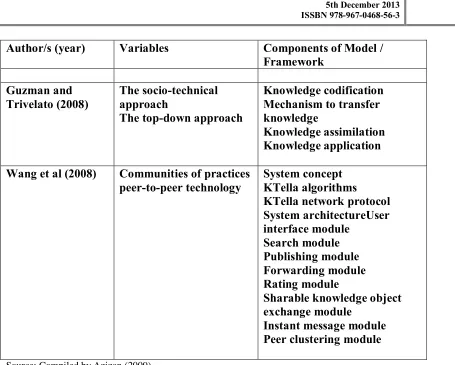
The analysis and evaluation by Guzman and Trivelato (2008) of the transfer process of codified knowledge was performed under two different approaches, namely the ‘socio-technical’ and the ‘top down’. The social-technical approach supports the transfer of codified knowledge better than does the top down approach. The framework followed the developed standards work as being evidence of a successful transfer of codified knowledge. The model used the idea of codified-oriented knowledge, divided into three stages (knowledge codification, mechanism used to transfer knowledge and knowledge assimilation and application). The study’s result showed that the socio-technical approach supports the process of codified knowledge transfer better does the top-down view. It also showed that codified knowledge is a dynamic concept that may need varying amounts and kinds of tacit knowledge to enable knowledge codification and assimilation. Finally, the result highlighted the need for an examination of the degree of context and task similarity between the sender and receiver units to be detailed, since small variations in organizational processes might imply significant alterations on informal work practices.
Wang et al.’s (2008) knowledge sharing model is one example of knowledge sharing from the objectivist perspective. Their model of knowledge sharing, called ‘KTella’, enables a community’s members to voluntarily share and retrieve knowledge more effectively. The authors examined the knowledge sharing characteristics and roles of communities of practice and developed a peer-to-peer knowledge sharing architecture that matches the behavioural characteristics of the member on the communities of practices. These communities of practice are an informal group of people who create, share, and leverage their knowledge and experience. Additionally, the model also provides basic knowledge sharing functions and mechanisms to make knowledge sharing effective and efficient, involving contributing, searching, companion finding and information filtering. It also appears that the model promotes knowledge sharing in the form of document sharing, idea and experience sharing, and professional judgement sharing; it also provides powerful tools to support and boost more knowledge sharing activities.
ICTMBE 2013 2nd International Conference on Technology Management , Business and Entrepreneurship
Mahkota Hotel Melaka Malaysia 5th December 2013
ISSBN 978-967-0468-56-3
2013
348 Figure 3: Knowledge sharing model / framework
Author/s (year) Variables Components of Model / Framework
McAdam and McCreedy (1999)
Old and new knowledge management paradigm
Knowledge category Intellectual capital Socially constructed
Argote and Ingram (2000a)
Social subnetworks (members, tasks and tools)
The member-member network
The task-task network The tool-tool network The member-task network The member tool network The task-tool network The member-task-tool network
Szulanski (2000) The source The recipient The context
Type of knowledge
Initial stage
Implementation stage Ramp-up stage Integration stage
Olivera (2000) Content Structure
Operating processes
Social networks Knowledge intranet Electronic bulletin boards Knowledge centers
Principe and Tell
(2001) Experience accumulation Knowledge articulation Knowledge codification
The explorer landscape (L-shaped)
The navigator landscape (T-shaped)
The exploiter landscape (staircase)
Hansen (2002) Dependent variables Project completion time Amount acquired knowledge
Independent variables Path lengths in a knowledge network Direct relations with
ICTMBE 2013 2nd International Conference on Technology Management , Business and Entrepreneurship
Mahkota Hotel Melaka Malaysia 5th December 2013
ISSBN 978-967-0468-56-3
2013
349
Author/s (year) Variables Components of Model / Framework
divisions in a knowledge network
Noncodified knowledge Alternative explanation
Control variables Betweenness centrality Project attribute controls
Ipe (2003) Individual The nature of knowledge The motivation to share The opportunities to share The culture of the work environment
Kalling and Styhre (2003)
Strategy level Practices level
Organizational context Cognitive factors Norm, institutions and incentives
Widen-Wulff and
Ginman (2004) Dimension of social capital The concept of each dimension
Information behaviour research
Possible measures
Context formal/informal
A structural
A content (communicative) A relational
Enberg et al. (2006) Project organization Project goals
Project work
Individual routine work Interactive problem solving
Informative meetings
Instances of interacting (face-to face meeting)
Instances of acting (individual work alone)
Alan (2006) Learning style of experiential learning theory
ICTMBE 2013 2nd International Conference on Technology Management , Business and Entrepreneurship
Mahkota Hotel Melaka Malaysia 5th December 2013
ISSBN 978-967-0468-56-3
2013
350
Author/s (year) Variables Components of Model / Framework
Guzman and Trivelato (2008)
The socio-technical approach
The top-down approach
Knowledge codification Mechanism to transfer knowledge
Knowledge assimilation Knowledge application
Wang et al (2008) Communities of practices
peer-to-peer technology System concept KTella algorithms KTella network protocol System architectureUser interface module
Search module Publishing module Forwarding module Rating module
Sharable knowledge object exchange module
Instant message module Peer clustering module
Source: Compiled by Azizan (2009)
The literature review reveals that the models by different scholars have developed from different perspectives. Figure 5 illustrates this variety in the models from objectivist perspectives,
[image:14.612.66.521.71.436.2]practice-based perspectives and mixed perspectives (the later combining the two earlier perspectives).
Figure 4: Knowledge sharing model / framework from different perspectives
Objective perspective Mixed perspectives Practice-based perspective Wang et al., (2008)
Alavi & Tiwana (2005)
Szulanski (2000) Olivera (2000)
Principe and Tell (2001) Hansen (2000)
McAdam and McCreedy (1999)
Argote and Ingram (2000a) Ipe (2003)
Kalling and Styhre (2003) Widen-Wulff and Ginman (2004)
Enberg et al. (2006) Alan (2006)
Guzman and Trivelato (2008)
ICTMBE 2013 2nd International Conference on Technology Management , Business and Entrepreneurship
Mahkota Hotel Melaka Malaysia 5th December 2013
ISSBN 978-967-0468-56-3
2013
351 Conclusion
ICTMBE 2013 2nd International Conference on Technology Management , Business and Entrepreneurship
Mahkota Hotel Melaka Malaysia 5th December 2013
ISSBN 978-967-0468-56-3
2013
352 References
Alan, G. M. (2006). A study exploring managers' knowledge sharing strategies through the learning styles of
experiential learning theory. Unpublished Ed.D., The George Washington University, District of Columbia, USA. Alavi, M., & Tiwana, A. (2005). Knowledge management: The information technology dimension. In M. Easterby-Smith & M. A. Lyles (Eds.), The blackwell handbook of organizational learning and knowledge management. USA: Blackwell Publishing.
Argote, L., & Ingram, P. (2000a). Knowledge transfer: A basis for competitive advantage in firms. Organizational
Behavior and Human Decision Processes, 82(1), 150-169.
Argote, L., Ingram, P., Levine, J. M., & Moreland, R. L. (2000b). Knowledge transfer in organizations: Learning from the experience of others. Organizational Behavior and Human Decision Processes, 82(1), 1-8.
Argote, L., McEvily, B., & Reagans, R. (2003b). Managing knowledge in organizations: an integrative framework and review of emerging themes. Management Science, 49(4), 571-582.
Bartol, K. M., & Srivastava, A. (2002). Encouraging knowledge sharing: the role of organizational reward systems.
Journal of Leadership & Organizational Studies, 9(1), 64.
Bock, G. W., & Kim, Y.-G. (2002). Breaking the myths of rewards: an exploratory study of attitudes about knowledge sharing. Information Resources Management Journal, 15(2), 14.
Chakravarthy, B., Zaheer, A., & Zaheer, S. (1999). Knowledge sharing in organization: A field study. US: St Paul: University of Minnesota, Strategic Management Resource Center.
Chong, J. N. (2007). Knowledge sharing and work practice. Unpublished Ph.D, Stanford University, California, USA.
Ciborra, C. U., & Patriotta, G. (1998). Groupware and teamwork in R&D: Limits to learning and innovation. R&D
Management, 28(1), 43-52.
Enberg, C., Lindkvist, L., & Tell, F. (2006). Exploring the dynamics of knowledge iIntegration: Acting and interacting in project teams. Management Learning, 37(2), 143-165.
Grant, R. M. (1996). Toward a knowledge-based theory of the firm. Strategic Management Journal, 17, 109-122. Guzman, G. (2008). Sharing practical knowledge in hostile environments: a case study. Journal of Workplace
Learning, 20(3), 195.
Guzman, G., & Trivelato, L. F. (2008). Transferring codified knowledge: Socio-technical versus top-down approaches. The Learning Organization, 15(3), 251.
Hendriks, P. (1999). Why share knowledge? The influence of ICT on the motivation for knowledge sharing.
Knowledge and Process Management, 6(2), 91-100.
Huysman, M., & de Wit, D. (2002). Knowledge Sharing in Practice. The Netherlands: Kluwer Academic Publishers. Ipe, M. (2003a). Knowledge sharing in organizations: a conceptual framework. Human Resource Development
Review, 2(4), 337-359.
Kalling, T. (2003). Organization-internal transfer of knowledge and the role of motivation: a qualitative case study.
Knowledge and Process Management, 10(2), 115-126.
Kalling, T., & Styhre, A. (2003). Knowledge sharing in organizations. Sweden: Copenhagen Business School Press. Lang, J. C. (2004). Social context and social capital as enablers of knowledge integration. Journal of Knowledge
Management, 8(3), 89-105.
Lee, D.-J., & Ahn, J.-H. (2007). Reward systems for intra-organizational knowledge sharing. European Journal of
Operational Research, 180(2), 938-956.
Lee, H., & Choi, B. (2003). Knowledge management enablers, processes, and organizational performance: an integrative view and empirical examination. Journal of Management Information Systems, 20(1), 179-228. Lessard, D. R., & Zaheer, S. (1996). Breaking the silos: distributed knowledge and strategic responses to volatile exchange rates. Strategic Management Journal, 17(7), 513-533.
Liao, S.-h., Fei, W.-C., & Chen, C.-C. (2007). Knowledge sharing, absorptive capacity, and innovation capability: an empirical study of Taiwan's knowledge-intensive industries. Journal of Information Science, 33(3), 340-359. Marouf, L. N. (2007). Social networks and knowledge sharing in organizations: a case study. Journal of Knowledge
Management, 11(6), 110.
Matzler, K., Renzl, B., Müller, J., Herting, S., & Mooradian, T. A. (2008). Personality traits and knowledge sharing.
ICTMBE 2013 2nd International Conference on Technology Management , Business and Entrepreneurship
Mahkota Hotel Melaka Malaysia 5th December 2013
ISSBN 978-967-0468-56-3
2013
353
McAdam, R., & McCreedy, S. (1999). A critical review of knowledge management models. The Learning
Organization, 6(3), 91.
Mei, Y. M., Lee, S. T., & Al-Hawamdeh, S. (2004). Formulating a communication strategy for effective knowledge sharing. Journal of Information Science, 30(1), 12-22.
Nonaka, I., & Takeuchi, H. (1995). The knowledge-creating company: How Japanese companies create the
dynamics of innovation. New York: Oxford University Press.
Olivera, F. (2000). Memory systems in organizations: an empirical investigation of mechanisms for knowledge collection, storage and access. Journal of Management Studies, 37(6), 811-832.
Pan, S. L., & Scarbrough, H. (1998). A socio-technical view of knowledge-sharing at Buckman Laboratories.
Journal of Knowledge Management, 2(1), 55.
Prencipe, A., & Tell, F. (2001). Inter-project learning: processes and outcomes of knowledge codification in project-based firms. Research Policy, 30(9), 1373-1394.
Reagans, R., & McEvily, B. (2003). Network structure and knowledge transfer: The effects of cohesion and range.
Administrative Science Quarterly, 48(2), 240-267.
Scholl, W., Konig, C., Meyer, B., & Heisig, P. (2004). The future of knowledge management: an international delphi study. Journal of Knowledge Management, 8(2), 19.
Smith, L. C. (2000). Track 1: knowledge discovery, capture and creation. Bulletin of the American Society for
Information Science and Technology, 26(2), 11-12.
Søndergaard, S., Kerr, M., & Clegg, C. (2007). Sharing knowledge: contextualising socio-technical thinking and practice. The Learning Organization, 14(5), 423.
Spender, J.-C. (1996). Making knowledge the basis of a dynamic theory of the firm. Strategic Management Journal,
17, 45-62.
Szulanski, G. (2000). The process of knowledge transfer: a diachronic analysis of stickiness. Organizational
Behavior and Human Decision Processes, 82(1), 9-27.
Wang, C.-Y., Yang, H.-Y., & Chou, S.-c. T. (2008). Using peer-to-peer technology for knowledge sharing in communities of practices. Decision Support Systems, 45(3), 528-540.
Widen-Wulff, G., & Ginman, M. (2004). Explaining knowledge sharing in organizations through the dimensions of social capital. Journal of Information Science, 30(5), 448-458.
Yang, C., & Chen, L.-C. (2007). Can organizational knowledge capabilities affect knowledge sharing behavior?