International Journal of Emerging Technology and Advanced Engineering
Website: www.ijetae.com (ISSN 2250-2459, Volume 2, Issue 5, May 2012)400
Development Of Experimental Set Up Of Improved Bamboo
Processing Machine
K. G. Ahuja1, Dr. A. V. Vanalkar2, P. G. Mehar3
Mr.Kapil Ahuja, Student of M.Tech Scholar(MED), KDK college of engineering Dr A. V. Vanalkar, Research Scholar, KDK college of Engineering, Nagpur, India Mr P.G. Meher, Professor, Department of Mechanical Engineering KDK college of Engineering
Abstract: - The present work shows the development of experimental set up of improved bamboo processing machine with a capability of doing two operations in a single unit. The details of different components, construction and working are explained in this paper. The force required to split the bamboo in 8 pieces is also included in this paper. This paper also includes the traditional process of processing the bamboo.
Key Words: - Bamboo, Splitting, slicing, knot removing, Splitting force estimation.
I. INTRODUCTION
The initial processes to be done on a bamboo to make it as a useful product is called as bamboo processing. The initial processes include Splitting, External and Internal Knot Removing, Slicing, Bamboo sticking making, Stick length setting, Stick Polishing [1], [5]. Bamboo and bamboo splits are used as the fencing material and for making various types of tool handles, ladders and scaffolding. In its natural form, bamboo as a construction material is traditionally associated with the cultures of South Asia, East Asia and the South Pacific, to some extent in Central and South America. Bamboo sticks are used for various purposes like building construction. Splits as well as slivers are used to make a wide range of products such as baskets, the core of incense-sticks, kites and toys, flutes and a large number of handicraft items. They are also use to make cages for poultry, drying, packaging and transport of grains. Bamboo splits are woven into mats and use to manufacture mat boards.
Traditionally the bamboo is processed in different steps and for each step a different machine is required, the main aim behind this development of experimental set up of improved bamboo processing machine is to reduce the number of steps and also to reduce the number of machines required to do the desired work. So an improved bamboo processing machine is fabricated which can perform splitting and slicing on a single machine. The design involves a new concept of making a special purpose of die for splitting and slicing, the concept behind this project is that, the machine is kept common for both the operations; only the die for splitting and slicing is different. This will eliminate the use of special machine for slicing which is to be done after splitting the bamboo. In this research, an approximate generalized experimental data based model for bamboo processing operation such as splitting and slicing, by varying some dependent parameters during experimentation is made.
II. LITERATURE REVIEW
International Journal of Emerging Technology and Advanced Engineering
Website: www.ijetae.com (ISSN 2250-2459, Volume 2, Issue 5, May 2012)401 The proposed machine in this investigation is not reported in the literature. Similarly, the proceedings of 7th World Bamboo Congress which took place in New Delhi in Feb., 2004 [5],[6] and [3] and shows that so far no attempt is taken in designing a machine for processing a bamboo which can perform multiple operations with a single unit. Hence, development of such type of machine is the main aim of this project. Obviously, when several operations can take place in one machine. It is bound to be commercially suitable.
III. CONCEPT OF PROJECT
Traditional bamboo processing machines are usually built to perform a single task as discussed above, but in our experimental set of improved bamboo processing Machine, we are planning to do two tasks with a single machine. Splitting and slicing will be performed on a single machine, by making a special purpose die.
In the first step the bamboo will be fixed in the machine between splitting knives set and a hydraulic pushing device which pushes forward the bamboo over the splitting knives. The bamboo will split in to a number of splints of equal widths depending on the number of knives present in the splitting knives set. In general width of splits varies from 10 mm to 15 mm depending on the species and quality of bamboo.
The strips are further divided into splits and the splits into Incense Stick. The splits may be made radial or tangential. While designing bamboo-processing machine initially various bamboo and woodworking processing machines are studied and schematic sketch of proposed machine was drawn as shown in figure 1. Further the requirement was to calculate the force required to split the bamboo into eight pieces and to further make slices from the bamboo pieces. Presently the formulae available to measure these quantities are for all the metals and wood but not for bamboo, hence we have adopted these formulae for bamboo as well.
[image:2.612.363.594.338.643.2]Figure 1 Sketch of proposed bamboo processing machine.
International Journal of Emerging Technology and Advanced Engineering
Website: www.ijetae.com (ISSN 2250-2459, Volume 2, Issue 5, May 2012)402 IV. CONSTRUCTION
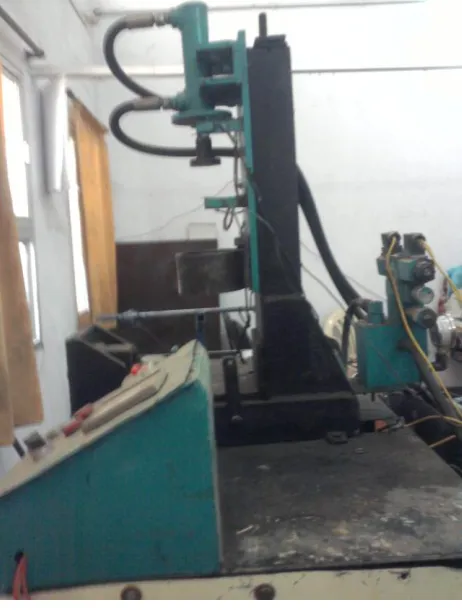
Figure no 2 shows the principle parts of the improved bamboo processing machine. The components includes
a. Hydraulic actuator b. Splitter Die c. Slicing Die d. AC supply
e. Hydraulic oil reservoir f. Direction control valve g. Control valve
Splitter Die
:-
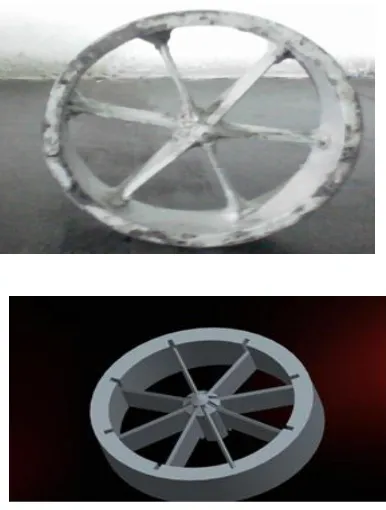
As shown in the sketch this die consists of eight cutters, when the bamboo is held against the cutter edge and hydraulic force is applied on to it so because of this force the bamboo gets split into eight pieces.
Splitter die is fitted in a hollow circular pipe section, 170mm in diameter and 60mm thick, sharp blades are fixed at equal distances. Blade width varies from 85 mm at center to 60 mm at outer radius with 10 mm thickness. According to number of splits of bamboo required, blades are increased or decreased. Maximum numbers of blades are six in the present splitter. Its handles are 120mm in length attach at opposite ends and supported on machine frame at back end of machine.
Slicing Die:-
This die consists of four tools having a length of 40 mm height of 25 mm and the end thickness of 2.5mm. These tools are placed parallel to each other and having a clearance of 2 mm so that we get the slices of about 1.5 mm. These tolls are fitted between two flat plates having a thickness of 4 mm. The split bamboo pieces are forced by using hydraulic force on to the slicing cutters in such a way that the split bamboo piece gets sliced in four pieces of 1.5 mm. The actual slicing die and CAD model of the same is also showed in figure no 3.
V. EXPERIMENTATION
[image:3.612.363.556.379.634.2]A number of experiments were conducted to study the effects of various machining parameters on bamboo processing operations. These studies have been undertaken to investigate the effects of various sizes of bamboo, speed, cutters and other machine parameters on torque, energy and time required in processing operations. During experimentation various variety and sizes of bamboo samples are collected and processed at three different speeds. For splitting operation different diameter of bamboos were taken in to consideration for obtaining cutting force required to split bamboos of different diameters. The result of the same is shown below. In the next step the already splitted bamboo pieces are forced on to the slicing tool and it gets sliced in four pieces, the actual slices are also shown in figure no 4.
Figure 3:- Actual working Die of splitter, Cad model of
International Journal of Emerging Technology and Advanced Engineering
Website: www.ijetae.com (ISSN 2250-2459, Volume 2, Issue 5, May 2012) [image:4.612.99.285.119.457.2]403 Figure 4 : Cad model of Slicing die and actual slices of
bamboo pieces
Force calculations
Area Of different size bamboos
1. A = π /4 (28.12^2 -11.42^2) = 518.07mm
2. A = π /4 (30.25^2 -13.37^2) = 578.29mm
3. A = π /4 (51^2 -31^2) = 1288.05 mm.
4. A = π /4(52.07^2 -32.07^2) = 1321.6mm
5. A = π /4 (58^2 -38^2) = 1507.96 mm
Pressure = Force × Area
We have already calculated area, now pressure will be taken from the pressure gauge already fitted on the main line of machine; the min pressure comes out to be 6.876 MPA.
F= 6.86 × 518.07 = 3455.55 N.
Bamb oo No
Inner Dia (mm )
Outer Dia (mm)
Area mm 2
Press ure MPA
Applie d force (N)
1 11.5
4
28.12 518. 07
6.670 3455.5 5
2 13.3
7
30.15 578. 29
6.670 3857.2 1
3 31 51 1288
.05
6.867 8845.0 6
4 32.0
7
52.07 1321 .66
6.867 9075.8 9
5 38 58 1507
.96
6.867 10355. 91
VI. CONCLUSION
The above discussed work gives a brief description regarding how a single is capable of doing two operations with a single unit. If compared with the traditional procedure of doing the above mentioned two operations, this machine can save a lot of time and cost as well. The next step in this project could be replacing the two individual die with a new improved single die which will be capable of doing the two operations at a same time.
REFERENCES
[1] Janssen Jules J.A., Technical Report International Network for Bamboo and Rattan 2001, Designing and Building with Bamboo [2] Gnanaharan R. and Mosteiro A.P., Manual on Processing of bamboo
International Journal of Emerging Technology and Advanced Engineering
Website: www.ijetae.com (ISSN 2250-2459, Volume 2, Issue 5, May 2012)404
[3] V.S. Oberoi, report of Technology Information, Forecasting & Assessment Council (TIFAC), New Delhi, Annual Report, 2004-05 on National Mission on Bamboo Applications (NMBA).
[4] Liu Kekun; “Production Process & Equipment For Bamboo Daily Products”, Proceedings Of International Training Workshop On Suitable Bamboo Management & Processing Technique For Small Size Bamboo Enterprises (2003); P.P.: -[88 –104].
[5] Proceeding of International Symposium titled “International Training Workshop On Sustainable Bamboo Management And Processing Techniques For Small – Size Bamboo Enterprises” took place in Hangzhou, Zhejiang of China on Oct. 4 -16, 2000 organized by Ministry of Science & Technology of China.
[6] The proceedings of 7th World Bamboo Congress , New Delhi in Feb., 2004
[7] Zone Fly Industrial and Trade Co., Ltd, China (www.zonefly.cn , http://www.wacatools.com)
[8] Basu S.K., Mukherjee S.N., Mishra R., Fundamentals Of Tool Engineering Design, Fifth Edition, Oxford and IBH Publishing Co. Pvt. Ltd., P.P.: - [44-45],[47],[48],[50],[22], 1993.
[9] Basu S.K.,Pal D.K , Design of Machine Tools, Fourth Edition, Oxford and IBH Publishing Co. Pvt. Ltd., P.P.:- [47],[37],1990.
[10] ASTME National Technical Publication Committee, Tool Engineer’s Handbook,, Second Edition, Mc-Graw Hill Book Company,Inc,New York, P.P.: - [26(36-37)], 1959.
[11] Central Machine Tool Institute, Banglore, Machine Tool Design Handbook, Fifth Edition, Tata Mc-Graw –Hill Publishing Co. Ltd., New York, P.P.: - [639],[666],[638],[639], 1988.
[12] Chieze Ibeneche, Torque and optical traps, African Journal of Biotechnology Vol. 7 (25), pp. 4663-4666, 29 December, 2008 [13] Mecmesin, testing and perfection (www. mecmesin.com)
[14] Jemielniak, K. Commercial tool condition monitoring systems, Int J Adv Manuf Technol,15, 1999, pp. 711-721.
[15] Modak, J. P. and Bapat, A. R., “Formulation of Generalised Experimental Model for a Manually Driven Flywheel Motor and its Optimization”, Applied Ergonomics, U.K., Vol. 25, No. 2, pp 119-122, 1994.
[16] Shiwalkar B.D., Design Data for Machine Elements, Dattatraya Publications,Nagpur(India).
[17] Soumitra Biswas and G Srikanth, report of Technology Information, Forecasting & Assessment Council (TIFAC), New Delhi, Annual Report,2004-05,2005-06,2007-08 on National Mission on Bamboo Applications (NMBA).
[18] Hilbert Schenck Junier, Theory of Engineering Experimentation, Mc Graw Hill, New York.
[19] Prashant Bamboo Machine Sales Corporation, Nagpur (www.prashantbamboo.com)
[20] Wood Masters(India) Machines Pvt. Ltd., Ludhiana (India) (www.woodmasterindia.com)