Journal of Chemical and Pharmaceutical Research, 2014, 6(5):1689-1695
Research Article
CODEN(USA) : JCPRC5
ISSN : 0975-7384
Synchronous generator parameters identification on-line using small population-based
particle swarm optimization
Xiuge Zhang, Ye Ren and Qizhou Hu
Zhengzhou Electric Power College, Zhengzhou, China
_______________________________________________________________________________________
ABSTRACT
The parameters of synchronous generators are the basis of power system analysis and operating control. Parameters identification of synchronous generator plays a key role for the power system stability analysis. In this paper, a small population-based particle swarm optimization (SPPSO) approach is used to acquire synchronous generator on-line model quickly and accurately. In the proposed approaches, three operations are introduced to improve the performance of the algorithm, namely mutation operation, DE-acceleration operation and migration operation. Furthermore, the synchronous generator practical model and the PMU data are adopted. The simulation results of the model obtained by SPPSO have been compared with hybrid genetic algorithm and PSO. The SPPSO algorithm shows better performance on the convergence as well as computation time and effort.
Key words—PMU data,synchronous generator, parameter identification, SPPSO
_____________________________________________________________________________________________
INTRODUCTION
The system parameter identification (System parameter Identification) is a branch of modern control theory. After processing input and output data of the control system, it is to estimate the mathematical model of system structure. Power system is a huge artificial complex system, and the transient stability calculation and real-time control of system are closely related to the generator, synchronous generator and load model .So, it has a very realistic significance to research the parameter identification of the power system.
Synchronous generator (SG) is an important part of the grid stability analysis. A precise on-line synchronous generator model is a foundation of the power grid stability analysis. Previously, parameters identification of synchronous generator is offline. The signals used for the parameters identification of synchronous generator are the generator's dynamic response to the step change under the condition of no-load. In this case, the obtained models are usually not accurate. With the development of PMU technology, it is possible to obtain the dynamic data and it provided the conditions for real-time online parameter of power system model. Thus, on-line parameter identification for synchronous generator becomes possible.
QO) to solve both offline and online parameters estimation problem for SG. The hybrid algorithm is proposed to increase the convergence speed and identification accuracy, but, PSO has premature convergence problem [10-12].
Motivated by above discussions, the paper presents a small population-based particle swarm optimization (SPPSO) method to identify synchronous generator parameters based on the PMU data. In this method, the parameters identification of synchronous generator is formulated as an optimization problem of input-output system. A small population-based particle swarm algorithm has less computation, fast convergence speed, the identification accuracy is high, it is suitable for real-time online parameter identification of power system. and the synchronous generator parameters identification becomes easy.
II. SYNCHRONOUS GENERATOR MODEL
A. Synchronous Generator Model Description
For the parameters identification of the synchronous generator, the first step is to establish the suitable mathematical model which can express different working conditions of synchronous generator precisely. Various types of synchronous generator are supplied by different manufacturers. Corresponding mathematical models of these synchronous generator s have been established by the manufacturers.
However these models are not practical in the on-line stability analysis of power system. Choosing an appropriate model is the key point for the parameters identification of synchronous generator.
With the information provided by the power plant, the five-step voltage synchronous generator practical model is adopted in this paper. The following equations show the basic aspects of the model.
D-Axis electric model:
(
)
⋅
−
=
⋅
⋅
+
−
+
−
−
−
−
−
=
⋅
⋅
+
⋅
−
−
−
=
d d q q fd fd ad d d d d d d d d q d q d d q fd fd ad d d d d d q d qi
X
E
u
u
R
X
T
i
T
X
X
T
X
X
E
T
E
T
T
dt
dE
u
R
X
T
i
X
X
T
E
T
dt
dE
'' '' ' 0 '' 0 '' ' ' 0 ' '' '' 0 '' ' 0 '' 0 '' ' 0 ' ' 0 ' ' 0 '1
1
1
1
1
1
1
Q-Axis electric model:
⋅
−
=
−
+
−
=
q q d d q q q q d q di
X
E
u
i
T
X
X
E
T
dt
dE
'' '' '' 0 '' '' '' 0 ''1
Motion equation of the rotor:
(
)
−
−
−
=
−
=
1
1
ω
ω
ω
δ
D
M
M
dt
d
M
dt
d
e mWhere, the notations represent: ''
d
' q
E
: transient EMF of q axis;fd
u
:excitation voltage;'' d
X
,X
q'' :sub-transient reactance of d and q axis;' d
X
:sub-transient reactance of d axis;d
X
,X
q:reactance of d and q axis; '0 d
T
,T
d''0:transient and sub-transient open-circuit time constant of d axis; ''0 q
T
:sub-transient open-circuit time constant of q axis.The parameters to be identified in this model are
X
d, ' dX
,X
d'',X
q, '' qX
,T
d'0,T
d''0,T
q''0andK
,K
=
X
adR
fd .B. Small Population-Based Particle Swarm Optimization
Small population-based particle swarm optimization is the improvement of particle swarm optimization. A small population size is adopted in the SPPSO approach, avoiding the heavy cost of computational time and resources in comparison with the past PSO approaches in which a large population size is usually employed. However, the adoption of small population size will lessen the population diversity, and the solution may converge to a local optimum with high probably. Therefore, there extra handing techniques, i.e., mutation operation, DE-acceleration operation, and migration operation, are incorporated to deal with this problem.
Mutation operation. In the PSO algorithm, the population diversity will decrease with iterations, especially using small population size. In this paper, the mutation operation is introduced in the SPPSO to address this issue. The mutation operation is acting on the particle's flying guides, unlike any other mutation operation which acts on the position of a particle or on it's flying velocity. Then the guides of particle
ith
generated as( )
<
=
otherwise
pbest
g
rand
if
gbest
i
glead
p
n rand
mut
) , 1 (
( )
<
=
otherwise
pbest
p
rand
if
pbest
i
plead
p
n rand
mut
) , 1 (
where
gbest
denotes the best position that the all particles has achieved so far;pbest
irepresents the best position the particleith
has achieved so far;gmut
andpmut
are the mutation probability for thegbest
andpbest
guides, respectively, and they are usually set in [0.01,0.20];rand
(
1
,
np
)
produces random integers uniformly distributed in [1, np].rand
()
generates random numbers uniformly distributed in [0, 1]. Within the introduced mutation operation, the velocity update formula can be described as( )
(
)
( )
(
k)
ij kj
k ij k
j k
ij k
ij
x
i
glead
r
c
x
i
plead
r
c
wv
v
−
+
−
+
=
+
2 2
1 1 1
Where
glead
kj andk j
plead
represent thejth
dimensionality positions of thegbest
andpbest
guides of theith
particle; np is the population size; N is the dimension of the search space.DE-acceleration operation. In the PSO, the particles optimization is enforced by changing the flight direction and velocity of the particles. It is an inefficient job. The adoption of mutation operation has no contributions to improve the convergence speed and optimize efficiency to some extent. Then the DE algorithm is introduced. The DE-acceleration operation is carried out on the
gbest
in case its fitness has not been improved after several iterations. The initial individuals are the allpbest
of the all particles respectively achieved so far. The individuals at the(
)
+
−
<
=
+otherwise
x
R
if rand
x
x
F
x
x
m ij acc m j r m j r acc m ij m ij~
()
~
~
~
~
1 1 2acc
p
j
N
m
l
n
i
=
1
,
2
,
⋅
⋅⋅
,
;
=
1
,
2
,
⋅
⋅⋅
,
;
=
0
,
1
,
⋅
⋅⋅
,
Where
R
accrepresents the scaling factor;r
1andr
2are different integers uniformly distributed in [1,np];l
acc is the maximum iteration of the DE-acceleration operation. In the iterative process, the parent individual will be replaced by its offspring once the fitness of the offspring is better than that of its parent. The best fitness at any iteration is compared with that of thegbest
, and the winner will be the newgbest
. This DE-acceleration operation will be executed until the fitness of thegbest
has been improved significantly or some certain number of iterations has been reached.Migration operation. The population diversity will be destroyed due to the small population size, and the introduction of the DE-acceleration operation will make the situation worse. Therefore, the migration operation is proposed. It is a re-initialization operation which is enforced when the population diversity is reduced to an intolerable degree. This degree can be expressed as a preset value acquiring from the experience. In this paper, the crowding level denoted by the following equation is adopted to represent the swarm diversity:
( )
∑∑
= ==
p n i N j k ij px
N
n
cl
1 11
µ
Where
( )
<
=
otherwise
f
if
π
x
mig k ij k ij0
1
µ
.In the above formula,π
ijk is the closeness degree on thejth
dimensionalitybetween the
gbest
and theith
particle.f
migrepresents its critical value. The closeness degree is produced as(
) (
)
(
) (
)
−
−
≥
−
−
=
otherwise
d
gbest
x
gbest
gbest
if x
gbest
d
gbest
x
j j k ij j j k ij j j j k ij k ijmin max
π
(
)
(
)
−
+
≤
−
+
=
otherwise
d
gbest
r
d
σ
if r
gbest
d
r
gbest
x
j j j j j j k ijˆ
min 2 min 3 max 1Where
(
max)
/(
max min)
j j j
j
gbest
d
d
d
−
−
=
σ
;d
maxj andd
minj represent the maximum value and minimum value of thejth
dimensionality respectively;r
1,
r
2andr
3are random numbers uniformly distributed in [0,1].The detailed steps of the SPPSO approach for the excitation system's parameters identification can be described as follows.
Step1: Set the parameters and initialize the population.
Step2: Select the
pbest
guide andgbest
guide for each individual according the mutation operation, and update the velocity for each individual. Then update the position of each particle.Step3: Calculate the fitness value for each individual in the population. Compare each particle's fitness value with that of its
pbest
. If the new fitness value of any particle is less than its previous value, the new coordinates for thatparticle will be stored as its
pbest
. The particle with the best cost value among all thepbests
is denoted as thenew
gbest
.Step4:If the cost of
gbest
is not improved meaningfully in several iterations, the DE-acceleration operation will becarried out until the fitness of the
gbest
has been improved significantly or some certain number of iterations has been reached.Step5:Calculate crowding level value of the population. Implement the migration operation if the diversity violates its desired level.
Step6: If the number of iterations reaches its maximum, or the fitness value of
gbest
is less enough, then go to step 7. Otherwise, go to step 2.C. Simulation results
This paper used PMU installed on the generator terminal to measure the power angle of generator, Generator outlet electric quantity information, will be decomposed into d, q axis component of the generator, Decoupling equations of d, q axis can be solved to make generator parameter identification. A small population of particle swarm optimization algorithm (SPPSO) and hybrid genetic algorithm was used to the generator model parameter identification.
The function simulation of the system is successfully fulfilled with single machine infinite bus system. The paper simulated the generator state by increasing 10% in the excitation voltage at t=15s and got the generator outlet voltage, generator excitation voltage, speed and the power angle, the data interval is 0.02s. The simulation system is shown in figure 1.
Figure1. Single machine infinite bus system
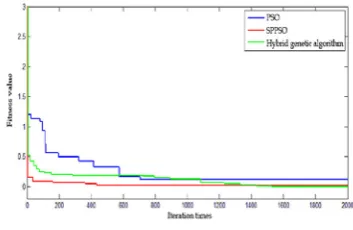
[image:5.595.216.393.336.451.2]The measurements used in the optimization are the field voltages of the excitation system. The initial population size of the SPPSO is set to 5, and the maximum iteration is set to 2000. The convergence curve compared with hybrid genetic algorithm and PSO is showed in figure2.
Figure 2. Comparison result of the convergence of SPPSO and PSO and hybrid genetic algorithm
As shown in figure2, the SPPSO algorithm display better on convergence compared with the PSO algorithm and hybrid genetic algorithm. , and the fitness value of SPPSO is less than that of SPO and hybrid genetic algorithm.
The identified parameters of the synchronous generator with SPPSO and hybrid genetic algorithm are shown in tableⅠ and tableⅡ.
TABLE ⅠPARAMETERS IDENTIFICATION RESULT OF D-AXIS OF THE SYNCHRONOUS GENERATOR
Parameter
d
x xd' xd'' ' 0
d
T '' 0
d
T K
PMU data 1.827 0.307 0.194 1.22 0.127 200
Hybrid genetic algorithm 1.8717 0.2681 0.1833 1.1970 0.1313 202.4372 SPPSO 1.9134 0.3125 0.1892 1.1810 0.1285 204.6517
TableⅡ PARAMETERS IDENTIFICATION RESULT OF Q-AXIS OF THE SYNCHRONOUS GENERATOR
Figure3 and 4 compare the output result of the models obtained by SPPSO and hybrid genetic algorithm.
Parameter
q
x ''
q
x '' 0
q
T
Simulation parameters value 1.903 0.208 0.177 Hybrid genetic algorithm 1.9382 0.1979 0.1754
[image:5.595.205.407.662.709.2]Figure3. Comparison result of simulation data and PUM data of d axis
Figure4. Comparison result of simulation data and PUM data of q axis
Figure3 and 4 show the good accuracy of both methods. The parameters of the synchronous generator obtained by SPPSO show a good fit to PMU data.
CONCLUSION
With high demand about security and stability analysis of power system, to obtain fast and accurate real-time grid model has become important for power system. The paper adopted SPPSO compared with hybrid genetic algorithm to make parameter identification of synchronous generator and got the better result. Compared with traditional methods, the proposed algorithm demonstrates the following principal advantages:
(1) better capability of approximation to PMU data; (2) faster learning speed;
(3) high precision.
It is quite evident from the comparisons that SPPSO approach shows superior fitness to the measured variables and better performance on the convergence as well as computational efforts. The future extension of the study will be on prediction and diagnosis for power system.
REFERENCES
[1]Lai L L , MaJT . IEEE Transactions on Energy Conversion,1996,11(3):523-530.
[2]M.Hasni, S. Djema, O. Touhami, R. Ibtiouen, M. Fadel and S. Caux. Serbian Journal Of Electrical Engineering
2007,4(1), 51-69.
[3]MouniE,TnaniS,ChampenoisG. Simulation Modeling Practice and Theory, 2008, 16(6):678-689. [4] Huang Miao,Li Wenyuan,Yan Wei, Electric Power Systems Research,2010,80(9):1137-1144. [5] Pangao Kou, Liang Fu, Huibin Wang, Li He, Bo Huang. Proceedings of the CSEE,2012,S1:249-255. [6] Liu L, Liu W,Cartes D A. Engineering Applications of Artificial Intelligence,2008,21(7):1092-1100.
[7] Pangao Kou, Jianzhong Zhou, Changqing Wang, Han Xiao, Huifeng Zhang, Chaoshun Li. Engineering Applications of Artificial Intelligence,2011,247.
[8]Cai J,Ma X,Li L. Energy Converse Manage,2007,48(2):645-53.
[10] Niewierowicz T,Escarela-Perez R,Campero-Littlewood E. Computers and Electrical Engineering, 2003, 29(4):505-522.