Developing models for delivering
insurance through CDFIs opportunities
and risks
Vik, PM, Dayson, KT and Ward, A
Title Developing models for delivering insurance through CDFIs opportunities and risks
Authors Vik, PM, Dayson, KT and Ward, A
Type Monograph
URL This version is available at: http://usir.salford.ac.uk/19120/
Published Date 2009
USIR is a digital collection of the research output of the University of Salford. Where copyright permits, full text material held in the repository is made freely available online and can be read, downloaded and copied for noncommercial private study or research purposes. Please check the manuscript for any further copyright restrictions.
DEVELOPING
MODELS
FOR
DELIVERING
INSURANCE
THROUGH
CDFIS
–
OPPORTUNITIES AND RISKS
FINAL
TECHNICAL
REPORT
Dr. Karl Dayson, Pål Vik and Aidan Ward Community Finance Solutions
About CFS
Located within the University of Salford, Community Finance Solutions (CFS) is an independent award-winning research and development unit engaged in promoting and developing integrated solutions for financial and social inclusion, and community ownership of assets.
For more information about CFS and our work, please visit our website at
Table of contents
EXECUTIVE SUMMARY _____________________________________________ i Glossary ___________________________________________________________ iv Acknowledgements____________________________________________________v 1. Introduction______________________________________________________1 2. Literature review: Access and barriers to access to insurance for low-income households in the UK __________________________________________________3
5.5.4. Sustainability____________________________________________41 5.6. Implications for CDFI insurance delivery _________________________42 6. Providing insurance to low-income households: the experience of international MFIs ______________________________________________________________44
EXECUTIVE SUMMARY
Introduction
The present study looked at the feasibility of delivering insurance products through the UK Community Development Financial Institution (CDFI) sector. Its UK-wide presence and experience of working with financially excluded consumers would suggest that the sector could potentially be an effective conduit of insurance. The focus of the study was mainly on Home Contents Insurance (HCI) and on life insurance. This was because low-income households are at greater risk of and are vulnerable to death of a household member and loss of home contents, given that they live in high-risk areas and often rely on a single income.
In order to ascertain the feasibility of a CDFI insurance delivery model, we conducted focus groups with actual and potential target CDFI clients to understand the extent and nature of demand for insurance products. We reviewed the experiences of eight international and UK insurance schemes aimed at the financially excluded to understand key challenges and potential mechanisms related to the delivery of insurance to low-income, financially excluded households. Finally, in order to understand the legal opportunities and barriers for the provision of insurance through CDFIs, we examined the regulatory framework for insurance provision.
Vulnerability and access to insurance in the UK
Low-income households in the UK are especially vulnerable to income shocks, as they are at greater risk of crime, illness and premature death. They are also often in a weak position to sustain and increase their income through the labour market. In addition, there are growing economic, fiscal and political pressures for households and individuals to finance life-stage and life-cycle costs.
Yet, despite their vulnerability, low-income households and tenants are much less likely to be insured compared to the overall population and particularly compared to the middle to higher-income groups. Data from the 2005/2006 Family and Resources Survey show that the ownership falls in tandem with income, and that 91.5% and 39.7% of home owners had home contents and life insurance respectively compared with 35.9 and 19.5 for tenants.
These households are less likely to have HCI due to their tenancy status, low income and exclusion from mainstream financial services. Also, research suggests that as financially excluded or marginalised consumers living on a low income, they are likely to demand policies serviced by cash, with no excess and small minimum sums insured, which are not widely available in the mainstream market.
UK national government policy in this area has mainly centred on increasing the outreach and uptake of social housing tenant insurance schemes. Part of the remit of the Financial Inclusion Champions – a programme run by the DWP to build and coordinate partnerships to promote financial inclusion – is to work with housing associations and social landlords in particular geographical areas to increase the supply and take-up of appropriate home contents insurance schemes.
Demand for insurance policies
participants had not got around to it, that the participants did not trust the insurer and that they did not like the principles of insurance.
As an ideal protection product, the participants wanted a simple and comprehensive policy covering all eventualities, including breakdown cover for household appliances. In addition, they wanted the product to be affordable and many wanted to at least have the option of paying in cash. Face-to-face sales were preferred, whereby the products and the fine print would be well explained. The focus groups participants also felt it was essential to be able to trust that the insurer would pay out in the event of a claim and that the claims process would respectful and would not criminalise the claimants.
Providing insurance to the financially excluded: the UK experience
Unfortunately, the lack of data makes it difficult to ascertain whether the existing schemes are making inroads in lowering the proportion of uninsured households. The estimates would indicate an average take-up of 10% for the Social Housing Landlord tenant insurance schemes. The ABI (2007) reports that despite the fall in costs in real terms of around 40% from 1994 to 2007, the proportion of the population with home contents and building insurance has remained relatively stable. This seems to be confirmed by data cited by Demos and Safe (2005).
We interviewed representatives from UK insurance schemes aimed at the financially excluded. The interviewees highlighted four issues that CDFIs must grapple with to make a dent in the number of uninsured households:
- Deep-rooted distrust among low-income households of insurers.
- Many low-income households believe that they do not have enough assets to warrant taking out an HCI policy.
- Many tenants mistakenly believe that they and the contents of their accommodation are protected against a range of incidents, such as leaking pipes. - Many elderly tenants, who have a greater propensity to take out insurance, have
already taken out an HCI policy with Age Concern.
Not all of the abovementioned factors were raised in the focus groups with CDFI target clients. For example, none of the focus group participants mentioned not having sufficient assets as a reason for not having insurance.
Providing insurance to the financially excluded: the experience of international MFIs
Drawing on the experience of the international microfinance sector in providing insurance for the financially excluded is an important component of the research. Because many MFIs have already incorporated insurance provision alongside microcredit and savings products, their experience may provide valuable insight into the potential institutional impact (human resources, structures and processes) of insurance provision for CDFIs.
The experiences of the international case study MFIs suggest that motivating staff and fitting the marketing and selling of insurance alongside their existing tasks constitutes a key challenge. Based on the practices applied by the case study MFIs, potential solutions to this include offering bonuses and putting in place a simple and quick method for explaining and selling insurance.
because it would contradict the goal of empowering their clients to access financial products corresponding to their particular needs.
That said a potentially very interesting lesson for the UK sector is the finding concerning a centralised back-office system. One of the international case study MFIs had a centralised back-office system which also enabled the reduction of cost per policy issued by the local microinsurance provider. A possibility for the UK CDFIs could potentially be to create a joint back-office system to reduce costs.
Regulatory framework – barriers and opportunities
There is no straightforward answer to the question on the regulatory implications for CDFIs if they were to get involved in insurance mediation1. First, it is possible that CDFIs may be exempt from regulation. The exclusions from regulation are largely contained in the “by way of business” test which tries to distinguish insurance intermediation carried out for business purposes for commercial gain from intermediation that is really a by-product of some other activity. In this case, the CDFIs would only need to report that they are within the parameters for exemption. Second, if the CDFIs were to be regulated, the numerous overlapping regulatory concerns and the move towards outcome-based regulation, makes it difficult to ascertain the exact implications of being regulated.
However, it would involve regular reporting to the FSA concerning financial status (e.g. balance sheet, profit and loss account, professional indemnity insurance etc), human resources (training and competence) and management systems (conduct of business, processes to deal with conflicts of interest). Although the CDFIs currently have some limited reporting in relation to DWP funding and have to comply with some relevant regulation under the Consumer Credit Act, becoming regulated under the FSA would most likely lead to a substantial increase in the regulatory burden and therefore an additional cost for CDFIs to meet.
Next steps – towards a model of CDFI insurance provision
On the basis of the government emphasis on increasing the proportion of households with HCI and of the latent demand for HCI detected in this study, it might seem natural to recommend that CDFIs start offering HCI. Nevertheless, for three reasons we recommend that the CDFIs do not offer HCI, at least for the time being:
- In light of the deep-rooted and very negative attitudes of the focus group participants towards HCI and HCI providers, we fear that offering HCI could potentially have a negative impact on the reputation of the CDFIs.
- Because scale appears to be a major driver of affordability nationally and internationally, there are serious doubts as to whether CDFIs would be able to achieve affordable policies for its clients, given the limited number of clients. - Although take-up can be improved, existing schemes have the potential
effectively meeting the demand of uninsured households. For example, the focus groups and the interviews with insurance providers suggest that premium-payment with rent is likely to raise up-take of existing social housing insurance schemes.
Instead, we recommend that the CDFIs examine the potential of offering a voluntary, combined life and credit life insurance policy. Historically, if delivered in the right way, life insurance policies have proven popular. Claims processing is in most cases more straightforward and less controversial.
1
Glossary
ABI Association of British Insurers
ADIE Association pour le droit a l’initiative économique – French
microfinance institution
CAP Christians Against Poverty
CDFI Community Development Financial Institution – independent
organisation lending and investing in deprived areas and underserved markets without access to mainstream finance
CETZAM Christian Enterprise Trust Zambia – Zambian microfinance institution
DWP Department for Work and Pensions
FSA Financial Services Authority
FSMA Financial Services and Market Act 2000
HCI Home Contents Insurance
IWG Insurance Working Group
MFI Microfinance Institution
NHF National Housing Federation
NIC National Insurance Contribution
OFL Options for Life
OI Opportunity International
RAMR Retail Mediation Activities Return
Acknowledgements
We would like to thank the Friends Provident Foundation for funding this project. We are also indebted to the members of the steering group Andrew Thompson (Friends Provident Foundation), Bernie Morgan (CDFA), Faisel Rahman (Fair Finance), Rebecca Driver (ABI), Philip Maloney and Matthew Harris (both from HM Treasury) for their valuable comments and observations.
We are grateful for the help from the African Community Banking Partnership, the Somali Brawanese Welfare Association, Preston Moneyline and Lower Kersal Community Centre in organising and recruiting for the focus groups. Finally, we are indebted to representatives from insurance companies, social housing landlords, social housing insurance brokers, microfinance institutions, community organisations, and the Financial Services Authority for their important contributions to the research.
1.
Introduction
This technical report presents the findings of a study into potential models for delivering affordable insurance through Community Development Finance Institutions (CDFIs). The UK CDFI sector already offers savings and affordable credit enabling low-income households to accumulate consumer durables and furniture, and to cope with small and predictable external shocks. Therefore it does not seem unreasonable that the sector should also enable its clients to manage and cope with unpredictable shocks with great financial implications by offering insurance products.
Yet to date, there has been limited focus on providing affordable insurance products to excluded households using CDFIs, let alone a feasibility study. This is somewhat surprising, considering that the Association of British Insurers (ABI) has cited the lack of trusted distribution networks to get the product to the market as one of the obstacles for insurance provision to low-income households.2 There are several reasons for why CDFIs could potentially be a trusted distribution network linking low-income segments of the market and insurers.
First, the sector is already marketing and delivering specialised financial products to low-income segments of the market. Hence the CDFIs have already grappled with many of the problems they are likely to encounter in delivering insurance to this segment of the market, such as information asymmetries, adverse selection and high transaction costs (Siegel et al, 2001). Moreover, research suggests that cross-selling insurance alongside other financial products is an important determinant of the possession of HCI (Whyley et al, 1998).
Second, the sector has an established circle of clients, to whom they could market these products. Currently the CDFIs have a presence in most of the UK with a growing outreach through offices and also by operating through the offices of social landlords.
Finally, in the case of the UK, a potentially added advantage of working through the CDFI sector is that it tends to insist on customers servicing loans through bank accounts and in some cases it offers support for customers to open and manage such accounts. This is important given that the reliance on direct debits and automated transfers is an important barrier for accessing and servicing insurance among financially excluded households.
Among the potential benefits for the CDFIs is that insurance may reduce the impact of external shocks on the ability of the clients to service loans and that it may constitute an additional source of income (Siegel et al, 2001).
However, the feasibility of delivering affordable insurance products through this sector ultimately depends on three factors:
- Is there a sufficient demand justify a CDFI insurance scheme?
- Are existing insurance schemes targeting the financially excluded sufficient to meet this demand?
- Do viable models for the delivery of insurance products to excluded households through UK CDFIs exist?
It is important to note that we in this study mainly focus on Home Contents Insurance (HCI) and on life insurance. As we discuss in Chapter 2, low-income households are
2
at greater risk of and are vulnerable to death of a household member and loss of home contents, given that they live in high-risk areas and often rely on a single income.
In order to answer the questions set out above, we conducted focus groups with actual and potential target CDFI clients to understand the extent and nature of demand for insurance products. We also reviewed the experiences of eight international and UK insurance schemes aimed at the financially excluded to understand key challenges and potential mechanisms related to the delivery of insurance to low-income, financially excluded households. Finally, in order to understand the legal opportunities and barriers for the provision of insurance through CDFIs, we examined the regulatory framework for insurance provision.
We find that there appears to be a latent demand for HCI and life policies, and historical data on the proportion of uninsured household would suggest that existing schemes do not meet the demand for HCI. However, in light of deep-rooted negative attitudes towards HCI and its providers, we recommend that the CDFIs do not start offering HCI because of the reputational risk for the CDFI sector. Instead, we recommend that the CDFIs examine the potential of offering a voluntary, combined life and credit life insurance policy. Historically, if delivered in the right way, life insurance policies have proven popular. Claims processing is in most cases more straightforward and less controversial.
The remainder of this report is divided into seven chapters:
- Chapter 2: Insurance for low-income households: demand, access and barriers
- Chapter 3: Methodology and research design
- Chapter 4: Demand for insurance products among CDFI target clients
- Chapter 5: Providing insurance to low-income households: the UK experience
- Chapter 6: Providing insurance to low-income households: the experience of international microfinance institutions (MFIs)
- Chapter 7: Regulatory review: Barriers and opportunities
- Chapter 8: Conclusions: Towards a CDFI model for insurance delivery
Additional documentation can be found in appendices:
- Appendix A: UK Insurance Scheme Interview Guide
- Appendix B: International Microinsurance Interview Guide
- Appendix C: Focus group topic guide
2.
Literature review: Access and barriers to access to insurance for
low-income households in the UK
2.1.Introduction
This chapter reviews a range of relevant academic papers, reports and statistical sources relating to insurance in order to provide an overview of the vulnerability of low-income, financially excluded households and the potential need for insurance products; the access to and barriers to access to insurance among deprived households and; UK and international insurance schemes targeting the financially excluded.
2.2.Vulnerability of low-income households
Low-income households in the UK often live a precarious existence. They are generally at greater risk of income shocks, as they have more unstable income stream owing to tenuous links to the labour market. According to Howarth and Kenway (2004, p.29), “40% of people making a new claim for job seekers’ allowance were last claiming the same benefit less than six months previously”, suggesting that many households on benefits move in and out of employment. Furthermore, there has been a general rise in temporary employment. For example, the 1990s saw a doubling of the number of men in non-permanent positions (Cam et al, 2003 cf. Burton et al, 2004).
Furthermore, for numerous reasons low-income households often find it difficult to meet immediate or short-term (e.g. legal fees, funeral and associated expenses), recurring costs (e.g. bills, rent, household consumption) and long-term effects (e.g. loss of income source) associated with income shocks (e.g. death in household, loss of job) and expenditure hikes.
First, low-income households are concentrated in low-wage, low-skill sectors or on a fixed wage. This income may in many cases be just enough to cover the very basics of consumption leaving little or no room to cut or to smoothen consumption in the face of external shocks or drops in income. In addition, many low-income households rely on single income. Smith and Middleton (2007) find that single-income households are less likely to escape poverty. Out of the households that entered poverty, 50% of the single-income households with a child of less than six years of age escaped after a year, compared to over 90% of dual-income households without children (Smith and Middleton, 2007, p.81).
Second, as they are on a low disposable income and often lack the safe means of saving (e.g. savings accounts), low-income households are often not able to build up a considerable buffer in the form of savings which they can draw on in the case of an emergency. Indeed, a recent study showed that 43% of households had no savings whatsoever (Treasury Select Committee, 2006 cf. New Policy Institute, 2007). This is particularly the case for low-income households. According to the Financial Resources Survey of 2004-2005, 60% of households with incomes in the poorest fifth found themselves unable to save as little as £10 on a monthly basis (New Policy Institute, 2007).
(Howarth and Kenway, 2004). Particularly for low-income households with children – one third of low-income households have children (Palmer et al, 2006) – it may be difficult to find a job with a sufficiently high salary to cover child costs, transport and other costs (Howarth and Kenway, 2004).
These drivers of vulnerability are further accentuated by broader economic, fiscal and political pressures for households and individuals to make provisions for old age and to generally finance life-stage and life-cycle costs. Increasingly, social funding has become means-tested. There has also been a move away from grants towards loans in aiding low-income households make lump-sum payments to replace white goods and other consumer durables. The different benefits available to households experiencing external shocks are detailed in Box 2.1.
Box 2.1: Public safety-nets
There are a wide range of benefits households can recur to in the event of external shocks. Here we look at benefits in the form of interest-free loans and grants available to households in the event of external shocks otherwise covered by HCI or life insurance. In the event of burglaries, flooding and other external shocks low-income households in the UK, can access grants and loans through the social fund. The access to these funds is restricted by local availability so even if the applicant meets the criteria the application may be turned down. - Community Grants: Grants available for furniture and household goods for recipients of
means-tested benefits. Applications are only granted if seen as essential for remaining or integrating into community. In 2007-2008, 247,000 grants were made of an average value of £458 (DWP, 2008). The majority of recipients are lone parent and disabled households. - Budgeting loans: Interest-free loans to cover one-off expenses, including household goods, granted to recipients of means-tested benefits. These loans are dependent on the local availability of funding. In 2007-2008, just below 1.2 million loans of an average value of £433 were awarded (DWP, 2008).
- Crisis loans: Non-means tested interest-free loan awarded to households experiencing an emergencies where payment of a crisis loan is the only means of avoiding a risk to health and safety. Payments can be issued immediately to living expenses or essential items. In 2007-2008, 1.4 million crisis loans of an average value of £82 were awarded (DWP, 2008).
Specifically in the event of the death of a household member, UK low-income households can potentially rely on the following public support mechanisms. It is worth noting that access to bereavement allowances is restricted by the insistence on National Insurance Contributions (NICs).
- Funeral grants: Grant covering burial plot, cemetery fees, travel costs and other funeral expenses granted to recipients of means-tested benefits and paid back from any estate of deceased. This grant is funded through the social fund and this depends on availability. - Bereavement payment: Spouses and partners of deceased can claim £2,000 lump sum
payment provided the deceased had paid their NICs or their death was caused by their job and either: the claimant is under State Pension age3 when person died; or deceased was not entitled to Category A state Retirement Benefit4 when they died.
- Bereavement allowance: Spouses and partners of deceased of 45 years of age and older can claim a maximum weekly allowance of £27.21-90.70 depending on deceased’ NICs. This allowance can only be claimed by spouses or partners without children, under State Pension age and provided the deceased had paid their NICs or their death was caused by their job. This allowance can be claimed if and until the widow or widower remarries or moves in with new partner.
3
The State Pension age is 60 for women and 65 for men
4
- Widowed Parent’s Allowance: Spouses and partners of deceased who are also parents may be able to claim a maximum of £90.70 per week provided the claimant is bringing up a child or young person under 19, the claimant is pregnant with the baby of the deceased, the claimant is under State Pension age and deceased paid NICs or died as a result of their job
- Guardian Allowance: This allowance is for people bringing up children whose parents have died. Claimant has to qualify for Child Benefit for child or children the person is bringing up and one of the parents who died was either born in the UK, was from EEA or Switzerland or had been in the UK for at least 52 weeks during any 2-year period since they were 16 years old.
In addition, in the event of death in the household the remaining household members may claim community grants and crisis loans provided they meet the relevant eligibility criteria.
The Department for Work and Pensions (DWP) is currently considering replacing the free crisis and budgeting loans granted under the Social Fund with interest-carrying loans issued by Third sector lenders (DWP, 2008). The emphasis on households being able to deal with life-stage and life-cycle costs is also reflected in the financial inclusion agenda. Much government effort has been directed at increasing the propensity to save among low-income households through the Savings Gateway and the Child Trust Fund. This means that households, including those at a low income, must increasingly ensure that they themselves are in a position to tackle income shocks and expenditure hikes.
2.3.Insurance as a coping strategy
Given these circumstances, insurance policies can under certain conditions be an effective strategy for low-income households to cope with external shocks. “Insurance reimburses an individual for some or all of a financial loss that is linked to an unpredictable event or risk” (Churchill et al, 2003, p.9).
This means that, providing the chance of the event occurring is relatively small, an insurance policy is likely to offer greater compensation than if the households were to put equivalent amounts into their savings accounts (Brown and Churchill, 1999). This is because the households with an insurance policy pool their resources to provide compensation for the policy holders who are negatively affected by the event in question, allowing the insurer to spread the risk over a pool of households and compensate the claimant in full (Brown and Churchill, 1999). Typically insurable events include fire, burglary or death of main bread-earner: they are unpredictable, but result in considerable losses.
It is important to stress that insurance policies are only effective means of coping with shocks that have a relatively high uncertainty and that cause large losses. Events that are more certain to happen and that have smaller loss implications may be more effectively dealt with by loans, savings or investment products. Life-cycle (weddings, funerals, baptisms) and life-stage events (retirement, setting up a home) are good examples of shocks for which households can be prepare through pension plans, loans and savings.
2.4.Access to insurance
from the most recent Expenditure and Food Survey (2005-2006) to look at the proportion of the population with life and HCI.
Extending the access to HCI is seen as a key priority for the government (HM Treasury, 2007), whilst life insurance is a potentially important product for vulnerable groups given the high prevalence of single-income households among the poor.
[image:16.595.87.512.201.275.2]Tables 2.1 and 2.2 display the proportions of UK households with home contents and life insurance by tenancy and income level respectively.
Table 2.1: Proportion of households with insurance by income level
UK average Lowest income decile
Second income decile
Below median income
Above median income
HCI 75.2 43.7 58.1 63.6 86.8
Life insurance
33.8 14.9 19.9 24.3 43.4
Notes: Shown as percentage of all households with home contents and life insurance Source: Expenditure and Food Survey 2005-2006
The data reported in Table 2.1 are largely in line with expectations and are similar to the findings of other studies. The proportion of households with HCI rises with income. For HCI, there seems to be a particularly large leap from the lowest to the second income decile. Only 4 in every 10 households of the lowest income decile have home content insurance compared to nearly 6 in every 10 for the second lowest.
These findings are largely corroborated by a recent survey conducted by the ABI (2007). The survey focused on households with very low income (<£10,000), low income (£10,000-15,000) and average incomes (£15,000-£30,000), and found that 35% and 20% of the very low and low-income households, respectively, had no form of insurance products (ABI, 2007). Disaggregated by product, the figures were even starker: among the lowest-income bracket 60% did not have a home content insurance and more than 75% did not have a life insurance (ABI, 2007). For low-income households, the figures were 40% and 60% respectively (ABI, 2007).
[image:16.595.83.514.585.650.2]As we discuss in greater detail below, there are numerous reasons for why low-income households often are without insurance products, including that mainstream products may be unaffordable and not adjusted to their needs, and that low financial literacy prevents low-income households from realising the potential benefits of insurance products.
Table 2.2: Proportion of households with insurance by tenancy
UK average Owner-occupied
Tenants Private tenants
SHL* tenants
HCI 75.2 91.5 35.8 36.5 36.3
Life insurance
33.8 39.7 19.5 17.2 21.2
Notes: Shown as percentage of all households with home contents and life insurance * Social Housing Landlord
Source: Expenditure and Food Survey 2005-2006
if slightly lower than those generated by the survey conducted by the ABI (2007). They found that around 40% of social and private tenants had home content insurance, whilst 24% had a life insurance policy.
The data in Table 2.2 suggests that the pattern concerning life insurance is similar with households in owner-occupied accommodation are more than twice as likely to have a life insurance policy compared to tenants.
In their study Demos and Safe (2004) argue that there has been a divergent trend in the possession of HCI over the past decade. Whilst overall the proportion of the population with home content insurance has risen, the proportion of households in council estates with such insurance has fallen (Demos and Safe, 2005). In 2004, there was an estimated 3 million households living on council estates lacking HCI (Demos and Safe, 2005). Demos and Safe (2005) also reported a rise in the proportion of households without HCI.
The great difference in possession of HCI between home owners and renters is not surprising. The lower propensity of renters for possessing home content insurance can be explained by the fact that they move more frequently, have less control over property security and other risk factors affecting premiums (HM Treasury, 2007). In addition, HCI is sold and marketed alongside other financial products, particularly structural or buildings insurance. Given that home-buyers are required to purchase such insurance, they are likely to purchase home content insurance at the same time. For tenants, who do not take out building insurance, this opportunity simply does not arise (Whyley et al, 1998).
Historical data suggests that the ownership of HCI has remained fairly stable over the last 15 years. The ABI (2007) reports that despite the fall in costs in real terms of around 40% from 1994 to 2007, the proportion of the population with home contents and building insurance has remained relatively stable. This seems to be confirmed by data cited by Demos and Safe (2005). Between 1994/1995 and 2003/2004 the proportion of registered social landlord tenants fell from 63.4% to 59.2%, but the proportion of council tenants without insurance increased from 54.4% to 60.8%. The data from the most recent FRS suggests that the proportion of social tenants without insurance has remained stable at around 64%.
In sum, as highlighted in this section, the access to home content insurance is significantly lower among low-income households and tenants compared with the overall population and particularly compared with the middle to higher-income groups.
2.5.Barriers to access
There is a wide range of factors accounting for the low ownership of life and HCI policies among households living on low incomes and in rented accommodation. On the demand side, there are three main factors reducing the propensity of households to take out insurance policies.
Second, the channels through which insurance is sold and distributed are likely to discourage low-income consumers from purchasing insurance policies. Insurance is often sold online or telephonically and serviced using direct debits. Yet, research indicates that these households often prefer a more personalised, face-to-face delivery and servicing of financial products (Collard et al, 2001; IPSOS Mori, 2007).
Finally, a low degree of financial literacy and understanding of insurance products may make low-income households less likely to solicit such products (Collard et al, 2001). In particular, the Insurance Working Group (IWG), established by the Financial Inclusion Taskforce, highlights the lack of understanding of the benefits of insurance and mistrust of insurance companies as important demand-side barriers to accessing insurance for low-income households (IWG cf. HM Treasury, 2007).
In light of these demand issues, Burton et al (2007) argue that the demise of industrial branch, or home service, insurance sold and serviced through an insurance sales agent network has been detrimental for the access to life insurance policies for low-income, working class households. The penalties imposed for missing direct debits combined with the high minimum premium payments make seeking insurance with traditional insurers undesirable (Alteroff et al, 2004). Conversely, the low minimum premiums, door collection service and flexibility of payment terms made industrial branch insurance an enticing product for low-income households (Burton et al, 2007).
However, over the past two decades three factors conspired leading to the demise of industrial branch insurance (Alteroff et al, 2004; Burton et al, 2005; Leyshon et al, 2004). First, in the 1980s there was an increasingly hostile view of the high cost door-to-door servicing of insurance associated with industrial branch insurance among regulators and policy-makers (Alteroff et al, 2004). Second, the introduction of the new Financial Services Act of 1986 led to increasing costs to comply with trading and staff training standards. Finally, legislation was introduced which allowed for the conversion of industrial branch companies to ordinary branch-based insurance companies.
On the supply-side, the high risks involved in delivering insurance to low-income households have worked as a barrier for the insurance industry in delivering insurance to these households. Low-income households often live in areas where they are at greater risk of becoming victims of crime. Households living on council estates are two times as likely to be burgled compared to non-council estate households (Safe and Demos, 2005).
Furthermore, considerable research suggests a strong link between deprivation and poor health outcomes. In Europe, research has found material poverty to be the single-most important indicator of life expectancy at birth (World Health Organisation, 2002). In the UK, death rates from heart disease and lung cancer among people aged 35 to 64 are twice as high among people from a manual background compared to non-manual background (Palmer et al, 2006). Further, twice as many people in the age group 45 to 64 have a limiting long-standing illness or disability among the poorest fifth compared to those on average incomes (Palmer et al, 2006). The figures are similar for adults at risk of developing a mental illness (Palmer et al, 2006).
to their needs. In addition, given their preference for face-to-face sales and the lack of other financial products such as current accounts, delivering insurance to this group would most likely involve a personalised, face-to-face delivery mechanism and possibly complementary financial education and support.
The barriers we discuss above are largely associated with the social and economic characteristics of low-income households as consumers. However, there are also other important non-economic barriers to insurance. A criminal conviction can effectively prevent a person or the people living with that person from accessing home content or other insurance policies (UNLOCK, 2008). Currently there are around 7.2 million people on the Offenders Index living in the community, for offences ranging from fines and absolute discharges to more serious crimes, such as arson and murder (Home Office cf. UNLOCK, 2008). People on the Offender Index have to report the offence to insurers for a minimum of 6 months after the conviction (absolute discharge) to forever (prison sentences of 30 months or more).
“The vast majority of insurers will refuse or cancel any cover for people with unspent convictions or a policyholder living in the same home” (UNLOCK, 2008, p.20). In a recent study by UNLOCK (2008), the National Association of Reformed Offenders, a fictional person with a fine of £250 for an unpaid fine for littering was unable to get any quotes for car or HCI with any of the major online price comparison sites due to unspent convictions.5 Another example of the impact of this barrier can be found in a recent article in the Observer. Jamie Elliot (2009) reports:
Michelle Barber is paying a high price for not telling her insurer about a minor conviction. Her home was wrecked by fire in 2007 and she now faces a bill for more than £240,000 because she failed to mention a £150 fine imposed three years earlier for an overpayment of benefits.
Another potential non-economic barrier to accessing mainstream insurance is religion. For many practicing Muslims, of which there are over 1.5 million in England according to the 2001 census, accessing mainstream insurance policies is at odds with their religion because they are incompliant with Sharia law. There are three specific aspects of the methodology of conventional insurance that contradict Islamic principles (Anwar, 1994).
First, mainstream insurance provision contains elements of usury or interest (Riba) which is not allowed under Islam. According to Islamic scholars, the insurers do not share the risk, but “earns the interest on the premiums merely for his service in [accurately] predicting the risk for the insured” (Choudhury, 1981, p.1). Also, insurance premiums are deposited in interest bearing investments, which is forbidden by Islam.
Second, there is an element of indeterminacy or uncertainty (Gharrar) in terms of claims and pay-out under mainstream insurance contracts because the insured does not know when or if the event against which he or she is insured will occur. Sales involving risk or hazard in which one does not know whether it will come to be or not contradicts Islam and Sharia Law.
5
The third element contravening Islamic principles is Maysir, which is the chance of total loss to one party in the contract. The insurer himself does not share in the pooled-risk of the insured, which in turn is covered by the premiums.
In light of the non-Sharia compliant nature of mainstream insurance a form of Islamic insurance called Takaful has been developed (Box 2.2).
Box 2.2: Takaful – Sharia compliant insurance
In response to the non-compliance of mainstream insurance policies with Islamic principles, alternative, Sharia compliant insurance policies have been developed. These have been distributed and serviced under the term Takaful, which means “guaranteeing each other”. The first Takaful insurance company, Sudan Islamic Insurance, was established in 1979 in Sudan. Today Takaful insurance is available in over 40 countries (Clarke et al, 2005).
There are several traits of Takaful insurance schemes that make them compliant with Islamic principles. Participants (read policy-holders) pay contributions to the company managing the scheme, which are fully or partially donations. The donations are used to pay indemnity when the insured risk occurs. The fact that payments are seen as donations is crucial given that uncertainty is allowed for donations. Also, uncertainty is also allowed between participants with similar interests. Any surplus, after having paid indemnity and expenses of company managing fund is to be shared among participants.
The company managing the scheme must have a Sharia Supervisory Board or committee which is “empowered to review the [insurance] company’s practices, contracts, transactions and operations” (Anwar, 1994, p.1315). Premium income can only be invested in Sharia-compliant activities, in other words it does not involve investing in alcohol-related or gambling.
Source: Anwar (1994); Clarke et al (2005)
2.6.Insurance schemes for the financially excluded in UK
As we have seen in the preceding section, the access to appropriate insurance policies in the UK have been restricted by the deprivation and the consequent neglect of the low-income market segment by the insurance industry. In response to this market failure, charities, social housing landlords, insurance brokers and insurers have developed two types of schemes to improve the access to insurance products among consumers with restricted access.
First, charities have marketed and aided low-income households in applying for mainstream insurance products. This approach has been based on the realisation that low-income households and a proportion of the elderly have often found themselves at a disadvantage in the market place for financial products. Low levels of technical competence and confidence (especially in IT and computing), and often a lack of understanding of financial products, have hampered these consumers’ ability to take advantage of offers on insurance products. After the debt advice charity Christians Against Poverty (CAP) closed their insurance broker service Options for Life in March 2007, the authors are not aware of any schemes of this particular design in operation.
- Minimum sum insured: As both households living on low incomes and disadvantaged elderly often have few assets they tend to prefer low minimum sums for insurance. Yet a search of HCI on price comparison sites reveals that the minimum sum insured for insurers start at £10,000 and some insurers set a minimum sum of as much as £20,000.
- Excesses: For most policies, the policy holder will have to pay an excess in relation to claims. This may be especially problematic for households living on a low income, because they are likely to make relatively small claims.
- Payments methods: Most insurers prefer that their policy-holders pay for policies via direct debit on a monthly basis, whilst research shows that low-income consumers often prefer to pay on a weekly or bi-weekly basis in cash.
- Age limits: Many insurers, particularly in the case of car, travel, life and to a lesser degree HCI, will not insure people above a certain age.
- Affordability: High minimum sums, penalties for cash payments and differential pricing based on postcodes may often make insurance policies unaffordable for many financially excluded consumers.
UK national government policy in promoting access to insurance among the financially excluded has mainly centred on increasing the outreach and uptake of social housing tenant insurance schemes. Part of the remit of the Financial Inclusion Champions – a programme run by the DWP to build and coordinate partnerships to promote financial inclusion – is to work with housing associations and social landlords in particular geographical areas to increase the supply and take-up of appropriate home contents insurance schemes.
2.7.International microinsurance schemes for the financially excluded
Internationally, the microfinance and credit union sector has been the main conduit for insurance policies for the financially excluded. Microfinance institutions (MFIs) and credit unions have provided formal insurance products to low-income households for decades and for semi-formal insurance products in the form of pay-outs linked to community savings schemes, as discussed below, for much longer than that.
There are probably in excess of 100 MFIs distributing insurance policies to millions of low-income urban and rural households in Africa, Asia, Latin America and Europe. The Indonesian MFI Bank Rakyat Indonesia alone provides life insurance to over 2.5 million clients. The around 40 MFIs within the network of Opportunity International (OI) serve 3.3 million low-income households in 10 Developing countries.
To date, most of the MFIs have focused on the provision of credit life insurance – an insurance product which covers the loan repayment in the event of the death of the borrower – and term life insurance, which compensates a given number of family members in the event of the death of the policy holder.
The preference for these products seems to have been borne out of operational considerations, and of the needs and preferences of the target customers of MFIs. On the operational side, life and credit life insurance are relatively easy to administer, especially if they are compulsory, and there is a limited risk for moral hazard6 (Churchill et al, 2003). Conversely, the drawbacks of property insurance, namely more resource-demanding administration and greater likelihood of fraudulent claims
6
Brown and Churchill (1999, p.22) define moral hazard as “dishonest, careless, or indifferent
(Brown and Churchill, 1999), may have contributed to discouraging the extensive distribution of such products through the microfinance sector.
On the demand side, in the absence of a well-developed public safety network, life insurance products protecting the rest of the household in the event of the death of the head of the household have been proved popular low-income households. This is perhaps particularly the case in Southern Africa, where there has proved to be a considerable demand for life insurance covering funeral costs among low-income households (Leftley, 2005; Leftley; 2006).
The provision of insurance products through the international microfinance sector has principally occurred through four models (Brown and Churchill, 2000; Leftley, 2005): - Mutual aid societies: Under this scheme risks are pooled and absorbed by an MFI or membership based financial institution. This is essentially a savings scheme with a pay-out to customers affected by a specific event, most commonly death. In most cases this scheme will involve compulsory savings a certain proportion of which will be paid out to affected households. Whilst the combination of savings and protection in many cases has proved popular among its customers (Leftley, 2005), such a scheme has proven to have several drawbacks. It is vulnerable to covariate shocks and there is no viable institutional form to allow it to carry the risk on its balance sheet (Leftley, 2005). Moreover because of difficulties to price the product, owing to the relatively small number of clients of most MFIs, such schemes often end up being over-priced and not good value for customers (Leftley, 2005)
- Provider model: Many have warned against MFIs adopting this model (e.g. Brown, 2002; McCord, undated; Churchill et al, 2003). Insurance provision requires considerable institutional and technical capacity. It is inadvisable and often not allowed to mix insurance provision with financial services as any losses from insurance provision could endanger deposits (McCord, undated).
- Partner-agent model: This is probably the most common model used by MFIs for insurance delivery. In many cases, by working with established insurers MFI may actually offer better-value for their clients than they would have been able to on their own (Leftley, 2005).
- Global agency model: A fourth model is establishing an independent microinsurance agency which can work and offer insurance products to appropriate partner organisations, including MFIs, generic groups (e.g. unions, religious organisations) and bonded sub-agents (Leftley, 2005). Opportunity International has been operating such an agency since 2005.
2.8.Summary
Low-income household in the UK are especially vulnerable to income shocks, as they are at greater risk of crime, illness and premature death. They are also often in a weak position to sustain and increase their income through the labour market. In addition, there are growing economic, fiscal and political pressures for households and individuals to finance life-stage and life-cycle costs. Yet, despite their vulnerability, low-income households and tenants are much less likely to be insured compared to the overall population and particularly compared to the middle to higher-income groups.
income and peripheral position vis-à-vis financial services makes these consumers unlikely to be targeted by cross-selling from the insurance and bank industry. Also, as financially excluded or marginalised consumers living on a low income, they are likely to demand policies serviced by cash, with no excess and small minimum sums insured, which are not widely available in the mainstream market.
3.
Methodology and research design
3.1.Research objectives and methodology
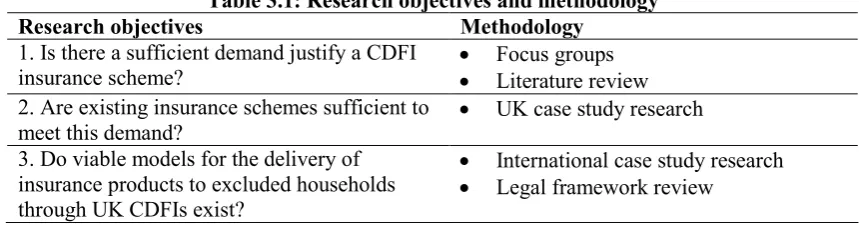
The main objective of this research project is to establish whether CDFIs can be effective conduits for insurance products targeted at the low-income, financially excluded households. In turn, the effectiveness of CDFI provision of insurance depends on three factors:
- Is there a sufficient latent demand among CDFI clients and target clients to justify a CDFI insurance scheme?
- Are existing insurance schemes aimed at the financially excluded sufficient to meet this demand?
- Do viable models for the delivery of insurance products to excluded households through UK CDFIs exist?
[image:24.595.81.511.310.423.2]In order to meet the research objectives set out above we developed and applied a multi-faceted methodology (Table 3.1).
Table 3.1: Research objectives and methodology Research objectives Methodology
1. Is there a sufficient demand justify a CDFI insurance scheme?
• Focus groups
• Literature review 2. Are existing insurance schemes sufficient to
meet this demand?
• UK case study research
3. Do viable models for the delivery of insurance products to excluded households through UK CDFIs exist?
• International case study research
• Legal framework review
3.2.Focus groups
Ultimately, the feasibility of a new product hinges on the willingness among actual and potential CDFI clients to purchase such a product. To explore the demand for insurance products among target customers, we conducted five focus groups with 31 target clients and actual clients participated (Table 3.2).
Table 3.2: Focus groups
Date Venue Group Participants
20th November
Lower Kersal Community Centre, Salford
Low-income CDFI target
clients 7
20th November
Lower Kersal Community Centre, Salford
Low-income CDFI target
clients 6
1st
December
Somali Brawanese Cultural Centre, London
Somali Brawanese
community 3
8th
December
Wild Goose Resource Centre, London
Zimbabwean community
10
15th January
Preston Moneyline, Preston CDFI clients
5
Total number of focus group participants:
31
The focus groups explored four topics linked to insurance (the completed Topic Guide can be found in Appendix C):
[image:24.595.82.511.518.694.2]explored focus group participants’ attitudes towards insurance products and insurance companies.
- Experience with insurers: Past positive and negative experiences with insurance companies may influence a household’s decision to take out insurance or not, even if it is not their own experience. Thus we asked the participants of their experience and that of their friends and relatives with insurance policies and companies. - Possession of insurance: We asked focus group participants if they were currently
insured and if they had been insured in the past. We also discussed reasons for having and not having insurance.
- Ideal protection products and suppliers: At the end of the focus group, the participants were asked to describe their ideal insurance product. This included cover, how they would prefer to buy the product (i.e. doorstep, face-to-face), service it (i.e. direct debit or cash) and who they would prefer to supply it (e.g. landlord, third sector lender).
3.3.UK case study research
As part of the research project we conducted case studies of three insurance schemes aimed at the financially excluded in the UK:
- Options for Life: This was an insurance broker for term life insurance to financially excluded consumers started by and marketed through the debt advice charity Christians Against Poverty.
- Age Concern Insurance: Age Concern has been marketing and selling a wide range of insurance products specifically designed for the elderly since the 1980s. - Social housing landlord insurance: Social housing landlords have been
delivering HCI policies targeted at and specially designed for social housing tenants for several decades. The case study of social housing landlord insurance was generic and did not focus on one specific scheme.
The review of UK schemes for the delivery of insurance products to low-income households is an important part of the study for two reasons. First, they offer an indication as to the extent to which existing initiatives are sufficient to cover the demand and need for insurance among low-income households. Second, such a review can reveal challenges in working with the lower-income market segment, as well as good and bad practice in delivering insurance.
The case study research focused on four aspects of the model:
- Affordability: This is an important aspect because financially excluded households have limited resources to pay for insurance and yet there may often be greater costs associated with delivering insurance to this segment of the population (face-to-face delivery, potentially greater risks of claiming etc).
- Marketing and take-up: The ultimate litmus test for the provision of insurance to financially excluded households is the absolute and relative take-up and the dent it makes in the proportion of uninsured households.
- Additional support and discontinuation: These are important aspects to consider, especially because discontinuation on some insurance products can lead to claw-back of premiums paid in and therefore threaten the sustainability of a scheme. - Sustainability: As far as possible we also tried to ascertain the extent to which the
The case study research was based on telephone and face-to-face interviews with relevant technical staff and managers of the insurance schemes (see Interview Guide in Appendix A). Moreover, where possible we consulted and reviewed studies, consultancy reports, business plans and annual reports.
3.4.International case study research
We also conducted case study research on five international MFIs that deliver insurance. Drawing on the experience of the international microfinance sector in providing insurance for the financially excluded is an important component of the research. Because many MFIs have already incorporated insurance provision alongside microcredit and savings products, their experience may provide a valuable insight into the potential institutional impact (human resources, structures and processes) of such a move for a community finance organisation.
However, selecting international microfinance institutions appropriate for comparison and conducive for identifying best-practice can be challenging. The market place and the regulatory framework within which they operate may often be markedly different from that of the UK CDFI sector. Therefore, we developed a set of criteria guiding the case study selection:
- Partner-agency models: The MFI in question would have to operate in partnership with an insurer rather than offering insurance on an in-house basis. Much of the lessons from in-house schemes are in areas such as reinsurance, actuarial science and risk management, which will be not of much use for CDFIs as any feasible model in the UK is likely to build on a partnership model.
- Non-member based MFIs: We decided only to focus on member, non-mutual MFIs. This was partly because member-based MFIs, such as credit unions and cooperatives, are often regulated in a very different way from non-member based MFIs, and in some cases, they are able to offer insurance products under the regulatory radar as member benefits (Churchill et al, 2003).
- Non-compulsory products: As far as possible we opted for MFIs delivering voluntary insurance products. Although compulsory insurance policies are administratively less onerous, less costly and often bypass problems such as adverse selection, CDFIs are unlikely to offer such products because it would contradict the goal of empowering their clients to access financial products corresponding to their particular needs.
- Innovative practices: Emphasis was also put on the development and application of innovative practices. Especially we looked for innovation making policies more affordable, reducing costs in distribution and marketing, and in reducing risks. - Geographic spread: As far as possible, we also aimed at achieving a good
geographic spread with representation of most parts of the world. However, geography was a secondary concern to the potential institutional lessons for CDFIs.
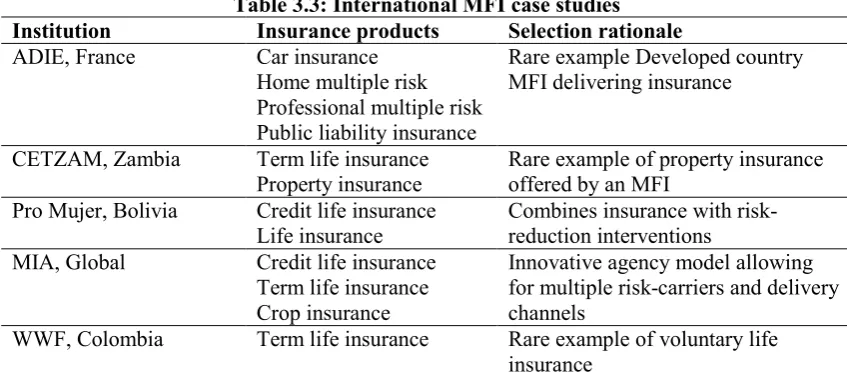
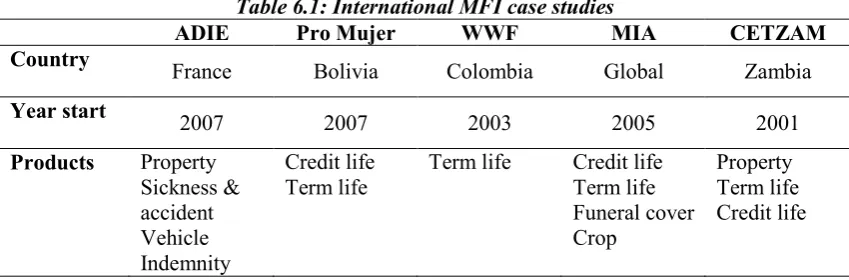
After an extensive review of existing web-based documentation and information, we conducted case studies of five MFIs (Table 3.3).
Table 3.3: International MFI case studies Institution Insurance products Selection rationale
ADIE, France Car insurance Home multiple risk Professional multiple risk Public liability insurance
Rare example Developed country MFI delivering insurance
CETZAM, Zambia Term life insurance Property insurance
Rare example of property insurance offered by an MFI
Pro Mujer, Bolivia Credit life insurance Life insurance
Combines insurance with risk-reduction interventions MIA, Global Credit life insurance
Term life insurance Crop insurance
Innovative agency model allowing for multiple risk-carriers and delivery channels
WWF, Colombia Term life insurance Rare example of voluntary life insurance
The case study research was based on telephone and face-to-face interviews with relevant technical staff and managers of the insurance schemes (see Interview Guide in Appendix B). Moreover, where possible we consulted and reviewed studies, consultancy reports, business plans and annual reviews.
3.5.Regulatory framework review
Ultimately, the ability to provide insurance policies through CDFIs depends on whether such a scheme would comply with current legislation. The review focused on the possibility of exemption of CDFIs from relevant legislation (as is the case with social housing landlords) and on the potential regulatory requirements for CDFIs if they were to distribute insurance as a) an introducer, b) an agent and c) a broker.
4.
Demand for insurance products among CDFI target clients
This chapter presents the findings of the focus groups concerning possession of and attitudes towards insurance conducted with Somali Brawanese, African Community Partnership, CDFI target clients and actual CDFI clients. The discussions and many of the questions guiding the discussion centred mainly on HCI, but focus group participants also discussed other types of insurance, such as extended warranty often sold with electrical goods, mobile phone insurance, life insurance, travel insurance and car insurance.
The chapter is organised into seven sections. The two first sections explore the attitudes towards and experiences respectively of focus group participants of insurers. The third looks at the possession of insurance and the fourth explores reasons for having and not having different types of insurance. The fifth looks at how households cope with external shocks in the absence insurance, while the sixth section explores aspects of ideal protection products in the eyes of the focus group participants. Finally, we discuss the implications of the findings for CDFIs wanting to deliver insurance.
The focus groups revealed that the participants generally held negative views of insurance. This was especially the case for the participants with bad experiences. The majority, 23 out of 31, of the participants did not have HCI for reasons of cost, bad experiences and that they had yet to consider it seriously. The ideal protection product was simple, affordable and comprehensive and was sold face-to-face and with the option of paying in cash.
4.1.Attitudes towards insurers
The attitudes that households hold towards and the experience they have had with insurance and insurance companies can play a role in determining whether people take out insurance or not. Research suggests that a poor reputation in settling claims can severely dampen demand for insurance products (Leftley, 2005). Indeed, the findings presented in this chapter indicate that both bad experiences and negative attitudes shape people’s propensity to take out HCI.
When asked about what they immediately associated with insurance, participants’ reactions ranged from fairly positive (‘a safety net’) or neutral (e.g. defining insurance) to outright negative (‘rip-off’ and ‘a con’), as illustrated by these comments:
“Are they going to cheat you when you try and claim?” Male CDFI target client
“I just think it’s a safety net really. It is a necessary evil unfortunately, I think, in today’s climate.”
Female CDFI target client
“Mostly we think about insurance for the house because that’s the main thing that you have to have”
Male, Somali Brawanese community
“The charge that you pay to have peace-of-mind insurance that your product or what you own is working for the next few years.”
Male, Somali Brawanese community
“Somebody wanting something for nothing. You pay them a lot of money and most of the time you’re not getting anything back.”
Female CDFI client
“I think the first thing that comes to mind is rip-off” Female CDFI target client
The negative perceptions of insurance and insurers appeared to be rooted in three criticisms.
4.1.1. Disagreement with principles of insurance
For some focus group participants their dislike of insurance arose from a disagreement with the principles of insurance. This sentiment was particularly strong among focus group participants with the African community. The aspect of insurance found to be most difficult to accept was that policy-holders would not get this money back unless they made a claim on their policy:
“House insurance as well. If you don’t pay, you lose your money. You pay certain amount of money. If you stop paying you lose.”
Female, African community
“I don’t like insurance. I paid £399 – £20 a month – and when I stopped paying it I lost the money. It isn’t worth it.”
Female, African community
“And if you don’t claim, I think they should give you...half or a quarter of that money you’ve paid that year”
Female African community
“My mother…stopped [paying her life policy] and the [insurance company] did not give her back the money she had paid in. So I don’t think what the insurance companies are doing is right”
Female African community
4.1.2. Distrust in insurers’ handling of claims process
Many focus group participants did often not believe that insurers would pay out if they were to claim. Insurers, they believed, would use loopholes and fine print to avoid having to pay out:
“There are so many loopholes in the insurance that if one thing is wrong, that’s it: you lose all your money.”
Female, African community
“The other thing I worry about insurance is what’s the loop holes they’ve got…You’re claiming this: Oh you’re not entitled to that.”
Male CDFI target client
“All the small writing. You normally don’t know what you’re putting yourself into”
Male CDFI target client