i
OPTIMISATION OF INSULATOR DESIGN FOR IMPROVED ELECTRIC FIELD PERFORMANCE
HAIRILASRI BIN AHMAD
A project report submitted in partial fulfillment of the requirement for the award of degree
Master of Electrical Engineering
Faculty of Electrical and Electronic Engineering, Universiti Tun Hussein Onn Malaysia
v ABSTRACT
vi ABSTRAK
vii
TABLE OF CONTENT
TITLE ...I DECLARATION ... II DEDICATION ... III ACKNOWLEDGEMENT ... IV ABSTRACT ... V ABSTRAK ... VI LIST OF FIGURES ... X LIST OF TABLES ... XII LIST OF SYMBOLS AND ABBREVIATIONS ...XIII
CHAPTER 1 INTRODUCTION ... 1
1.1 Background... 1
1.2 Problem Statement... 3
1.3 Objectives ... 4
1.4 Scope Of Project ... 5
1.5 Thesis Outline ... 5
CHAPTER 2 A REVIEW ON POLYMERIC OUTDOOR INSULATOR ... 7
2.1 Introduction... 7
2.2 Polymeric Insulators ... 8
2.3 Electric Field ... 10
2.4 Degradation of Polymeric Insulators ... 13
2.4.1 Electrical Stresses ... 13
2.4.1.1 Corona Discharges ... 14
2.4.1.2 Formation of Dry Bands ... 15
viii
2.4.1.4 Insulator‟s Flashover ... 16
2.4.2 Environmental Stress ... 17
2.4.3 Mechanical Stress ... 18
2.5 Field Optimisation Techniques ... 18
2.5.1 End Fittings Design ... 19
2.5.2 Weather Shed Insulation ... 20
2.5.3 Corona Ring ... 20
CHAPTER 3 RESEARCH METHODOLOGY ... 21
3.1 Introduction... 21
3.2 Finite Element Method ... 22
3.3 COMSOL Multiphysics ... 22
3.4 Project Process Flow... 23
3.5 Insulator Model ... 24
3.5.1 Modelling Simulation ... 24
3.5.2 Material Properties ... 25
3.5.3 Boundary Conditions ... 26
3.5.4 Meshing ... 26
3.5.5 Solver Study ... 26
CHAPTER 4 RESULT, ANALYSIS AND DISCUSSION ... 27
4.1 Introduction... 27
4.2 Electric Field Analysis ... 27
4.3 Electric Field Optimization Techniques ... 29
4.3.1 End Fitting Design ... 29
4.3.2 Insulator Weather Shed Profile ... 34
4.3.3 Corona Ring Installation ... 38
4.3.3.1 Horizontal Location of Corona Ring ... 40
4.3.3.2 Vertical Location of Corona Ring ... 41
4.3.3.3 Diameter of Corona Ring ... 42
ix
CHAPTER 5 CONCLUSION ... 46
5.1 Conclusion ... 46
5.2 Future Work Recommendation ... 47
x
LIST OF FIGURES
Figure 1.1 : Polymeric outdoor insulators ... 2
Figure 2.1 : Classification of power line insulators ... 8
Figure 2.2 : Cross section of composite insulator... 10
Figure 2.3 : Illustration of electric field ... 12
Figure 2.4 : Corona discharge effects in electrical transmission line ... 15
Figure 2.5 : Examples of the E-field distribution surrounding three different designs of composite insulator end fittings ... 19
Figure 3.1 : Flow chart of electric field optimisation for polymeric insulator ... 23
Figure 3.2 : Insulator model dimension ... 24
Figure 3.3 : 2D assymentric view of insulator model ... 25
Figure 4.1 : Electric field distributions along the 11 kV polymeric insulators... 28
Figure 4.2 : Equipotential lines around polymeric insulators ... 29
Figure 4.3 : Three configuration of end fitting design for polymer insulator ... 30
Figure 4.4 : Equipotential plots at HV terminal for three configuration end fitting designs ... 30
Figure 4.5 : Tangential field distributions along the leakage path for three different configuration of end fittings ... 31
Figure 4.6 : Optimisation of radius parameter for end fitting round edges ... 32
Figure 4.7 : Electric field distribution closed to the HV terminal ... 33
Figure 4.8 : Insulator profile with various distance between flanges to the shed: a) 7mm b) 24mm c) 35mm ... 34
Figure 4.9 : Equipotential lines at HV terminal for different profiles ... 35
Figure 4.10: Tangential field distributions along the leakage path near end fitting ... 36
Figure 4.11: Shed designs with shed radius optimisation ... 37
Figure 4.12: Optimization parameters for corona ring study ... 38
xi
Figure 4.14: Electric field distributions at leakage path 0.150m upwards ... 40
Figure 4.15: Design of proposed insulator ... 42
Figure 4.16: Equipotential lines for proposed insulator design ... 43
Figure 4.17: Electric field distributions closed to energized end fitting ... 44
Figure 4.18: Equipotential lines for proposed insulator design ... 45
xii
LIST OF TABLES
Table 3.1: Materials properties of insulator model ... 25
Table 4.1 : Comparison of tangential electric field ... 32
Table 4.2 : Reduction of electric field ... 34
Table 4.3 : Comparison of tangential electric field ... 36
Table 4.4 : Electric field performance of insulator with various radiuses ... 37
Table 4.5 : Optimised values of parameter D1 ... 41
Table 4.6 : Optimised values of parameter D2 ... 41
Table 4.7 : Optimised values of parameter D3 ... 42
xiii
LIST OF SYMBOLS AND ABBREVIATIONS
SiR - Silicone Rubber
EPDM - Ethylene Propylene Diene Methylene
EPR - Ethylene Propylene Rubber
FEM - Finite Element Method
BEM - Boundary Element Method
2D - Two Dimension
3D - Three Dimension
FRP - Fiber Reinforced Rod
IEC - International Electric Commission
ZnO - Zinc Oxide
UV - Ultra Violet
HV - High Voltage
kV - Kilo Volt
rms - root mean square
mm - Milimetre
cm - Centimetre
m - Metre
E - Electric Field
F - Force
Q - Charge
εr - Realtive Permittivity
1 CHAPTER 1
INTRODUCTION
1.1 Background
2
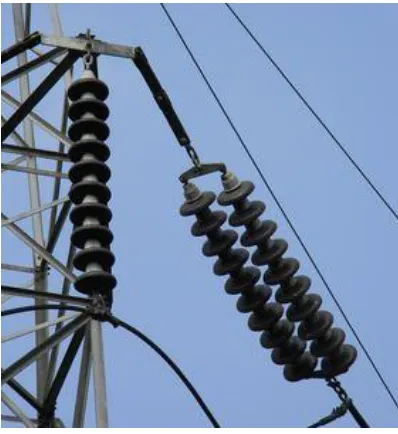
[image:12.612.227.426.245.462.2]Outdoor insulators are subjected to outdoor environmental stresses such as humidity, temperature and pollution. It has been used in electricity distribution systems to support, separate or contain conductors at high voltage. Therefore, it has dual functions as electrical equipment and also as mechanical equipment in the power system networks. As electrical equipment, it provides electrical support by insulating between conductors and transmission tower or pole and separating conductors in the transmission line. Insulators are used as mechanical equipment in providing mechanical support by supporting the load in the transmission line as shown in Figure 1.1 below.
Figure 1.1 Polymeric outdoor insulators
3
composite insulators is one shot moulding. This is the most commonly used technique today. By using this technique, the housing can be chemically bonded to the core. Therefore, the number of interfaces where moisture can penetrate is minimized.
Despite their lower weight, the easier handling, the reduced installation and maintenance cost and their better performance under high pollution conditions, composite insulators are more sensitive to the magnitude of electric field strength. High values of the electric field intensify the corona effect around conductors and causes general audio noise, radio noise, partial discharges and premature deterioration of the insulation quality [5, 6]. Moreover, environmental factors such as heat, ozone, UV radiation, salt and dust deposition, acid rain and wind are responsible for the gradual loss of the hydrophobicity of the polymer material [7].
There are many shapes and types of insulators used in power system transmission with different densities, tensile strengths and performing properties with the aim to withstand the worst conditions such as surge during lightning and switching operations which will voltage to spike. Reliability of the insulator is the most important property that must take into consideration whether it is a polymeric (composite) insulator or ceramic insulator. The good insulator should offer optimum electrical and mechanical strengths.
1.2 Problem Statement
4
The presence of pollution layer on composite insulator is very frequent near industrial, agricultural and coastal areas. Existence of pollution layer and combination with moisture due to wet weather condition such as dew, fog or drizzle, becomes conductive and leakage current flows through it. Due to flow of leakage current, dry bands may form on the insulator surface and the distribution of electric field and potential to become distorted and flashover may occur.
The study of electric field on polymeric insulator when subject to high voltage provides an important insight to improve the performance of the insulator. The design of a post insulator plays an important role in the insulator‟s performance. The insulator‟s shed profile can affect the water collection on the insulator‟s surface and may influence the electric field stress distribution along the insulator‟s surface.
Therefore, for the electric field control purpose, it is important to study these effects from a practical standpoint. The design of end fitting shape of polymeric insulators need to carefully designed to ensure the occurrence of corona in the vicinity of end fitting on the insulator to be kept at minimum frequency as possible. The performance and reliability of insulators may improve with the continuous improvement in the design.
1.3 Objectives
The main aim of this project is to optimize the electric field distribution around the insulator and furthermore to improve electric field performance. The objectives to be achieved are:
a. To simulate and analyse electric field distribution around polymeric insulators. b. To evaluate the effect of insulator shape and attachment structure towards
electric field performance under various weather conditions.
5 1.4 Scope of Project
For this project, polymeric insulator model chosen to develop is used for 11 kV. The focuses on this project are as follow:
i. The modelling and simulation work is accomplished using Finite Element Methods (FEM).
ii. 2D modelling and simulations for more realistic and accurate electric field computations.
iii. Insulator developed is ideal without considering any attached or nearby structure.
1.5 Thesis Outline
The thesis can be divided in five main chapters. Chapter 1 mainly focuses on the background of the project which is the problems faced by polymer insulators and the objectives that driven this project. The limitation of the project has been discussed in scope of project section.
Chapter 2 briefly discusses on polymeric insulators and factors that affecting insulators degradation. The influence of electric field on insulator performance and the techniques to optimize the electric field are reviewed.
In chapter 3, the method to investigate electric field distribution on insulator via computer software simulations is discussed. Finite element method is employed for insulator modelling to determine electric potential and field distribution along the leakage path under dry clean conditions. A model of 11 kV polymer insulators is used to identify the effectiveness of optimization techniques employed.
6
location are obtained. All the simulation results, discussion and analysis are made to study the influence of proposed methods on electric field distribution on the insulator.
7 CHAPTER 2
A REVIEW ON POLYMERIC OUTDOOR INSULATOR
2.1 Introduction
8
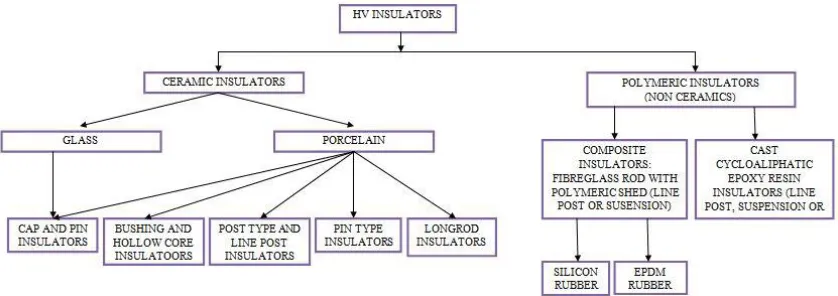
Figure 2.1 Classification of power line insulators
Porcelain insulators have a long journey of history. Initially, it has been used in the telegraph line at the beginning of the fourth decade of 19th century before the expansion of the usage for power lines area. In the 1960‟s an insulator having porcelain sheds supported by an epoxy resin fiberglass rod was developed [40]. However, the usage was not wide because of further developments in lighter weight polymeric insulating materials has taken place. Both porcelain and glass have outstanding insulating properties and weather resistance. However, they are lack in terms of their bulky size which becomes more difficult to install in remote area, vulnerable to vandalism and also the performance in polluted area are poor. This is due to its hydrophilic properties which enable water to easily form a continuous conductive film along the creepage path. This formation has encouraged the flashover and could cause the failure in power transmission lines.
2.2 Polymeric Insulators
9
since then, they became major option for utility companies around the world. After the introduction of polymeric insulators, the privilege to use it as a replacement for glass and ceramic has tremendously increase globally since the wide range of attractive advantages offered. They are easy to install due to their light weight and less prone to damage due to vandalism because of their elasticity surface. One of their major advantages is their low surface energy [9, 10] and thereby able to maintain a good hydrophobic surface property in presence of wet conditions such as fog, dew and rain [11]. Due to their hydrophobic surface, leakage current is reduced since it prevents water to form solid conducting layer on its surface.
10
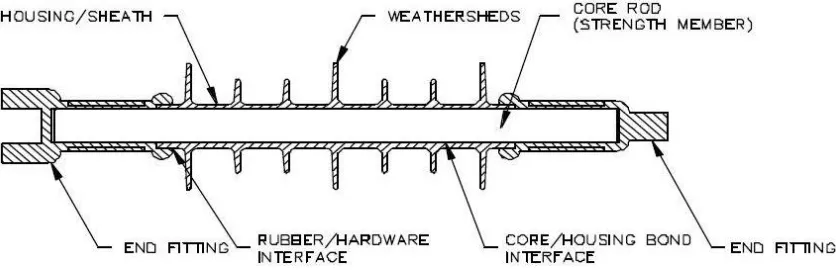
Figure 2.2 Cross section of composite insulator
The insulators selection for different voltage rating is depending on minimum specific creepage distance and IEC60815 standard requirements [41]. Regarding to the electrical and mechanical characteristics, the insulators are designed to satisfy the requirements set forth in IEC61109. During designing a perfect insulator, internal and external discharge activities are consider under normal condition [13].
Despite the numerous advantages offered by polymeric insulators, there are also some disadvantages of these insulators. The main disadvantages of composite polymeric insulator are that they are subjected to chemical changes on the surface due to weathering and from dry band arcing [19], suffered from erosion and tracking which may lead ultimately to failure of the insulator [20], the difficulty to evaluate life expectancy, long reliability is unknown and faulty insulators are difficult to detect.
2.3 Electric Field
11
compared to porcelain insulators. Electric field distribution of a composite insulator generally is more nonlinear than that of porcelain insulators.
The electric field intensity or known as the electric field strength is defined as the electrostatic force, F per unit positive test charge, q placed at a particular point, p in a dielectric [14]. It is denoted by E with the SI unit is Newton per Coulumb which is equivalent to volt per meter. Since force is a vector, then the electric field is classified as vector quantity which the direction of the field is taken to be the direction of the force it would exert on positive test charge. Field strength of 1 v/m represents a potential difference of one volt between points separated by one meter. The electric field is radially outward from a positive charge and radially inward toward a negative point charge. The relationship between electric field and force is given in equation below:
q F
E Equation 1
Referring to the Equation (1), the magnitude of the force is equal to qE and the direction of the force on a positively charged particle. The force on a negative particle is opposite to the field direction.
12
Figure 2.3 Illustration of electric field
Figure 2.3 shows the potential difference Uab between point a and point b having
scalar potential ϕa and ϕb in an electric field, E, which is defined as the work done by an
external source in moving a unit positive charge from b to a.
a
b
b a
ab Edx
U Equation 2
The rate of change between potential with distance will give the magnitude of electric field intensity. When the direction of E is opposite to the direction in which the potential is increasing most rapidly, the magnitude of the field intensity is at maximum.
max max
E dx
dUab
Equation 3
A physical interpretation of the electric field intensity finding process from the scalar potential, ϕ is given by Equation (3). The electric field intensity can be obtained from the potential gradient operation on the potential as shown in equation below:
13
Electric fields in high voltage cause polarization and electric losses in polymeric insulators [15]. High values of the electric field intensify the corona effect around conductors and cause in general audio noise, radio noise, partial discharges and premature deterioration of the insulation quality [16, 17]. When the insulator is exposed to the higher electric field, it will suffer from the phenomenon of electrical breakdown. Insulators become conductive when they reach at the breakdown level. In long term, space charge accumulation can persist within the insulation and its surface and this can produce localised breakdown at the intense electric field regions which can lead to erosion on the insulator [18].
2.4 Degradation of Polymeric Insulators
The performance of polymeric insulators may be affected and weakened by multiple stresses encountered in service. Reservations have been voiced in the past regarding the use of polymeric insulators, given their organic nature. Continuous service stress can lead to deterioration of the surface of the properties such as loss of hydrophobicity, discoloration, chalking and cracking. When the environmental stresses overwhelm or the severe contamination dominate, the material starts degrading [21]. Polymeric has weaker ionic bonds in contrast to covalent bonds in ceramic because of its compound chemical bond is subjected to chemical reaction. Beside material and design of the insulator, other factors that contribute to its degradation and ageing are electrical, mechanical and environmental stress [22, 23]. Polymers unlike ceramic and glass are organic materials that can degrade or age under these stresses.
2.4.1 Electrical Stresses
14 2.4.1.1 Corona Discharges
Corona is phenomenon that has the capability for degrading insulators, and can cause systems to fail. It is also known as partial discharge where type of localized emission resulting from transient gaseous ionization in an insulation system when the voltage stresses or voltage gradient exceeds its critical value. There are three types of corona which are plume, brush and glow. Plume is the most spectacular corona and it is called as so because of its general resemblance to a plume. It also has audible manifestations which are rather intense snapping and hissing sound. Brush corona is a streamer projecting radially from the conductor. The audible manifestation that is associated with brush corona is generally a continuous background type of hissing or frying sound. The glow corona is a very faint, weak light which appears to hug the conductor‟s surface and there is generally no sound that is associated with it.
Corona can occur within voids in insulators as well as at the conductor‟s or insulator‟s surface. The formation of corona is dependent upon atmospheric conditions such as air breakdown humidity and insulator‟s geometry. High potential area for the formation of corona discharge is at highly curved regions on electrodes, such as sharp corners, projecting points, edges of metal surfaces or small diameter wires. The high curvature causes a high potential gradient at these locations. Therefore, to suppress corona formation, terminals on high voltage equipment are frequently designed with smooth large diameter with rounded shape and corona rings are often added to insulators of high voltage transmission lines. The potential distribution depends on the insulator‟s length and the voltage stress at the terminal that is proportional to the line voltage and then fall rapidly with the increasing distance from terminal [24].
15
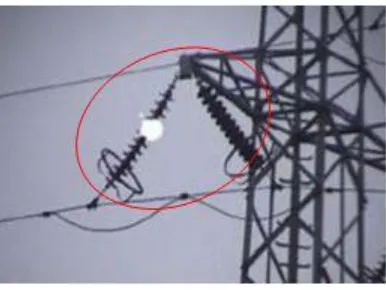
[image:25.612.231.424.131.276.2]chemical and thermal stresses consequently results in the degradation of the insulation material and is believed to causes mechanical failure on the entire insulator.
Figure 2.4 Corona discharge effects in electrical transmission lines
Audible and radio frequency noises that are generated from corona discharge may affect the area particularly near to electric power transmission lines. Corona discharge is undesirable in power transmission since it will cause the loss of power. Furthermore, ozone and nitrogen oxide that are produced can also be harmful to human‟s health where power lines run through settlements area.
2.4.1.2 Formation of Dry Bands
16 2.4.1.3 Wetting Discharges
The water droplets play several roles in the pollution flashover and aging of composite insulators, because of high permittivity and conductivity of water droplets, electric field intensity increases at the insulator surface [27]. It may lead to the breakdown of the insulator even though without the presence of actual contaminants. The surface corona discharges from water droplets age the weather shed material of the insulator. This phenomenon has led to the demolishing hydrophobicity and causing the dispersed of water and adjacent water droplets to coalesce. One of the aging mechanisms responsibles for the failure of the insulators is discharges on the surface of polymeric insulators. The discharges usually occur between water droplets on the insulator‟s surface. This will create several radicals and ionized species that may chemically react with the insulator‟s surface. Therefore, the original properties of dielectric materials may change. Water droplets will intensify the electric field strength on the insulator‟s surface under rainny and foggy conditions.
2.4.1.4 Insulator’s Flashover
Operation of composite insulators is also exposed to the flashover phenomenon that is caused by switching surge or lightning surge and contamination. It can result in insulator‟s failure. Contamination increases surface conductivity which causes flashover to persist after the arc has been initially cleared, allowing subsequent flashover to occur on reclosed. It is believed that failure due to such flashover is very much dependent on the duration of the faulty current [35].
17
polymeric insulators, the creation of partial arcs will lead to erosion and chemical degradation on the insulating material. These partial arcs‟ discharges will elongate along the insulator‟s profile due to the surface resistance which is sufficiently low and may eventually cause the insulator‟s flashover.
2.4.2 Environmental Stress
Polymeric insulators perform satisfactorily at the beginning of their service but will deteriorate due to continuous exposure to the stresses including environmental stress. Both mechanical and electrical performance of the insulators can affect by the environmental stresses. The environmental effects include ultraviolet (UV), moisture, heat, light, atmospheric pressure and biological degradation which are caused by microorganism in air [28]. Depending on the application and location of the installed insulator installed, one or more factors can act together to cause aging.
One of the major factors responsible for degradation of polymeric insulator is ultraviolet light. Insulators are exposed to sunlight under ultraviolet radiation. The main sources of ultraviolet light are sun, corona formation and dry band arcing activities on insulator‟s surface. The ability to resist degradation resulting from ultraviolet exposure is an important factor in determining the service life of insulators. The energy from sunlight that is destructive to polymers is between 320 nanometers and 270 nanometers [29]. The absorption of this UV radiation is the result of mechanical and chemical degradation of the polymer structure which can affect the dielectric and weathering properties of that polymer. The rate at which the degradation occurs is dependent upon the intensity and wavelength of the radiation.
The presence of moisture obviously will accelerate the effects on the insulator‟s surface. This condition is becoming even worse by the presence of surface contamination due to pollution. Ultraviolet radiation on polymer will result in negative effects as include:
i. Crazing, checking or cracking of the surface ii. Loss of hydrophobicity
18
Pollution is one of the main causes of flashover in the insulators. When the pollutants exist in the air settle on the insulator‟s surface and combine with the humidity of the fog, rain or dew, it will drive the insulator to fail. Chemical attack occurs due to pollution of the products and following of discharge activity on the insulator‟s surface. The mixture of pollutants, plus the humidity forming a layer that can become conductor and allowing passing currents will facilitate the conditions of short circuit. This is due to a decrease of the resistance of the insulator surface and could cause the tracking and erosion surface materials of polymeric insulators.
Water ingress in polymeric insulator occurs in three ways: i) through poor seals at end fittings, ii) through surface defect or damages, iii) through absorption of water into the polymeric material itself [30]. Corrosive chemicals and/or ionisable contaminants that are carried by the water affect the mechanical strength of the FRP rod and this is known to cause brittle fracture. Water absorption causes depolymerisation as well as polarisation of the interfaces between the polymer and the fillers. The permittivity and loss tangent will increase while the dielectric strength will decrease.
2.4.3 Mechanical Stress
Direct mechanical stress on insulators can be tensile, compressive or cantilever loading [30]. These stresses can cause the failure by damaging the fibre reinforced plastic (FRP) core. Mechanical stresses usually affect the insulator in combination with other stresses. Indirect mechanical stresses trap during the manufacturing process. This will provide arcing regions which would cause tracking and erosion.
2.5 Field Optimisation Techniques
19
insulator can also be reduced. Hence, various techniques can be considered in controlling E-field distribution along insulators.
2.5.1 End Fittings Design
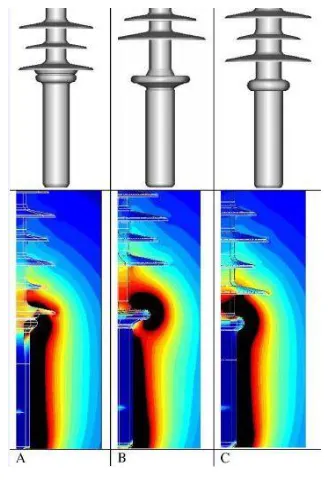
[image:29.612.263.427.285.528.2]The design of the end fitting has an influence on the E-field distribution within the composite insulator on the surface of weather shed material and on the surface of the metallic end fittings. The large end fittings design with rounded edges tends to reduce the peak magnitude of the E-field values in close proximity of the end fittings [31]. Figure 2.4 below shows the distribution of E-field for three different end fittings designs.
End fitting closed to the last shed
End fitting at a short distance from the last shed End fitting partly covered by silicone rubber
20 2.5.2 Weather Shed Insulation
In controlling the E-field magnitude, the geometrical shape of polymeric insulators should be taken into consideration. The weather sheds provide the required leakage distance and currently are supplied with different materials, shapes, diameters, thickness and spacing. In the compounding of the weather sheds, fillers are added to enhance the resistance to tracking and erosion as well as to provide improved mechanical performance in tensile strength, abrasion resistance, tear strength, modulus and to reduce flammability.
Gorur et al. [31] has conducted a study on the effect of polymer insulator profile on the erosion and tracking performance in salt fog. From the study, it was found that insulators with protected profiles maintained their initial surface hydrophobicity for a much longer time with low levels of leakage currents than other designs. The self-cleaning aspect of insulators is important for polymeric insulators with large shed spacing and insulators with alternating diameter sheds have shown better performance under both desert and coastal conditions that insulator with straight sheds, which also allows for reduced shed spacing designs [32]. As such, from the previous studies, it has shown that the shed profile influences the performance of insulators, particularly under contaminated conditions.
2.5.3 Corona Ring
21 CHAPTER 3
RESEARCH METHODOLOGY
3.1 Introduction
This chapter is discussing on how the work is carried out in order to obtain the aims of this project. The purpose of this project is to identify the highest electric field region along the polymeric insulator. After the determination of the highest region, optimisation technique is used to control and reduce the electric field. The reduced intensify of electric field can help the insulator to improve its performance and furthermore will improve its reliability. Several methods have been developed for the computation of electric fields and potentials along an insulator string.
22
3.2 Finite Element Method
Finite element method (FEM) is a numerical analysis technique which is used to obtain solutions to the differential equations. It has been applied widely in a variety of physical and also non-physical problems. These problems include diversity from solid, fluid and soil mechanics to electromagnetism or dynamic. The method essentially consists of assuming the piecewise continuous function for the solution and obtaining the parameters of the functions in a manner that reduces the error in the solution [39].
The FEM is most convenient for a field with many dielectrics, heterogeneous and non-linear materials, complex fields and a field containing distributed space charges and singular point. It is one of the most successful numerical methods for solving electrostatic field problems because it involves discretization of the domain according to the anticipated value of field distributions [38]. It is also a flexible method that is well suited to problems with complicated geometry. The FEM leads to comparatively simpler techniques for estimating fields at highly curved and thin electrode surfaces with different dielectric materials.
3.3 COMSOL Multiphysics
Finite elements simulation for the developed insulator is carried out using COMSOL Multiphysics software. It is the software that is used as a finite element analysis, solver and simulation software for various physics and engineering applications especially coupled phenomena or multiphysics.
23
For the evaluation of the results, the plot is generated by simulation in terms of variables or parameters.
3.4 Project Process Flow
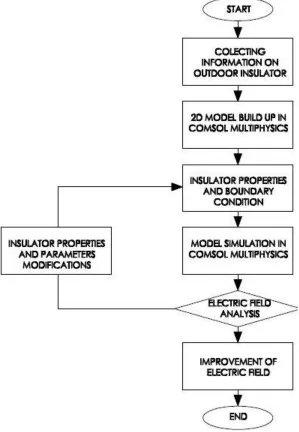
[image:33.612.198.497.250.682.2]In obtaining and analysing electric fields distribution, the process flow of the project can be simplified in Figure 3.1. The flow chart shows all of the processes involved starting from the initial stage until the desired results is obtained.
24
3.5 Insulator Model
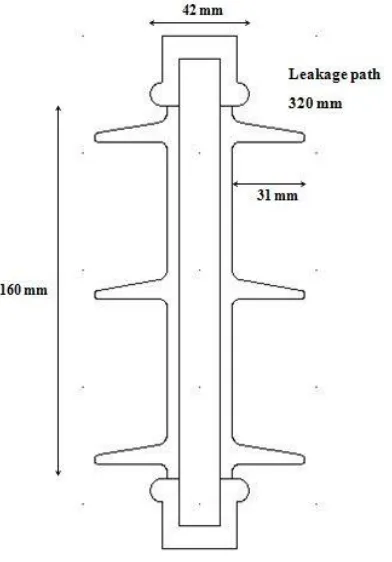
[image:34.612.247.443.217.498.2]For the project purpose, the model of insulator with rated voltage of 11 kV was developed. The model of insulator is shown in Figure 3.2 below. Simulation of the insulator is being considered to be under dry clean condition and uniform wet pollution. Insulator model is also considered in ideal condition without considering any attached or nearby structure and other hardware perpherals.
Figure 3.2 Insulator model dimension
3.5.1 Modelling Simulation
48
REFERENCES
[1] Hackam, R., “Outdoor high voltage polymeric insulators”, Proceedings of 1998
Interntational Symposium on ISEIM, pp. 1-16, 1998.
[2] R. S. Gorur, D. Shaffner, W. Clark, R. Vinson, D. Ruff, “Utilities Share Their Insulator Field Experience”, Transmission & Distribution World, pp. 17-27,
2005.
[3] Reynders, J. P., Jandrell, I. R., Reynders, S. M., “ Surface Aging Mechanisms
and Their Relationship To Service Performance of Silicon Rubber Insulation”,
10th International Symposium On High Voltage Engineering, London, UK, 22-27th August, 1999, pp. 54-58.
[4] Hillborg, H., Gedde, U. W., “Hydrophobicity Recovery of Poly Dimethyl Siloxane After Exposure To Corona Discharges. Polymer”, 1998, 39(10): 1991-1998.
[5] B. Zhang, S. Han, J. He, R. Zeng, P. Zhu, “Numerical Analysis of Electric Field Distribution Around Composite Insulator and Head of Transmission Tower”,
IEEE Transactions On Power Delivery, Vol. 21, No. 2, pp. 959-965, April 2006. [6] R. Boudissa, S. Djafri, A. Haddad, R. Belaicha, R. Bearsch, “ Effect of Insulator
Shape On Surface Discharges and Flashover Under Polluted Conditions”, IEEE Transactions On Dielectrics and Electrical Insulation, Vol. 12, No. 3, pp. 429-437, June 2005.
[7] E. Da Silva, S. M. Rowland, “In Service Surface Degradation of MV Composite
Insulators Under Severe Environmental Conditions and Low Electric Stress”,
49
[8] J. F. Hall, “History and Bibliography of Polymeric Insulator”, IEEE Trans. PD, Vol. 8, pp. 376-385, 1993.
[9] S. WU, “Polymer Interface and Adhesion”, Marcel Dekker Inc., NY, 1982. [10] J. Israelachviii, “Intermolecular and Surface Forces”, Academic Press, 1995. [11] S. H. Kim, E. A. Cherney and R. Hackam, “Hydrophobic Behaviour of
Insulators Coated With RTV Silicone Rubber”, IEEE Trans. EI, VOl. 27, pp. 610-622, 1992.
[12] B. Marungsri, “Fundamental Investigation on Salt Fog Ageing Test of Silicone
Rubber Housing Materials For Outdoor Polymer Insulators”, Doctoral Thesis, Chubu University, Kasugai, Aichi, Japan, 2006.
[13] R. Abd. Rahman, N. Hadrid, A. Haddad, “Stress Control on Polymeric Outdoors
Insulators”, pp.1-4, UPEC2010, 31stAug–3rd Sept.2010.
[14] C. Bayliss, B. Hardy, “Transmission and Distribution Electrical Engineering”, 4th Edition, Elsevier, ISBN 0080969135, 2011.
[15] Celine A. Mahieux, Environmental Degradation in Industrial Composites. [online] Elsevier, 2005.
[16] T. Zhao, M. G. Comber: “Calculation of Electric Field and Potential
Distribution Along Nonceramic Insulators Considering the Effects of Conductors
and Transmission Towers”, IEEE Transactions On Power Delivery, Vol. 15, No. 1, pp.313-318, January 2000.
[17] B. Zhang, S. Han, J. He, R. Zeng, P. Zhu: “Numerical Analysis of Electric-Field
Distribution Around Composite Insulator and Head of Transmission Tower”,
IEEE Transactions On Power Delivery, Vol. 21, No. 2, pp. 959-965, April 2006. [18] Varlow B.R., Robertson J. and Donnelly K.P, “Nonlinear fillers in electrical
50
[19] S. H. Kim, E. A. Chemey, R. Hackam and K. G. Rutheriord, “Chemical Changes
at the Surface of RTV Silicone Rubber Coatings on Insulators During Dry Band
Arcing”, IEEE Trans. DEI, Vol. 1, pp. 106-123, 1994.
[20] R. S. Gorur, E. A. Cherney, R. Hackam and T. Orbeck, “The Electrical
Performance of Polymeric Insulating Materials Under Accelerated Aging in Fog
Chamber”, IEEE Trans. PD, Vol. 3, pp. 1157-1164, 1988.
[21] R. Sundararajan, A. Mohammad, N. Chaipanit, T. Karcher and Z. Liu, “In
Service Aging and Degradation of EPDM Transmission Line Insulators In A
Coastal Environment”, IEEE Trans. DEI, Vol. 11, No. 2, pp. 348-361, 2004.
[22] Spellman C. A., Young H. M., Haddad A., Rowlands A. R., and Waters R. T., “Survey of polymeric insulator ageing factors,” in Proceedings of the Eleventh
International Symposium on High Voltage Engineering, Conf. Publ. No. 467, 1999, pp. 160-163, Vol. 164.
[23] Souza, A.L., Lopes, I.J.S., “Electrical field distribution along the surface of high voltage polymer insulators and its changes under service conditions”, IEEE
International Symposium on ELINSL, pp. 56-59. 2006.
[24] Hartings, R., “Electrical Fields Along a Post Insulator: AC Measurements and
Calculations”, IEEE Transaction on Power Delivery, Vol. 9, pp. 912-918, 1994.
[25] Venkatesulu B. and Thomas M. J., “Corona agind studies on silicone rubber nanocomposites,“ IEEE Transactions on Dielectrics and Electrical Insulation,
vol. 17, pp. 625-634, 2010.
[26] „Environmental Stresses On External Insulation’, http://electrical- engineering-portal.com/environmental-stresses-on-external-insulation, Retrieved on 29th March 2013.
[27] Joneidi, I. A., Shavegeni, A. A. and Mohseni, H., “Electric Field Distribution
51
Layer on Polymer Insulators Using Finite Element Method”, International Journal of Computer and Electrical Engineering, Vol. 5, No. 2, April 2013.
[28] M. Amin and M. Salman, “Aging of Polymeric Insulators (An Overview),” Department of Electrical Engineering, University of Engineering and Technology, Taxila, Pakistan.
[29] R. A. Bernstorf, R. K. Niedermier and D. S. Winkler, “Polymer Compounds
Used In High Voltage Insulators,” Hubbell Power Systems, The Ohio Brass Company.
[30] Laughton, M. A., Warne, D. F., “Electrical Engineer’s Reference Book,” Sixteenth Edition, Newnes Publication, 2002.
[31] R. S. Gorur, E. A. Cherney and R. Hackam, “Polymer Insulator Profiles
Evaluated In a Fog Chamber”, IEEE Trans. On Power Delivery, Vol. 5, No. 2, April 1990, pp. 1078-1085.
[32] R. Znaidi, “Research and Assessment of Insulator Performance in Marine and
Desert Environment”, Insulator News Marketing Report, pp. 12-22, 2000.
[33] Sima W., Espino-Cortes F.P., Edward A.C. and Jayaram H.S., “Optimization of Corona Ring Design fo Long-Rod Insulators Using FEM Based Computational
analysis IEEE International Symposium on Electrical Insulation”, Indianapolis, in USA, 19-22 September 2004, pp. 480-483.
[34] Sima W., Wu K., Yang Q., Sun C., “Corona Ring Design of +/-800 kV DC
Composite Insulator Based on Computer Analysis”, IEEE International Conference on electrical Insulation and Dielectric Phenomena, October 2006, pp. 457-460.
[35] Karady, G. G. and Brown, R. L., “Flashover Mechanism of Silicone Rubber
52
[36] Muniraj. C., Krishnamorthi. K. and Chandrasekar. S., “Investigation on
Flashover Development Mechanism of Polymeric Insulators by Time Frequency
Analysis”, J Electrical Eng. Tech., Vol. 8, No. 6, pp. 1503-1511, 2011.
[37] Ilhan. S. and Ozdemir. A., “Effect of Corona Ring Desgin on Electric Field
Intensity and Potential Distribution Along an Insulator String”, IEEE ELECO, 2007.
[38] W. Sima, Q. Yang, “Potential and Electric Field Calculation along an Ice
Covered Composite Insulator with Finite Element Method”, IEEE Proceeding Generation, Transmission and Distribution, 3, 153, 2006, pp. 343-349.
[39] Dixit. U. S., “Finite Element Method: An Introduction”, Department of Mechanical Engineering, Indian Institute of Technology Guwahati-781 039, India.
[40] M. T. Gencoglu, “The Comparison of Ceramic and Non-Ceramic Insulators”, e-Journal of New World Sciences Academy, Vol. 2, No. 4, 2007.