DEVELOPMENT OF ONE CYCLE CURRENT CONTROLLER USING RASPBERRY PI FOR 3 PHASE ACTIVE POWER FILTER FOR NONLINEAR
LOAD IMPROVEMENT
MOHD HAFIZ BIN MOHAMAD SHARI
A project report submitted in partial fulfilment of the requirement for the award of the
Master Electrical Engineering
Faculty of Electrical and Electronics Engineering Universiti Tun Hussien Onn Malaysia
ABSTRACT
ABSTRAK
TABLE OF CONTENTS
TITLE I
DECLARATION II
DEDICATION III
ACKNOWLEDGEMENTS IV
ABSTRACT V
ABSTRAK VI
TABLE OF CONTENTS VII
LIST OF TABLES X
LIST OF FIGURES XI
LIST OF SYMBOLS AND ABBREVIATIONS XIII
CHAPTER 1 INTRODUCTION 1
1.0 Introduction 1
1.1 Project Background 1
1.2 Problem statement 2
1.3 Aim and Objectives 3
1.4 Limitation / Scope of Project 3
1.5 Thesis Outline 4
CHAPTER 2 LITERATURE REVIEW 5
2.1 Introduction 5
2.2 Nonlinear load 5
2.3 Active Power Filter (APF) 7
2.3.1 Harmonics in Power System Due to
Nonlinear Loads: 8
2.3.2 Brief Introduction to Active Power Filter: 8 2.3.3 Control techniques used for Active Power Filter 9 2.3.4 Digital Controller for Active Power Filter: 9
2.4 Controller Approaches for Active Power Filter 11
2.4.1 PID controller 12
2.4.2 Fuzzy logic controller 13
2.4.3 Hysteresis control 14
2.4.4 One-Cycle Control 16
2.5 Raspberry Pi 19
CHAPTER 3 METHODOLOGY 23
3.1 Introduction 23
3.2 Block Diagram 24
3.3 Linear and Nonlinear Load Design 26
3.3.1 Linear Loads 26
3.3.2 Nonlinear Loads 26
3.4 Gate Driver Design 27
3.5 Controller Design 30
3.6 Current sensor 34
3.7 Inverter Circuit Design 34
3.8 Analogue to Digital converter (ADC) 36
CHAPTER 4 DATA ANALYSIS AND RESULT 38
4.1 Introduction 38
4.1.1 Simulation analysis 38
4.1.2 Nonlinear Load Result 39
4.1.3 One-Cycle Current Control (OCC) 41
4.1.4 Active Power Filter Simulation (Inverter) 44
4.2 Open loop Analysis of hardware 46
4.2.1 Hardware testing analysis 48
4.2.2 Raspberry Pi output analysis 48
4.2.3 Gate Driver analysis 49
4.2.4 Active Power Filter circuit analysis 51
4.2.5 Linear load Analysis 53
4.2.6 Nonlinear load analysis 56
4.2.7 Input sensor for linear load and nonlinear load 58 4.2.8 Output Inverter for linear load and
Nonlinear Load 61
CHAPTER 5 CONCLUSION AND RECOMMENDATIONS 67
5.1 Introduction 67
5.2 Conclusion and Discussion 67
5.3 Recommendation 69
REFERENCES 71
APPENDIX 1 74
LIST OF TABLES
2.1 Switching State for three phase inverter. 11
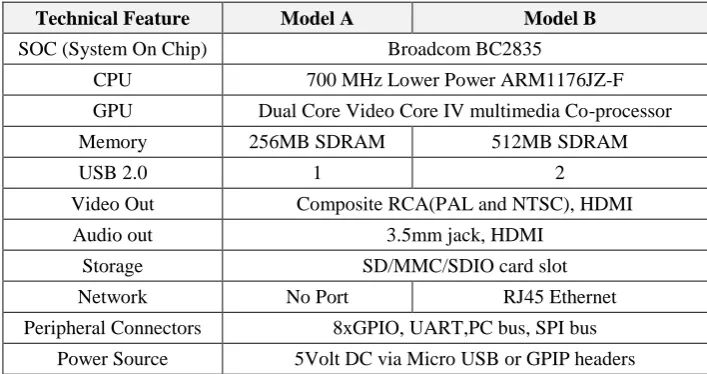
2.2 Raspberry Pi’s specifications 21
3. 1 Comparison of linear and nonlinear loads. 7
3. 2 List of the components for gate driver circuit 27
3. 3 List of components for three phase inverter 35
LIST OF FIGURES
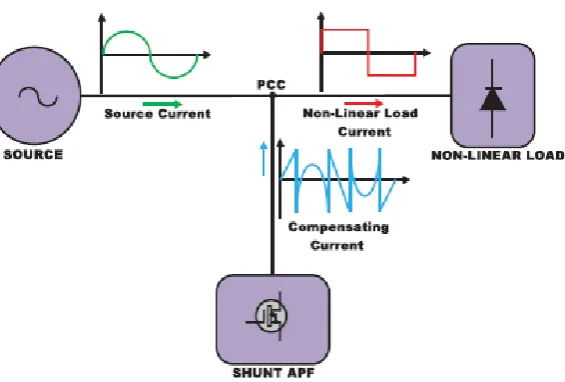
2. 1 Active Power Filter 7
2. 2 Schematic diagram for three phase switching 10
2. 3 One-Cycle Controlled Constant Frequency Switch [10] 16
2. 4 Switch Input x(t), Output and Switch Signal y(t)= X(t)K(t) [10] 17
2. 6 Raspberry Pi Controller 19
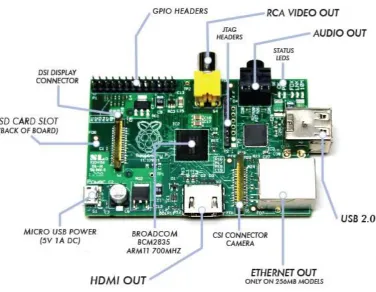
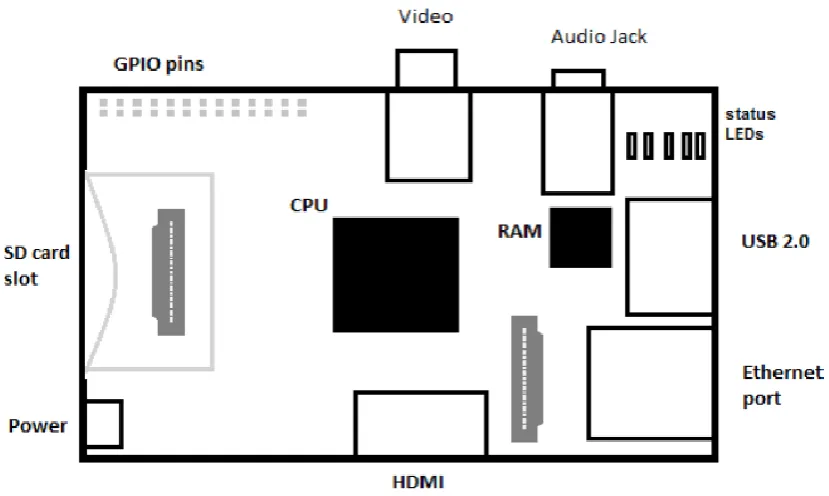
2. 7 Raspberry Pi’s hardware 20
3. 1 Block diagram of the project 24
3. 2 Circuit diagram of nonlinear load design 27
3. 3 The schematic diagram of the gate driver circuit 29
3. 4 Three-phase three-wire shunt active power filter 30
3. 5 One Cycle Current Controller (OCC) model for Phase A 32
3. 6 ACS712 Current sensor 34
3. 7 Circuit diagram of inverter (Active Power Filter) 35
3. 8 Communication Matlab and Raspberry Pi 36
4. 1 The Simulink model for One Cycle Current Controller (OCC) 39 4. 2 The Simulink diagram for Linear and Nonlinear load 40 4. 3 Current comparison waveform for linear and nonlinear load 40 4. 4 The Simulink model for One Cycle Current Controller (OCC) 41 4. 5 Current compensate result between current load harmonic, I_a and
current reference, Ia_ref. 42
4. 6 Tuning Controller result for I, PI and comparator block for I and PI 43
4. 7 PWM generator result 44
4. 11 Diagram for open loop analysis (hardware) 47 4. 12 Matlab/Simulink reference model for open loop test 47
4. 13 Diagram for Raspberry Pi output 48
4. 14 Result for Raspberry Pi output 49
4. 15 Diagram for gate driver output 49
4. 16 Result for gate driver output pulses (6 pulses) 51
4. 17 Diagram for APF output 51
4. 18 Result for APF circuit output for line to line voltage, VAB, 52
4. 19 Diagram for linear load 53
4. 20 Voltage Vs Current for linear load 54
4. 21 Three phase current for linear load 55
4. 22 Diagram for nonlinear load 56
4. 23 Result for analysis single phase current nonlinear load 57 4. 24 Result for analysis 3 phase current for nonlinear load 57
4.25 Diagram input sensor for linear load, 59
4.26 Diagram input sensor for nonlinear load 59
4. 27 Result ADC input sensor for linear load, 60
4. 28 Result ADC input sensor for nonlinear load 61
4. 29 Diagram for 3 phase current output inverter with linear load 62 4. 30 Diagram for 3 phase current output inverter with nonlinear load 62 4. 31 Result for 3 phase current output inverter for linear load, 63 4. 32 Result for 3 phase current output inverter for: Nonlinear load 63 4. 33 Closed loop diagram with one-cycle current controller for 3
phase APF with nonlinear load 64
4. 34 Result for closed loop diagram with One Cycle Current Controller (OCC) controller for phase-AB of APF before injected to
power supply. 65
LIST OF SYMBOLS AND ABBREVIATIONS
APF - Active Power Filter
PID - Proportional Integral Derivative PI - Proportional Integral
I - Integral
VFD - Variable Frequency Drives SMPS - Switch-mode Power Supply
SPWM - Sinusoidal Pulse Width Modulation UPS - Un-interruptible Power Supply
MOSFET - Metal Oxide Semiconductor Field Effect Transistor IGBT - Insulated-Gate Bipolar Transistor
VSI - Voltage Source Inverter CSI - Current Source Inverter VSAFs - Voltage Source Active Filter CSAFs - Current Source Active Filter
DC - Direct Current
AC - Alternative Current
VDC - Voltage DC
VAC - Voltage AC
THD - Total Harmonic Distortion PWM - Pulse Width Modulation
FLC - Fuzzy Logic Controller
CHAPTER 1
INTRODUCTION
1.0 Introduction
This chapter will introduce about project background, problem statement, aim, objectives and scopes of the development of One Cycle Current Controller (OCC) using Raspberry Pi for 3 phase Active Power Filter (APF) for nonlinear load improvement
1.1 Project Background
Power distribution system are faces a more challenging problem for nonlinear load, rectifier is a nonlinear load device which generates harmonics and the major problem in commercial building or domestic usage. [1][2] This is due primarily to new power conversion technologies, the Switch-mode Power Supply (SMPS) is an excellent power supply and also a highly contribution to nonlinear load, which can be found in almost every power electronic device such as computers, servers, telecom systems, broadcasting equipment, banking machines and other thing [1][2]. These harmonics cause an increase in level of RMS supply current, which results an increase of power loss, heating of equipment and voltage sags [1]. APF is designed to eliminate the majority of the harmonic current orders. IEEE 512-1992, harmonic voltage is formed when harmonic current travels through the impedance of the electrical system toward the lowest impedance point [3].
Proportional Integral Derivatives (PID), Fuzzy Logic, Artificial Neural Network (ANN), Sliding Mode Control (SMC), Hysteresis and One cycle current controller. The current regulation has played an important role in current controlled pulse-width-modulated (PWM) APF that is widely applied in high performance ac drives [6][7]. Beside that there are several parameters that must be considered, such as the current control technique to the nonlinear load and for this situation the One Cycle Current Control methods is to be used. Recently, an embedded microcontroller system such as Raspberry pi is quickly developed in many applications because it is an open source, the price is reasonable and performs as microcomputer. The other characteristic of Raspberry Pi it is directly interfaces to the MATLAB / Simulink by using the Target Installer. The model will perform in MATLAB / Simulink and also implements the simulation and hardware of one cycle Current Control method by using Raspberry Pi as a digital signal processing system. As a result the performance characteristics will be observed in terms of output current and effect to the nonlinear load.
1.2 Problem statement
Rectifier in a every single electronic appliance or electronic power supply typically one example of nonlinear load on a power system, arc discharge device such as florescent lamp, electric welding machine or heater it will cause current in the power system is interrupted by a switching action and the current contains frequency component that are multiples of the power system frequency [2][5]. Distortion power factor is a measure of how much the harmonic distortion of a load current decreases the average power transferred to the load. The effect of nonlinear loads are create harmonic current in additional to the fundamental AC current waveform and change the shape of the current from sine wave to some other form such as “double-hump”, and it can affect both the distribution system equipment and the loads connected to it.
High voltages and circulating currents caused by harmonic resonance, Equipment malfunctions due to excessive voltage distortion, Increased internal losses in connected equipment resulting in component failure and shortened lifespan, False operation of protection equipment and metering errors, Lower system power factor preventing effective utilization, Voltage regulator problems on diesel generators, Inability of automatic transfer switches to operate in closed transition [4].
1.3 Aim and Objectives
The main objective in this project is to implement a Active Power Filter (APF) based One Cycle Current Controller (OCC) in order to reduce harmonic distortions for the system with nonlinear load. Other proposed objectives of this project are listed below:
1. Develop and implement an One Cycle Current Controller (OCC) method to solve the nonlinear load affect to three phase supply.
2. Interface the MATLAB Simulink and the Raspberry Pi.
3. To control the current that supply into the three phase nonlinear load.
4. To built a low cost controller for three phase nonlinear load by using Raspberry Pi.
1.4 Limitation / Scope of Project
The limitation and scope of this project is to study the characteristic and effect of the harmonic of 3 phase nonlinear load and to evaluate the performance of Active Power Filter (APF) based One Cycle Current Controller (OCC). In this project the other scope of this project are:
1. Study of the one cylce current control technique by using Matlab/Simulink software for the simulation and hardware development.
2. Construct the 600W APF circuit, where the maximum Voltage 60Vdc and the maximum current 10A, in order to reduce the harmonic distortion.
4. Applied 3 phase rectifier as prototype of Nonlinear load with 10 Ω 50W (Wire Wound resistor).
5. Maximum Voltage and current supply able to handle by APF are 60 V and 5A.
6. Test the APF circuit and Analysis the result.
1.5 Thesis Outline
This thesis is organized into 5 chapters which are introduction, literature reviews, methodology, result and analysis, conclusion and recommendation.
This chapter is only the introduction of this proposed project; the chapter covers the brief idea about problem area, aim, objective and limitation to solve the problem. Chapter 2 will cover all the literature review about the principles of technique implemented in the Active Power Filter (APF) methods, the brief control strategy used in the proposed filter, commercial product and project that have been done before.
Chapter 3 will cover the methodology of this project. The methodology is on the work that must be done and focus in order to achieve the aim and objective specified before.
Chapter 4 covers the simulation and experiment result using Matlab/Simulink and Raspberry Pi and analyse the compensation performance of the proposed filter subject to rectifier of nonlinear load. The simulation and experiments result of the system performance have been observed.
CHAPTER 2
LITERATURE REVIEW
2.1 Introduction
This chapter will introduce about the previous project or research done before about nonlinear load, Active Power Filter, Three phase inverter Design, Raspberry Pi as controller. The research covers the usage of Matlab and Raspberry Pi for testing and the acquire result. This chapter will emphasize the importance of this project and the differences between it with other projects.
2.2 Nonlinear load
Nonlinear load are the biggest problem to solve because it create harmonic currents in addition to the fundamental frequency (original) AC current [2][4]. The current waveform does not conform to that the applied voltage or where a change is not proportional to change in applied voltage and it considered nonlinear load if its impedance changes with the applied voltage. The changing impedance that means the current drawn by the nonlinear load will not be sinusoidal even when it is connected to sinusoidal voltage. These non-sinusoidal currents contain harmonic currents that interact with the impedance of the power distribution system to create voltage distortion that can affect both the distribution system equipment and the loads connected to it exactly consumer [4].
on its DC bus. The SMPS draws current in short, high-amplitude pulses that occur right at the positive and negative peaks of the voltage. Typically these high current pulses will cause clipping or flat-topping of the 230VAC supply voltage. The “double-hump” current waveform of the 6-pulse rectifier in a VFD also will cause clipping or flat-topping of the 415V distribution system.[4]
Harmonics produce an increase in the resistance of the conductor and in turn, an abnormal common mode (neutral-ground) voltage difference and this will cause undesirable ground loops to occur. The electronic power supply is to transform an AC into a DC, their power source takes its current as portions of the 50 Hz sine wave to become deformed and multiple frequencies of 50 Hz are formed. Often, single phase loads produce triplets (3rd, 9th, etc.), while three phase loads produce 5th and 7th harmonics. Therefore, electric equipment and installations which are designed to operate at 50 Hz, can become damaged or unbalanced due to these harmonic frequencies which are different than the fundamental (50 Hz). The principal problem that arises is the overheating of equipment or conductors.[4]
Table 2. 1 Differences of linear and nonlinear loads.
No Linear Loads Nonlinear Loads
1
Examples; Power Factor Improvement Capacitor, Heaters, Incandescent Lamps. Etc
Examples; Computer, Laser Printer, SMPs, Rectifier, Refrigerator etc
2 Ohms law is valid Ohms law is not valid
3 Load current does not contain harmonics. Load current contains all odd harmonics 4 Could be inductive or capacitive. Can’t be categorized as leading or lagging loads.
5
Zero neutral current, if 1-Phase loads are equally balanced on 3-Phase Mains (Vector sum of line current)
Even if single phase loads are equally balanced on 3-phase neutral current could be 2.7 times the line current
6 May not demand high inrush currents while starting.
Essentially very high inrush current (20 time of Normal) is drawn while starting for approximant One cycle.
[image:17.595.188.471.377.568.2]2.3 Active Power Filter (APF)
Figure 2. 1 Active Power Filter
system [5]. The principle was proposed in 1970’s [6][7] Active Power Filter in three-phase system can be subdividing into two classes. In one class, the neutral is not present for examples are three-phase or three-phase wire filters. The other class, present of the neutral conductor and available for use for example three-phase for wire system or three phase four legs.
2.3.1 Harmonics in Power System Due to Nonlinear Loads:
The study begins with the detection of the harmonics arising due to the use of nonlinear loads. The main sources of voltage and current harmonics are due to control and energy conversion techniques involved in the power electronic devices such as chopper, rectifier, cyclo-converter etc. The harmonic sources are energy conversion devices such as power factor improvement and voltage controller devices of motor, high-voltage direct-current power converters, traction and power converters, battery-charging systems, static-var compensators, wind and solar-powered dc/ac converters, direct energy devices-fuel cells, storage batteries which require dc/ac power converters, control of heating elements[10]. The current and voltage harmonics were measured using a dynamic signal analyzer by M. Etezadi-Amoli, and plotted at for different substations [11]. Due to use of nonlinear loads like rectifier, chopper etc. the load current gets distorted, which is explained nicely by Robert considering harmonic study [12].
2.3.2 Brief Introduction to Active Power Filter:
2.3.3 Control techniques used for Active Power Filter
Designing a suitable controller for an APF is very important. A number control strategies such as instantaneous reactive power theory initially developed by Akagi et al. [15], synchronous frame d–q theory [16], synchronous detection method [17], notch filter and fuzzy logic controller method are used in the development of three-phase AFs and the gate pulses are generated by current control technique like sinusoidal pulse width modulation (SPWM), triangular PWM, hysteresis current control technique [18].
2.3.4 Digital Controller for Active Power Filter:
Advancement in microelectronics has motivated new directions for APF design starting from the use of analogue and digital components to microprocessors, microcontrollers, digital signal processors (DSP’s) [17][18] and FPGA implementation [19][20]. Further, these developments have made it possible to use different control algorithm such as proportional integral (P-I), fuzzy logic etc. for improving the steady state and dynamic performance of APFs. By implementing this performance, response as well as the cost is efficient compare to the analogue one.
2.3.5 Three Phase Inverter
current and switching circuit is to perform a DC supply switching follow controller output form.
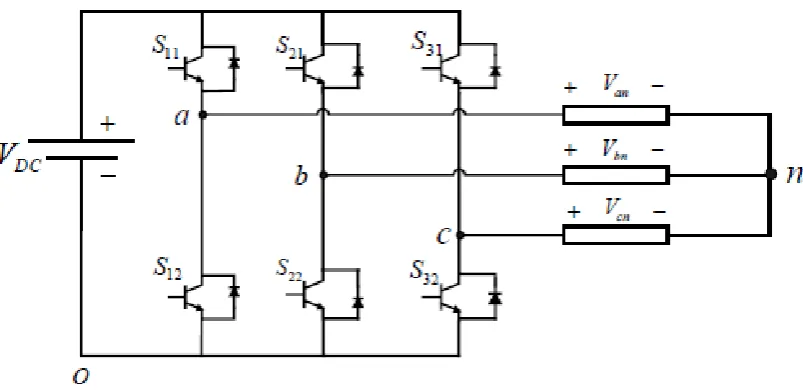
[image:20.595.120.522.349.545.2]The purpose of these topologies is to produce a three phase voltage where the amplitude, phase and frequency can be controlled. The three phase inverter DC/AC voltage sources are extensivelly being used in induction motor driver, active filter and unified power flow controllers in power system and uniterrupted power supplies to generate controllable frequency and AC voltage magnitudes using various pulse width modulation (PWM) strategies. The standard application for three phase inverter shown in Figure 2.2 has six switches (MOSFET or IGBT) the switching of which depends on the modulation scheme. The input DC is usually obtained from a single-phase or three phase utility power supply through a diode-bridge rectifier and LC or C filter.
Figure 2. 2 Schematic diagrams for three phase switching
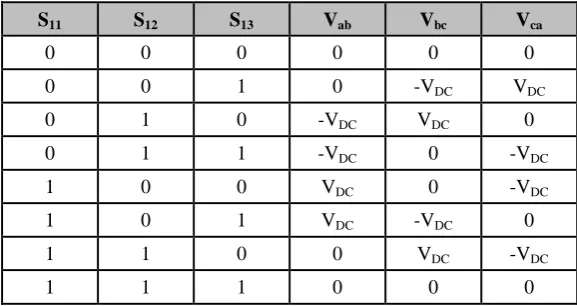
Table 2. 1 Switching States for three phase inverter.
S11 S12 S13 Vab Vbc Vca
0 0 0 0 0 0
0 0 1 0 -VDC VDC
0 1 0 -VDC VDC 0
0 1 1 -VDC 0 -VDC
1 0 0 VDC 0 -VDC
1 0 1 VDC -VDC 0
1 1 0 0 VDC -VDC
1 1 1 0 0 0
From the eight switching states as shown in Table 2.1, two of them produce zero ac line voltage at the output. In this case, the ac line currents freewheel through either the upper or lower components. The remaining states produce no zero ac output line voltages. In order to generate a given voltage waveform, the inverter switches from one state to another. Thus the resulting ac output line voltages consist of discrete values of voltages, which are -VDC,0, and VDC. The selection of the states in order to generate the given waveform is done by the modulating technique that ensures the use of only the valid states [21].
2.4 Controller Approaches for Active Power Filter
2.4.1 PID controller
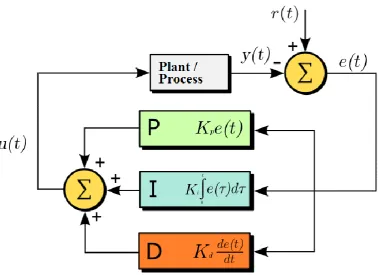
PID controller can be attributed partly to their robust performance in a wide range of operating conditions and partly for their practicality engineers can operate them in a simple and straightforward manner. Proportional-Integral-Derivative (PID) controller is prominent for its simplicity. [29]. A PI controller is a common mechanism used in industrial control applications. A PID controller is capable used for regulation of temperature, pressure, flow, speed and other process variables. PID controlled system is a combination of three elements which are proportional, integral and derivative. Equation 2.1, describing u(t) as the controller output, the final form of the PID algorithm is:
𝑢(𝑡) = 𝑀𝑉(𝑡) = 𝐾𝑝𝑒(𝑡) + 𝐾𝑖∫ 𝑒(𝜏)𝑑𝜏 + 𝐾0𝑡 𝑑𝑑𝑡𝑑 𝑒(𝑡) (2.1)
WHERE,
𝑒 = 𝑒𝑟𝑟𝑜𝑟
𝜏 = 𝑡𝑖𝑚𝑒 𝑜𝑟 𝑖𝑛𝑠𝑡𝑎𝑛𝑡𝑎𝑛𝑒𝑜𝑢𝑠 𝑡𝑖𝑚𝑒
Tuning parameter
𝐾𝑝 = 𝑝𝑟𝑜𝑝𝑜𝑟𝑡𝑖𝑜𝑛𝑎𝑙 𝑔𝑎𝑖𝑛 𝐾𝑖 = integral gain 𝐾𝑑 = 𝑑𝑒𝑟𝑖𝑣𝑎𝑡𝑖𝑣𝑒 𝑔𝑎𝑖𝑛
Figure 2. 3 A block diagram of a PID controller in a feedback loop
Relate the system to APF, conventional PID controllers used to extract the fundamental component of the load current thus facilitating reduction of harmonics and simultaneously controlling dc-side capacitor voltage of the voltage source inverter because of their benefit to the system that PID controller gives better speed response in terms of settling time, rise time and steady state error.
2.4.2 Fuzzy logic controller
The desired inverter switching signals of the shunt active filter are determined according the error between the compensate currents and reference currents. According [27] produced a paper on Fuzzy Logic controller for shunt Active Power Filter; the paper presents Active Power Filter based in detection load current and harmonic voltage at the point of installation by using the fuzzy logic method and to improve compensation capability of APF. The shunt APF is implemented with PWM current controlled voltage source inverter and switching patterns are generated through a fuzzy logic control. A fuzzy logic-based PWM control technique is used to generate the gating signals. Switching signal obtained [27] after proper amplification and isolation are given to the switching devices of the PWM converter. The DC link capacitor voltage is maintained constant by a fuzzy logic controller. Fuzzy logic is characterized by seven sets of membership function for each input and output variable by using Mamdani-type min operator and defuzzification using the centroid method. The performance of fuzzy logic controller is found to be excellent, total harmonic distortion is (THD) reduced and improve by tuning the fuzzy rule based using an expert view to produce more effectiveness and accuracy of controller.
2.4.3 Hysteresis control
Hysteresis current control method is the most usually suggested control method in time
domain. This method provides instantaneous current corrective response, good accuracy,
extreme robustness, good stability and allows fast current control [30][31][32]. The basic
principle of current hysteresis control technique is that the switching signals are derived
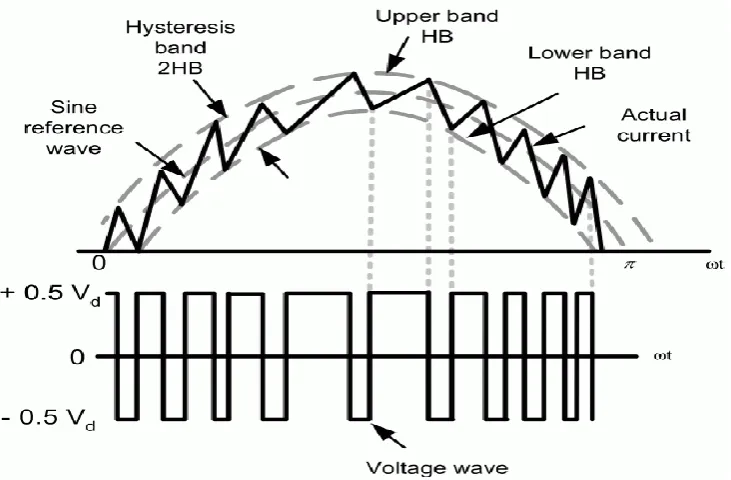
from the comparison of the current error signal with a fixed width hysteresis band. As
long as the error is within the hysteresis band, no switching action is taken. Switching
occurs whenever the error hits the hysteresis band. This control scheme is shown in
Figure 2. 4 Hysteresis Control Techniques
The APF is therefore switched in such a way that the peak-to-peak compensation current/voltage signal is limited to a specified band determined by upper band and lower
band as demonstrated by Figure 2.5. To acquire a compensation current with switching
ripples as small as possible, the value of upper band and lower band can be reduced.
However, doing so the results in high switching frequency. Thus, increases losses on the
switching transistors [31][32].
[image:25.595.137.503.445.685.2]2.4.4 One-Cycle Control
One Cycle Control (OCC) is the term used to describe a nonlinear control technique invented by Keyue Smedley and Slobodan Cuk because switches are nonlinear systems, the idea is that a pulsed nonlinear control should provide faster dynamic response and reject input perturbations better than linear control since the nonlinear control matches the system [23][24]. One Cycle Current Controller (OCC) technique able to be implemented under constant off time, constant on time, constant- frequency, or variable by adjustable time on and time off switches, constant-frequency is most commonly used [22]. The basic idea of One Cycle Current Controller (OCC) can be seen in Figure 2.3 below for a constant frequency switch
Controller
Clock
Constant Frequency
Switch
X(t) Y(t)
Vref
Comparator
Integrator R C
-+ +
-Figure 2. 6 One-Cycle Controlled Constant Frequency Switch [10]
[image:26.595.113.523.315.549.2]A switch, constant frequency, constant ON time, constant OFF time or variable as is defined as operating under a function k (t) at frequency 𝑓𝑠 =𝑇𝑠1 [23]:
𝑘(𝑡) = { 0 𝑇1 0 < 𝑡 < 𝑇𝑂𝑁
𝑂𝑁 < 𝑡 < 𝑇𝑠 (2.2) In each cycle, the switch is on for a time duration TON and is OFF for a time duration
TOFF, where TON + TOFF = Ts. The duty-ratio d =
𝑇𝑂𝑁
𝑇𝑠 is modulated by an analogue control reference Vref(t). The input signal to the switch is x(t) to produce an output
y(t) with the same frequency and pulse width as k(t), with x(t) as the envelope of y(t) as seen in Figure 2.4
t k(t)
x(t) Switch Y(t) = k(t) X(t)
Ts
Ton Toff
t
t
[image:27.595.135.518.293.543.2]t
Figure 2. 7 Switch Input x(t), Output and Switch Signal y(t)= X(t)K(t) [10]
Assuming that the switch frequency fs is much higher than the frequency bandwidth
of x(t) or Vref(t), the effective output value y(t) is equal to the average value over a
switch cycle: 𝑦(t) =𝑇1
𝑠∫ 𝑥(𝑡)𝑑𝑡 ≈
𝑇𝑠
0 𝑥(𝑡)
1
𝑇𝑠∫ 𝑑𝑡 = 𝑥(𝑡)
𝑇𝑂𝑛
0 𝑑𝑡 = 𝑥(𝑡)𝑉𝑟𝑒𝑓(𝑡) (2. 3)
D, then the output becomes Dx(t), as is the case in digital signal processing. For power processing applications, x(t) usually represents the power, while Vref(t) is the signal to be amplified. Ideally, the input power x(t) is constant, but in reality there are perturbations causing disturbances to the output y(t) also. If the switch duty ratio is modulated such that in each cycle the integration of the chopped waveform at the switch output is exactly equal to the integration of the control signal, i.e.:
∫𝑇𝑜𝑛𝑥(𝑡)𝑑𝑡 =
0 ∫ 𝑉𝑟𝑒𝑓(𝑡)𝑑𝑡
𝑇𝑂𝑛
0 ( 2. 4)
Then the output signal becomes instantaneously controlled within one cycle: 𝑦(t) =𝑇1
𝑠∫ 𝑥(𝑡)𝑑𝑡
𝑇𝑜𝑛
0 =
1
𝑇𝑠∫ 𝑉𝑟𝑒𝑓(𝑡)𝑑𝑡 = 𝑉𝑟𝑒𝑓(𝑡)
𝑇𝑠
0 (2. 5)
Since the switching frequency fs, is much higher than the time-varying reference voltage, the reference can be seen as constant in one period, thus simplifying the above equation to:
𝑦(𝑡) = 𝑉𝑟𝑒𝑓 (2. 6)
2.5 Raspberry Pi
[image:29.595.129.506.288.580.2]A Raspberry Pi is a small, credit-card sized microcomputer developed by Raspberry Pi Foundation, UK. This single boarded computer was developed with aim of teaching the basics of computer science and programming to school students all around the world. Although a microcontroller, like Arduino, is trendy for prototyping projects, a Raspberry Pi is quite different from the popular microcontroller. Actually, it is more like a computer than an Arduino.
Figure 2. 8 Raspberry Pi’s Controller
2.5.1 Hardware and specifications
does not have any Ethernet port whereas model B has a 512MB memory, 2 USB ports, and an Ethernet port as well.
Figure 2.9 Raspberry Pi’s hardware
composite video connector for video output as well as a 3.5mm stereo jack for audio output. The Raspberry Pi has 26 GPIO pins which help to connect to low level peripherals and expansion boards.
2.5.2 Raspberry Pi’s specifications
[image:31.595.141.495.304.491.2]Raspberry P’s specifications (Raspberry Pi Model A & Model B Comparison 2013). The Raspberry Pi used for this thesis study uses Raspbian Wheezy as an operating system. Raspbian is a Debian based free OS (operating system) for Raspberry Pi.
Table 2.2 Raspberry Pi’s specifications
Technical Feature Model A Model B
SOC (System On Chip) Broadcom BC2835
CPU 700 MHz Lower Power ARM1176JZ-F
GPU Dual Core Video Core IV multimedia Co-processor
Memory 256MB SDRAM 512MB SDRAM
USB 2.0 1 2
Video Out Composite RCA(PAL and NTSC), HDMI
Audio out 3.5mm jack, HDMI
Storage SD/MMC/SDIO card slot
Network No Port RJ45 Ethernet
Peripheral Connectors 8xGPIO, UART,PC bus, SPI bus Power Source 5Volt DC via Micro USB or GPIP headers
The advantages of the Raspberry Pi’s are stated below: [26]
A Raspberry Pi is a small, credit-card sized microcomputer developed by Raspberry Pi Foundation, UK with aim of teaching the basics of computer science and programming to school students all around the world. Actually, it is more like a computer than an Arduino.
Inexpensive – Raspberry Pi embedded devices are inexpensive compared to other microcontroller embedded devices.
Can be programmed using variety of programming languages – The Raspberry Pi programming environment is easy to use for beginners.
It is very easy to connect to internet
CHAPTER 3
METHODOLOGY
3.1 Introduction
3.2 Block Diagram
Phase C Phase B Phase A
UNBALANCED LOAD
CURRENT SENSOR
ONE-CYCLE CURENT CONTROLLER
GATE DRIVER CIRCUIT
DC POWER SUPPLY 3 PHASE
INVERTER
[image:34.595.135.493.73.378.2]ACTIVE POWER FILTER
Figure 3. 1 Block diagram of the project
Figure 3.1 shows the block diagram of the whole project of development of One Cycle Current Controller OCC using Raspberry Pi. This development of Active Power Filter (APF) consists of FIVE main parts which are the DC power supply as the input, gate driver circuit as an isolator circuit and PWM signal generator, three phase inverter, and current sensor as a feedback input current to the controller and One Cycle Current Controller (OCC). The power supply is generated by dropping the voltage from 3 phases 415V to 3 phases 24V and connects it to the three phase nonlinear load. For the load component consist of six power diode and power resistor with the rating of load 10Ω, 50 W and the diode characteristic will interrupt the fundamental waveform of current from supply and form “double hump” waveform to the load.
REFERENCES
[1] N. A. Rahim Member, IEEE, S. Mekhilef, and Z. Islam. “A New Approach
for Harmonic Compensation Using Single- phase Shunt Active Power Filter A New Approach for Harmonic Compensation Using Single- phase Shunt Active Power Filter”. Institute of Research Management and Consultancy, University of Malaya. April 30, 2005.
[2] H. Zhang, “Research and design of three-phase six-switch high power factor rectifier with one cycle control,” 2009 IEEE 6th Int. Power Electron. Motion
Control Conf., vol. 3, pp. 1704–1707, May 2009.
[3] Raymond E. Beighley, Charles A. Gougler, James R. Johnson. “Application
of Active Harmonic Filters for Power Quality Improvement”. IEEE 519-1992.
[4] H. M. Transformers and H. B. Filters, “MIRUS International Inc .,” 2010. [5] H. R. Riverfront, S. Louis, S. Leng, W. Liu, I. Chung, and D. Cartes, “Active
Power Filter for Three-Phase Current Harmonic Cancellation and Reactive Power Compensation,” pp. 2140–2147, 2009.
[6] Gyugyi L., Strycula E.C., “Active AC Power Filters”, IEEE IAS Annual Meeting, pp.529, 1976.
[7] Mohan N.,Peterson H.A., Long W.F., “Active Filters For AC Harmonic Suppression”, Proceeding of the IEEE-PES Winter Meeting, Paper A77026-8,1977.
[8] Madhavi L. Mhaisgawali, Mrs S.P.Muley “Speed Control of Induction Motor using PI and PID controller” IOSR Journal of Engineering (IOSRJEN), vol.3, Issue 5 (May2013
Electronics, Machines and Drives (PEMD 2012), 6th IET International Conference on , vol., no., pp.1,6, 27-29 March 2012
[10] Robert D Henderson, Patrick J. Rose “Harmonics: The effect on power quality and transformer” IEEE Trans. Industry Applications, vol. 30, no.3, (1994):pp. 528-532.
[11] Singh B., Haddad K. A., and Chandra A.,”A review of Active Power Filter for power quality improvement”, IEEE Trans. Industrial Electronics, vol.46. no.5, (1999):pp. 960-971.
[12] Peng F. Z., Akagi H., Nabae A., “A new approach to harmonic compensation in power system- a combined system of shunt passive and series active filters ” IEEE Trans. Industry Applications, vol. 26, (1990):pp.983-990.
[13] Akagi H., Kanazawa Y., and Nabae A., “Instantaneous reactive power compensators comprising switching devices without energy storage components,” IEEE Trans. Ind. Applicat., vol. IA-20, (1984):pp. 625–630. [14] Bhattacharya S. and Divan D., “Synchronous frame based controller
implementation for a hybrid series active filter system,” IEEE Conf. On Industry applications, vol.4,(1995):pp. 2531–2540.National Institute of Technology, Rourkela Page 64
[15] Lin C. E., Su W. F., Lu S. L, Chen C. L., and Huang C. L., “Operation strategy of hybrid harmonic filter in demand-side system,” IEEE-IAS Annul. Meeting, Industry applications, (1995):pp. 1862–1866.
[16] Dahono P.A, “New hysteresis current controller for single-phase bridge inverters” IETjournal on Power electronics, vol.2 (2009):pp. 585-594.
[17] Hongyu Li., Fang Zhuo, Zhaoan Wang, Lei W. and Wu L., “A novel time domain current detection algorithm for shunt Active Power Filter s” IEEE Trans. power systems, vol.20,(2005):pp. 644–651.
[18] Buso S., Malesani L., Mattavelli P. and Veronese R., “Design and fully digital control of parallel active filters for thyristor rectifier to comply with ICE 1000-3-2 standard” IEEE Trans.Ind. Applicat., vol. 34, (1998):pp. 508–517. [19] B.O. Slim, Braha A. and Ben saoud s. “Hardware design and Implementation
of digital controller for Parallel Active Filters” IEEE Conf. Design and test of integrated systems in nanoscale technology, (2006): pp. 331-334.
[20] Y.F.Chan, Moallem M., and Wei Wang “Design and implementation of modular FPGAbased PID controllers” IEEE Trans. Indus. Elect. vol. 54, (2007):pp. 1898-1906.
[24] Chongming Qiao and Keyue.M Smedley, "Three-Phase Active Power Filter with Unified Constant-frequency Integration Control," in Proceedings of IEEE In!. Conference on Power Electronics and Motion Control, PIEMC, vo!.2, pp.698--70S, 2000.
[25] K. M. Smedley and S. Cuk, “One-cycle control of switching converters,”
IEEE Trans. Power Electron., vol. 10, no. 6, pp. 625–633, 1995.
[26] Fung Po Tso; White, D.R.; Jouet, S.; Singer, J.; Pezaros, D.P., "The Glasgow Raspberry Pi Cloud: A Scale Model for Cloud Computing Infrastructures," Distributed Computing Systems Workshops (ICDCSW), 2013
IEEE 33rd International Conference on , vol., no., pp.108,112, 8-11 July 2013
[27] A. A. Salam, N. Azran, and A. Hadi, “Fuzzy Logic Controller for Shunt Active Power Filter,” pp. 256–259, 2014.
[28] L. Xinyang, W. Jie, Y. Gang, and A. T. Structure, “Application of Fuzzy Control in Harmonic Detecting and Current Control of APF,” 2012.
[29] Jingwei Xu; Xin Feng; Mirafzal, B.; Demerdash, Nabeel A., "Application of Optimal Fuzzy PID Controller Design: PI Control for Nonlinear Induction Motor," Intelligent Control and Automation, 2006. WCICA 2006. The Sixth
World Congress on, vol.1, no., pp.3953, 3957, 0-0 0.
[30] P. Rathika, D. Devaraj. “Fuzzy Logic-Based Approach for Adaptive
Hysteresis Band and Dc Voltage Control in Shunt Active Filter”. International Journal of Computer and Electrical Engineering , Vol. 2, No. 3, June, 2010.
[31] Zainal Salam, Tan Perng Cheng and Awang Jusoh. “Harmonics Mitigation Using Active Power Filter: A Technological Review”, Elektrika, VOL. 8, NO. 2, 2006, 17‐26
![Figure 2. 6 One-Cycle Controlled Constant Frequency Switch [10]](https://thumb-us.123doks.com/thumbv2/123dok_us/8764299.895593/26.595.113.523.315.549/figure-cycle-controlled-constant-frequency-switch.webp)
![Figure 2. 7 Switch Inputt x(t), Output and Switch Signal y(t)= X(t)K(t) [10]](https://thumb-us.123doks.com/thumbv2/123dok_us/8764299.895593/27.595.135.518.293.543/figure-switch-inputt-output-switch-signal-x-k.webp)