Journal of Chemical and Pharmaceutical Research, 2014, 6(8):400-407
Research Article
ISSN : 0975-7384
CODEN(USA) : JCPRC5
Formulation development and compatibility study of Ibandronate sodium
injection 3mg/3mL
Srikant Pimple*, Pravin Maurya, Krupal Salunke, Ruby Singh, Mukund Gurjar and Mahesh Shah
Research and Development, Emcure Pharmaceuticals Limited, Pune, Maharashtra, India
_____________________________________________________________________________________________
ABSTRACT
Intravenous bisphosphonates have been shown to be highly effective in preventing and treating postmenopausal Osteoporosis and the associated risk fracture. Ibandronate is a highly potent amino-bisphosphonate proven to significantly increase vertebral and non-vertebral bone mineral density when administered as I.V. injection. The main objective of present study was to develop a stable formulation and manufacturing process of Ibandronate sodium injection 3mg/3mL. As a part of preformulation study the compatibility study was performed. The excipients selected were the same as mentioned in PIL of reference listed drug. Compatibility study with regard to product contact materials such as Platinum cured silicone tube, SS316L (Metal), PVDF membrane filter, and stopper was performed and found compatible. Thermal cycling and Photostability study were also performed and indicates that drug product was thermal and photo stable. Ibandronate sodium injection was prepared by dissolving all the ingredients in Water for injection under continuous stirring and solution was filtered through Sterilized Optiseal Durapore PVDF cartridge filter 0.45 micron, followed by sterilized Optiseal Durapore PVDF cartridge filter 0.22 micron. Filling, stoppering and sealing was done in aseptic manufacturing and filling area. Terminal sterilization was done at 1210C. Formulations were visually inspected and results were found well within specified limits. Accelerated stability study at different time interval was performed and justified by relevant stability results.
Keywords: Ibandronate sodium, Compatibility Study, Photostability Study, Thermal Cycling, Stability Study. _____________________________________________________________________________________________
INTRODUCTION
Osteoporosis is "a disease characterized by low bone mass and micro architectural deterioration of bone tissue, leading to enhanced bone fragility and a consequent increase in fracture risk [1].
Osteoporosis is defined as a skeletal disorder characterized by compromised bone strength predisposing to an increased risk of fracture. Bone strength reflects the integration of two main features: bone density and bone quality. Bone density is expressed as grams of mineral per area or volume and in any given individual is determined by peak bone mass and amount of bone loss. Bone quality refers to architecture, turnover, damage accumulation (e.g. microfractures) and mineralization. A fracture occurs when a failure-inducing force (e.g., trauma) is applied to osteoporotic bone. Thus, osteoporosis is a significant risk factor for fracture, and a distinction between risk factors that affect bone metabolism and risk factors for fracture must be made[2, 3].
Bisphosphonates are important therapeutics in postmenopausal osteoporosis. Results of several large clinical trials attest to the efficacy of oral bisphosphonates in reducing fracture risk as well as their favorable safety and tolerability profile.
Ibandronate is a highly potent nitrogen-containing bisphosphonate that has the potential to be administered intermittently with extended between-dose intervals. Ibandronate sodium belongs to the bisphosphonate class, a group of drugs that delay or stop the natural process of bone tissue dissolution or resorption, leading to the maintenance or increase in bone density and strength. Ibandronate sodium's effect on bone tissue is related to its affinity for hydroxyapatite, a component of the bone matrix. This drug inhibits certain cells called osteoclasts from breaking down and nibbling at bone tissues, thus preventing bone resorption and turnover. In postmenopausal women, Ibandronate sodium decreases the rate of bone turnover, which can then result in a net increase in bone mass [5, 6, 7, & 8].
The main objective of the present research work was to formulate and optimize a stable formulation of Ibandronate sodium injection 3mg/3mL. Compatibility study and stability study was performed to stabilize the drug product in compliance with the reference listed drug.
EXPERIMENTAL SECTION
Materials:
Ibandronate Sodium was procured from Emcure Pharmaceuticals Ltd., Sodium Chloride and Sodium Acetate trihydrate was received from Merck, and Acetic Acid Glacial was received from J.T. Baker. The USP Type I clear glass vials and rubber stopper were obtained from Schott and Datwyler (Previously known as Helvoet) respectively.
Method:
Hot water for Injection was stored in a sterilized S.S. 316L jacketed manufacturing tank equipped with stirrer. Cooling of Water for Injection was done up to 20°C to 25°C by circulating chilled water through jacket of the manufacturing tank. Ibandronate Sodium, Sodium chloride, Sodium Acetate dihydrate, and Acetic acid glacial were dissolved in Water for Injection in the tank under stirring. Volume was adjusted with Water for Injection, and bulk solution was blanketed with nitrogen gas. pH of bulk solution (at 25°C) was recorded.
Table: 1 Manufacturing Formula and Manufacturing steps
Preformulation study:
Preformulation is defined as that phase of research and development process, where physical, chemical and mechanical properties of drug substance are characterized alone and when combined with excipients in order to develop safe, effective, stable formulation and robust, reproducible manufacturing process. Excipients used in drug product were of less endotoxins grade and similar to reference listed drug. All exipients are well documented in different pharmacopoeia. As a part of pre-formulation studies, following compatibility and stability studies were performed:
• Metal (SS316L) compatibility study
• Platinum cured silicone tubing compatibility study
• Filter compatibility study
• Stopper compatibility
Sr. No. Ingredients Qty/ vial
1 Ibandronate Sodium 1.125 mg
2 Sodium Chloride 8.600 mg
3 Sodium Acetate trihydrate 0.204 mg
4 Acetic Acid Glacial 0.510 mg
5 Water for Injection q.s. to 1 mL
Manufacturing steps Material/Equipment used
Preparation of bulk solution SS316L vessel
Filtration 0.45 µm membrane PVDF filters and 0.22 µm membrane PVDF filter
Filling 5 mL Clear glass vials
______________________________________________________________________________
• Freeze thaw study
• Photostability study
• Filter validation study
1. Metal (SS316L) compatibility study with unfiltered bulk solution:
SS 316L vessel is used as storage tank for prepared solution and as such must not interact with the drug product. The effect of SS 316L vessel on formulation was tested. About 60 mL of the unfiltered bulk solution was stored into SS 316L vessel and was kept at room temperature for 48 hrs. Samples were periodically collected from the container at 24 & 48 hours and given for analysis of the bulk solution for Description, pH, RS (Related Substances) & assay. The analytical results are given in the Table 2.
2. Platinum cured silicone tube compatibility study with unfiltered bulk solution:
In pharmaceutical manufacturing, silicone tubing is used in transfer of solution and as such must not interact with the drug product. About 60 mL of the unfiltered bulk solution was stored into glass container. Clean dried and autoclaved Platinum cured silicone tubing of approximate 10 cm length was immersed into the glass container and kept at room temperature for 48 hrs. Samples were periodically collected from the container at 24 & 48 hours and given for analysis of the bulk solution for description, pH, RS & assay. The analytical results are given in the Table 3.
3. PVDF membrane filters compatibility study with unfiltered bulk solution:
The compatibility study of filter is the most important test for sterility of any Injectable formulation. About 40 mL of the unfiltered bulk solution was stored into glass container. Clean and dried 0.45µm and 0.22µm PVDF membrane filter was immersed into the glass container and the container was kept at room temperature for 48 hrs. Samples were periodically collected from the container at 24 & 48 hours and given for analysis of the bulk solution for description, pH, RS & assay. The analytical results are given in the Table 4.
4. Compatibility of Ibandronate Sodium Injection with rubber stopper:
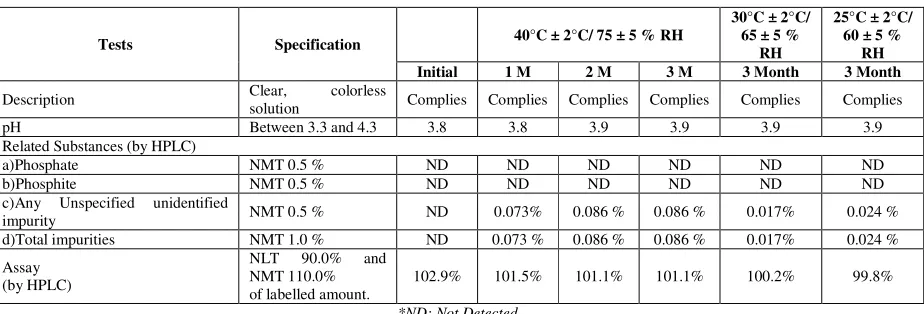
The container-closure system is an essential part of the final presentation of a pharmaceutical product. It defines the closure, protection, and functionality of a container while it ensures the safety and quality of the drug product over the product shelf life. To establish the compatibility of Ibandronate Sodium Injection with rubber stopper, prepared bulk solution of Ibandronate Sodium Injection was filtered through 0.45micron and 0.22 micron PVDF membrane filters. Filtered solution was filled in 5 mL USP Type -I clear glass vials, stoppered and sealed with rubber stoppers and aluminum seal. Sealed vials were subjected at different Stability conditions. The analytical results of stopper compatibility study are given in the Table 5.
5. Thermal Cycling (Freeze thaw & Cool thaw cycle) study:
The Freeze thaw & Cool thaw cycle study ensures that the product attributes at the extreme conditions of temperature are not altered. This study was designed to simulate the conditions that the product may experience during shipping.
Following procedure was followed for Freeze thaw & Cool thaw cycle: Cool thaw cycle study:
Cycle-I: Charge the samples in upright orientation in the refrigerator maintained at temperature between 2ºC to 8°C for 2 days. On 3rd day remove all vials from the refrigerator. Place the above samples in the 40 ± 2°C/75 ± 5 % RH chamber for 2 days.
Cycle-II: On 5th day remove all the vials from the 40 ± 2°C/75 ± 5 %RH stability chamber. Store them in refrigerator maintained at temperature between 2ºC to 8°C for 2 days. On 7th day remove all vials from the refrigerator. Place them in the 40 ± 2°C/75 ± 5 %RH chamber for 2 days.
Cycle-III: On 9th day remove all the vials from the 40 ± 2°C/75 ± 5 %RH stability chamber. Store them in refrigerator maintained at temperature between 2ºC to 8°C for 2 days. On 11th day remove all vials from the refrigerator. Place them in the 40 ± 2°C/75 ± 5 %RH chamber for 2 days.
Cool thaw cycle study (Study-I):
Thermal cycle (Freeze thaw & Cool thaw cycle) study:
Cycle-I: Charge the samples in upright orientation in the freezer maintained at temperature between -10ºC to -20°C for 2 days. On 3rd day remove all vials from the freezer. Place the above samples in the 40 ± 2°C/75 ± 5 % RH chamber s for 2 days.
Cycle-II: On 5th day remove all the vials from the 40 ± 2°C/75 ± 5 %RH stability chamber. Store them in freezer maintained at temperature between -10ºC to -20°C for 2 days. On 7th day remove all vials from the freezer. Place them in the 40 ± 2°C/75 ± 5 %RH chamber for 2 days.
Cycle-III: On 9th day remove all the vials from the 40 ± 2°C/75 ± 5 %RH stability chamber. Store them in freezer maintained at temperature between -10ºC to -20°C for 2 days. On 11th day remove all vials from the freezer. Place them in the 40 ± 2°C/75 ± 5 %RH chamber for 2 days. Upon completion of Cycle-III, remove all samples from the 40 ± 2°C/75 ± 5 % RH chamber.
Thermal cycle (Freeze thaw & Cool thaw cycle) study (Study-II):
The analytical results are given in the Table 6.
6. Photostability study
The study was carried out in Photostability chamber with samples as follows:
Test Sample: Product filled in clear glass vials
Control Sample: Product filled in clear glass vials wrapped by aluminium foil.
Carton Pack: Product filled in clear glass vials and packed in a carton.
______________________________________________________________________________
7. Filter validation study:
7.1 Bubble point test: A bubble point test is a test designed to determine the pressure at which a continuous stream of bubbles is initially seen downstream of a wetted filter under gas pressure. The point at which the first stream of bubbles emerges is the largest pore. Therefore, the bubble point value can be used to obtain a relative measure of the size of the single largest pore in a filter element. The purpose of this study was to determine the minimum product bubble point value for the sterilizing grade hydrophilic Durapore membrane wetted with Ibandronate sodium. The bubble point of the filter was detected at 44.6 psi and the limit of the filter was 50 psi.
7.2 Leachable and Extractable test: Leachables are compounds that migrate into a drug product from the sample container closure (SCC) system under normal storage conditions. Both the primary SCC in direct contact with the drug product and the secondary SCC, which does not contact the drug product, can be sources of leachables. Extractables are the compounds that can be extracted from the SCC that might become leachables. The conditions of an extraction study are selected based upon the drug product and are designed to mimic a worst-case-scenario for the intended drug product. In the present study no leachable and extractable were found after analyzing the solution with FTIR and RP-HPLC.
7.3 Bacterial Retention study: Bacterial retention study was performed to check the sterility and integrity of filter. Performance of sterilizing grade filter has been demonstrated to be acceptable as the membrane retained the B. diminuta challenge concentration equal to or greater than 1*107 cfu per cm2 of effective filtration area. So it was concluded that the challenge test was passed.
8. Stability study on development batch: To assess the stability of Ibandronate Sodium Injection, development batches were kept at accelerated (40°C ± 2°C / 75 ± 5 % RH), intermediate (30°C ± 2°C / 65 ± 5 % RH) & long term (25°C ± 2°C / 60 ± 5 % RH) condition. The analytical results are presented in Table 8.
RESULTS AND DISCUSSION
Table 2: Metal (SS316L) compatibility data at room temperature (~20-25°C)
Test Specification Initial 24 hrs 48 hrs
Description Clear, colorless solution Complies Complies Complies
pH Between 3.3 and 4.3 3.8 3.7 3.7
Related Substances (by HPLC)
a)Phosphite NMT 0.5 % ND ND ND
b)Phosphate NMT 0.5 % ND ND ND
c)Any unspecified unidentified impurity NMT 0.5 % ND ND ND
d)Total impurities NMT 1.0 % ND ND ND
Assay (by HPLC) Not less than 90.0% and not more than 110.0% of labelled
amount 103.1 % 101.3 % 100.2 %
*ND: Not Detected
Table 3: Platinum cured silicone tube compatibility data at room temperature (~20-25°C)
Test Specification Initial 24 hrs 48 hrs
Description Clear, colorless solution Complies Complies Complies
pH Between 3.3 and 4.3 3.8 3.7 3.6
Related Substances (by HPLC)
a) Phosphite NMT 0.5 % ND ND ND
b) Phosphate NMT 0.5 % ND ND ND
c) Any unspecified unidentified impurity NMT 0.5 % ND ND ND
d)Total impurities NMT 1.0 % ND ND ND
Assay (by HPLC) Not less than 90.0% and not more than 110.0% of
labelled amount 103.1 % 101.2 % 101.4 %
*ND: Not Detected
Table 4: PVDF membrane filters compatibility data at room temperature (~20-25°C)
Test Specification Initial 24 hrs. 48 hrs.
Description Clear, colorless solution Complies Complies Complies
pH Between 3.3 and 4.3 3.8 3.7 3.6
Related Substances (by HPLC)
a)Phosphite NMT 0.5 % ND ND ND
b)Phosphate NMT 0.5 % ND ND ND
c)Any unspecified unidentified impurity NMT 0.5 % ND ND ND
d)Total impurities NMT 1.0 % ND ND ND
Assay (by HPLC) Not less than 90.0% and not more than 110.0% of labelled amount 103.1 % 102.4 % 102.0 %
[image:6.595.69.531.511.668.2]*ND: Not Detected
Table 5: Analytical results of Stopper compatibility study
Tests Specification 40°C ± 2°C/ 75 ± 5 % RH
30°C ± 2°C/ 65 ± 5 %
RH
25°C ± 2°C/ 60 ± 5 %
RH Initial 1 M 2 M 3 M 3 Month 3 Month
Description Clear, colorless
solution Complies Complies Complies Complies Complies Complies
pH Between 3.3 and 4.3 3.8 3.8 3.9 3.9 3.9 3.9
Related Substances (by HPLC)
a)Phosphate NMT 0.5 % ND ND ND ND ND ND
b)Phosphite NMT 0.5 % ND ND ND ND ND ND
c)Any Unspecified unidentified
impurity NMT 0.5 % ND 0.073% 0.086 % 0.086 % 0.017% 0.024 %
d)Total impurities NMT 1.0 % ND 0.073 % 0.086 % 0.086 % 0.017% 0.024 %
Assay (by HPLC)
NLT 90.0% and
NMT 110.0% of labelled amount.
102.9% 101.5% 101.1% 101.1% 100.2% 99.8%
______________________________________________________________________________
Table 6: Analytical results of Freeze thaw & Cool thaw cycle study
Test Specification Thermal cycling Results
Initial Study I Study II
Description Clear, colorless solution Complies Complies Complies
Assay by HPLC Not less than 90.0% and not more than 110.0% of
labelled amount. 103.6% 103.9 % 101.8%
pH Between 3.3 and 4.3 3.7 3.8 3.8
Related Substances (by HPLC)
a)Phosphate NMT 0.5 % ND ND ND
b)Phosphite NMT 0.5 % ND ND ND
c)Any Unspecified unidentified impurity NMT 0.5 % 0.033 ND ND
d)Total impurities NMT 1.0 % 0.033 ND ND
*ND: Not Detected
Table 7: Analytical results of Photo stability study
Test Specification
Photostability study Initial Test
sample
Dark Control sample
Carton Control Sample
Description Clear, colorless solution Complies Complies Complies Complies
Assay (by HPLC) Not less than 90.0% and not more than
110.0% of labelled amount. 102.9% 103.6 % 103.6 % 104.1%
pH Between 3.3 and 4.3 3.8 3.7 3.7 3.7
Related Substances (by HPLC)
a)Phosphite NMT 0.5 % ND ND ND ND
b)Phosphate NMT 0.5 % ND ND ND ND
c)Any unspecified
unidentified impurity NMT 0.5 % ND 0.033 % 0.047% 0.025%
d)Total impurities NMT 1.0 % ND 0.033 % 0.047% 0.025%
*ND: Not Detected
Table 8: Stability Study Results
Tests Specification Initial 40°C ± 2°C/ 75 ± 5 % RH
30°C ± 2°C/ 65 ± 5 %
RH
25°C ± 2°C/ 60 ± 5 %
RH 1 M 2 M 3 M 3 Month 3 Month
Description Clear, colorless solution Complies Complies Complies Complies Complies Complies
pH Between 3.3 and 4.3 3.9 3.9 3.9 3.9 3.8 3.9
Related Substances (by HPLC)
a)Phosphite NMT 0.5 % ND ND ND ND ND ND
b)Phosphate NMT 0.5 % ND ND ND ND ND ND
c)Any unspecified
unidentified impurity NMT 0.5 % ND ND ND ND ND ND
d)Total impurities NMT 1.0 % ND ND ND ND ND ND
Assay (by HPLC)
NLT 90.0% and NMT 110.0%
Of labelled amount.
102.3% 101.7% 99.4% 100.0% 102.0% 101.5%
*ND: Not Detected
CONCLUSION
A stable formulation of Ibandronate sodium Injection 3mg/mL was developed and evaluated. Compatibility study of drug product with product contact material was performed. Based on the results obtained it can be concluded that Ibandronate Injection was found compatible with platinum cured silicon tubes, metal (SS316 L), PVDF membrane filters and stoppers. Results obtained from Thermal cycling and Photostability study also conclude that the dug product was thermal and photo stable. Accelerated stability studies at different conditions were performed and results were found well within limits.
REFERENCES
[2]Osteoporosis Prevention, Diagnosis, and Therapy, National Institutes of Health, Office of The Director, NIH Consensus Statement, 2000, Volume 17, Number 1March 27–29.
[3]J. A. Kanis & E. V. McCloskey & H. Johansson &C. Cooper & R. Rizzoli & J.-Y. Reginster, Osteoporos Int (2013) 24:23–57.
[4]Avis KE, Herbert A. Lieberman and Lachman. Pharmaceutical Dosage form: Parenteral Medication. 2nd Ed. Marcel Dekker, New York, Inc; 2004. P.17-8.
[5]Muhlbauer RC, Bauss F, Schenk R, Janner M, Bosies E, Strein K, Fleisch H BM21.0955, J Bone Miner Res, 1991, 6:1003–1011.
[6]www.metrohm.in | [email protected]
[7]Charles H Chesnut III, Arne Skag, Claus Christiansen, Robert Recker, Jacob A Stakkestad, Arne Hoiseth, Dieter Felsenberg, Hermann Huss, Jennifer Gilbride, Ralph C Schimmer, and Pierre D Delmas, Effects of Oral Ibandronate Journal Of Bone And Mineral Research, 2004, Volume 19, Number 8, 1241-1249.
[8]Pierre D. Delmas, Silvano Adami, Cezary Strugala, Jacob A. Stakkestad, Jean-Yves Reginster, Dieter Felsenberg, Claus Christiansen, Roberto Civitelli, Marc K. Drezner, Robert R. Recker, Michael Bolognese, Claire Hughes, Daiva Masanauskaite, Penelope Ward, Philip Sambrook, and David M. Reid, Arthritis & Rheumatism, June 2006, Vol. 54, No. 6, pp 1838–1846.e g