Journal of Chemical and Pharmaceutical Research, 2014, 6(7):310-315
Research Article
CODEN(USA) : JCPRC5
ISSN : 0975-7384
An improved attribute reduction algorithm based on mutual
information with rough sets theory
Yang Su-min
1,2, Meng Jie
1, Liu Qi-ming
2and Chen Jing
21
State Key Laboratory of Complex Electromagnetic Environment Effects on Electronics and Information System, Luoyang, Henan, China
2Department of Information Engineering, Ordnance Engineering College, Shijiazhuang, China
_____________________________________________________________________________________________
ABSTRACT
There aren’t core attributes in some information system, but the core attributes are the basis of attribute reduction algorithm based on mutual information, in order to solve the problem of a new attribute importance degree one new method on the basis of mutual information is proposed in the paper, which consists of its own information entropy and mutual information. Then the corresponding heuristic reduction algorithm is proposed. Experimental results show that the algorithm can solve non-core information system attribute reduction, but also can get attribute reduction faster, and the reduction number is also relatively small.
Key words: Rough set; attribute reduction; mutual information; attribute importance degree
_____________________________________________________________________________________________
INTRODUCTION
selected from the other attributes are added to the relative core, and the computing processing is ended when the core mutual information is equal with the conditional attribute. In actual information system, there will be a lack of core attributes. When the core attributes are empty, we must calculate mutual information after choosing one attribute, so the computational complexity increases significantly.
In this paper, one new attribute importance degree method is proposed, which depends on its own information entropy and mutual information,and the author gives the corresponding heuristic reduction algorithm. The experimental results show that the proposed algorithm not only can solve the problem of attribute reduction for the non-core information system, but also can obtain the attribute reduction results faster, and the number of reduction attribute is relatively small.
THE BASIC CONCEPTS OF ROUGH SETS THEORY
Definition 1: S =(U,A,V,f) is set to an information system. Among them,
{
[ ]}
UU U U
U = 1, 2,L, is non
empty finite sets which is called the domain space, A=
{
a1,a2,L,a[ ]A}
is non empty finite attribute set, which iscalled the attribute set,
V
=
∪
A
a ,a
∈
A
,V
a is attribute’s domain range, f :U ×A→Va is the information function. Whenx
isa
,x
has unique value inV
a .On the side, for sequence) ( , ), ( ), (
(c1 x c2 x c x
C L n and sequence D(d1(x),d2(x),L,dn(x) ,
A
=
C
∪
D
,
C
∩
D
=
φ
,)
,
,
,
(
U
A
V
f
S
=
is called as decision table of the information system. c1(x),c2(x),L,cn(x)is called as the condition attribute set.Definition 2: For the given knowledge representation systemS =(U,A,V,f), the in-discernable relationship of any attribute is as follows:
)
1
(
)}
,
(
)
,
(
(
:
)
,
{(
:
)
(
B
x
y
U
U
a
B
f
x
a
f
y
a
IND
=
∈
×
∀
∈
=
Definition 3: For the given the knowledge representation system
S
=
(
U
,
A
,
V
,
f
)
,P
⊆
A
,
X
⊆
U
,
x
∈
U
,
the lower and upper approximation set for
X
with regard toIND
(B
)
is as below respectively:{
x U IND C X}
XR( )=∪ ∈ : ( )⊆ ; (2)
R
(
X
)
=
∪
{
x
∈
U
:
IND
(
C
)
∩
X
≠
φ
}
(3)Definition 4: For the given knowledge representation system
S
=
(
U
,
A
,
V
,
f
)
, if P,Q⊆ A , the positivedomain
POS
p(Q
)
is defined as:) ( )
(
/ R X
Q POS
P U X p
⊆∪
=
Among them,R( X) is the lower approximation of
X
.Definition 5:
U
is a domain set,P
andU
is two equivalent relation of domainU
(knowledge),}
,
,
,
{
)
(
/
ind
P
x
1x
2x
nU
=
L
,U
/
ind
(
Q
)
=
{
y
1,
y
2,
L
,
y
n}
, then the probability distribution thatP
andQ
effect on the U is defined as follows:[
]
=
)
(
)
(
)
(
:
2 1
2 1
n n
x
p
x
p
x
p
x
x
x
p
X
L
L
;
[
]
=
)
(
)
(
)
(
:
2 1
2 1
m m
y
p
y
p
y
p
y
y
y
p
Y
L
L
(4)
Among them,
(
)
,
i
1
,
2
,
,
n
;
;
U
x
x
p
i=
i=
L
j
m
U
y
y
p
(
i)
=
j,
=
1
,
2
,
L
,
, the symbolE
is the base ofE
.∑
=−
=
n i ii
p
x
x
p
P
H
1)
(
log
)
(
)
(
, the conditional entropyH
(
Q
P
)
of the knowledgeP
relative toQ
is :)
5
(
)
(
log
)
(
)
(
)
(
1 1 i j n i m j i ji
p
y
x
p
y
x
x
p
P
Q
H
∑
∑
= =
−
=
The mutual information
I
(
P
;
Q
)
of the knowledgeP
relative toQ
is:)
(
)
(
)
;
(
P
Q
H
Q
H
Q
P
I
=
−
; (6)THE ATTRIBUTE IMPORTANCE BASED ON THE MUTUAL INFORMATION
In the process of decision, we pay attention which condition attribute is the most important for the last decision, so we must consider the mutual information between condition attribute and decision attribute. The article [17] proposed the method that obtained the attribute importance by the increasing amount of mutual information with adding one attribute. It is defined as follows:
})
{
(
)
(
)
;
(
})
{
;
(
)
,
,
(
a
R
Q
I
Q
R
a
I
Q
R
H
Q
R
H
Q
R
a
SGF
=
∪
−
=
−
∪
(7)Based on the above formula, the chosen attributes are that there is more number in the domain, but from the information theory, it is to select the one which is chaotic, but the selected attributes are not maybe useful for the decision.
In view of the above problems, the article [19] has made the improvement to the importance of attributes, which is defined as follows:
)
(
/
}))
{
(
)
(
(
)
(
/
)
(
})
{
(
)
,
,
(
a
R
Q
I
Q
R
a
I
Q
R
H
Q
a
H
Q
R
H
Q
R
a
H
Q
a
SGF
old=
∪
−
=
−
∪
(8)But the above calculation processing depends on the core attributes, in order to overcome no core problem, the author improves the formula (8), the result is as follows:
)
9
(
1
)
(
/
))
(
})
{
(
)
(
(
)
(
/
))
(
)
(
})
{
(
)
(
(
)
(
/
))
;
(
)
;
(
)
};
{
(
(
))
,
,
((
−
+
−
−
=
−
+
−
−
=
+
−
−
=
c
D
H
D
H
c
C
D
H
C
D
H
c
D
H
c
D
H
D
H
c
C
D
H
C
D
H
c
D
H
D
c
I
D
C
I
D
c
C
I
Q
R
a
SGF
newThe improved method not only considers the increment of mutual information after adding the attribute, but also considers its own information entropy. When the mutual information increment is equal, the smaller H(Qa) is, the
higher attribute importance degree is. The equation (9) can be in agreement with the actual situation, and also solve the attribute reduction with no nuclear attribute information system.
AN IMPROVED ATTRIBUTE REDUCTION ALGORITHM BASED ON MUTUAL INFORMATION On the basis of the formula (9) in the section 2, in this paper the author proposes a new attribute reduction algorithm, which does not need to calculate core attribute, whether one attribute is added into attribute reduction set or not is decided by the increment between the mutual information and conditional entropy. The specific algorithm description is as follows:
The Input: A compatible decision table system, Cis condition attributes set, D is the decision attribute,
U
is the domain.The Output: One reduction attribute set;
(1) The mutual information is calculated between condition attribute and decision attribute set; (2)let
R
=
φ
, the proceed is performed on the attribute setR
'=
C
−
R
,C
'=
C
−
R
as follows:For each attribute
c
i∈
C
', we calculate I(ci,D)/H(D,ci), and select the one that has maximum valuea
, if there is the same value for multiple attributes, we choose one which comes the earliest , thenR
=
R
∪
{a
}
(3), otherwise goes to ①.
(3)
R
is a reduction result, and we output it.THE SIMULATION EXPERIMENT
In order to verify the effectiveness of the above algorithm, we take it to compute the reduction set of a command and information system, as shown in table 1. From it, we can see that the system has 4 attributes, 14 experts give those
evaluation results, the condition attributes are
{
c
1,
c
2,
c
3,
c
4}
, decision attributes are{d
}
, the value of setC
is set as V={0,1,2}, which corresponds good, general, poor state respectively. The value of setD
is set as {0,1}, which corresponds good and bad for operation effect, after pre-treatment on the original data, we get the decision table shown in table1.The below is the processing in accordance with the algorithm of section 3:
We consider table 1 as an information system
}
14
,
13
,
12
,
11
,
10
,
9
,
8
,
7
,
6
,
5
,
4
,
3
,
2
,
1
{
x
x
x
x
x
x
x
x
x
x
x
x
x
x
U
=
,condition attribute set is}
,
,
,
{
c
1c
2c
3c
4C
=
, decision attribute set isD
=
{d
}
, then}
13
,
12
,
11
,
10
,
9
,
7
,
5
,
4
,
3
{
},
14
,
8
,
6
,
2
,
1
{{
)
(
D
x
x
x
x
x
x
x
x
x
x
x
x
x
x
[image:4.595.176.435.329.501.2]IND
=
TABLE 1: Decision table of information system
samples
Communication
quality
c
1System exchange
quality
c
2Safety
measure
c
3Personnel
diathesis
c
4 decisionresult
d
x1 0 0 0 0 0
x2 0 0 0 1 0
x3 1 0 0 0 1
x4 2 1 0 0 1
x5 2 2 1 0 1
x6 2 2 1 1 0
x7 1 2 1 1 1
x8 0 1 0 0 0
x9 0 2 1 0 1
x10 2 1 1 0 1
x11 0 1 1 1 1
x12 1 1 0 1 1
x13 1 0 1 0 1
x14 2 1 0 1 0
According to the description the algorithm of section 3, the steps are as follows: (1) Firstly we calculate the mutual information between set
C
and the setD
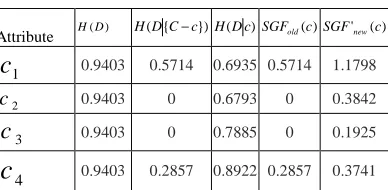
;(2) We calculate the importance degree of each attribute according to the formula (9), the table 2 lists the
result, from which we can see that the attribute
c
2 has maximum value, so it was chosen as the reduction elements,R
C
C
c
R
=
{
2},
'=
−
.(3) Then we calculate
I
(
R
;
D
)
=
0
.
261
,we can see I(R;D)≠ I(C;D)(4) According to the algorithm of section 3, we need to select another attribute to join reduction set from the remaining attributes, from table 2 we can find that the
c
1 attribute has the most importance degree among them, sowe add it into the reduction set,
R
=
{
c
2,
c
1}
.(5) Then we calculate
I
(
R
;
D
)
=
0
.
4605
,butI
(
R
;
D
)
≠
I
(
C
;
D
)
;(6) Then we select another attribute from table 1 to join
R
, according to the important degree,c
3are selected, because the equivalence classes of
{
c
1,
c
2,
c
4}
is}}
{
},
{
},
{
},
{
},
{
},
{
},
{
},
{
},
,
{
},
,
{
},
{
},
,
{{
x
1x
2x
3x
13x
4x
10x
5x
6x
7x
8x
9x
11x
12x
14 and the equivalenceclasses of
{
c
1,
c
3,
c
4}
is}}
{
},
{
},
{
},
{
},
{
},
{
},
{
},
,
{
},
{
},
{
},
{
},
,
and number of attribute combinations is the same. At present
2
c
is already in the reduction set, therefore we select4
c
to join the R set withoutc
3. We get the result as follows:}
,
,
{
c
2c
1c
4R
=
,I
(
R
;
D
)
=
0
.
9403
.(7) Due toI(R;D)=I(C;D), so we terminate the processing of the algorithm.
R
=
{
c
2,
c
1,
c
4
}
is one reduction set of the original information system.(8)
TABLE 2 Attribute important degree
Attribute H( D) H(D{C−c})H(Dc)SGFold(c)SGF'new(c)
1
c
0.9403 0.5714 0.6935 0.5714 1.17982
c 0.9403 0 0.6793 0 0.3842
3
c
0.9403 0 0.7885 0 0.19254
c
0.9403 0.2857 0.8922 0.2857 0.3741From table 2, we can see that the attribute importance degree of
c
1,
c
2,
c
3,
c
4 obtained by formula (8) were 0.5714,0,0, 0.2857 respectively, which is inconsistent with the actual situation. But the attribute importance degreeof
c
1,
c
2,
c
3,
c
4 is obtained according to the algorithm proposed in this paper is 1.1798, 0.3842, 0.1925, 0.3741respectively, the attribute importance degree of
c
2 is 0.3842 which is consistent with the actual system.CONCLUSION
Because some information systems may have no core attributes, but the core attributes is the foundation of the present attribute reduction algorithm based on mutual information, in order to solve the problem the author puts forward a new method to measure the importance degree of attribute and construct the corresponding heuristic reduction algorithm. This proposed algorithm takes into account the increment of mutual information after adding a attribute, but also its own information entropy, which can significantly decrease the ratio that the important attribute is taken as redundant attribute to remove. The experimental results show that the algorithm can not only solve the attribute reduction of non-core information system, but also be able to get reduction attribute faster and the reduction number is less than the present algorithms.
Acknowledgments
This research is supported by State Key Laboratory of Complex Electromagnetic Environment Effects on Electronics and Information System under Grants No. CEMEE2014K0368B.
REFERENCES
[1]Skowron A, Rauszer C. The discernibility matrices and functions in information systems[C]. In: Slowinski R(Eds.): Intelligent Decision Support-Handbook of Applications and Advances of the Rough Sets Theory, Kluwer Academic Publishers. London, pp: 331-362,1992.
[2]Zhang Teng-fei, XIAO Jian-mei,WANG Xi-huai. Acta Electronica Sinica, Vol.11, no. 33, pp:2080-2083, 2005.
[3]YE Dong yi. Acta Electronica Sinica, Vol. 28, no. 12,pp:80-82,2000.
[4]Cheng Jing, Zhu Jing, Zhang Fan. Journal of Hunan University (Natural Sciences), Vol.36, no.4, pp:86-88,2009.
[5]Jiang Y, Wang X, YE Z. Journal of System Simulation, Vol. 20, no. 14, pp : 3718- 3721, 2008.
[6]Chen Z, Zhang Q H. Study on attribute reduction algorithm based on fuzzy rough set[D]. Huaqiao University College of Computer Science and Technology,2006.
[7]Yang ming, Yang Ping. Control and Decision, Vol. 23, no.10, pp: 1103-1107, 2008.
[8]Zhang WeiXu, Zhangyan, Wang Xiaoyu. Computer Applications and Software, Vol30, no. 7, pp:43-46,2013.
[9]QIAN Jin , YE Feiyue , MENG Xiang Ping, LIU Da You. Engineering and Electronics, Vol.12, no. 29,
pp:2154-2157,2007.
[10]TENG Shu hua, ZHOU Shi lin, SUN Ji xiang, Li Zhi yong. Journal Of National University Of Defense Technology, Vol.32, no. 1, pp:90-94,2010.
[11]Liang J Y, Xu Z B. International Journal of Uncertainty, Fuzziness and Knowledge based Systems, , Vol.10, no.
[image:5.595.210.404.182.277.2]2008.
[13]Pei X B, Wang Y Z. Novel approaches to knowledge reduction in inconsistent decision systems, Natural Language Processing and knowledge engineering. IEEE NLP-KE’05 Proceedings of 2005 IEEE Internatonal
Conference, pp:746-749, January ,2005.
[14]Miao Duoqian,Fan Shidong. System engineering theory & practice, pp:48- 56, January ,2002.
[15]Jia Ping, Dai Jianhua, Pan Yunhe, et al . Journal of ZheJiang University ( Engineering Science) , Vol.40,no.6, pp: 1041 – 1044, 2006.
[16]Wang guoKuang. Rough theory and knowledge acquisition[M] . Xi’an jiao tong university press, 2001.
[17]Wang Hongkai, Yao Bingxue,Hu haiqing. The method of ascertaining weight based on rough sets theory [J].Computer engineering and application, Vol.36, pp: 20- 21,2003.
[18]Tan zongfeng, Xu zhangyan, Wangshuai. Computer engineering and application, Vol.48, no.18, pp: 115- 118,2008.
[19]Yanyan,Yang huizhong. tsinghua science and technology, Vol.47,no.S2, pp:1903-1906, 2007. [20]Bao xinzhong,Liu cheng. Journal of management, Vol. 6,no.6,pp:729-732,2009.