Published Online April 2015 in SciRes. http://www.scirp.org/journal/am http://dx.doi.org/10.4236/am.2015.64065
A Special Case of Variational Formulation
for Two-Point Boundary Value
Problem in
L
2
( )
Ω
Pedro Pablo Cárdenas Alzate
Department of Mathematics, Universidad Tecnológica de Pereira, Pereira, Colombia Email: [email protected]
Received 24 March 2015; accepted 22 April 2015; published 27 April 2015 Copyright © 2015 by author and Scientific Research Publishing Inc.
This work is licensed under the Creative Commons Attribution International License (CC BY).
http://creativecommons.org/licenses/by/4.0/
Abstract
We consider the nonlinear boundary value problems for elliptic partial differential equations and using a maximum principle for this problem we show uniqueness and continuous dependence on data. We use the strong version of the maximum principle to prove that all solutions of two-point BVP are positives and we also show a numerical example by applying finite difference method for a two-point BVP in one dimension based on discrete version of the maximum principle.
Keywords
Two-Point Boundary, Variational Problem, Stability Restriction
1. Introduction
In this paper, we have considered a simple two-point boundary value problem (BVP) for a second order linear ordinary differential equation. Using a maximum principle for this problem, we show uniqueness and conti-nuous dependence on data.
We write the BVP in variational form and use this together (with elements from functional analysis) we prove existence, uniqueness and continuous dependence on data. The finite difference method is a method for early development of numerical analysis to differential equations. In such a method, an approximate solution is sought at the points of a finite grid of points reducing the problem to a finite linear system of algebraic equations [1].
classes of solution techniques have emerged for solution of BVP for differential equations: the finite difference techniques, the finite element methods and the spectral techniques (see [4] and [5]). The last one has the advan-tage of high accuracy attained by the resulting discretization for a given number of nodes [6] [7] and [8].
2. Variational Formulation
We treat the two-point boundary value problem in Hilbert space L2
( )
Ω . We consider the problem( )
:
u = − αu′′+βu′+γu=g
in Ω=
] [
0,1 with u( )
0 =0 and u( )
1 =0. Here the coefficients α β, and γ are smooth and( )
( )
( )
0
0 , 0, Ω
2
x
x x β x
α α γ ′
< ≤ − ≥ ∈
Let φ an auxiliary function on C10
( )
Ω , so multiplying Equation (1) by φ and integrating over Ω we have( )
(
)
1 1
0φ αu βu γu dx 0gφdx
′
′ ′
− + + =
∫
∫
By using integration by parts with φ
( )
0 =φ( )
1 =0 we obtain(
)
1 1
0 −αφ′ ′u +βφu′+γφu dx= 0gφdx
∫
∫
Here (4) is the variational formulation of the problem (1). If we introduce the bilinear form
(
)
( )
1
0 αr s′ ′+βr s′ +γrs dx=α r s,
∫
with the functional
( ) ( )
1 0, d
L s = g s =
∫
gs x, we can write (3) as( )
( )
,L φ =α uφ
for all 1 0
H
φ∈ . We can say that function u is a weak solution of the problem (1) provided that 1 0
u∈H and (6) holds.
Next we show two theorems that demonstrate the existence of a solution of the variational equation (6). Theorem 1. Let g∈L2 and we assume that (2) holds. Then there exists a unique solution 1
0
u∈H of the problem (6) satisfying the condition
1
u ≤k g .
Theorem 2. Let β =0 and we assume that (2) holds. Furthermore let g∈L2 and 1 0
u∈H be the solution of the problem (6), then F u
( )
≤F( )
φ for all 10
H
φ∈ where
( )
1(
( )
2 2)
10 0
1
d d
2
F φ =
∫
α φ′ +γφ x−∫
gφ xIn theorem 1, we obtain the weak solution u of (6) and this solution is more regular than stated there, therefore u′′ exists as a weak function (derivative) and αu′′= − +g u′
(
β α−)
+γu∈L2. Hence, it follows that 2u∈H and also
0 u u g K u1 K g
α ′′ ≤ α ′′ ≤ + ≤
This expression together with 1
u ≤K g where 1 0 2
K = α− implies the regularity estimates 2
u ≤K g . We can see that the weak solution of (1) is a strong solution, but we can also see that with α less smooth we still obtain a weak solution in 1
0
H .
The next nonlinear boundary problem shows that all solutions are positive by using the strong version of maximum principle.
2.1. Numerical Examples
We consider the nonlinear boundary value problem
( )
( )
, 0 1 0
u
u′′ = − +u e u =u =
0
u
u= − = − +u′′ u e ≥
for all u∈. We can see that u usually takes the general form u= −αu′′+βu′+γu
Therefore, we have α γ= =1 and β =0. Now, the maximum principle states that for a differential operator
and a function u∈2
( )
Ω with the property that u≥0 in Ω, if γ ≥0 in Ω, then( ) ( )
{
}
Ω
minu≥min u 0 ,u 1 , 0
u and u respect the conditions of the principle, the boundary conditions of the problem are u
( )
0 =u( )
1 =0. Thus, all solutions of u are( )
0, Ωu x ≥ ∀ ∈u
The strong version of the principle refers to the case when there is a minimum interior point inside Ω, which results in a constant value of the function u inside the domain Ω. We know already that u≥0, and if we assume that u has a minimum point inside Ω say x0 then
( )
0 0,( )
0 0,( )
0 0u x = u x′ = u′′ x ≥
After this assumption, the expression = − + ≤u′′ u 0, but u≥0 by the initial hypothesis. Here, we have a contradiction, because the assumption that there is a minimum interior point is false. In the other words, the minimum 0 is attained only at the boundaries and all solutions inside the interval
( )
0,1 are positive, i.e.( )
0, Ωu x > ∀ ∈u
2.2. Variation Formulation and Existence of
− =
u
′′
g
In this case, we are going to solve
( )
in Ω 0,1u′′ g
− = =
with the following boundary conditions:
( )
0( )
1 0,( )
0( )
1 0 and( ) ( )
0 0( )
1 0u =u = u =u′ = −u′ +u =u′ =
2.2.1. Solution with BCs: u
( )
0 =u( )
1 =0Let
φ
∈C01( )
Ω an auxiliary function with the homogeneous boundary conditions as u, φ( )
0 =φ( )
1 =0. Mul-tiplying the initial differential operator −u′′ and the function f by φ, then expression (7) becomes( ) ( )
( ) ( )
u′′ x φ x g x φ x
− =
Next, integrate over Ω we have
( ) ( )
( ) ( )
1 1
0−u′′ x φ x dx= 0g x φ x dx
∫
∫
By using integration by parts, we can write the left hand side as
( ) ( )
( ) ( )
( ) ( )
( ) ( )
[ ]1 1 1
0,1 0−u′′ x φ x dx= − 0u′′ x φ x dx= 0u x′ φ′ x dx u x− ′ φ x
∫
∫
∫
The last term comes down to 0,
( ) ( )
[ ]0,1( ) ( )
1 1(
( ) ( )
0 0)
( )
1 0( )
0 0 0u x′ φ x u′ φ u′ φ u′ u′
− = − − − = − ⋅ + ⋅ =
therefore, the Equation (8) becomes
( ) ( )
( ) ( )
1 1
0u x′ φ′ x dx= 0g x φ x dx
∫
∫
which is the variational form of the (7).
*
(
)
1 0, d
a v w =
∫
v w x′ ′ (LHS) is a bilinear form because a v w(
,)
on Ω is a function a:Ω Ω× →. Now it is linear in each argument separately,(
)
(
)
(
)
(
)
1 1 1
0 0 0
1 1 1
0 0 0
, d d d ;
, d d d .
a u v w u v w x u w x v w x
a w u v w u v x w u x w v x
λ µ λ µ λ µ
λ µ λ µ λ µ
′ ′ ′ ′ ′ ′ + = + = + ′ ′ ′ ′ ′ ′ + = + = +
∫
∫
∫
∫
∫
∫
then a v w
(
,)
is symmetric. To show coercivity of a( )
⋅ ⋅, , we can apply Cauchy-Schwarz inequality( )
( )
2 1( )
2 2 2
0 d 0 d
x
v x =
∫
v y′ y ≤∫
v′ y≤ v′(
)
1 22 2
1 2
v = v − v′ ≤ √ v′
Coercivity of a
( )
⋅ ⋅, in Ω follows( )
( )
( )
2
1 1 2 2 1
Ω
0 0
, d d min
2
x
v a v v =
∫
v v′ ′ x=∫
v′ x≥ ∈ v′ ≥*
( ) (
)
10
, d
L w = g w =
∫
gw x (RHS). We can see that L w( )
is a function L:Ω→ and L is linear, in fact(
)
1(
)
1 1( )
( )
0 d 0 d 0 d
L λu+µv =
∫
g λu+µv x=λ∫
gu x+µ∫
gv x=λL u +µL vThe Equation (9) can be written as
(
v w,)
=L w( )
since a
( )
⋅ ⋅, is a bounded bilinear form, coercive in the Hilbert space Ω and L( )
⋅ is a bounded linear form in the same space, so the Lax-Milgram theorem states that there exists a unique vector u∈Ω i.e. a solution ofu exists.
2.2.2. Solution with BCs: u
( )
0 =u′( )
1 =0Similar to (7), this equation can be written using the auxiliary function φ and integration over the domain Ω and φ
( )
0 =φ′( )
1 =0 in this case.( ) ( )
( ) ( )
( ) ( )
[ ]( ) ( )
(
( ) ( )
( ) ( )
)
( ) ( )
( )
( ) ( )
1 1 0,1 0 0 1 0 1 0 1 0 d dd 1 1 0 0
d 0
d .
u x x x u x x x u x x
u x x x u u
u x x x
u x x x
φ φ φ
φ φ φ
φ φ ′′ ′ ′ ′ − = − ′ ′ ′ ′ = − − ′ ′ = − ′ ′ =
∫
∫
∫
∫
∫
Therefore, we can see that this function has the same variational formulation, i.e.
( ) ( )
( ) ( )
1 1
0u x′ φ′ x dx= 0g x φ x dx
∫
∫
Then, we can use the bilinear form and linear functional. Lax-Milgram lemma shows can be subsequently ap-plied to prove the existence of solution in a similar way as before.
2.2.3. Solution with BCs: −u′
( ) ( )
0 +u 0 =u′( )
1 =0Let the auxiliary function φ with the same boundary conditions φ′
( )
1 =0, −φ′( )
0 +φ′( )
0 =0. In this case, the LHS of (7) can be written as( ) ( )
( ) ( )
( ) ( )
[ ]( ) ( )
(
( ) ( )
( ) ( )
)
( ) ( )
(
( ) ( )
)
( ) ( )
( ) ( )
1 1 0,1 0 0 1 0 1 0 1 0 d dd 1 1 0 0
d 0 0 0
d 0 0 ,
u x x x u x x x u x x
u x x x u u
u x x x u
u x x x u
φ φ φ
φ φ φ
We can see that this quantity represents still a bilinear form
(
)
1(
)
( ) ( )
0
, d 0 0
a v w =
∫
v w′ ′ x+v wtherefore, a v w
(
,)
on Ω is a function a:Ω Ω× → and it is linear each argument separately, i.e.(
)
(
(
)
)
(
( )
( )
)
( )
(
(
)
( ) ( )
)
(
)
( ) ( )
(
)
1 1 0 0 1 0, d 0 0 0 d 0 0
d 0 0 ,
a u v w u v w x u v w u w x u w
v w x v w
λ µ λ µ λ µ λ
µ ′ ′ ′ ′ + = + + + + + ′ ′ + +
∫
∫
∫
(
)
(
(
)
)
( )
(
( )
( )
)
(
(
)
( ) ( )
)
(
)
( ) ( )
(
)
1 1 0 0 1 0, d 0 0 0 d 0 0
d 0 0 ,
a w u v w u v x w u v w u x w u
w v x w v
λ µ λ µ λ µ λ
µ ′ ′ ′ ′ + = + + + + + ′ ′ + +
∫
∫
∫
then, a v w
(
,)
is also symmetric. In this case the coercivity on the Hilbert space ω also applies, in fact(
)
( )
( )
(
( )
)
( )
2 2
1 1 2 2 2 1 2 1
Ω
0 0
, d d min 0 0
2 2
x
v v
a v w =
∫
v v′ ′ x=∫
v′ x≥ ∈ v′ +v ≥ +v ≥hence Lax-Milgram lemma can be applied to
( )
,( )
a uφ =L φ
where a
( )
⋅ ⋅, is a bilinear, symmetric coercive form and L a linear functional. A solution of u needs to exist in the domain Ω.3. Case of the Beam Equation
In this section, we give the variational formulation for the beam equation and we prove the existence and uni-queness of solution. We consider the beam equation
( )
44 d
, Ω 0,1 d
u g
x = =
with the boundary conditions u
( )
0 =u′( )
0 =u( )
1 =u′( )
1 =0. Now, using an auxiliary function 10
C
φ∈ with the same BCs as u, and integrating on Ω we get
( )
( )
1 3 1
0 u φdx 0fφdx
′ =
∫
∫
therefore ( )( )
( ) [ ] ( ) ( )1 3 3 1 3 1 3
0,1
0 u φdx u φ 0u φdx 0 0u φdx
′ = − ′ = − ′
∫
∫
∫
Thus, the variational form of the beam equation is
( )
1 3 1
0u φ′dx 0 fφdx
−
∫
=∫
Again, let the bilinear form and linear functional a v w
(
,)
and L w( )
to be equal to(
)
10
, d
a v w = −
∫
v w x′ ′We can see that a v w
(
,)
is a function a:Ω Ω× → and it is linear in each argument separately (as shown previously). Finally a v w(
,)
is also symmetric, i.e.( ) (
)
10
, d
L w = g w =
∫
fw xHere, the Lax-Milgram theorem can be applied to this system and show existence of a solution for u.
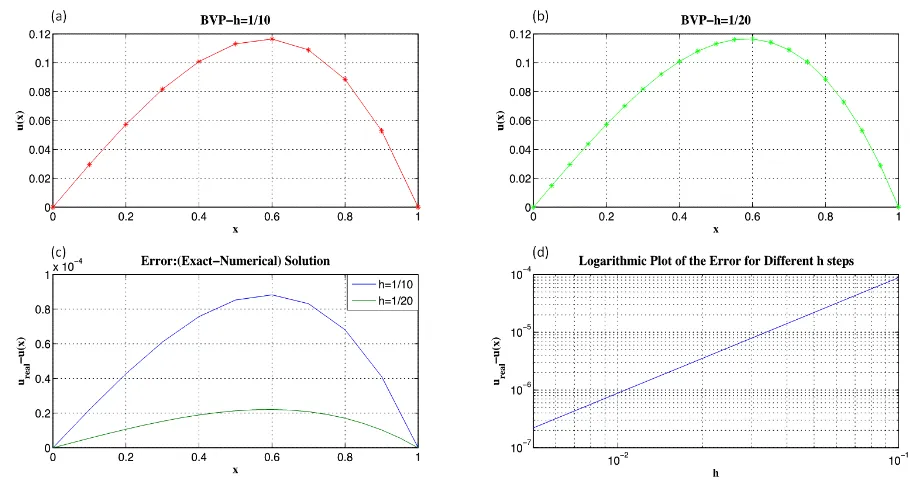
Figure 1. Solutions using the finite difference method (11) for (a) h = 1/10 and (b) h = 1/10. (c) Error when comparing these 2 grid choices with the exact solution. (d) Logarithmic plot of the error vs. the choice of h.
deflection and the slope of the deflection at the boundaries is 0 which means that the ends of the beam are fixed.
4. Maximum of the Error at the Mesh-Points for 2-Point BVP
In this example, we consider the two-point boundary value problem [9]( )
2 , Ω 0,1u′′ u x
− + = =
with u
( )
0 =u( )
1 =0. Applying the finite difference method ˆ :hUj = − ∂∂aj Uj+ ∂b Uj j+c Uj j =gj
with h=1 10 , 1 20 we show inFigure 1 the exact solution and the maximum of the error at the mesh-points.
Figure 1(a)andFigure 1(b) present similar plots. However, a h twice as small decreases the maximal error a 4 fold, shown inFigure 1(c). At the same point x = 0.6, the error is 2.209 × 10⁻⁵ vs. 8.829 × 10⁻⁵. The Loga-rithmic plot inFigure 1(d) shows a linear relationship between the error and h with slope 8 units.
Acknowledgements
We would like to thank the referee for his valuable suggestions that improved the presentation of this paper and group GEDNOL of the Universidad Tecnológica de Pereira-Colombia.
References
[1] Larsson S. and Thomée, V. (2009) Partial Differential Equations with Numerical Methods. Springer-Verlag, New York.
[2] McRea, G.J. and Godin, W.R. (1967) Numerical Solution of Atmospheric Diffusion for Chemically Reacting Flows. Journal of Computational Physics, 77, 1-42.
[3] Cárdenas Alzate, P.P. (2014) A Survey of the Implementation of Numerical Schemes for Linear Advection Equation. Advances in Pure Mathematics, 4, 467-479. http://dx.doi.org/10.4236/apm.2014.48052
[4] Cárdenas Alzate, P.P. (2014) A Survey of the Implementation of Numerical Schemes for the Heat Equation Using Forward Euler in Time. Journal of Applied Mathematics and Physics, 2, 1153-1158.
[5] Hundsdorfer, W. and Koren, B. (1995) A Positive Finite-Difference Advection Scheme Applied on Locally Refined Grids. Journal of Computational Physics, 117, 35-36. http://dx.doi.org/10.1006/jcph.1995.1042
[6] Canuto, C. and Hussaini, M. (1988) Spectral Methods in Fluids Dynamics, Springer Series in Computational Physics. Springer-Verlag, Berlin. http://dx.doi.org/10.1007/978-3-642-84108-8
[7] Dehghan, M. (2007) The One-Dimensional Heat Equation Subject to a Boundary Integral Specification. Chaos, Soli-tons & Fractals, 32, 661-675. http://dx.doi.org/10.1155/MPE.2005.61
[8] Lu, X, Tervola, P. and Viljanen, M. (2005) A New Analytical Method to Solve the Heat Equation for a Multi-Dimen- sional Composite Slab. Journal of Physics, 38, 2873. http://doi:10.1088/0305-4470/38/13/004