© 2017, IRJET | Impact Factor value: 5.181 | ISO 9001:2008 Certified Journal
| Page 674
Predictive Models and Optimization Techniques In
Machining of Hardened Steels: A Case Study
M.Rajesh
1, K.Ramadevi
2, Dr.G.Naga Malleswara Rao
31
Assistant Professor, Dept of Mechanical Engineering, Gates Institute of Technology, Gooty, Andhra
Pradesh, India
2
Assistant Professor, Dept of Mechanical Engineering, Gates Institute of Technology, Gooty, Andhra
Pradesh, India
3
Professor, Dept of Mechanical Engineering, Gates Institute of Technology, Gooty, Andhra Pradesh, India
---
Abstract
- A unique behavior is on display in hard turning. The process demonstrates high flexibility and an ability to fabricate the geometry of a complex workpiece in a set. It makes a variety of precision components with substantial potential benefits. Many studies have shown aspects and problems that have to be understood and dealt with if the process is to improve. The main factors affecting the reliability of hard turning are surface integrity and tool wear. The prediction of surface roughness, cutting force, and tool life in machining is a challenging task but necessary for proper optimization of the process. This article presents a brief review of the techniques of modeling and optimization that have significant influence in hard turning.Key Words: Machining optimization,Empirical Modeling,Parameters, Techniques, and Predictive Models.
1. INTRODUCTION: In their investigation of the process performance of turning hardened steel, researchers have looked at the effects of coatings, tool materials, and different shapes of inserts. Researchers have also investigated, experimentally, the effect of process parameters (namely residual stresses and white layer formation) on cutting forces and surface integrity. White layers are micro-structural changes observed in the surface layers of machine-hardened steels. Because the hard-turning process boasts several advantages over the grinding process, researchers have paid considerable attention to the machining of hardened steels, working with materials of hardness ranging from 45 to 65 HRC [1]. Some of the advantages include the cutting processing time, and removing cutting fluid[2]. Theseadvantages, however, can only be achieved as the cutting speed (Vc), feed rate (f) and the depth of cut (ap). To better understand hard turning,
researchers have studied the effect of these cutting parameters (Vc, f, ap) on tool wear, surface roughness, and surface
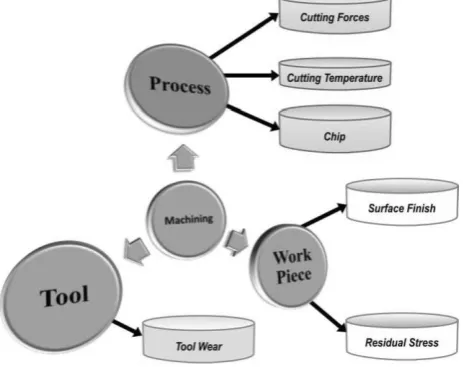
residual stress distribution in a workpiece [3]. Fig. 1 lays out the main factors to be studied for a better understanding of hard turning.Smith et al. [4] addressed the relationshipbetween surface integrity and fatigue life of hard-bc The results suggest that the effect of white layer outweighs that of surface residual stress on fatigue life. Delijaicov et al. [5] studied the influence of cutting vibrations on the hard turning of AISI 1045 steel with a hardness of 53 HRC. The results provided important implications concerning the surface roughness of hardened steel. Grzesik [6] explored the mechanisms of wear occurring with the mixed ceramic inserts during the hard machining of AISI 5140 having a hardness of 60 HRC. Grzesik [6] considered both microscopic and microstructural aspects, such as abrasion, fracture, plastic flow, adhesive tacking, and material transfer.
[image:1.595.156.388.563.746.2]© 2017, IRJET | Impact Factor value: 5.181 | ISO 9001:2008 Certified Journal
| Page 675
2. LITERATURE REVIEW
During the hard-turning process, complex and mu-tual interactions are created, at the contact surface, between tool and workpiece. Consequently, signifi-cant forces and high temperatures cause wear and sometimes breakage of the tool. Usually, such con-ditions lead to both contact surfaces being can be reduced or the mechanical characteristics modified. Davim and Figueira [11] investigated the machinability of cold work tool D2 steel heat-treated to a hardness of 60 HRC. They concluded that with an appropriate choice of cutting parameters it is possible to obtain a surface roughness Ra
smaller that 0.8 m. Aouici at al.
[12] experimentally stud-ied the effects, in hard turning, of cutting speed, feed rate, workpiece hardness, and depth of cut on surface roughness and cutting force components. AISI H11 steel had a hardness of 40, 45, and 50 HRC), machined using a CBN tool. Results showed that the cutting force components were influenced principally by the depth of cut and workpiece hard-ness. Sahoo et al. [13] carried out some machin-ability studies on flank wear, surface roughness, chip morphology, and cutting forces in finish hard turn-ing of AISI 4340 steel with a hardness of 47 HRC. The results indicated that a surface finish close to that of cylindrical grinding was produced by the best tool, type of chip, the components of the forces, and mixed alumina inserts. Yallese et al. [14] in-vestigated experimentally the behavior of a CBN tool during hard turning of 100Cr6 tempered steel. The results showed that a CBN tool offers good wear resistance despite the aggressiveness of the 100Cr6 with hardness of 60 HRC. Kamely et al. [15] stud-ied the tool life, wear mechanism, and
surface rough-ness in turning steel AISI D2 with a hardness of 60 HRC using mixed ceramic (Al2O3 + TiCN) coated with
TiN. Regarding roughness measurements, hard turning may be presented as a real alternative to substitute grinding operations.
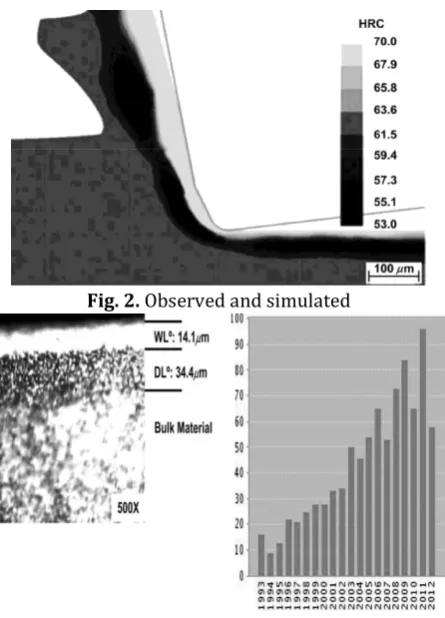
Fig. 2. Observed and simulated
[image:2.595.188.411.385.694.2]© 2017, IRJET | Impact Factor value: 5.181 | ISO 9001:2008 Certified Journal
| Page 676
3. MODELING AND OPTIMIZATION TECHNIQUES
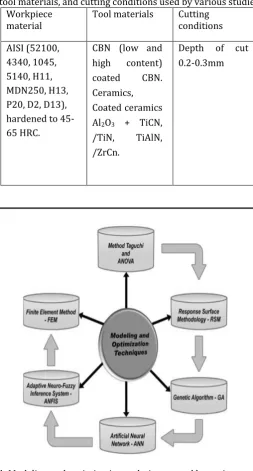
In research on hard turning techniques of modeling and optimization has attracted the attention of a number of researchers in view of its significant contribution to the overall cost of the product. Additionally, as the number of machining parameters increase, a greater number of experiments have to be carried out. As with most parts of machining pro-cesses, hard turning calls for a high degree of speci-ficity, which means for every application, piece of raw material, and cutting condition, a unique model is required. Fig. 4 shows modeling and optimization techniques in hard turning. Table 1.Workpiece material, tool materials, and cutting conditions used by various studies.
Workpiece
material Tool materials Cutting conditions
AISI (52100, 4340, 1045, 5140, H11, MDN250, H13, P20, D2, D13), hardened to 45-65 HRC.
CBN (low and
high content)
coated CBN.
Ceramics, Coated ceramics Al2O3 + TiCN,
/TiN, TiAlN,
/ZrCn.
[image:3.595.162.416.190.662.2]Depth of cut 0.2-0.3mm
Fig. 4. Modeling and optimization techniques used by various researches.
3.1.
Taguchi method and analysis of variance (ANOVA)
© 2017, IRJET | Impact Factor value: 5.181 | ISO 9001:2008 Certified Journal
| Page 677
the cutting performance and thereby improved the optimization process. Using the Taguchi method, Xueping et al. [23] in-vestigated the residual stress distribution in a hard-ened steel-bearing component 63 HRC. The study was able to obtain a
desirable compressive residual stress distribution. Also using the Taguchi method,Sahin [25] found the parameter having
the greatest effect on tool wear was cutting speed, followed by hardness of cutting tool, and lastly feed rate. Asilturk et al.
[1] conducted a study, based on the Taguchi method, on optimizing parameters to minimize surface roughness (Ra and Rz)
during the machining of AISI 4140 steel with a hardness of 51 HRC. Results of this study indicated that roughness was most affected by feed rate.
3.2.
Response surface methodology (RSM)
One approach to determine the relationship between various factors and responses is response surface methodology (RSM). RSM also ascertains the sig-nificance of these parameters on the responses.
RSM is useful in developing, improving, and opti-mizing the processes, providing an overall perspec-tive of the system response within the design space [26]. Utilizing the RSM, Gaitonde et al. [27] studied the effects of cutting speed, feed rate, and machin-ing time on hard turning of AISI D2 steel with a hard-ness of 59 - 61 HRC. The results showed that the ranges
of the parametersmet all variations. Bouacha et al. [28] carried out an experimental study with RSM on hard turning, using
CBN tool, of bearing steel with a hardness of 64 HRC. The results showed how much surface roughness is mainly influenced by feed rate and cutting speed. Lalwani et al. [29] investigated the effect of cutting parameters and surface roughness on finish hard turning of MDN250 steel with a hardness of 52 HRC. The machining experiments were conducted based on RSM. The results showed that cutting forces and surface roughness vary little with cutting speed
3.3. Genetic algorithm (GA)
Genetic Algorithm is an optimization method based on the genetic evolution of natural species. It differs from most optimization techniques because of its global searching criterion [30]. According Jin [31], the method bears a likeness to natural selection as it searches for better characteristics within a changing population. Kishawy et al. [32] studied and evaluated carbide tool performance during machining of hardened steel AISI 4340 steel with a hardness of 56 HRC. The research developed a GA to identify the constants in the proposed model. Results showed that the developed model is capable of predicting the rate of tool flank wear progression. Gomes et al. [33], utilizing GA, developed a multiple response optimization procedure for the AISI 52100 steel with a hardness of 55 HRC. This method was successfully applied and a result was optimized with good levels of quality, productivity, and economy. In hard turning operations Nandi and Davim [34] utilized GA to optimize the critical machining parameters to obtain a desired surface roughness on AISI results and the experimental results showed that surface roughness improved with cutting speed for constant values of feed rate and depth of cut.
3.4. Artificial neural network (ANN)
An artificial neural network (ANN), according to Haykin [35], is a distributed parallel system composed of simple processing units called nodes or neurons; the nodes performs specific mathematic functions (generally non-linear), thus corresponding
© 2017, IRJET | Impact Factor value: 5.181 | ISO 9001:2008 Certified Journal
| Page 678
3.5.
Adaptive Neuro-fuzzy inference system (ANFIS)
Adaptive Neuro-fuzzy inference systems (ANFISs) have been widely used in modeling, identifying, and monitoring complex systems. Since its origin in the early nineties, ANFIS has undergone various changes, giving rise to various trends in research. Its principle is based on extracting fuzzy rules in each level of a neural network. Once the rules have been obtained, they provide the necessary information on the global behavior of the system. [39]. Akkus and Asilturk [40] used ANFIS to model the surface roughness average values obtained when turning AISI 4140 steel with a hardness of 51 HRC. The high accuracy of the results demonstrated
3.6. Finite element method (FEM)
The finite element method (FEM), also known as finite element analysis (FEA), is a numerical technique for finding approximate solutions to partial differential equations and their systems as well as to integral equations (though less often). Hua et al.
[11]investigated the residual stress profile in the machined surface of steel AISI 52100 steel with a hardness of 60 HRC.
The researchers applied FEM at various levels of cutting conditions, workpiece hardness, and tool geometry. Numerical results showed that the best residual stress profile was obtained through an optimal combination between chamfer tool and feed rate. Umbrello and Jawahir
[12]presented a FEM that predicted white layer formation during machining of hardened AISI 52100 steel with a hardness of 56, 62, and 66 HRC. Results indicated that the proposed FEM model was suitable for studying the influence of cutting parameters and initial hardness on white layer formation. Caruso et al. [40] used FEM to study residual stresses induced by orthogonal cutting as well as the influence of flank tool wear on hardened steel AISI H13 steel with a hardness of 51 HRC. Results showed the developed FE model was able to re-produce experimentally observed surface residual stresses in orthogonal machining of AISI H13 tool steel. Using FEM, Duan et al. [42] investigated ser-rated chip morphology and cutting force during the machining of AISI 1045 steel with a hardness of 45 HRC. The investigation indicated that the simulation results were consistent with the experiments and that this FEM method could be used to predictchip morphology and cutting force. Using FEM,experimental cutting parameters on cutting force, material hardness, chip deformation, temperature, and heat flow. For this process, the researchers used hardened steel AISI 1045 steel with a hardness of 55 HRC. Results indicated that the proposed model fits quite well with and is suitable for practical applications, mainly industrial.
4. CONCLUSIONS
This paper has presented a brief review of the application of modeling and optimization techniques in machining of hardened steels. The major observations gleaned from the literature are the following:
In hard turning, the Taguchi method and ANOVA have proved to be efficient tools for controlling the effect on
tool wear and surface roughness.
Response surface methodology (RSM) presented the desired criteria optimization for determining the
relationship between the various factors (cutting speed, feed rate, and depth of cut) and the responses (cutting forces and surface roughness).
Genetic algorithm (GA) was used to identify the constants of the proposed model; the result is optimizing the
predicting of tool wear rate and improving surface roughness.
In general, artificial neural networks (ANNs) were well suited for accurate surface roughness prediction, cutting-tool flank wear prediction, and cutting tool state diagnosis.
Adaptive neuro-fuzzy inference systems (ANFISs) were able to accurately model the surface roughness
© 2017, IRJET | Impact Factor value: 5.181 | ISO 9001:2008 Certified Journal
| Page 679
ACKNOWLEDGEMENT
All glory and adoration is to almighty God, the sustainer of heaven and earth that sustain us till this movement I wish and thank Our principal of Gates Institute of Technology,Gooty for his moral and elderly advice. I pray that god almighty will continue.
REFERENCES
[1]W. Grzesik and K. Zak // Journal of Materials Processing Technology (2012)
[2]B. M. Gopalsamy, B. Mondal, S. Ghosh,
K. Arntz and F. Klocke // International Journal of Advanced Manufacturing Technology (2010)
[3]S. Smith, S.N. Melkote, E.L. Curzio, T.R. Watkins, L. Allard and L. Riester // Materials Science and Engineering A (2007)
[4]S. Delijaicov, F. Leonardi, E.C. Bordinassi and G.F. Batalha // Archives of Materials Science and Engineering (2010)
[5]W. Grzesik // Wear (2009).
[6]A.W. Warren and Y.B. Guo // Journal of Manufacturing Science and Engineering
(2009)
[7]D. Umbrello and L. Filice // Manufacturing Technology (2009)
[8]D. Umbrello, A.D. Jayal, S. Caruso, O.W. Dillon and I.S. Jawahir // Machining Science and Technology (2012)
[9] A. Attanasio, D. Umbrello, C. Cappellini, (2012)
[10]J.P. Davim and L. Figueira // Material and Design (2007)
[11]Y. Aouici and J.F. Rigal // Journal of the International Measurement Confederation(2012)
[12]A.K. Sahoo and B. Sahoo // Journal of the International Measurement Confederation (2012)
[13]M.A. Yallesea, C. Kamel, Z. Nassereddine, B. Lakhdar and J.F. Rigal // Journal of Materials Processing Technology (2009)
[14]M.A. Kamely, M.Y. Noordin, A. Ourdjini and Venkatesh // Journal of Advanced Manufacturing Technology (2008)
[15]Z. Chavoshi and Saeed // International Journal of Material Forming (2010).
[16]H. Bouchelaghem, M.A. Yallese,T. Mabrouki, A. Amirat and J.F. Rigal //Machining Science Technology (2010)
[17]M.C. Cakir, C. Ensarioglu and I. Demirayak // Journal of Materials Processing Technology (2009)
[18]B. Fnides, M.A. Yallese and H. Aouici // Scientific Journal Mechanika (2008) 59.
[19]A. Ramesh and N.S. Melkote // International Journal Machine Tools and Manufacture(2008)
[20]A.H. Suhail, N. Ismail, S.V. Wong and N.A.A. Jalil // American Journal of Engineering and Applied Sciences (2010)
[21]Z. Xueping, G. Erwei and C.R. Liu // Journal of Materials Processing Technology (2009)
[22]F.J. Pontes, A.P. de Paiva, P.P. Balestrassi, J.R. Ferreira and M.B. Silva // Expert Systems with Applications (2012)
[23]Y. Sahin // Journal of Materials Processing Technology (2009)
[24]D.C. Montgomery, Design and analysis of experiments, 7th ed. (New York: Wiley 2009).
[25]V.N. Gaitonde, S.R. Karnik, L. Figueira and J. Paulo Davim // Materials and Manufacturing Processes (2009).
[26]K. Bouacha, M.A. Yallese, T. Mabrouki and J.F. Rigal // International Journal of Refractory Metals and Hard Materials(2010)
[27]D.I. Lalwani, N.K. Mehta and P.K. Jain //
Journal of Materials Processing Technology (2008)
[28]A.M. Zain, H. Haron and S. Sharif // Expert System Applications (2010)
[29]H. Jin and M.L. Wong // Expert System Applications (2010)
[30]H.A. Kishawy, LeiPang and M. Balazinski //
International Journal of Mechanical Sciences (2011)
[31]J.H.F. Gomes, A.P. Paiva, J.R. Ferreira, S.C. Costa and E.J. Paiva // Advanced Materials Research (2011)
[32]A.K. Nandi and J.P. Davim // International Journal of Materials and Product Technology (2009)
© 2017, IRJET | Impact Factor value: 5.181 | ISO 9001:2008 Certified Journal
| Page 680
[34]V.S. Sharma, S. Dhiman, R. Sehgal and S.K. Sharma // Journal Intelligence Manufacturing(2008)
[35]D. Singh and P.A. Rao // International Journal of Advanced Manufacturing Technology(2007)
[36]R. Quiza, L. Figueira and J.P. Davim //
International Journal of Advanced Manufacturing Technology (2008). [37]A. Gajate, R. Haber, R. d. Toro, P. Vega and
a. Bustillo // Journal IntelligenceManufacturing (2012).
[38]H. Akkus and D. Asilturk // Scientific Research and Essays (2011).
[39]J. Hua, D. Umbrello and R. Shivpuri // Journal of Materials Processing Technology (2006)
[40]D. Umbrello and I.S. Jawahir // International Journal of Advanced Manufacturing Technology (2009).
[41]S. Caruso, J.C. Outeiro, D. Umbrello and
R. Saoubi // International Journal of Material Forming (2010) 515.
[42]C.Z. Duan, T. Dou, Y.J. Cai and Y.Y. Li //
International Journal of Recent Trends in Engineering (2009).
BIOGRAPHY
Mr. M. Rajesh received his B.Tech in Mechanical Engineering from JNTUH, University and M.Tech in Production Engineering from SVU University. Currently, He is a Asst.Professor in the department of Mechanical Engineering at Gates Institute of Technology, Gooty, India. He has published 6 papers in International Journals, 2 paper in National Journal and 3 papers in various International and National Conferences. His research interests include Metal Machining and Optimization.
Miss.K.Ramadevi received her B.Tech in Mechanical Engineering from JNTUA, University and M.Tech in Advanced Manufacturing Engineering from JNTUA University. Currently, She is a Asst.Professor in the department of Mechanical Engineering at Gates Institute of Technology, Gooty, India. She has published 2 papers in International Journals, 1 paper in National Journal and 2 papers in various International and National Conferences. His research interests include Metal Machining and Optimization.