© 2017, IRJET | Impact Factor value: 5.181 | ISO 9001:2008 Certified Journal | Page 1859
VISIBLE LIGHT COMMUNICATION
Shweta B. Suryawanshi
1, Prajakta Jadhav
2,
1
(Department of E&Tc, Asst. Prof. DYPIEMR, Akurdi, Pune, SPPU, India )
2
(Department of E&Tc, Asst. Prof. DYPIEMR, Akurdi, Pune, SPPU, India )
---***---Abstract -
LED is having advanced properties such as high brightness, reliability, lower power consumption and long lifetime. White LEDs are expected to serve in the next generation of lamps. An indoor visible-light communication system utilizing white LED lights has been proposed. Generally, plural lights are installed in our room. So, their optical path difference must be considered. In this paper, we discuss about the influence of interference and reflection. Based on numerical analyses, we show that the system will expect as indoor communication of next generation.Keywords – LED, Visible Light communication, optical
path.
1. INTRODUCTION
1.1 Visible light
V isible light is the form in which electromagnetic radiation with wavelengths in a particular range is interpreted by the human brain. Visible light is comprised of visually perceivable electromagnetic waves. wave lengths from 380 nm to 750 nm covered by visible spectrum. At the lower end of the spectrum there are violet-bluish tones and light at the other end of the spectrum is interpreted to be distinctly red.
1.2 Motivation
Use of VLC for data transmission is having many benefits. VLC eliminates drawbacks of transmission via electromagnetic waves outside the visible spectrum. VLC may causes health problems because of exposure to moderation is assumed to be safe on the human body. Moreover, there is no interference with electromagnetic radiation occurs so that visible light can be used in hospitals and other institutions without problem.
1.3 Visible Light Communications Consortium The Visible Light Communications Consortium (VLCC) which is nothing but comprised technology of Japanese companies. It was found in November 2003 VLC is used for data transmission to establish consistent proper standards
2. VLC DEVELOPMENT TIMELINE
Siemens researchers shows that the data transmission speeds of VLC systems are to be rapidly improving, with a frequency-modulated white LED and the Heinrich Hertz Institute in Berlin is to be capable of transmitting information up to 5 meters at a rate of 500 Mbps, efficiently faster than current Wi-Fi technologies which is operated at rates of up to 150 Mbps. The researchers were also able to demonstrate that a system using up to 5 LEDs with direct line of sight could transfer data over greater distances at 100 Mbps. Decreased levels of transmission would have occurred using diffused light from walls outside of line of sight.
Conventional wireless local area network (WLAN) links generally not as secure as VLC data transfer is, as it is indicated that only photoreceptors directly within the transmitted cone of light can get information, thereby making it apparently from impervious to interception.
Demonstration undertaken successfully in Japan showing the combination of VLC with indoor Global Positioning System (GPS).
VLC technology further to allow communication between a various electronic products, such as high definition televisions, information kiosks, personal computers (PCs), personal digital assistants (PDAs) and smart phones searched by The Centre for Ubiquitous Communication by Light (UC-Light) at the University of California.
© 2017, IRJET | Impact Factor value: 5.181 | ISO 9001:2008 Certified Journal | Page 1860 costs get reduced because of this specification
change, when the IrDA specification is used widely in portable technology.
Research in Japan to increase viable communication distances for VLC to hundreds of meters. Such work will allow the transmission of information by light from billboards, and from new generations of traffic lights to automobiles and trains.
German scientist, define that the problem of light smog can be avoided. It is adding of the transmission signals within the optical surrounding signals (as with natural sight). He stresses the importance of mimicking nature.
complimentary research and development which is a joint-cooperative agreement to advance communications technology industry is announced between VLCC and the international Infrared Data Association (IrDA) that is responsible for developing and establishing global specification standards for low-cost infrared technology for wireless communication.
3. GENERAL SYSTEM ARCHITECTURE
[image:2.595.313.567.168.261.2]In this section, basic VLC system using LEDs for indoor application is introduced, as shown in Figure 2. In this system, there are two kinds of lighting devices. The one used in optical downlink is composed of many plural white LEDs, replacing incandescent lamps on the ceiling and generally has a large superficial area and a wide angle of irradiance. Another lighting device, used in optical uplink, is composed of several white LEDs. It has a small superficial area and a narrow angle of irradiance, like an electric torch. From Figure 2, we can see data transmission from the lighting device LEDs to a PC equipped with a detector in the downlink and from a table lamp to a detector in the uplink [2].
Figure 2: VLC system for indoor application
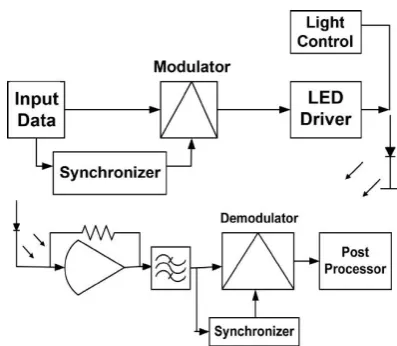
[image:2.595.333.532.379.552.2]This dual function is based on the fast switching of LEDs and the modulation of the visible light waves for wireless communications. Figure 3 shows the block diagram of the system model applicable for indoor environment.
Figure 3: Overall Block Diagram of VLC
This system consists of a light source which emits light and data simultaneously. Data is sent between two or more terminals; in each terminal there is a receiver and an emitter. The emitter transmits data into free space, to be received by a receiver from a different terminal. Block diagram of the transmitter is given in Figure 4.
Figure 4: Transmitter & Receiver Blocks
At first, we modulate information into the luminance and then transmit the information by blinking LED. For optical wireless links, the most viable modulation is intensity modulation (IM), in which the desired waveform is modulated onto the instantaneous power of the carrier.
Next, we receive the information by capturing the blinking transmitter. The most practical down-conversion technique is direct detection (DD). A photodiode is generally applied as a light sensor. The receiver block is as shown in Figure
[image:2.595.37.298.590.730.2]© 2017, IRJET | Impact Factor value: 5.181 | ISO 9001:2008 Certified Journal | Page 1861 the outdoor, for short range within 20-30 meters at 1
Mbps, to maintain Bit Error Rate (BER) of 10−6 , it is expected that an SNR of around 14 dB should be maintained. However, in our application, we have a target of around 70-90 meters of range, where data rate is not an important issue. In the intended application, a data rate of 128-256 Kbps would be sufficient within the limitation of around A4 size page information per second time period, suitable to be detected and interpreted by recipients.
3.1 MODULATION
In order to actually send data through LEDs, such as audio, image files, it is required to modulate these into a carrier signal. In the context of visible light communication, this carrier signal consists of light pulses sent out in short intervals. How these are exactly interpreted depends on the selected modulation scheme, two of which will be presented in section. At first, a scheme called subcarrier pulse position modulation is used which is already established as VLC-standard by the VLCC. The second modulation scheme is to be addressed is called frequency shift keying, commonly called as FSK.
3.1.1 Frequency shift keying
In frequency shift keying (FSK) data is represented by varying frequencies of the carrier wave. In order to transmit two distinct values (0 and 1), there need to be two distinct frequencies. This is also the simplest form of frequency shift keying, called binary frequency shift keying (BFSK). Figure 7 shows an example of frequency-shift keying by modulating of the data string. At this point it is important to clarify a common source of confusion: In none of the modulation schemes it is the actual light frequency that is changed. That would lead to unaccepted effects as changing the light frequency also means changing the wave length of the light. occurrence of light pulses defines the frequency whereas in frequency shift keying, the actual pulse frequency is changing depending on the data that is to be sent this appear in subcarrier pulse position modulation. In FSK, there is no position of pulses, because light pulses are sent without any interruption.
4. VISIBLE LIGHT COMMUNICATION SYSTEM USING WHITE LED
It is a kind of optical wireless communication that uses the “visible” white ray as the medium (Fig. 5). In this system, LED is not only used as a lighting device, but also to be used as a communication device.
Fig.5 Visible-light communication system utilizing white LED lights
LED is having dual functions like lighting and communication, Which emerges many new and interesting applications. The function is based on the fast switching of LEDs and the modulation of the visible-light waves for free-space communications.
The system has following advantages: ● Optical data transmission with few shadowing
throughout a whole room is enabled by high power and
distributed lighting equipment. ● Lighting equipment with white LEDs is easy to install
and aesthetically pleasing. In order to realize this system, study of optical properties as lighting equipment and an optical transmitter is required.
4.1 LED LIGHT DESIGN
4.1.1. Basic Properties of LED Lights
LED lights have two basic properties, a luminous intensity and a transmitted optical power. Luminous intensity is the unit that indicates the energy flux per a solid angle, and it is related to illuminance at an illuminated surface. At this time, the energy flux is normalized with visibility. The luminous intensity is used for expressing the brightness of an LED. On the other hand, the transmitted optical power indicates the total energy radiated from an LED, and as is a parameter from the point of view of optical communication. The luminous intensity is given as:
...……….(1)
where Ω is the spatial angle, and Φ is the luminous flux The integral of the energy flux Φe in all directions is the
transmitted optical power Pt, given as:
© 2017, IRJET | Impact Factor value: 5.181 | ISO 9001:2008 Certified Journal | Page 1862 Where ˄min and ˄max are determined by the sensitivity
curve of the PD (photo diode).
4.1.2. Illuminance of LED Lighting
In this subsection, the distribution of illuminance at a desk surface will be discussed. The illuminance expresses the brightness of an illuminated surface. The luminous
intensity in angle is given by [3]
……….………….……….(3)
A horizontal illuminance Ehorat a point (x, y) is given by
………...………….(4)
where I(0) is the center luminous intensity of an LED, Φ is the angle of irradiance , is the angle of incidence, and Dd
is the distance between an LED and a detector’s surface. The consideration for illuminance of LED lighting is required. Generally, illuminance of lights is standardized by International Organization for Standardization (ISO). By this set of standards, illuminance of 300 to 1500 lx in required for offices work.
5. ADAPTIVE EQUALISATION
The system has large optical power and large emission characteristic at transmitter to function as lighting device. Therefore, the BER performance is degraded excessively due to the effects of intersymbol interference. Performance of adaptive equalizer with LMS algorithm is evaluated in visible-light wireless environment.
5.1. Least Mean Squire Algorithm
Since an adaptive equalizer compensates for an unknown and time-varying channel, it requires a specific algorithm to update the equalizer coefficients and track the channel variations. A wide range of algorithms exist to adapt the filter coefficients. Here, LMS algorithm is introduced. A more robust equalizer is the LMS equalizer where the criterion used is the minimization of the mean square error (MSE) between the desired equalizer output and the actual equalizer output. It follows that when the desired equalizer output is known, the error signal ek is given
by[4]
………..(7)
To compute the mean square error |ek|2 at time instant k, equation (7) is squared to obtain
……….……...(8) The LMS algorithm seeks to minimize the mean square error given in equ. (8). The LMS algorithm is the simplest equalization algorithm and requires only 2N+1 operations per iteration.
Letting the variable n denote the sequence of iterations, LMS is computed iteratively by
………..(9)
where the subscript N denotes the number of delay stages in the equalizer, μ is the step size which controls the convergence rate and stability of the algorithm, and a vector yN is the input signal to the equalizer. Therefore,
the LMS equalizer maximizes the signal to distortion ratio at its output within the constraints of tap length of the equalizer. So, the convergence rate of the LMS algorithm is slow due to fact that there is only one parameter, the step parameter μ, that controls the adaptation rate.
6. APPLICATIONS
This technology can act as a standard light, but stand underneath it with a suitably-equipped gadget, such as a PDA (personal digital assistant), mobile phone or MP3 player, and data can be instantly transferred straight to the gadget, at speeds approaching that of optical fiber.
There can be many more applications: atexhibitions, where we can stand underneath a VLC lamp and download information from the display; in cameras and camera phones, with the optics from the camera lens being used to receive the data; in the office, with a VLC-equipped desk-lamp being used as a modem for our laptop, almost any place where we currently use WiFi.
7. CONCLUSION
© 2017, IRJET | Impact Factor value: 5.181 | ISO 9001:2008 Certified Journal | Page 1863
REFERENCES
[1]C.Pohlmann, “Visible Light Communication”,2014 [2]Navin Kumar, Nuno Lourenco, Michal Spiez, Rui L Aguiar, “Visible Light Communication Systems Conception and VIDAS”, 2010
[3]Toshiko Komine, "Fundamental Analysis for VLC System using LED Lights", IEEE Transactions on Consumer Electronics, vol. 50, no. 1, Feb. 2004.
[4]Toshihiko Komine, “Adaptive Equalisation for indoor visible wireless communication system”, 2005 Asia-Pacific Conference on Communications, Perth, Western Australia, 3 - 5 October 2005.
[5] Navin Kumar, Nuno Rafael Lourenco “Led-Based Visible Light Communication System: A Brief Survey and Investigation” Journal of Engineering and Applied Sciences. 2010; 5(4): 296 -307