International Research Journal of Engineering and Technology (IRJET)
e-ISSN: 2395 -0056 p-ISSN: 2395-0072Volume: 04 Issue: 03 | March -2017 www.irjet.net
© 2017, IRJET | Impact Factor value: 5.181 | ISO 9001:2008 Certified Journal
| Page 335
An E-commerce feedback review mining for a trusted seller’s profile and
classification of fake and authentic feedback comments
Sruthi sathyanandan s
1, 2Dhanya Sreedharan
1
Sree Buddha college of engineering, Alappuzha, India,
2
Sree Buddha college of engineering, Alappuzha, India
---***---
Abstract
- Nowadays before making a purchase from anE-commerce site we firstly browse the online reviews of products posted by the post-purchase customers. Today E-commerce sites uses trust models based on reputation of each sites. The trust models are computed based on the feedback ratings on E-commerce sites. The main problem that arises during the computation is the “all good reputation problem”.E-commerce sites like Amazon, EBay is highly prone to the “all good reputation problem”. Thus we need to use trust evaluation to compute the feedback ratings obtained from various E-commerce sites. For this we mine each of the feedback comments based on their dimensions and weights.So,in order to mine feedback comments an algorithm is used.
Key Words: Aspect mining, LDA, NLP, LEXICAL-LDA
1. INTRODUCTION
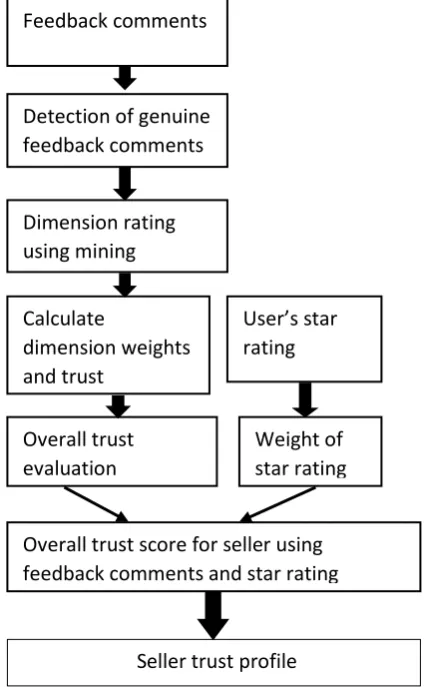
[image:1.596.328.541.253.597.2]Before making a purchase from an E-commerce site what we does is we go through each of the product reviews in that particular site. Because online feedback reviews helps us to find the post purchase experiences of products and services. However we know that all the reviews we find in an E-commerce site may not be genuine. Some reviews we find in an E-commerce site may be fake yet they may be written to appear as authentic. However it is a very tedious task to differentiate between authentic and fake reviews. Our main objective behind the paper is to find or to categorize sellers in an E-commerce site by providing each seller’s trusted profile. In an E-commerce site we can find a huge number of customer reviews. Also we should take into consideration that the reputation scores for each seller’s in an E-commerce site may be very high. Hence it will be difficult for a customer to find a trust worthy sellers. For E-commerce sites like E-bay and Amazon the reputation scores will be very high. So in this paper we consider a buyer’s feedback reviews in free text feedback comments. For this we propose an algorithm called Comm trust in order to mine feedback comments.
Fig 1: Architecture of an e-commerce feedback review mining for a trusted seller’s profile
The Proposed system can recognize the authentic review comments .The system categorizes each seller’s based on their trust in feedback comments. The overall feedback comments are taken in order to find the weights and dimension ratings. Then an overall trust evaluation is made in order to find trusted reviews. Here star ratings from the
Feedback comments
Detection of genuine
feedback comments
Dimension rating
using mining
Calculate
dimension weights
and trust
Overall trust
evaluation
User’s star
rating
Weight of
star rating
Overall trust score for seller using
feedback comments and star rating
International Research Journal of Engineering and Technology (IRJET)
e-ISSN: 2395 -0056 p-ISSN: 2395-0072Volume: 04 Issue: 03 | March -2017 www.irjet.net
© 2017, IRJET | Impact Factor value: 5.181 | ISO 9001:2008 Certified Journal
| Page 336
sites are also taken for trust computation. Then a seller’s trust profile is computed based on all these dimensions. Here the system deals with three main modules. They are as follows.
I. Trust evaluation on the basis of reputation
Trust evaluation is done in order to compute or examine the overall trust in an E-commerce feedback reviews. By computing the trust from the review we can reduce the reputation scores to a certain extend. For the easiness of computing trust usually sellers and buyers are referred to as individuals in an E-commerce system. For this we need to compute the dimension ratings from the review comments. Then we need to cluster these review comments represented as dimensions .Then we need to compute the corresponding dimension trust scores. The based on the computed dimension based trust scores each sellers are categorized.
II.Analysis of text feedback comments
We know that the customer feedback is the main thing that gives a business a clear view of products in an E-commerce site. We also know that the text review comments are sometimes noisy and thus analysing them is a tedious task. For each text feedback comments in an E-commerce site we give a particular weightage based on the positive, negative and neutral feedback comments.
III.Aspect opinion extraction
Here each text feedback review will be handled dependently and indepently.Here the nouns and noun phrases that frequently appear in a text feedback review is identified. Then an opinion lexicon dictionary is constructed based on the words in the text review. Then an overall summarization is made from the reviews.
2. LITERATURE SURVEY
2.1 Aspect rating analysis
[1] Discusses a new approach in opinionated text analysis problem called the Latent Aspect Rating Analysis also called as LARA.LARA aims to analyse opinions based on the topics of aspects in order to find individual opinions on each aspects along with the relative view on different aspects while forming a final judgement. This paper explains a probabilistic rating model to solve the problem in a convenient way. LARA is actually used to get a deeper understanding of a review. To get detailed understanding of review, we used a novel data mining problem called Latent Aspect Rating Analysis (LARA). With a collection of text
feedback reviews with overall ratings LARA analyses opinions expressed in each review in a level of topical Aspects. It is to discover each individual reviewer's latent
rating corresponding to each aspect and to the relative importance weight on aspects when forming a final judgment. The use of latent aspect ratings as well as the aspect weights in a single review can be used in a wide range of application. The latent ratings on various aspects can support aspect based opinion summarization. Here aspect weights can be directly used for checking reviewers' rating behaviours along with latent ratings and aspect weights can support personalized aspect-level ranking.
[2] Discusses predicting aspect-level based ratings instead of considering the overall rating. This paper firstly formulate the whole task as a multiple aspect ranking problem and then produces a set of numerical scores. A single score is allotted to each aspect. Then an algorithm is used to learn various ranking models by considering the individual aspects. The application of opinion extraction allows users to collectively analyse user’s opinions contained in Web documents. Here we consider an opinion as quadruple consisting of an opinion holder, the subject to be evaluated, the attribute from which a subject is to be evaluated including the value of the evaluation which expresses a positive or negative evaluation. We consider the definition as the tip for our opinion extraction task. Here in this paper we can describe opinion extraction Task as opinion units consisting of four elements. The feasibility of task definition based on an efficient corpus study. Here we can consider a huge task as two forms of relation extraction tasks. They are of aspect-evaluation relation extraction and aspect-of relation extraction. Later we can propose a machine learning-based method. This method will combine both the contextual clues and statistical clues of the text feedback comments.
International Research Journal of Engineering and Technology (IRJET)
e-ISSN: 2395 -0056 p-ISSN: 2395-0072Volume: 04 Issue: 03 | March -2017 www.irjet.net
© 2017, IRJET | Impact Factor value: 5.181 | ISO 9001:2008 Certified Journal
| Page 337
aspect ratings in order to discover the suitable topics that can extract small pieces of text explaining the aspects without the need of any annotation in the data. Later we can find that the model also finds the actual coherent topics and gains an accuracy in sentences to a standard classified model. The main area of work is to use a model for sentiment summarization system to evaluate it at a suitable level.[4] Discusses the problem in generation of a rated summary which gives a view of the total ratings for major aspects in order to gain a different perspective to the target entity. Here the problem in generation of a rated aspect summary is decomposed into three steps. The idea is to gain a different prospective to the target entity is quite good because each user’s may have different needs. However rated aspect summarization can help user’s to make a good decision by getting more detailed information.
[5] Discussed rating analysis without aspect keyword. Here a unified model is introduced for LARA (Latent Aspect Rating Analysis).This model does not need a pre-defined aspect keyword. Instead it mines ratings based on the weights assigned to each aspects by the reviewer. Here in this paper we introduced a unified Latent Aspect Rating Analysis Model (LARAM) .The model is able to explore all text data contained in a text data. It then discovers the overall ratings simultaneously. The model uses various factors like topical aspects, latent based ratings corresponding to each aspect and latent weights allotted to on different aspects by a online feedback reviewer. Thus a generative model for the review text and the whole rating enables LARA task to be used in various forms of review data without any aspect Keywords. LARAM model introduced in this paper can efficiently solve any problem of LARA, including identifying useful topical aspects, finding interesting differences in overall aspect ratings in a review, and for modelling preferences of user with relative view on different aspects. LARAM technique can support multiple application tasks, which includes aspect opinion summarizing, ranking entities based on overall aspect rating plus the analysis of user’s rating approach.
[6]Discusses modelling of the online reviews using multi-grain topic modelling. These models works based on LDA and PLSA.Here we introduce a framework to extract aspect ratings from online user reviews. The multi-grain LDA introduced by the paper considers both the local topics and the global topics. The aim of the system is to use a method for extracting aspects that can be rated from the overall reviews without the help of any humans. Therefore we used generative models of various documents, which represent the whole document to a mixtures of latent topics. Here we
mostly consider the application of standard methods that can be used for unsupervised modelling of documents. Probabilistic Latent Semantic Analysis, PLSA along with the Latent Dirichelet Allocation. The analysis allows us to find certain limitations of models. Thus we propose a new model called the Multi-grain LDA.
[7] Discusses jointly modelling all opinions and aspects using MAXENT-LDA hybrid model. Here a new topic modelling method that can independently separate opinions words and aspects is introduced. Bag of words representation is used to separate. MAXENT allows to us pos tags to separate words more easily. Here we uses a topic modelling form that is able to identify aspect as well as opinions by using a model named Maxent-Lda hybrid model. By using a supervised model we can find syntactic features in order to separate aspect and opinions. The model is then evaluated on feedback review datasets from various domains. The model introduced was found to be good in identifying the meaningful side of aspects compared to the previous models used. Also the model could perform fair with even a small amount of training data set or with any with training data set from various domain. The model joints both aspects and opinion words.
2.2 Trust relationships from online feedback
comments
[8] Discusses maintaining trust relationships from feedback comments. The system introduced in the paper is capable in extracting useful negative information from millions of feedback comments. It uses both personalises and feature based trust evaluation methods. The core algorithm used in the paper uses techniques from the field of natural language processing (NLP).The algorithm introduced in the paper is called the auction rules algorithm. It is a classification algorithm that classify comments to negative and positive comments based on a particular threshold value.
International Research Journal of Engineering and Technology (IRJET)
e-ISSN: 2395 -0056 p-ISSN: 2395-0072Volume: 04 Issue: 03 | March -2017 www.irjet.net
© 2017, IRJET | Impact Factor value: 5.181 | ISO 9001:2008 Certified Journal
| Page 338
accurate. Then an application called trust mail is used as variations on these algorithms in order to score messages in user’s inbox based on the ratings in a trusted network.
.[11] Discusses the trusting multi agent systems. This paper checks the role of each multi agent systems and then takes into account. There are two main approaches to trust used in this paper. First approach used is to allow all agents to trust among themselves. The second approach used is in the design of protocols and various interaction mechanisms. Here the paper uses a method to decrease the impact of malicious sites. Firstly the system calculates a trust value for calculating the Eigen vector of matrix to get a fully normalized trust values. For this the entire system’s history value is taken. All the computations are done in a distributed manner.
[12] Discusses an Eigen trust algorithm for reputation management of the E-commerce sites. This paper introduces a method to compute trust values globally. We use normalization to aggregate all global trust values. The system explained here completely relies on a centralised system in order to manage and store all the user ratings. This paper is completely implemented based on Eigen trust algorithm. This algorithm explains how to normalise values.
[13] Discusses the design of feedback analysing system to find trustworthy e-commerce seller. This paper uses a feedback analysis system in order to analyse the feedback comments and helps buyer’s to find out which organisation is good for making a purchase. For this both opinion mining and natural language processing techniques are used. For this two aspects are used. Both positive and negative aspects.[14] Discusses a general model for trust representation and aggregation. This paper presents a trust model, RLM for reputation prediction. Here the trust score is calculated based on the positive score and the negative score.
[15] Discusses identifying honest recommenders in e-commerce sites. This paper uses mechanisms to filter out untrustworthy sellers. Hence the system uses only recommenders that contribute positively to the computed reputation score. This paper uses a honesty checking processing by using another dimension that may affect the dishonest recommenders.
Acknowledgements
We are thankful to our project guide Prof Dhanya Sreedharan and PG Coordinator Prof. Minu Lalitha Madhavu for her remarks, suggestions and for providing all the vital
facilities like providing the Internet access and important books, which were essential. We are also thankful to all the staff members of the Department of Computer Science & Engineering of Sree Buddha College of Engineering, Alappuzha.
REFERENCES
[1]Latent aspect rating analysis on review text data: A rating regression approach Hongning Wang, Yue lu, Chengxiang Zhai department of computer science university of Illinois .
[2] Multiple aspect ranking using the good grief algorithm in snyder and regina barzilay computer science and artificial intelligent{bsnyder,regina}@csail.mit.edu
[3] A joint model of text and aspect ratings for sentiment summarization ivan titov department of computer science university of illinois at urbana-champaign urbana, il 61801 [email protected]
[4] Rated aspect summarization of short comments yue lu department of computer science university of Illinois at Urbana department of computer science university of Illinois at Urbana Champaign Urbana, il 61801 [email protected]
[5] Latent aspect rating analysis without aspect keyword supervision Hongning Wang, Yue lug, Chengxiang Zhai department of computer science university of Illinois at urbana-champaign Urbana il, 61801 usa {wang296, yuelu2, chai}@cs.uiuc.edu
[6] Modelling online reviews with multi-grain topic models Ivan titan department of computer science university of Illinois at urbana-champaign Urbana, il 61801 [email protected] Ryan McDonald google inc. 76 ninth avenue new York, NY 10011 [email protected]
[7] Jointly modelling aspects and opinions with a maxent-lda hybrid Wayne xin zhao†, jing jiang‡, hongfei yan†, xiaoming li† †school of electronics engineering and computer science, peking university, china
International Research Journal of Engineering and Technology (IRJET)
e-ISSN: 2395 -0056 p-ISSN: 2395-0072Volume: 04 Issue: 03 | March -2017 www.irjet.net
© 2017, IRJET | Impact Factor value: 5.181 | ISO 9001:2008 Certified Journal
| Page 339
[9] Formalising trust as a computational concept stephen paul marsh department of computing science and mathematics university of stirling
[10] Inferring trust relationships in web-based social networks jennifer golbeck, james hendler university of maryland, college park computer science department college park, md 20742 {golbeck, handler}@cs.umd.edu
[11] Trust in multi-agent systems school of electronics and computer science, university of Southampton, Southamuk [email protected]@ecs.soton.ac.uk;
[12] The Eigen trust algorithm for reputation management in p2p networks spender d. kava Stanford university.
[13] Design of feedback analysis system for deciding trustworthy e-commerce organization sonali rakhi d.wajgi m. tech student, dept. of computer science & engg.
[14] Rlm: a general model for trust representation and aggregation ieee, ling liu, senior member, ieee and jinshu su, member, ieee