© 2017, IRJET | Impact Factor value: 5.181 | ISO 9001:2008 Certified Journal | Page 2468
A Data collection scheme with multi-agent based approach for VSNs
Shilji k c
11
P G scholar, Dept. of Information and technology, Govt. engineering college Barton Hill Trivandrum, Kerala, India
---***---Abstract -
VSNs (vehicular sensor networks) is a newlyprogressive networking system of VANET (vehicular ad-Hoc networks). And it’s also considered as a subgroup of VANET. This paper focusses upon improving the energy efficiency and data collection in urban networks using agent mechanism. The important components like sensor nodes (vehicles) and roadside units together comprise a Vehicular Sensor Network (VSN). Vehicles are equipped with sensors for the collection and dissemination of data over the network. The road network is divided into small groups of nodes called clusters. It is a challenging task to manage the networks in a dynamic environment due to the various characteristics like high mobility of vehicles, high relative velocity, different behavior of drivers and occurrence of unpredictable link failures. To solve these issues an agent based communication is one of the potential solution approach. But single mobile agents are used in small road segments and have energy constraint problems as well as unnecessary communication delay. This mechanism focusses on a suitable and an efficient aspect to collect sensor readings from VSNs. It also shows the pros and cons of both cluster based and agent based solution approach and also discovers a new and improved scheme. It deploys multiple mobile agents for collecting sensor readings from the given urban areas. Mobile agents serve as an emerging potential solution to efficiently collect sensor readings in VSNs. It achieves remarkably higher network coverage on urban areas and reduces energy and delay constraint issues based on the following assumptions. Finally to overcome the short comings of an agent based scheme an improved multi agent based three layer network architecture approach is also discussed.
Key Words: Mobile agents, Road segment interest (RSI), Vehicular sensor networks (VSN)
1. INTRODUCTION
Vehicular Ad Hoc Networks (VANETs) [5] are discovered from the principles of mobile ad hoc networks (MANETs). Similarly VSN (Vehicular sensor networks) is an emerging networking system from the base concepts of VANET’s. It creates a wireless network for data exchange in the domain of vehicles within the road network. These are the key components of intelligent transportation systems (ITS).VSNs support a wide range of applications from simple one hop information collection and dissemination to multi-hop data
collection and dissemination of messages over vast distances. VSN (Vehicular sensor networks) is an extension of VANET, in which it consists of sensor nodes as vehicles and road side units (RSUs) [6]. VSN provides a sensing platform in which vehicles and RSUs communicates by collecting and disseminating the information throughout the network. Most of the aspects in Vehicular ad hoc networks and VANETs are same, but the details of both differ. Vehicles interact with the road side units and it can be characterized in an accurate way. Similarly the vehicles mobility range is restricted in an organized fashion. Vehicular Sensor Networks have been spotlighted for many applications such as the driving safety, driving efficiency, and data services in the road networks [7]. The sensors in the vehicles play a vital role in monitoring the road surfaces to detect obstacles and any road hazards. The monitoring is performed by collecting the data from various motion sensors (e.g., accelerometer), and obstacle detection sensors (e.g., ultrasonic and laser sensors) etc. Vehicles are embedded with sensors for the driving safety, particularly for monitoring the road surface and identifying the road hazards are critically important, and those sensing pieces of information can be shared among the vehicles to avoid possible dangerous circumstances and situations.
© 2017, IRJET | Impact Factor value: 5.181 | ISO 9001:2008 Certified Journal | Page 2469
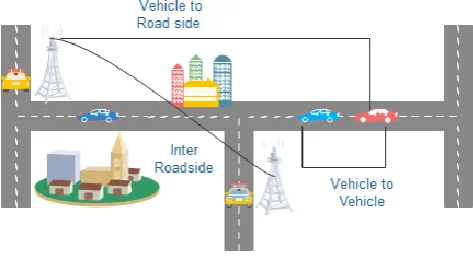
sending a query from RSU’s, sensor nodes receive it and [image:2.595.52.289.173.305.2]rebroadcast the packet to the vehicles in its coverage area. Types of vehicular communications are shown in fig -1.
Fig -1: Wireless Communication System
In VSNs due to the highly varying network topology data collection in dynamic networks getting challenging task. To efficiently collect sensor readings in Vehicular sensor networks mobile agents are the potential solution [8][2]. The term mobile agent refers from the agent technology system, it is a software component which migrates independently throughout the network. It can interact with other agents in the network and learn the required information and then perform its own tasks [1].Sensor nodes are used to provide variety of services in VANETs [16]. Hence each vehicle as well as the road side sensors monitor the traffic situation, such as density, average speed, etc. The basic idea behind mobile agents is to move code across a network from one node to another.
To address the problems of VSNs such as network management, service provisioning, information collection and distribution which is intrinsically difficult, a solution is proposed in which vehicles integrates with mobile agents and norm-aware agents [2].The basic idea behind mobile agents is to move code across a network from one node to another. Similarly the behavior of any interacting set of agents is regulated by norms can be considered a norm-governed system, where a norm is a rule that prescribes organizational concepts like (institutional) obligation, power permission, sanction, and other more complex relations. This network implementation in VANETs extends into VSNs under dynamic topology in which the sensor nodes are used to provide variety of services in VANETs. This study is focusing on to solve one of the issue of VSN’s that is, efficient data collection on urban areas and to provide a solution approach.
The rest of this paper is organized as follows. First, section 2 describes the literature review. This is followed by explanation about different VSN data collection schemes.
Section 3 addresses VSN’s three layer network Communication Architecture. Finally, section 4 concludes the paper.
2. LITERATURE SURVEY
There are two aspects which are involved for the data collection in VSNs- routing related and data-related [10]. The routing-related aspect is the routing of raw sensor readings, while the data-related aspect is for the coding and compression of aggregated data, and it focuses to reduce the data transmission overhead.
The paper focusses on the study about how to effectively gather raw sensor readings from the urban area in which the vehicular density is very much higher. All the proposed methods that address the issues and challenges of data collection in VSNs. These works are mainly fall into two models depending on whether raw sensor data is collected on demand: based or pull-based [11]. In the push-based model, every vehicle periodically broadcasts the gathered sensor readings to its one-hop neighbors and the collected information is disseminated to all other regions or collected by a data sink. Generally this model is preferred for traffic safety applications.
Due to the dissemination of collected data over the entire network will cause higher communication overhead. To reduce this a common technique adopted in the pull-based model is to divide the entire vehicles in the given area into a set of groups called clusters in which one vehicle (the cluster head) collects sensor data from all other vehicles in that cluster and exchanges the information with the next cluster by communicating via cluster heads. In [12], the authors propose the Clustered Gathering Protocol (CGP) in which vehicles collect data within a specified region by combining cluster-based data dissemination mechanism with geographical and opportunistic approaches. In the scheme, vehicles are grouped into a number of clusters and for each cluster, the cluster head is elected by using a back-off based algorithm. Cluster heads manage the collection and dissemination of data’s over the network as well as it forwards to the corresponding RSUs therefore reducing the required data transmission bandwidth. However, it creates a single point-of-failure due to the unique choice of cluster head collecting the information within each cluster and the efficiency of data gathering depends on the stability of the clusters.
© 2017, IRJET | Impact Factor value: 5.181 | ISO 9001:2008 Certified Journal | Page 2470
density in the cluster is low the algorithm results inunnecessary latency. That is each vehicle in the cluster must need to wait for its allocated time slot to respond its data to the cluster head. In [14] and [15], the authors proposed to adopt SDMA or TDMA to control medium access of vehicles, where the cluster heads are responsible for the space or time slot allocation and their synchronization. However, due to the mobility of the vehicles cause the instability of cluster heads similarly the coordination of communication is costly in many cases.
To solve these communication issues a new scheme is proposed an agent based data collection scheme [1]. In which this approach is based on deploying a single agent to collect the data within the specified region. In this scheme a remote data sink initiates the data packet called an agent, which specifies the coordinates of the road segment. It migrates among the vehicles and collects the requested data item. It combines an agent migration algorithm with the termination algorithm to achieve the data collection as well as reducing the communication overhead. Where all the vehicles are in single hop communication region. However the problem of this scheme shows that the transmission power of each vehicle is very much higher due to the single hop communication, hence it reduces the lifetime of each vehicles. Similarly due to the lossy links the maintenance will cause communication delay.
3. DISCUSSIONS AND SOLUTIONS
Based on our study on various data collection schemes of VSN we found that an agent based data collection mechanism is a better option for urban areas. But it can cover small segment of network area with a single hop communication. To achieve urban area data coverage ratio one of the solution method is to deploys multiple agents over the given network area instead of single agent mechanism. Hence MAS (mobile agent systems) based vehicular information vehicular sensor network in urban area is being proposed to solve the issues related to single agent scheme. Here, all vehicles are considered to be part of a VSN. Each vehicle as well as the road side sensors monitors the traffic situation, such as density, average speed, temperature, pressure etc. Based on these assumptions, in this section, a multi agent-based approach is considered, and also it incorporates with a clustering scheme to solve the existing network problems in VSN is discussed.
3.1 Advantages of using agents
Flexibility: Agents provides flexible services for the information collection and dissemination over the vehicular sensor network.
Adaptability: Agents adapt to varied network conditions such as mobility of vehicles, critical traffic situations, weather conditions, road changes, etc.
Maintainability: Agents provides less maintainable issues over the communication link loss and critical events.
Survivability: Wireless networks are very much vulnerable to failures. Similarly, in VSNs, it may be that a node fails to comply with the system specifications, either by design, by accident or from necessity. Agents are Dealing with such non-compliant behavior, can also be addressed.
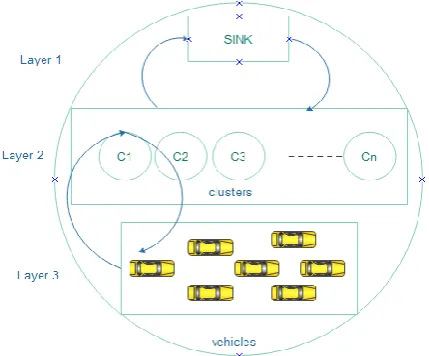
[image:3.595.309.524.422.600.2]Considering all the properties of the agent systems, a multi agent based data collection scheme by extending the agent technology in VANETs into VSNs is required to implement. Therefore, our solution is to propose a three-layer network architecture comprising: 1) mobile agents; 2) static agents. The mobile agent layer focusses in the implementation decisions made by static agents. The mobile agents operates on the domain of network whereas the static agents for applications. Thus an idea is proposed to converge both agent scheme and clustering scheme for the efficient data collection and dissemination over the network. In the following sub-section, we elaborate further on this novel network architecture. Three layer architecture shown in following Fig -2.
Fig – 2:Three layer Network Architecture
The system comprises the vehicles which are communicating themselves on the road which are within a given cluster (VSN). A cluster is formed based on radio range coverage of vehicles and the road-side base station. Here the given urban area is divided into a set of clusters in which each cluster comprises of cluster head called base stations and the clusters may communicate by using these base stations.
© 2017, IRJET | Impact Factor value: 5.181 | ISO 9001:2008 Certified Journal | Page 2471
bandwidth similarly it can reduce the transmission power ofvehicles.
The sink node refers to a transport station which initiates all the network communications and manages the performances. It consists a vehicle agency for the synchronization of data’s.
From the proposed network architecture, the information collection and network management model can be categorized into four parts: vehicle to vehicle, vehicle to base station, cluster to cluster and cluster to sink node [2]. There are several agents are used for the data communication between vehicles within the clusters. Following shows the different types of communications and the set of agents used for.
3.2. Vehicle to Vehicle Communication
Each of the participating vehicles within the cluster would be equipped with a set of agents such as Vehicle Manager Agent (VMA), Alarm Agent (AA), and Service Discovery Agent (SDA). These agents are responsible for collecting and disseminating traffic information. The vehicle agency within the sink node also consists of a traffic knowledge base (TKB) which is used for communication among agents.
VMA: It is a static agent deployed at every vehicle and synchronizes the interaction of all the agents within the vehicles.
AA: It is a mobile agent moves across the vehicles in the network by creating its clones, and it is used for the critical information dissemination. It also informs the VMA and updates the TKB.
SDA: It is a mobile agent which travels in the entire network for the services requested by the vehicle user and search for the services such as road maps, traffic density maps, Internet services, and location aware services (commerce, entertainment, parking, fuel stations, etc.). The agent also updates the TKB with services discovered.
TKB: It consists of information of critical events such as accidents, traffic density and the services available in the vehicle, services accessed, recently accessed road maps and it updates regularly.
3.3. Vehicle to Base station
A fixed infrastructure comprised of a number of base stations strategically placed in close proximity to the highways is necessary to facilitate the upload/download of data from/to the vehicles. The information from the sensors is the input to the base station. Information could be traffic density, vehicle types, adverse road conditions, etc. Each cluster consists a base station. The base station agency comprises of following components. Base Station Manager Agent (BSMA), Service Agent (SA), Advertisement Agent (ADA) and Cluster Knowledge Base (CKB).
BSMA: It is a static norm-governed agent deployed at each base station which maintains and synchronizes all the agents that are associated with base station. It regularly updates the
CKB with the visited vehicles information and services by interacting with VMA of each vehicle.
SA: It is a static agent responsible for collecting the information and services from the service providers of the cluster and regularly updates the CKB.
ADA: It is a mobile agent which travels in the network and informs the visited VMAs about the collected information’s for the requested vehicle user.
CKB: It regularly updates with information such as critical events within visited vehicle information, traffic density maps, road conditions, location aware services, advertisements, etc.
3.4. Cluster to Cluster
Clustering provides a method to disseminate the traffic
information as well as provide varieties of services with less communication overhead. The whole network is divided into groups of vehicles called clusters, in which a cluster head is selected for the overall communication management. These clusters are self-management groups that continually adapts the changing network topology and new cluster configurations. Communication between the clusters will take place with the help of BSMAs located in base stations that are fixed on the road side or within the cluster heads.3.5.
Cluster to Sink Node
Sink node consists of complete information of the transportation infrastructure which is collected from various cluster BSMAs. BSMAs of the clusters communicate with the Sink node manager. Sink node manager periodically constructs an overall picture of the road ways in terms of traffic, critical events, road conditions, etc., and constructs a road map and distributes to the BSMAs.
A multi-agent approach [9] [17] is presented in this paper is to deal with the shortcomings of single agent communication in VSN.As well as multi agent approach is efficient if the network area is extended into an urban road network. All the agent properties are inherits by multi agents and the system responds well in urban networks. In an urban road networks the density of vehicle is very much higher, it will cause communication link loss and data interferences between the vehicles. An agent technology is an efficient solution to observe and learn the desired environment and collect the required information, thereafter optimize communication among the vehicles, hence find the best routes to reduce the network traffic. Various routing protocols are available for the information routing. The routing protocols are classified into various categories such as cluster based routing protocols, topology based routing protocols, position based routing protocols, geo cast and broadcast routing protocols.
© 2017, IRJET | Impact Factor value: 5.181 | ISO 9001:2008 Certified Journal | Page 2472
cluster based routing protocols, the entire network isdivided into a number of small partitions called clusters. Clustering improves the performance of the network, hence can be utilized in numerous vehicular applications [4]. In this approach instead of communicating vehicles directly to the BSMA a cluster head is elected for the communication between the clusters. In which the cluster head continuously collects the data over the network and broadcasts to the corresponding BSMA’s. The limitations of cluster based data collection mechanism are that the single point failures and intra-cluster problems are addressed by using multi agents. All nodes always monitor their signal strength to the cluster head. If the signal strength decreases between the nodes and cluster head means the current cluster head has no longer been able to attach with all nodes. So the cluster head tries to handover all the member nodes to a neighboring cluster. The development of optimized routing system for the agent technology has been a promising solution.
Vehicular communications are formed in mobile environment of urban and rural areas and works well in both. Considering the large network with much number of nodes participating in the communication cause overhead due to their high mobility, Researches still exist about the study of feasibility of routing protocols [3].
4. CONCLUSION AND FUTURE WORK
On the basis of these studies it can be concluded that VSN’s are facing several limitations .In which my study is focusing on to solve the energy efficiency problem facing by vehicles in their single hop communication, and the higher transmission power of vehicles. This will reduce the vehicle’s or the network’s life time. In this paper both cluster based and agent based data collection schemes are discussed from which it can be concluded that due to the instability of cluster heads the agent based data gathering scheme performs well in a small segment of area instead of cluster based scheme. But the main drawback of this scheme is that less energy efficiency and higher transmission power. Findings of this study indicated that this problem can be solved by extending the agent based concept into a multi-agent system with a clustering mechanism that is able to monitor large urban regions through cooperation among several agents.
This paper has given a solution approach to the existing agent collection scheme. So the current work emphasizes on deploying multiple agent to collect data within an urban area network by a three-layer network architecture approach. Similarly it reduces the transmission power of the vehicles as well as improving the energy efficiency by multi-hop communication within the multiple agents. It achieves energy efficiency and higher data collection under dense traffics by deploying multiple agents. Similarly the multi agent based clustering scheme overcomes the limitations of single point failure and intra-cluster problems. It can be
concluded that multi-agent systems have a great potential to influence the design of future VSN's and their applications. Multi-agent systems should be providing more adaptability, and flexibility, for the realization of services and its applications within next generation VSN's environments.
The future work is the implementation of multi agent based three layer networking system with a clustering scheme.
ACKNOWLEDGEMENT
I would like to express my sincere gratitude towards my mentor Ms. Sangeetha U, Assistant Professor in Department of Information Technology at GEC Trivandrum, for her kind co-operation and encouragement which helped me to understand the vast topic of Vehicular Sensor Networks. I would like to thank my family and friends as well, for their continuous support and encouragement.
REFERENCES
[1] Hui Huang, Lavy Libman, Glenn Geers. “An Agent
Based Data Collection Scheme for Vehicular Sensor Networks,” IEEE International Conference, (2015).
[2] S.S. Manvi, M.S. Kakkasageri, Jeremy Pitt, Alex Rathmell,
“Multi-Agent Systems as a Platform for VANETs,” pp, 2-7. ( 2010).
[3] Amira Harrabi, Walid Chainbi, Khaled Ghedira. “A
Multi-Agent Approach For Routing On Vehicular Ad-Hoc Networks,” The 4th International Conference on Ambient Systems, Networks and Technologies, (ANT 2013).
[4] Rasmeet S Bali , Neeraj Kumar , Joel J.P.C. Rodrigues b.
“Clustering in vehicular ad hoc networks: Taxonomy, challenges and solutions,” Vehicular Communications @science Direct, may (2014).
[5] Moath Al-Doori, Ali H Al-Bayatti, “A comprehensive
survey on vehicular Ad Hoc network,” Article In Journal Of Network And Computer Applications, January (2014)
[6] G.G Md. Nawaz Ali, “Co-operative data access in multiple
Road Side Units (RSUs)-based Vehicular Ad Hoc Networks (VANETs),” ResearchGate publications Conference Paper, January (2011).
[7] Uichin Lee, Eugenio Magistretti , Biao Zhou, Mario Gerla,
Paolo Bellavista, Antonio Corradi, “MobEyes: Smart Mobs for Urban Monitoring with a Vehicular Sensor Network,” IEEE Wireless communications (vol. 13) pp. 1-3. October (2006).
[8] Oscar Urra, Sergio Ilarri, Thierry Delot and Eduardo
Mena, ”Mobile Agents in Vehicular Networks: Taking a First Ride,” Springer Berlin Heidelberg publications, (2010).
[9] S.S. Manvia , M.S. Kakkasageri and Jeremy Pitt,
“Multiagent based information dissemination in vehicular ad hoc networks,” ACM publications, journal in mobile information systems, (vol.4) pp. 363-389 dec (2009).
[10] B. Yu, J. Gong, and C.-Z. Xu, “Catch-up: A data aggregation
© 2017, IRJET | Impact Factor value: 5.181 | ISO 9001:2008 Certified Journal | Page 2473
[11] T. Nadeem, P. Shankar, and L. Iftode, “A comparative
study of data dissemination models for VANETs,” IEEE Annual International Conference on Mobile and Ubiquitous Systems: Networking and Services (MobiQuitous), San Jose, CA, Jul. (2006).
[12] I. Salhi, M. O. Cherif, and S.-M. Senouci, “A new
architecture for data collection in vehicular networks,” IEEE International Conference on Communications (ICC), Dresden, Germany, Jun. (2009).
[13] W.-R. Chang, H.-T. Lin, and B.-X. Chen, :Trafficgather, “An
efficient and scalable data collection protocol for vehicular ad hoc networks,” IEEE Consumer Communications and Networking Conference (CCNC), Las Vegas, NV, Jan. (2008).
[14] B. Brik, N. Lagraa, H. Cherroun, and A. Lakas,
“Token-based clustered data gathering protocol (TCDGP) in vehicular networks,” International Conference on Wireless Communications and Mobile Computing (IWCMC), Sardinia, Italy, Jul. (2013).
[15] B. Brik, N. Lagraa, M. B. Yagoubi, and A. Lakas, “An
efficient and robust clustered data gathering protocol (CDGP) for vehicular networks,” ACM international symposium on Design and analysis of intelligent vehicular networks and applications (DIVANet), New York, NY, Oct.(2012)
[16] Mohammad Jalil Piran, G. Rama Murthy, G. Praveen
Babu, “vehicular ad hoc and sensor networks;principles and challenges,” International Journal of Ad hoc, Sensor & Ubiquitous Computing (IJASUC) (Vol.2)pp-38-40 June (2011).
[17] Samira Harrabia, Walid Chainbib, Khaled Ghedirac, “A
Multi-Agent Approach For Routing On Vehicular Ad-HocNetworks,” The 4th International conference On Ambient systems, Networks and Technologies (ANT 2013).