© 2017, IRJET | Impact Factor value: 5.181 | ISO 9001:2008 Certified Journal
| Page 2460
Performance Evaluation of SCERP: A Cluster Based Network Lifetime
Improvement Protocol for WSN
Shital V. Bahale
1,
Dr.M.A.Pund
21
P.G. Student ME CSE(P.T.), PRMIT&R , Badnera -Amravati , M.S., India
2
Associate Professor Department of Computer Sci. & Engg. , PRMIT&R , Badnera –Amravati. , M.S., India
---Abstract:
Wireless sensing element networks (WSNs), have restricted energy for operation as a result of it includes of little size battery powered sensing element nodes as a power supply. As a result of the limitation of nodes energy, energy efficiency is a very important issue ought to be thought of once coming up with protocols for WSN. Clustering technique is that the most distinguished technique to reduce the sensingelement nodes energy consumption throughout
operation. This paper analyses the issues of existing cluster head selection method in LEACH protocol and thus proposes a replacement cluster primarily based
protocol (SCERP) that is meant to balance the
whole network energy consumption. SCERP uses a new methodology for cluster head election that improves energy efficiency of network and so extends the network lifetime. The simulation results shows planned protocol outperforms LEACH in terms of balancing nodes energy consumption and prolonging the lifespan of WSN.
Keywords:
Sensor Nodes, Cluster heads, WirelessSensor Networks, Base Station.
1.
INTRODUCTION
A self-organized network Wireless sensor network (WSN) [1] is composed by a large number of small sensors that are at random deployed in operational space. A sensing, processing, communication, transceiver and power units are consist in detector node [2]. To acquire interested knowledge, process, and communicate to different sensors inside the networks detector nodes are used, sometimes through radio frequency channel[3]. Wireless sensor networks (WSNs) are used in many applications embody home security, battle-field police investigation, watching movement of domesticated animals inside the forest, earth movement detection,
attention applications [4,19 ]. The main advantage of WSNs is their ability to work autonomously in harsh environments wherever it is dangerous or impossible for individual to reach [5]. Because of the price and tiny size of the detector nodes, they need been equipped with tiny batteries with restricted energy supply [6]. This has been a serious constraint of wireless sensor nodes that limits their lifespan and affects utilization of the wireless sensor networks. To increase lifespan and networks utilization, constant changing the batteries once they run out of energy might not be sensible, since these nodes in most cases are several (thousands of sensor nodes), recharging the weaken batteries at all time might not be possible. Therefore, there's a desire to reduce energy consumption in WSNs. For this reason, planning a WSN routing protocol, enhancing energy efficiency and therefore increasing the network lifespan has become a primary design objective for wireless sensor network.
Up til now, there are several cluster-based routing protocols developed to extend WSN lifespan, like LEACH [7,14,15], threshold-sensitive energy efficient sensor network (TEEN)[20], and power efficient gathering in sensor info systems (PEGASIS) [8].Section II, describe LEACH protocol and it’s shortcomings.
© 2017, IRJET | Impact Factor value: 5.181 | ISO 9001:2008 Certified Journal
| Page 2461
LEACH. In Section V conclusion and future improvement scope is given.
2.
RELATED WORK:
In [11] author W. R. Heinzelman, A. Chandrakasan, and H.Balakrishnan proposes an efficient communication protocol for wireless sensor network. LEACH is based on an aggregation technique that combines data received from sensor nodes and sends aggregated data to the base station rather than sending each transmission. This requires extra energy for data aggregation and for long-range transmission to the base station which may located too far. In LEACH protocol cluster head selection is periodical and role is rotated uniformly for every fixed duration so that each node will act as a CH at least once in its life span. Cluster Head distribution is based on some probability. If T(n) is 1 then the node n will be the CH in next round.
where, p is the probability of node n being selected as a CH, r represents the current round number and G is the set of nodes that are not selected as a CH in the last 1/p
rounds.
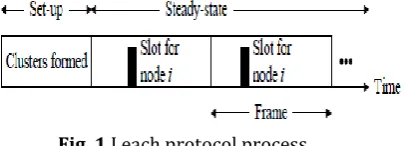
LEACH algorithm consist of two phases, they are set up phase and steady state phase. Cluster heads are elected in Setup phase and steady state phase is used to maintain the CH during the transmission of data.
Fig. 1 Leach protocol process
There is lack of balancing the total network energy consumption in Leach cluster head election process[7]. Therefore, it's possible that a low energy node will be elected as CH which is responsible for decline in network lifetime. Secondly cluster head selection does not taken into account nodes distance from base station therefore periodic data transmission drains low energy sensor nodes quickly , leads to unreliable network.
In [8] authors S. Lindsey, C. S. Raghavendra, presents PEGASIS which is a chain based protocol. The
idea behind the protocol is that so as to increase network lifetime, nodes need only communicate with their closest neighbors and they take turns in communicating with the base-station. When all nodes communication with the base-station ends , a new round will start and so on. To spread power draining uniformly over network this reduces the power required to transmit data per round. In term of the energy inconsistency this protocol however unable to treat every node unfairly.
In [20] A. Manjeshwar, D. P. Agrawal, presents TEEN protocol for energy efficient wireless sensor networks. A hierarchical clustering protocol, is TEEN which groups sensors into clusters with each cluster is headed by a CH. The sensed data is reported to their CH, then CH sends aggregated data until the data reaches to the sink. Thus, the sensor network architecture in TEEN is based on a hierarchical grouping where closer nodes form clusters and this process goes on the second level until the BS (sink) is reached. Two threshold values hard and soft threshold are used for data transmission. Main limitation of TEEN is that it is suitable only for time critical sensing applications.
Another clustering protocol, proposed by G. Smaragdakis, I. Matta and A. Bestavros in [16] is SEP. This protocol use non-homogenous sensor nodes to distribute energy uniformly in WSNs. In SEP protocol uses two different levels of energy for cluster head selection. A cluster head is elected from node with the highest weight according to their different energy and then subsequent CHs are elected using this process. This approach ensures that CHs are is not suitable for the widely used multi-level heterogeneous wireless sensor networks.
Totally different algorithms are used by all the aforementioned protocols to reduce the networks energy consumption. However the maximum prolongation of the overall network lifetime is not assured. Therefore, a protocol that elects as cluster heads nodes that minimize the total energy consumption in a cluster is proposed.
3. PROBLEM IDENTIFICATION AND WORK
DONE
The objective of this section is to propose the improved routing technique that's used to form most appropriate clustering and choice of cluster heads, that reduces average energy consumption and enhance the network lifespan by equalization load of network among all active participant sensor nodes. The Limitations of LEACH protocol [11,15,18] and also the key concepts of planned technique are asfollows: 1)Low-Energy adaptive clustering Hierarchy
[image:2.595.79.282.540.613.2]© 2017, IRJET | Impact Factor value: 5.181 | ISO 9001:2008 Certified Journal
| Page 2462
wireless sensor networks [7], but the cluster-head choice in LEACH protocol is lack of balancing the total network energy consumption, it doesn't think about residual energy of candidate nodes. Therefore, it's possible that a low energy candidate node designated as a CH. This could render the cluster useless as a result of the quickly exhausted battery power of the CH, with the result that low energy nodes run out of energy untimely and decline the network life. In the proposed SCERP protocol however check remaining energy of existing cluster heads. Previously elected cluster heads whose remaining energy is more than the threshold value, will remain as the cluster head for the next round as well. This is how, energy wasted in packet routing for electing a new cluster head and re-clustering can be saved. If cluster head s has less energy than required threshold, it will be replaced according to LEACH algorithm.
2)LEACH does not examine the distance between candidate nodes and the BS. Consequently, if the geographic position of the CH is far from the BS, it will consume a lot of energy forwarding data. On the other hand, SCERP calculates distance of each node from the base station using Euclidean distance formula and select only those nodes as cluster heads whose distance from the base station is shortest.
3.1 The Description Of Improved Algorithm
In order for a node to become cluster head in a cluster the following assumptions were made. All the nodes have the same initial energy. There are S nodes in the sensor field. Initially, all are normal nodes, i.e. there is no CHs ,j = 0 where
j is CHs counter.
1)
The SCERP protocol improves the cluster head selection procedure. For the first round of communication, cluster heads are selected among n nodes considering the ratio of residual energy of a node and average energy consumed it also calculates distance of each node from the base station using Euclidean distance formula and select only those nodes as cluster heads whose distance from the base station is shortest.2)
From the second round onwards cluster heads are selected based on the current cluster head nodes having residual energy greater than the threshold value required for operation. If cluster head s has less energy than the required threshold, it will be replaced according to LEACH algorithm with improved probability calculation formula.3)
Some nodes that turn into cluster heads as per above conditions send their cluster head announcement information to inform other nodes. The other nodes send cluster joining information to cluster head. Cluster head nodes receives and sends aggregated data to the sink.3.2 Radio Signal Propagation Model
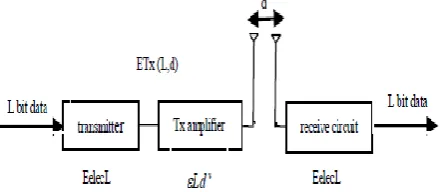
To describe energy feather of the communication channel this paper deals with the first order radio frequency energy consumption model [17]. According to the distance between the sending node and receiving node the first order radio model can be divided into free-space model and multi-path fading model.
Fig. 2 The Wireless Communication Model
The energy consumption between two nodes for transmitting l bits message with a distance of d can be shown as :
To transmit l bits data to a node with a distance of d, ETx(l,d) is the energy consumption. In above formula Eelec equals the per bit energy consumption for transmitter and receiver circuit. Emp and Efs are the amplifier parameters of transmission corresponding to the multi-path fading model and the free-space model respectively. d0 is the threshold distance between
multi-path fading model and the free-space model. If
d<=d0, the channel approximates free-space model, the
energy dissipation in transmitter amplifier is in direct ratio to d 2 . If d >d0, the multi-path fading model will be
employed and the energy dissipation is in direct ratio to
d 4 .To receive l-bit data, the radio expends energy:
E Rx(l) = l × E elec
4.
COMPARATIVE ANALYSIS AND SIMULATION
RESULTS
[image:3.595.330.551.288.384.2]© 2017, IRJET | Impact Factor value: 5.181 | ISO 9001:2008 Certified Journal
| Page 2463
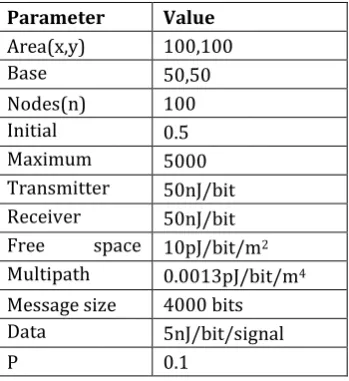
LEACH and SCERP to simulate it. The simulation parameters and the results of simulation are shown below.
Table 1.: Simulation Parameters
Parameter Value
Area(x,y) 100,100
Base
Station(x,y) 50,50
Nodes(n) 100
Initial
Energy(Eo) 0.5
Maximum
Lifetime 5000
Transmitter
Energy 50nJ/bit
Receiver
Energy 50nJ/bit
Free space
amplifier 10pJ/bit/m
2
Multipath
amplifier 0.0013pJ/bit/m
4
Message size 4000 bits Data
aggregation 5nJ/bit/signal
P 0.1
4.1The Network lifetime
The time from the beginning of the simulation to the time when the last node died is the Network Lifetime. The network life is divided into stable and unstable period in WSN[16]. The time from the beginning of the simulation to the time when the first node dies is usually means a Stable period. Unstable period is the time from the death of first node to the end of simulation. The network operation may become unstable if some nodes begin to die and unreliable data transferring will occur. Therefore, the network performance is improved if stable period is longer. In Leach Protocol, randomly distributing the nodes and randomly selecting the cluster heads causes some cluster heads die earlier because of the low energy or the long distance from the base station.
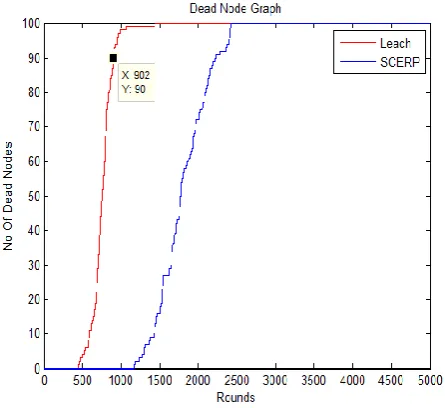
Fig. 3 shows total number of dead nodes, the X axis represents number of rounds and Y axis represents dead nodes. In Leach protocol the first node died in 439 rounds and in proposed protocol the first node died in 1171 rounds. The network reliability is extremely reduced when 90% nodes died and the running is almost meaningless. So the effective network lifecycle is the time from the simulation beginning to the time 90% nodes died. In Leach protocol 90% nodes died at 902 and in proposed protocol 90% nodes died at 2216 rounds. The stable period of lifecycle percentage in Leach Protocol is 8%, the one in the improved protocol is 23%. The stable period of lifecycle percentage in improved algorithm increases by 15%. From the analysis of Figure 3, the effective lifecycle of the improved algorithm is 26% longer than that of Leach protocol. These results indicate that the performance of
[image:4.595.74.249.147.338.2]improved protocol is much better than that of Leach Protocol. The theoretical analysis is consistent with the analysis of simulation results.
Figure 4 shows the comparison of energy consumption between the Leach and proposed protocol during the simulation time. X axis represents energy in joules and Y axis is representing the number of rounds.
From the analysis of Figure 4, the energy consumption of the improved algorithm is much lower than that of Leach Protocol for the same round of simulation. The results obtained are consistent with the design purposes of the improved algorithm.
[image:4.595.332.528.316.556.2]Comparison Table
Table 2. Comparison analysis for First dead node when Base station Position Changes
Initial
Energy
Base Station Position
Leach 90% Nodes
Dead
SCERP 90% Nodes Dead
0.1 50,50 198 426
0.2 50,50 370 859
0.3 50,50 533 1304
0.4 50,50 713 1799
0.5 50,50 902 2216
0.1 10,90 175 411
0.2 10,90 378 811
0.3 10,90 555 1221
0.4 10,90 767 1651
0.5 10,90 926 1913
0.1 90,90 175 405
0.2 90,90 359 888
0.3 90,90 552 1184
0.4 90,90 748 1510
© 2017, IRJET | Impact Factor value: 5.181 | ISO 9001:2008 Certified Journal
| Page 2464
Table 3. Comparison analysis for 90% dead nodeswhen Base station Position Changes
Fig. 5 shows comparison analysis of network lifetime when base station position changes for Leach and proposed SCERP protocol. In graph 100 nodes are distributed in the square area 100*100m with changing base station position from 50-50, 10-90, 90-90. The simulation results show that protocol performs well when base station is located near the sensor field. If base station is located far away energy consumption increases quickly and SCERP outperform it.
Fig. 3 The number of dead nodes per round in Leach and SCERP.(Network Lifetime)
Fig. 4 Energy Retention after each round in Leach and SCERP
Fig. 5 Comparison analysis of Network Lifetime when Base Station Position Changes for Leach and proposed
SCERP protocol.
5 . CONCLUSION
At present cluster head are randomly elected in Leach protocol that causes depletion of current energy
Initial
Energy Station Base Position
Leach 1stNode
Dead
SCERP 1stNode
Dead
0.1 50,50 78 229
0.2 50,50 156 451
0.3 50,50 252 671
0.4 50,50 376 958
0.5 50,50 439 1171
0.1 10,90 68 68
0.2 10,90 120 120
0.3 10,90 140 253
0.4 10,90 258 339
0.5 10,90 274 381
0.1 90,90 42 58
0.2 90,90 127 127
0.3 90,90 203 193
0.4 90,90 252 284
[image:5.595.53.246.142.363.2] [image:5.595.318.550.402.640.2] [image:5.595.41.264.498.702.2]© 2017, IRJET | Impact Factor value: 5.181 | ISO 9001:2008 Certified Journal
| Page 2465
of some cluster heads or their distances to base station are far, because of the heavy energy burden, these cluster heads will soon die. For this issue, this article proposed a new improved algorithm of Leach protocol which is aim at balancing energy consumption of the whole network and extending the network lifetime by balancing the energy consumption of these cluster heads. Matlab is used for emulating the new improved algorithm. The stable period of lifecycle is improved by 15% in the proposed protocol. Whereas simulation results shows that the effective lifecycle of the improved algorithm is 26% longer than that of Leach protocol. The simulation results indicate that the energy efficiency and also the lifespan of network are both improved than that of Leach Protocol. In future, focus is on to combine improved algorithm with multi-hop routing, paying more attention to the network overhead and the complexity of the environment.
REFERENCES
[1] Feng Shang, Mehran Abolhasan, Tadeusz Wysocki. An Energy-Efficient adaptive Clustering Algorithm for Wireless Sensor Networks. International Journal of Information Acquisition, 2009,6(2): 117-126. [2]D. Zhicheng, Z. Li, B. Wang and Q. Tang, “An
En-ergy-Aware Cluster-Based Routing Protocol for Wireless Sensor and Actor Network,” Journal of Information Technology, Vol. 8, No. 7, 2009, pp. 1044-1048. doi:10.3923/itj.2009.1044.1048
[3]Azat Rozyyev, H. Hasbullah and F. SubhanIndoor, “In-door Child Tracking in Wireless Sensor Network Using Fuzzy Logic Technique,” Research Journal of Informa-tion Technology, Vol. 3, No. 2, 2011, pp. 81-92. doi:10.3923/rjit.2011.81.92
[4]I. F. Akyildiz, W. Su, Y. Sankarasubramaniam and E. Cayirci, “A Survey on Sensor Networks,” IEEE Commu-nication Magazine, Vol. 40, No. 8, 2002, pp. 102-114.
[5]K. Sohrabi, J. Gao, V. Ailawadhi and G. J. Potie, “Proto-cols for Self-Organization of a Wireless Sensor Net-work,” IEEE Personal Communications, Vol. 7, No. 5, 2000, pp. 16-27.
[6]A. Gao, W. Wei and X. Xiao, “Multiple Hash Sub- Chains: Authentication for the Hierarchical Sensor Net-works,” Information Technology Journal, Vol. 9, No. 4, 2010, pp. 740-748.
[7] L. Jun, H. Qi, L. Yan, “A Modified LEACH algorithm in wireless sensor network based on ns2,” in Proc. Of International Conference on Computer Science and Information Processing, pp. 604-606, 2012.
[8]S. Lindsey, C. S. Raghavendra, “PEGASIS: power efficient gathering in sensor information systems,” in
Proc. Of IEEE Aerospace Conference, pp. 1-6, 2002.
[9]Azat Rozyyev, H. Hasbullah and F. SubhanIndoor, “In-door Child Tracking in Wireless Sensor Network Using Fuzzy Logic Technique,” Research Journal of Informa-tion Technology, Vol. 3, No. 2, 2011, pp. 81-92. doi:10.3923/rjit.2011.81.92
[10]Dr. M.A.Pund, “Dynamically adaptive routine protocol in wireless network” National Conference on Recent Treands in Soft Computing, Technoblitz-2010, COET Akola.
[11]W. R. Heinzelman, A. Chandrakasan, and H.Balakrishnan, “Energy Efficient Communication Protocol for Wireless Micro-sensor Networks,” in Proceedings of the 33rd Annual Hawaii International Conference on System Sciences, 2000 Hawaii.
[12]Kant Kumar Adlak & Manish Pandey, “Improved Architecture For Maximizing System Lifetime Of
Wireless Sensor Network Using Clustering
Algorithm”, International Journal of Computer Science and Informatics ISSN (PRINT): 2231 –5292, Volume-2, Issue-3, 2012.
[13]Heinzelman, W.B.C., A.P.; Balakrishnan, H.,” An application specific protocol architecture for wireless micro-sensor networks”,IEEE Transactions on Wireless Communications, 2002. 1(4): pp 660 – 670.
[14]L. Xunbo, L. Na, C. Liang, S. Yan, W. Zhenlin, Z. Zhibin, “An improved LEACH for clustering protocols in wireless sensor networks,” in Proc. of International Conference on Measuring Technology and Mechatronics Automation, pp. 496-499, 2010. [15]J. F. Yan, Y. L. Liu, “Improved LEACH routing
protocol for large scale wireless sensor networks routing,” in Proc. of International Conference on Electronics, Communications and Control, pp. 3754-3757, 2011.
[16]Smaragdakis G. Matta I. Bestavros A. A Stable Election Protocol for Clustered Heterogeneous Wireless Sensor Networks, Proceedings of the 2nd
International Workshop on SANPA
2004,Massachusetts, U.S, 2004:1-11
[17]Yuhua L, Yongfeng Z, Jingju G. “A New Clustering Mechanism Based on LEACH Protocol [C]”
Proceedings of the International Joint Conference on Artificial Intelligence. IEEE Communications Society. 2009: 715—718.
[18]Muhammad Haneef, Zhongliang Deng,
“Comparative analysis of classical routing protocol LEACH and its updated variants that improved network life time by addressing shortcomings in Wireless Sensor Network”,2011 IEEE
© 2017, IRJET | Impact Factor value: 5.181 | ISO 9001:2008 Certified Journal
| Page 2466
Development”Kuala Lumpur, International Journal SSRG,pp.19-23,May 24-26, 2016, ISSN: 2348 – 8387 [20]A. Manjeshwar, D. P. Agrawal, “TEEN: a routing
protocol for enhanced efficiency in wireless sensor