Munich Personal RePEc Archive
Variety-Skill Complementarity: A Simple
Resolution of the Trade-Wage Inequality
Anomaly
Kurokawa, Yoshinori
University of Tsukuba
April 2010
Variety-skill complementarity: a simple resolution
of the trade-wage inequality anomaly
Yoshinori Kurokawa
University of Tsukuba
April 13, 2010
(Published in
Economic Theory
, 46 (2011), 297-325.)
Abstract
The Stolper-Samuelson theorem predicts that the relative wage of high-skilled to low-high-skilled labor will increase in the high-skill abundant U.S. but decrease in low-skill abundant Mexico after trade liberalization, while it ac-tually began to rise in both countries in the late 1980s. We present a simple resolution of this "trade-wage inequality anomaly" in a model of variety trade. Variety trade increases the variety of intermediate goods used by the …nal good. If the varieties and high-skilled labor are complements, the skill premium rises in both countries. This linking of imports of new foreign varieties—the exten-sive margin—to wage inequality is compatible with evidence. Our numerical examples illustrate that small amounts of variety trade can produce a signi…-cant increase in relative wage.
Keywords Trade, Wage inequality, Variety-skill complementarity, Extensive margin
JEL Classi…cation F12, F16
1
Introduction
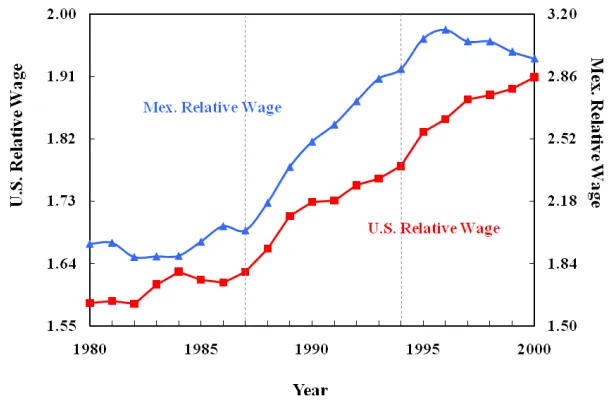
One of the most well documented empirical facts in recent U.S. economic history is that, as Fig. 1 shows, the relative wage of high-skilled to low-skilled labor began to rise in manufacturing industries in the late 1980s, and this fact was observed in Mexico as well.1 As can be seen, these two countries showed a surprisingly similar
timing of the rise in relative wage in the late 1980s and early 1990s.2 The data
also show that, as in Fig. 2, U.S.-Mexican trade (as a percent of U.S. GDP) was dramatically increasing during the same period.3 Hence, this increased trade might
have contributed to the recent increase in skill premium in these countries. However, there are a number of criticisms on this line of thought.
One criticism is based on a "trade-wage inequality anomaly." The standard Heckscher-Ohlin (H-O) model demonstrates a discrepancy between the model and data. The Stolper-Samuelson theorem of the H-O model predicts that the relative wage of high-skilled to low-high-skilled labor will increase in the high-skill abundant U.S. but decrease in low-skill abundant Mexico after trade liberalization. The H-O model thus generates a positive relationship between the trade and wage inequality in the U.S. but generates a negative relationship in Mexico. On the other hand, as we have seen in Fig. 1 and 2, the data generated a positive relationship between the trade and wage inequality in both countries in the late 1980s and early 1990s. This is a "trade-wage inequality anomaly."
A second criticism is based on price movements. The Stolper-Samuelson theorem predicts the same direction of movement of the relative price of high-skill to low-skill intensive goods and the relative wage of high-skilled to low-skilled labor since the rise
1Here, we use non-production and production workers as an index for high-skilled and low-skilled
workers in the U.S. and Mexican manufacturing industries (Berman et al. 1994; Robertson 2004). We calculate the U.S. relative wage during the period 1980-2000 on the basis of the U.S. Annual Survey of Manufactures (ASM). On the other hand, we calculate the Mexican relative wage on the basis of the Mexican Monthly Industrial Survey (Encuesta Industrial Mensual, or EIM) by …rst calculating the average monthly wage of non-production relative to production labor. The annual average is then produced by averaging this monthly relative wage.
2As shown in Fig. 1, the non-production/production wage ratio in Mexico reached a plateau after
the North American Free Trade Agreement (NAFTA) was enacted in 1994. Esquivel and Rodríguez-López (2003) also show the same movements of Mexican wages. Robertson (2004) argues, using the Mexican Industrial Census, that the Mexican skill premium declined from 1994 to 1998. We also note that the U.S. and Mexican relative wages are shown on di¤erent scales in Fig. 1, for here we want to emphasize the qualitative movements of these series. In Section 4, we will emphasize the quantitative di¤erence of the same series during the period 1987-1994.
3Here, U.S.-Mexican trade is de…ned by the sum of U.S. exports to and U.S. imports from Mexico.
in the relative wage of high skill should be driven by the rise in the relative price of high-skill intensive good in the high-skill abundant U.S. However, data show that the relative prices of high-skill intensive goods were declining or constant during the 1980s while the relative wage of high skill was increasing in the U.S. (Lawrence and Slaughter 1993).
A third criticism is based on the volume of trade. Trade-based explanations have often been criticized due to the small volume of trade as has been shown in Fig. 2. Krugman (1995) provides a theoretical argument to explain why the small volume of trade in the U.S. makes it unlikely that trade can account for the change in wages.4
Thus, mainly due to these criticisms, trade-based explanations for rising wage inequality have been minor in economic academia.5 Rather, major explanations have
been based on technological change. A sharp decline in equipment prices in the 1980s led to an increase in the demand for high-skilled workers, who were complements for this equipment, and a decline in the demand for low-skilled workers, who were substitutes (Krusell et al. 2000).6 This technology-based explanation is consistent
with the decline in the price of high-tech goods and the increase in the wage inequality both in the U.S. and in Mexico.
We now propose a simple theoretical framework to illustrate the possibility of an increase in wage inequality in each of the trading countries as a result of even small amounts of trade, and this can happen without a rise in the relative price of high-skill intensive good.
We …rst present a simple resolution of the trade-wage inequality anomaly. Our resolution is based on a straightforward application of the well-known model of variety trade in intermediate goods due to Ethier (1982).7 Ethier’s model demonstrates that
the variety of intermediate goods, which …nal goods producers can use, increases
4It should be noted that Krugman (2008) argues that, due to the increase in U.S. trade with poor
countries and the growing fragmentation of production, it is no longer safe to assume that the e¤ect of trade on wage inequality is very minor, although he admits that it is hard to prove the actual e¤ect.
5Many papers relate trade to wage inequality in the U.S. and Mexico. For example, Borjas and
Ramey (1994) show how trade volumes can be linked to U.S. inequality, and Harrigan and Balaban (1999) estimate an econometric general equilibrium model of U.S. wages as a function of prices, technology, and factor supplies. Hanson and Harrison (1999) and Revenga (1997) link changes in Mexican inequality to changes in trade policy, and Verhoogen (2008) links quality upgrading for export to Mexican inequality. See Feenstra and Hanson (2003) for a survey on trade and inequality.
6Berman et al. (1994), Karni and Zilcha (1995), Berman et al. (1998), and Katz and Autor
(1999) also relate technological change to wage/income inequality. Kremer and Maskin (1996) link technological change or skill-distribution to both wage inequality and segregation by skill, and their model is extended by McCann and Trokhimtchouk (2010).
in both countries after trade and, therefore, their production increases through the higher productivity caused by increased number of inputs. Let us emphasize again that Ethier says something increases in both countries after trade.
Upon application of this logic, we show that the variety trade in di¤erentiated intermediate goods increases the variety of intermediate goods used by the …nal good in both countries. The increased variety of inputs then can mean the increased variety of tasks to be handled and thus corresponds to higher demand for high-skilled labor. Through this variety-skill complementarity, the relative wage of high skill—the skill premium—rises in both countries. Thus our model provides a resolution of the trade-wage inequality anomaly.8 Moreover, our model manages to capture an interesting di¤erence in U.S. and Mexican wages: the smaller country Mexico shows a much larger increase in the skill premium than the larger country U.S. does as shown in Fig. 1.
We next argue that our model, though simple, has the capability of being applied to real world data, although a de…nitive answer must wait for more serious empirical work. In fact, the linking of imports of new foreign varieties—the extensive margin— to wage inequality is compatible with available empirical evidence. The correlation between the growth in the extensive margin and the growth in the relative wage of high-skilled labor was high, over 0.93, in both U.S. and Mexican manufacturing industries during the period 1980-2000. The variety-skill complementarity appears to be a plausible assumption as shown by the facts in regards to U.S. production organization. The movements of the relative price of high-skill to low-skill intensive goods and the relative wage of high-skilled to low-skilled labor are also consistent with the observations in the U.S., so our model does not require the Stolper-Samuelson price-wage mechanism.
We …nally show several numerical examples with plausible parameters to see if we can obtain a signi…cant increase in skill premium with relatively small amounts of trade. In fact, our numerical examples illustrate the possibility that increased U.S.-Mexican manufacturing variety trade, which is a small fraction of U.S. manufacturing GDP, is capable of signi…cantly contributing to the increase in skill premium in both U.S. and Mexican manufacturing industries from 1987 to 1994. We also show that trade and technological change are complementary in that they both can contribute
8Dinopoulos et al. (2009) also link variety trade to wage inequality. Their model, however,
to increased skill premium in both countries.
Of course, other economists have also been successful in resolving the anomaly on the basis of trade models. One major explanation is based on foreign direct invest-ment. Feenstra and Hanson (1996) show that foreign direct investment shifts produc-tion activities from the North to the South—an endogenous transfer of technology— and thus increases the North’s outsourcing the low-skill intensive goods to the South, and these goods are high-skill intensive goods by the South standards.9
A second major explanation is based on the Schumpeterian mechanism. Dinopou-los and Segerstrom (1999) show that trade increases the relative price of innovation (the reward for innovation relative to the current level of R&D di¢culty), thus en-couraging high-skill intensive R&D investment in each country.10 Acemoglu (2003)
shows that trade "induces" skill-biased technological change in the U.S., and this improved technology can be transferred to other countries by spillover e¤ects. Thus these explanations also demonstrate the rise in the relative wage of high-skilled labor in each of the trading countries.11
Compared to these past studies, without introducing any foreign direct invest-ment or dynamic Schumpeterian mechanism, this paper is successful in formulating a simpler trade model in which trade between two countries can cause an increase in wage inequality in both countries. Moreover, this paper is the …rst to quantitatively show the possibility that trade, even small in volume, signi…cantly contributes to the increase in skill premium both in the U.S. and in Mexico.
The rest of this paper is organized as follows. In Section 2, we formulate a very simple model of variety trade, and we provide a resolution of the trade-wage inequality anomaly. Section 3 shows that our model is compatible with available empirical evidence. In Section 4, we present our numerical examples. Finally, we summarize main results and mention future research in Section 5.
9Zhu and Tre‡er (2005) also show a mechanism closely related to this mechanism by Feenstra and
Hanson (1996). We note that Feenstra and Hanson (1996) resolve the trade-wage inequality anomaly observed during the 1980s on the basis of a skill intensity reversal: intermediate goods—previously produced in the North but now produced in the South—are relatively high-skill intensive in the South but relatively low-skill intensive in the North. This assumption, however, poses an empirical challenge since past research has found little evidence for the so-called "factor intensity reversal" over the period. We, however, resolve the anomaly without assuming this skill intensity reversal.
10Dinopoulos and Segerstrom (1999) show that a contemporaneous correlation between an index
of the relative price of innovation and an index of the U.S. skill premium was 0.80 during the period 1963-1989.
11Acemoglu (2003) might not be successful in explaining the fact that the U.S. and Mexico showed
2
The Model
In this section, we …rst formulate our model. Second, we explicitly solve the model and show that variety trade can increase the skill premium in both countries. Finally, we discuss some economic implications of the derived results.
2.1
Ingredients of the Model
Consider an economy with a …nal good sector and an intermediate goods sector. There are two types of skills: high-skilled and low-skilled labor. Their endowments are given by H and L, respectively. These skills di¤er in that the high-skilled labor can do both high-skill and low-skill tasks while the low-skilled labor can do only a low-skill task. As will be shown later, this excludes the possibility that the relative wage of high-skilled to low-skilled labor is less than one in equilibrium.
The production side is as follows. The …nal good sector is perfectly competitive and non-traded. It uses a continuum [0; n] of di¤erentiated intermediate goods and the high skill. The technology is given by the following constant returns to scale production function:
y=
" Z n
0
x(j) dj
=
+H
#1=
;
where y is the output of …nal good, x(j) and H are the demand for di¤erentiated intermediate good j and high skill, and0< <1. In our model, handling a variety of inputs is represented as handling a variety of tasks and thus corresponds to a high-skill task.12 We thus assume that <0, that is, the elasticity of substitution between
the varieties and high skill is given by = 1=(1 )<1. We de…ne this case <0
( <1) as the case where the varieties and the high skill are complements.13
On the other hand, the di¤erentiated intermediate goods sector is monopolistically competitive. Firms are symmetric and follow Cournot pricing rules.14 There is also 12In some papers, the number of inputs plays a role in a related way. Blanchard and Kremer (1997)
de…ne the index of complexity which relates the increased number of inputs to more complexity in production processes. Kremer (1993) shows that higher skill workers will use more complex technologies that incorporate more tasks.
13We note that we can generalize the production function of the …nal good by assuming that
the …nal good uses three factors: varieties, high-skilled labor, and low-skilled labor. The results, however, are unchanged as long as we assume that the varieties are more complementary to the high-skilled labor than to the low-skilled labor. We also note that, as will be noted in footnote 15, switching the role of high-skilled and low-skilled labor but assuming >0(the varieties and the low skill are substitutes) gives the same results in this model.
14In this model with a continuum[0; n]of di¤erentiated intermediate goods, Bertrand pricing rules
free entry and exit. The intermediate goods can be traded. Each variety does not require handling a variety of inputs and thus can use the low-skill. The technology of each variety is given by the following increasing returns to scale production function:
x(j) = 1
b max [l(j) f; 0];8j;
where l(j) is the demand for low skill to produce each variety j, f is the …xed cost in terms of low skill, and b is the unit low-skill requirement. We note that the high skill can also do this low-skill task.
The demand side is as follows. For simplicity, we focus on a representative con-sumer who has the endowments of high skill and low skill: H and L. He or she consumes the …nal good. His or her utility function is given by:
u(c) =c;
where c is the quantity of the …nal good he or she consumes. His or her budget constraint is given by:
pyc=wHHS+wLLS;
where py is the price of the …nal good, wH is the wage for the high skill, and wL is
the wage for the low skill. HS is the supply of high skill for the …nal sector, and LS
is the supply of low skill for the intermediate sector, which can include the high skill. We assume 0 HS H, L LS L+H, andHS +LS =H+L.
The feasibility conditions for high-skilled labor and low-skilled labor are:
H =HS;
Z n
0
l(j)dj =LS:
2.2
Explicit Solutions and the Autarky Equilibrium
We explicitly solve our model. First, we derive the solutions in the intermediate goods sector.
Given an arbitrary n, each producer of a variety facing the indirect demand by the …nal good sector maximizes the pro…t p(j)x(j) wLbx(j) wLf where p(j) is
output xand price p corresponding to this n can be given by:
x=
"
wLb
pyn(= ) 1
=(1 )
n =
# 1=
H;8j;
p= wLb;8j:
Since the price does not depend on the number of varieties n, the price when the pro…t of each variety becomes zero by the free entry and exit is also given by p = wLb= , and the zero pro…t condition px bx f = 0 gives the output x of
each variety. The equality of labor demand and supply in intermediate goods sector, n(bx+f) = LS, gives the number of varieties n. Thus the price p and output x of
each variety and the number of varieties n are given by:
p= wLb;8j;
x= f
b(1 );8j;
n= L
S(1 )
f :
We next derive the solutions in the …nal good sector.
In our model with the CES production function, it is not di¢cult to obtain an explicit solution for the demand for each variety by the …nal good sector, but we solve the maximization problem for the …nal good sector by means of the following short-cut method. De…ne a new good
X =
Z n
0
x(j) dj
1=
and its price pX, and we can show desired results more easily.
The pro…t of the …nal good sector now becomes:
py(X +H )1= pXX wHH:
First, by solving the cost minimization problem for the good X, we …nd that the price of X is:
pX = Z n
0
p(j) =( 1)dj
( 1)=
By symmetry p(j) =p, this becomes:
pX =n( 1)= p;
where p=wLb= .
Dividing both sides by wL gives:
pX
wL
=n( 1)= b: (1)
Second, we solve forX. Since the technology of the …nal good shows the constant returns to scale with X and H, we have the following equality:
y= pXX+wHH
py
:
On the other hand, the demand for the …nal good is given by:
c= wHH
S+w LLS
py
:
The …nal good market clearing y=c and the feasible condition for the high skill H =HS then give:
X = wLL
S
pX
: (2)
Third, we solve for the relative wage of high-skilled to low-skilled labor wH=wL.
The …rst order conditions with respect to X and H for the …nal sector give:
X H
1
= pX
wH
:
By using (2) andH =HS, in autarky equilibrium the relative wage of high-skilled
laborwH=wL is given by:
wH
wL
= pX
wL
LS
HS
1
: (3)
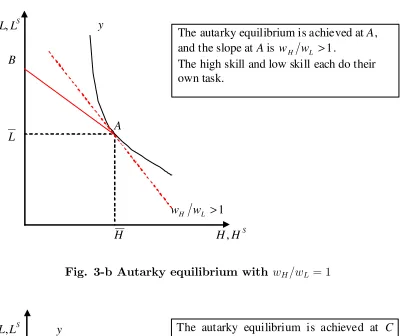
This autarky equilibrium is represented in Fig. 3-a and 3-b. The demand for high skill and low skill by the production side, H and L, is represented by the isoquant curve of the …nal good: y= [ (wLL=pX) +H ]1= which is given byy= (X +H )1=
and (2). On the other hand, the supply of labor for each sector, HS and LS, is
in Fig. 3-b, and thus the relative wage of high skill wH=wL, given by the slope of the
isoquant curve, is greater than or equal to one before trade.
Since the focus of this paper is on the skill premium, in the following main text we concentrate on the interesting case as shown in Fig. 3-a, in which the relative wage of high skill given by (3) is greater than one. Thus the high skill and low skill each do their own task, letting HS = H and LS = L. In Appendix A.1, we brie‡y
analyze the case as shown Fig. 3-b, in which the relative wage of high skill given by (3) is one and the high skill is doing both high-skill and low-skill tasks.
2.3
Trade Equilibrium and a Resolution of the Trade-Wage
Inequality Anomaly
Consider two countries: country 1 and country 2. They have identical technologies and preferences. They can be di¤erent in their endowments of high-skilled and low-skilled labor. We assume that the relative wage of high-low-skilled to low-low-skilled labor is greater than one in both countries before trade as shown in Fig. 3-a. Thus the high skill and low skill each do their own task, lettingHS
i =Hi and LSi =Li in each
countryi, i= 1;2. The number of varieties is thus given byni =Li(1 )=f in each
countryi before trade.
Let these two countries trade with each other. Then, from the derived solutions in the intermediate goods, we easily get the following information. The supply of labor for the intermediate goods sector, which is given byLS
i =Li before trade, cannot fall
below this Li after trade. This implies that the number of varieties produced within
each countryi, which is given byni =Li(1 )=f before trade, cannot fall below this
autarky level ni after trade. Thus the total number of varieties which is available to
the …nal good sector after trade, n1+n2, is greater than the autarky level ni in each
countryi.
Given this information, we show the following results. Here, let us focus only on country 1.
First, pX1 now becomes:
pX1 =
Z n1
0
p(j) =( 1)dj +
Z n1+n2
n1
p(j) =( 1)dj
( 1)=
:
By the symmetryp(j) = p1 forj 2[0; n1]andp(j) = p2 forj 2[n1; n1+n2], this
becomes:
pX1 = n1p1=( 1)+n2p2=( 1) ( 1)=
where p1 =wL1b= and p2 =wL2b= .
Dividing both sides by wL1 gives:
pX1
wL1
= n1+n2
wL2
wL1
=( 1)!( 1)=
b
: (1’)
Thus we see that the trading level ofpX1=wL1given by (1’) becomes lower than the
autarky level pX1=wL1 =n(1 1)= b= given by (1) since the coe¢cient ofb= becomes
smaller due ton1+n2(wL2=wL1) =( 1) > n1 and ( 1)= <0.
Second, from (2) we see that X1 increases after trade since pX1=wL1 decreases
and LS
1, which is L1 before trade, does not decrease. This implies that the marginal
product of high-skilled labor given by M P H1 = (X1+H1) (1=) 1
H1 1 increases for anyH1. That is, the demand for high skill by the …nal good shifts upward. Since the
supply of high skill for the …nal good, which is H1 before trade, does not increase,
this implies that the real wage of high skillwH1=py1 increases.
Finally, from (3) we see that since < 0 ( < 1), that is, since the vari-eties and high skill are complements, the relative wage of high skill wH1=wL1—
the skill premium—increases after trade. This is because (pX1=wL1) increases and
LS
1=H1S 1
, which is L1=H1 1
before trade, does not decrease.15
Thus it follows that the high skill and low skill each do their own task after trade as well as before trade. That is, the supply of labor for the …nal and intermediate sectors remains atHS
1 =H1andLS1 =L1, respectively. Hence, the number of varieties
produced within country 1 after trade remains at the autarky leveln1 =L1(1 )=f.
We note that the above results are also obtained in country 2. Hence, we get the following results.
The variety trade in intermediate goods causes the total number of varieties avail-able to the …nal good sector to simply increase from ni to n1 +n2, the sum of the
autarky levels, in each country i. This causes pXi=wLi to decline and thus causes Xi
to increase in both countries. Consequently, the demand for high skill shifts upward, thus increasing the real wage of high skillwHi=pyi in both countries. Moreover, since
the varieties and high skill are complements, the decrease in pXi=wLi also increases
the relative wage of high skill wHi=wLi—the skill premium—in both countries. Thus
our model has provided a resolution of the trade-wage inequality anomaly.
We can derive more results from the above discussion. First, since the number of varieties before trade is given by ni = Li(1 )=f in each country i, the ratio
15We note that switching the role of high-skilled and low-skilled labor but assuming >0 (the
of the number of varieties produced within each country before trade is given by n1=n2 = L1=L2. This implies that the rate of increase in ni is smaller in a country
with the larger size ofLi, and, therefore, the rate of decrease inpXi=wLiis also smaller
as can be seen in (1’). Hence, the rise in the relative wage of high skill wHi=wLi is
smaller in a country with the larger size ofLi as can be seen in (3).16
Second, if = 0 ( = 1), that is, if the production function of the …nal good is given by the Cobb-Douglas function, from (3) we see that the relative wage of high skillwHi=wLi is not a¤ected by the decrease inpXi=wLiand therefore does not change
after trade in either country.
2.4
Economic Implications of the Results
Before moving on to Section 3, we need to consider economic implications of some of the results which have been shown in Section 2.3 on the basis of the explicit solutions to the model. First, we explain the economic reason why the good X increases after trade, that is, why the M P H increases after trade.
As we have seen, the activities in the intermediate goods sector never change at all in each country after trade. Some changes, however, do occur after trade. The number of varieties used by the …nal good sector increases, while the input quantity of each variety used by the …nal good sector decreases in each country since each variety is shared by two countries.
Can the e¤ect of increase in the number of varieties be canceled by the e¤ect of decrease in the input quantity of each variety? The answer is no. This is because the e¤ect of increase in the number of varieties is greater than the e¤ect of decrease in the input quantity of each variety. This is the crucial e¤ect in the variety-trade models which Ethier (1982) called the "international returns to scale." That is, the increased number of inputs translates into higher productivity. Thus the goodXincreases after trade, that is, the M P H increases after trade.
We next explain the economic reason why the relative wage of high skill can rise after trade. Now the …nal good market clearings yi = ci in each country i, i = 1,2,
before trade are given by:
yi =
wHiHi+wLiLi
pyi
:
16In fact, this prediction is compatible with the following observations: the number of production
Since wHi=pyi =M P Hi, this becomes the following:
yi =M P Hi Hi+
wLi
pyi
Li:
As we have seen, the marginal product of high skill increases in each country after trade. For the same reason, the output of …nal good also increases in each country after trade.
Since M P Hi = Xi +Hi
(1=) 1
Hi 1 and yi = Xi +Hi
1=
, it can be shown that the rate of increase inM P Hiis greater than the rate of increase inyi since <0,
that is, since the varieties and high skill are complements. This relationship and the …nal good market clearing conditionyi =M P Hi Hi+wLi=pyi Li imply that the rate
of increase in M P Hi should be greater than the rate of change in wLi=pyi. In other
words, the rate of increase in the real wage of high skill wHi=pyi is greater than the
rate of change in the real wage of low skill wLi=pyi . Thus the relative wage of high
skill wHi=wLi can increase in each countryi.
3
Indirect Evidence for Mechanism
In this section, we …rst show that the linking of imports of new foreign varieties—the extensive margin—to wage inequality is compatible with available empirical evidence. Second, we claim that variety-skill complementarity appears to be a plausible assump-tion. We …nally show that our model demonstrates price movement consistent with observed facts.
3.1
Extensive Margin and the Relative Wage of High-Skilled
Labor
Fig. 4-a plots the 1980-2000 data on the growth in what Kehoe and Ruhl (2009) call the "least traded goods" in U.S. manufacturing imports from Mexico and on the relative wage of high-skilled to low-skilled labor in U.S. manufacturing industries. Fig. 4-b, on the other hand, plots the growth in the least traded goods in Mexican manufacturing imports from the U.S and the relative wage in Mexican manufacturing industries during the same period.
International Trade Classi…cation (SITC) (revision 2) 3-digit manufacturing data from the OECD International Trade by Commodities Statistics (ITCS).17 The source of
data for the U.S. and Mexican relative wages is the same as for Fig. 1.
As can be seen in Fig. 4-a and 4-b, the least traded goods that account for 10 percent of U.S. manufacturing imports from Mexico in 1980 account for 42.5 percent in 2000, and the least traded goods that account for 10 percent of Mexican manufac-turing imports from the U.S. in 1980 account for 17.5 percent in 2000, respectively. This indicates that each country started importing goods that it had not imported before or had imported only in small quantities. Moreover, these …gures reveal that this growth in the least traded goods was highly correlated with the growth in the relative wage in each country over 1980-2000. In fact, the correlation between these two series was high in each country: it was 0.932 and 0.947 in the U.S. and Mex-ico, respectively. Thus the linking of the extensive margin to the skill premium is compatible with this evidence in both countries.
It is worth noting that the method by Kehoe and Ruhl (2009) used in this paper for measuring the extensive margin is di¤erent from methods used in the few previous studies of the extensive margin. Broda and Weinstein (2006), for example, classify a good as not traded if the value of trade is zero, and Evenett and Venables (2002) classify a good as not traded if its yearly value of trade is less than or equal to 50,000 1985 U.S. dollars, regardless of the country to be studied. In Kehoe and Ruhl’s de…nition of a traded good, on the other hand, goods with very small but non-zero amounts of trade can also be considered, and the actual dollar value of the cuto¤ can di¤er across countries.
3.2
Variety-Skill Complementarity
In our model, we have represented the variety of inputs as the variety of tasks which workers need to handle. Thus it is plausible to assume that the increased variety of inputs—the increased variety of tasks to be handled—translates into higher demand for high-skilled workers. In fact, this variety-skill complementarity appears to be a plausible assumption as shown by the historical facts in regards to U.S. production organization emphasized by Mitchell (2005).
During the …rst half of the 20th century, the spread of mass production, which is
17See Kehoe and Ruhl (2009) for the detailed procedure used to construct Fig. 4-a and 4-b. We
characterized by Ford’s factories, led to the larger size of manufacturing plants. On the other hand, during the second half of the century, ‡exible machine tools have allowed plants to operate at a smaller scale. The organization of production has changed from mass production with a traditional assembly line to smaller customized batches, thus making the size of plants smaller.18
Workers on the assembly line have a single routine task to perform; however, workers in each batch are no longer as highly specialized in a single routine task. Each batch is highly customizable and requires a worker who can handle a wide variety of tasks depending on the custom features of the batch. The change in the production organization therefore a¤ected the number of tasks and therefore a¤ected the importance of skills. As the tasks shifted from a single routine task to a wide variety of tasks, the required skill shifted from low skill to high skill.
Our assumption of the variety-skill complementarity is thus compatible with these historical facts in regards to U.S. production organization, although a de…nitive an-swer must wait for serious empirical work.19
3.3
Relative Price of High-Skill Intensive Goods
The standard H-O model predicts the same direction of movement of the relative price of high-skill to low-skill intensive goods and the relative wage of high-skilled to low-skilled labor since the rise in the relative wage of high skill should be driven by the rise in the relative price of high-skill intensive good in the high-skill abundant U.S. However, data show that the relative prices of high-skill intensive goods were declining or constant during the 1980s while the relative wage of high skill was increasing in the U.S. (Lawrence and Slaughter 1993).
Our model demonstrates price movement consistent with this observed fact whereas the H-O model cannot. In Section 2.4, it has been shown that the rate of change in wLi=pyishould be smaller than the rate of increase inM P Hi since <0. This implies
that wLi=pyi can rise (but it should rise less than M P Hi), and, therefore, the price
of high-skill intensive …nal good relative to the low-skill wage, pyi=wLi, can decline.
Here, let us recall that the price of the skill intensive variety relative to the low-skill wage,pi=wLi, is constant atb= before and after trade. Hence, the relative price
of high-skill to low-skill intensive goods,(pyi=wLi)=(pi=wLi), can decline while the
rel-18Milgrom and Roberts (1990) present the empirical facts on a change in the size of U.S.
manu-facturing plants.
19The above historical observation is compatible with the theoretical result obtained by Kremer
ative wage of high skill rises, letting <0. Thus the rise in the relative wage of high skill can happen without the rise in the relative price of high-skill intensive good.20
4
Numerical Examples
We have shown that trade—in particular, variety trade—can theoretically cause the increase in skill premium in two countries and that our model is compatible with available empirical evidence. This section shows several numerical examples with plausible parameters to see if relatively small amounts of variety trade can produce a signi…cant increase in skill premium without technological change.21
An increase in variety trade is here represented as a tari¤ reduction, for a tari¤ reduction in each country can mean that each country can use more foreign varieties.22
Technological change, on the other hand, is here represented as a decrease in …xed cost f. A decrease inf can cause an increase in the number of varieties,n =L(1 )=f, without an increase in variety trade and thus can cause an increase in the demand for the high skill.23
4.1
Model with Tari¤s
We introduce tari¤s into our simple model and assume that each country i, i =
us; mex, imposes iceberg tari¤s i on imports from the other country, that is, the
import quantity of a foreign variety is equal to the sum of the input quantity of the foreign variety used by the …nal good and the iceberg tari¤s. We also introduce the share parameter , 0< <1, into the production function of the …nal good:
yi =
" Z
nus+nmex
0
x(j)i dj
=
+ (1 )Hi
#1=
; i=us; mex:
We note that the de…nition of an equilibrium with tari¤s and all the derivations of equations below are shown in Appendix A.2. We also note that our focus is on
20We note that the price of …nal good can be constant or increase if <<0:
21Our model is very simple and thus cannot perform full-scale calibrations capturing many facts.
Here, we just want to show several numerical examples with plausible parameters.
22In Section 2, we have looked at the movement from autarky to trade in order to show our idea
in the simplest way. However, here we begin with a trade equilibrium in order to compare our model with actual trade data. Thus variety trade can increase due to the increased import volumes of existing foreign varieties as well as the imports of new foreign varieties.
23We note that in our model "technological change" refers to non-trade-based technological change
wHi=wLi >1, thus HiS =Hi and LSi =Li, i=us; mex.
The relative wages of high skill are now given by:
wHus
wLus
= 1 (1 )
f
b =( 1)
Lus+Lmex (1 + us)
wLmex
wLus
=( 1)!!( 1)=
Lus
Hus
1
;
(4) wHmex
wLmex
= 1 (1 )
f
b =( 1)
Lus (1 + mex)
wLus
wLmex
=( 1)
+Lmex
!!( 1)=
Lmex
Hmex
1
:
(5) The volume of U.S.-Mexican variety trade relative to U.S. GDP is given by:
2 LusLmex(1 + us)
=( 1)
Lus(wLus=wLmex) +Lmex(1 + us) =( 1)
=(wHus=wLus)Hus+Lus; (6)
where wHus=wLus is given by (4).
4.2
Numerical Examples: Variety Trade and the Skill
Pre-mium
We simulate our model, "backcasting" from 1994 to 1987, to see what changes in U.S. and Mexican skill premium between 1987 and 1994 are predicted by the model.24
We …rst give plausible values to some parameters. The value of = 0:83(= 1/1.2) is chosen so that the markup charged by each variety is 1.2. Norrbin (1993) and Basu (1996) both obtained empirical estimates of 1.05-1.4 for markups for intermediate goods, indicating that our choice is plausible. We normalizeb = 10 and f = 100, the choice of which leaves our results (percent changes in skill premium) unchanged. We note that by keepingf constant from 1987 to 1994, we assume that no technological change occurs. The labor endowments Li and Hi, i = us; mex, are constructed
from the OECD Structural Analysis (STAN), the ASM, and the EIM data. U.S. endowments are …rst chosen from the data. We then calculateLmex so that the ratio
Lus=Lmex matches with the observed ratiowLusLus=wLmexLmex in each year (e¤ective
labor units). This is because, as will be shown later, the balance of trade holds at
24Bergoeing and Kehoe (2003) quantitatively test the "new trade theory" by "backcasting" from
wLus=wLmex = 1 in each year under our choice of parameters. We also calculateHmex
so that the ratio Hmex=Lmex matches with the observed ratio.25
We then perform our simulations with the following method.
Step 1: We choose the value of .
Step 2: We simulate our model to 1994 data. We normalize us;1994 = 0:01 and
then calculate the values of and mex;1994 so that the U.S. relative wage in
1994 given by (4) matches with the corresponding data, satisfying the balance of trade in 1994 at wLus=wLmex = 1.
Step 3: We "backcast" to 1987. We calculate the values of tari¤s us;1987 and
mex;1987 so that the change in (6) between 1987 and 1994 is the same as the
observed change in the volume of U.S.-Mexican manufacturing variety trade relative to U.S. manufacturing GDP, satisfying the balance of trade in 1987 at wLus=wLmex = 1 as well.
Step 4: We calculate how much the U.S. and Mexican relative wages (4) and (5) increase from 1987 to 1994.
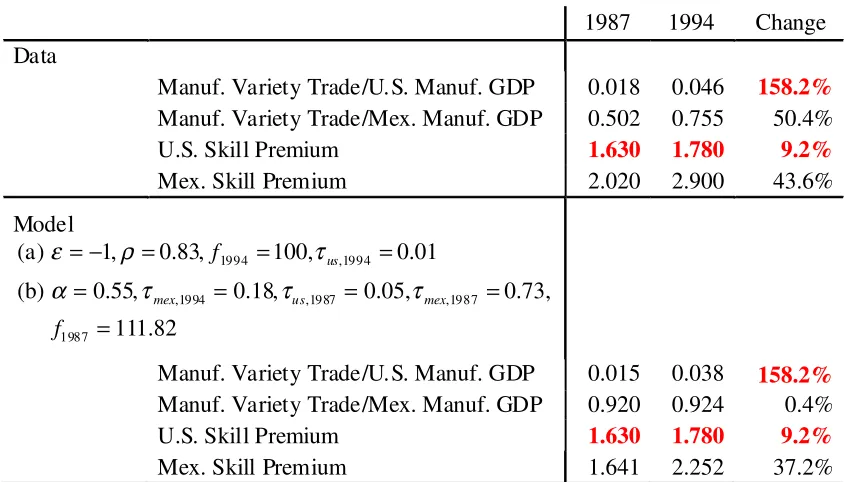
Table 1-a reports the results of our benchmark numerical example in which = 1
( = 0:5). Here, the volume of U.S.-Mexican manufacturing variety trade is measured by multiplying the Grubel-Lloyd index (a measurement of the variety-trade share) and the volume of U.S.-Mexican total manufacturing trade. The index for a country is a weighted average over SITC (revision 2) 3-digit manufacturing industries as follows:
1
P
kjEXk IMkj P
k(EXk+IMk)
;
where EXk and IMk represent exports and imports of industry k. These data are
obtained from the OECD ITCS and the OECD STAN.26 The data for the U.S. and
Mexican relative wages are extracts from Fig. 1. The parameters in the model are listed separately: free parameters in (a) and calculated parameters in (b).
As can be seen, the U.S. relative wage in 1994 is the same as the observed data, 1.780, and the volume of U.S.-Mexican manufacturing variety trade relative to U.S.
25U.S. endowments are: H
us;1987 = 6707:6; Lus;1987 = 12242:7; Hus;1994 = 6274:3; Lus;1994 =
11845:3 (in thousands of workers). Mexican endowments are: Hmex;1987 = 94:6; Lmex;1987 =
222:5; Hmex;1994 = 210:0; Lmex;1994 = 481:2; which satisfy: Lus;1987=Lmex;1987 = 55:03;
Lus;1994=Lmex;1994= 24:61; Hmex;1987=Lmex;1987= 0:425; Hmex;1994=Lmex;1994= 0:436:
26We note that the manufacturing variety trade includes variety trade in both …nal and
manufacturing GDP increases by 158.2 percent as do the corresponding data. As a result, the U.S. relative wage increases by 6.8 percent from 1987 to 1994 while the data show a 9.2 percent increase, and the Mexican relative wage increases by 34.2 percent while the data show a 43.6 percent increase.
Thus the results indicate that increased variety trade accounts for 73.8 percent of the change in U.S. skill premium and accounts for 78.5 percent of the change in Mex-ican skill premium in the manufacturing industries during the period 1987-1994. We have here illustrated the possibility that U.S.-Mexican manufacturing variety trade, which is a small fraction of U.S. manufacturing GDP, can signi…cantly contribute to the increase in wage inequality.27
We note, however, that U.S.-Mexican manufacturing variety trade is not small from the Mexican viewpoint. In fact, U.S.-Mexican manufacturing variety trade as a fraction of Mexican manufacturing GDP was 50.2 percent in 1987 and 75.5 percent in 1994 as shown in the table. The table also shows the corresponding results in the model, but the results are far from the data in terms of the percent change. This is because much of the ‡uctuations in the trade to GDP ratio in Mexico were caused by ‡uctuations in GDP and in the real exchange rate. Our model cannot capture these ‡uctuations.
Table 1-b reports the results of the numerical example in which the reduction in f—technological change—occurs together with the tari¤ reduction from 1987 to 1994. The results indicate that if f decreases by 10.6 percent together with the same tari¤ reduction as in the previous benchmark example, then this can cause U.S. skill premium to increase by the same as data and can account for 85.4 percent of the increase in Mexican skill premium.28
Thus the results indicate that trade and technological change are complementary in that they both can contribute to increased skill premium in both countries.
4.3
Sensitivity Analysis
The results obviously depend on the values of and . We present some calculations for a variety of and .
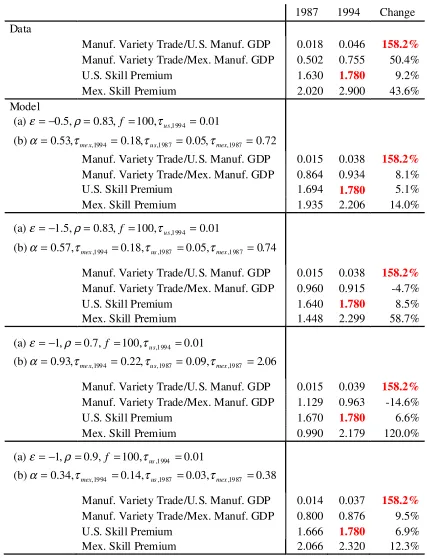
Table 2 reports the results of the numerical examples in which = 0:83remains unchanged but = 0:5( = 0:66) and = 1:5( = 0:4), respectively. The results
27It should be noted that even if we use data on trade in intermediate goods instead of data on
variety trade, the numerical results would be little changed. This is because evidence suggests that a considerable amount of trade in intermediate goods is variety trade (Turkcan 2005).
28We note that the 10.6 percent decrease in f is equivalent to the 10.6 percent increase in the
indicate that a more negative value of —a smaller elasticity of substitution between the varieties and high skill, —is accompanied by a larger change in skill premium in both countries.
Table 2 also reports the results of the numerical examples in which = 1remains unchanged but = 0:7 and = 0:9, respectively. The results indicate that a change in the value of —the elasticity of substitution between varieties—has larger e¤ects on skill premium in the smaller country, Mexico.
5
Conclusion and Future Research
The main purpose of this paper has been to provide a simple resolution of the trade-wage inequality anomaly in a model of variety trade compatible with available em-pirical evidence.
Section 2 has presented a simple resolution of the anomaly. We have shown that the variety trade increases the variety of intermediate goods used by the …nal good in both countries; as a result, if the varieties and high skill are complements, the skill premium rises in both countries after trade. Thus variety trade can stimulate variety-skill complementarity.
Section 3 has shown that our model is compatible with available empirical evi-dence. The correlation between the growth in the extensive margin and the growth in the relative wage of high-skilled labor was high, over 0.93, in both U.S. and Mexican manufacturing industries during the period 1980-2000. The variety-skill complemen-tarity appears to be a plausible assumption as shown by the facts in regards to U.S. production organization, and the rise in the relative wage of high-skilled to low-skilled labor can happen without the rise in the relative price of high-skill to low-skill inten-sive goods, which is also consistent with the observed fact in the U.S.
Section 4 has shown that our model can produce a signi…cant increase in relative wage with relatively small amounts of trade. In fact, our numerical examples have illustrated the possibility that increased U.S.-Mexican manufacturing variety trade, which is a small fraction of U.S. manufacturing GDP, is capable of signi…cantly con-tributing to the increase in skill premium in both U.S. and Mexican manufacturing industries from 1987 to 1994.
trade can theoretically increase wage inequality is not necessarily negative, for our model shows that the real wage of both high skill and low skill can rise despite the increase in inequality.29
Of course, room for future research still exists. First, this paper has made a the-oretical contribution in formulating a simple trade model to illustrate the possibility of an increase in skill premium as a result of variety trade. It, however, has not yet provided a compelling empirical analysis, although it has shown several numerical examples. This is because (a) trade in …nal goods is ignored in this paper, (b) much of output is services, which are largely non-traded but ignored in this paper, and (c) trade is not balanced in data.
Thus, in another paper, we formulate a more general version of our variety-trade model which can resolve problems (a)-(c) and allow us to perform a full-scale cali-bration.30 In the model calibrated to the Mexican input-output data for 1987, our
numerical experiments show that the increase in U.S.-Mexican manufacturing variety trade can account for approximately 12 percent of the actual increase in Mexican skill premium over 1987-2000. The result indicates that our mechanism is an important factor contributing to the increase in skill premium in its own right, but it seems to be quantitatively less important than other mechanisms such as technological change.31
Second, intermediate goods are horizontal in nature in our model, but it would be interesting to modify the model to consider vertical integration as in Yi (2003). Third, we can analyze the relationship between competition policies and wage inequality. In our model, the change in the number of varieties is related to wage inequality. This implies that government can a¤ect wage inequality by entry policies which adjust the number of …rms. Finally, our model has been applied to the problems of trade between the U.S. and Mexico, but we can also directly apply it to the problems of intra-trade among EU nations.
29In fact, the real wage of non-production labor has increased, and, further, the real wage of
production workers have slightly increased since the 1980s.
30See Atolia and Kurokawa (2009).
31Berman et al. (1994) argue, using a regression, that skill-biased technological change can account
Appendix
A.1
The Movement of High-Skilled Labor
In Section 2, we have focused on the interesting case in which the relative wagewH=wL
given by (3) is greater than one before trade. Thus the high skill and low skill each do their own task, letting HS =H and LS =L. In this appendix, we brie‡y analyze
the other case in which the relative wage wH=wL given by (3) is one and the high
skill is doing both high-skill and low-skill tasks before trade.
In the autarky equilibrium as shown in Fig. 3-b, the relative wage wH=wL given
by (3) is one atC, and part of high skill is doing the low-skill task in the intermediate goods sector. This movement of high skill fromA toC maximizes the output of …nal good, that is, the consumer’s utility.
As we have seen in Section 2.3, the case as shown in Fig. 3-a let us conclude that the skill premium rises after trade. On the other hand, if it is one before trade as shown in Fig. 3-b, it can be shown that the relative wage wH=wL rises or remains
after trade, and, in any case, the number of varieties used by the …nal good surely increases.
A.2
Model with Tari¤s
A.2.1 Equilibrium
De…nition 1 An equilibrium is prices pyus, pymex, p(j), j 2 [0; nus+nmex], wHus,
wHmex, wLus, wLmex, and quantities cus, cmex, yus, ymex, x(j)us, x(j)mex, x(j), j 2
[0; nus+nmex], Hus, Hmex, l(j), j 2 [0; nus+nmex], HusS, HmexS , LSus, LSmex, and the number of …rms in the intermediate sectors nus, nmex, given iceberg tari¤s us and
mex, such that
1. Final good: Given prices pyi,p(j), and wHi, quantities yi, x(j)i, and Hi solve (a) U.S.
max pyusyus
Z nus
0
p(j)x(j)usdj
Z nus+nmex
nus
p(j) (1 + us)x(j)usdj wHusHus
s,t,
yus =
" Z
nus+nmex
0
x(j)usdj
=
+ (1 )Hus
#1=
(b) Mexico
max pymexymex
Z nus
0
p(j) (1 + mex)x(j)mexdj
Z nus+nmex
nus
p(j)x(j)mexdj wHmexHmex
s,t,
ymex =
" Z
nus+nmex
0
x(j)mexdj
=
+ (1 )Hmex
#1=
;
2. Intermediate goods: Given price wLi, quantity x(j) solves (a) U.S. j 2[0; nus]
max p(j)x(j) wLusbx(j) wLusf; where x(j) = x(j)us+ (1 + mex)x(j)mex;
(b) Mexican j 2[nus; nus+nmex]
max p(j)x(j) wLmexbx(j) wLmexf; where x(j) = (1 + us)x(j)us+x(j)mex;
3. Consumer: Given prices pyi, wHi, and wLi, quantities ci, HiS,LSi solve (a) U.S.
maxcus s,t, pyuscus =wHusHusS +wLusLSus;
(b) Mexico
maxcmex s,t, pymexcmex =wHmexHmexS +wLmexLSmex;
4. Market clearing:
cus =yus; cmex =ymex;
x(j)us+ (1 + mex)x(j)mex =x(j); j 2[0; nus];
(1 + us)x(j)us+x(j)mex =x(j); j 2[nus; nus+nmex];
Hus =HusS; Hmex =HmexS ; Z nus
0
l(j)dj =LSus; j 2[0; nus];
Z nus+nmex
nus
l(j)dj =LSmex; j 2[nus; nus+nmex]:
A.2.2 Solutions
Intermediate Goods
Introducing tari¤s does not change the solutions in the intermediate goods sector. By the symmetryp(j) =pus forj 2[0; nus]andp(j) = pmex forj 2[nus; nus+nmex],
the price and output of each variety and the number of varieties in each country are now given by:
pus =
wLusb
; j 2[0; nus]; pmex =
wLmexb
; j 2[nus; nus+nmex];
xus =
f
b(1 ); j 2[0; nus]; xmex =
f
b(1 ); j 2[nus; nus+nmex];
nus =
Lus(1 )
f ; nmex =
Lmex(1 )
f :
Final Good
The pro…t of the …nal good sector now becomes:
pyi( Xi + (1 )Hi)
1=
pXiXi wHiHi; i=us; mex:
By solving the cost minimization problem for the good X, we can …nd that the price of X in each country is:
pXus=
Z nus
0
p(j) =( 1)dj+
Z nus+nmex
nus
((1 + us)p(j)) =( 1)dj
( 1)=
;
pXmex =
Z nus
0
((1 + mex)p(j)) =( 1)dj+
Z nus+nmex
nus
p(j) =( 1)dj
( 1)=
:
By the symmetryp(j) =pus forj 2[0; nus]andp(j) = pmex forj 2[nus; nus+nmex],
pXus = nuspus=( 1)+nmex((1 + us)pmex) =( 1)
( 1)=
;
pXmex= nus((1 + mex)pus) =( 1)+nmexpmex=( 1)
( 1)=
:
The good X in each country is now given by:
Xus =
wLusLus
pXus
; Xmex =
wLmexLmex
pXmex
The relative wage of high-skilled to low-skilled labor in each country is now given by:
wHus
wLus
= 1 pXus
wLus
Lus
Hus
1
; wHmex wLmex
= 1 pXmex
wLmex
Lmex
Hmex
1
:
By substitutingpXi, ni, andpi, i=us; mex, into the above formula, the equilibrium
relative wages are rewritten as follows:
wHus
wLus
= 1 (1 )
f
b =( 1)
Lus+Lmex (1 + us)
wLmex
wLus
=( 1)!!( 1)=
Lus Hus 1 ; (4) wHmex wLmex
= 1 (1 )
f
b =( 1)
Lus (1 + mex)
wLus
wLmex
=( 1)
+Lmex
!!( 1)=
Lmex Hmex 1 : (5) A.2.3 Trade
Step 1: Balance of trade.
The balance of trade (U.S. exports = U.S. imports) is given by the following:
nuspus(1 + mex)xus;mex =nmexpmex(1 + us)xmex;us;
where (1 + mex)xus;mex means that the imports of a U.S. variety by Mexico, and
(1 + us)xmex;us means that the imports of a Mexican variety by the U.S.
Step 2: The …rst order conditions for each variety by the …nal good. The …rst order conditions for each variety by the …nal good give:
xmex;us = (1 + us)1=( 1)xus;us; xus;mex = (1 + mex)1=( 1)xmex;mex:
Step 3: The ratio of each country’s share in each variety. From Steps 1 and 2, we obtain the followings:
(1 + us) (1 + us)1=( 1)xus;us
(1 + mex)xus;mex
= nuspus
nmexpmex
;
(1 + us)xmex;us
(1 + mex) (1 + mex)1=( 1)xmex;mex
= nuspus
nmexpmex
:
Thus, by substitutingni and pi, i=us; mex, into the above formula, the ratio of the
becomes:
xus;us=(1 + mex)xus;mex =LuswLus=LmexwLmex(1 + us) =( 1):
The ratio of the demand for a Mexican variety by the U.S. to the demand for a Mexican variety by Mexico also becomes:
(1 + us)xmex;us=xmex;mex =LuswLus(1 + mex) =( 1)=LmexwLmex:
Step 4: Trade.
The volume of U.S.-Mexican variety trade is represented as the sum of U.S. exports and imports:
nuspus(1 + mex)xus;mex+nmexpmex(1 + us)xmex;us:
From Step 3, this becomes:
nuspus
LmexwLmex(1 + us) =( 1)
LuswLus+LmexwLmex(1 + us) =( 1)
xus+nmexpmex
LuswLus(1 + mex) =( 1)
LuswLus(1 + mex) =( 1)+LmexwLmex
xmex:
By substituting ni, pi and xi, i = us; mex, into the above formula, the volume of
U.S.-Mexican variety trade is given by:
LuswLusLmex(1 + us) =( 1)
Lus(wLus=wLmex) +Lmex(1 + us) =( 1)
+ LmexwLmexLus(1 + mex)
=( 1)
Lus(1 + mex) =( 1)+Lmex(wLmex=wLus)
;
where the balance of trade requires the following equality:
LuswLusLmex(1 + us) =( 1)
Lus(wLus=wLmex) +Lmex(1 + us) =( 1)
= LmexwLmexLus(1 + mex)
=( 1)
Lus(1 + mex) =( 1)+Lmex(wLmex=wLus)
:
Accordingly, the volume of U.S.-Mexican variety trade is simply given by:
2 LuswLusLmex(1 + us)
=( 1)
Lus(wLus=wLmex) +Lmex(1 + us) =( 1)
:
Thus the volume of U.S.-Mexican variety trade relative to U.S. GDP is given by:
2 LusLmex(1 + us)
=( 1)
Lus(wLus=wLmex) +Lmex(1 + us) =( 1)
References
Acemoglu, D.: Patterns of skill premia. Rev Econ Stud70, 199-230 (2003)
Alexopoulos, J., Cavalcanti, T. V. de V.: Cheap home goods and persistent inequal-ity. Econ Theory (2009). doi: 10.1007/s00199-009-0495-4
Atolia, M., Kurokawa, Y.: Variety trade and skill premium in a calibrated general equilibrium model: the case of Mexico. Tsukuba Economics Working Papers No. 2009-006, Department of Economics, University of Tsukuba (2009)
Basu, S.: Procyclical productivity: increasing returns or cyclical utilization? Q J Econ 111, 719-751 (1996)
Bergoeing, R., Kehoe, T.J.: Trade theory and trade facts. Federal Reserve Bank of Minneapolis Research Department Sta¤ Report No. 284 (2003)
Berman, E., Bound, J., Griliches, Z.: Changes in the demand for skilled labor within U.S. manufacturing: evidence from the Annual Survey of Manufactures. Q J Econ 109, 367-397 (1994)
Berman, E., Bound, J., Machin, S.: Implications of skill-biased technological change: international evidence. Q J Econ 113, 1245-1279 (1998)
Blanchard, O., Kremer, M.: Disorganization. Q J Econ 112, 1091-1126 (1997)
Borjas, G.J., Ramey, V.A.: Time series evidence on the sources of trends in wage inequality. Am Econ Rev (Papers and Proceedings)84, 10-16 (1994)
Broda, C., Weinstein, D.E.: Globalization and the gains from variety. Q J Econ 121, 541-585 (2006)
Dinopoulos, E., Segerstrom, P.: A Schumpeterian model of protection and relative wages. Am Econ Rev 89, 450-472 (1999)
Dinopoulos, E., Syropoulos, C., Xu, B.: Intraindustry trade and wage-income in-equality. Working Paper, Department of Economics, University of Florida (2009)
Esquivel, G., Rodríguez-López, J.A.: Technology, trade, and wage inequality in Mexico before and after NAFTA. J Dev Econ 72, 543-565 (2003)
Ethier, W.J.: National and international returns to scale in the modern theory of international trade. Am Econ Rev 72, 389-405 (1982)
Evenett, S.J., Venables, A.J.: Export growth in developing countries: market entry and bilateral trade ‡ows. Working Paper, University of Bern and London School of Economics (2002)
Feenstra, R.C.: Integration of trade and disintegration of production in the global economy. J Econ Perspect 12, 31–50 (1998)
Feenstra, R.C., Hanson, G.H.: Foreign investment, outsourcing and relative wages. In: Feenstra, R.C., Grossman, G.M., Irwin, D.A. (eds.) The Political Economy of Trade Policy: Papers in Honor of Jagdish Bhagwati, pp. 89-127. Cambridge, MA: MIT Press (1996)
Feenstra, R.C., Hanson, G.H.: Global production sharing and rising inequality: a survey of trade and wages. In: Choi, K., Harrigan, J. (eds.) Handbook of International Trade, pp. 146-187. Oxford: Basil Blackwell (2003)
Grubel, H.G., Lloyd, P.J.: Intra-Industry Trade: The Theory and Measurement of International Trade in Di¤erentiated Products. New York: John Wiley and Sons (1975)
Hanson, G.H., Harrison, A.: Trade liberalization and wage inequality in Mexico. Ind Lab Relat Rev 52, 271-288 (1999)
Harrigan, J., Balaban, R.A.: U.S. wages in general equilibrium: the e¤ects of prices, technology, and factor supplies, 1963-1991. NBER Working Paper No. 6981 (1999)
Karni, E., Zilcha, I.: Technological progress and income inequality. Econ Theory5, 277-294 (1995)
Kehoe, T.J., Ruhl, K.J.: How important is the new goods margin in international trade? Federal Reserve Bank of Minneapolis Research Department Sta¤ Report No. 324 (2009)
Kremer, M.: The O-ring theory of economic development. Q J Econ 108, 551-575 (1993)
Kremer, M., Maskin, E.: Wage inequality and segregation by skill. NBER Working Paper No. 5718 (1996)
Krugman, P.R.: Increasing returns, monopolistic competition, and international trade. J Int Econ 9, 469-479 (1979)
Krugman, P.R.: Growing world trade: causes and consequences. Brookings Pap Econ Act, 327-377 (1995)
Krugman, P.R.: Trade and wages, reconsidered. Brookings Pap Econ Act, 103-154 (2008)
Krusell, P., Ohanian, L.E., Rios-Rull, J.-V., Violante, G.L.: Capital-skill comple-mentarity and inequality: a macroeconomic analysis. Econometrica 68, 1029-1053 (2000)
Lawrence, R.Z., Slaughter, M.J.: International trade and American wages in the 1980s: giant sucking sound or small hiccup? Brookings Pap Econ Act: Micro-economics, 161-226 (1993)
McCann, R.J., Trokhimtchouk, M.: Optimal partition of a large labor force into working pairs. Econ Theory42, 375-395 (2010)
Milgrom, P., Roberts, J.: The economics of modern manufacturing: technology, strategy, and organization. Am Econ Rev80, 511-528 (1990)
Mitchell, M.F.: Specialization and the skill premium in the 20th century. Int Econ Rev 46, 935–955 (2005)
Norrbin, S.C.: The relationship between price and marginal cost in U.S. industry: a contradiction. J Polit Econ101, 1149-1164 (1993)
Ray, D.: On the dynamics of inequality. Econ Theory 29, 291–306 (2006)
Revenga, A.: Employment and wage e¤ects of trade liberalization: the case of Mex-ican manufacturing. J Lab Econ15, 20-43 (1997)
Robertson, R.: Relative prices and wage inequality: evidence from Mexico. J Int Econ 64, 387-409 (2004)
Turkcan, K.: Determinants of intra-industry trade in …nal goods and intermedi-ate goods between Turkey and selected OECD countries. Istanbul University Econometrics and Statistics e-Journal1, 21-40 (2005)
Verhoogen, E.A.: Trade, quality upgrading and wage inequality in the Mexican manufacturing sector. Q J Econ123, 489-530 (2008)
Yi, K.-M.: Can vertical specialization explain the growth of world trade? J Polit Econ 111, 52-102 (2003)
Table 1-a Results for benchmark numerical example
1987 1994 Change
Data
Manuf. Variety Trade/U.S. Manuf. GDP 0.018 0.046 158.2%
Manuf. Variety Trade/Mex. Manuf. GDP 0.502 0.755 50.4% U.S. Skill Premium 1.630 1.780 9.2%
Mex. Skill Premium 2.020 2.900 43.6%
Model 73 . 0 , 05 . 0 , 18 . 0 , 55 . 0 (b) 01 . 0 , 100 , 83 . 0 , 1 (a) 1987 , 1987 , 1994 , 1994 , = = = = = = = − = mex us m ex us f τ τ τ α τ ρ ε
Manuf. Variety Trade/U.S. Manuf. GDP 0.015 0.038 158.2%
Manuf. Variety Trade/Mex. Manuf. GDP 0.912 0.924 1.4% U.S. Skill Premium 1.667 1.780 6.8%
Mex. Skill Premium 1.678 2.252 34.2%
Table 1-b Results for benchmark numerical example with technological
change
1987 1994 Change Data
Manuf. Variety Trade/U.S. Manuf. GDP 0.018 0.046 158.2%
Manuf. Variety Trade/Mex. Manuf. GDP 0.502 0.755 50.4% U.S. Skill Premium 1.630 1.780 9.2%
Mex. Skill Premium 2.020 2.900 43.6%
Model 82 . 111 , 73 . 0 , 05 . 0 , 18 . 0 , 55 . 0 (b) 01 . 0 , 100 , 83 . 0 , 1 (a) 1987 1987 , 1987 , 1994 , 1994 , 1994 = = = = = = = = − = f f mex us mex us τ τ τ α τ ρ ε
Manuf. Variety Trade/U.S. Manuf. GDP 0.015 0.038 158.2%
Manuf. Variety Trade/Mex. Manuf. GDP 0.920 0.924 0.4% U.S. Skill Premium 1.630 1.780 9.2%
[image:32.612.96.519.428.669.2]Table 2 Results for numerical examples with di¤erent and
1987 1994 Change Data
Manuf. Variety Trade/U.S. Manuf. GDP 0.018 0.046 158.2%
Manuf. Variety Trade/Mex. Manuf. GDP 0.502 0.755 50.4% U.S. Skill Premium 1.630 1.780 9.2%
Mex. Skill Premium 2.020 2.900 43.6% Model 72 . 0 , 05 . 0 , 18 . 0 , 53 . 0 (b) 01 . 0 , 100 , 83 . 0 , 5 . 0 (a) 1987 , 1987 , 1994 , 1994 , = = = = = = = − = mex us me x us f τ τ τ α τ ρ ε
Manuf. Variety Trade/U.S. Manuf. GDP 0.015 0.038 158.2%
Manuf. Variety Trade/Mex. Manuf. GDP 0.864 0.934 8.1% U.S. Skill Premium 1.694 1.780 5.1%
Mex. Skill Premium 1.935 2.206 14.0%
74 . 0 , 05 . 0 , 18 . 0 , 57 . 0 (b) 01 . 0 , 100 , 83 . 0 , 5 . 1 (a) 1987 , 1987 , 1994 , 1994 , = = = = = = = − = mex us mex us f τ τ τ α τ ρ ε
Manuf. Variety Trade/U.S. Manuf. GDP 0.015 0.038 158.2%
Manuf. Variety Trade/Mex. Manuf. GDP 0.960 0.915 -4.7% U.S. Skill Premium 1.640 1.780 8.5%
Mex. Skill Premium 1.448 2.299 58.7%
06 . 2 , 09 . 0 , 22 . 0 , 93 . 0 (b) 01 . 0 , 100 , 7 . 0 , 1 (a) 1987 , 1987 , 1994 , 1994 , = = = = = = = − = mex us me x us f τ τ τ α τ ρ ε
Manuf. Variety Trade/U.S. Manuf. GDP 0.015 0.039 158.2%
Manuf. Variety Trade/Mex. Manuf. GDP 1.129 0.963 -14.6% U.S. Skill Premium 1.670 1.780 6.6%
Mex. Skill Premium 0.990 2.179 120.0%
38 . 0 , 03 . 0 , 14 . 0 , 34 . 0 (b) 01 . 0 , 100 , 9 . 0 , 1 (a) 1987 , 1987 , 1994 , 1994 , = = = = = = = − = mex us mex us f τ τ τ α τ ρ ε
Manuf. Variety Trade/U.S. Manuf. GDP 0.014 0.037 158.2%
Manuf. Variety Trade/Mex. Manuf. GDP 0.800 0.876 9.5% U.S. Skill Premium 1.666 1.780 6.9%
Fig. 1 Relative wage of high-skilled to low-skilled labor in U.S. and
Mexican manufacturing industries, 1980-2000
[image:34.612.167.437.402.584.2]Fig. 3-a Autarky equilibrium with wH=wL >1
H L
A
The autarky equilibrium is achieved atA, and the slope atAis wH wL >1.
The high skill and low skill each do their own task.
1
>
L
H w
w y
B
S
L L,
S
[image:35.612.99.501.390.655.2]H H,
Fig. 3-b Autarky equilibrium with wH=wL= 1
L
H B
The autarky equilibrium is achieved at C betweenAandB, and wH wL =1.
Part of the high skill denoted by Hx is doing the low-skill task.
A
1
=
L
H w
w y
S
L L,
S
H H, C
x
H
H −
x
Fig. 4-a Least traded goods growth: U.S. manufacturing imports from
Mexico, 1980-2000
Fig. 4-b Least traded goods growth: Mexican manufacturing imports
[image:36.612.140.476.431.648.2]