Power Allocation in Primary User-Assisted Multi-Channel
Cognitive Radio Networks
Qiong Wu, Junni Zou, Kangning Zhu
Department of Communication Engineering, Shanghai University, Shanghai, China Email: [email protected], [email protected], [email protected]
Received June, 2013
ABSTRACT
This paper addresses power allocation problem for spectrum sharing multi-band cognitive radio networks, where the primary user (PU) allows secondary users (SUs) to transmit simultaneously with it by coding SU's signal together with its own signal. The PU acts as the relay for the SUs and sells its transmit power to the SUs to increase its benefit, and the SUs bid for the PU's transmit power for maximizing their utilities. We propose a power allocation scheme based on traditional ascending clock auction, in which the SUs iteratively submit the optimal power demand to the PU according to the PU's announced price, and the PU updates that price based on all SUs' total power demands. Then we mathe-matically prove the convergence property of the proposed auction algorithm (i.e., the auction algorithm converges in a finite number of clocks), and show that the proposed power auction algorithm can maximize the social welfare. Finally, the performance of the proposed scheme is verified by the simulation results.
Keywords: Power Allocation; Cognitive Radio; Auction; Cooperative Communications
1. Introduction
With the rapid deployment of wireless services in the last decade, the scarcity in radio spectrum emerges a critical issue for wireless communications. However, the report from the Federal Communications Commissions shows that most of the licensed spectrum is severely underuti-lized in traditional fixed spectrum allocation [1]. Cogni-tive radio (CR) is a technology that can deal with the dilemma between spectrum scarcity and spectrum under-utilization [2]. It allows the unlicensed users (secondary users (SUs)) to access licensed bands owned by the li-censed users (primary users (PUs)) without interfering with them.
As described in [3], SUs can access the spectrum owned by the primary user using spectrum sharing, where the SU coexists with the PU and transmits with power constraints to guarantee the quality of service (QoS) of the PU. To improve the efficiency of resource utilization, cooperative communications has been intro-duced in CR networks. In [4], the SU transmitter allo-cates only part of its power to deliver its own messages, and uses the remaining power to forward PU’s messages so as to compensate the interference at the PU receiver. A dynamic spectrum leasing architecture was proposed in [5], which allows PUs to reduce their power expendi-ture by using the SUs as relay nodes. The authors in [6] formulated the resource allocation problem as a two-tier game, in which each PU acts as a relay for multiple SUs
and sells the unused radios to SUs. However, the studies in the literature on PU-assisted cooperative communica-tions in spectrum sharing CR networks are still relatively sparse, and how to control the transmit power at the PU for secondary transmissions remains an open problem.
Network Coding has been proved to be a promising approach to reduce time-slot overhead for cooperative communications in wireless networks [7]. In [8], the ex-change of independent information between two nodes in a wireless network has been analyzed. It demonstrated that information exchange can be efficiently performed by exploiting network coding and the broadcast nature of the wireless medium. The authors in [9] addressed the power allocation problem in a network-coded multiuser two-way relaying network, where multiple pairs of users communicate with their partners via a common relay node. In cognitive radio networks, the authors in [10] showed that distributed network users can automatically adjust their coding structure, then collaborate together to avoid the degrading effects of signal fading. In this study, we consider the scenario that PU helps SUs by forward-ing their combinforward-ing signals to improve transmission effi-ciency.
net-work size. Game theory has been widely recognized as a powerful tool for distributed resource allocation in inter-active multiuser systems. In order to address both system efficiency and user fairness issues of CR networks, the authors in [14] proposed a distributed power control strategy by using a cooperative Nash bargaining game model. In [15], a joint power and rate control strategy were presented for SUs on the basis of a cooperative game theoretic framework. Three auction-based schemes were proposed in [16] for multimedia streaming over CR networks. In [17], the authors considered auction-based power allocation in multi-band CR networks, where mul-tiple SUs transmit via a common relay, and bid for the transmit power of the relay.
In this paper, we consider the power allocation prob-lem for spectrum sharing multi-band CR networks, where the PU allows the SUs to transmit simultaneously with it by coding SU’s signal together with its own signal. The PU acts as the relay for the SUs and sells its transmit power to the SUs to increase its benefit, and the SUs bid for the PU’s transmit power for maximizing their utilities. Our main contributions are as follows: First, we propose a power allocation scheme based on traditional ascending clock auction (ACA-T), in which the SUs iteratively submit the optimal power demand to the PU according to the PU’s announced price, and the PU updates that price based on all SUs’ total power demands. Second, we mathematically prove the convergence property of the proposed auction algorithm (i.e., the auction algorithm converges in a finite number of clocks), and show that the proposed power auction algorithm can maximize the social welfare. Finally, the performance of the proposed scheme is verified by the simulation results.
2. Network Modeling and Notations
Consider a CR system consisting of a primary user di-vided into M non-overlapping narrowband subchannels and N secondary users. The primary user transmits sig-nals from the primary transmitter (PT) to the primary receiver (PR). Each secondary user i sends messages from secondary transmitter si to secondary receiver di. The PT acts as the relay and assists SUs’ transmissions. We employ analog network coding and the amplify-and- forward relaying protocol at the PT. Assume that each sub-channel of the PT can be accessed by only one SU, and the channel occupancy by the SUs is maintained by the PT. For simplicity, we consider the scenario where
N=M. The cases with N < M and N > M can be analyzed in a similar way.
The structure of a CR frame under spectrum sharing consists of a channel allocation slot, an auction slot and a data transmission slot. In channel allocation slot, the SUs who intend to send data to their receivers submit their transmission requests to the PT. The PT then randomly
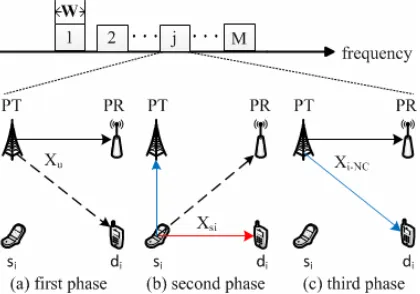
assigns a sub-channel to each SU. As shown in Figure 1, SU i is designated to the jth sub-channel of the PT, and the transmission time period is divided into three phases. Here the solid lines indicate the intended communica-tions, while the dotted lines represent the interference.
In the first phase: At each sub-channel, the PT trans-mits its data to its destination PR with power Pu. Assume that the total transmit power of the PT is Pt, then we have
Pu=Pt/M. As in the wireless environment, the data will be transmitted in a broadcast way, so all the receivers in the system will overhear and receive the data. The sig-nals received at the PR and the secondary receivers are respectively given by
PR PR PR
PT u PT u
Y P G X nPT (1)
i i
d d di
PT u PT u
Y P G X nPT (2) where Y{ }{ }
represents the signal received at { } from
{} , Xu is the information symbol transmitted by PT with E X[| u| ] 12 , n{ }{ }
is the additive white Gaussian
noise (AWGN) with variance 2. And G{ }{ }
denotes
the fading channel gain from to { , where its am-plitude is exponentially distributed. Assume all the channel gains remain static during each transmission frame, and are available to the PT.
{} }
{ } 2
|
{ }
|G
The signal-to-interference-plus-noise-ratio (SINR) of
Xu at the PT in the first phase is
2
(1) /
PR PR
PT P Gu PT
(3)
In the second phase: SU i transmits its signal with power Pi. The signals received by di, PT and PR are
i i
i
i i
d d
i s ii d
s s
Y PG X ns (4)
i i i i
PT PT PT
s i s s s
Y PG X n (5)
i i i i
PR PR PR
s i s s s
Y PG X n (6) where Xsi is the signal transmitted by si in this phase
[image:2.595.320.530.573.720.2]with E X[| si | ] 12 .
Thus, the SINR of Xsi at SR di in the second phase is 2 (2) / i i i i d d i
s PGs
(7)
In the third phase: In this case, the PT makes a com-bination of
i YPT
s and its own signal Xu with network coding [18], then amplifies and forwards the combined signal Xi-NC. Then the received signals are
PR PR PR
PT NC ui PT i NC PT
Y P G X n (8)
i i
d d di
PT NC ui PT i NC PT
Y P G X n (9) where { }
{ } NC
Y represents the signal received by using net- work coding, Pui is the PT’s transmit power for SU i, and
| |
i i
PT
u s
i NC PT
u s X Y X X Y
(10) Substituting (5) into (10), we can rewrite (8) and (9) as
2( )
1 i i
i PR ui PT
PR PT PR
PT NC u s s PT
PT i s
P G
Y X X
PG
n n (11)
2( )
1 i i i i i d
ui PT d
PR PT
PT NC PT u s s PT
i s
P G
Y X X
PG
n n (12)
In the previous two time phases, PT and si have trans-mitted their data respectively. And we assume that the destination nodes PR and di know exactly the useful messages from their source nodes, where Xu is for the PR from PT in the first phase and
i
s
X is for di from si in the second phase. So after they have received signals
Xi-NC in the third phase, each destination node can per-fectly distinguish its useful signal from the combined signals.
Thus, the PT can completely extract Xu from Xi-NC and we can get the required signal ˆPR
PT NC
Y
2( )
1
ˆ
i i
PR
ui PT PT P
u s P
PT i s
PR PT NC
P G R
T
X n n
PG
Y
(13)And di extracts Xsi from Xi-NC, then we have the needed signal YˆPT NCdi
2( )
1
ˆ
ii i i i i
d
ui PT PT PT d
i s s s PT
PT i s
di PT NC
P G
PG X n n
PG
Y
(14)From (13), the PU’s SINR in the third phase is
2 2
(3)
(1 )
i PR
PR ui PT
PT PR PT
ui PT i s
P G
P G PG
(15) Using (14), the SINR at node di is given by
2 2 (3) (1 ) i i i i d
d ui PT
PT d PT
ui PT i s
P G
P G PG
(16)
Therefore, with (3) and (15), the PU’s achievable rate in the jth sub-channel is
2
2 2 2
log (1 (1) (3)) / 3
P P
log (1 )
3 (1 P P )
i
j PR PR
PU PT PT
PR PR
u PT u PT
PR PT ui PT i s
R W
G G
W
G G 2
(17)
As for SU i, its achievable rate is 2
2 2 2 2
log (1 (2) (3)) / 3
P P
log (1 )
3 (1 P P )
i i i i i i i i i d d C
i s PT
d d PT
i s u PT i s
d PT
ui PT i s
R W
G G PG
W G G (18)
where W is the sub-channel’s bandwidth. The coefficient 1/3 dues to the fact that cooperative transmission uses one third of the resources.
3. Problem Formulation
There are two fundamental questions on power allocation to be addressed: 1) The incentives of PU and SUs for using cooperative transmissions; 2) The optimal power
Pui allocated to SU i. In this section, we present a game-theoretic framework of the transmit power alloca-tion at the PU for the SUs.
3.1. SUs’s Utility Function
To depict a SU’s satisfaction with the received relay power from the PT, we define a utility function for SU i as:
C C
i i
U gR Pui (19) where in the right side of the equation, the first term is the gain and the second term is the cost by using coop-erative transmissions. g is a positive constant providing conversion of units, C is the achievable rate in (18),
i R
represents the price per unit of power charged by the PT, and Pui denotes how much power SU i will buy from the PT.
Each SU aims at maximizing its own utility, which subjects to the total available transmit power Pt of the PT. Thus, we can model the optimal cooperative power de-mand of each SU as
max
s.t. 0ui P P
C C
i i
P
ui t
U gR Pui
(20) Clearly, the utility function is concave in Pui, so we can solve the optimal power Pui by taking the deriva-tive of in (19) with the respect to Pui as
C i U C i U 0 C C i i ui ui U R g
P P
2
2
2
' ; 1
3ln(2) 1 ; i i i i i d i s i PT PT
i s i s
i i d
PT PG gW W A PG PG B C G (22)
Substituting (22) into (21), we can get the optimal co-operative power Pui( ) expressed in (23) for maximiz-ing the utility function UiC.
2 2 2
1 ( )
2( ) 4 '
( ) (2 ) ,
,2,..., ui
i i
i i i i i i i i i i i
P
A B
W
B C ABC B C AC BC
i i N
(23)
3.2. PU’s Utility Function
The PU’s utility is based on the rate it achieves and the gain of selling its power Pt to the SUs. Thus, the PU’s utility function is given by
C
PU PU
U gR Pt (24) where RPU
Mj1RPUj is the total achievable rate of the PU in all M sub-channels, and Pt is the total pay-ment from the SUs.The choice of price is important to the PU. Since the PU can choose either to use the power itself or to share the power with SUs. For the PU, we define the res-ervation price of the power as the expense of relaying for the SUs. This reservation price is also called cost, which represents the adverse effects of SUs’ transmissions on PU’s performance. It may consist of device depreciation, power consumption, performance degradation of PU, etc. We denote the reservation price of PU as 0.
4. Power Auction Mechanism
We model a single-auctioneer, multiple-bidder power trading market, in which the PU wants to sell and the SUs want to buy the relay power. And we discuss how the PU sells its power to the SUs by using an auction mechanism. The auction procedures can be briefly de-scribed as follows: the PT, i.e. the “auctioneer”, an-nounces a price, the SUs, i.e. the “bidders”, report to the auctioneer their demanded power at that price. The auc-tioneer updates the price and the process repeats until the total demanded power meets the maximum available supply power of the PT.
The proposed scheme is based on the traditional as-cending clock auction (ACA-T) [16]. As shown in Algo-rithm 1, before the auction, the PT initially sets clock index 0, the step size 0, and a reserved price
0
. For each auction clock 0,1,..., there is a specific price corresponds to it. The PT announces
the price to the SUs. Based on the announced price , each SU submits its optimal power demand Pui(), which refers to (23), to the PT. After receiving all the demands, the PT sums up all the bids
1 ( ) N ( )
tal i ui
P
P ( )
tal t
P P
and compares it with Pt. If , the auction continues to time 1. Then the PT raises the price 1
tal T
P
and announces the new price to all SUs. Otherwise, the auction con-cludes and the current time denoted as T. Since the price increases discretely, the demanded power of each SU may decrease, and we might have ( ) Pt. In order to fully utilize the power Pt (i.e. Ptal( T) Pt), we apply a proportional rationing rule [19] and the final allocated power is given by
*
( ) ui ui ui T
ui
P P 1
1 1 1 ( ) ( ( ) ui T N N ui i i P P P P
1N i
) ( ) t T P ( )T
T T ui P
(25)
Algorithm 1 Ascending Clock Power Auction Algo-rithm
1. Initialization
PT initializes clock index 0, step size 0, gives the available power , and announces the ini-tial price
t
P
0
with the reserve price.
Each SU i computes its optimal power demand 0
( ) ui
P , and submits the bid to PT.
PT sums up all the bids 0 1 ui( 0) N i
Ptal( ) P ,
and compares it with
t
P.
t 2. Bid Update
WHILE (Ptal( ) P 1
)
· PT sets , 1; · PT announces to all the SUs;
· Each SU computes its Pui( ) based on (23), and submits the best bid to PT;
· PT sums up all the bids Ptal()
iN1Pui(). END3. Power Allocation
Conclude the auction, set T
*
ui
, and according to (25), allocate Pui* to SU i.
4. Payment
Finally, each SU i pays TP to PT.
where
iN1Pui*PtTP
0
. Consequently, the payment from SU i to the PT is . Note that, the power constraint in the auction is
*
ui
iPui Pt
*
min( , max( , 0))
i
opt t ui
P P P (26) Theorem 1. The proposed auction game in Algo-rithm1will conclude in a finite number of clocks.
Proof: It is straightforward to see that the optimal bid
( )
ui
P is a non-increasing function in , i.e. 1
( )
ui
P Pui(), and when Pui(1)Pui()Pt or 1
( )
ui ui(
P P ) 0, , the equality occurs. Cause increases with a fixed index 0, and for a suffi-cient large , there will be Pui(1)Pui()Pt . Then, there exists a finite large number T makes
1
i ( )
N
ui T t
P P
, which means that the auction
con-cludes at clock
T.From theorem1, we can see that the proposed power auction algorithm has the convergence property.
Theorem 2. When is sufficiently small, the pro-posed ascending-clock auction will converge to
, which maximizes the social welfare.
* * *
1 2
(Pu ,Pu ,...,PuN)
Proof: The proposed distributed algorithm can maxi-mize the sum of rates, i.e. is the solu-tion to the following optimizasolu-tion problem:
* * *
1 2
(Pu ,Pu ,...,PuN)
1
1
max ( )
s.t.
0 , 1, 2,...,
ui N
C i ui P
i N
ui t i
ui t
R P
P P
P P i N
(27)which is convex in terms of Pui, since is concave in
Pui. We find the optimal Pui by solving the Karush- Kuhn-Tucker (KKT) conditions, and we formulate the Lagrangian of problem (28) as [20]:
C i R
1 1
1 1
( , , , ) ( ) ( )
( )
N N
C
ui i i i ui ui t
i i
N N
i ui t i ui
i i
L P R P P P
P P P
(28)Then, the KKT conditions are given by:
1
1
0,
3ln 2 ( )( )
( ) 0,
( ) 0, 1, 2,..., 0, 1, 2,..., 0 , 1, 2,...,
i i
i i i i i ui i ui i ui
N
ui t i i ui t i ui
ui t N
ui t i
B C W
A C A P B P C P
P P
P P i N
P i N
P P i N
P P
N
(29)
where 0,i0,i 0, i 1, 2,...,
( ) ui
P
are the lagran-gian multiplier with the relevant of power constraints. By solving the optimal convex problem above, we can get the solution that is in the form in (23), and makes s, the outcome (P Pu*1, u*2,...,PuN*)
PU
1 ui( ) t iP P
N. Thu
is the solution that maximizes the social warfare of all
the SUs when sells out its cooperative transmit power
In this section, we present simulation results to demon-e proposdemon-ed powdemon-er allocation
Pt.
5. Simulation Results
strate the performance of th
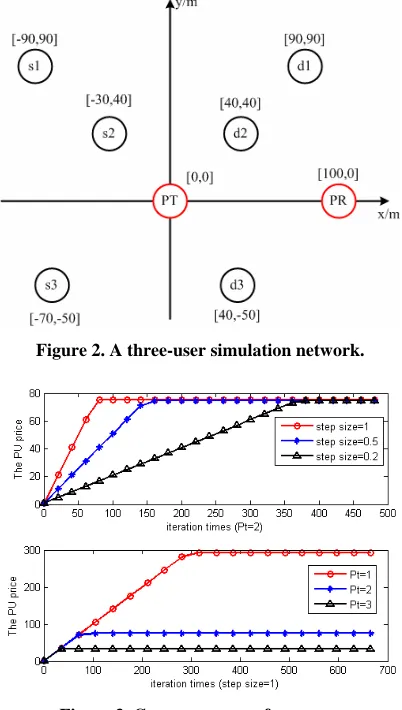
algorithm. We consider a scenario as shown in Figure 2, where three secondary links (s1d s1, 2d s2, 3d3 ) want to be relayed by PU. The channel gains are
(0.097 /d), where d is the distance between two nodes, and the path-loss exponent is 4. We assume that the various units are positioned such that d does not ap-proach zero. The transmit power of each SU is Pi=0.01W,
1, 2, 3
i
, the transmit power budget of PU is fixed, the reserve price 0 1, the conversion factor is g = 0.01, and the noise variance is 21013.
[image:5.595.323.524.373.728.2]Figure 3 verifies the convergence of the proposed power allocation algorithm. When Pt is identified (Pt = 2), the different step sizes will reach the same price , and the convergence speed increases with the increasing of the step size . This proves that, the power auction proc- ess will conclude in finite clocks and finally reaches to
Figure 2. A three-user simulation network.
[image:5.595.60.290.465.647.2]the optimal power allocation. From the below sub-fig, we can see that with the same step size ( 1), the iteration times T decreases with the increasing of Pt. This is be-cause that when the total relay power Pt of PT is suffi-ciently large, and the total demanded cooperative power by SUs is less than Pt, then the relay will sell the power early in the auction with a relatively lower price.
Figure 4 shows the allocated power of each SU. It’s evident that with the increase of PU’s power Pt, the co-operative power of each SU increases, with SU 2 has the largest power while SU 3 has the smallest. This attrib-uted to the local information of the SUs, such as location, their transmit power, the path-loss.
We furt e users in
issio
the the so
her show the rates and utilities of th
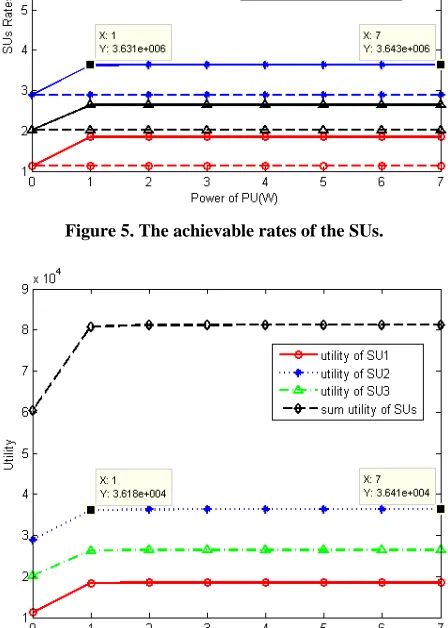
the CR network in Figure 5 and Figure 6. Figure 5 shows the rates in cooperative transm n (CT) in this paper versus the direct transmission (DT). It is obvious that the cooperative way can greatly improve the rates of SUs. And with the relay power increases, the rates of each SU increase slowly. The sum rates of this coopera-tive communication can effeccoopera-tively maximize
cial welfare. The order of magnitude of the rates is big, so the growth in the image is not that obvious. In Figure 6, we can see that the utilities of SUs have the same trend with rates, which demonstrates that the auction-based power allocation algorithm in this work can greatly im-prove the SUs’ utilities.
6. Conclusions
[image:6.595.311.536.89.279.2]In this article, we tackled the power allocation problem for the relay-assisted SUs’ transmission, where the PU acts as the relay and the SUs transmitting in spectrum underlay mode. We proposed a distributively power auc-tion algorithm, which based on the tradiauc-tional ascending clock auction (ACA-T). The convergence and social
[image:6.595.311.535.173.487.2]Figure 5. The achievable rates of the SUs.
Figure 6. The utility achieved by the SUs.
welfare properties are investigated and simulated. Future work can be extended to the case with many PUs in the network.
7. Acknowledgements
The work has been partially supported by the NSFC grants (No. 61271211), and the Research Program from Shanghai Science and Technology Commission (No. 11510707000).
REFERENCES
[1] FCC, “Spectrum policy task force report ET Docket, Tech. Rep. 02-155,” FCC, Tech. Rep., Nov. 2002.
[2] J. Mitola and G. Q. Maguire, “Cognitive Radio: Makin Sof
mun
g tware Radios More Personal,” IEEE Personal
[image:6.595.61.291.529.717.2]doi:10.1109/98.788210
unications, Vol. 23, No. 2, 2005, pp. 201-220.
/JSAC.2004.839380
[3] S. Haykin, “Cognitive Radio: Brain-empowered Wireless Communications,” IEEE Journal on Selected Areas in Comm
doi:10.1109
V. Tarokh, “Achievable R ,” IEEE Transactions
Infor-[4] N. Devroye, P. Mitran and in Cognitive Radio Channels
ates
mation Theory, Vol. 52, No. 5, 2006, pp. 1813-1827. doi:10.1109/TIT.2006.872971
[5] S. K. Jayaweera and M. Bkassiny, “Asymmetric Coop-erative Communications Based Spectrum Leasing via Auctions in Cognitive Radio Networks,” IEEE Trans.
Wireless Com 11, pp. 2716-2724.
doi:10.1109/TWC.2011.061311.102044
mun., Vol. 10, No. 8, 20
cient P [6] P. Cheng, A. Guo, Y. Xu, X. Wang and X. Gao, “A Game
Approach for Dynamic Resource Allocation in Cognitive Radio Networks,” Wireless Communications and Signal Processing (WCSP), 2010, pp. 1-6.
[7] J. N. Laneman, D. N. C. Tse and G. W. Wornell, “Coop-erative Diversity in Wireless Networks: Effi roto-cols and Outage Behavior,” IEEE Transactions Informa-tion Theory, Vol. 50, No. 12, 2004, pp. 3062-3080. doi:10.1109/TIT.2004.838089
[8] Y. Wu, P. A. Chou and S. Y. Kung, “Information Ex-change in Wireless Networks with Network Coding and Physical-layer Broadcast,” MSR-TR-2004, Vol. 78, 2005. [9] J. Zou and H. Xu, “Auction-Based Power Allocation for
Multiuser Two-Way Relaying Networks,” IEEE Transac-tions Wireless CommunicaTransac-tions, Vol. 12, No. 1, 2013, pp. 31-39.doi:10.1109/TWC.2012.113012.111725
[10] K. B. Letaief and W. Zhang, “Cooperative Communica-tions for Cognitive Radio Networks,” Proceedings of the IEEE, Vol. 97, No. 5, 2009, pp. 878-893.
doi:10.1109/JPROC.2009.2015716
[11] A. Ghasemi and E. S. Sousa, “Fundamental Limits of Spectrum-Sharing in Fading Environments,” IEEE Transactions Wireless Communications, Vol. 6, No. 2, 2007, pp. 649-658.doi:10.1109/TWC.2007.05447
[12] Y. Chen, G. Yu, Z. Zhang, H. hwa Chen and P. Qiu, “On
5
Cognitive Radio Networks with Opportunistic Power Control Strategies in Fading Channels,” IEEE Transac-tions Wireless CommunicaTransac-tions, Vol. 7, No. 7, 2008, pp. 2752-2761.doi:10.1109/TWC.2008.07014
[13] S. Stotas and A. Nallanathan, “Optimal Sensing Time and Power Allo-cation in Multiband Cognitive Radio Net-works,” IEEE Transactions Wireless Communications, Vol. 59, No. 1, 2011, pp. 226-235.
doi:10.1109/TCOMM.2010.110310.090473
[14] C. Yang, J. Li and Z. Tian, “Optimal Power Control for Cognitive Radio Networks under Coupled Interference Constraints: A Cooperative Game-Theoretic Perspective,”
IEEE Transactions Vehicular Technology, Special Issue on Cognitive Radio, 2010.
[15] P. Zhou, W. Yuan, W. Liu and W. Cheng, “Joint Power and Rate Control in Cognitive Radio Networks: A Game-Theoretical Approach,” in Proc. IEEE Interna-tional Conference on Communications, 2008, pp.
3296-3301.
[16] Y. Chen, Y. Wu, B. Wang and K. Liu, “Spectrum Auc-tion Games for Multimedia Streaming over Cognitive Radio Networks,” IEEE Transactions on Communica-tions, Vol. 58, No. 8, 2010, pp. 2381-2390.
doi:10.1109/TCOMM.2010.08.090528
[17] J. Zou, H. Xiong, D. Wang and C. W. Chen, “Optimal Power Allocation for Hybrid Overlay/Underlay Spectrum Sharing in Multiband Cognitive Radio Networks,” IEEE Transactions Vehicular Technology, Vol. 62, No. 4, 2013, pp. 1827-1837.doi:10.1109/TVT.2012.2235152
[18] S. Sharma, Y. Shi, Y. T. Hou and S. Kompella, “Is Net-work Coding Always Good for Cooperative Communica-tions,” IEEE INFOCOM, 2010, pp. 1-9.
[19] L. M. Ausubel, “An Efficient Ascending-bid Auction for Multiple Objects,” American Economic Review, Vol. 94, 2004, pp. 1452-1475.doi:10.1257/0002828043052330 [20] S. Boyd and L. Vandenberghe, Convex Optimization.