Published Online April 2016 in SciRes. http://www.scirp.org/journal/apm http://dx.doi.org/10.4236/apm.2016.65026
The Towering Zeta Function
Michael M. Anthony
Enertron Corp., Hohenwald, TN, USA
Received 18 November 2015; accepted 23 April 2016; published 26 April 2016 Copyright © 2016 by author and Scientific Research Publishing Inc.
This work is licensed under the Creative Commons Attribution International License (CC BY).
http://creativecommons.org/licenses/by/4.0/
Abstract
Over a century and half has passed when Bernhard Riemann hypothesized that the non-trivial roots of the Riemann zeta function ζ(s)all lie on the half-line s= +1 i
2 σ . In this paper the Zeta
function is iterated as a power tower and its properties are applied as an approach to an indica-tion that the Riemann hypothesis might be true. It is known that complex valued Power towers converge under certain conditions to exponential power towers of entire functions. These proper-ties can be used to resolve the Riemann Hypothesis.
Keywords
Riemann Hypothesis, Zeta, Power Towers, Convergence, Exponential Iterations
1. Introduction
The Zeta function seems to be the pyramid that holds the number systems together in a towering edifice of com-binatorial relations.
Let denote the complex numbers. They form a two-dimensional real vector space spanned by 1 and i
where i is a fixed square root of −1, and x y, belong are real numbers, i.e. =
{
x+iy x y: , ∈}
. The Rie-mann Zeta function is a complex variable function defined as( )
1
1 1 1
,
1 2 3
s
s s s
n
s n s
ζ ∞ −
=
= + + +=
∑
∈ (1)I will use the convention, s= +σ τi , where, τ∈ ℜ
(
reals .)
Euler proved that the function ζ
( )
s ,s= +σ it, σ >1 can be represented in terms of primes, p. ζ( )
s is analytic for σ >1 and satisfies in this half-plane the identity:( )
11
1 1
1
s s
n p
s
n p
ζ
− ∞
∞
=
= = −
Here, p is a prime. Except for a pole at s=1, ζ
( )
s behaves properly and can be easily extended using the Gamma function. The extension of ζ( )
s to the entire complex plane can be obtained by consideration the en-tirety and the general definition of the Gamma function:( )
10
Γ z e t zt dt
∞ − −
=
∫
(3)Change variables by the substitution t=n2πx, 2 s
z= , in (3),
( )
2 12 2 2
0
Γ e d
2
s s
n x s
n π π x x
∞ −
− =
∫
(4)Extracting ζ
( )
s from (4),( )
2 12 2
1 0
Γ e d
2
s s
n x
n s
s π x x
π ζ− ∞ ∞ − −
= =
∑∫
(5)The convergence of the series,
( )
21 e n x
n
S x π
∞ −
=
=
∑
(6)in the interval
[
0,∞]
gives the relation:( )
( )
12 2
0
Γ d
2
s s
s
s S x x x
π ζ− = ∞ −
∫
(7)This can be split into two separate integrals,
( )
1( )
1( )
12 2 2
0 1
Γ d d
2
s s s
s
s S x x x S x x x
π ζ− = − +∞ −
∫
∫
(8)Note that the sum (6) is related to the Jacobi Theta function. See Ref. [1]
( )
2en x
n
x π
θ ∞ −
=−∞
=
∑
(9)( )
2 2( )
1
2 2 e n x e n x 1 1
n n
S x π π θ x
∞ ∞
− −
= =−∞
=
∑
=∑
− = − (10)The Jacobi theta function obeys the symmetry
( )
( )
1
1 2
x
θ
x =θ
x− (11)Thus
(
( )
)
( )
1
1
2 2 1 2 1
x S x + = S x− + ,
( )
1 1 1 12 12( )
2 2
S x− = − + x +x S x (12)
The integral (8.0) now becomes
( )
( )
1( )
11
2 2 2
1 1
Γ d d
2
s s s
s
s S x x x S x x x
π ζ− =∞ − − − +∞ −
∫
∫
(13)( )
1 1 1( )
( )
12 2 2 2 2
1 1
1 1
Γ d d
2 2 2
s s s
s
s x x x S x x S x x x
π ζ
− =∞ − − − + + +∞ −( )
(
)
( )
1 12 2 2 2
1 1
Γ d
2 1
s s s
s
s S x x x x
s s
π ζ
− = − +∞ − + − −
∫
(15)The right side of the relation (15.0) is invariant to the substitution s→ −1 s. This gives the reflection for-mula for ζ
( )
s :( )
1(
)
2 Γ 2 1 Γ 1
2 2
s s
s s
s s
π ζ− =π−−ζ − −
(16)
The reflection formula indicates that the roots should obey a reflection and conjugate symmetry if they lie on the 1/2-line.
One can also study the maxima and minima of infinite products powers by looking at the functions that ap-proximate the ζ-function.
Proposition 2: The Zeta function is related to power towers. Let s= +σ τi ,
(
)
ln( )(
( )
)
(
( )
)
1 1
e i n cos ln sin ln
k k
i n σ τ n σ n i n
ζ σ τ ∞ − − ∞ − τ τ
= =
+ =
∑
=∑
+ (17)The ζ function can be written as a series in powers of n, where n is an integer, in the form:
(
)
( )
1
e n
n in n n
i r θ
ζ σ τ ∞
=
+ =
∑
(18)where, n
n
r n
σ −
= , ln n
n n
τ
θ = − .
Note that in (21), as τ →0 the minimum value of the terms for
1
logn−n
3
1 1 1
0, log , log , , log , ,
2 3 nn
(19)
is when n=3, but has repeated values for n=2, at n=4, since
1 1
2 4
2− =4− . One can also write the Zeta func- tion as follows:
(
)
1
n n
i
n n
n
i n n
σ τ
ζ σ τ ∞ − −
=
+ =
∑
(20)From numerical calculations, the minima and maxima of the real and the complex parts of
n i n
n
τ −
for
1
n> , occurs when n = 3. This is due to the fact that ln 2 ln 4
2 = 4 . One sees that something special is happening between these three points, n=2,n=3 andn=4 for the functions that define ζ σ
(
+iτ)
. The graphs in Fig-ure 1, Figure 2, and Figure 3 show the relationship of these points and they are tied together by the fact that( )
2( )
4f = f .
One can see that all three functions are somewhat related by the relation s:
( )
( )
( )
2, 2, 4otherwise
f y x y
f x
f y
= = =
≠
(21)
This is true for the functions,
( )
1n,( ) ( )
ln [image:3.595.77.546.78.644.2]Figure 1. Shows that the minimum values of cos ln
( )
n n
verus n is close to e.
[image:4.595.202.459.481.723.2]Figure 2. Shows the maximum value of sin ln
(
( )
n n)
is again exp (1).Figure 3. Shows the graphs of the real component 1
n
n−
One finds that these functions have their maxima and their minima in the range,
1
e e
e− ≤ ≤x e (23)
This is exactly the range where real power towers converge. I will use this later when I discuss power towers.
2. Relationship of the Riemann Zeta Function to Power Towers
Power towers have been studied extensively. I start by describing power towers following some conventional methods that have been used by Knuth Ref. [2] and others.
DEFINITION 1
Let n∈Z. A power tower is defined as a follows:
a
a
a n a
↑
↑↑ = (24)
Here, I am using the Knuth notation for the tower of powers raised n times. See Ref. [2].
DEFINITION 2
( )
1if 0,
if 1.
n
n
z
z n
g z
z − n
=
=
>
(25)
I have used the case n=0 as the argument itself, although in the literature most authors start with the defi-nition n
( )
, 1.g z =z n=
It is understood that such a power tower is iterated from some past argument to its present argument. By past I mean, the values that would have occurred in an iteration of the function that lead the iteration to its present value.
DEFINITION 3. If the limit of zn exists then define it as follows:
lim n
n z z
∞ →∞ =
(26)
DEFINITION 4. For z∈\
{
x∈:x≤0 and}
n∈, define the future power tower as the iterates starting from the present value n=1 as the first value that leads to a future thn value. Symbolically,
( )
( )
(
1( )
)
if 1
if 1
n
n
g z n
g z
g g − z n
=
= >
(27)
It is understood that such a power tower is iterated from its present state to some future value. By future I mean the argument values that will occur in an iteration of the function from its present value to some future value.
DEFINITION 5.The complex Lambert W function W z
( )
solves for 𝑧𝑧 the equation:( )
eW z( ) , .W z =z z∈ (28)
( )
W z is multi-valued and as has many branches with the usual notation for the th
k branch as W k z
(
,)
, with k∈Z for the branch chosen. The principal branch of the function is W( )
0,z =W z( )
and for real ar-guments, the function is denoted by W x( )
. See Refs. [3]-[5]. The branch points of W k z(
,)
take on real val-ues only for k∈ =Z{
0, 1 .−}
The function W k z(
,)
, satisfies, W(
0,z)
>0 for x>0,W( )
0, 0 =0. The onlyother branch point that has real values is W
(
−1,z)
which lies in the range(
, 1 ,)
1, 0 ex
−∞ − ∈ −
. Curves oth-er than the semi-line,
(
−∞ −, 1 ,)
can be described by the parametric curves,(
)
(
)
(
) (
)
(
)
cot , 2 , 2 1 , 0.
cot , 2 1 , 2 2 , 0
k
i k k k
C
i k k k
η η η η π π
η η η η π π
− + ∈ + ≥
=
− + ∈ + + <
These are subsets of the “Quadratrix of Hippias”.
Since limη→0
(
ηcotη η+i)
= −1, the real values of the function occur at the branch points(
0, 1−)
.Consider the function,
( )
.g z =z (29)
Let
,
z
z=c (30)
LEMMA 1: The fixed points of g z
( )
are( )
(
( )
)
( )
, log
, , .
log
W k c
h k c k Z
c −
= ∈
−
Proof:
log
e z c 1,
z − =
log
log e z c log .
z y − c
− = −
Using the Lambert W-function, W z
( )
eW z( )=z, for the thk branch point,
( )
(
)
( )
, log , log
W k c
z k Z
c −
= ∈
− (31)
Obviously, z is constant over the range of values of c that satisfy the relation (31), thus the fixed points of the function g z
( )
are,( )
,(
, log( )
( )
)
, .log
W k c
h k y k Z
c −
= ∈
− (32)
If c∈,c∉
{ }
0,1 , the sequence{
k( )
}
k g z∈
converge to fixed points that satisfy (32) and exponential
function of z, as will be seen later. For real values of x, the function g x
( )
only converges within the range of validity1
e e
e− ≤ ≤x e , i.e. 0.6922006275≤ ≤x 15.154 (33)
How does this relate to the iterations of the Zeta function?
DEFINITION6: Define an iterated exponential as the Towering Zeta function:
( )
(
(
(
( )
)
)
)
nz z
ζ
=ζ ζ ζ
ζ
(34)Here, ζn is defined as a future iterated exponential by taking the ζ-value of (z) and then taking the ζ-value
of ζ ζ
(
( )
z)
and repeating this process n-times. The arrow shows the direction of iteration of Towering Zeta functions and the arrow → means take increasing nests of ζ values of prior Zeta values to obtain a new future value.DEFINITION 7: Define the inverse past iterated exponential of the Towering Zeta function ζ
( )
z , Re( )
z >1, as follows:( )
1(
1(
1(
1( )
)
)
)
n
z z
ζ =ζ− ζ− ζ− ζ− (35)
Here the arrow ← means take decreasing past nests of ζ−1 where the inverse-zeta function is one of the set
of infinite solutions to the equation, ζ
( )
x =z and so( )
1
.
z x C
ζ
− = ∈Since the solutions to (36) are multivalued, we wish to fix particular solutions that will revert the function values back to original values from its inverse values.
Start with the reflection formula:
( )
1(
)
2 Γ 2 1 Γ 1
2 2
s s
s s
s s
π ζ− =π−−ζ − −
(37)
( )
1(
)
2 Γ 2 1 Γ 1
2 2
s s
s s
s s K
π ζ− =π−−ζ − − =
where,
2 1 2 1 0
e d
s n x
n
K π x x
∞
∞ −
−
= =
∑∫
Let there be solutions
{
z zs, 1−s}
∈, such that( )
(
)
2 2
1
1 1
2 2
1
1 1
, ,
Γ Γ
2 2
1 , , 1
1 1
Γ Γ
2 2
s s
s s
s s
s s
K K
s z s z
s s
K K
s z s z
s s
π π
ζ ζ
π π
ζ ζ
−
− −
−
− −
= → = ∈
− = = − ∈
− −
(38)
Then the infinite number of possible inverse-solutions are paired as follows:
1 1
s s
z +z− = (39)
Then these particular solutions of the function obeys the rules:
( )
(
)
,n n
s s
z z
ζ ζ
= (40)( )
( )
(
)
(
( )
)
( )
,
,
,
n m n
s
m n n m
s
m
s s
s
z m n
z z z m n
z n m
ζ
ζ ζ ζ ζ
ζ −
− >
= = =
>
(41)
( )
(
( )
)
n n k k
s s
z z
ζ =ζ − ζ (42)
For example, if only consider z∈
{
zs =σ0+iτ0}
, then there exists a sequence of constants σn+iτn such that(
)
(
)
(
)
(
(
)
)
(
)
(
)
(
(
)
)
(
)
(
(
(
)
)
)
(
)
(
)
(
(
(
(
(
)
)
)
)
)
1
0 0 0 0 1 1
2
0 0 0 0 1 1 2 2
3 2
0 0 0 0 1 1 0 0 2 2 3 3
1 2
0 0 0 0
n n n
i i i
i i i i
i i i i i i
i i
ζ σ τ ζ σ τ σ τ
ζ σ τ ζ ζ σ τ ζ σ τ σ τ
ζ σ τ ζ ζ σ τ ζζ σ τ ζ ζ ζ σ τ ζ σ τ σ τ
ζ σ τ ζ ζ − ζ − ζ σ τ
+ = + = +
+ = + = + = +
+ = + = + = + = + = +
+ = +
(43)
( )
( ) ( ) ( )( ) ( ) ( ) ( ) ( ) ( ) ( ) ( ) ( )
( ) ( ) ( ) ( ) ( )
1 1 1
2
1 2 3 1 2 3 1 2 3
1 2 3 1 2 3
1 2 3
1 2 3
1 2 2 2 3 3 3
z z z z z z z z z
z z z z z z
z z z
z ζ ζ ζ
ζ − − − − − − − − − − − − − − − − − − − − − + − − − + − − − + − − − − − − = + + = + + + + + = + + + (44)
( )
(
1)
2 1 2 2 2 1 z a a a z a
ζ ∞ ∞ − −
= =
=
∑∏
(45)
As another general example,
( )
1 1 1 2 1 2 3 1 4 5 3 1 4 5 5 1 5, z a a a a a a a a a n form z a ζ − ∞ −∑ = ∞ −∑ = ∞ −∑ = ∞ = − ∞ = ∑ = =∑
∑
(46)This can be converted to a product form:
( )
1 2 1 1 3 1 4 2 1 3 5 4 5 5 1 1 5, z a a a a a a a a a n form z a ζ − − ∞ −∏ = ∞ −∏ = ∞ = ∞ ∞ − = = ∏ = =∏
∑∏
(47)
Here, a a0, 1,,an=1, 2, 3,,∞ are independent integers. In general,
( )
0 1 1 0 2 1 1 2 1 3 1 1 2 1 1 1 z a a a a a an an n an n n a n n a a z a ζ − − ∞ −∏ = ∞ − −∏ = ∞ −∏ = − ∞ = − − − − ∞ ∞ − = = ∏ =∑ ∏
(48) Thus, taking 1 1 1 1 11 n a n n n z zn n n
a
z a a
∞ − = − − − ∞ − − = ∑
=
∏
= (49)Then,
( )
1 n n n a z z ζ ∞ = =∑
(50)Thus,
ζ
n( )
z is a power tower that can be put in the general form:( )
( )
1 n
n n
a
z g z
ζ ∞
=
=
∑
(51)
This however is only valid for ℜ
( )
z >1.Now consider the same power towers in terms of primes. In terms of primes, let
0 b
p be the b1th=1, prime with p1=2. Then,
( )
1 11 1 1 1 1 1 1
1 1
1 1 1 0
1 1
1
z
b a z
b
z z
b b b b b a
p z p p p ζ − ∞ ∞ ∞ ∞ − = = = = = − = = −
∏
∏
∏∑
( )
2(
1)
0 0 1 1 1 2 2 2 2 1 0 a z b a b a p b b a z p
ζ ∞ ∞ − ∞= ∞= −
( )
(
2)
1 21 20 2 0
1 1 1 1
1 0
an an bn an pbn n bn an bn
n n n a p n b b a z p ζ − … ∞ ∞ − − −∏ =∑ = − ∞ = ∞ = − − − − − − ∞ ∞ = = ∑ ∏ =
∏∑
(53) Thus, taking( )
1( )(
( )
)
1 1 0
n n n n n
a P z
n b n
b a
P z p − ζ P z
∞ ∞ −
− = =
=
∏∑
= (54)The Zeta power tower in terms of primes becomes the simple form:
( )
( )
1( )1 0 n n n n n
a P z
n n
b b a
z P z p
ζ ∞ ∞ − −
= =
= =
∏∑
(55)
3. Convergence of
n( )
z
ζ
for
1
> ℜ
( )
z
>
0
Consider the extended Zeta function, ℜ
( )
z >0.( )
( )
00 0 1 1 1 1 1 2 a z z a z a
ζ ∞ −
− =
= −
−
∑
(56)Then,
( )
( )
0 0( )0 0
1 0 1 1
1a z2b z
b a
z a
ζ ∞ ∞ − −
= =
=
∑∑
− (57)Using this,
( )
(
)
( )
1(
(
0(1 ))
(
0 ( )0)
)
(
0(1 ))
(
( )0)
00 0 0 0
0 0
1 0 0
1 1
1 2 1 2 1
1 1 1
1 2
a
b z z b z a
b a b a z
b a a
a
a b
z a
ζ ζ ∞ ∞ − ∞= − ∞= − − − ∞= − ∞= − −
= =
∑ ∑ ∑ ∑
=
∑∑
− (58)( )
1(
0(
0(1 ))
1(
0 ( )0)
)
(
0(1 ))
(
0 ( )0)
0 1
0 0
1 0 0
1 1
1 2 1 2 1
1 1 1
1 2
a
b z z b z a
a a z
b b
b a a
a a b a − − ∞ ∞ ∞ − ∞ − = = = = ∞ ∞ − − − − = = ∑ ∑ ∑ ∑
=
∑∑
− (59)( )
(
)
(
( )0 0(1 ))
0 1 1 1
1 1 0 0
1 2 1
1 1 1 1
1 2 2
a b za z
a b b
a b b a
a
− −
∞ ∞ ∞ ∞ − −
= = = =
=
∑∑
−∏∏
(60)Further,
( )
(
)
(
)
( )
(
)
( )( )
( ) ( )( )
(
)
( )( )
( )(
)
( ) 1 0 0 2 11 0 10 1 1 11 0 0 2 2 2
2 2 1 1
0 0 0 0 1 12 2 0 1 1 11
2 2 2 2 2 1 1
1 2 2
2
1 1 1 1
1 2 2
2
1 1 1 1
1 2 2
1 2 2
b z z a
b a
a b b b
b z ab b ba
a b b
a
a
a b b
a b b a
a
a b b
a b b a
z a
a ζ ζ ζ
∑ − ∑ − ∞ ∞ − − = = − − − ∞ ∞ ∞ ∞ − − = = = = ∞ ∞ ∞ ∞ − − = = = = = − = −
∑∑
∏∏
∑∑
∏∏
b01 a01 ∞ ∞ = = ∏ ∏ Thus, taking,
( )
(
)
( 1)11 11
1 n2n 2n n
n n
Z
a b b
n n
b a
Z a −
− −
∞ ∞ −
= =
= −
∏ ∏
(61)The iterated zeta function becomes:
( )
1 1 n n n n a b z Zζ ∞ ∞
= =
=
∑ ∑
Note that
( )
( )
(
)
( 1)1 1
1 1 1 1 1 1
1 n2n 2n n
n n n n n n
Z
a b b
n
n n
a b a b b a
z Z a
ζ − − − ∞ ∞ ∞ ∞ ∞ ∞ − = = = = = = =
∑ ∑
=∑ ∑
−∏ ∏
(
1)
(
( )
( )
( 1))
1 1 1 1 1 1 1 1 1 2 n n n n n n Z a n Z a a b a − − − − ∞ ∞ − ∞ − = = = = −
−
∏
∑ ∏
(63)( ) ( )
(
11 11 1)
1 1 1 1 1 1 1 1 1 1 2 n n an bn nan bn n
Z a n Z a a ∞ ∞ − = = − − ∞ ∞ − = = − − ∞ − − = ∑ ∑ ∑ ∑ = −
−
∑
(64)( )
(
( )
)
( )( ) ( )
(
1( ))
1 1 1 1 1 1 1 2 n n n n z a n n z a n
z z a ζ
ζ
ζ ζ ζ − ∞ − −
− − = = = − −
∑
(65)This is just the relation for the general zeta function:
( )
( ) ( )
( ) 1 1 1 1 1 2 n n z a n z a z aζ ∞ −
− =
= −
−
∑
(66)One sees that this is also a power tower product but this time the sum and the product operators are doubled. Thus the iterated exponential power tower of the zeta function for ℜ
( )
z >0 can be separated into the product of two power towers:( )
(
)
( 1)11 11
1 n2n 2n n
n n
Z
a b b
n n
b a
Z a −
− −
∞ ∞ −
= =
= −
∏ ∏
(67)(
)
( 1)11 11
e n2n 2n n
n n
Z
ia b b
n b a a π − − − ∞ ∞ − = =
=
∏ ∏
(68)Since the raising power is not over the entire product, this becomes difficult to write in the general Knuth form. The future iterates of the function
ζ
∞( )
z converges to a constant whenever there exists some root of the Towering Zeta function,𝑠𝑠𝑟𝑟 that satisfiesζ
r( )
z =s mr, < ∞
. Thus, all the arguments that lead to a root are unique and no periods of the function can exist in the past iterations. This does not exclude close to periodic re-gions. This subject has been extensively studied in Julia Sets theory.
( )
( ) 1 1 0 r r z s r nz n ζ
ζ + ∞ − =
=
=
∑
=
(69)
Let
ζ
r(
z∈zs)
=sr be a root of the Zeta function. Then, the future iterates ζr k+
( )
z ,k=1, ,∞
, converge toconstants over all arguments.
( )
(
( )
)
( )
1
0
r r
r
z z s
ζ+ =ζ ζ =ζ = (70)
Obviously, the function vanishes for 1−sr also.
When the function is continued over values of k for a given root, sr,
( )
( )
( )
( )
( )
( )
( )
(
)
( )
(
)
1 2 13 4 0 1 0 , 2 1 0.2078862250 , 20.2078862250 0.3448741787 ,
0.2959050806 0.2959050806 .
This can be seen when the function is taken to the limit, and becomes an image of itself.
( )
( )
(
1)
limn→∞ζk z =ζ c∞ =ζ c∞− =c∞ =Constant.
(72)
The solutions to the relation ζ
( )
x =x, for can be obtained if one takes1
c
a
a ∞ c
∞
∞ −
∞ ∞
= =
∑
(73)Thus
ζ
∞( )
x converges for real values when n is large and obviously the power tower product converges to the constant function,( )
x(
1( )
x)
( )
c c 0.295905005575214ζ∞ ζ ζ∞− ζ
∞ ∞
= → = ≈ −
(74)
If there appears an argument
ζ
r( )
z =s rr, < ∞
, then ζ
( )
c∞ =c∞ is the fixed point and the real limit of thefunction
ζ
∞( )
z , when sr is a root of the Zeta function. The convergence becomes real and the complex part of the arguments vanish. A plot of these values for k1( )
0r s
ζ+ = is shown in Figure 4 for the converging
val-ues. Thus c∞ is a super attractor for all roots of the Zeta function.
Any roots sr of the Zeta function that appears in any iteration of the function at the rth term, r<n, will converge the function,
ζ
n( )
z . The functions of the infinite iterative form:(
i)
(
(
(
(
i)
)
)
)
,ζ σ τ
∞ + =ζ ζ ζ
ζ σ τ
+(75)
have certain attracting and repelling values, and are sometimes periodic with respect to n. If one takes roots sr of the function as a starting point one finds that the function generates constants for each value of n, such that:
( )
( )
( )
( )
(
( )
)
( )
( )
(
)
( )
0
0 1
1 2
2 3
3 4
4
0 1
, 2 1
0.2078862250 , 2
0.2078862250 0.3448741787 ,
0.2959050806 .
r r
r r
r r
r
r
r
s c s
s s c
s s c
s c
s c
s c
ζ
ζ ζ
ζ ζ ζ
ζ ζ
ζ ζ
ζ∞
∞
= =
= = =
= = = −
= − = = −
= − = = −
= = −
(76)
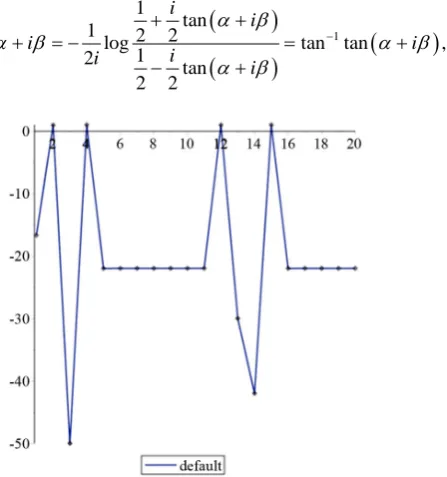
[image:11.595.209.431.365.705.2]Then, for all roots sr of the zeta function, there exists a unique sequence of real constants that are invariant with respect to all the roots and that converge to the same value, c∞. The plots below show examples of how
the function’s values change for the real arguments generated by some complex roots.ℜ
(
ζn( )
sr)
, is the vertic-al axis as n changes (horizontal axis) for various indicated values of τ =2, 3, 4,14.1347251 and 21.0220396. One can see that the function has alternating maxima and minima at integer values of n with the lowest value occurring again at n=3. This is again due to that fact that the function converges to a constant for all roots asn→ ∞.
One can surmise that any root sr such that ζ
( )
sr vanishes will generate a convergent sequence of real ar-guments sk, for the functions k( )
, 0,k
s k
ζ > such that
( )
( )
10 .
2
r
s c∞
ζ
ℜ > > = − (77)
Assuming the Riemann Hypothesis, there is a symmetry between the real parts of the known complex roots s, of the function about zero:
( )
1 1 1 1
0 0 .
2 it 2 ζ 2 it ζ 2
ℜ + ± = → ± = → = −
This symmetry is due to the fact that at any point in a large number of iterations where a root sr, one could replace zero of ζ
( )
sr with the equivalence, 0≡ζ( )
sr ;( )
(
)
(
)
(
0)
(
(
( )
0)
)
,n .ζ ζ ζ
ζ
→ζ ζ ζ
→ ∞( )
(
)
(
)
1 1
it 0 , .
2 2 n
ζ ζ ζ ζ ζ ± →ζ ζ ζ ζ →ζ ζ ζ − → ∞
This implies that the convergence of the iterations of functions must be symmetric about a zero of the func-tion as implied by the mean value theorem menfunc-tion earlier.
It is worth noting that the complex parts of iterates of the complex arguments result in real arguments if the products of the components of the iterates is real. Thus the roots are expected to be composed of a spectrum of complex factors whose iterates are real since they result in a quadratic convergence to the real values due to the symmetry of the reflection formula.
4. Convergence of the Riemann-Zeta Function for Complex Values
Let Z belong to integers and Z+ to the subset of positive integers. Any sequence of arguments can be created by
functional iteration. Let function g z
( )
:→ , with an initial value z0. The sequence obtained( )
( )
{
z z0, 1=g z0 ,,zm−1=g zm ,}
can yield periodic m-cycles( )
mc c
g z =z for some zc∈. A critical periodic point zc can be classified depending on the value of the derivatives,
(
m( )
)
c g zc
χ = ′. Such points are studied in Fractals, Chaos theory, Attracting Periodic Cycles, and in Mandelbrot Sets, using Newton approxima-tions and this critical point is classified as
Superattracting if 0
Attracting if 1
Neutral if 1
Repelling if 1
c
c
c
c
χ χ χ
χ
= < =
>
(78)
Let
{
z0,z1,,zk−1}
be an k-cycle of the differentiable function( )
0n
g z , with k
( )
0( )
1k k
z =g z =g z−
. Then, from definition (7),
( )
( )
(
[
]
)
( )
1 log
n n
n k
k
g z c g z
=
′ =
∏
(79)
• If z=gp
( )
z is a periodic point of period m, then gm( )
z =z, if and only if m divides p. This product is referred to as the multiplier of a periodic point z of period p. Since the zi lie on a cycle,( )
( )
( )
( )
0 for all .k k
i
g ′ z = g ′ z i
• If z=gp
( )
z is a periodic point of period m, then,ζ
p( )
z =ζ
q( )
z if and only if m divides p−q.LEMMA 2: If s is a root of the Zeta function, then the Towering Zeta function,
ζ
m( )
z ≠ζ
( )
s for finite values of m>1, unless either z∈[ ]
cm , or z=s when m=1.Proof: The case m=1 is trivial for
ζ
1( )
z =ζ
( )
s =0. Suppose there exists someζ
r( )
z =cr, where r is a positive integer. Then there exists some( )
(
r1)
r
z c
ζ ζ− = (80)
i.e. there exists a sequence of arguments,
( )
( )
( )
( )
(
( )
)
( )
( )
(
)
( )
0
0 1
1
2
2
3
3
4
4 0
1 , 2 1
0.2078862250 ,
2
0.2078862250 0.3448741787 ,
0.2959050806 .
r r
r r
r r
r
r
r
s c s
s s c
s s c
s c
s c
s c
ζ
ζ ζ
ζ ζ ζ
ζ ζ
ζ ζ
ζ∞
∞
= =
= = =
= = = −
= − = = −
= − = = −
= = −
(81)
( )
(
)
(
2)
(
(
(
3( )
)
)
)
(
(
(
(
0( )
)
)
)
)
2 3 0 ,
r r
r r
c c c s
ζ ζ ζ − ζ ζ ζ ζ − ζ ζ ζ ζ ζ ζ
− = − = =
(82)
Then,
( )
(
)
(
)
(
0)
[ ]
.
m
z=ζ ζ ζ ζ ζ z ∈ c
(83)
The iterated exponential that generates a root
ζ
r( )
c0 =0, must satisfy all roots independently, since if for some r, zr is a root ofζ
m( )
z , then zr must generate a particular sequence of real arguments in a future se-quence of arguments that must converge to c∞, as k→ ∞, i.e., ζ0( )
z0 =z0,ζ1( )
z0 =z1,
( )
( )
( )
1 2 1
0 2, , 0 1, 0
r r
r r
z z z z z z
ζ ζ − ζ −
−
= = =
,
( )
0 1( )
01
0, , .
2
r r
z z c
ζ
ζ
+∞
= = − →
Such a sequence of real
arguments cannot generate another complex root in the future direction. As an aside, Little wood showed that if the sequence z kk, =1,,r, contains all the imaginary parts of all zeros in the upper half-plane in ascending order, then,
1
lim k k 0
k→∞z+ −z = (84)
There cannot exist such a sequence of roots in the past or future arguments of
( )
0n
z
ζ
since when a root is encountered the sequence of arguments converge and never goes to zero but once. However, considering the fact that the Zeta function is multivalued at the roots, any root could be used in the future of a Zero, and as such a product of all roots following the Hadamard product for the Zeta function can be used in the future of a Zero of the function.( )
2(
( )
( )
)
1
e 1 e 1 e 0 with 0 Re 1
2
a bs s s n
n
s s
s s
n ρ
ρ
ζ ζ ρ ρ
ρ
+ −
≥
= ⋅ ⋅ − ⋅ + = < <
∏
∏
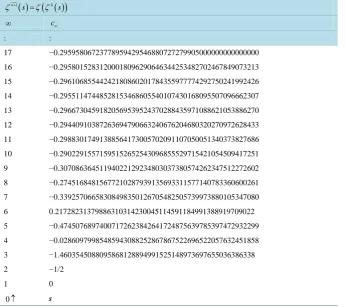
All roots converge the function to the real line from the complex plane (Figure 5).
Starting from a given root, the future iterations of the Towering Zeta function function over successive argu-ments that start from a root will lead to a convergence for every root. Table 1 shows the iterations from a root s
in an upward future trend toward convergence to c∞. However starting from some past iteration, there exist an
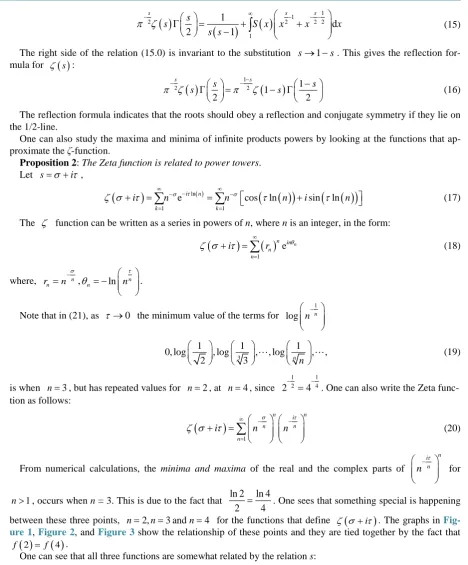
[image:14.595.194.432.216.359.2]infinite number of roots that could be generated by a past iteration through zero.
Table 1 shows successive past values of arguments for the roots, that solve the iterated relation,
( )
( )
1
n n
k k
z z
ζ+ =ζ , where n runs up the tables in a future direction, i.e. arguments of n1
( )
k z
ζ+ lead to
( )
n k
z
ζ
. As can be seen from Table 1, the function can become almost oscillatory for some values of negative roots. Values down the table are arguments that can generate roots as starting arguments of successive values of( )
nk
z
ζ
. [image:14.595.145.492.416.723.2]Figure 5. Shows the convergence from positive complex roots of the function to the real line.
Table 1.Iterations of the roots of the Towering Zeta Function over real arguments.
( )
(
( ))
1
n n
s s
ζ+ =ζ ζ
∞ c∞
: :
17 −0.29595806723778959429546880727279905000000000000000
16 −0.29580152831200018096290646344253482702467849073213
15 −0.29610685544242180860201784355977774292750241992426
14 −0.29551147448528153468605540107430168095507096662307
13 −0.29667304591820569539524370288435971088621053886270
12 −0.29440910387263694790663240676204680320270972628433
11 −0.29883017491388564173005702091107050051340373827686
10 −0.29022915571595152652543096855529715421054509417251
9 −0.30708636451194022129234803037380574262347512272602
8 −0.27451684815677210287939135693311577140783360600261
7 −0.33925706658308498350126705482505739973880105347080
6 0.21728231379886310314230045114591184991388919709022
5 −0.47450768974007172623842641724875639785397472932299
4 −0.02860979985485943088252867867522696522057632451858
3 −1.4603545088095868128894991525148973697655036386338
2 −1/2
1 0
LEMMA 3: Le t0 1 4 r
< < , s0=σ0+iτ0, and let f s
( )
0 =ζ
∞( )
s0 , be a non-vanishing function on the disc0
s ≤r, which is analytic in the interior. Then,
0
3
max .
4 n
s ≤r ζ − < − c π
Use Voronin’s theorem and let
( )
0( )
0n
f s =
ζ
s . Then, s0=ζn−1( )
s0 ( )
( )
0
1
0 0 0 0
3
max .
4
n n
s r ζ ζ s it ζ s ε
− ≤
+ + − <
(85)
Further, since 3 0 0 if 0 ,
4+it ≠ t ∈Z the constant ε0 cannot be zero. However, we can choose z0 and make
( )
( )
1 1
0 0 0
3 4
n n
s it z
ζ − ζ −
+ + =
( )
( )
1 1
0 0 0
3 4
n n
z s it
ζ
−ζ
−→ − = +
So that
( )
( )
0
0 0 0
max n n .
s≤r ζ z −ζ s <ε
Obviously as n→ ∞, the convergence demands that ε →0 0.
As n→ ∞,ε0 →0. Now choose 1
( )
0 0.n s
ζ− =
0
0 0
3
max .
4 n
s r
it c
ζ ε
≤
+ − <
(86)
Then there exists a negative constant such that
( )
0.5000000000 1
0.2078862250 2
0 0.3448741787 3
0.2954619778
n n
n
n
c n
n
ζ
− =
− =
= ≈
− =
− = ∞
(87)
Then,
0
3
max .
4 n n n
r ζ it c ε
≤
+ − <
(88)
The constants t0 must vanish at infinity since
ζ
n( )
0 is self similar andζ
∞( )
c∞ =c∞, and any approxi-mations of a constant function must be a constant-function, then, one suspiciously finds that:0
0 0
0.5000000000 1 2.941285387 , 1
0.2078862250 2 3.233399162 , 2
3
max 0.3448741787 3 3.096411208 , 3 .
4
0.2954619778 3.145380381 , ,
s
n n
n n
n n
n n
ζ ε
=
− = − =
− = − =
− − = ≈ − = <
− = ∞ − → ∞
(89)
This value deviates from π by 0.003787727780215700.
( )
(
1( )
)
(
2( )
)
(
3( )
)
( )
1( )
1 d d
1, 1, 1, 1,
d d
k n
n n n n
k
z
z z z z z
z z
ζ
ζ ζ ζ − ζ ζ − ζ ζ − ζ −
=
= =
∏
(90)
( )
1(
( )
)
0 d
1, d
n
n k
k
z z
zζ ζ ζ
−
=
=
∏
(91)
Thus the derivative of the function
ζ
n( )
z is just products of the derivatives of the iterate functions taken over n−1 values. Note that the derivatives of( )
gn ,( )
( )
(
[
]
)
1( )
1 log
n n
n k
k
g z c g z
−
=
′ =
∏
(92)
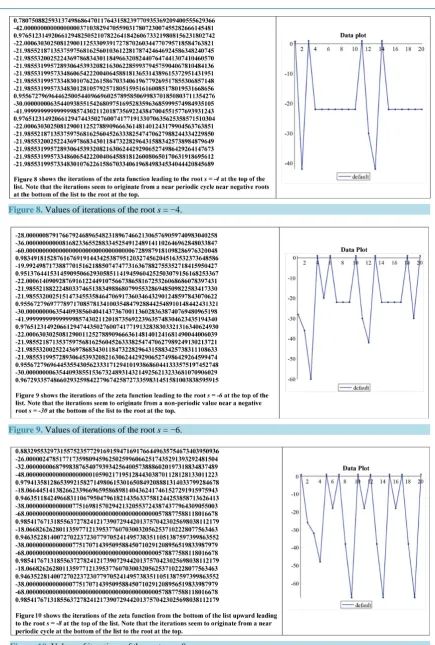
have been shown by D.L. Shell [6], to be periodic. Obviously, the power towers are intimately related to the Towering Zeta function and the almost periodic relationship is exactly the sort of behavior one sees with the Zeta function:
0.95567279697780404255437895947517132067057510101417 30.000000006354409385604136689519632230386337754576 41.999999999999999867430211201873569223963122161146 0.97651231492066129474435027600741771913283
ζ − −
805368063 22.000360302508129001125278890966636148140124168019 21.985521871353759756816256045263338254747062798673 21.985532002522436978683430118473228296431588342576
−
−
−
21.985532002522436978673430118473228296400065068011 0.95567179697780404255436748814883558583102891315578 30.000000006354409385604136689521105193219591530893 41.999999999999999857430211201873
−
−
≈ − 569223963122331657
0.97651231492066129474435027600741771913283810174678 22.000630302508129001125278890966636148140124543817 21.985521871353759756816256045263338254747062795690
−
−
(93)
LEMMA 4:
For
(
1( )
)
1
n z
ζ −
ℜ > ,
(
( )
)
( )
( ) 1
d
ln d
n n z
z n
u u v
v z
z
v ζ ζ
ζ −
−
−
∞ − ≠
=
∏
.
Proof:
( )
(
1)
(
1( )
)
1,
n n
z z
ζ ζ′ − =ζ ζ−
( )
(
)
(
( )
)
(
( )
)
1( )1 1
2
d d ln
1, ,
d d n
n n n
z v
v
z z z
z z vζ
ζ ζ − ζ ζ − ζ ∞ −
=
= = = −
∑
(94)
Differentiating
ζ
n( )
z , one gets:( )
1( )
1
d d
d d
n n k
k
z z
z z
ζ − ζ
=
=
∏
(95)
Which is the same as the power tower derivatives when c=e.
( )
( )
(
[
]
)
1( )
1 log
n n
n k
k
g z c g z
−
=
′ =
∏
Hence,
( )
1( ) 1( )2 2
d
ln ln
d
n z n z
n v v v v z v v z ζ ζ
ζ ∞ − − ∞ − −
− − = = =
∑
=∏
(97) Noting that( )
0 1 1 0 2 1 1 2 1 3 1 1 2 1 1 1 z a a a a a an an n an n n a n n a a z a ζ − − ∞ −∏ = ∞ − −∏ = ∞ −∏ = − ∞ = − − − − ∞ ∞ − = = ∏ =∑ ∏
(98)The derivative becomes,
( )
0 1 1 0 2 1 1 3 1 4 2 1 3 1 1 1 1 2 2 d ln d z a a a a a an an an an an an ann v v z v z ζ − − ∞ −∏ = ∞ − −∏ = ∞ −∏ = − ∞ − −∏ = − ∞ ∞ − −∑ −=∏ −= − ∞ − = =
∏
0 1 1 0 2 1 1 3 1 4 2 1 3 1 1 2 1 1 2 ln z a a a a a an an an an an an an v v v − − ∞ −∏ = ∞ − −∏ = ∞ −∏ = − ∞ − −∏ = − ∞ − −∏ = − ∞ − = − ∞ − = ∏ = ∏
(99) 0 1 1 0 2 1 1 3 1 4 2 1 3 1 1 2 1 110 1 1 0 2 1 1 3 1 4 2 1 3 1 1 2 1, 11
2 ln z a a a a a an an an an an an n an an
z a a a a a an an an an an an n an anv an
a v a v v − − ∞ −∏ = ∞ − −∏ = ∞ −∏ = − ∞ − −∏ = − ∞ − −∏ = − ∞ ∞= = − − − − ∞ −∏ = ∞ − −∏ = ∞ −∏ = − ∞ − −∏ = − ∞ − −∏ = − ∞ ∞= ≠ = − − − ∞ = − ∑ ∏ ∑ ∏ =
∏
(100)Put ak+1→u, and use
( )
0 1 1 0 2 1 1 2 1 3 1 1 2 1 1 1 z a a a a a an an n an n n a n n a a z a ζ − − ∞ −∏ = ∞ − −∏ = ∞ −∏ = − ∞ = − − − − ∞ ∞ − = = ∏ =∑ ∏
(101)( )
( ) ( ) 1 2 1, d ln d n n z n z u vu u v
z v z v ζ ζ ζ − − − ∞ ∞ − = = ≠ =
∏
∏
(102)LEMMA5: Define Z =
{
s∈|ζ( )
s =0,and0≤ ℜ( )
s >1}
and let s∈ and, s= +σ τi . Define( )
(
)
( )
{
1}
0 0 | 0 0 0 0 1
n
Z = s ∈ ζ ζ − s = and ≤ ℜ s >
and let s0∈,n∈, and s0=σ0+iτ0, then,
( )
{
}
{
1}
0 0 | 0 , 1 .
n
Z ⊂ s ∈ ζ − s =s n≥
Proof: