http://dx.doi.org/10.4236/sgre.2013.48055
Performance of Corrugated Wick in “V” Type Solar Still
Pattarumadathil Unikkatt Suneesh1, Rajan Jayaprakash2*, Tekkethil Namshad3, Sanjay Kumar4 1R&D Centre, Bharathiyar University, Coimbatore, India; 2Department of Physics, Sri Ramakrishna Mission Vidhyalaya, College of
Arts and Science, Coimbatore, India; 3National Institute of Technology, Calicut, India; 4Dr. B. R. Ambedkar University, Bihar, India.
Email: [email protected], *[email protected]
Received November 2nd, 2013; revised December 2nd, 2013; accepted December 10th, 2013
Copyright © 2013 Pattarumadathil Unikkatt Suneesh et al. This is an open access article distributed under the Creative Commons Attribution License, which permits unrestricted use, distribution, and reproduction in any medium, provided the original work is pro- perly cited.
ABSTRACT
This works reports performance of corrugated wick in a “V” type solar still. The still was tested in two configurations: plane wick integrated with drip system and corrugated wick integrated with drip system. A mathematical modeling has been proposed to validate experimental results. The experiment was performed in Tamilnadu, India climatic conditions (11˚ North 77˚ East). Experimental investigations on productivity and internal heat transfer are analyzed. The results indicate that the mean standard deviations between theoretical and experimental values are less than 7% (temperature of rippled wick), 3% (temperature of glass in rippled system), 6% (temperature of flat wick) and 3% (temperature of glass in flat system) an average for the working hours of the day. The distillate yield produced was 2800 ml/m2/day by plane
wick and 2200 ml/m2/day by corrugated wick.
Keywords: Solar Still; Fresh Water; Glass; Corrugated Wick
1. Introduction
The distillation is one of the important methods of get-ting clean water from brackish and sea water using the free energy supply from the sun. The increase of popula-tion and human agricultural and industrial activity make the availability of fresh water in arid and semi-arid re-gions a problem of great importance all over the world. Solar distillation process has the advantage of zero fuel cost, but requires more space (for collection) [1]. Aug-mentation of distillate yield using wick was reported by many authors [2,3]. Velmurugan et al. has studied effect of different wick materials in the distillate yield. Mina-sian and Al-karaghouli have experimentally investigated an improved design of the single slope coupled to a wick in order to enhance still output. Phadatare and Verma [4] have studied the variation of productivity with respect to water depth and been concluded that productivity de-creases with an increase of water depth. The energy ab-sorbed by the absorber basin is mostly transferred to the water. As a result, water gets heated. In water filled sys-tem early hour radiations are used for acquiring latent heat of evaporation to a greater extent and then evapo-rated water gets condensed on the inner surface of the top
cover by releasing its latent heat. So most of the water filled systems show high distillate yield after noon. Mru- gavel and Srithar [5] have conducted experiments on basin type solar still with different wick materials and concluded optimized output using light cotton wick. The effects of climatic, design and operational parameters on the productivity of the wick-type solar still have been mentioned by Yeh and Chen [6]. Talbert et al. [7] and Tanaka et al. [8] have mentioned that the wick-type solar still has attractive performance against the basin-type solar still. In this work, a “V” type solar still was fabri-cated and tested. A comparative study was conducted with plane wick and corrugated wick. A transient theory has been proposed to validate the effect of wick shape in performance of the “V” type solar still.
2. Materials and Methods
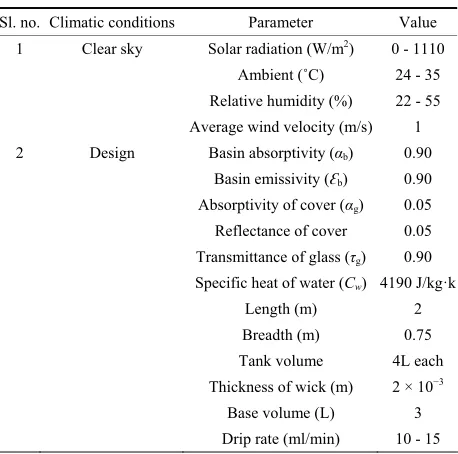
A “V” type solar still was designed and fabricated as illustrated in Figures 1-5. The specification and
opera-tional parameters of solar still are shown in Table 1. A
rectangular basin of dimension 2 m × 0.75 m × 0.05 m was designed and coated with black paint for good ab-sorption. An inlet pipe of 13 mm was used for pouring water into the still. Heat loss was reduced by surrounding
Figure 1. Photographic view of “V” type solar still.
Figure 2. Photographic view of corrugated absorber.
Figure 3. “V” type solar still without glass cover.
Figure 4. Corrugated wick.
Figure 5. Schematic representation of “V” type solar still.
Table 1. Still technical and operation details.
Sl. no. Climatic conditions Parameter Value 1 Clear sky Solar radiation (W/m2) 0 - 1110
Ambient (˚C) 24 - 35
Relative humidity (%) 22 - 55 Average wind velocity (m/s) 1 2 Design Basin absorptivity (αb) 0.90
Basin emissivity (Ɛb) 0.90
Absorptivity of cover (αg) 0.05
Reflectance of cover 0.05 Transmittance of glass (τg) 0.90
Specific heat of water (Cw) 4190 J/kg·k
Length (m) 2
Breadth (m) 0.75
Tank volume 4L each Thickness of wick (m) 2 × 10⁻³
Base volume (L) 3 Drip rate (ml/min) 10 - 15
the basin with a wooden case. The inter space between still and wooden case was filled with saw dust to reduce heat loss at low cost. The top cover of the still has been made by glass thickness of 3 mm (Figure 1). An inward
slope of the glass cover was maintained towards the cen-ter of the still and the cover was cemented by chemical adhesive to minimize air leakage (Figure 2). An outlet is
also provided to drain out distilled water and a 2˚ slope is maintained for the water collection channel for smooth outward flow of distilled water (Figure 3). The
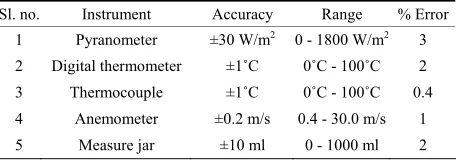
experi-ments were carried out in the time duration of 9 h - 18 h. The hourly variation of various temperatures like ambi-ent (Tamb), glass (Tg) and wick (Tw) were recorded using calibrated K-type thermocouples. Commercial grade jute was used as wick because of wide availability and low cost. Accuracies and error percentage of various measur-ing instruments used in the experiment are shown in Ta-ble 2.
[image:2.595.60.288.228.332.2] [image:2.595.57.289.343.718.2]Table 2. Accuracies and error for various measuring instru- ments.
Sl. no. Instrument Accuracy Range % Error 1 Pyranometer ±30 W/m2 0 - 1800 W/m2 3
2 Digital thermometer ±1˚C 0˚C - 100˚C 2 3 Thermocouple ±1˚C 0˚C - 100˚C 0.4 4 Anemometer ±0.2 m/s 0.4 - 30.0 m/s 1
5 Measure jar ±10 ml 0 - 1000 ml 2
3. Mathematical Model
The following assumptions are made in the mathematical modeling of the system. Heat loss is negligible across the side wall and basin liner of the system. Variation of in-cident angle of solar radiation is negligible. The glass plates and basin are assumed to be parallel. The energy balance of the glass cover and wick surface are necessary to model the system.
3.1. Energy Balance for Glass Cover
The energy received by the glass cover includes incident solar radiation and energy received from wick surface. The energy balance equation for the glass cover is given by,
Energy received by the glass cover = Energy lost from the glass cover
cos
wg w g
g ga g a
h T T
G t h T T
(1)
wg cw ew rw
h h h h (2)
The convective heat transfer coefficient from the wick surface hcw is given by Dunkle’s relation [9],
1 3
273.15 0.884
268900
w g w
cw w g
w
P P T
h T T
P
(3)
The partial pressure of water vapour in the air in N/m2,
is estimated for a given temperature (˚C) using the fol-lowing correlation [10],
2
7235 431.43 10.76
P T T (4)
The evaporative heat transfer coefficient is given
by, ew
h
3
16.276 10 w g
ew cw w g P P h h T T
(5)
The radiation heat transfer coefficient is given by
[11], rw
h
2 2
1 1 1
w g w g
rw
w g
T T T T
h
(6)
Heat transfer from glass to air is due to convection and radiation.
ga cg r
h h hg (7)
The convective heat transfer coefficient from the glass cover is given by [12],
2.8 3.0 cg
h V (8) The radiative heat transfer from the glass to air is given by,
2 2
rg eff g s g s
h T T T T
(9)The sky temperature Ts is given by [13], 1.5
0.0552
s a
T T (10)
3.2. Energy Balance for Wick Surface
Solar energy received by the wick surface is used for raising the temperature of wick surface together with water. Energy is lost from the wick to glass cover by convection, evaporation and radiation. Energy balance for the wick surface is given by,
Energy received by wick surface = Energy loss from wick surface
d 1 d cos 1 cos ww w w wm wm bm bm
wg w g
T G t m c m c m c
t
h T T
(11)
Using energy balance equations of wick and glass, modified differential equation in Tw can be written as
3 d d w w T
C T C
t 4 (12)
where,
2
3
1 wg
w w wm wm bm bm
h C
C
m c m c m c
(13)
14
cos
w
w w wm wm bm bm
G t h C
C
m c m c m c
wg (14)
1 1 cosg ga a
ga
G t h T
C
h
(15)
2 cos cos wg ga wg h C h h (16)
4. Result and Discussion
model-ing ambient temperature was taken as 30˚C. Experiments were conducted with Plane wick (θ = 0˚) and corrugated wick (θ = 45˚). The hourly variation of solar intensity and
ambience temperature corresponding to March 2013 is presented in Figure 6, which have been used for
compu-tation. Radiation received was in the range of 0 W/m2 to
1000 W/m2. The ambient temperature is in the range of
24˚C - 35˚C. The fresh water productivity of the still is generally proportional to daily solar radiation. The measured ambient temperature is lower than other tem-peratures.
The temperature profile of corrugated-“V” type solar still is shown in Figure 7. Experimental variation of
wick temperature was in the range of 30˚C - 65˚C. The mean standard deviations between theoretical and ex-perimental values are less than 7%. Numerically calcu-lated wick temperature was in the range of 30˚C - 68˚C. No significant variation was found between theoretical and experimental values of glass temperature. The varia-tion was in the range of 30˚C - 52˚C. In both cases, the temperatures increases first and reaches a maximum and then decreases. Variation of experimental and theoretical values of glass and wick temperature for plane-“V” type solar still is shown in Figure 8. Experimental variation
of wick temperature was in the range of 30˚C - 68˚C. The mean standard deviations between theoretical and ex-perimental values are less than 6%. Numerically calcu-lated wick temperature was in the range of 30˚C - 65˚C. Variation between theoretical and experimental values of glass temperature was negligible. The variation was in the range of 30˚C - 52˚C (exp) and 30˚C - 55˚C (the). On comparing Figures 7 and 8, wick temperature is higher
for plane “V” type solar still. The solar radiation received was uniformly distributed over the absorber. The area of plane wick was less than that of corrugated wick. So the solar energy absorbed per unit area is higher and hence temperature is larger. The distillate output is independent of absorber area unless we provide any method of solar concentration. Figure 9 presents the experimental results
8 10 12 14 16 18
300 400 500 600 700 800 900 1000
Solar radiation Ambient
Time (hours)
S
o
lar
radi
ati
on
(W
/m
2)
26 28 30 32 34 36
Ambi
ent t
e
mperat
ure (
o
C)
Figure 6. Solar radiation.
9 10 11 12 13 14 15 16 17
0 10 20 30 40 50 60 70
Temperat
ure i
n
oC
Time in Hrs
Tw the
Tw exp
Tg the
Tg exp
[image:4.595.310.539.87.253.2]Rippled solar still
Figure 7. Variation of temperature (corrugated-“V” type solar still).
8 10 12 14 16 18
30 40 50 60 70
T
e
mpe
rat
ur
e
in
o C
Time in Hrs
T w the T
[image:4.595.307.537.532.716.2]w exp Tg the Tg exp Flat solar still
Figure 8. Variation of temperature (plane-“V” type solar still).
8 10 12 14 16 18
-50 0 50 100 150 200 250 300 350
Yield(mi/
m
2 /Hr
)
Time in Hrs
[image:4.595.64.284.567.719.2]Flat-solar still Rippled-solar still
of the hourly yield for corrugated and plane mode. The total amount of daily productivity obtained by the plane-“V” type solar still was 2800 ml/m2/day. Finally,
with corrugated absorber, productivity decreased to 2200 ml/m2/day.
5. Conclusion
In the present study, several conclusions can be obtained as follows: 1) solar radiation received is independent of absorber area, 2) structural modification of wick/m2 has
no significance, 3) in wick-type solar stills, plane wick with drip system could be efficient, 4) the wick tempera-ture for the plane wick is higher than that of the corru-gated wick and the still output is higher for the plane system, 5) a change in the angle (0˚ - 45˚) causes de-crease in distillate yield by 600 ml/m2/day, and finally 6)
the proposed mathematical model gave good match with experimental results.
REFERENCES
[1] J. A. Duffie and W. A. Beckaman, “Solar Engineering of Thermal Processes,” Madison, 1991.
[2] V. Velmurugan, M. Gopalakrishnan, R. Raghu and K. Srithar, “Single Basin Solar Still with Fin for Enhancing Productivity,” Energy Conversion and Management, Vol. 49, No. 10, 2000, pp. 2602-2608.
http://dx.doi.org/10.1016/j.enconman.2008.05.010 [3] N. A. Minasian and A. A. Al-Karaghouli, “An Improved
Solar Still: The Wick Basin Type,” Energy Conversion and Management, Vol. 36, No. 3, 1995, pp. 213-217. http://dx.doi.org/10.1016/0196-8904(94)00053-3
[4] M. K. Phadatare and S. K. Verma, “Influence of Water Depth an Internal Heat and Mass Transfer in a Plastic Solar Still,” Journal of Desalination, Vol. 217, No. 1-3,
2007, pp. 267-275.
http://dx.doi.org/10.1016/j.desal.2007.03.006
[5] K. Kalidasa Murugavel and K. Srithar, “Performance Stu- dy on Basin Type Double Slop Solar Still with Different Wick Materials and Minimum Mass of Water,” Renew- able Energy, Vol. 36, No. 2, 2011, pp. 612-620. http://dx.doi.org/10.1016/j.renene.2010.08.009
[6] H. M. Yeh and L. C. Chen, “The Effect of Climatic, De- sign and Operational Parameters on the Performance of Wick-Type Solar Distillers,” Energy Conversion and Ma- nagement, Vol. 26, No. 2, 1986, pp. 175-180.
[7] S. Talbert, J. Eibling and G. Lof, “Manual on Solae Dis- tillation of Saline Water,” US Department of the Interior, OSW, R&D, Report No. 546, 1970.
[8] K. Tanaka, A. Yamashita and K. Watanabe, “Solar World Forum,” Vol. 2, Pergamon Press, Oxford, 1982.
[9] R. V. Dunkle, “Solar Water Distillation, the Roof Type Still and a Multiple Effect Diffusion Still,” International Developments in Heat Transfer, ASME, Proceeding of International Heat Transfer, Part V, University of Colo- rado, 1961, p. 895.
[10] T. Siaka and M. Pierre, “A Numerical Model and Ex- perimental Investigation for a Solar Still in Climatic Con- ditions in Abidjan (COTE DTOIRE),” Renewable Energy, Vol. 11, 1997, pp. 319-330.
http://dx.doi.org/10.1016/S0960-1481(96)00131-0 [11] J. Duffie and W. Beckman, “Solar Engineering of Ther-
mal Processes,” 2ndEdition, John Wiley and Sons, New York, 1991.
[12] J. H. Watmuff, W. W. S. Charters and D. Proctor, “Solar and Wind Induced External Coefficients Solar Collectors,” Revue Internationale Heliotechnique, Vol. 2, 1977, p. 56. [13] V. B. Sharma and S. C. Mullick, “Estimation of Heat-
Transfer Coefficients, the Upward Heat Flow, and Eva- poration in a Solar Still,” ASME Journal of Solar Energy Engineering, Vol. 113, 1991, pp. 36-41.
http://dx.doi.org/10.1115/1.2929949
Nomenclature
C: Specific heat (J/kgK)h’: Heat transfer coefficient (W/m2K)
G: Intensity of solar radiation-diffused (W/m2) m: Mass flow rate (kg/s)
p: Pressue (N/m2) T: Temperature (K)
t: Time (s)
V: Velocity of wind (m/s)
α’: Fraction of solar radiation absorbed
θ: Angle of the ripple
ε: Emissivity
hwg: Heat transfer coefficient (water-glass) (W/m2·K)
hga: Heat transfer coefficient (glass-ambience) (W/m2K)
σ: Stefan-Boltzman’s constant, W/m2·K4
Subscripts
g: Glassw: Water
a: Ambient
cw: Convective from water
ew: Evaporative from water
rw: Radiative from water
cg: Convective from glass
rg: Radiative from glass
eff: Effective
S: Sky
wm: Wick material