Munich Personal RePEc Archive
Building a Responsibility Model to
Foster Information Technology:
Contributions from Social Sciences
Christophe, Feltus
PReCISE Research Centre, Faculty of Computer Science, University
of Namur, Belgium, CRP Henri Tudor, Luxembourg
30 October 2010
Online at
https://mpra.ub.uni-muenchen.de/83356/
Building a Responsibility Model to Foster Information Technology:
Contributions from Social Sciences
Christophe Feltus
PReCISE Research Centre, Faculty of Computer Science, University of Namur, Belgium CRP Henri Tudor, Luxembourg
Abstract
The economic context advocates a better understanding of responsibilities and an enhancement of these responsibilities within a moral perspective. These arising requirements have oriented our research toward the elaboration of an innovative responsibility model. This paper aims at enriching our responsibility model on the basis of a further analysis of these concepts in human sciences literature.
1. Introduction
The current crisis has highlighted the necessity for a global rethinking of the economy. Industrial analyses as well as academic surveys have put forward the need for improving the management of IT in many areas such as
transparency, commitment, accountability, control,
procurement and alignment with the business. All of these domains are gathered under IT Corporate Governance umbrella and are progressively integrated in standards and norms such as ISO 38500:2008 [1] or COBIT 4.1 [2].
In parallel to these progressively formalized and newly arising requirements, companies are used to work with well-known experienced and approved management frameworks of their day-to-day operations, management or investments. These frameworks are for instance ITIL [3], COBIT, CIMOSA [4], or ISO 15504 [5]. Such frameworks mostly target a well-defined activity domain or a precise technology type, and address the above listed
governance’s requirements with a very specific approach
and according to a precise context dependency understanding. All of these frameworks deal in one way or another with a responsibility concept. The consequence of this abundance of frameworks is the existence of an equal amount of responsibility models and interpretations.
Based on the assumption that all of those components are consistently used for the elicitation of corporate rules and policies, it is obvious through that grounding a convergence between them would quickly bring relevant benefits to the business. Moreover, assuming that these rules and polices most of the time formulate the behavior of a system [6] and of its stakeholders, we deduce that the
stakeholders’ responsibility represent a paramount
significance to adequately govern a company.
Assuming the importance of the responsibility concept, the analysis of its representation through professional standards, norms and frameworks as well as the examination of scientific literature highlight, that, as yet, there does not exist a consensual and common understanding of its conceptual components.
Taking that into account, our research aspires to globally improve the IT governance mainly by advising a common responsibility model dedicated to the industrial and scientific usage. The elaboration of such a model is realized through a double activity. First, a theoretical model is constructed based on the analysis of its conceptual components issued from social, managerial,
psychological and computer science literature’s incomes.
Secondly, the theoretical model is enhanced and validated
by confrontation with industrial frameworks.
Simultaneously, improvement proposals of these existing industrial frameworks are proposed by adjunction of conceptual components from the responsibility model they lack.
In this paper, we present the responsibility model and explain some of its most important components based on literature review and previous works.
2. The responsibility concept
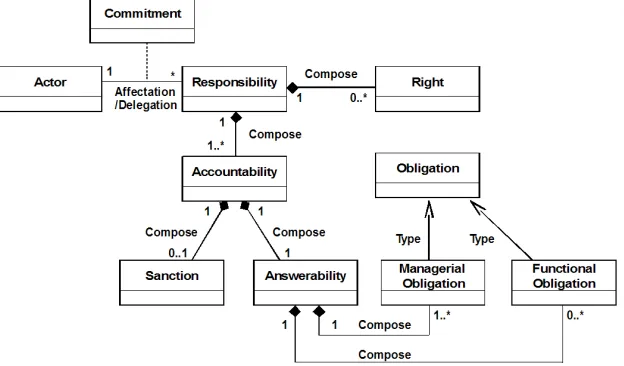
There exists a plethora of responsibility definitions and this paper will not propose a new one but would rather synthesize a definition from existing ones. We may state that commonly accepted responsibility definitions encompass the idea of having the obligation to ensure that something will happens. Our previous works [7] [8] [27] [51] have reviewed the responsibility concept and have led to the development of a synthetic and pragmatic responsibility model (figure 1.) This model addresses
three responsibility concepts’ blocs that are the right to
perform actions, the obligation to achieve results of
actions and the assignment of stakeholders’ responsibility.
In this paper, the assignment process will be closely associated to the delegation mechanism [53]. Each of
these concepts’ blocs are explained in detail in the
Cholvy et al. [9] explains that responsibility is a concept with several facets corresponding to very different meanings. She provides three responsibility definitions, which implicitly encompass the three concept blocs relating to our model right, obligation and delegation. The first definition links the responsibility concept to something negative that has happened because of a person or could have prevented it from happening. This definition is mainly issued from the legal world and is closely related to a notion of causality. The second definition claims that responsibility is an obligation or a moral duty to report or explain the action or someone
else’s action to a given authority (answerability). This
definition helps defining an obligation considered as a legal duty and introduced in parallel the moral duty, which
will be closely analyzed in the following sections. The third definition considers responsibility according to a position within an organization and explains that a person responsible for a task should be prepared to justify his actions and might be exposed to sanctions or rewards. This justification adds the accountability concept and
consequently, nuances accountability versus
[image:3.612.158.470.257.440.2]answerability. These three definitions highlight important responsibility facets like obligation, moral duty, reporting or justification, and accountability or answerability. However, it is unclear how these concepts are linked together and how they interact, i.e. answerability vs. accountability vs. justification and obligation vs. moral duty. The following sections attempt to clarify this understanding.
Figure 1. Responsibility Model Building Blocs UML Diagram
3. The obligation concept
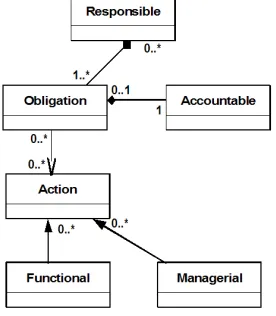
The stakeholder responsible for specific action also has the obligation to achieve this action. Two main obligation types exist: functional and managerial obligation (figure 2.) Functional obligation is related to functional actions (direct production of goods) and managerial obligation concerns managerial actions (like i.e.: control, management, allocation of resources,
etc.) At the organization’s top layers, these kinds of obligations could be illustrated by recent laws like the Public Company Reform and Investor Protection Act of 2002 [10], known under Sarbanes-Oxley and the Basel II [11] requirements for financial institutions, which have highlighted the necessity of more engagements in the hands of employees and more precisely the CEO and CFO. This engagement may be translated into an obligation to be kept informed of the status of the accounts. In the field of ICT, obligation exists mainly in engineering methods like I* [12] and appears through the obligation to achieve a task or to
perform an action. The distinction of functional and managerial obligation is strengthened by Dobson [13] who defines functional obligation as what a role must do with respect to a state of affairs, whereas he defines a structural (managerial) obligation as what a role must do in order to fulfill a responsibility such as directing, supervising and monitoring, whenever an obligation or a right is delegated.
This concept of obligation is subject to more debate. For Bettini et al. [14], obligations are conditions or actions, which must be fulfilled either by users or a system after a decision. In [15], Sandhu et al. define obligations as requirements, which have to be fulfilled by the subject for allowing access. Crook et al. [16] extend the notion of obligation to obligation policy relating to actions which must be carried out on targets by subjects when a predefined event occurs and Haley et al. in [17] define it as what actions must be taken before access can be granted.
concept doesn’t exist in the realm of the access control
[image:4.612.124.262.171.329.2]model that rather tends to speak about the right or/and the obligation required to access information. E.g.: the right to read a document or the obligation to satisfy conditions before accessing it. By contrast, a task is a centrical concept in requirement engineering. E.g.: in Tropos, [18] a goal may be achieved by fulfilling a task.
Figure 2. Obligation UML Diagram
Accountability (figure 3) is a concept existing in the fields of education [19], politics [20] and healthcare [21]. Accountability is a concept that exists for as long as the responsibility concept but this has been emphasized by the requirements for corporate governance. Accountability encompasses answerability and eventual sanctions or rewards. It is an important component of the obligation within which it justifies the achievement of an action and gives its evidence. This concept describes the state of being answerable regarding the achievement of a task. Behind the researches, which have introduced it, Fox [22] argues that accountability is generated from transparency. He
explains that one person’s transparency is another‘s surveillance and in the same way, one person’s accountability is another’s persecution. Fox defines
accountability with the two following concepts:
answerability and sanctions. For him, soft
accountability is equivalent to answerability, whereas hard accountability is composed of answerability and sanctions. Stahl [23] confirms that responsibility and accountability are very closed concepts. He explains that accountability describes the structures, which have to be in place to facilitate responsibility and that responsibility is the ascription of an object to a subject rendering the subject answerable for the object. Stahl also focuses on the sanction as being of central importance for the responsibility. He nuances the sanction as positive or negative. His vision of responsibility is that it is constructed based on the three
dimensions: object, subject and authority. For Stahl, authority is the entity that can determine and enforce the sanctions associated to the responsibility ascription (based and relying on a normative framework).
This approach presents de facto authority as a type of actor rather than as a particular capability representing the power to command and control others agents. We prefer the second approach.
Authority is also a concept used in CIMOSA [24]
Figure 3. Accountability UML Diagram
There exist others definitions of accountability. Laudon et al [26] express this concept by the following
way: “Accountability is a feature of systems and social institutions: It means that mechanisms are in place to determine who took responsibility actions, who is
responsible” with the following responsibility definition: “responsibility has to do with tracing the
causes of actions and events, of finding out who is
answerable in a given situation”. Accountability is for
Goodpaster et al. [54] a mechanisms’ set allowing such tracing of causes, actions, and events whereas for Spinello [28], it is a necessary but not a sufficient responsibility condition.
4. The right concept
The right concept (figure. 4.) encompasses all the facilities required to perform the action the stakeholder is responsible for. These facilities could take on many
forms like the capabilities’, the authorities’ or the
delegation right.
[image:4.612.327.548.182.353.2]Authority: describes the power or right to give orders or makes decisions. This concept is introduced
in Cimosa as the “power” to command and control
others agents and to assign responsibilities. Cimosa [4] argues that responsible agents have rights over resource in the first and over process, activity and task in the second place. Cimosa distinguishes the resource and
the capability: Resources are companies’ assets
[image:5.612.340.526.113.217.2]required for carrying out processes whereas capabilities are technical abilities provided by a specific resource and are of four types (functional, object oriented, performance or operational).
Figure 4. Right UML Diagram
Delegation: is a type of right to transfer some part of the responsibility to another actor. This transfer may concern the transfer of right or obligation or both. I.e. an actor may transfer the responsibility to achieve an activity to another actor. This obligation delegation may or not be accompanied by the delegation of right.
This delegation of rights depends on the stakeholders’
right of holding this responsibility This delegation may or not also includes the transfer of obligation as the obligation to be accountable [29].
5. Affectation / Delegation Process
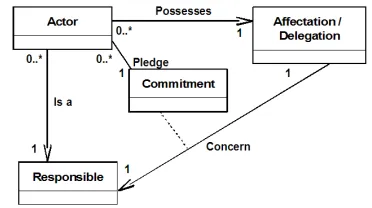
Affectation / Delegation is the action of linking a stakeholder to a responsibility (figure 5). This affectation / delegation may take on different forms like: natural (the adult who plays the role of parent), legal or moral. In industry, the affectation is often resulting from a cascade of delegations or assimilated processes: the CEO is responsible of the global activity of the industry and may delegate the management of the production to the production manager, the management of the quality to the quality manager, the management of the marketing to the marketing
[image:5.612.82.300.220.397.2]manager, etc. Thereafter, all these managers delegate some of their responsibilities to subalterns, which at the end constitutes a delegation chain.
Figure 5. Delegation / Affectation UML Diagram
Actor (stakeholder) appears as a key component of the affectation / delegation action. It represents a person external or internal to an organization, a system or a software component. Stakeholder has to achieve a task he is responsible for. Number of synonyms of it exists like subject, employee, user or agent. For administration facilities, those stakeholders are often grouped together based on their profile. As previously explained in the literature overview, the most famous type of classification is the role but variations exist such as for example the team, the hierarchy, or geographical constraints.
Traditional policy model such as RBAC do not address it, however I* partly introduces it (e.g. when
defining dependency as an “agreement” between two
actors). For Yu [12], commitment provides an abstraction that allows workability to be judged without having to know about the routines used to achieve or the need to judge the workability of the individual elements that make up those routines. Commitment is the property that bridges the gap between ability and workability. Workability indicates that an agent believes that some routine would work even though it is incompletely specified or known.
Even if this concept rarely appears in professional literature, many states-of-the art have been produced in the scientific literature as for instance Shojiro Takao [30]. Scientists generally have agreed upon the idea that the commitment depicts the relationship between the individual and the organization. They have furnished many definition of it: Monday [31] explains
that it can be seen as “the relative strength of an individual’s identification with and individual’s
identification with an involvement in a particular
organization”, Stebbins [32] defines it as “the
awareness of the impossibility of choosing a different
social identity […] because of the immense penalties in making the switch”. For Grusky [33], the commitment
is “the nature of the relationship of the member to the
system as a whole” and for Hrebiniak et al. [34]:“A
structural phenomenon which occurs as a result of individual-organizational transactions and alterations in side-bets or investment over time”.
Another interesting issue of Stahl’s researches is that: ”A responsibility ascription that is to be successful
in improving social reality must be based on acceptable rules that the individuals involved are ready to adhere
to”. This obligation highlighted by Stahl strongly
advocates the needs of actors’ commitment.
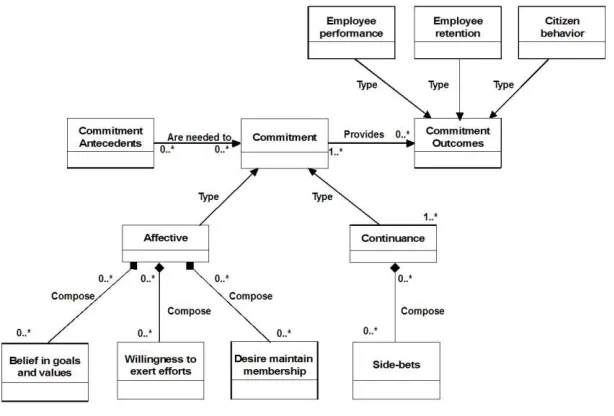
All of these definitions tend to demonstrate that there exist different types of commitment. The two most recognized are affective commitment (also referred to as emotional, attitudinal or value-related) and continuance commitment (or calculative). See figure 6. Affective commitment is the one defined by Monday and which Porter [35] has depicted through the Organizational Commitment Questionnaire (OCQ) in terms of a strong belief in and acceptance of the
organization’s goals and values, a willingness to exert
considerable effort on behalf of the organization and a strong desire to maintain their membership in the organization. Meyer et al. [36] have highlighted that employees with affective commitment tend to work harder for their companies than employees with other type of commitment.
[image:6.612.168.475.393.601.2]
Figure. 6.: Commitment UML Diagram
Continuance commitment is the one defined by researchers such as Stebbins [32], Hrebiniak et al. [34]. This kind of commitment represents the fact that an
employee doesn’t want to leave the organization because
of the loss of advantages gained by his seniority in the company and the alterations in side-bets. Many authors have proposed scales to measure continuance commitment:
Mathieu et al. [37], Hackett et al. [38], Ritzer et al. [39], Meyer et al. [36], Hrebiniak et al. [34].
personal sacrifice when a decision has to made whether to leave or stay with a company.
Others commitments’ perspectives exist like the
normative commitment reflecting the employee’s
obligation feeling to remain in the organization [41], the internalization reflecting the value congruence between organization and employees [42] or the utilitarian component characterizing the give-and-take relationship between employee and the organization [30]. These types of commitment are not being represented in figure 6.
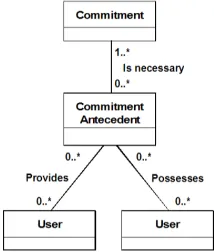
The analysis of the commitment is achieved based on the antecedents and on the outcomes as shown in figure 7.
Antecedents are the factors influencing the
organizational commitment and upon which we can act or not to enhance this commitment. Antecedents may take many forms like the characteristics and experience that a person adds to the organization [31], the age of the employee and the period of the time he is with the organization [41] [43] [44]. The perception of the job security [45], the management culture and style [46], the
[image:7.612.328.519.69.160.2]employees’ investments in time, money and effort [47].
Figure 7.: Commitment Antecedents UML Diagram
2. Outcomes are the benefits resulting in the
employee’s commitment. Three main types of outcomes
are distinguished from the existing surveys:
The employees’ performance [36]. Committed
employees performed better because of their high expectations of their performance. Moreover, employees demonstrate a high level of performance when there are committed to both their organization and their profession.
The retention of employee. Many studies have
proved the link between the commitment and the employee turnover [48] [49] [36].
The citizen behavior or extra-role behavior. The
[image:7.612.131.238.326.452.2]research over this outcome however remains inconclusive.
Figure 8. Commitment Outcome UML Diagram
As explained in figure 8, the outcomes of the commitment like the employees’ performance could be associated as capabilities for others responsibility.
5. Conclusion
The current economic context and ongoing willingness to improve corporate and IT governance of companies advocate a strengthening of the definition and acceptation
of rules governing a system’s behavior. Simultaneously, we
observe that the responsibility concept is central to these rules but remains poorly and in an unstructured way addressed within professional norms, standards and frameworks.
Consequently, this paper proposes an analysis of the mains concepts dealing with the notion of responsibility and defining an innovative responsibility model, which tends to integrate all of the meaningful analyzed concepts.
7. References
[1] ISO/IEC 38500 (2008), International Standard for
Corporate Governance of IT (IT Governance)
[2] CobiT 4.1, Control Objectives for Information and Related Technology, Information Systems Audit and Control Association
[3] ITIL (2001), Service Delivery, The Stationery Office Edition, ISBN 011 3308930.
[4] Vernadat F. B., Enterprise Modelling and Integration,
Chapman & Hall, London (1995), ISBN 0-412-60550-3
[5] ISO/IEC 15504, “Information Technology – Process
assessment”, (parts 1-5), 2003-2006.
[6] N. Dulay, E. Lupu, M. Solman, N. Damianou, A
Policy Deployment Model for the Ponder Language , An
extended version of paper in Proc. IEEE/IFIP
International Symposium on Integrated Network
Management, (IM’2001), Seattle, May 2001, IEEE Press.
Fourth International Conference on Availability, Reliability and Security IEEE, 16-19/3/2009, Japan.
[8] Feltus, C., Petit, M., Ataya, G., Definition and Validation of a Business IT Alignment Method for Enterprise Governance Improvement in the Context of
Processes Based Organizations, 2008 Corporate
Governance of IT International Conference, NZ.
[9] L. Cholvy, F. Cuppens, and C. Saurel. Towards a logical formalization of responsibility. In Proc. of the Sixth International Conference on Artificial Intelligence and Law, pages 233--242, 1997.
[10]Sarbanes, P. S. and Oxley, M. (2002) “Sarbanes
-Oxley Act of 2002”.
[11]Basel Committee on Banking Supervision,
“International convergence of capital measurement and capital standards”; BIS; Basel, June 2004.
[12]Yu, E. S., Liu, L. (2001). Modelling Trust for System Design Using the i* Strategic Actors Framework. Workshop on Deception, Fraud, and Trust in Agent
Societies Held During the Autonomous, Eds. Lecture
Notes In Computer Science, vol. 2246. Springer-Verlag, London, 175-194.
[13]Dobson, J. and Martin, D., “Enterprise Modeling
Based on Responsibility”, TRUST IN Technology: A Socio-Technical Perspective, Clarke, K., Hardstone, G., Rouncefield, M. and Sommerville, I., eds., Springer, 2006.
[14]C. Bettini, S. Jajodia, X. S. Wang, and D. Wijesekera, Provisions and Obligations in Policy Management and Security Applications, 28th VLDB conference, China, 2002
[15]Ferraiolo, D. F., Sandhu, R., Gavrila, S., D. Kuhn, R., Chandramouli, R. (2001), Proposed NIST Standard for
Role-Based Access Control, ACM Transactions on
Information and System Security, 4 (3), 224-274.
[16]Crook, R., Ince, D., Nuseibeh, B., (2002) Towards an Analytical Role Modelling Framework for Security
Requirements, Security Requirements Group, Departement
of Computing, The Open University, Walton Hall, Milton Keynes, MK7 6AA, UK
[17]Charles B. Haley, Robin C. Laney, Jonathan D. Moffett, and Bashar Nuseibeh, Using Trust Assumptions
with Security Requirements, Requirements Engineering
Journal, vol. 11 no. 2 (April 2006) pp. 138-15.
[18]Fuxman, M. Pistore, J. Mylopoulos, P. Traverso,
“Model Checking Early Requirements Specification in
Tropos”, In the Proceedings of the 5th Int. Symposium on
Requirements Engineering, RE’ 01, Toronto, Canada,
2001
[19]Darling-Hammond, L. & Snyder, J. (1992). Reframing accountability: Creating learner- centered schools. In A.
Lieberman (Ed.), The Changing Contexts of Teaching
Chapter 2, pp. 11-36. Chicago, IL: University of Chicago Press.
[20]Schedler, A. (1999). Conceptualizing Accountability. in Schedler, A., Diamond, L., Plattner, M. F. The Self-Restraining State: Power and Accountability in New Democracies. London: Lynne Rienner Publishers. 13–28.
[21]Ellis WC and Osten WM, A strategy to enhance
accountability in health care delivery. Physician executive
16(6):17-20 1990.
[22]Fox, J. A., The uncertain relationship between
transparency and accountability (August 1, 2007). Center for Global, International and Regional Studies. Reprint Series. Paper CGIRS-Reprint-2007-2. 2007-2
[23]Stahl, B. C. & Wood, Ch. (2006): Forming IT Professionals in the Internet Age: A Critical Case Study In: Yoong, Pak & Huff, Sid (eds.) (2006): Managing IT Professionals in the Internet Age. Idea Group, Hershey, PA: 120 – 139
[24]CEN/ISO (2005). Enterprise Integration – Constructs for enterprise modelling, prEN 19440, CEN/TC 310 and ISO/TC 184, BSI secretariat, London, UK.
[25]Feltus, C., Petit, M., Vernadat, F., Enhancement of CIMOSA with Responsibility Concept to Conform to Principles of Corporate Governance of IT, 13th IFAC Symposium on Information Control Problems in Manufacturing, 3-5/6/2009, Moscow, Russia.
[26]Laudon, K.C. and Laudon, J.P. (1999), Essentials of Management Information Systems, 4th edition London et al., Prentics Hall.
[27]Feltus C, Dubois E, Petit M. Conceptualizing a responsibility based approach for elaborating and verifying
rbac policies conforming with cobit framework
requirements. In Requirements Engineering and Law (RELAW), 2010 Third International Workshop on 2010 Sep 28 (pp. 34-43). IEEE.
[29]Norman, T. J. and Reed, C. 2001. Delegation and Responsibility. 7th international Workshop on intelligent Agents Vii. Agent theories Architectures and Languages
(July 07 - 09, 2000). Eds. Lecture Notes In Computer Science, vol. 1986. Springer-Verlag, London, 136-149.
[30]Shojiro Takao, Organization-Individual Linkages,
Keio Business Review, No.33, 1996, pp. 153 – 164
[31]Mowday, R.T., Porter, L. W. and Steers, R. M.
(1982), Employee-Organization Linkages: The Psychology
of Commitment, Absenteeim, and Turnover. New York: Academic Press.
[32]Stebbins, R. A. (1970). On Misunderstanding the concept of commitment: A theoretical Clarification. Social Forces, 48, pp. 526 – 529
[33]Grusky, O. (1996), Career Mobility and
Organizational Commitment, Administrative Science
Quarterly, 10, pp. 488 – 503
[34]Hrebiniak, L.G. and Alutto, J. A. (1972) Personal and
Role-Related Factors in the Development of
Organizational Commitment, Administrative Science
Quarterly, 17, pp. 555 – 573
[35]Porter, L. W., Crampton, W. J. and Smith, F. J. (1976), Organizational Commitment and Managerial
Turnover, Organizational Behavior and Human
Performance, 15, pp. 87 – 98.
[36]Meyer, J. P. Allen, N. J. (1984), Testing the ‘Side-Bet
Theory’ of Organizational Commitment: Some
Methodological Considerations, Journal of Applied
Psychology, 69, pp. 372 – 378
[37]Mathieu, J. E., Zajac, D. M. (1990), A review and Meta-Analysis of the Antecedents, Correlates, and
Consequences of Organizational Commitment,
Psychological Bulletin, 108, pp. 171 – 194.
[38]Hackett, R. D., Bycio, P. and Hausdorf, P. A. (1994),
Further Assesssments of Meyer and Allen’s (1991) Three
-Component Model of Organizational Commitment,
Journal of Applied Psychology, 79, pp. 15 – 23.
[39]Ritzer, G. and Trice, H. M. (1969), An Empirical
Study of Howard Becker’s side-bet Theory, Social Forces, 47, pp. 475 – 479.
[40]McGee, G. W., Ford, R.C. (1987), Two (or More) Dimensios of Organizational Commitment: Reexamination of the Affective and Continuance Commitment Scale,
Journal of Applied Psychology, 72, 638 – 642.
[41]Allen, N.J., Meyer, J. P. (1990), The Measurement and Antecedents of Affective, Continuance, and Normative
Commitment to the Organization, Journal of Occupational
Psychology, 63, pp. 1 – 18.
[42]O’Reilly, C and Chatman, J. (1986), Organizational Commitment and Psychological Attachment: The Effects of Compliance, Identification, and Internalization, Journal of Applied Psychology, 71, pp. 492 – 499.
[43]Buchanana, B., II. (194), Building organizational Commitment: The Socialization of Managers in work organizations, Administrative science Quarterly, 19, pp. 533 – 546.
[44]Hall, D. (1977), Organizational Identification as a function of Career Pattern and Organizational Type,
Administrative Science Quarterly, 17, pp. 340 – 350.
[45]Lio, K. (1995), Professional Orientation and
Organizational Commitment among Employees: an Empirical Study of Detention Workers, Journal of Public Administration Research and Theory, 5, pp. 231 – 246.
[46]Niehoff, B. P., Enz, C.A., Grover, R. A. (1990), The Impact of Top-Management Ctions on Employee Attitudes and Perceptions, Group & Organization Studies, 15, 3, pp. 337 – 352.
[47]Florkowski, G., Schuster, M. (1992), Support for Profit Sharing and Organizational Commitment: A Path Analysis, Human Relations, 45, 5, pp. 507 – 523.
[48]Blau, G. J. (1985), The measurmement and Prediction
of Career Commitment, Journal of Occupational
Psychology, 58, pp. 277 – 288.
[49] Porter, L.W., Steers, R. M., Mowday, R. T., Boulian,
P. V. (1974), Organizational Commitment, Job
Satisfaction, and Turnover Among Psychiatric
Technicians, Journal of Applied Psychology, 59, 603 – 9.
[50]Schneider, F.B., Least privilege and more [computer security], Security & Privacy, IEEEVolume 1, Issue 5, Sept.-Oct. 2003 Page(s): 55 – 59
[51]Feltus C, Petit M. Building a responsibility model using modal logic-towards Accountability, Capability and Commitment concepts. In 2009 IEEE/ACS International Conference on Computer Systems and Applications.
[52]Mary Beth Chrissis, Mike Konrad, Sandy Shrum
l'amélioration des processus - CMMI (r) pour le développement, version 1.2
[53]Di Renzo, Bernard, and Christophe Feltus. "Process assessment for use in very small enterprises: the NOEMI assessment methodology." EuroSPI 2003.
[54]Goodpaster, K.E., Matthews, J.B.Jr., (1982), Can a
corporation have a moral conscience ? Hardvard Business