•
THIS REPORT DESCRIBES THE WORKS CARRIED OUT IN THE FRAME OF THE
INDEX
I. ORGEL Physics Calculation Methods
II. ORGEL Dynamie-s
ID.
Aquilon II Critical ExperimentsIV. ORGEL Experimental Physics Program .for 1962.
V. ORGEL Critical Experiment (EGO)
VI. ESSOR Physics Calculations
I. ORGEL PHYSICS CALCULATION METHODS
The reactor physics calculations are divided into the following parts
1) Unirradiated lattice calculations
----~---~---"---~--The calculations of the lattice parameters are performed by the CAROLINE I code (ref. l).
This code is written in Fortran language for IBM 7090. The method used to calculate the unirradiated lattice para ... meters has been established at Euratom as the basis of the French correlation on heavy water cooled and pioderated lat .. tices and tested on the results from recent Canadian and
Eu-ratom' s critical experiments on natural uranium-organic cooled-heavy water moderated lattices.
Among the input data of Caroline I it is necessary to calcu-late some "spectral constants" to take into account the change of the spectrum due to the strong difference of temperature between the heavy water and the coolant.
The calculation of these II spectral constants II is performed by
2
-2)
;_e!1_?!1_f~~f!.~~!1j-~:!<;.~!~~-The calculation of the Xenon pcisoning corresponding to equilibrium state is performed. by the perturbation method {ref. 3).
An average factor G is defined which allows to reduce the cal cu-lation on the react·or to a calcucu-lation on a point. The curves of G as a function of the maximum flux of the reactor are plotted by as·suming the following parameters
~o =
where :
R0 = radius of flattened zone of the pile Rl = external radius of the pile
Re = extrapolated radius H = height of the pile
He = extrapolated height of the pile
h=
For the calculation of the Xenon poisoning the values of R0 , R1, Re, H, He, are established from a one-group calculation of the core.
The effects on the lattice balance of structure materials as joints between fuel elements in the channel, structures of the control system and so on, are evaluated by PDQ and CURE codes.
4)
~!'-A.!~~1:.1 ..
:!:!~!i.Y.!!x.::l~~t_!~e ..
.3:.1!<!!~~! ..
c.Y.:l!:
3
-The point reactivity curve is determined by using mainly the AECL proposed data for the £is sions products, the Westcott factors for the spectrum effects.
The neutron temperature is calculated by means of a simplified moeel {ref. 5) which evaluates separately by simple methods the heating effects of the coolant and the hardening due to the selective absorption of the fuel. A typical curve showing the dependence of the neutrons temperature on the coolant temperature is plotted in fig. 1.
Due to the fact that in our correlation forunirradiated lattices the p factor has no physical meaning, one cannot use this value to calculate the initial conversion factor. Therefore, we evaluate this factor by using the values suggested by Hellestrand to calcu-late the effective resonance integral.
The method established for point reactivity calculation is being tested on the experimental Canadian results for rods irradiated in NRX and oscillated in GLEEP.
The variation of the reactivity balance following the fuel cycle a.ssu ... med in the design is calculated by the RLT2 code {ref. 6).
The method utilized in this code is based on the perturbation theory. The steady state conditions are supposed.
The following types of fuel cycles have been considered up to now in the code :
Homogenized fuel model Single rod fuelling
.. 4
-This program will be compared in the next months with the more
elaborated "fuel move11 code {ref. 7) to test the validity of the
ap-proximations done.
Critical size and control rod calculations
---M-~---~---Two group calculations to determine the critical size are perfoi"rned
by WANDA code.
After having fixed the total reactivity to be controled, it was possible
to determinate the number of control rods by means of the supercell
method (infinite assembly, one energy group, homogenized core).
A more accurate calculation of the e.fficiency of the control rods was
successively made by the equivalent poison method, using the
pro-grammes WANDA 4 (1 dimension, 2 groups, homogenized core) and
PDQ for 2 dimensions (14). With the latter a certain fine structure
can be considered. The extrapolation length for the thermal group
at the rod surface has been found by the KUSHNERIUK method,
.. :>
-II. ORGEL DYNAMICS
The ORGEL dynamic behaviour is being studied by the Theo-retical Dynamics Group i n two ways :
1) a detailed core dynamics study by means of a relatively complex model,
2) a plant dynamics study with the core only as a simplified point reactor.
To 1) : The mathe:natical set-up of the core dynamics is given in the internal reports (10) and (11). The machine calculations will be performed during June 1962.
The reactor kinetics are described by the usual equations, where the main variable is the total reactor power supposed
to be rigorously proportional to the neutron den.;ity. The number of delayed neutron groups ls reduced to ':wo by a
least square method ( 12); influence of photoneutrons from DzO is included.
The reactivity feedback is represented by several temporally constant temperature coefficients tiines the temperature ex-cesses of the corresponding materials over their steady state initial values. The neutron temperature is a linear combina-tion of the
n
2o
and the coolant temperature... 6
-Heat losses through pressure tube are described by an overall
heat transfer coefficient, whilst the moderator temperature is
kept constant.
Since all temperatures and also their transient excesses are
space dependent they must be averaged over the volume before
introducing them in the kinetic equation by the squared neutron
flux. (one group method}.
Nevertheless the spati.al temperature distribution is considered
in the heat transfer equations. For each material the thermal
balance is established. The axial derivitives in the coolant's
balance are replaced by finite difference quotients which
force to introduce some inlet and outlet temperatures. In order
to keep a sufficient fine structure, the channel length is thus
subdivided into several zones, formerly 5, now 3. The zone
onlet {or outlet) temperatures are proper averages of the mean
temperatures o£ adjacent zones.
On account of the pyro¥t;ic disintegration danger a uniform core
outlet temperature for all channels is d~sirable. Thus the channel
flow %'ates must be adjusted proportionally to the power developed.
Provided the same geometry for all channel$, the radial coolant
speed di$tribution is proportional to the neutron flux distribution.
Though a centrally flattened flux is assumed, the heat transfer
coefficients then vary considerably in radial core direction.
The can and :fuel temperature excesses are £or this reason better
described when introducing Z (formerly 3) concentric shells of
the core. Thus 2x3=6 subvolumes exist, the heat transfer behaviour
- 7 ..
Special care has been devoted to a good description of the temperature-dependent thermal contact resistance between fuel and can, since this value is responsible for inherent
reader stability, the fuel temperature coefficient being practi .. cally the only negative one.
Normally, the system is not closed without describing back-reactions on the inlet temperature propagated through the primary circuit. But we simulate some kind of regulator which allows a control rod motor to drive as long as the coolant outlet temperature deviates from a reference tem-perature (400 • C). The characteristics of the regulator should be found out from the simulation itself. Then the original re-gulator can be ciupled with the simulator. In this way each manual action on the reactivity is more or less rapidly
counter-balanced by the regulator action and no power change follows.
It has been shown that mass flow changes are not desirable in order to change the reactor power. Thus the only remaining control method is to change the inlet temperature. If the secon .. dary flow rate is decreased, an increase in the thermal
As long as the time behaviour of the core inlet temperature
is not known from plant simulation, arbitrary variations of it
are introduced in order to study the power and temperature
development insicle t:r.e core. The complete system consists
of 22 differential plus 42 algebraic equations.
To 2) : The plant dynamics considers as main components :
(point) core, heat exchanger, turbine with intermediate
super-heating, condenser, pumps, preheating of supply water; and
in th.e primary circuit : moderator cooling, organic pressure control. All necessary control loops are simulated in such a
way that a minimum number of true inputs exists. The heat
exchanger type is a BENSON boiler without steam drum and
shi!tb.g limits between economize r, evaporator, and
super-heater. A primary bypass loop is probably not necessary.
Perturbation.a like power changes as well as accidental cases
like ruptures etc. shall be studied.
This work is done under contract by the German firm
SIEMENS-SCHUCKERTWERKE AG. and will pass int:o the Ispra analogue
machine in July and August 1962.
After having exercised these two probleI'r.\S, which each one
requires the whole analogue facility of two PACE computers,
it is intended to couple the systems. Then 3 computers will
be a .. ,ailabl e, but the description of both parts must be
simpli-fied. The purpose is to examine such accidents like primary
.. 9
-the temperature fielti inside -the core.
From the theoretical standpoint there is a severe drawback of
the model insofar as the core heat transfer can be described
spatio-temporally (repartition into subvolumes), but not the
neutronics. The usual kinetic equations are the temporal part
of separated solutions of the partial differential equation for
neutron diffusion. Thus no spatial distort ions of the neutron
flux or the power distribution can be taken in account.
Of course, such distortions exist as well already for the steady
initial state due to rod insertions and the temperature field as
for the transients due to shim rod movements and new
tempe-rature excesses.
As a basic study it is thus intended to abandon the known kinetic
equations and to treat a time spatio-temporal dynamics starting
from the neutron diffusion equation itself. The complication is
considerable ba:ause the problem is an initial value problem for
the time but a boundary value problem in space. The number of
space coordinates to be considered as well of neutron energy
groups in the diffusion equation is a question of digital machine
capacity. The calculation must be started from zero power where
the ne-utron flux is not yet distorted by temperature reasons.
Studies on self stability of ESSOR have been also made at Ispra
while the design was still in evolution, and the stability appeared
to be sufficient, due to temperature coefficients alone.
Now, a detailed mathematical model has been worked out by
Oroupe-ment Atomique Alsacienne Atlantique and Interatom, taking into
account the different control devices and test- loops regulation,
with special attention to the interference of loop regulations on
- 9 bis ..
The model was initially represented by a set of 95 equations.
Due to the limited capacity of the computers available at lspra
(two PACE 231 R, i. e. 200 amplifiers), the problem has been simplified to 80 equations. This ultimate problem is now
under-going pl"eliminary tests on computer, and results should be
10
-III. AQUILON II. CRITICAL EXPERIMENTS
A set of experiments was carried out during the months of
June and July 1961, on the Aquilon II heavy water, natural
uranium research reactor at Saclay, France (ref. 8).
The object of these experiments was to determine the material
buckling of natural uranium oxide lattices, moderated by heavy
water and cooled by organic liquid of ORGEL type.
The measurements were performed using the method of
progres-sive substitution developped by R. Naudet and wo .. worker at
Saclay.
The ORGEL elements were made up of a cluster of 19 rods of
clad natural uranium oxide, submerged in organic liquid and
held in an hexagonal tube (fig. 2).
The charaderistics of the three ORGEL element types used for
the measurements are the following
Type AO 120 AO 121 AO 161
Fuel rod diameter (mm) 12 12 16.2
Uranium oxide density (g/cm3) 10.15 10. 15 9.85
Can inside diameter (mm) 13 13 17
Can thickness (mm) 1 1 1
Can mate rial Mg Mg Al
Magnesium density {g/ cm 3) 1.74 1.74
Aluminium tube and can density(g/ cm 3) 2. 70 2.70 2.70
Volume organic liquid cm3/cm 12.33 12.33 17. 43
Equivalent inside tube diameter(mm) 76. 50 76.50 95.38
Tube thickness ( mm) 1. 2 1. 2
1.0
Center-to-center distance between
11
-The organic liquid usedwas monoisoprophyldiphenyl having the
empirical formula C1sH16 with a density at 20°C of O. 973 g/crn3 (4. 78 1022 hydrogen atoms per cm3).
A chemical analysis carried out on an aluminium sample piece
taken from a tube showed the presence of the following
impuri-ties (
%
by weight)Cu
<.
0.01Mg
<
0.01Mn c.'. 0.01
Si
=
0.18Fe = 0.22
Zn <. 0.01
Ti
=
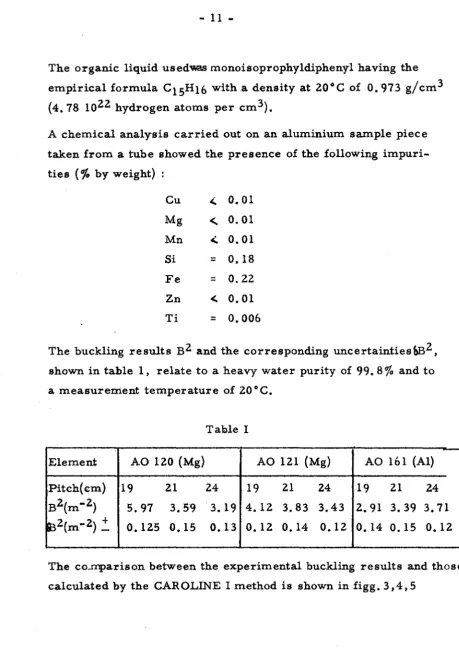
0.006The buckling results B2 and the corresponding uncertaintiesf)BZ,
shown in table 1, relate to a heavy water purity of 99. 8% and to
a measurement temperature of 20 ° C.
Table I
Element AO 120 {Mg) AO 121 {Mg) AO 161 (Al)
Pitch{cm) 19 2.1 24 19 21 24 19 21 24 B2 (m-Z.)
5.97
3.59 3.19 4.12 3.83 3. 43 2.91 3.39 3.71a32(m-2) ~ 0.125 0.15 0.13 0.12 0.14 0.12 0.14 0.15 0.12
The co..mparison between the experimental buck.ling results and those
[image:18.584.69.529.58.722.2]lZ
-lY. ORGEL EXPERIMENTAL PHYSICS PROGRAM
Measurements of the effective resonance capture integral and of the fine structure of the flux in ORGEL type fuel elements will be performed by the Neutron Physics Service, C. C.R.
Euratom, lspra, Italy, within the framework of the experi-mental program related to ORGEL lattice physics.
1. Effective resonance capture integral
The fuel element investigated is of the EGO type, and con-sists of an hexagonal array of 19 natural uranium metal rods, 1. 2 mm dia. , contained in an aluminum tube filled with organic liquid. Two geometries ( corresponding to rod
spacing~ of zero and 1 mm., respectively) and two organic liquids (diphyl and monoisopropyldiphenyl) will be tested. The measurement will be performed by the activation tech-nique, using gold as the standard. The irradiation facility selected is the Ispra-I reactor at the Euratom Center of Ispra (a 5 MW, 90% enriched uranium, CP-5 type reactor). Experimental work should start during the second semester 1962.
2.
Fine structure measurement The fuel elements investigated are.. 13
-B. ECO elements, with the same geometries and organic liquids
as above.
The measurement will be performed by activation of dysprosium
detectoi's placed in the fuel and in the organic. The irradiation
will be carried out in the Aquilon II facility, CEN, Saclay, France
(a natural uranium, heavy-water moderated critical assembly),
replacing the central portion of the reference lattice with the
lat-tice under consideration. Experimen~l work should start during
14
-V. ORGEL CRITICAL EXPERIMENT (EGO)
ECO is a critical experiment conceived especially for buckling measurements by substitution method.
Its purpose is essentially the study of heavy water moderated and organic cooled lattices, the fuel is metallic uranium, ura-nium oxide or carbide.
Anyhow, according to the Commission• s wishes, ECO may be used for buckling measurements on lattices using cooling fluids other than organic liquids.
Schematically EGO consists of an aluminium tank which can hold 20 t of heavy water and which lays on a 90 cm thick lower graphite reflector. Radially the tank is surrounded by a thermal insulator and a 90 cm reflector. The upper end of the fuel ele .. ments plunged in heavy water, hang on an automatic mechanism which allows a continual pitch variation of the lattice between
170 and 300 mm. The assembly is closed in a light concrete biological shielding having 1, 70 m thickness; this allows expe .. riments up to 1 KW power.
The ECO control is performed by the heavy water level adjust-ment (by means of pumps of different speeds and by means of a set of dosing vessels), as well as by a set of two vertical regu-lating plates sliding between the tank and the reflector and two horizontal regulating plates circulating in the lower reflector under the reactor tank.
.. 15
-Besides the a:utomatic lattice pitch drive we mentioned before, there
is the possibility of using the reactor as a bare pile by means of the
introduction of a boral skirt between tank and side reflector. The tern ..
perature coefficient measurements are made easier by the possibility
of adjusting in a continuou$ way the moderator temperature between
10 and
so•c,
whilst the coolant temperature of the 25 central fuelelements, forming the substitution lattice, may be controled between
a low value corresponding to the moderators temperature and a high
value of approximately 300°C.
A swinging channel being abl~ to move inside the reactor b~tween the
lattice fuel elements allows the extraction of a neutron beam from
the center of the reactor; this is intended for spectrum
measure-ments by the time-of-flight-method.
An accelerator moving under the reactor shielding can send its beam on a target placed in the mid of the reactor.
A 10 m long axial channel crossing the react or axially from bottom
to top allows the oscillation of two fuel elements linked end to end.
In order to compare the irradiated or synthetic fuel to the unirradia-ted fuel a large number of experimental accessories is presently
being studied to allow the physicists to obtain as much information
as possible from this critical experiment; let us mention for instance
the facilities allowing the periodical variation of organic liquid
ap-pearent densit, in. the clusters and allowing oscillation of certain
cluster elements, some pre-set automatic counting units, a
gene-ralized set for the processing of critical experiments data, some
samples oscillators for cross section measurements, a source jerk
facility for pulsed studies, a semi-hot cell for dismantling the
lightly or moderately irradiated fuel elements, some sets of
minia-ture drills and of activable detectors allowing flux mapping by
.. 16 ..
Progress Report
The building was studied by the Architecture Office of the G. G. R. - Ispra and an Italian firm is in charge of its reali-zation. The contract has been signed on the 8th May 1962, but works already started in March and the foundations are now achieved.
At this moment the underfoundations of the real reactor bloc are being built.
A Dutch firm has been charged by a contract signed on Decem-ber 15th, 1961 of the reactor engineering, the preliminary design of whi eh had been executed at the Reactor Physics Department. The construction of the reactor itself will start practically against the end of May 1962.
Buildings should be achieved at the e:nd of 1962 and the reactor circuits will be in a position to work wit 1i. light water against May 1963, whilst the official divergence would take place at the 1st of July, 1963.
Nearby the EGO building, another building is simultaneously being constructed; it will contain laboratories for the groups assuring EGO operation and maintenance.
17
-The :reflector's graphite is delivered by a French firm and its
nuclear control is made by CEA.
The Reactor Physics Department is now studying the transport
and handling problems of the heavy water for the critical
expe-riment and the Brussel' s Free University is presently
per-forming an hydraulic test on 'lull size mock-up in order to
study the influence of the hydraulic circuits of the react or on
the thermal homogeneousness and moderator disturbance.
The oscillation mechanis·m of fuel ele.ments in the axial channel
works already as a reduced scale mock-up; the accelerator, a
1 Mev Van de Graaf, has been ordered and should be delivered
at Ispra at the end of 1962.
The remaining accessories are presently being studied or
- 18 ...
VI. ESSOR PHYSICS CALCULATIONS
The work made for the ESSOR reactor may be divided into two parts.
In the first part we performed the neutronic study of a variant of the reactor. Namely, we studied a reactor in which the ORGEL channels were arranged on a circular ring and inside there were the feeding fuel elements; therefore an arrange-ment exactly opposite to the primitive one. The aim of this change 'Was to reduce the power produced in the feeding zone and to increase the uniformity of the irradiation of the ORGEL channels. The main results of this study are reported in
"Dossier de comparaison ESSOR 11 written by G. A. A. A. and
INTERATOM in order to compare the two variants.
In the second part we studied the way of flattening the axial distribution of the neutron thermal flux in the ORGEL fuel elements in order to satisfy the following condition : the difference between the flux values a~ the centre and each ex-tremity of a ?Ortion of fuel element 700 mm long cut into halves by the horizontal plane of symmetry of the core, must be smaller than 10
% •
300
200
-.. - --'
1 _
100
200
300
400
r
c·c
::t±i: -~
-:\1 · :!:_fi} TJ
---H---t l
J :r +;-+r
1"
+.
H
. ~
-t+-p:'2T ·.;:+
,++ 04:1.r i- +rt
,; m~
r
' C'n
iH"i~
th-_ m
=ruVIII. REFERENCES
I. G. Casini, W. De Haan, E. Diana, C. Foggi, A. Kind, G. Rossi
-Caroline I , une methode de calcul pour les reseaux eau lourde-organique non irradieS.
EUR/C-IS/608/62 £.
2. Go Rossi - ORGEL lattice calculatio;.1s and two thermal group dif-fusion model.
EUR/C-IS/2147/61 e.
3. G. Casini, J. Pillon - Poids statistique pour le calcul de l'effet sur la reactivite du Xenon
a
l'equilibre-EUR/C-IS/830/62 f.
4. G. Blaesser , G. Casini, J. Pillon - Variation de la reactivite
a
long terme pour differents types de circulation du combustibleEUR/C-IS/784/ 61 f.
5. A. Kind, G. Rossi - A simplified model for the determination of the thermal neutron spectrum in a fuel element
-EUR/C-IS/870/62 f.
6. G. Casini, B. :Uorpem.a - Programme RLT 2 (22/5053/553)
-EUR/C-IS/586/62 f.
7. N. B. McLeod et al. - The effect of fuel a:rid poison management on nuclear power system - NYO - 9715
8. G. Casini, C. Foggi, F. Toselli - Critical experiments on natural uranium oxide, organic cooled, heavy water lattices
-to be published in "Energia Nucleare Milano - Italy
9. E. Diana - Sur une methode pour aplatir le flux neutronique axial dan s le reacteur ESSOR - EUR/C-IS/798/62 f.
10. H. Wundt - Dynamic behaviour of an ORGEL type pressure tube reactor - 1st edition
-EUR/C-IS/1696/61 e.
11. H. Wundt - Dynami.c behaviour of an ORGEL type pressure tube
reactor - 2nd edition -EUR/C..;IS/562/62 e.
12. H. Wundt - Some prattical remarks on the analogue treatment of reactor kinetics with delayed neutrons
13. E. Vincenti, P. Barbaste - Calcul du nombre des barres de contrile, premiere estimation
-EUR/C-IS/2320/61 f.
14.
E. Vincenti, P. Barbaste, M. Schuster - Calcul des barres de contrGleEUR/C-IS/4:74/62 f.
15. V. Raievski - The ECO reactor - IAEA Symposium on the
program-ming and utilisation of research reactors - October 16-21 , 1961 -Vienne
16. P. Bonnaure - Specifications pour Petude et la construction de
1' experience critique Orgel (ECO); EUR/C-iS/1519/61 f.
17. Aranovitch - Experience hydraulique ECO - Projet de contrat
18. R. Nicks, C. Pleinevaux, C. Rinaldini - Etude du blindage de !'experience critique Orgel
-19.
20.
EUR/C-IS/732/61 f.
1· F. Toselli - Differents methodes de mesure de f, p et
t
applicables dans la pile ECO.EUR/C-IS/156/62 f.
G. Casini, R. Cenerini, F. Toselli - Choix de I' element de combustible du reseau de reference de !'experience critique Orgel.(ECO).
EUR/C-IS/2245/61 f.
21. Mesures, sur le rea.cteur ECO, de Itevolution des proprietes neutroniques des resea.ux Orgel en fonction de !'irradiation par la methode d1oscillation.
lere pa.rtie: lllus.tration de la methode - Etude de la cinetique du rea.cteur ECO. R. Arb.an , R. Cenerini, F. Sciuto EUR./C-lS/293/62 f.
2eme partie: Mecanisme d1oscillation - Avant projet - R. Arhan,
J. Elbaz.