MALAYSIAN ICT COMPREHENSIVE COMPETENCY
STANDARDS FOR TEACHERS
1AZIDAH ABU ZIDEN, 2FONG SOON FOOK, 3GERARD BOEY KONG HOONG, 4
MUHAMMAD FAIZAL ABDUL RAHMAN
1
Associate Professor, School of Educational Studies, Universiti Sains Malaysia, Malaysia 2
Professor, Faculty of Humanities, Arts and Heritage, Universiti Malaysia Sabah, 3
Head of Department. American Degree Program, HELP University, Malaysia
4
Information Technology Officer, INSTUN, Malaysia
E-mail: [email protected], [email protected], [email protected], 4
ABSTRACT
While technology has been recognise as having tremendous potential to enhance learning across all disciplines, there are queries on how teachers in Malaysia are able to optimize and inculcate critical and creative thinking skills by using technology to support teaching and learning. Despite of huge investment in Information and Communication Technology (ICT) over the past decade in various education initiatives, the potential of technology usage in Malaysian schools have not reached the desired outcomes among teachers and students. The study has explored the possible missing link for the realization of the expected return-of-investment by establishing a Malaysian competency standard to review and regulate ICT-related training curriculum. This study proposed to design and develop the Educational Technology Competency Standards for 21st Century Malaysian Teachers by using the modified Delphi technique. Education technology experts from local and foreign universities as well as practitioners of ICT in local schools, colleges and universities formed the Delphi expert panel. Using an initial draft version of the standard developed through literature review, document analysis and expert roundtable discussion, the experts went through an iterative cycle of review, compare, amend and comment until the expert group’s responses achieve consistency for each of the competency elements. The consistent and valid responses for each of the competency elements that achieve consensus then formed a reliable final all-encompassing ICT competency standard for the teaching profession in Malaysia. It is with this ICT competency standard that teacher training programmes can be adequately designed and developed to train teachers to achieve the desired ICT competency standard in compliance with the Malaysia National Education Blueprint 2013 – 2025.
Keywords: ICT Competency standard; Modified Delphi Technique, Teachers, Teaching Profession, 21st Century Skills
1. INTRODUCTION
Since the advent of the personal computer in the early 1980s, the progress and development of Information and Communication Technology (ICT) have increased by leaps and bounds. ICT applications have affected how societies and economies around the world thrive in the 21st century and has become a pervasive tool used by society for play, work, communication and collaboration. It has become so indispensable that the public and private sectors depend on it to conduct the daily business activities. Visionaries foresee that the workforces of the future will need
ISSN: 1992-8645 www.jatit.org E-ISSN: 1817-3195
In the case of Malaysia, since the 90s the ICT had slowly creep into education, for instant in 1992 the Ministry of Education, Malaysia introduced the “Computers in Education” programme [2], where computer labs were set up in sixty secondary schools throughout Peninsular Malaysia. This initiative was the beginning of ICT in schools where labs were equipped with networked computers running basic software applications. The introduction of computer labs at that time started a cascading effect of ICT initiatives for education and culminated with the introduction of Smart School Concept which was one of the seven flagship applications of the Multimedia Super Corridor in late 1996. The Smart Schools Concept had all the ingredients needed to develop the next generation of ICT literate workforce that would possess creative and innovative traits. With this, it is hoped that the next generation will a make a quantum leap that could propel the country into a developed nation by 2020. In meeting this not too distant aspiration, billions were invested on ICT for education and amounted close to RM6 billion since 1999 and up to 2010 [3].
Although huge amounts of financial resources and many man-hours spent on ICT in education, this endeavour did not elevate teaching and learning in schools to new heights. Somehow, along the way, teachers reverted to old ways and ICT was hardly integrated into teaching and learning of core subjects. Although teachers were given initial training, there was evidence to indicate insufficiently and unsustainable training plans for teachers. Research conducted by [4] found training gaps that were not sustainable to provide the momentum for change and recommended teachers should “… be continuously trained in the use of technology for the purpose of teaching and learning” and therefore professional development and lifelong learning are crucial elements to continuously support teachers’ ICT knowledge and skills upgrade. Furthermore, as technology has the characteristics to progress with quantum leaps of improvement over short periods, this thus justify the recommendation by [4]. Hence, the need for continuous professional development to ensure teachers’ ICT competency are in alignment with ICT trends in education is crucial for sustainability.
In order to ensure that all teachers have reached such levels of ICT competency covering knowledge, skills, abilities, and attitudes in Malaysia, it is, therefore, imperative to establish a
national ICT competency standard that is aligned to the Malaysia National Education Blueprint 2013 – 2025. With the competency standards established it would elevate the overall quality of education, narrow teacher’s ICT competency gaps and improve in-service teacher training programmes that are aligned with competency standards (Ch’ng, 2010). The rationale of the study is to serve as a guideline for Malaysian educational institutions such as schools and polytechnics teachers to evaluate the competency of their teachers’ ICT in order to facilitate new ways of teaching and learning in the 21st Century. The standards will also be used to accreditate more than 450,00 teachers in Malaysia. The Educational Technology Competency Standards could be shared to developing bottom billion nations (eg Laos, Myanmar, Cambodia, African nations etc.)
On the other hand, the establishment the ICT standard for teachers, will ensure that in-service teachers are capable of integrating ICT in teaching and learning, produce students that are capable of meeting the needs of the 21st century workplace and help teachers to achieve the desired ICT competency standard in compliance with the Malaysia National Education Blueprint 2013 – 2025. Hence, the research tried to answer these
research questions:
• What are the important main categories of educational technology competencies for Malaysian teachers across all disciplines based on the
consensus of panel experts?
• What are the important competency indicators of educational technology competencies for Malaysian teachers across all disciplines based on
the consensus of panel experts?
• What are the important items to determine the criteria for assessment of ICT competencies among Malaysian teachers based on the consensus of panel experts?
2. RESEARCH DESIGN
used to solicit the Delphi expert panel’s opinions before an instrument can be drafted. In the case of this research, the modified Delphi technique was employed and qualitative documents analysis of literature was conducted to build a draft instrument prior to the Delphi iteration. ICT competency standards established by organisation such as UNESCO and ISTE, and those found in Australia, Europe and Asia as well as related literature on Malaysia education policies, future direction and focus were also included in the reviewed.
[6] describes the Deplhi technique as providing opportunities for experts to communicate their opinions and knowledge anonymously about a complex problem, to see how their evaluation of the issue aligns with others, and to change their opinions, if desired, after reconsideration of the findings of the group’s work (p. 504). [7], further explained that the Delphi technique goes through a multi-stage survey process, where feedback of group opinion is provided after each round. By performing the iteration process, the technique assumes that the range of responses will narrow down and achieve consistency and thereafter determine if consensus is achieved. This would also determine the validity of the content through an iterative process of rate and review until a consensus is achieved. The diverse group in Delphi evaluated the proposed competency standards to make sure that all the items are suitable to be included in the standard. When consensus is achieved, the result can be used to formulate expert opinions and suggestions for decision making, forecasting or proposal implementation. [8] suggested that, while there are many variations of the Delphi technique and their applications, there are four distinct characteristics which are: anonymity; iteration; Controlled feedback and statistical “group response”.
D es ig n in g
Preparing initial draft (main category, competency indicator
and items) ←
• Analysis of overseas ICT competenc y standard guidelines • Document analysis • Literature
Review • Explorator
y Interview • Workshop •Pilot study ↓
Validating the draft of the competency standards in a roundtable discussion.
↓ Developing Round 1
questionnaire V al id at in g ↓
Formation of Delphi expert panel
↓
Carry out the Delphi technique for 3 Rounds
↓
Analysing data and designing standards and competency criteria
D ev el o p in g ↓
Obtaining the content and construct validity from the
experts of educational technology
↓ ↓
Educational Technology Competency Standards for 21st
Century Malaysian Teachers Determinin g the criteria for the assessment of Educational Technology Competenc y Standards for 21st Century Malaysian Teachers Im p li ca ti o
n ↓ ↓
Curriculum & Developing the Modules of ICT
training
Competenc y-Based Assessment
[image:3.612.306.527.101.532.2]System
Figure 1. Research Design of Developing ICT Competency Standards, Adapted from [9]
ISSN: 1992-8645 www.jatit.org E-ISSN: 1817-3195 teachers respectively. Studies conducted by [13]
used the Delphi technique to develop mobile learning curriculum. The aptness of the modified Delphi technique in gaining consensus among experts and its proven application in education was the reason why it was chosen to develop the Educational Technology Competency Standards for 21st Century Malaysian Teachers. The outcome of the research was a competency standard that is relevant, comprehensive and strongly agreed by a group of expert who have similar interest and expertise within the context of Malaysian education and aligned to the Malaysia National Education Blueprint 2013 – 2025.
3. DETERMINING THE MAIN
COMPETENCY CATEGORIES,
INDICATORS AND ITEMS
The development of the Educational Technology Competency Standards for 21st Century Malaysian Teachers is based on existing standard structure in practice and developed by UNESCO and ISTE. The standard generic structure as shown in Figure 2, consists of a competency category followed by indicators and items. The level starts by defining a category name and summary description that reflects the overall essence of the said category. In each of the category, there will be indicators which specify what a teacher should be able to do. In addition, in each indicator, there will be items that describe specific measurable competencies that teachers are to achieve in order to meet the standards.
3.1 Document Analysis and Formulating the Main Competency Categories and Indicators
The main competency categories and indicators of the proposed Educational Technology Competency Standards for 21st Century Malaysian Teachers were developed based on literature review of various existing standards. In the initial stage, document and comparative data analysis of various ICT Competency Standards for Teachers around the world were analysed. The 12 standards analysed were UNESCO Ver 1.0, UNESCO Ver 2.0, ISTE’s NETS 1997, ISTE’s NETS 2000, ISTE’s NETS 2008 ISTE Standards•T, USM 2010, CETS China Educational Technology Standards 2004, National ICT Competency Standard for Teachers Philippines, ICT Skill Standard for Teachers of the Republic of Korea, Australia Teacher Competency Standards, ECDL / ICDL for Teachers and EPICT Competence Framework. The conclusion of this
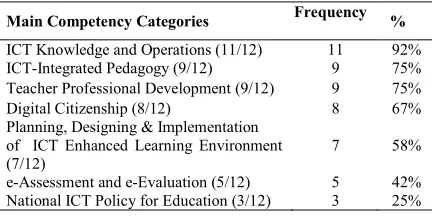
[image:4.612.310.526.237.345.2]initial study (refer to Table 1) indicates the dominant categories (most appeared) were ICT Knowledge and Operations, ICT-Integrated Pedagogy, Teacher Professional Development and Digital Citizenship, followed by Planning, Designing & Implementation of ICT Enhanced Learning Environment. The least appeared categories were e-Assessment and e-Evaluation and National ICT Policy for Education.
Table 1 Rank Order of Most Frequent Main Competency Category
In supporting the main categories and indicators derived from the analysis of the 12 standards, a review of local literature further indicated that the initial main categories together with the indicators should be included in the Delphi study. It is with confidence that the first three main categories, ICT Knowledge and Operations, ICT-Integrated Pedagogy and Teacher Professional Development are important main categories.
Research findings on teacher utilisation of ICT in schools were low and according to [3]), “… the ministry found out that 80% of teachers spend less than one hour a week using ICT. Only a third of students perceive their teachers to be using ICT regularly.” According to UNESCO in [3], findings “even when ICT is used in teaching, in most cases it has not gone much beyond the use of PowerPoint as an instructional tool”. The findings indicate the lack of usage of ICT in education and teacher’s skill and know-how on ICT Knowledge and Operations have not reached the competency required and therefore teachers are not motivated to use them in class.
UNESCO in [3], findings further mentioned: “There is no evidence that ICT is being used to foster students’ creativity, problem-solving, and critical thinking and communication skills.” Besides the lack of skill and know-how on ICT Knowledge and Operations, teachers had very little idea on how to integrate ICT in education. The fact that the [3] had to announce in the Malaysia
Main Competency Categories Frequency %
ICT Knowledge and Operations (11/12) 11 92% ICT-Integrated Pedagogy (9/12) 9 75% Teacher Professional Development (9/12) 9 75% Digital Citizenship (8/12) 8 67% Planning, Designing & Implementation
of ICT Enhanced Learning Environment (7/12)
7 58%
Education Blueprint 2013-2025, under the topic of ICT for Education (pp 6-20) that teacher will be taught to “… embed ICT in teaching and learning in order to support student learning”. This confirms that teachers not only lack ICT Knowledge and Operations but also ICT-Integrated Pedagogy. Therefore, training development for pre-service and in-service teacher is a priority and under the Teacher Career Package announced in the blueprint, the following enhancement and initiatives for teachers will take place:-
1. Continuous Professional Development (CPD) Masterplan to provide tailored support to each teacher.
2. New standards for CPD, new entry standards and monitoring mechanism for recruitment of new teachers, and career-long support and evaluation of teachers.
The declaration of new standards for CPD is a clear indication that there ought to be a national teacher standard which includes ICT competency as one of the important milestones to achieve. In the Malaysia Education Blueprint 2013-2025 [3],“Ethics and Spirituality” is one of the six student aspirations to be achieved by students in their education endeavour. In the area of ethics in the 21st century, the practice of ethics goes beyond traditional forms and norms of interactions. Socialising, communication and collaboration using ICT has become the norm in today’s Internet age, therefore the teaching of ethics has to be extended to cover digital citizenship where students learn the right social and ethical behaviour when they are online.
The ICT for Education roadmap in the Malaysia Education Blueprint 2013-2025 [3], further confirmed the support and commitment to providing the necessary incentives and platform for Planning, Designing & Implementation of ICT Enhanced Learning Environment.
The roadmap will provide:-
1. Students with the skills and knowledge to learn effectively and live productively in an increasingly global and digital world.
2. All 10,000 national schools with 4G Internet access and a virtual learning platform that can be used by teachers, students, and parents through the 1BestariNet programme.
3. Training to all teachers to embed ICT in teaching and learning in order to support student learning.
4. Increase numbers of ICT devices until the student-to-device ratio reaches 10:1.
5. ICT innovations for delivery such as distance-learning and self-paced distance-learning before scaling up nationwide.
3.2 Peer Debriefing through Exploratory Interview
The results of the main categories and indicators were also reviewed by a group consisting of five individuals selected based on the expertise in education technology as well as practitioners of ICT in education to verify the proposed first draft of the main competency categories and indicators. Exploratory interview in the form of peer debriefing with each of the individuals help refined the main categories and indicators before competency items were included. The outcome of the literature review, analysis of main categories from other existing standards and exploratory interviews established the seven categories and their indicators that provided the focus and direction to steer the research forward.
3.3 Establishing the Competency Items
After establishing the refined draft of the main categories and indicators by expert third parties, the research continued to develop the competency items for each of the indicators. By reviewing literature of existing ICT competency standards, it provided the way in crafting the competency items. The outline competency items reflected the respective competency indicators and provided the instrument to measure teachers’ achievement of ICT competencies. At this stage, the completed draft standard was ready for further cross-examination and validation in a roundtable discussion.
3.4 Roundtable Discussion Meeting - Enhancing the Proposed Initial Draft
ISSN: 1992-8645 www.jatit.org E-ISSN: 1817-3195
The result of this roundtable discussion was an enhanced and validated revision of the Educational Technology Competency Standards for 21st Century Malaysian Teachers. The output was then ready to develop into a comprehensive questionnaire for the Delphi Round 1. Unlike the initial stages employing qualitative method to develop the draft competency, the next stage will employ a more rigorous scientific method to verify the draft through a cycle of rating and reviewing until responses between cycles are consistent. This consistency in responses ensures the results are reliable and the consensus achieved are credible and dependable.
3. FORMING THE DELPHI EXPERT PANEL AND DETERMINING THE GROUP SIZE
Determine the right group is crucial in establishing the final competency standard. Therefore, according to [14] the members of the Delphi panel should meet four conditions as stated below :-
1. Possess extensive knowledge and experience in the research problem,
2. Are committed to involve,
3. Have spare time to participate in the research process of the Delphi technique, 4. Possess effective communication skills.
Another interesting point on selecting the Delphi expert panel by different personnel from various levels in the job hierarchy should be included. According to [15] “(1) the top management decision makers who will utilize the outcomes of the Delphi study; (2) the professional staff members together with their support team; and (3) the respondents to the Delphi questionnaire whose judgments are being sought” (p. 85). This ensures that each level is represented and whose opinions taken into consideration when developing the outcomes.
The ideas and suggestions above provided a clear direction on selecting the Delphi expert members for this research. By considering the suggestions, the Delphi study included personnel from different levels such as department heads, professors, senior lecturers and teachers. Experts in education technology and practitioners of ICT in education from schools, colleges and universities were selected.
In order to ensure the results of the research are valid and reliable the sample size and criteria for selecting the right respondents to form the Delphi expert panel are important. Literature review indicated that a typical Delphi sample size may range from 10 to 30 participants [16] and furthermore according to [17]“... the group size does not depend on statistical power, but rather on group dynamics for arriving at consensus among expert … literature recommends 10 to 18 experts on a Delphi panel”.
Therefore the key to forming a Delphi expert panel for this research relies heavily on getting the right respondents who are experts in education particularly those with expertise in education technology and as well as practitioners of ICT in education. As long as the composition of respondents has the expertise and knowledge, the Delphi iterations will lead to consensus, thus the research decided to have a sample size in the region of 10 to 30 participants.
4. PROCEDURE OF THE MODIFIED DELPHI TECHNIQUE
After the formation of the Delphi expert panel, Round 1 started and each of the members selected was contacted through email and invited to participate as a member of the expert panel. An invitation and appointment letter was sent via email to each of the members. Of the 33 selected expert members, only 23 responded and participated in the exercise. In order to achieve good response from the selected Delphi expert panel in Round 1, the members have the option to answer the questionnaire either online through SurveyMonkey or a questionnaire prepared using Microsoft Word which was attached in the invitation email. In this case, majority of the respondents used SurveyMonkey and data collection was automated as the inputs were compiled automatically. The Delphi expert panel was given a week to reply the questionnaire, and majority of the panel members did reply except for a few. An email reminder was sent to them and a week later 23 participants responded in Round 1.
proposed in Round 1. This information was then used to build the Round 2 questionnaire. In Round 2, the questionnaire was prepared in Microsoft Word. The computed group median, majority range for each of the competency categories, indicators and items were indicated together with the individual’s response from the previous round. The comments from Round 1 and new competency indicators and items proposed were included in the questionnaire for members to respond. When the questionnaire was ready and verified, Round 2 of the Delphi iteration began with an invitation letter to the members and given one week to respond and 17 members returned the questionnaire. As a follow up to those who have not responded an email reminder and after a follow-up appeal letter, they replied and agreed to retain their results from Round 1 and did not response to the new competency indicators and items proposed in Round 1. Therefore, the new competency indicators and items will be computed and prepared in Round 3 for only 17 members who have responded to Round 2.
The data collected from the questionnaire in Round 2 was computed for the median, 1st Quartile, 3rd Quartile and Inter Quartile using Microsoft Excel. The Wilcoxon Match-paired Signed-rank test was conducted for all the competency categories, indicators and items between Round 1 and Round 2 by using Statistical Package for Social Sciences (SPSS). The results of the test showed that the responses for 2 competency indicators and 1 item did not meet the consistency and stability criteria. Therefore, the 2 competency indicators and 1 item were included in the Round 3 questionnaire together with the new competency indicators and items proposed by the panel in Round 1. Qualitative data analysis was also conducted on the responses by the Delphi expert panel from Round 2.
In Round 3, five competency indicators and two items were used to develop the questionnaire. The questionnaire was then sent to the Delphi expert members for response and 17 members responded to all the questions posted and 6 members who retained their Round 2 responses we excluded from the new competency indicators and items proposed by the panel in Round 1. However, they have decided to retain their responses in Round 3 for two competency indicators and one item from the earlier round.
The data collected from the questionnaire in Round 3 was computed for the median, 1st Quartile, 3rd Quartile and Inter Quartile using Microsoft Excel. The Wilcoxon Match-paired Signed-rank test showed consistency and stability for the responses between Round 2 and Round 3. All the competency categories, indicators and items reached consensus as well and this concluded the Delphi iteration [16].
5. DATA ANALYSIS
The quantitative data analysis used in the Delphi iterations to determine expert consensus and the number of iterations are important criteria of the Delphi technique. Reliable and valid statistical methods should be used to ensure the outcomes of the research are credible. According to [7]“… it is important to distinguish between the two different concepts ‘consensus/agreement and stability’ …” in Delphi studies. In many Delphi studies, it is common practice to stop the survey procedure after a number of agreed iterations and achieving level of consensus [7] Furthermore, [18] commented that if responses between rounds were not stable or consistent, it would be meaningless even if consensus were achieved.
As in any Delphi study, the responses from the members in successive rounds are actually dependent samples as in the before-and-after experiments [7] therefore the responses are from the same people answering the same set of questions from the previous round. In the case of this research, the Wilcoxon Matched-pairs Signed-ranks test (ordinal scales for responses that were nonparametric) was used to test for consistency and stability. Similar past research on developing competency standards in Malaysia [11;13;12;9] also adopted the Wilcoxon Matched-pairs Signed-ranks test to determine consistency and stability between rounds. When consistency and stability of responses between rounds are achieved, the Delphi iteration will end. The next step is to determine the level of consensus which can either be High, Average or No consensus for each of the main competency category, indicator and item. The quantitative definition to define the level of consensus is based on the value of Quartile Deviation (QD) and the formula is (1):
ISSN: 1992-8645 www.jatit.org E-ISSN: 1817-3195 Q1 = 1st Quartile (1)
In past research conducted by [11] and [12] the level of consensus and level of importance were used to determine if the main competency categories, indicators and items would be adopted as a standard. Table 2 shows the combined criteria (Quartile Deviation & Median) to determine the adoption as a standard for each of the main competency category, indicator and item.
Table 2. Criteria for Standards Adoption of Main Categories, Indicators and Items:
Adapted from Norizan (2003) and Ch’ng (2010)
6. RELIABILITY AND CONSISTENCY
As this research is based on the exploratory mixed method design or better known as the QUAL-Quan Model. The opening qualitative study of the research was an extensive study of existing literature, exploratory interview with experts and roundtable discussion among experts to produce the initial draft of the Educational Technology Competency Standards for 21st Century Malaysian Teachers. The finalised initial draft standard was further corroborated and its validity enhanced by the quantitative results and findings produced during the Delphi iteration process.
In establishing the trustworthiness of the initial draft construct which consisted of competency categories and indicators during the opening qualitative study, the research procedure used the exploratory interview to assess the findings of the initial draft using the peer debriefing method [19]. The initial draft was presented to a group of education technology experts as well as practitioners of ICT in education for critical comments and feedback. This ensures that expert
third party perspectivse were taken into consideration before the next step of building the competency items for each of the competency indicators. Another peer debriefing was also conducted in a roundtable discussion when the full draft was completed.
During the Delphi iteration phase, the stability of responses between rounds confirmed through Wilcoxon Match-pairs Signed-ranks test as suggested by [13] establishes consistency of the Delphi expert panel’s responses between rounds. The consistency indicator provides a measure of reliability before the level of consensus are interpreted (through the value of quartile deviation which measures the variability). As cited by [9] and supported by Young, “… that researcher can evaluate the consensus obtained in Round 1 and Round 2 to present to the panel as a measurement of reliability”. Furthermore, through various levels of rigorous examination to obtain validation for the content validity and construct validity, the research procedure, therefore, has achieved the rigour required of a research through valid and reliable research methodology. The overall reliability of the final standard can further be established as the results produced were concluded by education technology experts as well as supported by the appropriate perspectives of local teaching profession from universities, colleges and schools in Malaysia.
7. RESULTS AND DISCUSSION
As shown in Table 3a, all the main categories and indicators that were proposed in the initial draft before the Delphi iteration received high level of consensus and importance. The results indicate that all the seven main categories and indicators were qualified to be accepted to form the ICT competency standard. Further analysis noted that the main category that achieved the highest consensus based on QD value is Cat2: e-Assessment and e-Evaluation (4 indicators) with QD=0.00 followed by Cat4: ICT Knowledge and Operations (3 indicators) with QD=0.25 and both achieved high level of importance with a median value of 4. Comparing the results to Table 1, the Cat2: e-Assessment and e-Evaluation which was less frequently found in the 12 standards that were analysed is unanimously agreed by the Delphi expert panel and deem relevant in the context of education in Malaysia. The Delphi panel expert also highly agreed with Cat4: ICT Knowledge and Operations as an accepted competency category
Median (M)
Level of Importance
Quartile Deviation
(QD)
Level of Consensus
Adopt Competency
M ≥ 4 High QD ≤
0.50 High Yes
M ≥ 4 High
0.50 < QD ≤ 1.00
Average No
M ≥ 4 High QD >
1.00 No No
M ≤ 3.9 Average or Low
QD ≤
0.50 High No
M ≤ 3.9 Average or Low
0.50 < QD ≤ 1.00
Average No
M ≤ 3.9 Average or Low
QD >
[image:8.612.78.306.260.418.2]which is commonly found in various ICT competency standards that the research initially found during the literature review. Thus, confirms Cat4’s aptness to be included too in the ICT competency standard.
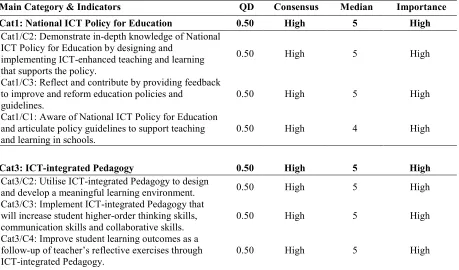
As shown in Table 3b, the Cat1: National ICT Policy for Education (3 indicators), Cat3: ICT-integrated Pedagogy, Cat5: Planning (4 indicators), Designing & Implementation of ICT Enhanced Learning Environment (3 indicators) and Cat7: Teacher Professional Development (2 indicators) achieve similar results for level of consensus and importance. All the categories were accepted to form the ICT competency standards as these main categories achieved high consensus with QD=0.50 and higher median value at 5. It is interesting to take note that Cat1: National ICT Policy for Education has received strong agreement in the Malaysia education context even though initial literature review showed that this main category does not appear to be a common category in the various ICT competency standards that was studied.
The acceptance of Cat3: ICT-integrated Pedagogy, Cat5: Planning, Designing & Implementation of ICT Enhanced Learning Environment and Cat7: Teacher Professional Development into the ICT competency standard by the Delphi study is aligned with the Malaysia Education Blueprint 2013-2025. As mentioned by UNESCO in [3] that lack of using ICT to foster students’ creativity, problem-solving, and critical thinking and communication skills justify the need for Cat3: ICT-integrated Pedagogy. Teachers should be equipped with the knowledge and know-how to integrate ICT in education to elicit 21st century soft skills among students. Furthermore, better learning environment to meet the digital needs of students [3] requires teachers to have the competency to plan, design and implement ICT enhanced learning environment, thus justify Cat5: Planning, Designing & Implementation of ICT Enhanced Learning Environment. Finally, the inclusion of Cat7: Teacher Professional Development is crucial for teachers to possess an attitude for continuous improvement to make a paradigm shift in order to “Learn, Unlearn and Relearn” as quoted by Alvin Toffler.
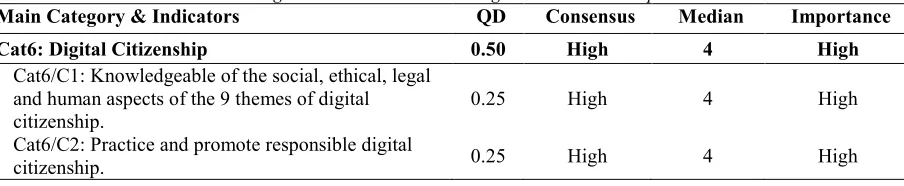
As shown in Table 3c, Cat6: Digital Citizenship (2 indicators) was also accepted into the ICT competency standard as it achieve high level of consensus with QD=0.50 and high importance. Among all the main categories, it has the least
favourable combination of QD=0.50 and median value of 4 when compared to the rest of the main categories. One recent finding on Cyber Maturity in the Asia–Pacific Region by ASPI (2014) mentioned that “… online environment is also rapidly growing in importance as an avenue for political and social expression in Asian societies”. With respect to this statement, Digital Citizenship has a major role for all Malaysian and behaving appropriately online has its place in today’s digital world. According to the report, cyber awareness rating for Malaysia is average with a score of 57.9 when compared to developed nations such as Australia (75.8), Japan (75.3), Singapore (74.7), South Korea (75.5), United Kingdom (81.2) and USA (86.3). It is therefore appropriate and timely, for teacher to have this competency to ensure cyber awareness reaches the masses through education.
8. LIMITATIONS
Although this study has selected people who are considered experts in the area, the major limitation of the Delphi method is that it typically involves gathering experts in a field and asking them about potential developments in their field. It is important to highlight that the assumptions that the experts have wide and in-depth knowledge in the area might not be precise as expertise in one field doesn't carry over into another. So, the term ‘experts’ in the area of study may vary and of when something may or may not happen without also including people with knowledge of other areas may be problematic.
The other limitation is majority of the members of Delphi expert panel in this study were from the northern region of West Malaysia and may not be representative of all experts in Malaysia. The extended length of interval between iterations may have caused the number of participants to reduce in Round 2 and Round 3. Thus, the results of new items proposed in Round 1 may be affected. As such, the results of this study cannot be generalised among teachers in other nations as the majority of participants were Malaysian.
9. CONCLUSION
ISSN: 1992-8645 www.jatit.org E-ISSN: 1817-3195 2013 – 2025. The concluded results of the research
are relevant competency statements made up of main categories, indicators and items that represent attributes such as knowledge, skills, abilities, and attitudes that are measurable against the competency standard. The research process started with literature review, document analysis and exploratory interview to form the main categories and indicators. This exercise provided the initial structure to begin the crafting of measurable competency items. With the completed first draft, it was further validated through a roundtable discussion which eventually aided the development of an enhance version of the initial draft. The enhanced draft was further validated through 3 rounds of the iterations by the Delphi expert panel. The achievement of a stable and consistent response between iterations for each of the elements concluded the Delphi iteration. By analysing the level of consensus and importance, the research was able to determine if each main category, indicate and item should be adopted into the final competency standard. The final instrument was also examined by experts in educational technology for the content validity and construct validity and thus endorsed. Overall the modified Delphi technique provides the rigour needed and hence the developed ICT competency standard is valid and reliable.
REFERENCES
[1] Partnership for 21st Century Skills (2011). P21
Framework Definitions.
http://www.p21.org/storage/documents/P21_Fr amework_Definitions.pdf. Accessed 15 Oct 2014.
[2] Multimedia Development Corporation (1997), The Malaysia Smart School: Implementation
Plan [PowerPoint slides].
http://www.moe.edu.my/btp/wp-content/doc_pap/pemantapan88sb/Smart SchoolImplementationPlan.pdf. Accessed 10 Oct 2014.
[3] Ministry of Education Malaysia (2013). Malaysia Education Blueprint 2013 – 2025 (Preschool to Post-Secondary Education). http://www.moe.gov.my/cms/upload_files/artic lefile/2013/articlefile _file_ 003108.pdf. Accessed 19 October 2014.
[4] Ya’acob, A., Mohd Nor, N. F., Azman, H. (2005). Implementation of the Malaysian Smart School: An Investigation of Teaching-Learning Practices and Teacher-Student
Readiness. Internet Journal of e-Language Learning & Teaching. 2(2), July 2005, 16-25.
[5] Hsu, C. C., & Sandford, B. A. (2007). The Delphi Technique: Making Sense of Consensus. Practical Assessment, Research & Evaluation. 12, 10.
[6] Kennedy, H. P. (2004). Enhancing Delphi research: Methods and results. Journal of Advanced Nursing, 45(5), 504–511.
[7] Von der Gracht, H. (2012). Consensus measurement in Delphi studies Review and implications for future quality assurance. Technological Forecasting & Social Change. 79 (2012) 1525–1536
[8] Rowe, G. & Wright, G. (2001). Expert opinions in forecasting: the role of the Delphi technique, in: J.S. Armstrong (Ed.), Principles of Forecasting: A Handbook for Researchers and Practitioners, Kluwer Academic Publishers, Boston et al., pp. 125–144.
[9] Fong, S.F., Ch’ng, P.E., Por, F.P. & Abu Saada, A.H. (2011). The Delphi Technique: A Methodological Tool to Determine ICT Competency Standards. In S. Barton et al. (Eds.), Proceedings of Global Learn 2011 (pp. 865-874). Association for the Advancement of Computing in Education (AACE).
[10] Stitt-Gohdes, W. L. & Crews, T. B. (2004). The Delphi Technique: A Research Strategy for Career and Technical Education. Journal of Career and Technical Education. 20, 2.
[11] Norizan Abdul Razak. (2003). Computer Competency of In-Service ELS Teachers in Malaysia Secondary Schools. Tesis Doktor Falsafah. University Kebangsaan Malaysia. [12] Ch’ng, P. E (2010). Piawaian Kompetensi ICT
Untuk Guru-guru Sains dan Matematik. Unpublished doctoral dissertation, Universiti Sains Malaysia, Penang, Malaysia.
[13] Ahmed Sobri Shuib. (2009). Reka Bentuk
Kurikulum M-Pembelajaran Sekolah
Menengah. Tesis Doktor Falsafah. University Malaya
[14] Adler, M., & Ziglio, E. (1996). Gazing into the Oracle: The Delphi method and its application to social policy and public health. London: Kingsley Publishers.
[15] Dajani, J.S., Sincoff, M.Z., & Talley, W.K. (1979). Stability and agreement criteria for the termination of Delphi studies. Technological Forecasting and Social Change. 13(1), 83–90. [16] Dunn, W. N. (1994). Public policy analysis:
[17] Okoli, C. & Pawlowski, S.D., (2004). The Delphi Method as a Research Tool: An Example, Design Considerations and Applications. Information & Management, 42,(1), 15–29.
[18] Delbecq, A. L., Van de Ven, A. H., & Gustafson, D. H. (1975). Group techniques for program planning. Glenview, IL: Scott, Foresman, and Co.
ISSN: 1992-8645 www.jatit.org E-ISSN: 1817-3195
Table 3a. Categories And Indicators With High Consensus And Importance Level (High QD)
Main Category & Indicators QD Consensus Median Importance
Cat2: e-Assessment and e-Evaluation 0.00 High 4 High
Cat2/C1: Utilise ICT supported formative and summative assessment methods and tools to assess students' learning progress of subject matter.
0.50 High 5 High
Cat2/C3: Apply multiple methods of ICT supported evaluation to assess students' appropriate use of technology resources for learning, communication and productivity.
0.50 High 5 High
Cat2/C4: Apply continuous evaluation and reflection
on the use of ICT that supports meaningful learning. 0.50 High 5 High
Cat2/C2: Utilise ICT supported formative and summative assessment methods and tools to assess learning outcomes of subject matter.
0.50 High 4 High
Cat4: ICT Knowledge and Operations 0.25 High 4 High
Cat4/C1: Knowledgeable and confident in using
common and emerging ICT tools at work. 0.25 High 4 High
Cat4/C2: Utilising ICT to communicate and collaborate with various stakeholders for instance students, parents, fellow educators, authorities for learning, disseminating information/feedback or sharing of experience and expertise.
0.50 High 5 High
Cat4/C3: Leverage and utilise the web for research,
continuous learning and upgrading of knowledge. 0.50 High 5 High
Table 3b. Categories And Indicators With High Consensus And Importance Level
Main Category & Indicators QD Consensus Median Importance
Cat1: National ICT Policy for Education 0.50 High 5 High
Cat1/C2: Demonstrate in-depth knowledge of National ICT Policy for Education by designing and
implementing ICT-enhanced teaching and learning that supports the policy.
0.50 High 5 High
Cat1/C3: Reflect and contribute by providing feedback to improve and reform education policies and
guidelines.
0.50 High 5 High
Cat1/C1: Aware of National ICT Policy for Education and articulate policy guidelines to support teaching and learning in schools.
0.50 High 4 High
Cat3: ICT-integrated Pedagogy 0.50 High 5 High
Cat3/C2: Utilise ICT-integrated Pedagogy to design
and develop a meaningful learning environment. 0.50 High 5 High
Cat3/C3: Implement ICT-integrated Pedagogy that will increase student higher-order thinking skills, communication skills and collaborative skills.
0.50 High 5 High
Cat3/C4: Improve student learning outcomes as a follow-up of teacher’s reflective exercises through ICT-integrated Pedagogy.
[image:12.612.74.533.461.731.2]Cat3/C1: Identify various ICT tools and resources that
will enhance student-centered learning. 0.50 High 4 High
Cat5: Planning, Designing & Implementation of
ICT Enhanced Learning Environment 0.50 High 5 High
Cat5/C3: Implementation of ICT-integrated
meaningful learning at topic and lesson level within a learning environment.
0.25 High 4 High
Cat5/C1: Plan and manage ICT-integrated meaningful learning by analysing goals of the curriculum and ICT technologies.
0.50 High 4 High
Cat5/C2: Design ICT-integrated meaningful learning at the curriculum level and cascading down to topics and lessons within a learning environment.
0.50 High 4 High
Cat7: Teacher Professional Development 0.50 High 5 High
Cat7/C2: Evaluate and reflect on ICT-integrated knowledge and skills in support of student meaningful learning for continuous improvement.
0.50 High 5 High
Cat7/C1: Network with learning communities using ICT in ongoing professional development and lifelong learning.
[image:13.612.75.527.401.494.2]0.50 High 4 High
Table 3c. Categories And Indicators With High Consensus And Importance Level
Main Category & Indicators QD Consensus Median Importance
Cat6: Digital Citizenship 0.50 High 4 High
Cat6/C1: Knowledgeable of the social, ethical, legal and human aspects of the 9 themes of digital citizenship.
0.25 High 4 High
Cat6/C2: Practice and promote responsible digital
![Figure 1. Research Design of Developing ICT Competency Standards, Adapted from [9]](https://thumb-us.123doks.com/thumbv2/123dok_us/8907139.957348/3.612.306.527.101.532/figure-research-design-developing-ict-competency-standards-adapted.webp)