A RULE-BASED SYSTEM FOR ADVISING
UNDERGRADUATE STUDENTS
1MS.GHALIA MUSALAM SALIM ALFARSI , 2 DR. KHALED ABDALGADER M. OMAR, 3MS.MARYAM JUMA ALSINANI
1
ALBuraimi University College-Oman
2
Sohar University -Oman.
3
ALBuraimi University College-Oman
E-mail:1 [email protected], [email protected], [email protected]
ABSTRACT
Academic advising of the undergraduate students is playing a fundamental rule and one of the most important responsibilities for the academic staff in most of the leading universities. The expert system is considered as one of most achievement area in artificial intelligence. This research was motivated by the idea that successfully being able to develop an academic advisory system of this nature, will increase the breadth and scope of students and academic staff problems solved, and subsequently academic activities can successfully be achieved to an excellent level in the university learning process. However, the performance of any advisory expert system will be limited by the quality of the gained knowledge (i.e., knowledge acquisition). The aim of this research is to propose a modification of the exiting knowledge acquisition framework to be suitable to use for higher education institute (e.g., Al-Buraimi University College) in pursuance of developing a prototype rule-based expert system, dedicated for undergraduate students academic advising. The output of the system also provides the undergraduate students proposal courses that are precise and non-conflict, working as an advisor.
.; it gives the undergraduate student a plan and advisee with the appropriate subjects according to the courses that have been taken, prerequisites, and project scope if it is already determined by him/her with the explanation The Empirical results show that the implementation of proposed model for undergraduate advisory expert system leads to a significant improvement in performance.
Keywords:Rule-Based Expert System, Knowledge Acquisition, Knowledge Base.
1. INTRODUCTION
Due to the growing number of students and academic programs in the educational institutions, there are large amount of valuable knowledge expressed in those institutions. This in turn has created the need for automated techniques form acquires huge amount of knowledge and an expansion of analysis process. The knowledge has been considered as a serious factor for any success achievement in any educational institutions such as universities [33]. Knowledge-gained, therefore, is the knowledge that has been acquired from the professional experts which then represent in the fundamental source shared (i.e., knowledge-base). Assessments and guidance details can then be consequentially retrieved from the acquired knowledge by using the inference tools such as rule-based expert system ([6];[9];[11]; [19];[27]).
The expert system (ES) is one of most achievement areas in artificial intelligence. It is rule-based decision engine that helps the non-expertise users for improving their skills. The ES is considered as program that construct based on knowledge gaining from the experts [33]. The expert system stores the acquired knowledge in the knowledge-base and then executes a set of procedures and preconditions to arrive at the final results with the help of the specialists to be able to reach the optimal situation [11]. Generally, expert system consists of the following components: (i) end user interface, (ii) inference engine, and (iii) knowledge base ([4]; [9]; [11] ; [19]).
The motivation in this rescerch On belief that successfully being able to develop such academic advisory expert system will lead to an increase in the breadth and scope of problems to which students, academic staff, and other academic activities can successfully be achieved an excellent level in the university learning process. However, the performance of any advisory expert system will be limited by the quality of the gained knowledge (i.e., knowledge acquisition), and in the case of academic advisory expert system, performance will depend fundamentally on the quality of the academic expert knowledge acquisition framework that is used. Thus, while the research makes a prototype for the rule-based system, the issue of developing an expert knowledge acquisition framwork (i.e. model) holds a central position. Thus the main question that The rescerch addresses is:
What are the possibilities and capabilities to modify an existing knowledge acquisition framework to be more robust to use for Al-Buraimi University College in order to develop a rule-based system in an effective manner?
2. BACKGROUND AND RELATED WORK
Current Situation Of Academic Advising
Academic advising of the undergraduate students is playing a fundamental rule and one of the most important responsibilities for the academic enviroment in most of the leading universities.Academic advising of the undergraduate students is playing a fundamental rule in directing the students’ registration and it is one of the heart responsibilities for the academic staff in most of the leading universities. It becomes an area of concern. Within universities, systems and strategies don’t always change rapidly enough to serve new different ways of working [13]. Laffet al. (1987) described that in the process of registration, faculty are not accustomed to the students’ integration of personal and educational growth in the process of registration. Accordingly, the students communicate with their advisor for a
variety of causes such as their (GPA)1. The challenge is the academic advisor, faculty, staff, and administrators available to the student any time. In addition, faculty along with the staff and administrators consider this issue as playing an essential ‘not peripheral’ role to the educational experience. Some organizations such as National
Academic Advising Association
(NACADA)2(2004) and American Association of State Colleges and University (AASCU)3(1994). Emphasize that the academic advising quality depends on providing appropriate real-time or delayed interaction between faculty, advisors and students, and among students to support them in making informed decisions and choices about career and academic goals. and identify academic advising as an academy experiment that learning goals and results must be put and evaluate at a later time(NACADA, n.d.). There was a feeling that advises were essentials of the educational situation, like job preparation and finds the way during the confusion of the university. It is a must to improve the students learning abilities, eloquent, calling for self-critical thinking and discussed the possible functions with advisers. Other views may vary because in some cases the advisers indeed do all the type of “Advising Process”.
Also, to guide students to the distance-learning environment, offering an environment where faculty advisors and professional advisors work towards the achievement of competencies that is needed to be an advisor of distance learners, and advising on the level of students’ needs and students’ preferences [32].
The extremely central part of becoming organization all attempts to teach and keep hold of students is academic adviser in favour of this motive. The academic advice can be supposed to be viewed as the “core of the wheel” which is not like any of a choice of the assistant offered and intended for undergraduate student. Academic advise provide student individual association for institute so as to make inquiries specify be very important to learner preservation plus student achievement. Laff (1994) also addresses the difficulty of implementing developmental theory,
1. GPA (Grade Point Average).
2. NACADA (National Academic Advising Association is a global committee for academic advising).
expressing that since human development is very complex, there is hardly one kind of developmental theory. Simultaneously, students deal with different types of development tasks of different levels. He also states that the development theories are descriptive and define stages, or positions, that define cross-sections. What is not defined, he confirms, is the ongoing development movement from one stage to another. He, along with Creamer (1994)
, acknowledge that developmental advising needs to teach students the skills to deal with transitional process, if it intends to teach. In the years since the Crookston’s model was first introduced, Laff (1994) detects, the delivery of advice to students by advisors has been steady, but this is not a developmental advising task. By some assessment measures, the overall advising results don’t seem be have improved. ([12] ; [14]; [26]).
The expert system is one of most achievement areas in artificial intelligence.Expert system is based rule-based decision engine that helps the non-expertise users for improving their skills. It is the program that construct based on knowledge gaining from the experts [33].
3. ACADEMIC ADVISING
DIFFICULTIES
Undergraduate advising is one of the important responsibilities for the educational staff in institutions of higher education. Similarly Similarly, new and registered students have to make appointments with their assigned advisors to plan and schedule their timetable. The advising system is very critical to students for the sake of preventing wrong choices based on trends or peers ( [19]; [10]). Furthermore, the present advising system places a vast load on the academic advisors, as it is time consuming and they could face a monotonous procedures by answering the same questions again and again. The advisors may not know about the modifications that may apply on prerequisites, processes or curricula courses by the university. Besides, the lack of knowledge regarding to the academic and learning process of newly appointed faculty members may cause them problems in the advising process ([17];[5]; [33]. Laff et al. (1987) presented that the new advisors are not skilful enough to encourage the integration of individual and learning development of undergraduates (Aldahadha& Al-Bahrani, 2012) [5]. Academic experience represents the challenge to create an academic
guidance system to serve the students, academic members and administrative departments (Pajewski, 2006[26]; Aldahadha& Al-Bahrani, 2012[5]).
4. EXPERT SYSTEM
The expert system is one of most achievement areas in artificial intelligence.Expert system is based rule-based decision engine that helps the non-expertise users for improving their skills. It is the program that construct based on
knowledge gaining from the
experts[33].(Mohammad & Al Saiyd, 2010). The expert system is the program that stores the knowledge in a knowledge-base and executes a set of procedures and preconditions to arrive at the final results with the help of the specialists to be able to reach the optimal situation [11]. The expert system stores the knowledge from the expertise and self-knowledge which called Meta knowledge which has already found a place in market position. Normally, expert system consists of the following components: (i) end user interface, (ii) inference engine, and (iii) knowledge base ([4]; [9]; [11] ; [19]). Last decade, however, shows that a growing number of organizations have shifted their informational systems towards a rule-based expert system approach [33]. This fact generates the need for new tools and environments that intelligently port the legacy systems in modern, extensible and scalable knowledge-integrated systems [16]. The power of solving the problems in the expert system is to acquire the knowledge and structure to employ them in expert system services ([15]; [28]). Therefore the achievement of expert system completely depends ongoing on how it fits the element which works as one.
5. PROPOSED EXPERT SYSTEM
Secondly, to develop a prototype rule-based expert system, based on the modified framework, for the academic advising of the undergraduate students in IT department.
This model will cover several sections. The first section includes domain knowledge and knowledge resource. The second section is about knowledge Acquisition method that used in our model and analysis consist of four components: Domain knowledge determination, Knowledge resources determination, Acquisition knowledge
methodology, Acquisition knowledge analysis and validation
Section three representation knowledge Acquisition and constricted rules. The fourth section is the export system resource and implementation that include the Knowledge base, Facts, rules and Students Information Database. Section three explains the first two sections of the model the Knowledge Acquisition and Validation.
Domain Knowledge Determination Knowledge Resources Determination
Documents, etc. Human Knowledge
Acquire Knowledge Method Determination
Manual Method Semiautomatic Method Full automatic Method
Acquired Knowledge Analysis and Validation
Acquired Knowledge Representation
Constructed Rules Validation
Rule-Based Construction
Expert System Resources
Maintenance Students Information Database Knowledge-base Facts, rules Inference Engine
Rule Interpreter Explanation Components
User Interface
Advice and Consultation Conclusions Query from Student F o rm al is m R u le s K n o w le d g e V al id at io n D o m ai n U p d at in g K n o w le d g e A cq u is it io n M o d el
6. CLASSIFICATION OF THE SYSTEM
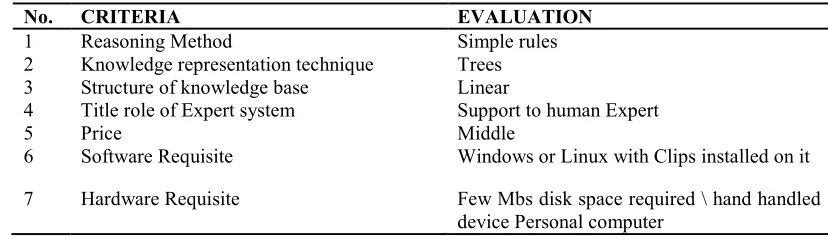
[image:5.612.107.521.206.327.2]There are many aspects in which academic advising expert system is like any other expert system or even like any piece of software. Our expert system use IF-THEN rules stored in an unstructured knowledge base. In this research classified our system on the basis of the following criterion.
Table 1: Classification of the system
7. IMPLEMENTATION
The representation of knowledge is the main factors to illustrate the expert’s knowledge as it results from domain expert. It contains the structures and rules that distinct elements of the expert system. The knowledge decision maker gives the expert system the input and accepts the system’s description of how it arrives at its end. Generally, it includes the enchanting text from the knowledge base and appropriates them into a few predefined sentence layouts. The expert system is the system that stores the knowledge in a knowledge-base and executes a set of procedures and preconditions to arrive at the final results with the help of the specialists to be able to reach the optimal situation [11].
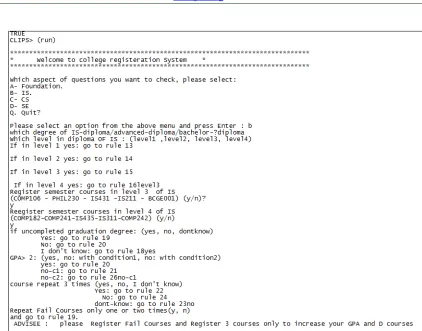
Students of the Information Technology study of Al-Buraimi University College were used as subjects in an undertaken case study. There are three possible scenarios for a student planning to register a course at the start of a new semester.
• The student could have only the current semester course to register.
• The student could have failed courses twice along with the other current semester registered courses.
• The student could have a warning of low GPA(s) three times along with the current semester registered courses.
Using the applicable scenario for a particular student, and with the set of rules outlined in the university policy for course registration (i.e. it is
modeled as rules and stored in our developed knowledgebase), our proposed system CLIPS recommends for the current semester the set of courses to register. It of course puts into consideration the different course status (course perquisites, compulsory or elective courses).
8. SYSTEM EVALUATION
We perform two types of evaluations. First, Human experts conducted a usability evaluation of the prototype in order to assess the level of user satisfaction with the system. Second, we used the alpha (α-test) testing and beta (β-test) testing standard evaluation criteria in order to evaluate the proposed rule-based system.
8.1 Human Experts Evaluation
The well-known direct method was used to conduct a simple experiment that tests the system's advising conclusion against those of human advisors. As to the participants in the evaluation testing, they are course advisors of each level from the department of Information Technology, Al-Buraimi University College. Each participant received the same set of questions, and had a running version of the proposed rule-based expert system installed in their machines. To evaluate the degree of how true of false are the advising conclusions of the proposed system are, the course advisors were asked to rank the advising conclusion of our
No. CRITERIA EVALUATION
1 Reasoning Method Simple rules
2 Knowledge representation technique Trees
3 Structure of knowledge base Linear
4 Title role of Expert system Support to human Expert
5 Price Middle
6 Software Requisite Windows or Linux with Clips installed on it
7 Hardware Requisite Few Mbs disk space required \ hand handled
proposed system on a score scale of 0-5. A brief overview of the direct method of rule-based expert system evaluation used by each participant (i.e evaluator) is as follows:
• A copy of the proposed rule-based expert system is presented to the participant to be evaluated.
• The participant chooses a general case based on his experience, and runs this case on the proposed rule-based expert system.
• After running the selected general case, the participant answers a given set of questions (14) and approximates a quantities answer to each question on a
0 to 5 scale, with 5 being very true and 0 being very false.
• As given in the weight column, each result is multiplied by a weighting factor.
• The sum of the weighted values is divided by the sum of the weight (19), which gives the result in the numerical range of 0 to 5.
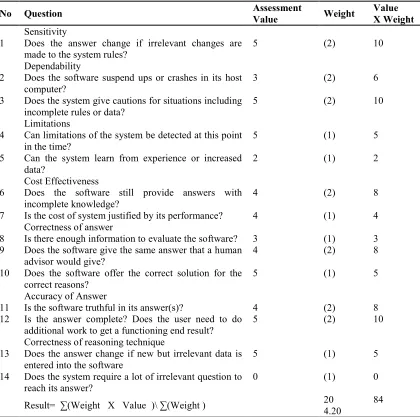
[image:6.612.99.519.289.706.2]Table 2 shows the results of the human expert evaluation experiment conducted by one of the participants, as a sample.
Table 2: Human Expert Evaluation Questions
No Question Assessment
Value Weight
Value X Weight
Sensitivity
1 Does the answer change if irrelevant changes are made to the system rules?
5 (2) 10
Dependability
2 Does the software suspend ups or crashes in its host computer?
3 (2) 6
3 Does the system give cautions for situations including incomplete rules or data?
5 (2) 10
Limitations
4 Can limitations of the system be detected at this point in the time?
5 (1) 5
5 Can the system learn from experience or increased data?
2 (1) 2
Cost Effectiveness
6 Does the software still provide answers with incomplete knowledge?
4 (2) 8
7 Is the cost of system justified by its performance? 4 (1) 4 Correctness of answer
8 Is there enough information to evaluate the software? 3 (1) 3 9 Does the software give the same answer that a human
advisor would give?
4 (2) 8
10 Does the software offer the correct solution for the correct reasons?
5 (1) 5
Accuracy of Answer
11 Is the software truthful in its answer(s)? 4 (2) 8
12 Is the answer complete? Does the user need to do additional work to get a functioning end result?
5 (2) 10
Correctness of reasoning technique
13 Does the answer change if new but irrelevant data is entered into the software
5 (1) 5
14 Does the system require a lot of irrelevant question to reach its answer?
0 (1) 0
Result= ∑(Weight X Value )\ ∑(Weight ) 20 84
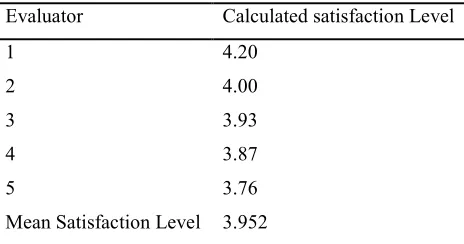
A sample result summary of 5 participants in calculating the experimental evaluation is given in the Table 3.
Table 3: Results of Evaluation Experiments
From the results presented in the above table, proposed system had a mean satisfaction level score of 3.952 out a maximum of 5.0, which is indicative of a 79.04% level of user satisfaction. The implication of this result is that after the experts have considered important metric dimensions such as correctness of answer, accuracy, quality of reasoning technique, sensitivity, reliability, cost effectiveness, and observed limitations of the system, the system obtained a mean rating of 79.04%. This connotes an appreciably good rating for the proposed rule-based expert system, and an indication of its viability to support the task of academic advising in the department of information technology at Al-Buraimi University College.
8.2 The α-test and β-test Evaluation
α-test Alpha testing is a virtual or else real prepared trying through probable client or else a self-governing trial group by the side of developer position. Alpha testing is over and over again engaged used for off-the-shelf program at the same time as a shape of interior receipt trying, earlier than go away in the direction of beta testing types. In this research, the main objectives of experiment are to verification and validate the proposed approach and assessment using alpha testing.
9. CONCLUSIONS
The results of this research assist the undergraduate students in the department of information technology in Al-Buraimi University College to select the appropriate subjects for their schedules. The system also provides an accurate and non-conflict proposal courses for
the undergraduate student. It works as an advisor as it gives the undergraduate student a plan with the appropriate subjects according to the courses that have been taken. The system referred to dissimilar clusters of undergraduates, counselor for assess its outcomes in addition to evaluate it among manual structure.
10. RECOMMENDATIONS & FUTURE WORK
For the future work will extended our work to all the departments inside the college not only IT department and design a new question- lists for future work related to the new requirements that will appear during the development of the organization and academic area .The examples below can be taken into consideration for further future as follows: - The possibility of registration is usually bound
with the fulfillment of the main requirements. That is to say, whether the students are allowed to register or not?
- Is it possible to be enrolled in the college when the students do not register prerequisites courses? - Is it possible for the students to graduate when
he/she does not register some of the optional courses?
- The possibility of transforming the system to the computing cloud to be able to give notifications to the enrolled students concerning their GPA and other important issues.
Evaluator Calculated satisfaction Level
1 4.20
2 4.00
3 3.93
4 3.87
5 3.76
REFERENCES:
[1] B. W. Boehm, "Spiral
Development:Experience, Principles,and Refinements," Special Report CMU/SEI, vol. 008, 2000.
[2] M. Edward, N. Latorre and H. John G, "A Natural Language Conversational System," in
Twenty-Seventh International Florida
Artificial Intelligence Research Society
Conference.
[3] B. Chandrasekaran, "Generic task in knowledge based reasoning. High level bulding blocks for expert system design,"
IEEE Expert, vol. 1, no. 3, pp. 23-30.
[4] M. A. A. Ahmar, "A Prototype Student Advising Expert System Supported with an Object-Oriented Database," International Journal of Advanced Computer Science and
Applications, pp. 100 - 105, (2011).
[5] B. Aldahadha and M. Al-Bahrani, "Academic Advising Services among Sultan Qaboos University and University of Nizwa students in light of Some Variables," International Journal for Research in Education (IJRE) No.
32, 2012, no. 32, pp. 23-44, (2012).
[6] A. Al-Ghamdi, S. Al-Ghuribi, A. Fadel, F. Al-Aswadi and T. AL-Ruhaili, "An Expert System for Advising Postgraduate,"
International Journal of Computer Science
and Information Technologies, vol. Vol. 3
(3), no. 0975-9646, pp. 4529 - 4532, (2012). [7] B. W. Boehm, "A Spiral Model of Software
Development and Enhancement," IEEE, vol. 5, no. 21, pp. 61-72, (1988).
[9] J. Cernik, "Framework For An Expert System Generator," may 2009. [Online]. Available: https://etd.ohiolink.edu/!etd.send_file?accessi on...disposition. [Accessed 10 oct (2014)]. [10] R. M. Choudhari, "Expert System For
Student Advisement," Department of Mathematics and Computer Science,South Carolina State University, Orangeburg, SC 29117, 2009. [Online]. Available: http://www.sedsi.org/2009_Conference/proc/ proc/p080911001.pdf.. [Accessed (2014)]. [11] O. Daramola, O. Emebo, I. Afolabi and C.
Ayo, "Implementation of an Intelligent Course Advisory Expert System," (IJARAI) International Journal of Advanced Research
in Artificial Intelligence, vol. 3, no. 5, pp.
6-12, (2014).
[12] S. P. David, "Knowledge Acquisition in the Development of Large Expert System,"
ManchesterSpang Robinson on AI, vol. 8, no.
2, pp. 43-51, (1987).
[13] T. Feghali, I. Zabib and S. Hallal, "A Web based Decision Support Tool for Acadmic Advising," International Forum of Educational Technology & Socity (IFETS),
vol. 14, no. 1, pp. 82-94, (2011).
[14] S. Frost, "Development advising:Practices and attitudes of faculty advisors," NACADA
Journal, vol. 13, no. 2, pp. 15-21, (1993).
[15] B. R. Gaine, "Social and Cognitive Processes in Knowledge Acquisition," Elsevier, vol. 1, no. 1, p. 39–58, (1989).
[16] A. Kara and A. Karahoca, "Developing An Expert-System For Diabetics," (2008). [17] A. Khali and J. Williamson, "Role of
Academic Advisors in the Success of Engineering Students," Universal Journal of
Educational Research 2, no. 10.13189, pp.
73-79, (2014).
[18] K. Makhubele, "A Knowledge Based Expert System for Medical Advice provision," (2012).
[19] B. McMahan and R. Bates, "An Automatic Dialog System for Student Advising,"
Journal of Undergraduate Research, (2010).
[20] P. Meseguer, "Towards a Conceptual Framework for Expert System Validation,"
Spanish National Research Council, pp. 1-31,
(1992).
[21] A. H. Mohammad and N. A. M. Al Saiyd, "A Framework for Expert Knowledge Acquisition," IJCSNS International Journal of Computer Science and Network Security,
vol. 10, no. 11, pp. 145 - 151, (2010). [22] L. Mostafa, G. Oately, N. Khalifa and W.
Rabie, "A Case based Reasoning System for Academic Advising in Egyptian Educational Institutions," in 2nd International Conference on Research in Science, Engineering and
Technology, Dubai (UAE), (2014).
[23] L. Mostafa and N. Khalifa, "The Role of Semantic Expansion Network in E-advising,"
in International Conference on Managgement
[24] NACADA, "National Academic Advising Association," [Online]. Available: www.nacada.ksu.edu. [Accessed January (2015)].
[25] O. Noran, "LNAI 2903 Case Study: A Course Advisor Expert System," (2003). [Online]. Available: http://link.springer.com/. [Accessed 26 January 2015].
[26] S. G. Pajewski, "Engagement In Academic Advising: A comparison Between Students In Interdisciplinary Programs And Students In Noninterdisciplinary Programs," (2006). [Online]. Available: http://d-scholarship.pitt.edu/10358/1/pajewskis2_etd. pdf.. [Accessed 7 DEC 2014].
[27] M. Patankar, "A Rule‐Based Expert System Approach to Academic Advising," IETI, vol. 35, no. 1, pp. 49-58, (2006).
[28] P. F. C. Peter, "AN EXPERT SYSTEM FOR
DIAGNOSIS OF PROBLEMS IN
REINFORCED CONCRETE
STRUCTURES," Australia, (1996).
[29] M. Robert, A. M and Tashi, "An Automated Advising System For Course," JCSC, vol. 3, no. 18, pp. 17-25, (2003).
[30] Stojanovic, Maedche, N and Studer, "Ontology Evolution as Reconfiguration Design Problem Solving," Proceeding of
international conferance on knowledge
capture, pp. 162 - 171, (2003).
[31] Turban, "Decision Support and Expert Systems:Management Support Systems,"
Prentice Hall Inc, (1995).
[32] WANNORAINI_BT._ABDUL_LATIF, "Expert System for selection acadmic Program," Nov (2005).
[33] A. H. Mohammad and N. A. M. Al Saiyd, "A Framework for Expert Knowledge," IJCSNS International Journal of Computer Science
and Network Security, vol. 10, no. 11, pp.
APPENDIX
Figure1: Overall Life Cycle of Expert Systems Development Process
Figure2: knowledge acquisition model (Mohammad & Al Saiyd, 2010)
Knowledge Engineering Methodology
Software Engineering Methodology
Expert System Testing
Expert System Maintenance
E
x
p
lor
at
i
M
odi
fic
a
R
ef
or
m
ul
at
i
Inference Engine
Knowledge Maintenance
Explanation Component
Specification of Conceptualization
Declarative formalism
Knowledge
Validation
Knowledge Construction
Knowledge Base
Knowledge Modeling
Knowledge
Representation
Domain Knowledge
Identification for Problem-Solving
Declarative & Procedural Knowledge
Acquisition
Find who can provide the related
knowledge
Figure5: Student Guide Selections Of Information System CAN I SELECT IS MAJOR
WHICH DEGREE YOU WANT YES
HIGHER DIPLOMA BACHELOR
DIPLOMA
ADVISEE ADVISEE ADVISEE
-FOUR LEVELS-NO ELECTIVE COURSES -GENERAL
COURSES REQUIRE
-SIX LEVELS
-ONE ELECTIVE
COURSES -GENERAL
COURSES REQUIRE
-EIGHT LEVELS
-THREE ELECTIVE
COURSES -GENERAL