Full Length Research Article
FIRST YEAR DENTAL STUDENTS’ PERCEPTIONS ABOUT EDUCATIONAL ENVIRONMENT:
EXPECTED VERSES ACTUAL PERCEPTIONS
*,1
Faraz Ahmed Farooqi,
2Imran Alam Moheet,
3Soban Qadir Khan and
4Aws Saleh Ar Rejaie
1,3
Department of Clinical Affairs, College of Dentistry, University of Dammam, KSA
2,4Department of Substitutive Dental Sciences, College of Dentistry, University of Dammam, KSA
ARTICLE INFO ABSTRACT
Objective: To estimate the difference between students' expected and actual perceptions about their educational environment.
Method: A prospective study was conducted in the College of Dentistry, University of Dammam, Saudi Arabia involving first year dental students of the academic year 2013-14. The students were asked to fill out two versions of the Dundee Ready Education Environment Measure (DREEM), one in the beginning (expected DREEM) and the other at the end (actual DREEM) of their academic session. The sum of students' responses (scored on a Likert scale ranging from 0 to 4) and a mean with standard deviation was calculated for every question. Then a mean for each of the five subscales of the expected and actual DREEM, and an overall score for the two versions of DREEM were estimated.
Results: Fifty five students (response rate: 72%) including 25 males (45%) and 30 females (55%) filled out the DREEM questionnaire on both occasions. The total scores for the expected and actual DREEM questionnaires were 114.47 and 105.5 respectively, the difference between the two scores being statistically insignificant at P<0.05. There was no statistically significant difference between male and female students' perceptions in any of the five subscales of the expected and actual DREEM questionnaires.
Conclusion: The overall results of the study illustrated a healthy educational environment in the College of Dentistry, University of Dammam, Saudi Arabia. Some problems areas were, however, identified that need to be addressed in future to further improve the quality of learning environment in the college.
Copyright © 2015 Faraz Ahmed Farooqi et al. This is an open access article distributed under the Creative Commons Attribution License, which permits unrestricted use, distribution, and reproduction in any medium, provided the original work is properly cited.
INTRODUCTION
Since past few years, Medical schools have been taking interest to examine perceptions regarding educational environment (Genn, 2001). Educationists from all over the world have modernized the medical education system to match students’ perceptions and actual educational environment
(Roff et al., 1997) (Miles and Leinster, 2007) (Henning et al.,
2011). There is definite and positive effect of curriculum on
learning environment (Plucker, 1998) (Pimparyon et al., 2000)
(Lizzio, Wilson and Simons et al., 2002) (Mayya and Roff,
2004). The educational climate of a school, which suits or attracts a student more, can play an important role in producing a good professional (Roff and McAleer, 2001).
*Corresponding author: Faraz Ahmed Farooqi
Department of Clinical Affairs, College of Dentistry, University of Dammam, KSA
To provide an educational environment which is comfortable to students, it is critical to explore their perceptions. Many questionnaire-based studies have been performed to evaluate educational environment in different educational institutes. We used Dundee Ready Educational Environment Measure (DREEM) because it has been commonly used by researchers
(Bassaw et al., 2003) (Till, 2004) (Pololi and Pololi, 2000).
The DREEM is one of the methods prepared to measure educational climate especially in health professional education
system (Roff et al., 1997). This method helps to assess
students’ perceptions and also gives a chance to find areas of strength and weakness in the present curricula and in
educational environment (Roff et al., 2001) . It can also be
used to evaluate students’ perceptions at different course
levels (Jiffry et al., 2005). DREEM can also find change in
students’ expectations by performing the study at the beginning of each year. Till (2005) used DREEM to compare differences between actual educational environment and
ISSN: 2230-9926
International Journal of Development Research
Vol. 5, Issue, 06, pp. 4735-4740, June,2015
DEVELOPMENT RESEARCH
Article History: Received 26th March, 2015
Received in revised form 30th April, 2015
Accepted 13th May, 2015
Published online 28th June, 2015
Key words:
Dental education, DREEM,
students’ ideal environment. The purpose of the study was to identify gap between ideal and actual environment. Health education system is changing rapidly in Saudi Arabia and with time, the number of medical and dental institutes which were following conventional curricula has now shifted to a more innovative curricula and community oriented program. In order to identify the strengths and weaknesses of the educational environment in the College of Dentistry in Jezan, DREEM was used to assess’ female students’ perceptions about institutional environment (Hasan and Gupta, 2013). Another study was performed recently in college of medicine, Qaseem University about perception of new students regarding medical college (Al-Mohaimeed, 2013). In King Abdulaziz
University, Al-Hazimi et al. (2004) studied medical students’
perceptions about educational environment. We chose Dundee Ready Educational Environment Measure (DREEM) for assessing student’s perceptions because of its consistency and strength which is well recognized in literature since more than a decade. DREEM claimed as “culture free tool” to compute the educational environment and broadly used in health and medical institutions across the countries and nationalities
(Yousoff, 2012). No prospective or Expected versus Actual
DREEM study was done before in Saudi Arabia or no previous study on male dental students in Dammam. That is why the present study was undertaken. This study was conducted in College of Dentistry, University of Dammam Saudi Arabia. The aim of the study was to evaluate the difference between students’ expected and actual DREEM.
Methods and study subjects
A prospective study was conducted in the College of Dentistry, University of Dammam, Saudi Arabia involving first year dental students of the academic year 2013-14. Ethical Approval for conducting the study was taken from Scientific Research Committee, University of Dammam holding certificate number IRB-2014-02-026. The purpose of the study was described to all students and they were briefed
about the questions and grading. The students were asked to
fill out two versions of the Dundee Ready Education Environment Measure (DREEM), one in the beginning (expected DREEM) and the other at the end (actual DREEM)
of their academic session. . They were informed to respond on
the basis of their expectations about starting their professional
education in a dental school. The expected DREEM was
distributed to 76 students (total students) and it was filled by 58 (76%). The actual DREEM was answered by 61 (80%) students (present on the day of the study) at the end of the academic year. 55 (72%) students who participated in DREEM survey on both occasions made up the final sample for the study.
All 50 questions were close ended and the respondents had to sore their responses using a Likert scale ranging from 0 (strongly disagree) to 4 (strongly agree). Nine questions having negative statements were scored as 0 (strongly agree) to 4 (strongly disagree). Reverse coding was done for negative items presented in Table 1 in italic font (item # 4, 8, 9, 17, 25, 35, 39, 48 and 50). The questions were categorized into five
subscales. Perception of learning had 12 questions and
maximum score was 48, perception of teaching had 11 questions and maximum score was 44, academic
self-perception had 8 questions and score was up to 32, regarding atmosphere there was 12 questions and maximum score was 48 and social self-perception had 7 questions and maximum
possible score was 28. The maximum possible DREEM score
was 200.
Data Analysis
Statistical package of social sciences (SPSS version 19) was
used for data entry and data analysis. The response to each
question was entered using codes 0 to 4. The sum of students' responses and a mean with standard deviation was calculated for every question. Then a mean for each of the five subscales of the expected and actual DREEM, and an overall score for
the two versions of DREEM were estimated. The Magnitude
of difference between students’ expected and actual DREEM was derived by subtracting mean of actual DREEM from mean
of expected DREEM. The criterion suggested by McAleer and
Roff (2001) was used for interpretation of the scores. The expected and actual mean DREEM scores for all individual questions, subscales and the overall DREEM scores were compared using Wilcoxon sign rank test while Mann-Whitney U-test was used to compare the respective scores of the male
and female participants. P-value less than 0.05 were
considered as significant.
RESULTS
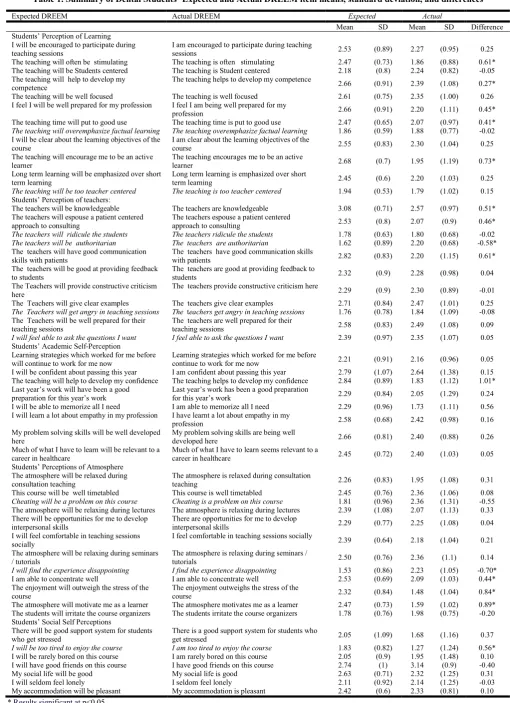
There were 25(45%) male Students and 30(55%) females who participated in the study. The average score was 114.47 for expected and 105.5 for actual DREEM out of 200. The score for every sub-scale of DREEM along with the overall score are shown in Table 1. The mean score of individual items of expected and actual DREEM of students are presented in
Table 1. The results of the study showed that only 1 item (The
teacher will be knowledgeable) in the expected DREEM received a score >3, 40 items got scores ranging from 2 to 3 and 9 items carried scores ≤2. In the actual DREEM again only one item (I will have good friends on this course) received a score of >3 while the number of items receiving
scores from 2 to 3 and ≤2 was 34 and 15 respectively. The
magnitude of difference (dissonance) between students expected and actual DREEM is shown in Table 2.
Table 1. Summary of Dental Students’ Expected and Actual DREEM item means, standard deviation, and differences
Expected DREEM Actual DREEM Expected Actual
Mean SD Mean SD Difference
Students’ Perception of Learning I will be encouraged to participate during teaching sessions
I am encouraged to participate during teaching
sessions 2.53 (0.89) 2.27 (0.95) 0.25
The teaching will often be stimulating The teaching is often stimulating 2.47 (0.73) 1.86 (0.88) 0.61*
The teaching will be Students centered The teaching is Student centered 2.18 (0.8) 2.24 (0.82) -0.05
The teaching will help to develop my competence
The teaching helps to develop my competence
2.66 (0.91) 2.39 (1.08) 0.27*
The teaching will be well focused The teaching is well focused 2.61 (0.75) 2.35 (1.00) 0.26
I feel I will be well prepared for my profession I feel I am being well prepared for my
profession 2.66 (0.91) 2.20 (1.11) 0.45*
The teaching time will put to good use The teaching time is put to good use 2.47 (0.65) 2.07 (0.97) 0.41*
The teaching will overemphasize factual learning The teaching overemphasize factual learning 1.86 (0.59) 1.88 (0.77) -0.02
I will be clear about the learning objectives of the course
I am clear about the learning objectives of the
course 2.55 (0.83) 2.30 (1.04) 0.25
The teaching will encourage me to be an active learner
The teaching encourages me to be an active
learner 2.68 (0.7) 1.95 (1.19) 0.73*
Long term learning will be emphasized over short term learning
Long term learning is emphasized over short
term learning 2.45 (0.6) 2.20 (1.03) 0.25
The teaching will be too teacher centered The teaching is too teacher centered 1.94 (0.53) 1.79 (1.02) 0.15
Students’ Perception of teachers:
The teachers will be knowledgeable The teachers are knowledgeable 3.08 (0.71) 2.57 (0.97) 0.51*
The teachers will espouse a patient centered approach to consulting
The teachers espouse a patient centered
approach to consulting 2.53 (0.8) 2.07 (0.9) 0.46*
The teachers will ridicule the students The teachers ridicule the students 1.78 (0.63) 1.80 (0.68) -0.02
The teachers will be authoritarian The teachers are authoritarian 1.62 (0.89) 2.20 (0.68) -0.58*
The teachers will have good communication skills with patients
The teachers have good communication skills
with patients 2.82 (0.83) 2.20 (1.15) 0.61*
The teachers will be good at providing feedback to students
The teachers are good at providing feedback to
students 2.32 (0.9) 2.28 (0.98) 0.04
The Teachers will provide constructive criticism here
The teachers provide constructive criticism here
2.29 (0.9) 2.30 (0.89) -0.01
The Teachers will give clear examples The teachers give clear examples 2.71 (0.84) 2.47 (1.01) 0.25
The Teachers will get angry in teaching sessions The teachers get angry in teaching sessions 1.76 (0.78) 1.84 (1.09) -0.08
The Teachers will be well prepared for their teaching sessions
The teachers are well prepared for their
teaching sessions 2.58 (0.83) 2.49 (1.08) 0.09
I will feel able to ask the questions I want I feel able to ask the questions I want 2.39 (0.97) 2.35 (1.07) 0.05
Students’ Academic Self-Perception
Learning strategies which worked for me before will continue to work for me now
Learning strategies which worked for me before
continue to work for me now 2.21 (0.91) 2.16 (0.96) 0.05
I will be confident about passing this year I am confident about passing this year 2.79 (1.07) 2.64 (1.38) 0.15 The teaching will help to develop my confidence The teaching helps to develop my confidence 2.84 (0.89) 1.83 (1.12) 1.01* Last year’s work will have been a good
preparation for this year’s work
Last year’s work has been a good preparation
for this year’s work 2.29 (0.84) 2.05 (1.29) 0.24
I will be able to memorize all I need I am able to memorize all I need 2.29 (0.96) 1.73 (1.11) 0.56
I will learn a lot about empathy in my profession I have learnt a lot about empathy in my
profession 2.58 (0.68) 2.42 (0.98) 0.16
My problem solving skills will be well developed here
My problem solving skills are being well
developed here 2.66 (0.81) 2.40 (0.88) 0.26
Much of what I have to learn will be relevant to a career in healthcare
Much of what I have to learn seems relevant to a
career in healthcare 2.45 (0.72) 2.40 (1.03) 0.05
Students’ Perceptions of Atmosphere The atmosphere will be relaxed during consultation teaching
The atmosphere is relaxed during consultation
teaching 2.26 (0.83) 1.95 (1.08) 0.31
This course will be well timetabled This course is well timetabled 2.45 (0.76) 2.36 (1.06) 0.08
Cheating will be a problem on this course Cheating is a problem on this course 1.81 (0.96) 2.36 (1.31) -0.55
The atmosphere will be relaxing during lectures The atmosphere is relaxing during lectures 2.39 (1.08) 2.07 (1.13) 0.33 There will be opportunities for me to develop
interpersonal skills
There are opportunities for me to develop
interpersonal skills 2.29 (0.77) 2.25 (1.08) 0.04
I will feel comfortable in teaching sessions socially
I feel comfortable in teaching sessions socially
2.39 (0.64) 2.18 (1.04) 0.21
The atmosphere will be relaxing during seminars / tutorials
The atmosphere is relaxing during seminars /
tutorials 2.50 (0.76) 2.36 (1.1) 0.14
I will find the experience disappointing I find the experience disappointing 1.53 (0.86) 2.23 (1.05) -0.70*
I am able to concentrate well I am able to concentrate well 2.53 (0.69) 2.09 (1.03) 0.44*
The enjoyment will outweigh the stress of the course
The enjoyment outweighs the stress of the
course 2.32 (0.84) 1.48 (1.04) 0.84*
The atmosphere will motivate me as a learner The atmosphere motivates me as a learner 2.47 (0.73) 1.59 (1.02) 0.89* The students will irritate the course organizers The students irritate the course organizers 1.78 (0.76) 1.98 (0.75) -0.20 Students’ Social Self Perceptions
There will be good support system for students who get stressed
There is a good support system for students who
get stressed 2.05 (1.09) 1.68 (1.16) 0.37
I will be too tired to enjoy the course I am too tired to enjoy the course 1.83 (0.82) 1.27 (1.24) 0.56*
I will be rarely bored on this course I am rarely bored on this course 2.05 (0.9) 1.95 (1.48) 0.10
I will have good friends on this course I have good friends on this course 2.74 (1) 3.14 (0.9) -0.40
My social life will be good My social life is good 2.63 (0.71) 2.32 (1.25) 0.31
I will seldom feel lonely I seldom feel lonely 2.11 (0.92) 2.14 (1.25) -0.03
My accommodation will be pleasant My accommodation is pleasant 2.42 (0.6) 2.33 (0.81) 0.10
continue to work for me now” (0.05)(0.607), “Much of what I have to learn seems relevant to a career in healthcare” (0.05)(0.702), “This course is well timetabled” (0.08)(p-0.413), “The teachers are well prepared for their teaching sessions” (0.09)(0.493). And in some areas they experienced more than what they were expecting. The negative differences in Table 1 symbolized that realities got higher score than expectations. Some important differences were in items: “I find the experience disappointing” (-0.7)(0.005), “The teachers are authoritarian” (-0.58)(0.007), “Cheating is a problem in this course” (-0.55)(0.060), “I have good friends on this course” (-0.4)(0.178).
DISCUSSION
The ' DREEM' questionnaire was used in the present study because of its validity and reliability that is well recognized in the literature (Ostapczuk, 2012). To enhance their learning experience institute should aspire to provide the best possible educational environment and learning experience to students in order to promote them for their complete potential in which dream is a very helpful (Preethi, 2014). In the present study the total score obtained for actual DREEM was 105.5/ 200 that indicated 'a more positive than negative learning environment'
in the College of Dentistry, Dammam University (McAleer
and Roff, 2001). Even though the actual DREEM score of the
College of Dentistry, Dammam University was less than the recommended score of 120 (Roff, 2005) but still it was higher than the respective scores of other institutions in Saudi Arabia and neighboring countries including, King Saud University’s medical college (89.9) (Al-Ayed and Sheik, 2008), King Abdulaziz University’s medical college (102) (Al-Hazimi, 2004), Sana’a University Yemen (100) (Al-Hazimi, 2004), Kuwait University (105) (Bouhaimed, Thalib and Doi, 2008),
Gulf Medical University UAE (100) (Roff et al 2001) with the
expectation of Umm Ul Qura University (107) (Al-Hazimi 2004).
The actual DREEM score of the College of Dentistry, Dammam University when compared with scores of universities outside the Kingdom, it appeared less than the
ones accomplished by total score accomplished in Dundee
(139) (Al-Hazimi, 2004) Koirala institute of Health Science, Dahran, Nepal (130) (Shehnaz and Sreedharan, 2011),
Nigerian Medical School (118) (Roff et al., 2001) but
comparatively better than Canadian Memorial Chiropractic
College (97) (Till, 2004).All 5 subscales of DREEM received
scores from students which were more towards constructive perception in actual DREEM. But in some areas, difference between students’ expected and actual DREEM were found significant.
Namely; student’s perception of learning (p=0.004), academic self-perception (p=0.001) and perception of atmosphere (p=0.049). There are few limitations with this study. Firstly the English version of the questionnaire was used because no validated Arabic version was available. As the students are getting their education in English, so the chance of threat is very low. Another limitation with low expected DREEM scores about college environment could be because of the fact that students are enrolled after high school, so they don’t have enough experience about college life.
Students Perception of Learning (SPL)
The difference between expected and actual students’
perception was 2.21 which was statistically significant
(p-0.004). Another area receiving a high dissonance score was
'Teaching is too teacher centered'. It may be showing a cultural trend but requires serious attention.
Students Perception of Teachers (SPT)
Student’s perception about teacher received quite low dissonance compare with the perceptions in other areas (table 2). Among the questions which were asked to evaluate perceptions regarding teaching, two scores in both actual and expected perception. These scores affect the aggregated mean when coalesced with other responses. Questions, which got low scores, need to study more to describe the possible reasons of low score.
Students Academic Self Perception
None of item in this domain received score lesser than 2.0 for their expectations and nearly all the value were matched in the actual DREEM score showing a positive environment except
for two items. Although according to criteria of McAleer and
Roff 2001 this subscale shows many negative aspects in the
educational environment as compare to other domains. One of
[image:4.595.68.523.78.160.2]the items was; I am able to memorize all I need (1.73). The reason for this could be because this was their first exposure to the professional education and they were not fully aware of the challenges. With passage of time and with a little help and guidance they will improve. The second item; teaching helps develop my confidence (1.83), with a dissonance factor of 1.01 is point to look at. The students had high hopes from their professional education in boosting their confidence but it hasn’t. The reason could be that the students feel teaching is teacher centered which may not help them in building their confidence.
Table 2. Overall scores of actual and expected DREEM's subscales'
Expected DREEM Actual DREEM
Subscale Mean (SD) Max Mean (SD) Max Difference
Students’ Perception of Learning 28.16 5.56 48 25.95 5.96 48 2.21* Students’ Perception of teachers 25.05 5.17 44 23.89 5.56 44 1.16 Students’ Academic Self-Perception 19.71 3.75 32 16.09 4.40 32 3.62* Students’ Perceptions of Atmosphere 26.26 4.60 48 24.64 5.67 48 1.62* Students’ Social Self Perceptions 15.29 2.77 28 14.94 4.56 28 0.35
Total 114.47 200 105.51 200 8.96
Students’ Perceptions of Atmosphere
It is known that atmosphere represents the true life of educational environment. Student’s experienced well time tabled course and opportunities, which enhanced their inter-personal skills, same as what they had expected. Cheating was more difficult than what they expected. Even though this domain represented a positive side, few areas of concerns were also highlighted. It seems that students are more stressed which is evident by the low score in ‘enjoyment outweighs stress of the course (1. 48)’ and ‘the atmosphere motivates me a learner (1.59)’. These two areas need more focus as the dissonance was also high for them 0.84 and 0.89 respectively. A corrective measure is already in place (new student support system) which hopefully will monitor and correct these issues.
Students’ Social Self Perceptions
Students who participated in this study showed a very positive response to this domain and believe that their social life is better than what they had expected. The only concern they have shown is with the student support system (1.68). This is a very critical area and needs improvement. As of now a new support system is already in practice and maybe we will see healthy scores in next evaluation.
Conclusion
The present study the provided the useful information
regarding the students' perceptions about their learning
environment.Most of the DREEM domains were perceived as
positive by the students indicating a healthy educational environment in the College. Some problematic areas were identified that should be looked into for exact causes and rectification.
Recommendations
Corrective measures are to be taken to address the areas of
weakness in the educational environment of College of Dentistry highlighted by the present study.
Once the strategies for improvement are implemented the
DREEM surveys need to be repeated periodically to monitor the situation.
Conflict of Interest Statement
The Authors Report no financial or personal conflict of interest in this research.
Acknowledgement
I would like to express my deep gratitude to Dr. Abdul Khabeer and Dr. Amal Nawasra for their valuable support with conducting the survey and development of research work. I would also like to thank Deanship of Scientific Research, University of Dammam for providing a research grant for this study (Grant No. 2014099).
REFERENCES
Al-Ayed, IH. and Sheik, SA. 2008. ‘Assessment of the educational environment at the college of medicine of King
Saud University Riyadh’, East Mediterr Health J,
14(4):953–959.
Al-Hazimi, A., Al-Hyiani, A. and Roff, S. 2004. ‘Perceptions of the educational environment of the medical school in King Abdul Aziz University, Saudi Arabia’, Med Teacher, 26 (6):570–3.
Al-Hazimi, A., Zaini, R., Al Hyiani, A., Hassan, N., Gunadi, A., Ponnamperuma G., K., Arunathilake, I., Roff, S., McAleer, S. and Davis, M. 2004. ‘Educational environment in traditional and innovative medical schools:
A study in four undergraduate medical schools’, Educ
Health, 17(2):192–203.
Al-Mohaimeed, A. 2013. ‘Perceptions of the educational
environment of a new medical school Saudi Arabia’, Int J
Health Sci, 7(2):150-9.
Bassaw, B., Roff, S., McAleer, S., Roopnarinesingh, S., De Lisle, J., Teelucksingh, S. and Gopaul, S. 2003. ‘Students’ perceptive of the educational environment, Faculty of
Medical Sciences, Trinidad’, Med Teacher, 25(5): 522–
526.
Bouhaimed, M., Thalib, L. and Doi, SAR. 2009. ‘Perception of the educational environment by medical students
undergoing a curricular transition in Kuwait’, Med Princ
Prac, 18:204–208.
Genn, JM. 2001. ‘Curriculum, environment, climate, quality and change in medical education: a unifying perspective’, AMEE Education Guide No. 23. Dundee: Association for Medical Education in Europe, p no. 7–28.
Hasan, TI. and Gupta, P. 2013. ‘Assessing the learning environment at Jazan Medical School of Saudi Arabia’,
Med Tech, 35(suppl 1):s90-6.
Henning, MA, Shulruf, B, Hawken, SJ and Pinnock, R 2011, ‘Changing the learning environment: The medical student voice’, Clin Teach, 8(2):83–87.
Jiffry, MTM., McAleer, S., Fernando, S. and Marasinghe, RB. 2005. ‘Using the DREEM questionnaire to gather baseline information on an evolving medical school in Sri Lanka’,
Med Teacher, 27 (4):348–52.
Lizzio, A., Wilson, K. and Simons, R. 2002. ‘University students’ perceptions of the learning environment and academic outcomes: implications for theory and practice’,
Stud Higher Educ, 27(1):27-52.
Mayya, S. and Roff, S. 2004. ‘Students’ perceptions of the educational environment: a comparison of academic achievers and under-achievers at Kasturba Medical
College’ India, Educ Health, 17(3):280-91.
McAleer, S. and Roff, S. 2001. ‘A practical guide to using the
Dundee Ready Education Environment Measure
(DREEM)’, In: Genn JM, ed. Curriculum, Environment, Climate, Quality and Change in Medical Education: a Unifying Perspective. AMEE Education Guide No. 23. Dundee: Association for Medical Education in Europe page 29–33.
Miles, S. and Leinster, SJ. 2007. ‘Medical Students’ perceptions of their educational environment: expected
versus actual perceptions’, Med Educ, 41(3):265-72.
Ostapczuk, MS1., Hugger, A., de Bruin, J., Ritz-Timme, S. and Rotthoff, T. 2012. ‘DREEM on, dentists! Students' perceptions of the educational environment in a German dental school as measured by the Dundee Ready Education
Pimparyon, P., Caleer, SM., Pemba, S. and Roff, S. 2000. ‘Educational environment, student approaches to learning
and academic achievement in a Thai nursing school’, Med
Teacher, 22(4):359-64.
Plucker, JA. 1998, ‘The relationship between school climate
conditions and students aspirations’, J Educ Res,
91(4):240-46.
Pololi, L. and Price, J. 2000. ‘Validation and use of an instrument to measure the learning environment as
perceived by medical students’, Teach Learn Med,
12:201-207.
Preethi, G., Pai, Vishma, Menezes, Srikanth, Atreya, M., Subramanian and Jnaneshwara, P. 2014. ‘Shenoy5 Medical
Students’ Perception of their educational environment’, J
Clin Diagn Res, 8(1): 103–107.
Roff, S., McAleer, S., Harden, R., Al-Qahtani, M., Ahmed, AU., Deza, H., Groenen, G. and Primparyon, P. 1997. ‘Development and validation of the Dundee Ready Education Environment Measure (DREEM)’, Med Teacher, 19(4):295-99.
Roff, S. and McAleer, S. 2001. ‘What is educational climate?’, Med Teach, 23(4):333–334.
Roff, S. 2005. ‘The Dundee Ready Educational Environment Measure (DREEM): A generic instrument for Measuring students’ perceptions of under graduate health professions
curricula’ Med Teach, 27(4):322–325.
Roff, S., McAleer, S., Ifere, OS. and Bhattacharya, S. 2001. ‘A
global diagnostic tool for measuring educational
environment: Comparing Nigeria and Nepal’, Med
Teacher, 23(4):378-82.
Shehnaz, SI. and Sreedharan, J. 2011. ‘Students’ perceptions of educational environment in a medical school experiencing curricular transition in United Arab
Emirates’, Med Teach, 33(1):e37– 42.
Till, H. 2004. ‘Identifying the perceived weaknesses of a new curriculum by means of the Dundee Ready Education
Environment Measure (DREEM) Inventory’, Med
Teacher, 26:39-45.
Till, H 2005, ‘Climate studies: can students’ perceptions of the ideal educational environment be of use for institutional
planning and resource utilization?’, Med Teacher, 27
(4):332–7.
Yousoff, SB. 2012. ‘The Dundee ready educational environment measure: A confirmatory factor analysis in a
sample of Malaysian Medical students’, Int J Humanities
Social Sci, 2(16):313-32.