An Analysis Optimal Buffer Management Policy to
Improve QOS in DTN Routing Protocol
Animesha Garpal
Department of Computer
Science and Engineering
Maulana Azad National Institute
of Technology
Bhopal-462051, India
Prof. Shweta Jain
Department of Computer
Science and Engineering
Maulana Azad National Institute
of Technology
Bhopal-462051, India
Dinesh Singh Baghel
Department of Computer
Science and Engineering
Maulana Azad National Institute
of Technology
Bhopal-462051, India
ABSTRACT
Existing Network Architectures like DSR and AODV cannot be performed in environments where end-to-end path is not stable due to network partitioned, intermittent connectivity and node mobility. A delay-tolerant network is a network designed so that temporary or intermittent communication problems and limitations have the least possible adverse impact. In Order to perform data delivery in such operational environment (e.g. deep space, under water) researchers have proposed store-carry- and- forward protocol: A node store message in its buffer and carry until a suitable transmission opportunity arises and whenever buffer overflow buffer management policy play a important role in Delay tolerant Network The function of buffer management policy is minimize the Drop and maximize the Delivery Rate. This paper provides a comparative review of different buffer management policy and proposed buffer management policy.
General Terms
Delay Tolerant Network; Buffer Management; Routing Protocol
Keywords
Store-Carry-forward; Buffer Management policies; Delay Tolerant Network
1.
INTRODUCTION
A Delay-Tolerant Network (DTN) is defined as a network of regional networks, which requires a novel protocol layer to reside on top of existing networks such as the Internet and wireless cellular network.[8] The DTN can bear long or variable transmission delay from several hours to days. This insensitivity to delay opens new horizon for applications necessary for larger delay than the current network architecture limits This emerging technology transmits data by adopting store-carry-forward paradigm[4], where a node store the message in its buffer, carries it while moving and deliver or forward when encounter with other node(s).Because of limited bandwidth, limited resource, intermittent Connectivity[9], frequently changing behavior, Node mobility and long delay routing procedure in delay tolerant network become the most challenging issue[7][6] To improve the delivery of messages in such challenged network environments, we need to consider several research issue, one
buffer management policy because in store-carry-and-forward paradigm there is high possibility of buffer overflow [15][16][17] Although a large amount of effort has been invested in the design of efficient routing algorithms for DTNs, there has not been a similar focus on buffer management policies A critical issue is to select which message(s) to be dropped upon a full buffer, therefore efficient drop policy is necessary to overcome congestion and to improve quality of service[12]. This paper gives a comparative review of various buffer management techniques.
2.
EXISTING BUFFER MANAGEMENT
POLICES
When a new message arrives at a node and its buffer is full, the node must drop the buffered message(s) to sustain this new arrival. The function of good buffer management policy is to minimize this drop [5]; following is the list of available buffer management technique in DTN
2.1
T-drop
:
Drop the message having size lie between the threshold value
2.2
Mean drop:
Drop the message having size less than mean value of buffered message
2.3
Drop Random:
Drop the message in random manner2.4
Drop –Least-Recently-Received:
The message with the long stay time in buffer will be dropped. The idea is that the Packet that has been in buffer for long time has less probability to be passed to other nodes
2.5
Drop Oldest:
The message with the shorted remaining life time (TTL) in network is dropped. The idea of dropping such a packet is that if packet TTL is small, it has been in the network for long time and thus has high probability to be already delivered.
2.6
Drop last:
network. Global knowledge means how many time a particular message stores in different nodes.
2.9
SHLI - Evict shortest life time first:
Drop the message having shorter lifetime. The idea behind this is that if a node having shortest life time the message will be automatically dropped after completion of TTL [10].2.10
LEPR - Evict least probable first:
Drop the message on the basis of P-value, each node calculate the p-value on the basis of probability that a message will be delivered or not2.11
N-Drop:
When node send message it increase the value of forwarding no and whenever this no reaches to N message gets deleted [11].
2.12
GBD (Global Knowledge based
Drop):
GBD drop message according to global knowledge of network
2.13
E-Drop:
When a new message is come and buffer is full than that time this policy checks the size of any message which is equal or more than the incoming message and that message will be dropped to accommodate new one
2.14
HBD:
A deployable variant of GBD that uses the new utilities based on estimates of m and n, where m is the expected no of same message that stored in different n nodes.
3.
AVAILABLE ROUTING PROTOCOL
FOR EVALUATIONS
3.1
Epidemic:
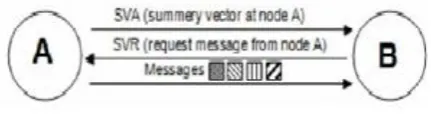
In epidemic routing [1], application messages are diffused on relay nodes called carriers. When carrier node while moving comes in contact with other node it performs the pair-wise exchange of messages. This blind cyclic exchange of each message continues on all encountered nodes which increases the delivery of messages via multiple paths. The epidemic routing protocol is more robust but it consumes high volume of network resources such as buffer space, bandwidth and energy.
3.2
Prophet Routing:
[image:2.595.327.537.194.350.2]Epidemic replicates messages to all encounter nodes falling within the range but Prophet is a Probabilistic Routing Protocol [2] which forwards the message to a node by utilizing its encounter history and transitivity. Prophet router uses the metric called delivery predictability which is updated for each node on encounters. If node A wants to transmit the message to destination D then node A look in neighbors nodes and forward the message to node which has high encounters with D.
Fig 2 Prophet Router
In fig 2 when node A wants to transmit message to node D , node A looks for encounter probability of its neighbor B and C and observe that node B has high probability so it communicates with D via node B.
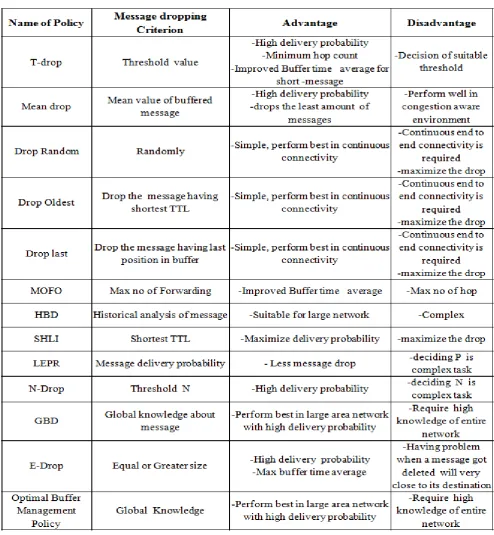
[image:2.595.61.277.592.652.2]Table 1: Description of policy
4.
ANALYSIS OF VARIOUS
ALGORITHM
Traditional packet dropping policies are widely used in delay tolerant networks [10]. This paper provides complete review
DTN the end-to-end path between nodes don’t exist for the most of time so these policies might not perform adequately
in DTN always.
and hence QoS improved much better, but deciding appropriate threshold for particular situation is challenging task.
Mean Drop policy [8] perform well in congestion aware environment. One factor which can raise the network throughput is to control the redundant message drop, Mean Drop first computes the mean of all buffered messages and drops all those messages which are equal or greater than the Mean Size. This intuitive idea gives priority to relay messages and improves the average delivery probability. According to study Mean-Drop (MD) drops the least amount of messages and sustains more messages .Moreover against MD policy, ESTF produced higher number of drops as compared to MOFO. In epidemic routing policy the MD policy reduce message drop by an average 42.5% as compared to ESTF and 23.75% against MOFO. The reason is that, MD policy controls the unnecessary drop of messages using mean-size metric and bound the infection rate of epidemic in better way than ESTF and MOFO. However, in prophet due to predictability the prophet have better control on drop but still MD drop policy outperforms and also reduces the drop by average of 33.75% and 14% as contrast to ESTF and MOFO.
MOFO [10] is most forwarded first, in which mostforwarded message gets deleted but In MOFO when ever congestion arises it continues to drops messages to free space for new messages resulting more relay and increase in hop so require some improvement
E-Drop [5]which is an enhancement of MOFO drop the
message whose size is greater or equal to new message, E-DROP policy can be adjust to minimize the metrics of relayed, dropped , average latency overhead ratio ,hop count and to maximize the average delivery probability and buffer time. We examine the Overhead ratio with respect to router 50% less in E-Drop in epidemic and 20% less in prophet routing compare to MOFO, E-Drop perform much better in terms of hop count, buffer time average and average latency compare to MOFO
Optimal Buffer Management Policy and GBD (Global Knowledge based Drop) [13] are based onglobal knowledge of network provide good result but requires complex approach to acquire the knowledge of number of node that have a particular message in the whole network. All the buffer management policies discussed so far fail to consider network-wide information, such as the number of replicas of each message, the number of nodes, etc. Yet, optimality cannot be achieved without this information.
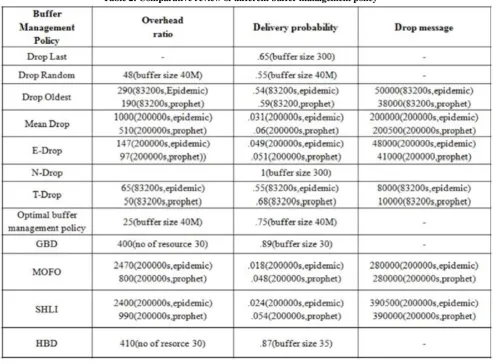
SHLI, LEPR, N-Drop having much better performance compare to classical buffer management policy but don’t having special knowledge about network. This table illustrates the comparative performance metric of different management policy. SHLI purely works on shortest TTL so there is some possibility that a message is about to deliver gets deleted.
[image:4.595.57.554.390.754.2]LEPR perform well in terms of hop count, buffer time average but require complex knowledge to decide P-value. N-Drop also minimize no of drop and hop count but deciding the N for different-different node quite complex.
5.
PROPOSED WORK
Traditional buffer management policy has many pros and cons i.e. some of the policies work well only in continuous environment and some not perform better in DTN limitation like limitation of buffer, connectivity and limitation of bandwidth. In order to provide better delivery rate and delay rate this proposed work suggests a buffer management policy and we assume that it improve the performance of DTN. Whenever drop occurred must check Age of message (TTL) and No of replica of that message
Proposed Algorithm
1. Begin2. New Message M (new) Arrives at node N 3. Available Buffer Size will be checked
(a) If BA >= M (new),
Then put the M (new) in buffer (b) If Buffer Available (BA) < M (new)
Than go to next step,
4. Find the two message that has highest & second highest replication at node N
5. Let the message be MH and MSH 6. Compare TTL
(a) If TTL (MH) >= TTL (MSH)
Than discard MH & add M (new) in buffer (b)Else discard MSH & add M (new) 7. END
6.
CONCLUSION
DTN is expected to become increasingly important in next-generation Internet structures. One of the important research issues in DTN is buffer management. In this study, we proposed a buffer management policy and provided a comparative review of existing buffer management policy. It would be encouraging to inspect and explore this area and propose more polices with local knowledge and partial network knowledge based approaches that take into account of different message sizes and limited buffer sizes and can implemented in DTN real applications. In particular, buffer management optimization strategy considering delivery ratio, delay, and overhead simultaneously is presented to significantly improve the overall performance of routing algorithms in DTNs
7.
REFERENCES
[1] Vahdat and D. Becker, “Epidemic routing for partially connected ad hoc networks,” Duke University, Tech. Rep. CS-200006, 2000.
[2] Lindgren, A. Doria, and O. Schelen. Probabilistic Routing in intermittently connected networks, volume 3126, pages 239–254. 2004
[3] E. Daly and M. Haahr. Social network analysis for routing in disconnected delay-tolerant manets. In Proc. of ACM MobiHoc, 2007.
[4] P. Hui, J. Crowcroft, and E. Yoneki. Bubble rap: Social
International Journal of Computer Applications (0975 - 8887) Volume 13- No.7, January 2011.
[6] T. Spyropoulos, K. Psounis, and C. S. Raghavendra. Efficient routing in intermittently connected mobile networks: The multiple-copy case. ACM/IEEE Transactions on Networking,Feb. 2008.
[7] Delay tolerant networking research group. http://www.dtnrg.org.
[8] Sulma Rashid,A. H. Abdullah,M. Soperi, Mohd Zahid,Qaisar Ayub.”Mean Drop an Effectual Buffer Management Policy for Delay Tolerant Network” European Journal of Scientific Research ISSN 1450-216X Vol.70 No.3 (2012), pp. 396-407 © EuroJournals Publishing, Inc. 2012
[9] T. Small and Z. J. Haas. Resource and performance tradeoffs in delay- tolerant wireless networks. In SIGCOMM Workshop on delay Tolerant Networks (WDTN), 2005.
[10]A.indgren and K. S. Phanse, “Evaluation of queuing policies and forwarding strategies for routing in intermittently connected networks,”in Proc. of IEEE COMSWARE, pp. 1-10, Jan. 2006.
[11]Yun Li, Ling Zhao, Zhanjun Liu,Qilie Liu.” N-Drop Congestion Control strategy under Epidemic Routing in DTN.” Research center for wireless information networks,chongqing university of posts & Telecommunications ,chongqing 400065,china, pp. 457-460, 2009
[12]Sulma Rashid,Qaisar Ayub,”Effective buffer management policy DLA for DTN routing Protocals under congetion”, International Journal of Computer and Network Security,Vol 2,NO 9,Sep 2010. pp .118-121 [13]Amir Krifa, Chadi Barakat, Thrasyvoulos Spyropoulos,
“Optimal Buffer Management Policies for Delay Tolerant Networks,” IEEE Conference on Sensor, Mesh and Ad Hoc Communications and Networks (SECON 2008), June 2008.
[14]Qaisar Ayub, Sulma Rashid,” T-Drop: An optimal buffer management policy to improve QOS in DTN routing protocols”, Journal of Computing, Vol 2, ISSUE 10, OCTOBER 2010. pp .46-50.
[15]Sulma Rashid, Qaisar Ayub, M. Soperi Mohd Zahid , A.Hanan. Abdullah. “Optimization of DTN routing protocols by using forwarding strategy (TSMF) and queuing drop policy (DLA)”, International Journal of Computer and Network Security, Vol 2,ISSUE 10,OCTOBER 2010. pp .71-75.