http://dx.doi.org/10.4236/ijcns.2014.78034
PROFHMM_UNC: Introducing a Priori
Knowledge for Completing Missing
Values of Multidimensional Time-Series
A. A. Charantonis
1,2, F. Badran
2, S. Thiria
11Laboratoire d’Océanographie et du Climat: Expérimentation et Approches Numériques, Université Pierre et
Marie Curie, Paris, France
2Laboratoire CEDRIC, Conservatoire National des Arts et Métiers, Paris, France
Email: [email protected]
Received 27 June 2014; revised 25 July 2014; accepted 10 August 2014
Copyright © 2014 by authors and Scientific Research Publishing Inc.
This work is licensed under the Creative Commons Attribution International License (CC BY).
http://creativecommons.org/licenses/by/4.0/
Abstract
We present a new method for estimating missing values or correcting unreliable observed values of time dependent physical fields. This method, is based on Hidden Markov Models and Self-Orga- nizing Maps, and is named PROFHMM_UNC. PROFHMM_UNC combines the knowledge of the physi-cal process under study provided by an already known dynamic model and the truncated time se-ries of observations of the phenomenon. In order to generate the states of the Hidden Markov Mod-el, Self-Organizing Maps are used to discretize the available data. We make a modification to the Viterbi algorithm that forces the algorithm to take into account a priori information on the quality of the observed data when selecting the optimum reconstruction. The validity of PROFHMM_UNC was endorsed by performing a twin experiment with the outputs of the ocean biogeochemical NEMO-PISCES model.
Keywords
Multidimensional Time-Series Completion, Hidden Markov Models, Self-Organizing Maps
1. Introduction
se-ries has been addressed by many different statistical or machine learning methods, such as the Maximum like-lihood algorithm [1], expectation maximization algorithm [2], K-Nearest Neighbor [3], Varies Windows Simi-larity Measure [4] or Regional Gradient Guided Bootstrapping [5]. All these methods tend to reconstruct miss-ing data that are subsequently used by the correspondmiss-ing prediction models. Thus the reconstruction of the initial time-series is disconnected from the dynamic model.
Most dynamic numerical models that have been developed over the years can reproduce the available obser-vations of the phenomena under study, with varying degrees of success. In Geophysical sciences there exists a large amount of data sets and dynamic models [6] related to different physical phenomena. The accuracy of such numerical models is measured by comparing their output values to these observations. After the initial imple-mentation of the model, there are often further studies that use the available data sets and the first implementa-tion of the model in order to modify its internal parameters and improve its accuracy. The most prominent field of study attempting to combine model and data for improving our knowledge of the phenomena under study is data assimilation [7].
In this paper, we present a new method, which we will referred to as PROFHMM_UNC, for “PROFile recon-struction with HMM, taking into account UNCertainties” that combines the dynamic of the model and the available time series of observations in order to estimate the missing values or correct unreliable observed val-ues. This is done by simplifying the dynamic model by transforming it into a multiple-state Hidden Markov Model (HMM). The reconstruction of the missing values and correction of the unreliable observations is done by applying a modified version of the Viterbi algorithm [8] which we introduce in this paper. This modification we introduce to the Viterbi algorithm uses a specific weighting function that modifies, during the optimum path selection process, the impact of the emission probability of an observation based on it’s a priori confidence. PROFHMM_UNC makes use of Self Organizing Maps to generate the hidden and observable states of the mod-el as used in PROFHMM [9], or SOS-HMM [10].
In the following, we present the general methodology we used to achieve that task and give an example of its implementation by performing a twin experiment for reconstructing the oceanic sea-surface Chlorophyll-A dis-tributions and sea-surface Temperature based on the NEMO-PISCES model [11].
2. Methodology
The general theory behind the Hidden Markov Models is given in this section, followed by the introduction of our proposed modification to the Viterbi algorithm. This modification is used by the HMM for finding the most likely sequence of hidden states that results in a given sequence of observed events, when given an external in-dicator of the confidence in the data. We then briefly overview some of the advantages of discretizing multidi-mensional models into states through the use of self-organizing maps when trying to translate it into an HMM.
2.1. Hidden Markov Models
2.1.1. Modelisation
A first order Markov model is a stochastic model made of a set of possible states X ii, ∈
[
1,,Nhid]
, and a transition probability matrix, noted Tr. First order Markov models assume the first order Markovian property, meaning that each consecutive state of the model depends solely on its previous state. Therefore the transition probabilities of a temporal sequence of states ,[
1, ,]
t
i
X t∈ T , which are noted aij, are equal to
( )
,(
1 2) (
1)
t t t t
ij i j i i i i j i i
a =Tr i j =P X =X X X − X =P X = X X − =X . The transition probabilities are considered invariant with time. Tr corresponds to a statistical learning of the dynamic processes governing the temporal transitions between these states.
Expanding this principle, a Hidden Markov Model (HMM) is a stochastic model with two sequences: one se-quence of unobservable states, and one sese-quence of observations that have a statistical link with the unobserva-ble states. We will henceforth refer to the unobservaunobserva-ble states as hidden states, and symbolize them with Xi. The hidden states are assumed to follow the first order Markovian property.
[
]
, 1, ,k obs
Y k∈ N . A hidden state Xi emits its observations according to an emission probability matrix, noted Em. The matrix elements connects the hidden states Xi to the observable ones such as
( )
, i( )
k(
k i)
Em i k =b Y =P Y X .
All the probabilities are determined during the training phase, by using an appropriate data set containing concurrent sequences of observed and known hidden states.
2.1.2. Reconstruction
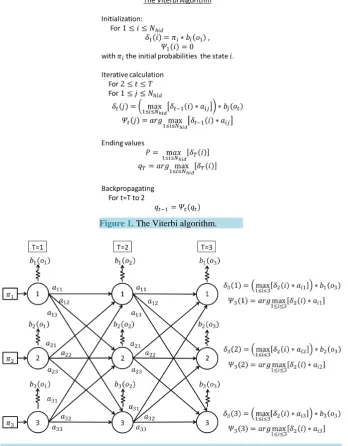
After having determined the transitions and emissions probabilities, the Viterbi algorithm is then applied to find the most likely sequence of hidden states, given a sequence of concurrent observations. This is done by calculat-ing, for each step of the observed sequence, the most likely sequence of states to end up at a given state, given the sequence of observations obtained up to that moment. The algorithm stocks these probabilities in a matrix, and the indexes of the states that generate these maximum probabilities for each state in another matrix. The algorithm then backpropagates to find the most likely sequence of indexes to have generated that sequence of observations.
The maximum probability to reach state j at time t is noted δt
( )
j and can be formulated as:( )
(
max1 1( )
)
( )
t j i N t i aij bj ot
δ = ≤ ≤ δ− ∗ ∗ , with ot corresponding to the observation at time t. We use the matrix
( )
1( )
1
arg max
t t ij
i N
j δ− i a
≤ ≤
Ψ = ∗ , to store the index of most likely previous state of the Markov model to reach the
state j at time t. This is primarily used when backpropagating through the algorithm in order to generate the most likely sequence of hidden states, which is noted qt. The probability of the sequence
( )
1
arg max
T T
i N
q δ i
≤ ≤
= is
noted P, and T correspond to the index of the final time-step. The complete algorithm is shown in Figure 1, and a graph representation of an HMM is shown in Figure 2.
2.2. Taking into Account Uncertainties
When applying HMMs it is generally assumed that the observation acquisition procedure and quality remain con-stant. However there are cases for which a combination of human errors and exterior parameters interfere and prevent the obtaining of sequences in which we have complete confidence in.
Given a Hidden Markov Model for which there exists a method for determining observation probabilities
(
)
i
b Obs for which we have full confidence on the observation, we present a modification of the Viterbi algo-rithm which takes into account a change of confidence in a given observation.
To do so, we first introduce a confidence function, named conf Obs
(
)
. This function gives an external nu-merical evaluation of the quality of the observation. The conf Obs(
)
function is scaled from 0 to 100, with 0 corresponding to a complete lack of confidence in the data (or a lack of data), and 100 corresponding to acquisi-tion of a fully-trustworthy observaacquisi-tion.The confidence function is used, along with the b Obsi
(
)
by a weighting function Fw(
b Obs conf Obsi(
)
,(
)
)
, in order to introduce in the HMM the confidence we have in the observed data. The function(
)
(
)
(
,)
w i
F b Obs conf Obs needs to be monotonically decreasing for both b Obsi
(
)
and conf Obs(
)
and takes values from 1 in the case of a non-trustable observation(
conf Obs(
)
=0)
up to b Obsi(
)
for a fully trustable observation(
conf Obs(
)
=100)
. A typical form of Fw which is parameterized by different values of b Obsi(
)
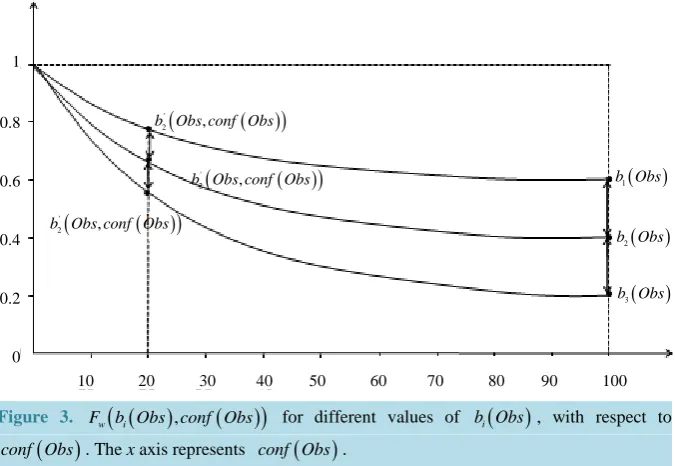
can be seen in Figure 3. Other functions could be chosen depending on the a priori information we want to intro-duce.The two functions are introduced in the Viterbi Algorithm when calculating the maximum probability to reach the state j at time t, by transforming it, from δt
( )
j =(
max1≤ ≤i Nδt−1( )
i ∗aij)
∗b oi( )
t to( )
(
max1( )
)
(
( )
,( )
)
t j i N t i aij Fw b oi t conf ot
δ = ≤ ≤ δ ∗ ∗ . This corresponds to the transformation of the probability
( )
i tb o into a weighting term b o conf oi′
(
t,( )
t)
=Fw(
b oi( )
t ,conf o( )
t)
, which is no longer a probability.Figure 1. The Viterbi algorithm.
Figure 2. A graph of the evolution of an HMM with 3 hidden states over three time-steps. The Viterbi Algorithm calculated the δt
( )
i at each time-step t = 1, 2, 3 the maximum probabilityto reach a the state i, given the observations up to that point, and kept the indexes Ψt
( )
i ofthe previous statethat generated this maximum probability. When it reaches the final step it finds the index that generates the maximum δt
( )
i , and backpropagates through the most likely states to have generated it.When the confidence is null,
(
Fw( )
ot =0)
, the function Fw(
b oi( )
t , 0)
=1, and therefore( )
max1( )
t j i N t i aij
δ = ≤ ≤ δ ∗ , making the determination of the best path at the time t depend solely on the transi-tion probabilities. Similarly, when the confidence is maximal,
(
conf o( )
t =100)
, the function( )
(
,100)
( )
w i t i t
F b o =b o and the determination of the best path at time t is done with the same process as with the unmodified Viterbi algorithm. The modification therefore can be considered a trade-off function between a regular Markov model and an HMM.
Figure 3. F b Obs conf Obsw
(
i(
)
,(
)
)
for different values of b Obsi(
)
, with respect to(
)
conf Obs . The x axis represents conf Obs
(
)
.2.3. Use of Self Organizing Maps with Hidden Markov Models
In order to build the HMM to model such a problem, it is necessary to discretize the dynamical model outputs into a discrete set of states. This can be a complicated task. A common method which is used in cases were the dy-namical model can be described with few states, is to create independent states by clustering the available data [12]. A way to cluster the data is to reduce the dimension of the problem by using a Principal Component Analy-sis (PCA) [13], and then make use of Learning Vector Quantization to generate states of the HMM [14]. However reducing of the dimension of the data through a PCA, would hinder the reconstruction of highly multidimensional vectors, and would not permit a fine discretization of the data, which is important in time-series completion. In our method we use Self-Organizing Topological Maps (SOM) which are clustering methods based on neural networks [15]. They provide a discretization of a learning dataset into a reduced number of subsets, called classes, which share some common statistical characteristics. Each class corresponds to an index. For each class, the hid-den data attributed to it is represented by a referent vector, which approximates the mean value of the elements belonging to it. These referent vectors are used to label any other data of the same dimension with the index of the “nearest” referent vector. The indexes represent the states of the HMM and their referent vectors are used to gen-erate sequences of indexes of states that serve to learn the emissions and transition probabilities.
The SOM training algorithm forces a topological ordering upon the map, and therefore any neighboring classes have referent vectors that are close in the Euclidean sense in the data space. This particularity is used by PROFHMM, and by extension by PROFHMM_UNC, to improve the emissions and transitions probabilities of the HMM. It permits the inclusion of a high number of states in the HMM modeling of a phenomenon for which we have relatively few concurrent hidden and observable vectors. The process of improving these probabilities is detailed in the Appendix.
3. Application
PROFHMM_UNC can be applied to real-world data for which we have a model that is consistent with the ob-served quantities. However, for the scope of this article we chose to perform a twin experiment with the outputs of the NEMO-PISCES model [10], which allow us to present the general behavior and some quantified perfor-mances of the PROFHMM_UNC. Doing so we can control the behavior of PROFHMM_UNC for different situa-tions: low or high confidence.
3.1. The Model
NEMO-PISCES is an ocean modeling framework which is composed of “engines” nested in an “environment”.
(
)
1 b Obs ( )(
)
' 2 ,b Obs conf Obs
(
)
2 b Obs ( ) 3 b Obs10 20 30 40 50 60 70 80 90 100 1 0.8 0.6 0.4 0.2 0 ( )
(
)
' 2 ,b Obs conf Obs
( )
(
)
' 2 ,
The “engines” provide numerical solutions of ocean, sea-ice, tracers and biochemistry equations and their related physics. The “environment” consists of the pre- and post-processing tools, the interface to the other components of the Earth System, the user interface, the computer dependent functions and the documentation of the system. We obtained the output of this model by running the ORCA2_LIM_PISCES version of NEMO, which is a coupled ocean/sea-ice configuration based on the ORCA tripolar grid at 2˚ horizontal resolution forced with cli-matological forcing (winds, thermodynamic forcing) in conjunction with the PISCES biogeochemichal model [10].
We extracted the five-day averaged outputs of this model at the grid points representing the BATS station (32 N - 64 W), shown in Figure 4. This station is one of the model calibration sites due to the existence of the Ber-muda Atlantic Time Series (BATS) of the JGOFS campaign [12]. From the available data, we processed the val-ues of the Sea Surface Temperature (SST), Sea Surface Chlorophyll-A (SCHL), Wind Speed (WS), the incident Shortwave Radiation (SR) and Sea Surface Elevation (SSH), averaged every five days. These averaged time steps are denoted tNEMO. This gave us a complete data set of these five parameters for 1239 tNEMO time-steps spanning
from 1992 to 2008. We then generated a matrix containing the mean value of these parameters averaged for three consecutive tNEMO time-steps. This average corresponds to the mean values of the parameters for a fifteen
consec-utive-days period, denoted tHMM. The data set containing the values of the five “observable” parameters at the
dif-ferent tHMM time-steps is noted Datahid and is a five-dimensional matrix with 413 tHMM time-steps.
In order to generate the observable situations and to simulate satellite data, we added to each geophysical pa-rameter at the tNEMO temporal resolution, a white noise following a Gaussian N (0, 0.35 ∗σparam), where σparam is
the standard deviation of each parameter. The data was then once more averaged every 3 consecutive tNEMO time
steps, in order to reach the tHMM temporal resolution. This generated the Dataobs matrix.
3.2. Statistical Learning and Weighting Function Configuration
The SOM map (denoted sMaphid in the following) providing the hidden states of the HMM was trained with
Da-tahid. As described in Section 2.3, by classifying the Datahid vectors, we generated a sequence of indexes, denoted
SIhid. These indexes correspond to the hidden states of the model at these consecutive tHMM time-steps.
The SOM map (denoted sMapobs in the following) providing the observable states of the HMM was trained
with Dataobs. Since the generation of Dataobs included the calculation of the mean value at the tNEMO temporal
res-olution, the white noises added to the signal is smoothed. Dataobs is a five-dimensional data set (containing SCHL,
SST, SSH, WS, SR) with 413 rows. The sequence of indexes of the observable data, SIobs coincides temporally
with SIhid, and was generated by classifying the Dataobs vectors.
The generation of the hidden and observable states was done by using the two SOMs. Both sMaphid and
sMa-pobs contain 108 neurons that represent, respectively, the hidden and observable states of the HMM, distributed on
an array formed of 12 by 9 lattices. They were generated using Datahid and Dataobs from 1992 to 2005, each data
set corresponding to 340 tHMM time steps; the sequence of observations from the year 2006, corresponding to 24
tHMM time steps, were used as a validation set, and the years 2007 and 2008, corresponding to a sequence of 49
tHMM time steps, were used to test the performance of the method.
The size of the maps were set by iteratively increasing the number of states of each map, selecting the dimen-sions that had the smallest root mean square (RMS) errors between the actual data of the validation year 2006 and its reconstruction by PROFHMM.
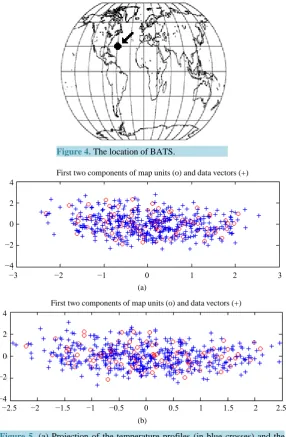
In Figure 5(a) we present, projected on the first plane given by the PCA of Datahid, the spatial distribution of
the referent vectors of the hidden states as red circles, while the blue crosses correspond to the data vectors from Datahid. Similarly, in Figure 5(b) we present, projected on the first plane of the PCA of Dataobs, the spatial
dis-tribution of the referent vectors of the hidden states as red circles, while the blue crosses correspond to the data vectors from Dataobs. The first plane of the PCA of the hidden data set corresponds to 69.3% of its variance, while
the first plane of the PCA of the observable data set corresponds to 68.2% of its variance. Both hidden and ob-servable states are well distributed over their respective data set. Therefore we can make the assumption that the selected states represent accurately the variance of the observed phenomenon. It is important to note that this is just a projection of the data on the first plane and that we did not reduce the dimension of our vectors by applying this PCA.
Figure 4. The location of BATS.
(a)
[image:7.595.230.401.89.240.2](b)
Figure 5. (a) Projection of the temperature profiles (in blue crosses) and the referent vectors of sMaphid (in red circles), onto the first plane of the PCA of
Datahid; (b) Respectively, projection of the observation vectors (in blue crosses) and the referent vectors of sMapobs (in red circles), onto the plane determined by the two first eigenvectors of the PCA of Dataobs.
The SOM maps were used to classify the datasets and generate two sequences of state indexes, SIobs and SIhid.
These sequences were subsequently used to train the Hidden Markov Model according to the procedure presented in Section 2, and to estimate the HMM parameters.
The weighting function was set to
(
) (
)
(
)
(
)
(
(
)
)
1 exp 0.035 exp 3.5
,
1 exp 3.5 1 exp 3.5 w
X Y X
F X Y = − ∗ − ∗ + − −
− − − − whose form can
be seen in Figure 3. The determination of the form of this function and the specific values for the exponential, was a modeling choice made to force a slight degradation of b oi
( )
t for high conf o( )
t , while greatly increas-ing them for very low ones.We made the assumption that, due to exterior factors such as heavy cloud coverage or satellite instrument mal-function, only during some (or none) of these time-steps there were observations available. The confidence func-tion was therefore defined as the percentage of available time-steps used to generate the observafunc-tion. The
flow-−3 −2 −1 0 1 2 3 4
2
0
−2
−4
First two components of map units (o) and data vectors (+)
−2.5 −2 −1.5 −1 −0.5 0 0.5 1 1.5 2 2.5 4
2
0
−2
−4
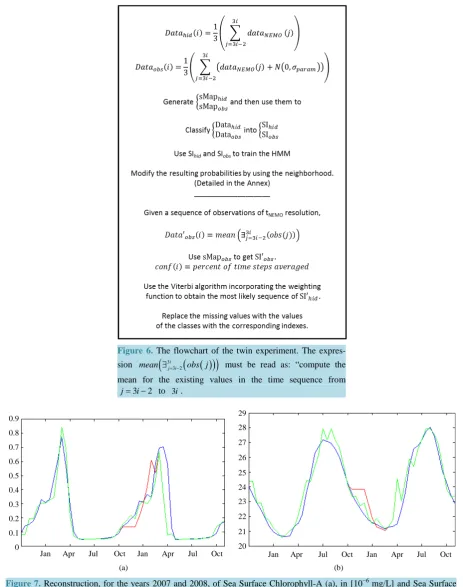
chart of PROFHMM_UNC for the twin experiment is shown in Figure 6.
3.3. Performances
To test the performances of the model, we classified the hidden and observable data from the years 2007 and 2008 according to their respective sMaps. However, we simulated a perturbed sequence of data for which we in-troduced exterior indicators of confidence: for twelve consecutive tHMM time steps we considered that the
observ-able data was not given from the mean of three consecutive tNEMO time steps, but by the value of only one of these.
Doing so we increased the noise level of those specific data points. Therefore, an empiric way to set the confi-dence value conf Obs
(
)
at approximately a third of the maximum confidence, conf Obs(
)
=35, since we sam-pled the data at the rate of one out of the three consecutive time-steps.The twelve consecutive time-steps data shown in Figure 7, correspond to a period spanning from October 2007 to March 2008. We focused on the reconstruction of the Chlorophyll-A, in Figure 7(a) and the temperature, in Figure 7(b). The curves in this figure correspond to the reconstructions: in red for a complete confidence
(
)
(
conf Obs =100)
in the observations and in green for the aforementioned conf Obs(
)
=35. The real model values are in blue. We can see that, by applying the PROFHMM_UNC, we increased our trust in the transitions probabilities of the HMM and better fitted the curve of the real data.After presenting these results, we progressively varied the value of conf Obs
(
)
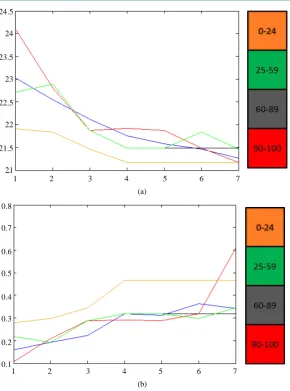
by increments of 5, and plot-ted the resulting curves of CHL and SST for the 7 tNEMO time step period which had their sampling modified. Asseen in Figure 8, we only obtain 5 different curves when performing this experience. In orange, we can see that if we give zero to small confidence in the data
(
conf Obs(
)
∈[
024]
)
, we obtain a curve that almost does not take into account the observations and chooses the hidden states based on transitions only. The reconstruction therefore is far away from reality. In green we have the result obtained when we have a small, but not null confi-dence in the observations(
conf Obs(
)
∈[
2559]
)
, this curve is closer to the NEMO values. In black, we have the values obtained with a higher confidence in the data(
conf Obs(
)
∈[
6089]
)
. The black curve follows the NEMO-PISCES values quite well; is hidden by the green curve up to the fifth time step, then approximates the real data slightly better. Finally when we completely trust the data,(
conf Obs(
)
∈[
90100]
)
the model takes too much into account the modified observed data, increasing therefore the error of the reconstruction.It is interesting to note that there are only 5 curves obtained when varying the values of conf Obs
(
)
. This is due to the way the Viterbi Algorithm functions, whose principle is to select the optimum path: slight changes in the values of confidence will create slight modifications, which are often not enough to overcome a threshold value needed to change the index of the selected state, therefore generating the same path. The choice of the form of family of functions Fw controls the speed of the decrease of the impact of the a priori emissions probabilities on the selection of the optimum path by the Viterbi Algorithm. This, in turn also changes the length and place-ment of the intervals of conf Obs(
)
values that present the same reconstruction.Figure 8 also raises another important point on the determination of the conf Obs
(
)
function. In the experi-ment above, we initially considered an empirical value of 35, trying to approximate the fact that we only sampled the data at the rate of one out of the 3 tNEMO time steps. This was equivalent to assuming that they wereindepen-dently selected using a simple probability distribution. However, as seen in Figure 8, the results obtained in the interval
[
6089]
better fitted the data. This happens because the tNEMO time step sampling is strongly correlatedwith the two ignored ones, and its associated data value contains a significant percentage of the total information we would have obtained by sampling all of the time steps. Therefore, it is important to perform a preliminary study to determine the confidence function that best fits the problem. This is especially true in the cases for which PROFHMM_UNC could be applied, since spatial and temporal sampling at different resolutions is often encoun-tered in different fields of study, such as geophysical problems related to satellite information.
In order to present a quantifiable measure of the improvement obtained by applying PROFHMM_UNC, we performed a dedicated test by generating 10.000 different Dataobs. This was done while varying the placement of
the consecutive 7 tHHM time steps period of low confidence throughout the 2 testing year period. The Dataobs
ma-trices were generated by adding a, significantly stronger, white noise, that follows N (0, 1.5 ∗σparam) distribution,
to the Datahid. We then calculated, for the years 2007-2008 the RMS errors between the reconstructed and NEMO
outputs of the sea surface chlorophyll-a and sea surface temperature for each confidence interval. The results are shown in Table 1.
Figure 6. The flowchart of the twin experiment. The
expres-sion
(
3(
( )
)
)
3 2i j i
mean ∃= − obs j must be read as: “compute the
mean for the existing values in the time sequence from 3 2
j= −i to 3i.
[image:9.595.200.425.84.425.2]
(a) (b)
Figure 7. Reconstruction, for the years 2007 and 2008, of Sea Surface Chlorophyll-A (a), in [10−6 mg/L] and Sea Surface Temperature (b), in ˚C. The blue line corresponds to the unmodified data of Datahid. The red one corresponds to the values of
the reconstruction while using the HMM without a modification of the emission probability, considering that the modified observations have a confidence of 100. The green one corresponds to the result obtained by using PROFHMM_UNC, and using a confidence of 35 for each observation between, October and March. Out of that time period, the two curves coincide and we cannot differentiate the green and red curve.
0.9
0.8
0.7
0.6
0.5
0.4
0.3
0.2
0.1
0
Jan Apr Jul Oct Jan Apr Jul Oct
29 28 27
26
25 24 23
22 21 20
(a)
[image:10.595.170.461.78.470.2](b)
Figure 8. Variation of the reconstructed values of Sea Surface Chlorophyll-A (a) and Sea Surface Temperature (b) with respect to the value of the
(
)
conf Obs function, for a 7 tHMM period (from October 2007 to the first half
of January 2008) assuming that each tHMM observation is computed from a
sin-gle tNEMO. In blue we have the actual values of the model. The colorbar indi-cates the valued of conf Obs
(
)
.Table 1. RMS errors of the Chlorophyll-A and Temperature.
( ) [90 100]
conf Obs ∈ conf Obs( )∈[6089] conf Obs( )∈[2559] conf Obs( )∈[024]
1.5 ∗σparam Chl-A SST Chl-A SST Chl-A SST Chl-A SST
Max RMS 0.4828 5.6496 0.5496 4.7629 0.5771 5.2840 0.4972 4.3496
Min RMS 0.0013 0.1858 0.0011 0.0693 0.0011 0.1032 0.0013 0.1311
Mean RMS 0.1384 1.2895 0.1135 0.9303 0.1180 0.9919 0.1722 1.4349
highlights the importance of performing a preliminary study to determine the appropriate confidence function for each phenomenon.
There exist variations of the Viterbi algorithm such as Lazy Viterbi [16] and the Soft Output Viterbi [17] [18]. We limited ourselves to the Viterbi Algorithm, yet the modification could easily be applied to those approaches.
24.5
24
23.5
23
22.5
22
21.5
21
1 2 3 4 5 6 7
0.8
0.7
0.6
0.5
0.4
0.3
0.2
0.1
[image:10.595.88.540.575.660.2]4. Conclusions
In this paper we have presented PROFHMM_UNC, a new methodology that combines a dynamic model and ob-servations in order to constrain the outputs of a dynamic model to better fit the obob-servations, while respecting the dynamic processes of the model. This was used to complete time-sequences with missing data, and to correct ob-servations for which we have an external indicator of unreliability. The improvements obtained by using the me-thod were illustrated through a twin experiment. The results of this experiment highlight the importance of per-forming a preliminary study to determine a case-appropriate confidence function. PROFHMM_UNC is very gen-eral and could be applied to model a system which is not described numerically, by learning the dynamic pro- cesses using a large amount of sequences of observations.
Going forward we might intend to apply this methodology for generating realistically complete time series of states, based on real satellite observations, to further be used by PROFHMM in order to retrieve 3D fields of pa-rameters based on discrete observations generated by PROFHMM_UNC.
Acknowledgements
The research presented in this paper was financed by Centre National de l’Etude Spatial (CNES, French national center of spatial studies), and the Delegation Gouvernemantale pour l’Armement (DGA, French Military Re-search Delegation), which we wish to thank for their support. We wish to also thank Cyril Moulin and Laurent Bopp from LSCE for their help with NEMO-PISCES and Michel Crepon for his input on the method.
References
[1] Dempster, A.P., Laird, N.M. and Rubin, D.B. (1977) Maximum Likelihood from Incomplete Data via the EM Algo-rithm. Journal of the Royal Statistical Society. Series B, 39, 1-38.
[2] Ghahramani, Z. and Jordan, M.I. (1994) Supervised Learning from Incomplete Data via an EM Approach. Advances in Neural Information Processing Systems (NIPS 6), Morgan Kauffman, San Fransisco, 120-127.
[3] Wasito, I. and Mirkin, B. (2005) Nearest Neighbour Approach in the Least-Squares Data Imputation Algorithms. In-formation Sciences, 169, 1-25.
[4] Chiewchanwattana, S., Lursinsap, C. and Chu, C.-H.H. (2007) Imputing Incomplete Time-Series Data Based on Va-ried-Window Similarity Measure of Data Sequences. Pattern Recognition Letters, 28, 1091-1103.
http://dx.doi.org/10.1016/j.patrec.2007.01.008
[5] Prasomphan, S., Lursinsap, C. and Chiewchanwattana, S. (2009) Imputing Time Series Data by Regional-Gradient- Guided Bootstrapping Algorithm. Proceedings of the 9th International Symposium on Communications and Informa-tion Technology, Incheon, 163-168.
[6] Grayzeck, E. (2011) National Space Science Data Center, Archive Plan for 2010-2013. NSSDC Archive Plan 10-13.
[7] Robinson, A.R. and Lermusiaux, P.F.J. (2000) Overview of Data Assimilation. Harvard Reports in Physical/Interdis- ciplinary, Ocean Science, No. 62.
[8] Viterbi, A.J. (1967) Error Bounds for Convolutional Codes and an Asymptotically Optimum Decoding Algorithm.
IEEE Transactions on Information Theory, 13, 260-269. http://dx.doi.org/10.1109/TIT.1967.1054010
[9] Charantonis, A.A., Brajard, J., Moulin, C., Bardan, F. and Thiria, S. (2011) Inverse Method for the Retrieval of Ocean Vertical Profiles Using Self Organizing Maps and Hidden Markov Models—Application on Ocean Colour Satellite Image Inversion. IJCCI (NCTA), 316-321.
[10] Jaziri, R., Lebbah, M., Bennani, Y. and Chenot, J.-H. (2011) SOS-HMM: Self-Organizing Structure of Hidden Markov Model, Artificial Neural Networks and Machine Learning—ICANN 2011. Lecture Notes in Computer Science, 6792, 87-94. http://dx.doi.org/10.1007/978-3-642-21738-8_12
[11] Madec, G. (2008) NEMO Ocean Engine. Note du Pole de modélisation, Institut Pierre-Simon Laplace (IPSL), France.
[12] Willsky, A.S. (2002) Multiresolution Markov Models for Signal and Image Processing. Proceedings of the IEEE, 90, 1396-1458. http://dx.doi.org/10.1109/JPROC.2002.800717
[13] Jolliffe, I.T. (2002) Principal Component Analysis. 2nd Edition, Springer, Berlin.
[14] Kwan, C., Zhang, X., Xu, R. and Haynes, L. (2003) A Novel Approach to Fault Diagnostics and Prognostics. Pro-ceedings of the 2003 IEEE International Conference Robotics & Automation, Taipei.
[16] Doneya, S.C., Kleypasa, J.A., Sarmientob, J.L. and Falkowski, P.G. (2002) The US JGOFS Synthesis and Modeling Project—An Introduction. Deep-Sea Research II, 49, 1-20. http://dx.doi.org/10.1016/S0967-0645(01)00092-3
[17] Viterbi, A.J. (1998) An Intuitive Justification and a Simplified Implementation of a MAP Decoder for Convolutional Codes. IEEE Journal on Selected Areas in Communications, 16, 260-264. http://dx.doi.org/10.1109/49.661114
Appendix
Advantages of Using Self-Organizing Maps for the Determination of HMM States
Self-Organizing Topological Maps (SOM) which are clustering methods based on neural networks. They provide a discretization of a learning dataset into a reduced number of subsets, called classes, which share some common statistical characteristics. Each class is represented by a referent vector, which approaches the mean value of the elements belonging to it, since the training algorithm can be forced to perform like the K-means algorithm at the final stages of its training.
The topological aspect of the maps can be justified by considering the Map as an undirected graph on a two- dimensional lattice whose vertices are the classes. This graph structure permits the definition of a discrete dis-tance, noted d, between two classes, defined as the length of the shortest path between them on the map.
Any vector that is of the same dimensions and nature as the data used to generate the topological map, can be classified by assigning it to the class whose referent it resembles most. Therefore a sequence of data vectors can be classified in order to generate a sequence of indexes that correspond to the indexes of the classes to which they were assigned.
In our method, we trained two SOMs, the first containing the observations, called sMapobs and the second
con-taining the hidden states, called sMaphid. The hidden states correspond to the discretization of the numerical
dy-namic model.
The classes of sMapobs and sMaphid correspond respectively to the discretization of the observation vectors into
a set amount of observable states, Y kk, ∈
[
1,,Nobs]
, and to the hidden states of the HMM, X ii, ∈[
1,,Nhid]
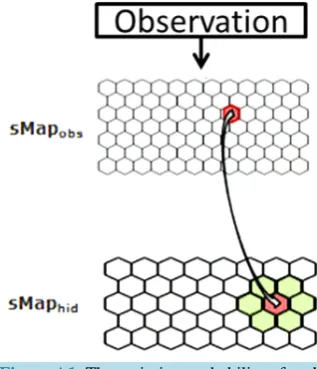
. The topological aspect of the SOMs is useful in overcoming the usual lack of sufficient data in estimating the transition and emission probabilities of the HMM. After an initial estimation of the probabilities over each availa-ble training sequence, noted seq, these transitions, Trseq, and emissions Emseq, can be combined and adjusted bytaking into account the neighboring properties of the topological maps.
This is done by considering the neighborhood matrices NMobs and NMhid, of dimensions
(
Nobs,Nobs)
and(
Nhid,Nhid)
respectively, where( )
, 1, if(
,)
2 an( )
1, if(
,)
20, else d 0, e
,
lse
k l
obs h d
i j
i
NM k l = d Y Y < NM i j = d X X <
, (1)
with d A B
(
,)
being the discrete distance on the respective maps.The final Em and Tr matrices we used, noted Emfinal and Trfinal, were computed by applying for 1≤ ≤i Nobs
[image:13.595.232.391.487.672.2]and for 1≤ ≤j Nhid:
Figure A1. The emission probability of each class Yk of the sMapobs is emitted from a class Xi of sMaphid that takes into account
the probability of being emitted by a class Xj
( )
, 1(
( )
, 1(
( )
,( )
,)
)
hid
N
final seq c seq seq k hid seq
Em i j = +
∑
w ∗ L ∗Em i j +∑
= NM j k ∗Em i k , (2)Which was normalized to become ei j, where ,
1 1
hid
N i j i= e =
∑
,for 1≤i j, ≤Nhid
( )
, 1(
( )
, Nobs1(
( )
,( )
,)
)
final seq c seq seq k hid seq
Tr i j = +
∑
w ∗ L ∗Tr i j +∑
= NM i k ∗Tr i k , (3)which is normalized to become tri j, where ,
1 1
hid
N i j i= tr =
∑
.The term wc corresponds to a weighting constant that prevents the actual measured probabilities from being overshadowed by their neighborhood values. Its value is determined by an iterative optimization process on an independent test data set. In the case of the application (Section 3.2) its value is taken to be equal to 9. The impact of neighboring states on the probabilities has been schematized in Figure A1.