http://dx.doi.org/10.4236/jwarp.2014.614121
How to cite this paper: Fujihara, Y., Yamamoto, Y., Tsujimoto, Y. and Sakagami, J.-I. (2014) Discharge Simulation in a Data- Scarce Basin Using Reanalysis and Global Precipitation Data: A Case Study of the White Volta Basin. Journal of Water Re-source and Protection, 6, 1316-1325. http://dx.doi.org/10.4236/jwarp.2014.614121
Discharge Simulation in a Data-Scarce Basin
Using Reanalysis and Global Precipitation
Data: A Case Study of the White Volta Basin
Yoichi Fujihara
1*, Yukiyo Yamamoto
2, Yasuhiro Tsujimoto
2, Jun-Ichi Sakagami
31Faculty of Bioresources and Environmental Sciences, Ishikawa Prefectural University, Nonoichi, Japan 2Japan International Research Center for Agricultural Sciences, Tsukuba, Japan
3Faculty of Agriculture, Kagoshima University, Kagoshima, Japan
Email: *[email protected]
Received 24 July 2014; revised 21 August 2014; accepted 15 September 2014
Copyright © 2014 by authors and Scientific Research Publishing Inc.
This work is licensed under the Creative Commons Attribution International License (CC BY).
http://creativecommons.org/licenses/by/4.0/
Abstract
Basins in many parts of the world are ungauged or poorly gauged, and in some cases existing measurement networks are declining. The purpose of this study was to examine the utility of rea-nalysis and global precipitation datasets in the river discharge simulation for a data-scarce basin. The White Volta basin of Ghana which is one of international rivers was selected as a study basin. NCEP1, NCEP2, ERA-Interim, and GPCP datasets were compared with corresponding observed pre-cipitation data. Annual variations were not reproduced in NCEP1, NCEP2, and ERA-Interim. How-ever, GPCP data, which is based on satellite and observed data, had good seasonal accuracy and reproduced annual variations well. Moreover, five datasets were used as input data to a hydrolog-ic model with HYMOD, whhydrolog-ich is a water balance model, and with WTM, whhydrolog-ich is a river model; thereafter, the hydrologic model was calibrated for each datum set by a global optimization me-thod, and river discharge were simulated. The results were evaluated by the root mean square error, relative error, and water balance error. As a result, the combination of GPCP precipitation and ERA-Interim evaporation data was the best in terms of most evaluations. The relative errors in the calibration and validation periods were 43.1% and 46.6%, respectively. Moreover, the results for the GPCP precipitation and ERA-Interim evaporation were better than those for the combination of observed precipitation and ERA-Interim evaporation. In conclusion, GPCP precipitation data and ERA-Interim evaporation data are very useful in a data-scarce basin water balance analysis.
Keywords
Reanalysis Data, Global Precipitation Data, Ungauged Basin, Hydrologic Model, Discharge Simulation, Africa
1. Introduction
A large number of hydrologic models have been developed up to the present. Some models are able to simulate water use with human activities as well as natural water cycles (e.g., [1]-[3]). Furthermore, physically sophisti-cated hydrologic models such as SWAT (Soil and Water Assessment Tool) developed by [4] are opened as a public domain model, and nowadays, anyone can run a sophisticated hydrologic model without any difficulties. Moreover, these hydrologic models are used in the impact assessment on river discharge of climate change and to establish water resources planning based on the simulations.
However, in developing countries and international rivers, it is often very difficult to obtain meteorological and hydrological data which are input into hydrologic models. Also the quality of observation data is extremely poor, and the situation that meteorological and hydrological observations have been stopped happens quite often. Drainage basins in many parts of the world are ungauged or poorly gauged, and in some cases existing mea-surement networks are declining [5]. Therefore, sometimes it is impossible to apply a hydrologic model to si-mulation because of observation, even if there is a hydrologic model.
On the other hand, datasets from general circulation models and products estimated by satellites have been developed drastically recently. The spatial and temporal resolution of those data becomes higher rapidly. A rep-resentative dataset is re-analysis data, which is frequently used for a water balance analysis in global or conti-nental scale and climate studies (e.g., [6]-[9]). Moreover, Biemans et al. [10] compared seven global gridded precipitation datasets at river basin scale in terms of mean annual and seasonal precipitation. Getirana et al. [11] assessed different precipitation datasets including reanalysis data in the Negro River basin which is the most important tributary of the Amazon basin. Kotsuki and Tanaka [12] discussed four precipitation data sets to esti-mate runoff in Southeast Asia. However, simulated runoffs using these data sets have not been examined in African basins, which are sometimes hampered by the fact that only little hydro-meteorological information is available [13].
In this study, the utility of reanalysis and global precipitation datasets are examined in the rainfall-runoff analysis in the Volta River basin, which is one of the representative basins in Africa. NCEP1 (National Centers for Environmental Prediction and National Center for Atmospheric Research Reanalysis 1), NCEP2 (NCEP and Department of Energy Reanalysis 2), ERA-Interim (European Reanalysis-Interim), and GPCP (Global Precipi-tation Climatology Project) datasets are compared with corresponding observed precipiPrecipi-tation data. Datasets are used as input data to a hydrologic model and river flows are simulated and the simulation results are compared with the observed data.
2. Study Area
The Volta River basin which is one of international rivers was selected as a study basin. The Volta River basin shared between five riparian countries: Benin, Burkina Faso, Ghana, Ivory Coast and Mali [14]. The Volta River basin is very flat. The predominant land use types are Guinea savannah in the southern and Sudan savannah in the northern part. The main geological systems of the basin are Precambrian platform and a sedimentary layer, the Voltaian sandstone basin [13]. The predominant soil types are lixisols in the southern and arenosols in the northern part.
The Volta River basin is situated in the semi-arid to sub-humid climate zone with mean annual temperature between 27˚C and 36˚C in the northern and between 24˚C and 30˚C in the southern part [13]. Mean annual pre-cipitation ranges from less than 300 mm (North) to more than 1500 mm in the South whereof around 80% falls between July and September. Evapotranspiration is a very important factor in this region. The mean annual po-tential evaporation lies between 2500 mm in the North and 1500 mm in the South [13].
3. Methods
3.1. Data
of Energy) and ERA-Interim (European Reanalysis-Interim) [18] developed by ECMWF (European Centre for Medium-Range Weather Forecasts) were also selected (Table 1). Daily precipitation and evaporation data can be collected up to the present. However, collection period is from 1997 to 2009, considering other meteorologi-cal data.
In addition to reanalysis data, some high resolution global precipitation data are developed using satellite data and ground observation data. GPCP (Global Precipitation Climatology Project) one-degree daily [19] is selected in these data sets (Table 1). These data are based on multiple passive microwaves, infrared satellite observations and gauge observations. Its temporal resolution is daily and spatial resolution is 1˚ × 1˚ latitude/longitude grid. Since GPCP is only precipitation dataset and other metrological data are not distributed, ERA-Interim evapora-tion data are therefore used because its spatial resoluevapora-tion is the highest among reanalysis datasets. The data pe-riod is from 1997 to 2009 which is the same as reanalysis data sets.
In order to validate the accuracy of reanalysis and global precipitation datasets, daily rainfall data at Tamale city from Ghana Meteorological Agency (GMet) was collected. The data from 1975 to 2009 could be collected. When the accuracy of reanalysis data and global precipitation datasets are compared, the data from 1997 to 2009 (13-year) are used, which is the same as reanalysis and global precipitation datasets.
River flow data from GRDC (Global Runoff Data Centre) was also collected. A hydrologic model described in 3.2 with reanalysis data and global precipitation data sets are run. Simulated runoff is then compared with the river flow data from GRDC to validate the accuracy of datasets. Considering the observation period and data qualities, NAWUNI station in White Volta River was selected as a target point (Figure 1). The basin area up to NAWUNI is about 92,950 km2. River flow data from 1975-2006 could be collected. However, considering the period of reanalysis data and global precipitation datasets, the river flow data from 1997 to 2006 is used to compare simulation and observation.
3.2. Hydrologic Model and Its Application
Whole study area is from −6˚W to 3˚W and 5˚N to 15˚N, which covers whole Volta River basin. This domain (9˚ × 10˚) is divided by 0.5˚ latitude-longitude spatial resolution (18 × 20 grids). At each grid cell, a water bal-ance model which is explained in 3.2.2 and 3.2.3 is applied to calculate runoff which is subsequently routed through a grid-based flow network to simulate stream flows at selected points within the basin. Grid-based flow network is based on STN-30 (Simulated Topological Network) made by [20] and its flow directions were mod-ified by a map indicating actual river flow routes and locations.
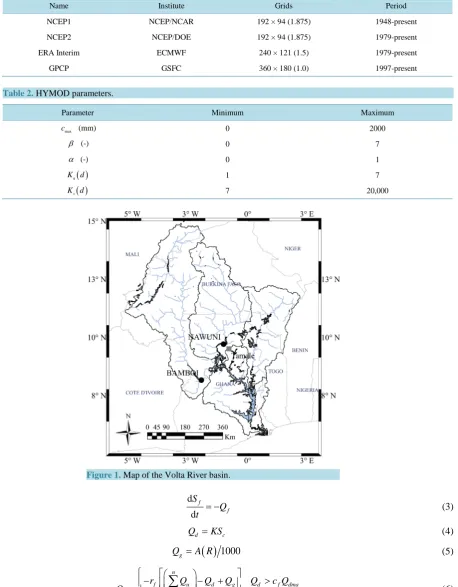
HYMOD (Hydrology Model) was adopted as a water balance model (Figure 2), developed by [21]. The model assumes that the soil moisture storage capacity (c) varies across the catchment and, therefore, that the proportion of the catchment with saturated soils varies over time. The spatial variability of soil moisture capacity is described by the following distribution function
( )
max
1 1 c
F c
c
β
= − −
(1)
where cmax: maximum soil moisture storage (mm),
β
: degree of spatial variability of the stores (-). Evapora-tion from the soil moisture store occurs at the rate of the potential evaporaEvapora-tion. Following evaporaEvapora-tion, the re-maining rainfalls are used to fill the soil moisture stores. Excess rainfall is sent to the routing module. The routing module divides the excess rainfall using split parameter( )
α and routes these through parallel concep-tual linear reservoir meant to simulate the quick and slow flow response of the system. The flow from each re-servoir is controlled by the quick flow residence time( )
Kq and the slow flow residence time( )
Ks . The si-mulated stream flow is therefore the addition of the outputs from each of these reservoirs. Number of parameters is five. Maximum and minimum values (Table 2) are decided based on the past research [22].WTM (Water Transport Model) was adopted as a river flow simulation proposed by [23]. This model is a qu-asi-linear reservoir model that computes discharge through each grid cell of the simulated river basin based on runoff inputs from HYMOD, a river networking system, channel transfer rates, and the timing and extent of floodplain inundation. For a single grid cell the flow and continuity equations are
1
d
d
n c
u d g f
S
Q Q Q Q
t
= − − −
Table 1. Data sets used in this study.
Name Institute Grids Period
NCEP1 NCEP/NCAR 192 × 94 (1.875) 1948-present
NCEP2 NCEP/DOE 192 × 94 (1.875) 1979-present
ERA Interim ECMWF 240 × 121 (1.5) 1979-present
GPCP GSFC 360 × 180 (1.0) 1997-present
Table 2. HYMOD parameters.
Parameter Minimum Maximum
max
c (mm) 0 2000
β (-) 0 7
α (-) 0 1
( )
q
K d 1 7
( )
s
[image:4.595.84.543.104.692.2]K d 7 20,000
Figure 1. Map of the Volta River basin.
d
d
f f
S Q
t = − (3)
d c
Q =KS (4)
( )
1000g
Q =A R (5)
1 0
n
f u d g d f dma f
d f dma
r Q Q Q Q c Q
Q
Q c Q
− − + >
=
<
Figure 2. Diagram of the HYMOD conceptual hydrologic model [22].
where Sc: channel storage (m3), Sf: floodplain storage (m3),
K
: downstream transfer coefficient (-),A
: grid cell area (m2), n: number of upstream donor cells,R
: runoff simulated by HYMOD (mm), Qu: upriver inflow (m3), Qd: discharge exported downstream (m3), Qg: runoff generated locally within the grid cell con-sidered (m3), Qf: exchange between channel and flood plain (m3), Qdma: long term mean annual downstream discharge (m3). The coefficient rf determines the fraction (0.0 to 1.0) of potential volume change that is as-signed to floodplain storage, and cf is the flood initiation parameter, giving the proportion (0.0 to 1.0) of long-term mean annual flow required to invoke floodplain exchanges. Maximum and minimum values (Table 3) are decided based on the past research.Reanalysis data contain precipitation and evaporation data. However, GPCP is only precipitation data sets. Therefore, GCPC is combined with ERA-Interim evaporation data, because ERA-Interim is the highest spatial resolution among the reanalysis datasets used in this study. Observed meteorological data are also precipitation data only, and is combined with ERA-Interim evaporation data (Table 4). These five pattern data sets are used as input data to the hydrologic model, and optimized parameter is calibrated for each data and validated in terms of accuracy. 1997 to 2000 (4-year) is used as a calibration period and 2001 to 2006 (6-year) is used as a valida-tion period.
ES (Evolution Strategy) was used to calibrate five parameters of HYMOD (Table 2) and three parameters of WTM (Table 3). ES is one of the global optimization methods [24]-[26] and is more powerful or efficient than SCE-UA (Shuffled Complex Evolution) method developed by University of Arizona. SCE-UA is most fre-quently used in parameter calibrations. Objective function to express the differences between observations and simulations is RMSE (Root Mean Square Error) which is tend to balance water volume and emphasizes the error at high flows.
(
)
21
1 RMSE
N
ci oi
i
Q Q
N =
=
∑
− (7)where Qoi: observed runoff, Qci: simulated runoff, and N: number of data.
4. Results and Discussion
4.1. Precipitation
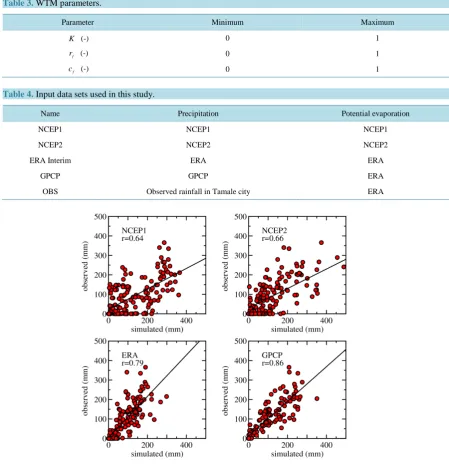
precipi-tation which includes Tamale city are compared with observed rainfall data (Figure 3). This figure shows that correlation coefficient is 0.64 - 0.66 in NCEP1 and NCEP2. On the other hand, correlation coefficient of ERA is 0.79, indicating that ERA is the best performance among reanalysis datasets. On the other hand, GPCP made by satellite and ground rainfall data has better correlation coefficient (0.86) than reanalysis data. Therefore, it is found that GPCP is the best datasets in terms of monthly rainfall accuracy among the sets.
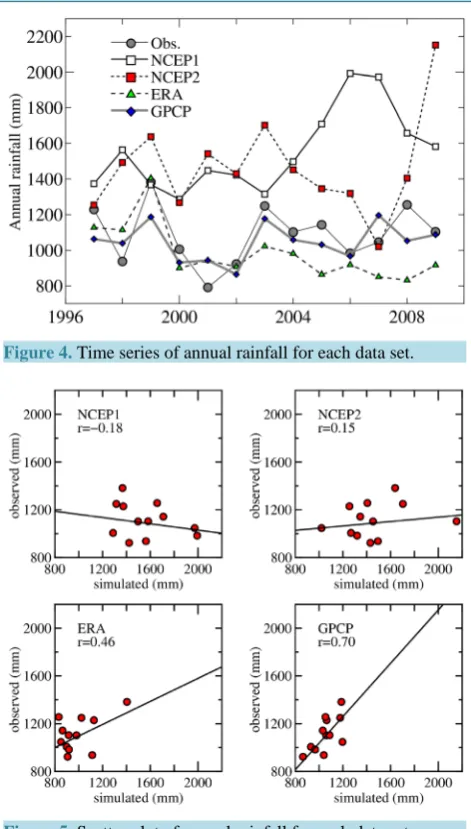
[image:6.595.84.534.243.709.2]Moreover, each data set and observed rainfall in annual rainfall were compared (Figure 4). This figure shows that NCEP1 and NCEP2 are quite overestimation compared with observations and annual variability does not match observations. Although ERA-Interim has a tendency to underestimate in later periods (2005-2009), an-nual variability quite matches with observations and much better accuracy than NCEP1 and NCEP2. On the other hand, annual variability of observed rainfall is quite well reproduced by GPCP, and its accuracy is the best in the data sets. Scatter plots of annual precipitations are shown in Figure 5. In NCEP1 and NCEP2, correlation coefficient is −0.18 - 0.15, indicating almost no-correlation in annual period. ERA-Interim is much better than
Table 3. WTM parameters.
Parameter Minimum Maximum
K (-) 0 1
f
r (-) 0 1
f
c (-) 0 1
Table 4. Input data sets used in this study.
Name Precipitation Potential evaporation
NCEP1 NCEP1 NCEP1
NCEP2 NCEP2 NCEP2
ERA Interim ERA ERA
GPCP GPCP ERA
OBS Observed rainfall in Tamale city ERA
Figure 4. Time series of annual rainfall for each data set.
Figure 5. Scatter plot of annual rainfall for each data set.
NCEP1 and NCEP2, but correlation coefficient is 0.46 and the performance is not good very much. On the other hand, GPCP of correlation coefficient is 0.70 and it is found that GPCP is much better than other data sets.
4.2. River Flow
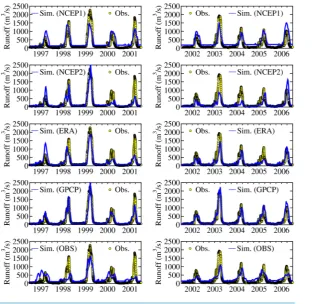
Model parameters are calibrated for each data set (Table 4) using the ES, and simulation and observation are shown in Figure 6. In addition to RMSE as an objective function, relative error and water balance error are shown in Tables 5-7.
1 1 Relative error
N
ci oi i oi
Q Q
N = Q
−
=
∑
(8)1 1
1
Water balance error 100
N N
ci oi
i i
N oi i
Q Q
Q
= =
=
−
=
∑
∑
×∑
(9)Figure 6. Time series of river flow for each data set.
Table 5. RMSE (m3/s) for simulated river discharge.
Period NCEP1 NCEP2 ERA GPCP OBS
Calibration 266.6 193.8 230.8 111.4 309.4
Validation 253.4 278.2 217.0 147.5 280.5
Table 6. Relative error (%) for simulated river discharge.
Period NCEP1 NCEP2 ERA GPCP OBS
Calibration 157.9 66.0 79.1 43.1 188.3
Validation 234.1 53.5 72.2 46.6 201.4
Table 7. Water balance error (%) for simulated river discharge.
Period NCEP1 NCEP2 ERA GPCP OBS
Calibration 32.7 −2.4 6.5 5.5 28.9
Validation 57.4 −30.2 −13.8 13.7 21.8
at Tamale city and ERA-Interim evaporation) are the worst results among all data sets used in this study. It is found that only one observed precipitation datum does not represent spatial variability of rainfall in the basin.
The correlation coefficient between GPCP and observed data in monthly is 0.79 (Figure 3) and the correla-tion coefficient between GPCP and observed data in annual is 0.70 (Figure 5). Moreover, time series of annual rainfall were quite well reproduced by GPCP (Figure 4) and time series of river flows were quite well repro-duced by the combination of GPCP and ERA-Interim (Figure 6). From these results, precipitation of GPCP and evaporation of ERA-Interim make good performance in rainfall-runoff analysis in data-scarce basin that use meteorological data cannot be used at all.
5. Conclusion
The utility of reanalysis data and global precipitation data were examined in the rainfall-runoff analysis for an ungauged basin. NCEP1, NCEP2, ERA-Interim, and GPCP data were compared with corresponding observed precipitation data. Although the reanalysis data such as NCEP1, NCEP2, and ERA had fair seasonal accuracy, annual variations were not reproduced in these data. However, GPCP data, which are based on remote sensing data, had good seasonal accuracy and reproduced annual variations, making it the best among the data sets ex-amined. Furthermore, five pattern data sets were used as input data to a hydrologic model with HYMOD, which is a water balance model, and with WTM, which is a river model; thereafter, the hydrologic model was calibrated for each data set, and river flows were simulated. The results were evaluated by considering the root-mean-square error, relative error, and water balance error. The results indicate that the combination of GPCP precipitation and ERA evaporation data was the best in terms of most evaluations. The relative errors in the calibration and valida-tion periods were 43.1% and 46.6%, respectively. Moreover, the results for the GPCP precipitavalida-tion-ERA evapo-ration were better than those for the combination of observed precipitation and ERA evapoevapo-ration. It was found that GPCP precipitation data and ERA evaporation data are very useful in an ungauged basin water balance anal-ysis.
Acknowledgements
This research was partly supported by Japan Society for the Promotion of Science (JSPS) Grants-in-Aid Nos. 16380164 and 19208022. This study has been implemented as a part of the international research project entitled “Development of Rice Production Technologies in Africa” conducted by Japan International Research Center for Agricultural Sciences, Japan. The authors would like to extend their thanks to Dr. Stephen K. Nutsuga, Di-rector, SARI for his meticulous consultation, and Mr. YahayaInusah and Mr. AlhassanZakaria who are principal technical officers in SARI for their dedicated assistance.
References
[1] Haddeland, I., Lettenmaier, D.P. and Skaugen, T. (2006) Effects of Irrigation on the Water and Energy Balances of the Colorado and Mekong River Basins. Journal of Hydrology, 324, 210-223.
http://dx.doi.org/10.1016/j.jhydrol.2005.09.028
[2] Hanasaki, N., Kanae, S. and Oki, T. (2006) A Reservoir Operation Scheme for Global River Routing Models. Journal of Hydrology, 327, 22-41. http://dx.doi.org/10.1016/j.jhydrol.2005.11.011
[3] Siebert, S. and Döll, P. (2010) Quantifying Blue and Green Virtual Water Contents in Global Crop Production as well as Potential Production Losses without Irrigation. Journal of Hydrology, 384, 198-217.
http://dx.doi.org/10.1016/j.jhydrol.2009.07.031
[4] Arnold, J.G., Srinivasan, R., Muttiah, R.S. and Williams, J.R. (1998) Large Area Hydrologic Modeling and Assess-ment, Part 1: Model Development. Journal of the American Water Resources Association, 34, 73-89.
http://dx.doi.org/10.1111/j.1752-1688.1998.tb05961.x
[5] Sivapalan, M., et al. (2003) IAHS Decade on Predictions in Ungauged Basins (PUB), 2003-2012: Shaping an Exciting Future for the Hydrological Sciences. Hydrological Sciences Journal, 48, 857-880.
http://dx.doi.org/10.1623/hysj.48.6.857.51421
[6] Lenters, J.D., Coe, M.T. and Foley, J.A. (2000) Surface Water Balance of the Continental United States, 1963-1995: Regional Evaluation of a Terrestrial Biosphere Model and the NCEP/NCAR Reanalysis. Journal of Geophysical Re-search, 105, 22393-22425. http://dx.doi.org/10.1029/2000JD900277
Tempera-ture for the Mackenzie River Basin. Journal of Hydrometeorology, 4, 1194-1211.
http://dx.doi.org/10.1175/1525-7541(2003)004<1194:EOTESW>2.0.CO;2
[8] Su, F., Adam, J.C., Trenberth, K.E. and Lettenmaier, D.P. (2006) Evaluation of Surface Water Fluxes of the Pan-Arctic Land Region with a Land Surface Model and ERA-40 Reanalysis. Journal of Geophysical Research, 111, D5.
http://dx.doi.org/10.1029/2005JD006387
[9] Bromwich, D.H., Fogt, R.L., Hodges, K.I. and Walsh, J.E. (2007) A Tropospheric Assessment of the ERA-40, NCEP, and JRA-25 Global Reanalyses in the Polar Regions. Journal of Geophysical Research, 112, D10111.
http://dx.doi.org/10.1029/2006JD007859
[10] Biemans, H., Hutjes, R.W.A., Kabat, P., Strengers, B.J., Gerten, D. and Rost, S. (2009) Effects of Precipitation Uncer-tainty on Discharge Calculations for Main River Basins. Journal of Hydrometeorology, 10, 1011-1025.
http://dx.doi.org/10.1175/2008JHM1067.1
[11] Getirana, A.C.V., Espinoza, J.C.V., Ronchail, J. and Filho, O.C.R. (2011) Assessment of Different Precipitation Data-sets and Their Impacts on the Water Balance of the Negro River Basin. Journal of Hydrology, 404, 304-322.
[12] Kotsuki, S. and Tanaka, K. (2013) Uncertainties of Precipitation Products and Their Impacts on Runoff Estimates through Hydrological Land Surface Simulation in Southeast Asia. Hydrological Research Letters, 7, 79-84.
http://dx.doi.org/10.3178/hrl.7.79
[13] Wagner, S., Kunstmann, H. and Bárdossy, A. (2006) Model Based Distributed Water Balance Monitoring of the White Volta Catchment in West Africa through Coupled Meteorological-Hydrological Simulations. Advances in Geosciences,
9, 39-44. http://dx.doi.org/10.5194/adgeo-9-39-2006
[14] Shahin, M. (2002) Hydrology and Water Resources of Africa. Water Science and Technology Library, 41, Kluwer Academic Publishers, Dordrecht, Boston, London.
[15] Onogi, K., Tsutsui, J., Koide, H., Sakamoto, M., S., Kobayashi, Hatsushika, H., et al. (2007) The JRA-25 Reanalysis.
Journal of the Meteorological Society of Japan, 85, 369-432. http://dx.doi.org/10.2151/jmsj.85.369
[16] Kalnay, E., Kanamitsu, M., Kistler, R., Collins, W., Deaven, D., Gandin, L., et al. (1996) The NCEP/NCAR 40-Year Reanalysis Project. Bulletin of the American Meteorological Society, 77, 437-471.
http://dx.doi.org/10.1175/1520-0477(1996)077<0437:TNYRP>2.0.CO;2
[17] Kanamitsu, M., Ebisuzaki, W., Woollen, J., Yang, S.K., Hnilo, J.J., Fiorino, M. and Potter, G.L. (2002) NCEP-DEO AMIP-II Reanalysis (R-2). Bulletin of the American Meteorological Society, 83, 1631-1643.
http://dx.doi.org/10.1175/BAMS-83-11-1631
[18] Dee, D.P., Uppala, S.M., Simmons, A.J., Berrisford, P., Poli, P., Kobayashi, S., et al. (2011) The ERA-Interim Reana-lysis: Configuration and Performance of the Data Assimilation System. Quarterly Journal of the Royal Meteorological Society, 137, 553-597.
[19] Huffman, G.J., Adler, R.F., Morrissey, M., Bolvin, D.T., Curtis, S., Joyce, R., McGavock, B. and Susskind, J. (2001) Global Precipitation at One-Degree Daily Resolution from Multi-Satellite Observations. Journal of Hydrometeorology,
2, 36-50. http://dx.doi.org/10.1175/1525-7541(2001)002<0036:GPAODD>2.0.CO;2
[20] Vörösmarty, C.J., Fekete, B.M., Meybeck, M. and Lammers, R. (2000) Global System of Rivers: Its Role in Organiz-ing Continental Land Mass and DefinOrganiz-ing Land-to-Ocean Linkages. Global Biogeochemical Cycles, 14, 599-621.
http://dx.doi.org/10.1029/1999GB900092
[21] Boyle, D.P., Gupta, H.V. and Sorooshian, S. (2000) Toward Improved Calibration of Hydrological Models: Combining the Strengths of Manual and Automatic Methods. Water Resources Research, 36, 3663-3674.
http://dx.doi.org/10.1029/2000WR900207
[22] Kollat, J.B., Reed, P.M. and Wagener, T. (2012) When Are Multiobjective Calibration Trade-Offs in Hydrologic Mod-els Meaningful? Water Resources Research, 48, Published Online.
[23] Vörösmarty, C.J., Moore III, B., Grace, A.L., Gildea, M.P., Melillo, J.M., Peterson, B.J., Rastetter, E.D. and Steudler, P.A. (1989) Continental Scale Models of Water Balance and Fluvial Transport: An Application to South America. Glo- bal Biogeochemical Cycles, 3, 241-265. http://dx.doi.org/10.1029/GB003i003p00241
[24] Fujihara, Y., Oda, M., Horikawa, N. and Ogura, C. (2011) Hydrologic Analysis of Rainfed Rice Areas Using a Simple Semi-Distributed Water Balance Model. Water Resources Management, 25, 2061-2080.
http://dx.doi.org/10.1007/s11269-011-9796-z
[25] Fujihara, Y., Tanakamaru, H., Hata, T. and Tada, A. (2003) Calibration of Rainfall-Runoff Models Using the Evolution Strategy. Proceedings of the 1st International Conference on Hydrology and Water Resources in Asia Pacific Region,
2, 885-890.
![Figure 2. Diagram of the HYMOD conceptual hydrologic model [22].](https://thumb-us.123doks.com/thumbv2/123dok_us/8129215.796438/5.595.128.469.86.341/figure-diagram-hymod-conceptual-hydrologic-model.webp)